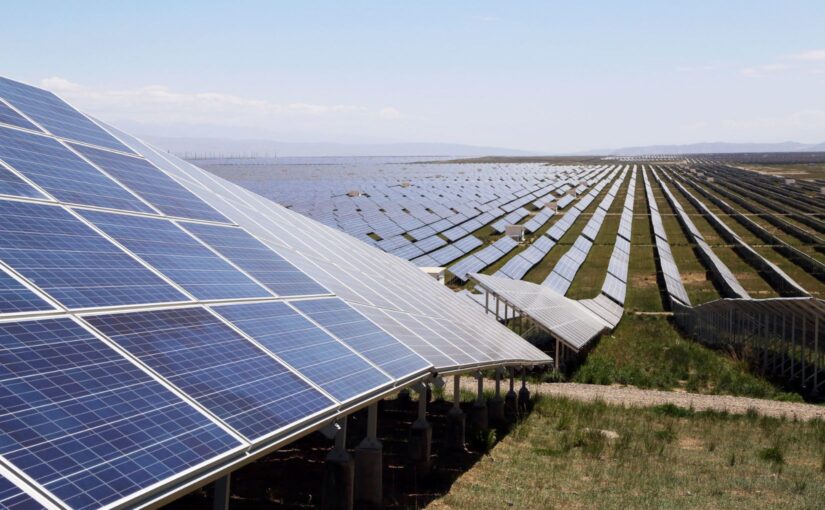
China and climate – the question of leadership

The following is an expanded version of a talk given by London-based climate activist Paul Atkin at the Socialist China Conference 2025 on the subject of China’s leadership role in fighting climate breakdown.

The piece argues that climate change is no longer a distant eventuality but a present-day crisis. Drawing on IPCC science, Paul stresses we are already on a dangerous trajectory and in a decisive decade. China is directly suffering climate impacts including flooding, drought, heat deaths and crop yield loss, and as such has a compelling reason to lead on mitigation and adaptation. 

China frames its approach to environmental protection through the lens of ecological civilisation and the Two Mountains proposition popularised by Xi Jinping – that green mountains with clear water are as valuable as mountains of gold and silver. China’s political system, Paul contends, allows a centralised, state-driven push for renewable energy and clean infrastructure at scales and speeds that the capitalist world cannot easily emulate.

The country is now a global powerhouse in solar, wind, batteries and electric vehicles, and as a result its domestic emissions may already have peaked. China’s solar and wind installation rates are staggering: “Last year China installed as much renewable power in one year as the US has in its entire history, and this will accelerate.”

Abandoning overseas coal investments, China is helping developing countries leapfrog fossil dependency via exports of solar panels and other clean energy hardware.In contrast, Trump “is locking the US into a suicidal entrenchment in increasingly outmoded fossil fuel technology”.

The article concludes that China is emerging as the de facto climate leader, charting an urgently-needed path of sustainable development. The choice for the rest of the world is whether to hitch itself to the US’s fossil-fuel wagon or align with a cleaner, renewable-based future enabled in large part by China’s commitment, investment and innovation.

This article first appeared on Paul Atkin’s blog, Urban Ramblings. Below the text we embed the video of the speech.

I edit the Greener Jobs Alliance Newsletter and convene the National Education Union Climate Change Network, but am speaking in a personal capacity because both organisations contain a range of views about China and its role in climate change. These are mine.

Marx used to quote Hegel’s dictum that “The owl of Minerva spreads its wings only with the falling of dusk” to note that people by and large learn from events only after they have happened. In the case of the climate crisis, dusk is falling already and we know what is happening. 

IPCC Reports are very clear about the increase in greenhouse gases, the increase in global temperatures that arise from that, and the impacts are increasingly documented, as well as reported as they happen. We are experiencing it. It’s not a single cataclysm that may or may not happen some time in the future. It is happening now. Slowly from the point of view of political/electoral cycles, but with terrifying rapidity in geological terms; such that we are in a crucial decade in the century that will make or break human civilization. 

Continue reading China and climate – the question of leadership
China makes firm commitment to advancing the cause of women’s equality at a global level

On 13 October, the 2025 Global Leaders’ Meeting on Women was held in Beijing, on the theme One Shared Future: New and Accelerated Process for Women’s All-round Development. The meeting, co-hosted by China and UN Women, brought together numerous heads of state, government officials and representatives from several continents, and was timed to coincide with the 30th anniversary of the groundbreaking United Nations World Conference on Women that took place in the city in 1995.

China has been a strong, persistent and active supporter of gender equality, adhering to Mao Zedong’s famous phrase that “women hold up half the sky”. As UN Women Executive Director Sima Bahous has remarked, “China’s experience in promoting gender equality offers valuable lessons for the world.”

Gender disparity in education has essentially disappeared in China, with females making up 49 percent of the university student population. Women constitute 43 percent of the workforce, and are well-represented in every field, from science and technology to commerce, from politics to agriculture. Women also make up 31 percent of Communist Party members, a figure which has been steadily increasing in recent decades. Maternal mortality rate has reduced to 15.1 per 100,000 live births, a quarter of what it was 30 years ago. The average life expectancy for Chinese women is 81 years.

A robust legal framework has been constructed to protect and promote women’s rights, including the 1950 Marriage Law enshrining gender equality and marital freedom; the 2016 Anti-Domestic Violence Law; and the 2022 revision of the Law on the Protection of Women’s Rights and Interests, which explicitly bans workplace discrimination. Meanwhile, campaigns raising awareness about women’s rights and opposing gender discrimination and bias have been implemented at all levels of the education system.

In his keynote address to the meeting, President Xi Jinping observed that women’s equality has become a global consensus:

Gender equality has been etched in the agenda of our times, galvanising the whole world in its unwavering pursuit of that goal… Equality between men and women is now a universal consensus of the international community. It has been included in United Nations development agenda and priority development targets, and 189 countries have ratified the Convention on the Elimination of All Forms of Discrimination against Women.

He further noted that, “thanks to years of hard work, we have secured historic achievements and seen historic changes in the cause of women in China.”

We have reduced maternal mortality ratio by nearly 80 percent since 1995, and joined the leading upper-middle-income countries in core indicators for maternal and child health. Today, women in China truly “hold up half the sky” in economic and social development. They make up more than 40 percent of the workforce, more than half of internet start-up founders, and more than 60 percent of all medalists in the past four Summer Olympic Games. In the new era, Chinese women, more confident and vibrant than ever before, are taking part in the whole process of state and social governance. They are fighting on the front lines for rural revitalisation and common prosperity as well as scientific innovation and digital transition. They are writing a splendid history of the cause of women in China. On the new journey of Chinese modernisation, every woman is a star.

Nonetheless, there is a great deal of work remaining to be done in this field, both in China and globally. “Complex challenges still hamper women’s all-round development… Deep-rooted problems such as violence and discrimination still persist, the gender digital divide is widening, and equality between men and women remains a lofty yet arduous task.” Xi called on all countries to “improve mechanisms against violence and resolutely crack down on all forms of violence against women” and to “improve institutions and laws, introduce further tangible and accessible policy measures, channel more quality health and educational resources to all women, and strive to afford all women full and equal enjoyment of various rights”.

Xi’s speech concluded with a promise of substantial support for global projects in support of women’s equality.

To further support the global cause of women, I’d like to make the following announcement: In the next five years, China will donate another 10 million US dollars to UN Women; earmark a quota of 100 million US dollars in China’s Global Development and South-South Cooperation Fund for implementing development cooperation projects for women and girls in collaboration with international organisations; launch 1,000 “small and beautiful” livelihood programs with Chinese assistance that take women and girls as priority beneficiaries; invite 50,000 women to China for exchange and training programs; and establish a Global Center for Women’s Capacity Building, which is aimed at conducting capacity building and other development cooperation with relevant countries and international organisations to train more female talent.

We publish below the text of Xi Jinping’s speech, originally published in Xinhua, as well as a recently published detailed white paper from China’s State Council Information Office, entitled China’s Achievements in Women’s Well-Rounded Development in the New Era, originally published in English on Global Times.

Carrying Forward the Spirit of the Beijing World Conference on Women and Promoting the New and Accelerated Process for Women’s All-Round Development

Keynote Address by H.E. Xi Jinping President of the People’s Republic of Chin at the Opening Ceremony of the Global Leaders’ Meeting on Women, Beijing, October 13, 2025

Distinguished Colleagues and Guests,

Ladies and Gentlemen,

Friends,

Continue reading China makes firm commitment to advancing the cause of women’s equality at a global level

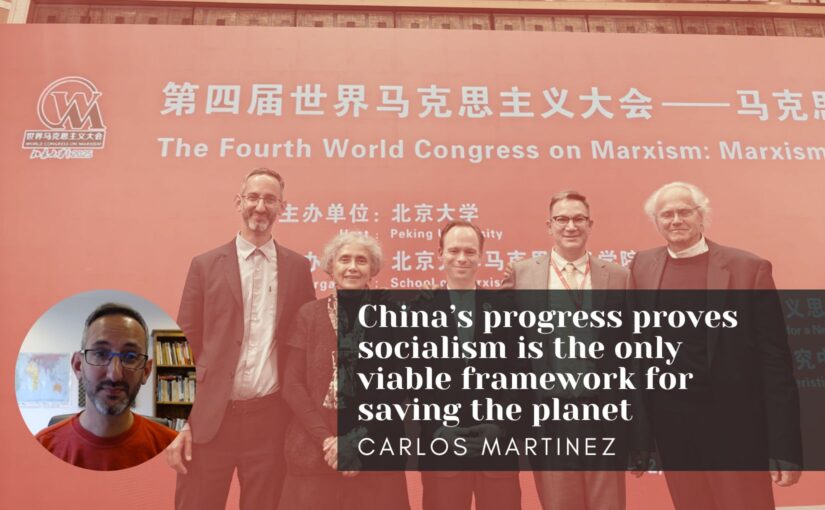
China’s progress proves socialism is the only viable framework for saving the planet

The following is the text of a presentation given by Carlos Martinez to the Fourth World Congress on Marxism, which took place on 11-12 October 2025 at Peking University (PKU), China, organised by PKU’s School of Marxism.

The presentation gives an overview of the progress made by China in recent years with regard to clean energy, and poses the question: why is it China, rather than the advanced capitalist countries, that has emerged as the world’s only ‘green superpower’? Carlos argues that the fundamental reason lies in China’s economy being “structured in such a way that political and economic priorities are determined not by capital’s drive for constant expansion but by the needs and aspirations of the people.”

On the other hand, “the balance of power in capitalist countries is such that even relatively progressive governments find it very difficult to prioritise long-term needs of the population over short-term interests of capital.”

Carlos notes that, as a result of its systematic investment in renewable energy, electric vehicles, transmission systems, batteries and more, China has become the first country to meaningfully break the link between economic development and greenhouse gas emissions. “While governments in the West justify inaction on climate on the basis that it would harm economic growth, China is the first country to make the green transition a powerful driver of economic growth, thereby addressing both the immediate needs of the Chinese people for modernisation and the long-term needs of humanity for a habitable planet.”

China’s progress is set to have a profound global impact. As a result of Chinese innovations and economies of scales, there has been a global reduction in costs, such that for much of the world, solar and wind power are now more cost effective than fossil fuels.

And for those of us in the advanced capitalist countries, where political power is dominated by a decaying bourgeoisie, China’s example can be used to help create mass pressure to stop our governments and ruling classes from destroying the planet, and to encourage sensible cooperation with China on environmental issues.

The Congress featured an impressive array of Marxist academics and authors, including Gong Qihuang, President of Peking University; Li Yi, Vice President of the Party School of the Central Committee of the Communist Party of China (National Academy of Governance); John Bellamy Foster, Editor-in-Chief of Monthly Review; Cheng Enfu, Professor, School of Marxism, Chinese Academy of Social Sciences; Radhika Desai, Professor, University of Manitoba; Roland Boer, Professor, Renmin University of China; Pham Van Duc, Professor, Vietnam Academy of Social Sciences; and Gabriel Rockhill, Professor, Villanova University. The Congress has been reported on CGTN, including brief video interviews with Carlos Martinez and Radhika Desai.

We will never again seek economic growth at the cost of the environment. (Xi Jinping)

There is a prevailing prejudice in the West that China is a climate criminal – the world’s largest emitter of greenhouse gases, and a country that continues to build coal-fired power stations. This connects to a wider perception of socialist governance as being antithetical to environmental protection.

And yet China’s remarkable progress over the last two decades in tackling pollution, protecting biodiversity and developing clean energy is causing this narrative to fall apart.

China has recently passed a historic milestone in its energy transition: cumulative installed solar capacity has exceeded 1 terawatt, representing 45 percent of the global total and far outstripping the United States and European Union.

At the United Nations climate summit in September, President Xi Jinping announced that China was committing to cut carbon dioxide and other pollution by at least 7 to 10 percent by 2035 – the first time that China has set a concrete target for reducing emissions as part of its Nationally Determined Contributions under the Paris Agreement.

Credible evidence suggests that China’s greenhouse gas emissions have already peaked, five years earlier than promised.

Since 2013, China’s solar installed capacity has increased by a factor of 180, while wind power capacity has grown sixfold.

China dominates the global green technology supply chain, producing the overwhelming majority of solar modules, wafers, and battery components.

Continue reading China’s progress proves socialism is the only viable framework for saving the planet

KJ Noh: Washington has been preparing for war with China for over a decade

This wide-ranging interview with political analyst KJ Noh on India and Global Left centres on China’s geopolitical role, the US’s evolving imperial strategy, and the urgent need for solidarity among the nations of the Global South.

KJ begins by responding to the criticism that China is not doing enough to end the genocide in Palestine. He states bluntly: “let’s be clear – no country is doing enough. We are witnessing a live-streamed genocide – children are starving, journalists and doctors are being killed, and an entire population is being besieged and starved. This cannot and should not be tolerated.”

Nonetheless, he contends that blaming third parties such as China diverts responsibility from the Western powers funding, arming and shielding Israel. “In reality, this is not just an Israeli genocide — it is a US-led imperial genocide, with Israel acting as the subcontractor. The project of colonisation and control of West Asia’s resources is part of a larger imperial strategy.”

Regarding China’s position, KJ notes that China was one of the first countries to recognise the State of Palestine, and has long supported its liberation struggle. China last year hosted reconciliation talks among 14 Palestinian factions and has explicitly backed the right of occupied peoples to armed resistance. He further argues that China’s approach is constrained by international structures it cannot unilaterally override.

Turning to US policy and the unfolding New Cold War, KJ asserts that Washington has been preparing for war with China since at least 2009, when the “Air-Sea Battle” doctrine was formulated — a continuation of its “Shock and Awe” strategy of pre-emptive decapitation. He describes a three-stage process of escalation: information warfare, military positioning and provocation, warning that the US now considers tactical nuclear weapons usable. The US, he argues, seeks proxies such as Taiwan Province, the Philippines and South Korea to wage a regional war that could quickly turn nuclear.

To avoid becoming proxy battlegrounds, KJ urges that countries of the Global South build sovereignty — digital, financial, energy, and territorial — and strengthen mutual alliances such as BRICS and the Shanghai Cooperation Organisation.

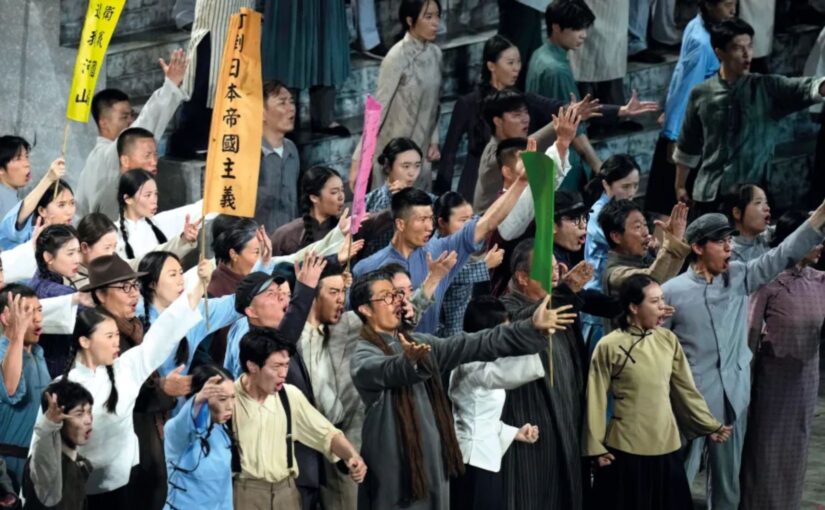
China and World War II: why should we remember?

In the following article, which originally appeared in the Morning Star, Jenny Clegg reflects on the abiding lessons to be drawn from China’s role in the allied victory over fascism in World War II. She points out:

“That China was the first country to resist fascist aggression, its most consistent opponent, fighting for 14 years (1931-45) at a cost of some 35 million casualties, is little understood in Britain: for most people the victory of WWII was won by the West.

“In fact, the Chinese people’s resistance held down some 50 to 60 per cent of Japan’s forces which otherwise would have been used to intensify the fighting in the Pacific and Burma theatres, even opening up a second front against the USSR. Had the USSR not been able to concentrate all its forces against Hitler, the Allies’ war in Europe could well have been lost.”

Jenny, whose father Arthur Clegg led the work of the China Campaign Committee in the 1930s and 1940s, was one of the delegation of family members of those foreign friends and comrades who supported the Chinese people during the war, who were invited to Beijing to attend the 80th anniversary commemoration of victory. She notes:

“China’s display of military defence on September 3 was in total contrast to its weak and divided state in the 1930s in the face of Japanese aggression, a reassurance to the Chinese people that their sacrifices of over eighty years ago would not occur again.”

Chinese society itself was transformed in the course of the war: “Class and gender relations were shattered as the Westernised city-elites began to rebuild their lives in the semi-feudal hinterland, the urban and the rural mixing together… Forging close links between the party, army and rural population, Mao saw resistance as integral to the revolutionary process, transforming the national democratic movement in due course into a social revolution.”

Today: “We cannot understand international developments without understanding the rise of China, and we cannot understand China without understanding both its transformation through war and its transformative role in WWII.”

Jenny presented a similar analysis in her contribution to the webinar on ‘World War Against Fascism: Remembering China’s Role in Victory 80 Years On’, organised by Friends of Socialist China and the International Manifesto Group on September 21.

At China’s Victory Day parade on September 3, Xi Jinping delivered a warning — the world stands at a crossroads between peace and war, and to prevent a catastrophic conflict engulfing the world again, nations must learn from history.

That China was the first country to resist fascist aggression, its most consistent opponent, fighting for 14 years (1931-45) at a cost of some 35 million casualties, is little understood in Britain: for most people the victory of WWII was won by the West.

In fact the Chinese people’s resistance held down some 50 to 60 per cent of Japan’s forces which otherwise would have been used to intensify the fighting in the Pacific and Burma theatres, even opening up a second front against the USSR. Had the USSR not been able to concentrate all its forces against Hitler, the Allies’ war in Europe could well have been lost.

Japan’s expansion into the Pacific in 1941 forced Churchill and Roosevelt to recognise China as an ally and an equal. Britain abrogated the Unequal Treaties (barring Hong Kong) in January 1943, and, as an allied power, China became a founding member of the United Nations in 1945. Why has all this been forgotten in the West and why should we remember this today?

China’s display of military defence on September 3 was in total contrast to its weak and divided state in the 1930s in the face of Japanese aggression, a reassurance to the Chinese people that their sacrifices of over eighty years ago would not occur again.

China’s war dates from Japan’s invasion of Manchuria in 1931, an aggression which shattered the League of Nations’ fragile structure of peace. Local resistance was brutally suppressed but Chiang Kaishek chose instead to concentrate his forces against the CPC’s bases.

Beyond words of condemnation, the world’s major powers took no action, emboldening Japan and the forces of fascism worldwide further. Japan’s invasion of 1937, following the 1936 German-Japan Anti-Comintern pact, was an act of world war. Under pressure from the left wing of the KMT, Chiang ended the anti-communist drive, joining the CPC-initiated United Front to resist the aggression.

The Chinese people stood virtually alone. While Britain leaned towards appeasement, even closing China’s supply route along the Burma Road in 1940, US loans came too little and too late. For a couple of years, the USSR supplied military and financial aid, sending advisers and volunteer pilots under a secret agreement with the KMT. The heroic 10-month stand of Wuhan in 1938 against grinding Japanese savagery, gained China a high international profile.

Continue reading China and World War II: why should we remember?

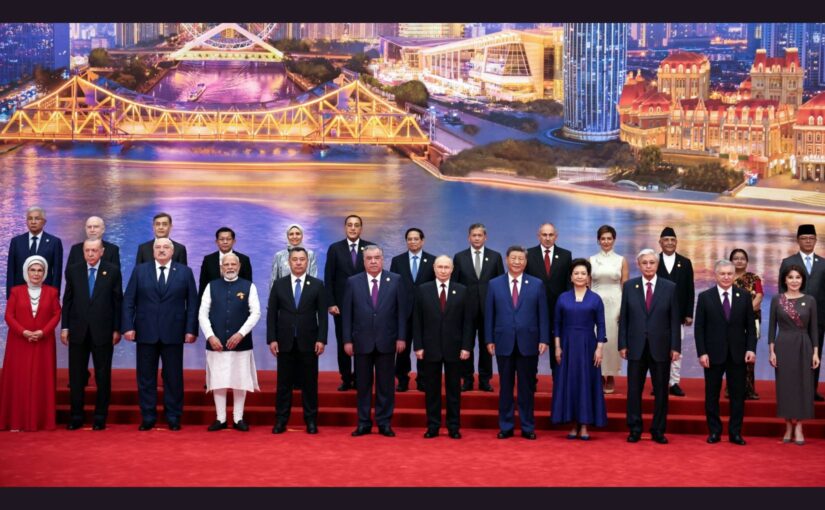
Tianjin Declaration advances roadmap for Shanghai Cooperation Organisation

On August 31-September 1, the Chinese coastal city of Tianjin hosted the 25th Meeting of the Council of Heads of State of the Shanghai Cooperation Organisation (SCO).

The meeting adopted the Tianjin Declaration. At just over 6,000 words, it sets out a comprehensive roadmap for the next phase of the organisation’s development across a wide range of issues and sectors. It begins by noting that:

“The global political and economic landscape, as well as other fields of international relations, are undergoing profound historical changes. The international system is evolving toward a more just, equitable, and representative multipolarity, opening new prospects for countries’ own development and mutually beneficial cooperation.

“At the same time, geopolitical confrontations are intensifying, posing threats and challenges to the security and stability of the world and the SCO region. The global economy, particularly international trade and financial markets, is suffering severe shocks.

“The year 2025 marks the 80th anniversary of the victory in World War II and the founding of the United Nations. The great victory of peace-loving nations united to defeat Nazism, fascism, and militarism determined the course of world history and created conditions for establishing a stable international relations system ensuring peaceful development for humanity. Member states call for remembering the heroic feats of peoples and the historical lessons of World War II.”

In a clear reference to the Five Principles of Peaceful Coexistence, adopted by China’s Premier Zhou Enlai and Indian Prime Minister Jawaharlal Nehru in 1954, it states:

“Member states advocate respect for the right of all peoples to independently choose their political, economic, and social development paths, emphasising that mutual respect for sovereignty, independence, territorial integrity, equality, mutual benefit, non-interference in internal affairs, and the principle of non-use or threat of use of force are the foundation for the stable development of international relations.”

It adds that: “Member states reaffirm the practical significance of promoting the building of a new type of international relations featuring mutual respect, fairness, justice, and win-win cooperation, as well as a community with a shared future for humanity, and conducting dialogue based on the concept of ‘One Earth, One Family, One Future.’”

Regarding some key international issues at present, the Declaration affirms:

PALESTINE:

“Member states reaffirm their deep concern over the ongoing escalation of the Palestinian-Israeli conflict and strongly condemn the actions that have caused numerous civilian casualties and a humanitarian disaster in the Gaza Strip.

Continue reading Tianjin Declaration advances roadmap for Shanghai Cooperation Organisation

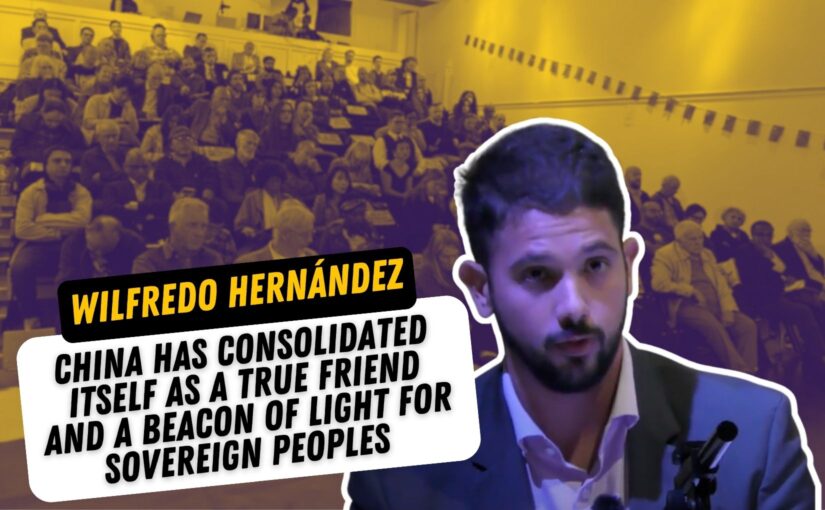
China has consolidated itself as a true friend and a beacon of light for sovereign peoples

Wilfredo Hernández Maya, Counsellor of the Embassy of the Bolivarian Republic of Venezuela, was among the members of the diplomatic corps in London who extended greetings in the opening rally of our 2025 second annual conference, held on Saturday, September 27.

Gathered in Bolívar Hall, he noted that, “your presence in this space, which bears the name of our Liberator, Simón Bolívar, is deeply meaningful: it unites the memory of the struggles for independence with today’s commitment to building a fairer, more supportive and multipolar world.”

“Today, through its clear international leadership, China offers us pathways of progress, cooperation and development in a world where traditional hegemonic powers seek to impose their will on our peoples through violence, imperialism, and a supremacist and racist vision.”

We are pleased to publish Comrade Wilfredo’s speech below.

Dear friends,

On behalf of Ambassador Félix Plasencia González and the Bolivarian Government of Venezuela, I extend to you all a fraternal word of welcome to our Bolívar Hall, which today is honoured to open its doors once again to celebrate the 76th anniversary of the founding of the People’s Republic of China, together with Friends of Socialist China, as well as representatives of solidarity movements and the diplomatic corps of brotherly nations present here.

Allow me to begin by expressing our sincere gratitude to Friends of Socialist China for choosing Bolívar Hall once more as the venue for this important gathering. Your presence in this space, which bears the name of our Liberator, Simón Bolívar, is deeply meaningful: it unites the memory of the struggles for independence with today’s commitment to building a fairer, more supportive and multipolar world.

We also wish to give special thanks to the friendly embassies and solidarity movements whose steadfast commitment accompanies us in the defence of sovereignty, the self-determination of peoples and respect for international law. Your support and friendship stand as testimony that our causes are shared, and that international cooperation founded on mutual respect is not only possible but essential.

Dear comrades,

In this year, when we mark both the 76th anniversary of the founding of the People’s Republic of China and the 80th anniversary of the victory over fascism, we must remember the millions of men and women who gave their lives in the struggle against imperialist barbarism. That achievement was more than a military triumph: it represented the affirmation of the dignity of all humanity and the birth of a new hope. The brave Chinese people rose from the ruins and, through sacrifice, wrote one of the most glorious chapters in world history.

Venezuela recognises in that epic struggle the spiritual strength that continues to inspire the Chinese Revolution, today a beacon of sovereignty and social justice for its people and for the world. The People’s Republic of China, with its renewed and robust global leadership, now puts forward proposals of great meaning and potential for humanity, such as the Global Governance Initiative presented by President Xi Jinping at the Shanghai Cooperation Organisation Summit, held in Tianjin this year.

This new international project complements the three initiatives previously advanced by China: the Global Development Initiative, the Global Civilisation Initiative and the Global Security Initiative. Together, they point towards building a Community of Shared Future for Mankind, in full harmony with Venezuela’s Bolivarian Diplomacy of Peace and with our vision of a balanced world order, based on the sovereign equality of States, respect for international law, genuine multilateralism, and a focus on the wellbeing of peoples.

Continue reading China has consolidated itself as a true friend and a beacon of light for sovereign peoples

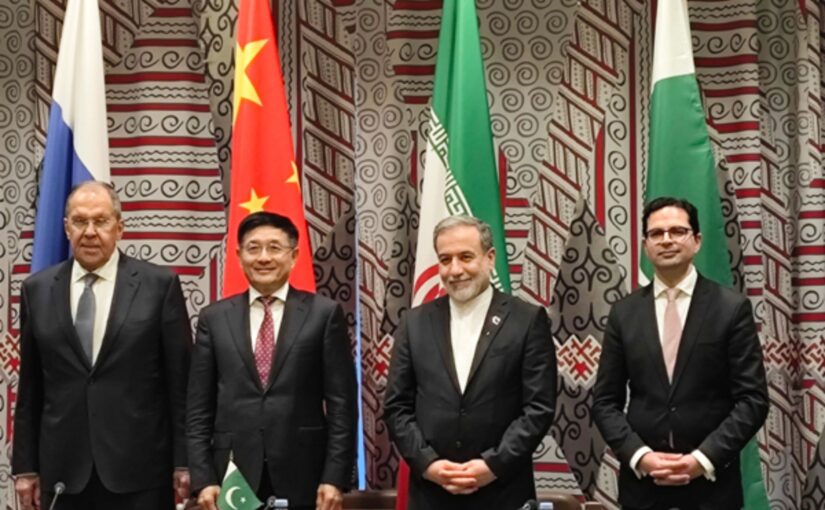
China, Russia, Pakistan and Iran reject US return to Afghanistan

On September 25, 2025, Russian Foreign Minister Sergei Lavrov chaired the fourth Informal Meeting on Afghanistan Between Foreign Ministers of China, Russia, Pakistan and Iran on the sidelines of the 80th session of the United Nations General Assembly in New York. China was represented by Special Envoy on Afghan Affairs of the Ministry of Foreign Affairs Yue Xiaoyong.

The meeting adopted a joint statement that stresses the principle that the sovereignty, independence and territorial integrity of Afghanistan must be respected. It also expresses unambiguous opposition to any attempt to reestablish foreign military bases in or around Afghanistan, especially by those who bear direct responsibility for the country’s current predicament.

China Daily noted: “At a time when certain voices in Washington have openly hinted at ‘reclaiming’ Bagram Air Base in Afghanistan, the four countries’ collective position is both timely and significant.”

The “certain voices” refer specifically to remarks made by US President Donald Trump at a September 18 press conference with UK Prime Minister Keir Starmer during the fawning and obsequious state visit arranged by the British ruling class.

The interim Afghan government issued a statement on September 21 saying it firmly rejects recent US calls to reclaim the air base and reaffirming its unwavering commitment to national sovereignty. It urged Washington to honour its pledge in the 2020 Doha Agreement that there would be no military interference.

The following articles were originally published on the website of the Chinese Foreign Ministry and China Daily.

Special Envoy on Afghan Affairs of the Ministry of Foreign Affairs Yue Xiaoyong Represents China at the Fourth Informal Meeting on Afghanistan Between Foreign Ministers of China, Russia, Pakistan and Iran

September 26 (MFA) – On September 25, 2025, Russian Foreign Minister Sergei Lavrov chaired the fourth Informal Meeting on Afghanistan Between Foreign Ministers of China, Russia, Pakistan and Iran during the 80th session of the United Nations General Assembly in New York. Special Envoy on Afghan Affairs of the Ministry of Foreign Affairs Yue Xiaoyong attended the meeting on behalf of China. The meeting discussed issues of common interest, such as the current situation in Afghanistan, and issued a Joint Statement.


Joint statement on Afghanistan shows regional resolve for peace

September 29 (China Daily) – On the sidelines of the 80th session of the United Nations General Assembly in New York, the foreign ministers of China, Russia, Pakistan and Iran held a meeting on Afghanistan and released a joint statement on Thursday. At a time when certain voices in Washington have openly hinted at “reclaiming” Bagram Air Base in Afghanistan, the four countries’ collective position is both timely and significant.

The joint statement stresses the principle that the sovereignty, independence and territorial integrity of Afghanistan must be respected. Equally important, it conveys unambiguous opposition to any attempt to reestablish foreign military bases in or around Afghanistan, especially by those who bear direct responsibility for the country’s current predicament. Such actions, the statement rightly warns, would not only be inconsistent with the aspirations of the Afghan people but also harmful to regional peace and stability.

The Afghan government issued a statement on Sept 21 saying it firmly rejects recent US calls to reclaim the air base and reaffirming its unwavering commitment to national sovereignty. It urged Washington to honor its pledge in the 2020 Doha Agreement that there would be no military interference.
Deputy spokesman of the Afghan administration Hamdullah Fitrat posted the statement on his X account, which highlighted that Afghanistan’s independence and territorial integrity remain paramount in all bilateral engagements, particularly with the US.

For over two decades, Afghanistan endured the heavy costs of military intervention. Instead of bringing peace or development, the prolonged presence of foreign forces deepened internal divisions, disrupted social cohesion and left the country with massive security and humanitarian challenges. It should be an international consensus that Afghanistan needs stability, reconstruction and genuine respect for its sovereignty — not a return of external military deployments.

The joint statement by the four regional stakeholders therefore reflects the voice of both justice and reason. It shows that the four countries are determined to support Afghanistan in pursuing an Afghan-led and Afghan-owned path to peace and development. It also demonstrates their consensus that the international community’s responsibility lies in providing humanitarian and reconstruction assistance rather than reviving old patterns of intervention.

When asked about the joint statement at a regular news conference on Friday in Beijing, Chinese Foreign Ministry spokesperson Guo Jiakun reiterated China’s firm position. As he pointed out, the statement fully illustrates the respect that Afghanistan’s neighboring countries have for its sovereignty, independence and national dignity. It also reveals the shared will of the peace-loving countries to help Afghanistan rebuild and remain stable.

As Guo stressed, as a close neighbor and a responsible major country, China is ready to work with the international community to continue extending assistance to Afghanistan and to play a constructive role in promoting its peace and reconstruction. China’s commitment to Afghanistan is rooted in principles, not in geopolitical calculations.

The joint statement makes clear that reintroducing military infrastructure into Afghanistan would serve no purpose other than to open old wounds, sow new divisions and destabilize the entire region. What the Afghan people need most today is relief from poverty, assistance in rebooting their economy and assurances of lasting peace — not the shadow of yet another round of military entanglement.

The quadripartite meeting in New York and its outcome also demonstrate the growing role of regional diplomacy in addressing global challenges. China, Russia, Pakistan and Iran have made their collective voice heard on the world stage. Their stance highlights that countries directly affected by Afghanistan’s instability are both willing and able to assume the responsibility for guiding regional peace and security.

The situation in Afghanistan remains complex, but the way forward should be clear. The international community must focus on helping the Afghan people overcome humanitarian difficulties, rebuild their economy and restore social stability and vitality.

The joint statement thus stands as a timely reminder that regional peace cannot be secured through military means, but through respect, assistance and cooperation. China and its partners have shown both resolve and vision in charting that path. The world should take note — and follow suit.

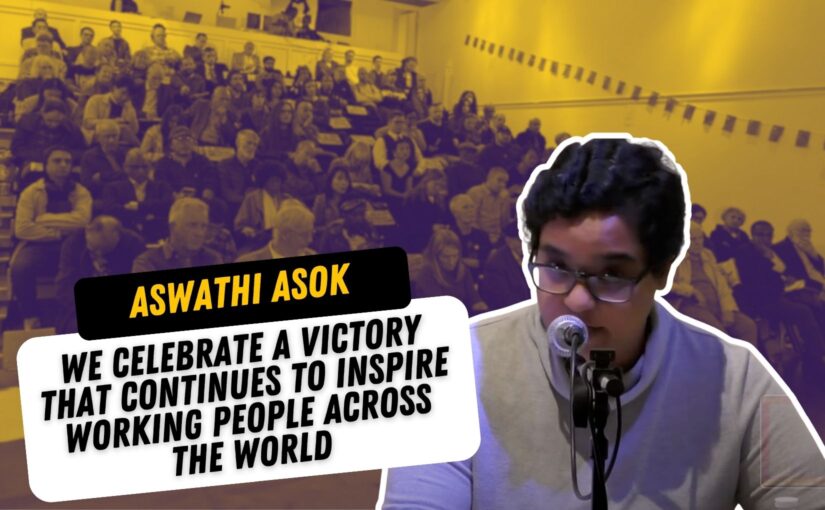
We celebrate a victory that continues to inspire working people across the world

We are very pleased to publish below the speech delivered by Comrade Aswathi Asok, Executive Committee member of the Association of Indian Communists (AIC), during the closing rally of our China Conference 2025, held on Saturday September 27.

Aswathi notes that: “The Chinese revolution of 1949 was more than a change of government. It showed that the oppressed can rise, organise and shape their own future,” and goes on to outline how, from the earliest days, progressive movements in India, “looked to the Chinese people’s bravery with admiration and with a sense of kinship.”

She also outlines the social and developmental achievements of her home state of Kerala under elected communist governments:

“I grew up in a tradition, where in many homes the photograph of Chairman Mao still hangs on the wall, not as decoration but as a reminder that ordinary people can make history… Let us carry forward the banner of socialism with courage, unity, discipline, and hope. And I believe that China, with its rich experience, will support and lead the awakening of the working class around the globe.”

The AIC is the overseas wing of the Communist Party of India (Marxist), India’s largest communist party.

Dear comrades, friends and distinguished guests,

On this seventy sixth anniversary of the founding of the People’s Republic of China, I am honoured to be here and bring greetings from the Association of Indian Communists, the overseas wing of the Communist Party of India (Marxist). As someone born and raised in a neighbouring country of China, it is with great pride and joy that I join you to celebrate a victory that continues to inspire working people across the world. As we all know, the Chinese revolution of 1949 was more than a change of government. It showed that the oppressed can rise, organise and shape their own future.

Continue reading We celebrate a victory that continues to inspire working people across the world

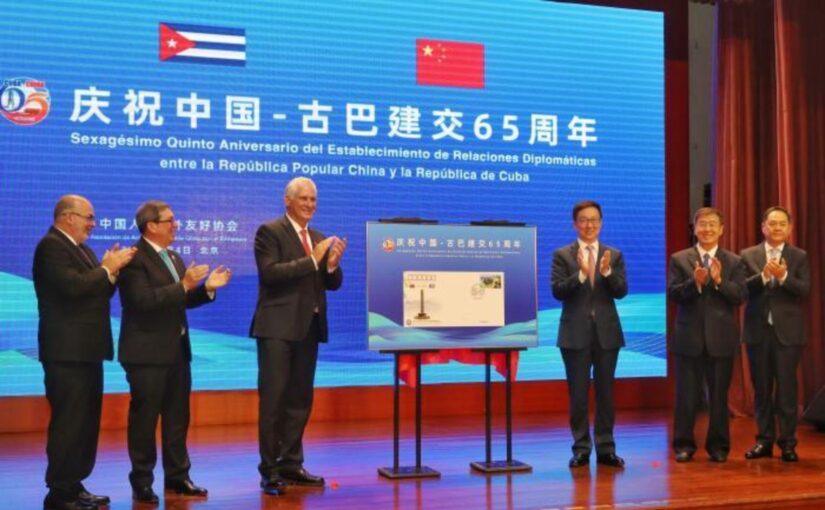
Cuba-China diplomatic relations: 65 years from history to the future

The leaders of China and Cuba exchanged messages on September 28, marking the 65th anniversary of the diplomatic relations between the two socialist countries.

In his message to Miguel Diaz-Canel, First Secretary of the Central Committee of the Communist Party of Cuba and Cuban President, General Secretary and President Xi Jinping noted that 65 years ago, Cuba took the lead among Western Hemisphere countries in establishing diplomatic relations with New China, opening a new chapter in China-Cuba relations. Over the past 65 years, China-Cuba relations have continued to deepen, becoming a model of solidarity and cooperation between socialist countries as well as a model of sincere mutual assistance among developing countries.

Xi also recalled that not long ago, Diaz-Canel came to China to attend the commemorations marking the 80th anniversary of the victory in the Chinese People’s War of Resistance against Japanese Aggression and the World Anti-Fascist War. They met again and reached an important consensus on building a closer China-Cuba community with a shared future.

A joint congratulatory message by Diaz-Canel and General Raul Castro, leader of the Cuban Revolution, noted that for more than 60 years, Cuba-China relations have stood the test of time and continued to grow, with the two sides enjoying deep political mutual trust, close exchanges on socialist development, and a continually strengthened traditional brotherhood and friendly cooperation.

In a September 29 article, Granma, the official voice of the Cuban Communist Party (PCC), referenced the long history of friendship and solidarity between the two peoples, dating back to the wars of independence fought by the Cuban people in the latter part of the 19th century:

“On the century-long journey that unites the peoples of the two countries, the bonds have grown stronger and stronger: ‘There was not a single Cuban Chinese traitor, there was not a single Cuban Chinese deserter,’ reads the monument built in Havana in memory of those who fought for Cuba’s independence.

“The phrase on the metal plaque is still relevant today. In a sense, it can be interpreted as a prediction of the ties that were forged, and which have led to this friendship being described as ‘ironclad.’”

Granma further notes that, alongside the establishment of diplomatic relations in 1960:

“Ernesto Che Guevara’s visit to the Asian giant that same year was a key moment in the history of Chinese-Cuban ties and contributed to the development of a strategic relationship.

“In 1993, President Jiang Zemin would be the only head of state to visit the island, in a crucial context, after the collapse of the socialist camp… Years later, the Cuban government described the visit as ‘an invaluable gesture of brotherhood and confidence in our country’s capacity.’

“The images of Fidel on the Great Wall of China in 1995 are a fundamental part of the shared history. On December 1st, he walked 500 metres of the colossal structure, becoming the international head of state who had reached the highest point.”

Continue reading Cuba-China diplomatic relations: 65 years from history to the future

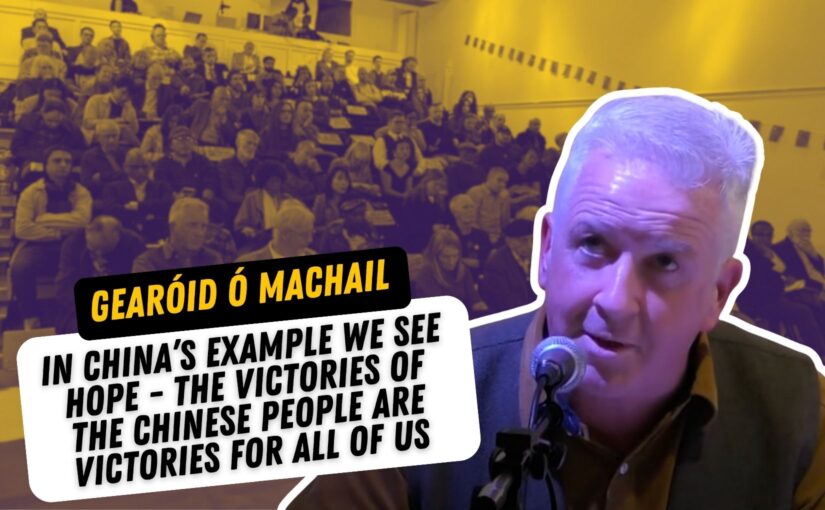
In China’s example we see hope – the victories of the Chinese people are victories for all of us

The following is the text of the speech delivered by Gearóid Ó Machail, Member of the National Executive Committee of the Communist Party of Ireland (CPI), to the closing rally of our China Conference 2025, held on Saturday September 27.

Gearóid’s talk touches on a number of important topics, including the importance of the fraternal relations between the CPI and the Communist Party of China (CPC), the Irish and Chinese struggles against imperialism, and the importance of people-to-people ties.

Comrades and friends,

Ar dtús báire ba mhaith liom a rá gur mór an onóir dom labhairt libh inniu ag an chruinniú tábhachtach seo atá á óstáil ag Cairde na Síne Sóisialaí. Cuirim beannachtaí réabhlóideacha ó chroí ó Pháirtí Cumannach na hÉireann agus cuirim ár ndlúthpháirtíocht in iúl le muintir na Síne agus le Páirtí Cumannach na Síne.

I begin my speech today with some words in my native language not least in honour of Kneecap and their tremendous victory this week.

It is a great honour to address you today at this important gathering of esteemed company hosted by my dear comrades in Friends of Socialist China. I bring warm revolutionary greetings from the Communist Party of Ireland and express our deep solidarity with the People’s Republic of China, with the Chinese people, with the Communist Party of China and with all Friends of Socialist China.

The Communist Party of Ireland deeply values its fraternal relations with the Communist Party of China. These ties are not transactional – they are built on mutual respect, shared ideological foundations, and a commitment to building socialism in our respective contexts. Over the 46 years since the establishment of diplomatic relations, China and Ireland have deepened exchanges and cooperation across politics, economy, science and technology, and culture, bringing tangible benefits to both peoples.

We meet here at a time when the achievements of Chinese socialism are not only undeniable but are increasingly vital to the future of human civilisation and the survival of our delicate, global eco-system. From lifting hundreds of millions of people out of poverty to leading the world in green development and technological innovation, China stands as a beacon of what is possible when a proud and resilient people chart their own course, guided by socialist principles and a commitment to national sovereignty.

Continue reading In China’s example we see hope – the victories of the Chinese people are victories for all of us

DPRK foreign minister: Consolidating and developing relations with China is an unwavering stance

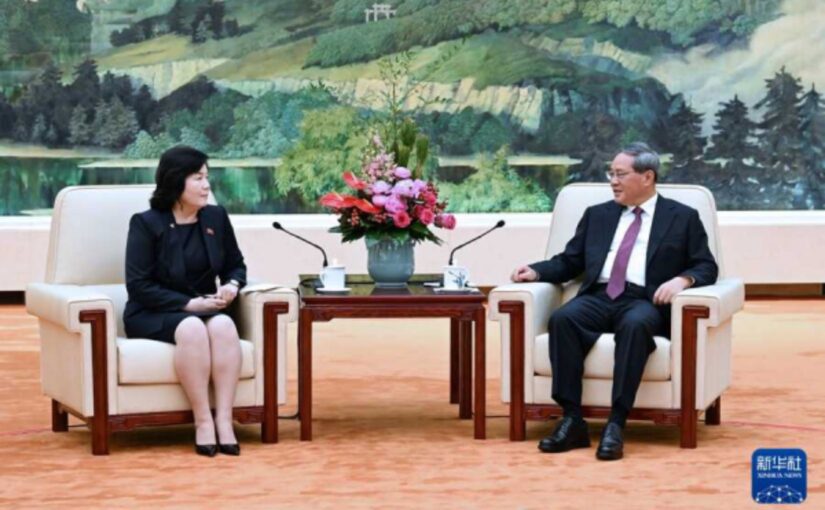
Foreign Minister of the Democratic People’s Republic of Korea (DPRK)  Choe Son Hui visited China from September 27 to 30 at the invitation of her Chinese counterpart Wang Yi. This visit followed on closely from that paid by top DPRK leader Kim Jong Un, September 2-4, to participate in the commemoration of the 80th anniversary of victory in the Chinese People’s War of Resistance Against Japanese Aggression and the World Anti-Fascist War. Choe had also accompanied Kim Jong Un on that visit.

Chinese Premier Li Qiang met with Choe on the morning of September 29.

According to the Chinese Foreign Ministry, he said that China and the DPRK are neighbours connected by mountains and rivers, and share a time-honoured, ever-growing and profound friendship across generations. Earlier this month, General Secretary Xi Jinping held a meeting with General Secretary Kim Jong Un in Beijing, reaching important common understandings on deepening and developing China-DPRK friendly and cooperative relations. China has always viewed and advanced the development of China-DPRK relations from a strategic and long-term perspective. China is ready to work with the DPRK to implement the common understandings reached by the top leaders of the two Parties and two countries, further promote traditional friendship, strengthen strategic communication, and jointly advance the socialist cause of both countries for the greater benefit of the two peoples.

Choe Son Hui said that the recent meaningful and fruitful meeting between the top leaders of the two Parties and two countries has charted the course for the development of DPRK-China relations. Consolidating and developing relations with China is an unwavering stance of the DPRK and serves the fundamental interests of both countries and their peoples. She sincerely wishes China’s continuous and new achievements on the path toward advancing modernisation and national rejuvenation under the wise leadership of General Secretary Xi Jinping.

The Korean Central News Agency (KCNA) added that Choe Son Hui said that the respected Comrade Kim Jong Un had a significant meeting and talks with General Secretary Xi Jinping days ago and reached an agreement on revitalising high-level visits between the two sides. She stressed that it is the invariable stand of the Workers’ Party of Korea (WPK) and the government of the Democratic People’s Republic of Korea to further develop the traditional DPRK-China relations of friendship and cooperation as required by the times.

She also referred to the struggle of the DPRK people who are making all efforts to successfully greet the Ninth Congress of the WPK after definitely concluding all the undertakings planned for this year, the last year of implementing the five-year plan for national economic development.

Continue reading DPRK foreign minister: Consolidating and developing relations with China is an unwavering stance

China strongly condemns US misuse of veto to shield Israel

On September 18, the United States yet again abused its veto power in the United Nations Security Council to block a call for a ceasefire and an end to the carnage and humanitarian catastrophe in Gaza.

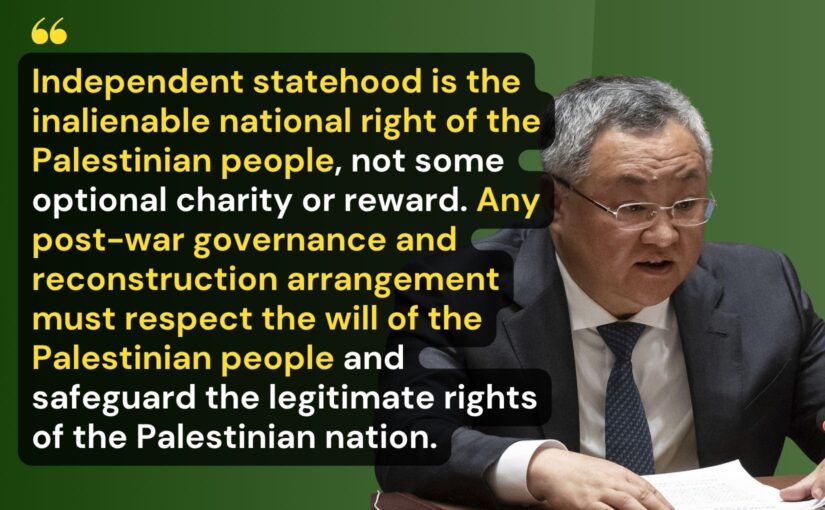
In this regard, Chinese Ambassador to the UN, Fu Cong has made three strong statements decrying the actions of the United States and Israel and in support of the just and inalienable national rights of the Palestinian people.

Speaking at a United Nations General Assembly debate on the matter, held on October 1, he said:

“Time and again, the Security Council has sought to take actions, only to be forcefully blocked by the United States again and again. On September 18, the United States once again vetoed a Security Council draft resolution on Gaza. China expresses its deep disappointment and regret over this. If it were not for the United States’ repeated abuse of the veto, the Security Council’s response to the Gaza crisis would not have been so inadequate. If it were not for the United States’ shielding of Israel, Council resolutions and international law would not have been so flagrantly violated.”

He outlined three imperatives as follows:

  • A lasting ceasefire in Gaza must be achieved immediately. History has repeatedly demonstrated that military means is not the way out, and that one’s own security cannot be built on the insecurity of others.
  • The humanitarian catastrophe in Gaza must be alleviated. Under the man-made blockade, Gaza is witnessing an unprecedented humanitarian catastrophe. China reiterates that the weaponisation of humanitarian aid is unacceptable, the militarisation of aid distribution mechanism is unacceptable, and attacks on aid-seeking civilians and humanitarian workers are unacceptable.
  • The two-State solution must be implemented.  Both Gaza and the West Bank are inseparable parts of the Palestinian territory. Any post-war governance and reconstruction arrangements must adhere to the principle of Palestinians governing Palestine and respect the will of the Palestinian people.

At a UN Security Council briefing on September 29, he noted: “Last week, at the general debate of the 80th UN General Assembly, the high-level meeting on the implementation of the two-State solution, and other major events, the international community once again issued a powerful call for an immediate end to the killings, for saving lives, and for achieving peace. This is not merely the most fundamental requirement for upholding fairness and justice. More importantly, it is the bare minimum required by human morality and conscience.

Continue reading China strongly condemns US misuse of veto to shield Israel

Unearthing solidarity across continents – the Morning Star Nanjing connection

A chance discovery during an office move has rekindled historic ties between the Morning Star and China’s Xinhua Daily.

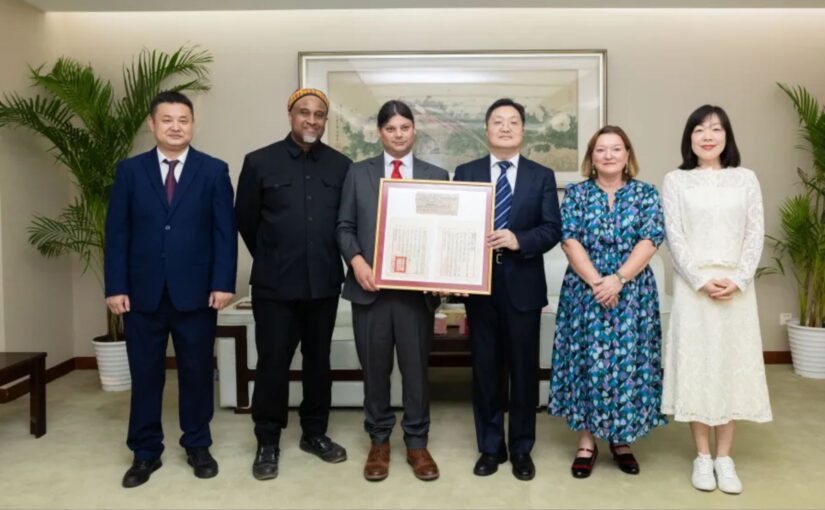
In 2021, assistant business manager Bernadette Keaveney unearthed a 1950 letter in traditional Chinese characters, written by Xinhua to the Daily Worker — the Morning Star’s predecessor — congratulating it on its 20th anniversary. Rediscovered thanks to the widow of former editor Pat Devine, the letter has now been formally presented to Xinhua Daily’s museum in Nanjing by a delegation from the Star.

Founded in 1938 by Zhou Enlai and other prominent leaders, Xinhua Daily was the first national newspaper of the Communist Party of China. Its history of resilience — publishing under Japanese bombardment and Kuomintang censorship — resonated with the Morning Star delegation, who recalled the Daily Worker’s own sacrifices during the Spanish Civil War and the Blitz.

At a ceremony in Nanjing, Xinhua vice-president Chen Renyun hailed the “deep historical roots and similar values” of the two papers, calling them comrades-in-arms united by “a friendship which crosses national borders and is based on common ideals.” Chen proposed deepening content collaboration and embracing digital co-operation to revitalise this relationship in the modern era.

Morning Star editor Ben Chacko emphasised the significance of renewing ties at a time when the West is pushing a New Cold War narrative. “We want to challenge those voices who present China’s rise as a threat,” he said, praising China’s commitment to peace, development and win-win co-operation. He concluded: “Like our past comrades who corresponded all those decades ago, we live far apart, but are united by our shared ideals.”

The following report by Roger McKenzie first appeared in the Morning Star on 27 September 2025.

A chance find during an office move led a delegation from the Morning Star to a reception thousands of miles away in China this week to renew a decades-old comradeship.

While clearing out our old building in 2021, the Star’s stalwart assistant business manager Bernadette Keaveney came across a historic letter.

The letter, written in old style Mandarin from China’s Xinhua Daily to the Morning Star’s predecessor the Daily Worker in 1950, congratulates our paper on its 20th anniversary.

This rediscovery of the letter from the Nanjing, east China-based newspaper would not have been possible without Gloria Findlay, the widow of former Daily Worker international editor Pat Devine — the letter’s addressee. She sent the letter back to us after his death knowing it was an important piece of our history.

Continue reading Unearthing solidarity across continents – the Morning Star Nanjing connection

Symbolic significance of Western states’ recognition of Palestine

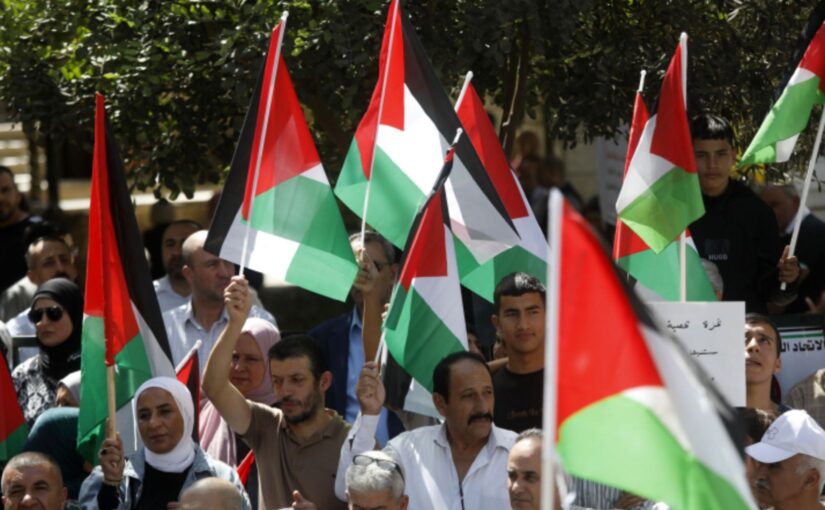
In late September, several Western states, including Britain, France, Canada, Australia and others, formally recognised the State of Palestine. This follows similar moves over the last two years by Ireland, Norway and Spain, bringing the total to 157 UN member states. The recognition reflects growing outrage at Israel’s devastating assault on Gaza, which has killed more than 65,000 people and destroyed the bulk of the territory’s infrastructure. UN investigators have confirmed what is widely known: that Israel is committing genocide, deliberately targeting civilians and obstructing food supplies.

In the following article for Beijing Review, Carlos Martinez observes that China recognised the State of Palestine in 1988 – being one of the first countries to do so – and has long been a consistent supporter of Palestinian national rights. Since the beginning of the current genocide, Beijing has called for an immediate, comprehensive ceasefire and Israeli withdrawal, the restoration of humanitarian aid, and top-level negotiations towards a lasting peace based on Palestinian statehood.

Carlos notes that, last year, China hosted representatives of 14 Palestinian factions, including Hamas and Fatah, facilitating the Beijing Declaration on national unity. Chinese officials have also defended the Palestinian right to resist colonial occupation at the International Court of Justice.

The stark contrast between Washington’s obstructionism and China’s active promotion of peace underscores a broader global divergence: China is increasingly seen as a stabilising force advocating dialogue and justice, while the US is perceived as hegemonistic and destabilising.

The article concludes:

While wider recognition of Palestinian statehood represents a victory for Palestinians, it is a largely symbolic step. Gaza is experiencing the worst humanitarian crisis of the 21st century. Illegal settlements are expanding in the West Bank. Self-determination and national rights for Palestinians are still far from being realised.

The peoples of the world must continue to mobilise to demand an immediate ceasefire, an immediate withdrawal of Israeli troops, an end to the siege, a resumption of full humanitarian aid, and the earliest possible UN-level dialogue towards a just and lasting peace and the realisation of the legitimate national rights of the Palestinian people.

In late September, a number of Western countries including Britain, Canada, Australia, France, Portugal, Luxembourg, Malta and Monaco announced their formal recognition of the State of Palestine.

This follows similar announcements by Ireland, Norway and Spain last year, meaning that 157 out of 193 United Nations member states now recognize Palestinian statehood, which was originally declared by the Palestinian Liberation Organization (PLO) in 1988.

That these Western countries, longstanding supporters of Israel, have finally chosen to extend formal recognition to Palestine is a significant development, and reflects the growing international revulsion at Israel’s genocidal assault on Gaza, which has to date resulted in the deaths of at least 65,000 people, the majority of them women and children.

Gaza’s infrastructure has been systematically destroyed, with hospitals, schools, water and power supplies deliberately targeted. A new report by the UN Independent International Commission of Inquiry on the Occupied Palestinian Territory has found that Israel is responsible for the commission of genocide in Gaza. The report continues: “It is clear that there is an intent to destroy the Palestinians in Gaza through acts that meet the criteria set forth in the Genocide Convention.”

International bodies have also confirmed that Israel is deliberately obstructing the entry of food into Gaza and that, as a result, there is an ongoing famine in the territory.

The horrors of this war have shocked public opinion around the world, leading to a powerful global mass solidarity movement which has become too big to ignore. This has prompted governments in the West to reconsider their position on Palestinian statehood.

Continue reading Symbolic significance of Western states’ recognition of Palestine

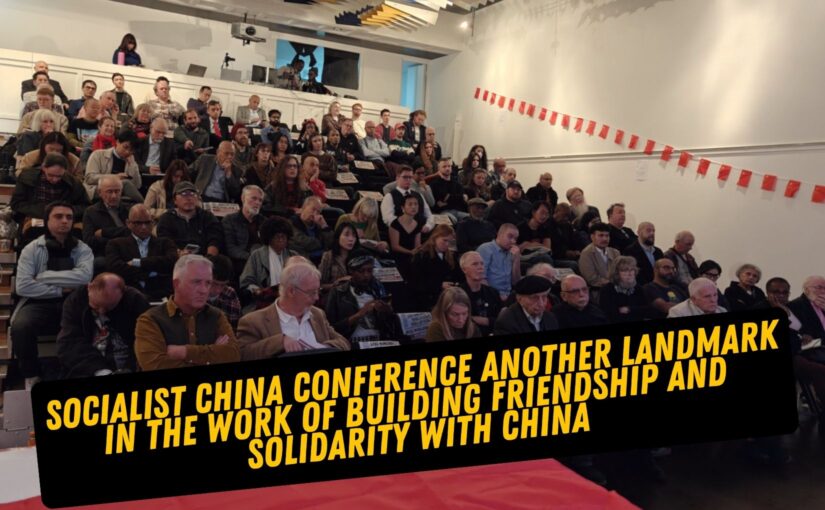
Socialist China Conference another landmark in the work of building friendship and solidarity with China

On Saturday 27 September 2025, Friends of Socialist China held a successful conference at Bolivar Hall, London, to mark the 76th National Day of the People’s Republic of China. Attended by well over a hundred people, the event featured panel discussions on China’s role as a force for peace and multipolarity, its achievements in overcoming poverty and building socialism, and its leadership in combating climate breakdown.

Introducing the event, Professor Radhika Desai reflected on the importance of this annual gathering, noting that China’s “size and level of development give it an objectively critical role in the global transition to socialism, having subtracted a sixth of humanity from the ravages of capitalism and its imperialism, and promised to make it a modern socialist society by 2049”. Meanwhile, “while the West is the fomenter in chief of the world chaos, China and its allies are emerging as the centre of a spreading and steadying calm.” Radhika emphasised that it is essential for progressive forces worldwide to build understanding of, and friendship with, China.

The opening rally was addressed by a number of senior diplomats based in London: Jiang Zhouteng, Minister Counsellor at the Embassy of the People’s Republic of China; Pablo Arturo Ginarte Sampedro, First Secretary of the Embassy of the Republic of Cuba; Timofey Kunitskiy, Counsellor of the Embassy of the Russian Federation; Wilfredo Hernández Maya, Counsellor of the Embassy of the Bolivarian Republic of Venezuela; and Thavone Singharaj, Counsellor and Deputy Head of Mission, of the Embassy of the Lao People’s Democratic Republic. Each of them brought greetings from their respective governments and expressed solidarity with Socialist China and with our conference. A video of greetings from Zhang Weiwei – Professor of international relations at Fudan University – was also shown.

Former MP and leader of the Workers Party of Britain, George Galloway, was expected to speak at the opening rally, but was prevented from doing so due to being detained, with his wife Gayatri, by Sussex Police on their arrival at Gatwick Airport under Schedule 3 of the Counter Terrorism and Border Security Act 2019. As we noted in a website post the following day: “Friends of Socialist China vehemently condemns this further brazen assault on democratic rights by the British state and its attacks on anti-imperialists. We extend our full support and solidarity to George and Gayatri and to the comrades of the Workers Party, as we do to all those subject to state repression on account of their political work against imperialism and war and in support of peace, democracy and social progress.”

Following the opening rally, we had a panel discussion on the theme 80 years since the defeat of fascism: China as a force for peace and multipolarity, with contributions from Mick Wallace (Former MEP; Former TD [Member of the Irish Parliament] for Wexford); Keith Bennett (Co-editor of Friends of Socialist China); Jenny Clegg (author and peace activist); Luke Daniels (President of Caribbean Labour Solidarity) and Francisco Domínguez (Secretary of the Venezuela Solidarity Campaign).

The second panel was on China’s achievements in overcoming poverty and building socialism, chaired by R Islam (Friends of Socialist China Britain Committee) and featuring contributions from Ali Al-Assam (Managing Director of the NewsSocial Cooperative); Eben Williams (Education Officer for the Young Communist League); and Fiona Sim (Co-founder of the Black Liberation Alliance).

The final panel was on the theme How China is leading the fight against climate breakdown, chaired by David Peat (Iskra Books) with contributions from Paul Atkin (environmental campaigner); Yanan Song (lecturer in Global Politics at SOAS University of London) and Carlos Martinez (co-editor of Friends of Socialist China).

The closing rally featured speeches from Robert Griffiths (General Secretary of the Communist Party of Britain); Aswathi Asok (Executive Committee member of the Association of Indian Communists); and Gearóid Ó Machail (National Executive Committee member of the Communist Party of Ireland). It was chaired and introduced by Ileana Chan of Empire Watch.

We were also delighted that Dr Jenny Clegg’s new book, Storming the Heavens – Peasants and Revolution in China, 1925-1949, was launched at the conference. Drawing on decades of research, the book examines land, class and revolution, analysing peasant struggles, imperialism, and the Communist Party of China’s evolving strategy in crucial phases of the revolution.

All speeches from the event can be found on the YouTube channels of Friends of Socialist China and the event’s media partner, Empire Watch.

The conference was supported by a broad range of progressive organisations: The Morning Star, Communist Party of Britain, Workers Party of Britain, Communist Party of Ireland, International Manifesto Group, Black Liberation Alliance, Iskra Books, Praxis Press, Manifesto Press, Young Communist League, Caribbean Labour Solidarity, Third World Solidarity, No 2 NATO, and Institute for Independence Studies.

The conference marks another landmark in the work of building friendship and solidarity with China, and understanding of its role in the world.

The videos of the opening and closing rallies, and the panel discussions, are embedded below.


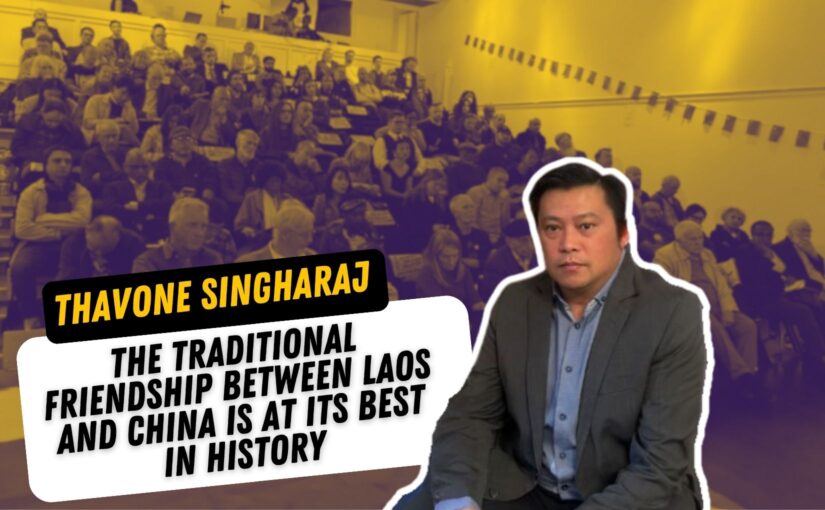
The traditional friendship between Laos and China is at its best in history

The opening session of our China Conference 2025, held in London on September 27, was addressed by senior diplomats from the embassies of the People’s Republic of China, Republic of Cuba, Russian Federation, Bolivarian Republic of Venezuela and Lao People’s Democratic Republic.

We are very pleased to print below the warm speech given by Comrade Thavone Singharaj, Counsellor and Deputy Head of Mission of the Lao Embassy.

The speech outlines the thriving bilateral relations, across various sectors, between the two socialist neighbours as Laos prepares for its 12th national party congress, due to be held in early 2026, and to celebrate the 50th anniversary of the founding of the people’s democratic republic on December 2nd this year.

It is a profound privilege and honour for me to join comrades today, and I would like to thank Comrade Keith Bennett for giving this opportunity.

As you may know, this year marks the 76th Anniversary of the founding of the People’s Republic of China whereby we are about to hear stories of both the past and current development of China later today. While I am taking the floor, I would like to express my congratulations and appreciation for the successful hosting of the 25th Shanghai Cooperation Organisation Summit 2025, as well as the commemorations marking the 80th anniversary of the victory in the Chinese People’s War of Resistance against Japanese Aggression and the World Anti-Fascist War held earlier this month. These two historical events organised by the Party and State of China are considered to elevate the role of the Communist Party of China and the People’s Republic of China on the international stage, showing the world community the strength and growth of the People’s Republic of China amidst the complex changes in the regional and international situation in recent years.

I would also like to congratulate the outstanding achievements that the Party, State and people of China have achieved under the leadership of the Communist Party of China with General Secretary and President Xi Jinping at the core, especially the implementation of the Resolutions of the 20th National Congress of the Communist Party of China and the 14th Five-Year Plan for Socio-Economic Development of the Chinese Government, just to name some.

Back to 25 April 1961, Laos and China established bilateral relations making this year the 64th anniversary of diplomatic relations. Since then, our bilateral relations and cooperation have gradually enhanced from strength to strength. Our two nations have stood side-by-side through times of struggle and currently work together to advance socialist development and prosperity.

The latest visit to China by H.E. Thongloun Sisoulith, General Secretary of the Lao People’s Revolutionary Party (LPRP) and President of the Lao People’s Democratic Republic (LPDR) on 4-6 September has brought our bilateral relations to a greater height. Our two nations have signed a total of 11 cooperation documents in order to pave the way for our future directions. The two leaders reaffirmed their commitment to work together and also agreed to focus on the operation of the China-Laos Railway and development along the route to upgrade key projects in defence, law enforcement and security, and other fields. In addition, both sides valued that the Laos-China and China-Laos relationship is now at the best in history and will work together to implement a new shared future Master Plan (2024-2028) and pledged to accelerate its implementation for even greater success, which has laid a strong foundation for cooperation across multiple sectors.

Continue reading The traditional friendship between Laos and China is at its best in history

Li Qiang issues rallying call for development at UN

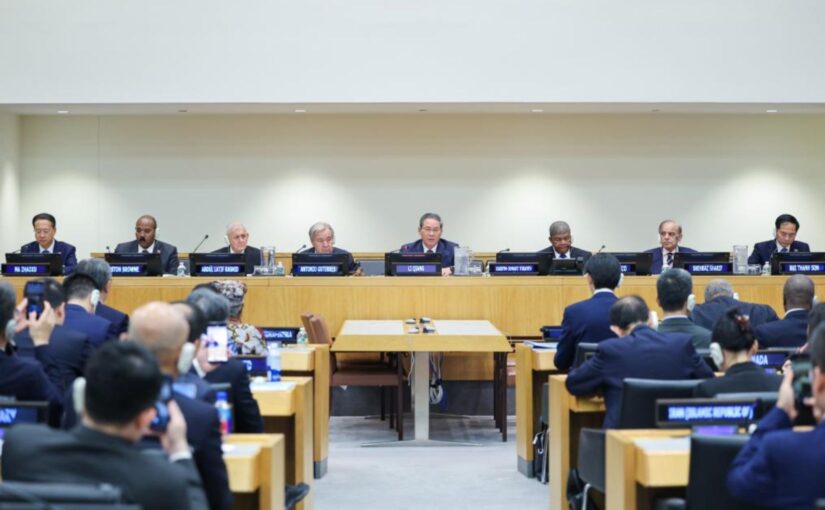
During his recent visit to New York to attend the 80th session of the United Nations General Assembly, Chinese Premier Li Qiang also addressed a high-level meeting on the Global Development Initiative (GDI), proposed by China.

Held on September 23, the meeting was attended by UN Secretary-General Antonio Guterres, Kazakh President Kassym-Jomart Tokayev, Iraqi President Abdul Latif Rashid, Angolan President Joao Lourenco, Prime Minister of Antigua and Barbuda Gaston Browne, Pakistani Prime Minister Shehbaz Sharif, Nigerien Prime Minister Ali Mahaman Lamine Zeine, as well as ministerial-level officials from more than 30 countries and heads of international organisations.

In his speech, Li Qiang noted that: “Development is a timeless theme for human society. At its very inception, the United Nations embedded the promotion of global development into its Charter… The Global Development Initiative (GDI) put forward by President Xi Jinping at the UN General Assembly in 2021 aims to advance the broadest common interests of all humanity.”

He said that a review of history shows that when countries worked together in solidarity for shared benefits, global development would advance steadily and everyone would gain; when zero-sum mentality reared its head and division and confrontation rose, global development would come to a halt, and everyone would lose. Saying that China stands ready to work with all parties to further implement the GDI, advance the UN 2030 Agenda for Sustainable Development at a faster pace, and reinvigorate global development, he put forward four points as follows:

  • We need to foster a stable and open international environment for development. Peace and stability underpin development and prosperity; openness and cooperation sustain economic growth. Decoupling, severing supply chains and bloc confrontation would only hurt the global economy, disrupt global order and create greater risks.
  • We need to build balanced and universally beneficial partnerships for development. Behind the growing North-South development gap in recent years are the inequalities and inequity in rights, opportunities and rules. Certain developed countries are reluctant to fulfill their pledges of development financing, and even cut off funding to global development institutions, which has seriously undermined North-South cooperation.
  • We need to cultivate future-oriented drivers for innovation-driven development. At present, rapid advances in technologies such as artificial intelligence (AI) and big data are becoming a powerful driver of global development. We need to seize the opportunities to enhance international cooperation on scientific and technological innovation and oppose such moves as putting up walls and barriers and blocking the flow of technology.
  • We need to promote green and low-carbon development with greater sustainability. Climate change, environmental degradation and overconsumption of resources are major challenges facing the world. Development is in urgent need of a green transition. Climate and ecosystem know no borders, and homeland Earth should be jointly preserved.

He added that China will continue to strengthen scientific and technological cooperation to empower global development. Over the years, China has readily shared its scientific and technological innovation outcomes and advanced the AI Capacity-Building Action Plan for Good and for All, to help countries across the Global South enhance digital and intelligence capabilities. In the next five years, China will establish a funding program dedicated to digital capacity-building within the Global Development Capital Pool to support the ‘Digital South’ initiative under the GDI. China will also initiate an International Alliance of Sustainable Development Satellites to provide solid support of space observation data for global development.

Continue reading Li Qiang issues rallying call for development at UN

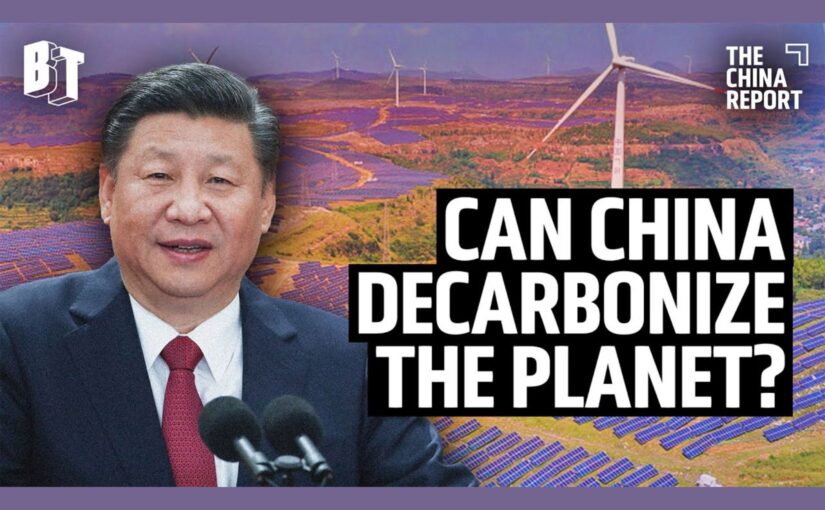
Decarbonising the planet: China leads the way out of the climate crisis

In the video below, KJ Noh interviews Carlos Martinez about China’s role in humanity’s common struggle against climate breakdown. In particular, the two discuss the new comprehensive review by global energy think tank Ember of China’s clean energy progress and its implications for the rest of the world.

KJ and Carlos go into some depth regarding China’s commitment to renewable energy and environmental protection, and the reason China has emerged as the undisputed global leader in clean technology while the US administration is doubling down on fossil fuel and the military-industrial complex.

The two discuss the geopolitics of the climate crisis, concluding that, for much of the US ruling class, a strategy of suppressing China’s rise is a significantly higher priority than saving the planet; “better dead than red” for the 21st century. KJ and Carlos also cover the global significance of China’s innovation, investment and economies of scale, noting that thanks to China’s efforts, there’s been a dramatic cost reduction in green tech around the world, allowing many countries of the Global South to leapfrog fossil fuel-based development.

The interview was originally recorded and broadcast on BreakThrough News on 30 September 2025.