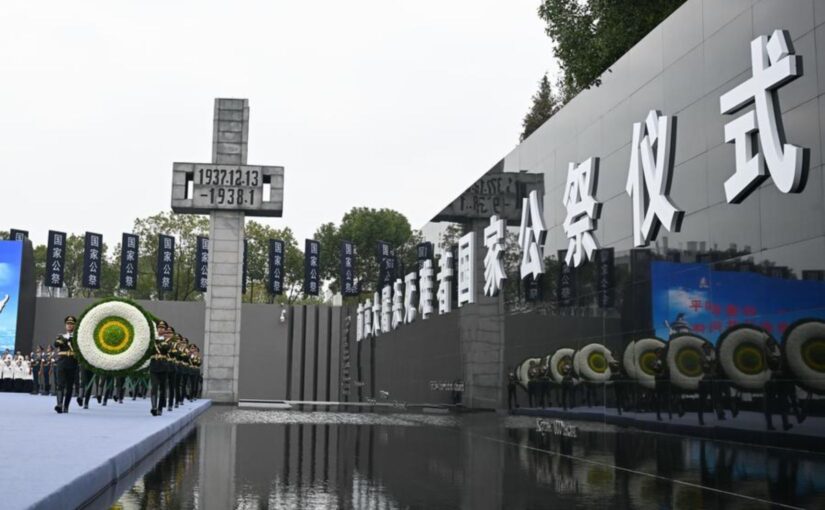
We are very pleased to publish below an article by Stephen Chang, Director of People’s Forum Limited, written to mark the 88th anniversary of the Nanjing Massacre and China’s 12th National Memorial Day. In the course of just six weeks, the Japanese slaughtered some 300,000 civilians in the city. Today, there are just 24 registered survivors of the massacre, after eight of them passed away in the course of this year.
Having outlined the cruelty and barbarity of the fascist Japanese army, Stephen notes that in the West such facts remain little-known, for example in comparison to the Nazi war crimes. This is in large part due to the United States incorporating the Japanese fascist remnants as junior partners in their own imperial and hegemonic project right from the end of the war. This has extended through a number of Japanese prime ministers, up to and including the present incumbent, whose shameless far right ultra-militarism and dangerous threats against China have plunged relations between the two countries to a new low.
Stephen concludes with a poignant account of his China visit this April, when he took his three youngest grandchildren to see for themselves the real China:
“In Nanjing we spent three solid hours at the Nanjing Massacre Museum as my youngest grandson aged 12 was totally absorbed in slowly looking at the museum’s exhibits and reading the English translations. It is very heartening to see the younger generation taking an interest and learning from history, and hopefully contributing to a better world… We all have a duty to equip the younger generation to learn from history.”
December 13 was the anniversary of the Nanjing massacre by the fascist Japanese Imperial Army, a barbaric force subservient to war criminal Emperor Hirohito who was worshipped by the Japanese Imperial Army and people as a deity.
The fascist Japanese invaded and occupied the Northeastern part of China on 18 September 1931 and attacked the whole of China from 1937. The Nanjing massacre started on 13 Dec 1937, four days following the retreat of China’s National Revolutionary Army following its defeat at the Battle of Nanjing. For six weeks the fascist Japanese army, with orders to kill all and burn all, rampaged through Nanjing, committing acts of barbaric inhuman violence on defenceless civilians, murdering 300,000 men, women and children and raping between 60,000 to 80,000 women, followed by killing them so that they could never bear witness. The Japanese barbaric and animalistic crimes against women are the most notorious in modern warfare.
To put the scale of Japan’s atrocities into perspective the number of people killed by the fascist Japanese exceeded (1) the estimated deaths of 80,000 to 120,000 by the US bombing of Japan throughout WW2, and (2) the combined estimated 140,000 and 70,000 killed by the atomic bombs on Hiroshima and Nagasaki respectively in August 1945.
The cruelty and barbarity of the fascist Japanese army included their killing by:
- Mass samurai-style beheadings and gasoline dousing and burning of captives tied together.
- Live burials, burial of people to their waists and watching them being torn apart by German Shepherd dogs, and roasting of people.
- Bayonet training for Japanese infantry and tossing babies and young children in the air to be killed by bayonets as a competition amongst the fascist Japanese army as to who would kill more in a given time.
- Grenade launchings directed at escaping Chinese swimming across the Yangtze River to escape the killings.
Among the Westerners who witnessed and recorded the atrocities was an American missionary stationed in Nanjing at that time, John G Magee Sr, a Yale alumnus. Instead of fleeing from Nanjing Magee remained to save lives and document the Japanese crimes with a 16mm movie camera and subsequently smuggled his films out of China. His films were among the first visual evidence of the Nanjing Massacre. Two of Magee’s original film reels on the massacre were gifted by Magee’s grandson to The Yale Divinity School Library.
Iris Chang’s book “Rape of Nanjing” which was made into a film by Alpha Education of Toronto, Canada (initiator and founder of Toronto’s Asia Pacific Peace Museum) is outstanding in exposing Japan’s barbarity and war crimes and contains blood curdling accounts of the Nanjing Massacre.
Her book is based on in-depth research into Western and Chinese eyewitnesses’ diaries, interviews with survivors and remorseful former soldiers of the Japanese Imperial Army, and Japanese soldiers’ diaries and journals. Much of the above is from Chang’s book, which sets things out in far greater detail than is possible here.
Almost everyone is aware of the Holocaust and Hitler’s war crimes. However, few people in the West, especially in the US, are aware of the crimes against millions of people in China from 1931 to 1945 committed by fascist Japan, including the experiments on live Chinese, Russian and Korean men, women and children, to further Japan’s knowledge of biological warfare conducted by the Japanese Unit 731 based in Harbin in North East China, occupied by the Japanese from 1931 till 1945.
This is primarily because, following the surrender of Japan in 1945, the US made a deal with the surviving fascist leaders of Japan including war criminal Emperor Hirohito that in return for (a) giving to the US Japan’s findings from its Unit 731 and (b) Japan’s political, economic and military subservience to the US imperial global interest, especially in east Asia, the US would shield Japan and provide it with “military security”.
Today, the US’ largest overseas deployment is in Japan with 55,000 military personnel, 15 major bases and 120 operational military bases under United States Forces Japan (USFJ), with significant concentrations in Okinawa, part of the Ryukyu islands, which forms part of the First Island Chain forming a natural maritime barrier that limits China’s access to the Pacific.
The US groomed the post-war Japan leadership to be subservient to the US. A key example was fascist Nobusuke Kishi who was responsible for the exploitative economic and social management of the Japanese puppet state of Manchukuo in China, where Unit 731 was based. He was imprisoned as a war criminal to be tried at the end of WW2, but was released by the US, groomed to take the leadership of the newly-formed Liberal Democratic Party (LDP) and became Japan’s prime minister from 1957 to 1960.
War criminal Kishi’s younger brother, an ultra-right wing fanatical conservative, Eisaku Sato, was Japan’s prime minister from 1964 to 1972. Kishi’s grandson Shinzo Abe, also an ultra-right wing conservative and denier of Japan’s war crimes, was Japan’s prime minister from 2006 to 2007 and from 2012 to 2020.
2025 is the 10th anniversary of UNESCO’s (United Nations Educational, Scientific and Cultural Organisation) decision on 10 October 2015 to inscribe documents of the Nanjing Massacre on the Memory of the World Register.
At that time Japanese Foreign Ministry, under the prime ministership of neo-fascist Shinzo Abe , protested and questioned the veracity and integrity of the documents, and accused UNESCO of not being “fair”.
The above is in spite of all the materials submitted by China meeting the screening criteria of the Memory of the World Register, especially the criteria on veracity and integrity, and the filing rules of UNESCO.
The above behaviour of the Japanese Foreign Ministry is consistent with the shameless position of the Japanese establishment of the past 80 years since the end of WW2 in denying Japanese war crimes during WW2 against all facts and evidence and white washing the history of Japanese barbarity committed throughout Asia, including re-writing textbooks taught at schools throughout Japan that downplay and deny wartime atrocities like the Nanjing Massacre, and the Japan Imperial Army’s forced sexual slavery (“comfort women”) of Chinese, Korean, Filipino and Indonesian women.
While China has not touched an inch of Japan, Japan has fought wars and invaded China twice in the past 120 years: the Sino-Japanese war of 1894 to 1895 resulting in Japan seizing Taiwan and the surrounding islands from China; and the invasion of China on 18 September 1931 with all-out war against the whole of China from 1937 until Japan’s utter defeat in 1945 by the Chinese people’s resistance led by the Communist Party of China.
Today under Japan’s ultra-right wing neo-fascist prime minister, Sanae Takaichi, Japan is again flexing its muscles, threatening China’s development and growth and acting as a vassal state of the US in pursuit of US’ imperial intent in East Asia. Takaichi is no different from Japan’s previous neo- fascist prime ministers such as Shinzo Abe other than she is more outspoken.
The US is encouraging and supporting Japan’s right wing fascist re-militarising of the country, not in the interest of the people of Japan but to use it to maintain and enhance US imperial hegemony in East Asia. Today the US is the biggest threat to global peace using Japan as its agent of conflict in East Asia.
However, China today is not the China of the first part of the 20th century. Today, China is fully prepared to deal a deadly blow against all those who threaten her peaceful rise, development and growth to improve the living standards and lives of the peoples of the China and the world.
In April this year I went to China, visiting Shanghai, Nanjing, Xi’an and Beijing, with my three youngest grandchildren and their mothers, my two daughters.
The purpose of the visit was for my grandchildren to see for themselves the real China compared to the lies about China mouthed almost daily by the UK establishment and the UK mainstream media, to hide the truth about socialist China and prevent the British people comparing the achievements of socialist China led by the Communist Party of China in the interest of the Chinese people, as opposed to the UK’s political class that serves the interests of US’ and UK’s global oligarchs at the expense of the British people’s interest and well-being.
In Nanjing we spent three solid hours at the Nanjing Massacre Museum as my youngest grandson aged 12 was totally absorbed in slowly looking at the museum’s exhibits and reading the English translations. It is very heartening to see the younger generation taking an interest and learning from history and hopefully contributing to a better world by standing up in the interests of the vast majority of people of their country and the world and opposing neo- imperial intent and the suppression of people’s interests.
We all have a duty to equip the younger generation to learn from history, and come to know and oppose those regional and global aggressors bent on maintaining and enhancing their imperial hegemony agenda using their vassal states as their military arm.






Information like this has to be placed everywhere.
Who was building up the Japanese armed forces? All ex-Japanese armed forces officers, and probably soldiers too.
This is the same with the German Bundeswehr.