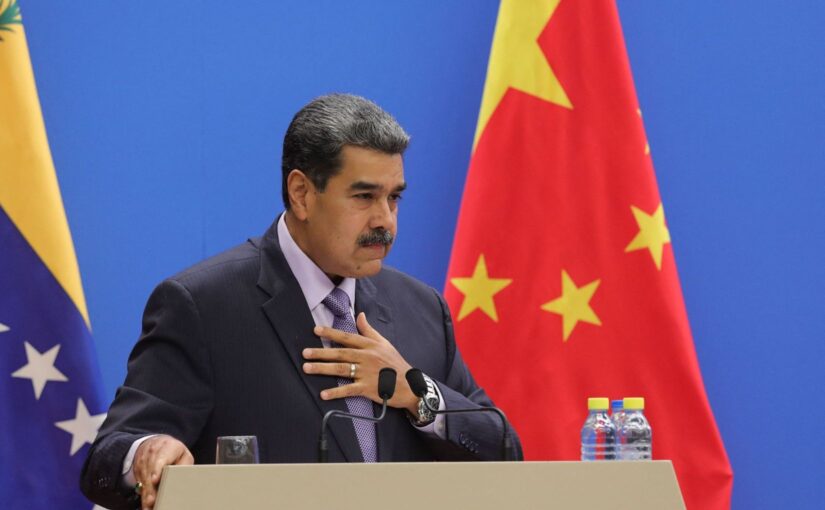
China has immediately responded to the latest US aggression against Venezuela and its brigandish and gangster-like kidnapping, in blatant violation of international law, of the country’s President Nicolás Maduro and his wife Cilia Adela Flores de Maduro.
On Saturday January 3, in a statement issued prior to confirmation of President Maduro’s arrival in New York, a foreign ministry spokesperson said that China is deeply shocked by and strongly condemns the US’s blatant use of force against a sovereign state and action against its president, adding:
“Such hegemonic acts of the US seriously violate international law and Venezuela’s sovereignty and threaten peace and security in Latin America and the Caribbean region.”
The next day, in a further statement, the Foreign Ministry said that China called on the United States to immediaetely release Venezuelan President Nicolás Maduro and his wife.
“China calls on the United States to ensure the personal safety of Maduro and his wife, release them at once, stop toppling the government of Venezuela, and resolve issues through dialogue and negotiation.”
Also, on Sunday January 4, the issue was directly addressed by Foreign Minister Wang Yi.
When holding the Seventh Round of China-Pakistan Foreign Ministers’ Strategic Dialogue with Pakistani Deputy Prime Minister and Foreign Minister Mohammad Ishaq Dar in Beijing, Wang Yi said that China always opposes the use or threat of force, as well as any imposition of one country’s will on another.
“We never believe that any country can play the role of world policeman, nor do we agree that any country can claim itself to be an international judge,” Wang said, adding that the sovereignty and security of all countries should be fully protected by international law.
China is willing to work with the international community, including Pakistan, to firmly uphold the United Nations Charter, maintain the bottom line of international morality, adhere to the equality of all countries’ sovereignty, and jointly safeguard world peace and development and promote the building of a community with a shared future for humanity.
On China-Pakistan relations, Wang said China hopes this visit will kick off the commemoration of the 75th anniversary of diplomatic relations between the two countries.
Both sides agreed to unite the Global South to safeguard common interests, uphold the UN Charter, and oppose bullying acts that violate the sovereignty of other countries.
On January 3, the Xinhua News Agency issued a commentary entitled, ‘Venezuela strike shows who is really undermining the International law’. It said:
“The US military incursion into Venezuela and the action against its President, Nicolás Maduro, as announced by the US administration, once again lays bare Washington’s reliance on unilateral force to shape outcomes beyond its borders. This aggression also hollows out decades of US rhetoric positioning America as the guardian of international rules.
“Article 2(4) of the United Nations Charter, a foundational principle of international law, explicitly prohibits the use or threat of force against the sovereignty and territorial integrity of states. Therefore, the action against a sovereign nation’s leader has shown the world, unequivocally, who stands as the true transgressor of international law.
“History offers ample precedent. From Iraq and Libya to Panama and Grenada, the United States has repeatedly used or threatened force under dubious justifications… Venezuela, long subjected to sanctions and political pressure, now joins that list, with diplomacy once again sidelined in favor of military coercion.”
It concluded: “For the rest of the world, speaking out unequivocally in defence of sovereignty and multilateralism is no longer optional. It is essential to preventing a return to a world where power, not law, decides the fate of nations.”
It should also be noted that Maduro’s kidnapping came just hours after he had met with a Chinese government delegation led by Qiu Xiaoqi, Special Representative of the Chinese Government on Latin American Affairs. President Maduro had posted on his Telegram channel:
“I had a pleasant meeting with Qiu Xiaoqi, Special Envoy of President Xi Jinping. We reaffirmed our commitment to the strategic relationship that is progressing and strengthening in various areas for building a multipolar world of development and peace.”
The United Nations Security Council is to meet on Monday January 5 to discuss the situation, at the request of Colombia, supported by China and Russia.
Venezuela’s UN Ambassador Samuel Moncada, on January 3, wrote to the Security Council stating that:
“This is a colonial war aimed at destroying our republican form of government, freely chosen by our people, and at imposing a puppet government that allows the plundering of our natural resources, including the world’s largest oil reserves.”
The following articles were originally published by the Xinhua News Agency.
China strongly condemns U.S. use of force against Venezuela
BEIJING, Jan. 3 (Xinhua) — China is deeply shocked by and strongly condemns the U.S.’s blatant use of force against a sovereign state and action against its president, a Chinese foreign ministry spokesperson said here Saturday.
It’s reported that the U.S. launched military strikes on Venezuela and Donald Trump posted on Truth Social that the U.S. has “successfully” carried out a large-scale strike against Venezuela and its leader, President Nicolas Maduro, along with his wife, have been taken and “flown out of the country.”
Such hegemonic acts of the U.S. seriously violate international law and Venezuela’s sovereignty, and threaten peace and security in Latin America and the Caribbean region, the spokesperson said, adding that China firmly opposes it.
“We call on the U.S. to abide by international law and the purposes and principles of the UN Charter, and stop violating other countries’ sovereignty and security,” said the spokesperson.
China calls on U.S. to release Venezuelan President Nicolás Maduro and his wife at once
BEIJING, Jan. 4 (Xinhua) — China called on the United States to release Venezuelan President Nicolás Maduro and his wife at once, said a Chinese foreign ministry spokesperson on Sunday.
The spokesperson made the remarks in response to media reports that on Saturday, the United States sent forces to seize Maduro and his wife and took them out of the country, and that the governments of multiple countries have voiced opposition.
China expresses grave concern over the U.S. forcibly seizing Maduro and his wife and taking them out of the country, said the spokesperson, adding that the U.S. move is in clear violation of international law, basic norms in international relations, and the purposes and principles of the UN Charter.
China calls on the United States to ensure the personal safety of Maduro and his wife, release them at once, stop toppling the government of Venezuela, and resolve issues through dialogue and negotiation, said the spokesperson.
Chinese FM on Venezuela situation: China always opposes imposing one country’s will on another
BEIJING, Jan. 4 (Xinhua) — China always opposes the use or threat of force, as well as any imposition of one country’s will on another, Chinese Foreign Minister Wang Yi said on Sunday when speaking of the situation in Venezuela.
Wang, also a member of the Political Bureau of the Communist Party of China (CPC) Central Committee, made the remarks when holding the Seventh Round of China-Pakistan Foreign Ministers’ Strategic Dialogue with Pakistani Deputy Prime Minister and Foreign Minister Mohammad Ishaq Dar in Beijing.
Wang said the current international situation is more volatile and intertwined, with unilateral bullying becoming increasingly severe.
The sudden change of situation in Venezuela has drawn high attention from the international community, Wang said.
“We never believe that any country can play the role of world policeman, nor do we agree that any country can claim itself to be an international judge,” Wang said, adding that the sovereignty and security of all countries should be fully protected by international law.
China is willing to work with the international community, including Pakistan, to firmly uphold the United Nations Charter, maintain the bottom line of international morality, adhere to the equality of all countries’ sovereignty, and jointly safeguard world peace and development and promote the building of a community with a shared future for humanity, Wang said.
On China-Pakistan relations, Wang said China hopes this visit will kick off the commemoration of the 75th anniversary of diplomatic relations between the two countries.
Noting that China-Pakistan all-weather strategic cooperative partnership has become a crucial stabilizing factor in the regional and even global landscape, Wang said China is willing to work with Pakistan to implement the consensus reached between the leaders of the two countries in the new year, and advance the building of a China-Pakistan community with a shared future.
Dar has conveyed cordial greetings from the leaders of Pakistan to the Chinese leaders, and extended congratulations on the CPC’s adoption of the recommendations for formulating the 15th Five-Year Plan.
Dar said Pakistan is willing to work with China to carry forward the traditional friendship, enhance strategic alignment of their development plans, deepen practical cooperation, and advance the continuous growth of the Pakistan-China all-weather strategic cooperative partnership.
Pakistan reaffirms its adherence to the one-China principle and will continue to firmly support China on all issues concerning its core interests, added Dar.
Both sides agreed to unite the Global South to safeguard common interests, uphold the UN Charter, and oppose bullying acts that violate the sovereignty of other countries.
Venezuela strike shows who is really undermining the International law
BEIJING, Jan. 3 (Xinhua) — The U.S. military incursion into Venezuela and the action against its President, Nicolas Maduro, as announced by the U.S. administration, once again lays bare Washington’s reliance on unilateral force to shape outcomes beyond its borders.
This aggression also hollows out decades of U.S. rhetoric positioning America as the guardian of international rules. By bypassing the United Nations Security Council, Washington has again acted in direct opposition to the tenets of international law.
Article 2(4) of the United Nations Charter, a foundational principle of international law, explicitly prohibits the use or threat of force against the sovereignty and territorial integrity of states. Therefore, the action against a sovereign nation’s leader has shown the world, unequivocally, who stands as the true transgressor of international law.
History offers ample precedent. From Iraq and Libya to Panama and Grenada, the United States has repeatedly used or threatened force under dubious justifications, often leaving prolonged instability in its wake. Venezuela, long subjected to sanctions and political pressure, now joins that list, with diplomacy once again sidelined in favor of military coercion.
That this aggression unfolded in Latin America makes it especially damning. The region has endured a long history of U.S. intervention, and the logic behind it has never truly disappeared.
As CNN noted in an analysis, “Deep in the heart of this action lies Washington’s wider ambitions for greater control of its near-abroad, for what they have termed an updated Monroe Doctrine.”
The doctrine may no longer be openly proclaimed, but its essence remains intact: the Western Hemisphere is still treated as Washington’s exclusive sphere of influence.
By its own repeated actions, Washington has emerged as one of the most serious threats to the very international order it claims to defend.
For the rest of the world, speaking out unequivocally in defense of sovereignty and multilateralism is no longer optional. It is essential to preventing a return to a world where power, not law, decides the fate of nations.





