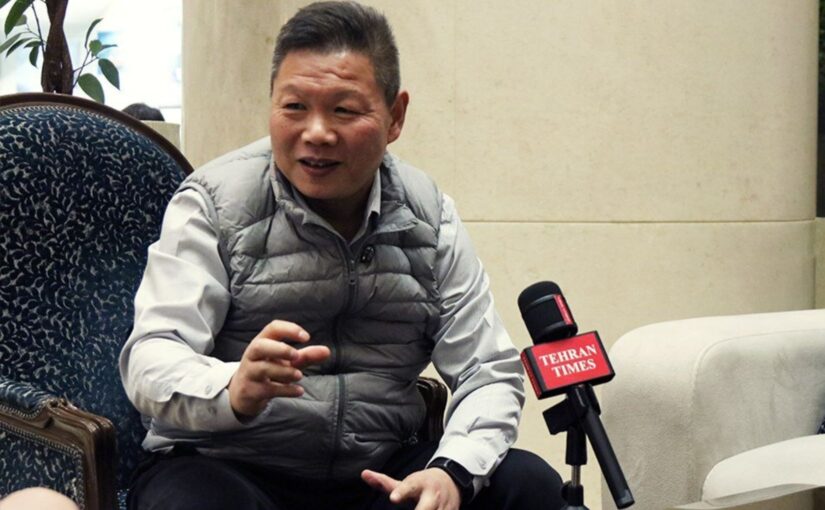
The following is the text of an interview conducted by the Tehran Times with Chinese scholar Professor Jin Liangxiang on the sidelines of the recent Conference on People’s Rights and Legitimate Freedoms in the Thoughts of Ayatollah Khamenei.
Professor Jin notes that: “The Americans like to talk about liberal democracy and, when doing so, they link it to human rights. They even intervene in the domestic affairs of countries in the Middle East – such as Iran and many others – in the name of humanitarian concerns.
“But in Gaza and Palestine, we have witnessed atrocities committed by Israel, resulting in more than 70,000 deaths. In this regard, the Americans have turned a blind eye. So, I believe the United States is not in a position to lecture others about liberal democracy or to intervene under the banner of humanitarianism.”
Responding to a question on different perceptions of people’s rights and freedoms, he stresses that resistance is the only way out:
“When we talk about freedom, we must begin with justice. The most serious challenge to justice in the region is hegemony and power politics. Therefore, resistance becomes the only viable approach to achieving justice.
“We should not assume that hegemonic powers will make concessions on their own. Those policies will not disappear by themselves. The only way to deliver justice is through resistance. Even though the Middle East has experienced some changes in recent years, as long as oppression exists, resistance will continue.”
However: “The evolution of the international order will be a long process. People across the region – not only Iranians – do not accept hegemony. But weakening hegemonic structures and transforming the global order will take time… So, patience is required. BRICS is developing strong momentum and is expanding with new members. It will need time for internal integration, improving mechanisms, and organising resources. But it will become an important mechanism in shaping the future international order, playing a growing role not only financially but also politically and in the security arena.”
Jin is a senior research fellow at the Shanghai Institute for International Studies (SIIS) as well as a nonresident senior fellow at the Middle East Council on Global Affairs, based in Doha, Qatar.
The following article was originally published by Tehran Times. A video of the interview may be viewed here.
How do you assess China’s role in shaping global norms on human rights, especially in non-Western contexts?
I think there are different kinds of narratives and efforts to shape international norms. The Americans like to talk about liberal democracy and, when doing so, they link it to human rights. They even intervene in the domestic affairs of countries in the Middle East—such as Iran and many others—in the name of humanitarian concerns.
But in Gaza and Palestine, we have witnessed atrocities committed by Israel, resulting in more than 70,000 deaths. In this regard, the Americans have turned a blind eye. So, I believe the United States is not in a position to lecture others about liberal democracy or to intervene under the banner of humanitarianism. In fact, what we are seeing is the collapse of the so-called liberal democratic model.
China’s narrative on these issues is different. When we talk about human rights, we start with the fundamental right to development. Not only China but also Iran and the broader Global South have the legitimate right to develop. Our GDP remains relatively low, and we all have the right to build our societies. We also have our own ways of protecting human rights while strengthening governance. Our experience, I believe, will stand the test of time.
From your perspective, what is the most urgent challenge to people’s rights and legitimate freedom in the region? How does the framework proposed at this conference offer a better response than Western human-rights models?
When we talk about freedom, we must begin with justice. The most serious challenge to justice in the region is hegemony and power politics. Therefore, resistance becomes the only viable approach to achieving justice.
We should not assume that hegemonic powers will make concessions on their own. Those policies will not disappear by themselves. The only way to deliver justice is through resistance. Even though the Middle East has experienced some changes in recent years, as long as oppression exists, resistance will continue. And it may take different forms.
With BRICS and other emerging multilateral platforms gaining influence, how do you see these organizations impacting Middle East geopolitics—especially regarding Palestinian statehood and regional negotiations?
The evolution of the international order will be a long process. People across the region—not only Iranians—do not accept hegemony. But weakening hegemonic structures and transforming the global order will take time.
At this particular moment, when people desire peace, we cannot afford a violent transition of global order. So patience is required. BRICS is developing strong momentum and is expanding with new members. It will need time for internal integration, improving mechanisms, and organizing resources. But it will become an important mechanism in shaping the future international order, playing a growing role not only financially but also politically and in the security arena.
Yet the most important thing is patience. Global changes do not happen overnight.
How have U.S. policies in West Asia shaped the current balance of power? How do you interpret Washington’s approach to Iran and its regional allies considering ongoing conflicts?
The United States has played a very negative and destructive role. Its unconditional support for Israel has enabled the atrocities committed by Israel, leading to a disastrous humanitarian crisis in Palestine. This is extremely alarming.
Regarding tensions over the Iranian nuclear program, Western countries tend to blame Iran, but this is unfair. In 2015, Iran and the P5+1 reached a very good agreement—the JCPOA. However, it was the United States that withdrew from the deal, causing the impasse and the failure of subsequent negotiations.
According to the JCPOA and various IAEA reports, Iran fully implemented its commitments shortly after the agreement was reached. But the United States never removed the sanctions. This is the fundamental reason behind the deadlock. If any progress is to be made in the future, the United States must demonstrate sincerity and seriousness by removing the sanctions. Otherwise, no real improvement can be achieved.