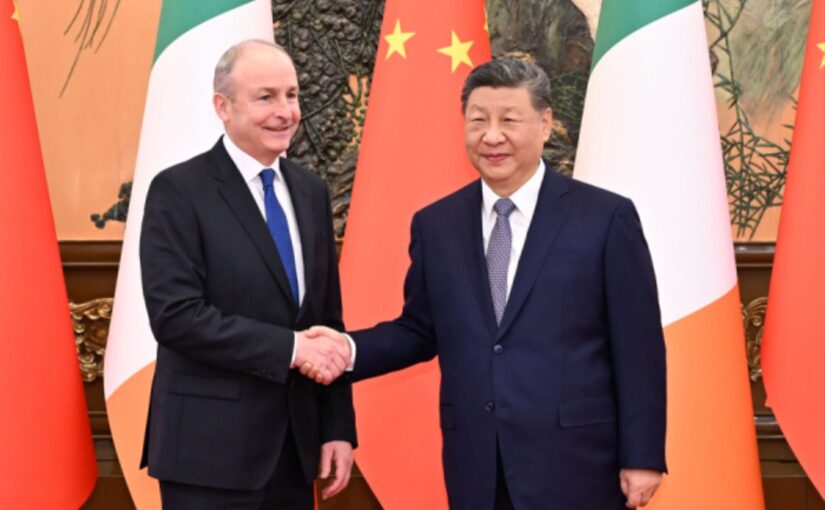
Chinese President Xi Jinping has taken the opportunity of his first meeting with a foreign visitor in 2026 to denounce unilateral and bullying acts in international relations – a clear reference not least to the piratical action of the United States in brutally kidnapping, maltreating and attempting to humiliate Venezuelan President Nicolás Maduro and his wife.
Xi was meeting on the morning of January 5 with Irish Taoiseach (Prime Minister) Micheál Martin, who began an official visit to China the previous day. It is the first visit to China by an Irish head of government in 14 years and will last until January 8.
At the start of his opening remarks, Xi Jinping made a significant statement, noting that both China and Ireland are peace-loving, open, inclusive, self-reliant and enterprising. The two countries achieved independence and national liberation through the struggle of the people and have advanced toward modernisation with the hard work of one generation after another.
He added that mutual respect, equality and mutual benefit are valuable experience gathered from long-term steady development of China-Ireland relations. He said the two sides should jointly pass them down and carry them forward and underlined the need for China and Ireland to maintain friendly exchanges at multiple levels and in different fields, continuously enhance communication and understanding, accommodate each other’s core interests and major concerns, cement political mutual trust, and consolidate the political foundation of bilateral relations. China stands ready to work with Ireland to step up economic and trade cooperation, seek synergy of development strategies in such areas as artificial intelligence, the digital economy, and pharmaceuticals and health, and encourage two-way investment, so as to draw on each other’s strengths, share opportunities, and pursue common development. The two sides need to strengthen cooperation in education, culture and tourism, and foster closer people-to-people bonds. China welcomes more Irish youth to come to China for study and exchanges.
President Xi then pointed out that the world today is undergoing changes and turbulence. Unilateral and bullying acts are dealing a serious blow to the international order. All countries should respect other countries’ development paths chosen independently by their people and observe international law and the purposes and principles of the UN Charter. Major countries, in particular, should lead by example. Both China and Ireland support multilateralism and advocate international fairness and justice. The two sides should strengthen coordination and cooperation in international affairs, jointly uphold the authority of the UN, and work for a more just and equitable global governance system.
Taoiseach Martin noted that Ireland and China enjoy a deep and long-standing friendship, and that economic and trade cooperation and people-to-people exchanges between the two countries have strengthened enormously. President Xi Jinping paid a successful visit to Ireland in 2012 [as Vice President], laying a solid foundation for the growth of the Ireland-China strategic partnership for mutually beneficial cooperation in recent years. It is admirable that China has effectively formulated and implemented long-term national development strategies and produced major achievements. Ireland unequivocally subscribes to the one-China policy and is committed to strengthening and growing the strategic partnership for mutually beneficial cooperation between the two countries. Ireland stands ready to deepen cooperation with China in such areas as trade, investment, science and technology, biomedicine, renewable energy, artificial intelligence and education. China plays an indispensable role in international affairs and has made positive contributions to upholding the authority of the UN and promoting world peace.
The Irish Times reported Martin as saying after his meeting with the Chinese leader that: “In our discussions this morning, President Xi was very clear on the importance of the UN and the need to reform the UN, the need for the UN to reclaim authority on the global stage. And that’s something that Ireland ascribes to very, very strongly.”
Following his talks with Xi, Martin visited the Forbidden City, where he wrote in the visitors’ book: “It is a fascinating place encompassing an extraordinary period of your nation’s history. I pay tribute to the great work and success in conserving and preserving such historically important buildings and artefacts. It has been a most stimulating and fascinating visit which will inspire further study.”
The Forbidden City was home to China’s emperors for some 500 years.
Denis Staunton, Beijing correspondent for the Irish Times, further reported that, in their meeting Xi Jinping had told Micheál Martin that an Irish novel had helped sustain him when he was going through difficult years as a teenager, when he was ‘sent down’ to live and work in a poor rural area for seven years.
The Taoiseach told Xi that he had read the same book, The Gadfly by Ethel Voynich, in his youth and it had also made a profound impression on him. “Coincidentally, I had read it as a late teenager as well, and had a first edition copy presented to me by an uncle of mine,” Martin said.
“It was unusual that we ended up discussing The Gadfly and its impact on both of us, but there you are.”
Staunton added: “Set in Italy during the revolutionary ferment of the 1830s and 1840s, the novel was a huge success after its publication in 1897. It struck a chord with Irish nationalists and later with communists in both the Soviet Union and China because of its evocation of a revolutionary culture and camaraderie.
“The Gadfly has a Cork connection because Voynich was the daughter of the mathematician George Boole, who taught at Queen’s College Cork, which later became University College Cork.”
A July 30, 2010, article in the Irish Times by Maggie Armstrong, marking the 50th anniversary of Voynich’s death at the age of 96, explained:
“She was born in 1864 at Ballintemple, Cork, to brilliant parents. Her father was the mathematician George Boole, the inventor of Boolean logic, which underpins computer language. Her mother Mary Everest was a psychologist and mathematician, and niece of George Everest, after whom the largest peak in the world is named.
“At 18 she studied music in Berlin and moved to London. There, she moved in circles with [Friedrich] Engels, Eleanor Marx, [George Bernard] Shaw, [Oscar] Wilde and [William Butler {WB}] Yeats. She became a Marxist, Russophile, translator, musician and social worker. In 1891 she married Polish revolutionary Wilfred Voynich, but clung to her independence, travelling to Russia and on an intrepid journey to the Ukraine to disseminate contraband books.
“Through this jagged lifestyle she garnered material for her magnum opus.. She had no idea of the scale of appeal the novel was to generate, but it became the stuff of blockbusters. Set in the 1840s in Austria-dominated Italy, it champions revolutionary idealism, revolt and martyrdom. It tells the story of the Gadfly, a swashbuckling rogue and enfant terrible of left-wing journalism in Florence – lame, scarred and disfigured from a life of battery and self-sacrifice.
“Like its eponymous hero, The Gadfly grew wings across continents. It was translated into 20 languages and adapted into an opera in 1928, a film in 1955 (with a score by [Dmitri] Shostakovich), and theatre (unofficially) by Shaw.”
After referring to the novel’s popularity in the Soviet Union and China, Armstrong writes:
“Marxist republican Peadar O’Donnell mentions it in his cabalistic accounts of the ‘C’ wing of Mountjoy Prison. He discusses the solace it afforded his comrade prisoners during the ‘cigarette famine’ in Mountjoy. The book was bedtime reading for IRA man Joe McKelvey, who placed it beside him for the last time on the night before his execution on December 8th, 1922.”
The following article was originally published on the website of the Chinese Foreign Ministry.
President Xi Jinping Meets with Taoiseach of Ireland Micheál Martin
On the morning of January 5, 2026, President Xi Jinping met at the Great Hall of the People in Beijing with Taoiseach of Ireland Micheál Martin, who is on an official visit to China.
President Xi Jinping noted that both China and Ireland are peace-loving, open, inclusive, self-reliant and enterprising. The two countries achieved independence and national liberation through the struggle of the people, and have advanced toward modernization with the hard work of one generation after another. Since establishing the strategic partnership for mutually beneficial cooperation in 2012, the two countries have seen bilateral trade quadruple, two-way investment grow in a balanced manner, and mutual goodwill between the two peoples as they work to make their countries better. Mutual respect, equality and mutual benefit are valuable experience gathered from long-term steady development of China-Ireland relations. The two sides should jointly pass them down and carry them forward. China is ready to work with Ireland to strengthen strategic communication, deepen political mutual trust and expand practical cooperation, to deliver more benefits to the two peoples and provide more impetus for China-Europe relations.
President Xi Jinping underlined the need for China and Ireland to maintain friendly exchanges at multiple levels and in different fields, continuously enhance communication and understanding, accommodate each other’s core interests and major concerns, cement political mutual trust, and consolidate the political foundation of bilateral relations. This year marks the beginning of China’s 15th Five-Year Plan period. Over the next five years, China will continue to promote high-quality development and expand high-standard opening-up. China stands ready to work with Ireland to step up economic and trade cooperation, seek synergy of development strategies in such areas as artificial intelligence, the digital economy, and pharmaceuticals and health, and encourage two-way investment, so as to draw on each other’s strengths, share opportunities, and pursue common development. The two sides need to strengthen cooperation in education, culture and tourism, and foster closer people-to-people bonds. China welcomes more Irish youth to come to China for study and exchanges.
President Xi Jinping pointed out that the world today is undergoing changes and turbulence. Unilateral and bullying acts are dealing a serious blow to the international order. All countries should respect other countries’ development paths chosen independently by their people, and observe international law and the purposes and principles of the U.N. Charter. Major countries, in particular, should lead by example. Both China and Ireland support multilateralism and advocate international fairness and justice. The two sides should strengthen coordination and cooperation in international affairs, jointly uphold the authority of the U.N., and work for a more just and equitable global governance system. China and the EU should keep a long-term perspective, stay committed to working together as partners, view and handle differences in an objective and rational way, and pursue mutually beneficial cooperation. Ireland will hold the rotating EU presidency in the second half of the year. It is hoped that Ireland will play a constructive role for the sound and steady growth of China-EU relations.
Taoiseach Martin noted that Ireland and China enjoy a deep and long-standing friendship, and that economic and trade cooperation and people-to-people exchanges between the two countries have strengthened enormously. President Xi Jinping paid a successful visit to Ireland in 2012, laying a solid foundation for the growth of the Ireland-China strategic partnership for mutually beneficial cooperation in recent years. It is admirable that China has effectively formulated and implemented long-term national development strategies and produced major achievements. Ireland unequivocally subscribes to the one-China policy and is committed to strengthening and growing the strategic partnership for mutually beneficial cooperation between the two countries. Ireland stands ready to deepen cooperation with China in such areas as trade, investment, science and technology, biomedicine, renewable energy, artificial intelligence and education. China plays an indispensable role in international affairs, and has made positive contributions to upholding the authority of the U.N. and promoting world peace. All international disputes should be settled in accordance with international law. Ireland would like to maintain close communication and coordination with China to safeguard international law, uphold free and open trade, and promote world prosperity and stability. It is important for EU-China relations to maintain steady growth. Ireland is ready to play a constructive role for the sound development of EU-China relations.
Wang Yi was present at the meeting.