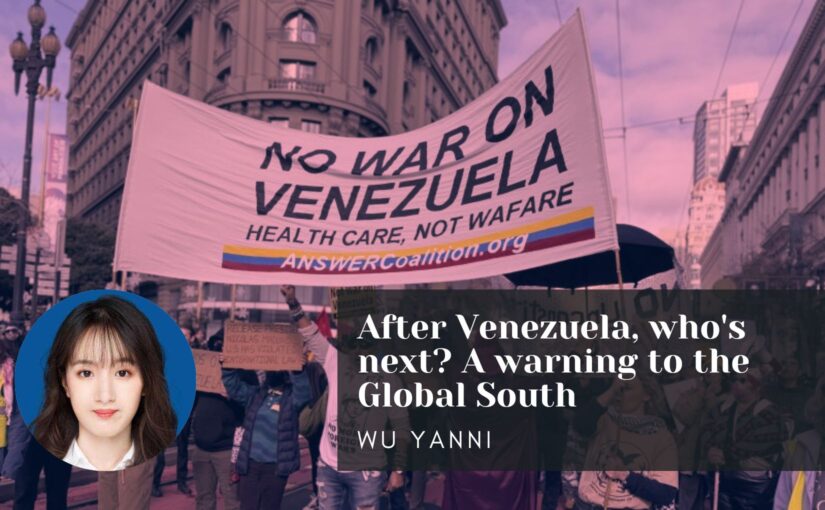
We are pleased to publish below an original article by Wu Yanni, a Beijing-based political commentator and contributor to Chinese and international media, which draws attention to the destabilising consequences of unchecked US power in international affairs. Drawing on Kofi Annan’s observation that the world resembles an interconnected community, Wu Yanni argues that when a single hegemonic actor behaves as a bully without meaningful constraint, global norms erode and instability spreads, creating a dangerous “broken windows effect” in global politics.
The article centres on the Trump administration’s kidnapping of Venezuelan president Nicolás Maduro not as an isolated event, but as a warning to the Global South. It recounts accusations made at the UN General Assembly last year by Venezuelan Foreign Minister Yván Gil, who charged Washington with resource plunder, orchestrating regime change, assassination attempts, mercenary incursions, and economic warfare expressed through over 1,000 unilateral sanctions targeting Venezuela’s oil industry and productive sectors. The author emphasises that Venezuela foresaw these threats, yet its appeals were largely ignored, demonstrating a global asymmetry where moral condemnation has failed to translate into real limits on US conduct.
To underline that this is a structural, not episodic, problem, the article revisits historical US interventions – including the 1989 invasion and seizure of Panama’s president, the 1973 coup in Chile, and the 1954 CIA-backed overthrow in Guatemala – portraying a consistent pattern of military force, subversion, espionage and sanctions.
The author concludes that solidarity without power is insufficient. The Global South must transform shared principles into durable institutions, pursue substantive UN reform to give international law binding force, and strengthen regional and cross-regional alliances, financial systems and energy cooperation to resist unilateral coercion. The crisis, she insists, will define the next era of geopolitics: if the power gap remains unfilled, “international order” will become an empty phrase.
As ex-UN Secretary-General Kofi Annan observed, the world is like a global village. However, if a single “village bully” is able to operate with impunity for years and the village council in question–the United Nations–is not working as it should, there will be concerns. Such multiple violations of norms and rules have the potential to set off a “broken windows effect,” encouraging other world powers to follow suit and ultimately throwing the international order into disarray. This is not just a Venezuela crisis; this is a warning for countries in the Global South. If today it’s Venezuela, what will tomorrow be?
A Cry That Was Unheard
The year 2025 marks the 80th anniversary of the founding of the United Nations. Last September, in the UN General Assembly’s general debate, the United States was accused by Venezuelan Foreign Minister Yván Gil of trying to plunder Venezuela’s natural resources and engineer regime change. Actions of aggression against Venezuela in recent years, he pointed out, have been widespread: clandestine subversion and conspiracy operations, including assassination attempts involving drones; economic warfare, most brutally expressed in 1,042 coercive sanctions against Venezuela’s oil industry and productive sectors; and many incursions by mercenaries.
In that context, Venezuela wasn’t ill-prepared for what now has befallen President Nicolás Maduro. On the contrary, risks such as this had been anticipated for a long time. But Venezuela’s repeated warnings did not attract the attention of much of the international community.
Many countries of the Global South hope to see a world free from hegemonism and militaristic empires. Nevertheless, we must recognize that their own voice has not reached the global stage yet–so much so that a leader of a sovereign state could be openly seized, as the United States has done. Washington has been widely condemned since the incident. Yet what has proved a problem is that such criticism has fallen short in placing meaningful restrictions on U.S. conduct.
Unity Without Power
History provides ample precedents of U.S. actions involving the violent intervention, incarceration or ousting of foreign leaders. In 1989, U.S. forces invaded Panama and arrested President Manuel Noriega, before he was brought over to the United States for trial. In 1973 Washington stepped strongly into Chile’s internal politics, where it helped drive the coup that brought down and killed the democratically elected President Salvador Allende. The CIA staged a coup in Guatemala in 1954 that forced President Jacobo Árbenz to resign. By direct military action and by means of espionage, subversion, sanctions or economic coercion, the interference of others’ sovereignty and reconfiguration of political fortunes have figured prominently in Washington’s foreign policy playbook.
Cuba, Colombia, Brazil and Mexico and countless other Latin American states, as well as members of the expanded BRICS and the larger Global South, are far from unaware of Washington’s motives for pushing back against Maduro: to assert more US influence in Latin America and to ensure access to critical oil resources. In recent years, the growth of multilateral projects like BRICS and the Community of Latin American and Caribbean States (CELAC) has showcased the work of Latin American governments to de-dollarize and achieve more strategic independence. But this nascent unity has not yet crystallized as a force to meaningfully balance US power in the Western Hemisphere.
The Step Forward: Fix the Power Vacuum, Not Just Wait for Charity
The problem is not whether the United States will engage in such behavior again in the future, but whether the world will adjust to it. Moral condemnation cannot replace the power vacuum at the United Nations, nor can it be corrected merely by putting faith in the self-restraint of hegemonic powers.
For the Global South, the way forward is to develop shared principles into institutional durability, to upgrade emotions of solidarity into concrete, cooperative tools that can act against unilateral coercion. This means that substantive reform of multilateral institutions is necessary to give international law and UN architecture real binding force, rather than effectively being mere decorative symbols that collapse under great-power pressure.
Second, countries in the Global South must reinforce relationships of finance, energy, settlement mechanisms, and narrative-building so as to make them less susceptible to being weaponized and subjected to sanctions by a single hegemon.
Thirdly, when confronting glaring breaches of international law, states are compelled to transcend piecemeal solutions and make use of regional and cross-regional alliances to craft a coherent, long-lasting, repeatable response.
History proves time and again that rules do not enforce themselves and that order doesn’t auto-rebuild. This hegemonic behavior will only get replicated if the power vacuum remains. Venezuela is not an exception or aberration. The real danger is that, if left unattended, the so-called “international order” will itself turn into just an empty phrase. This is a crisis and a defining question of our time for the Global South– one that cannot be postponed another two decades.