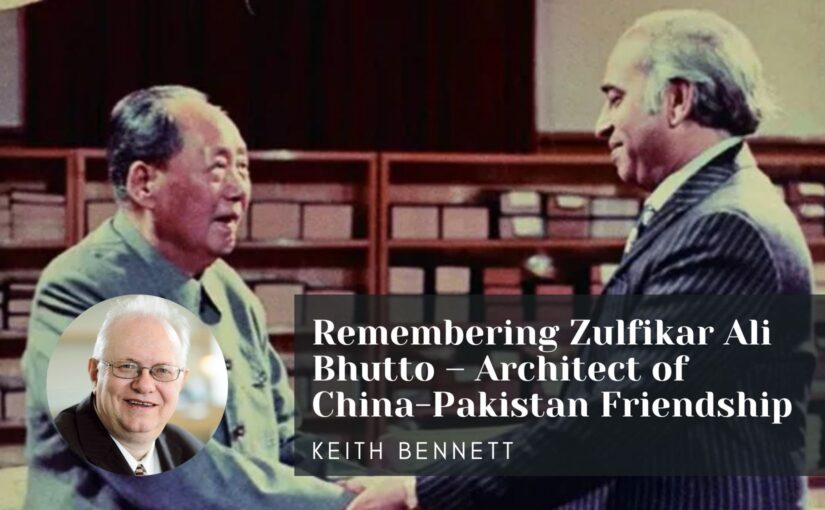
Third World Solidarity organised a meeting on Monday January 5, 2026, marking the 98th birth anniversary of the late Pakistani leader Zulfikar Ali Bhutto, who made an outstanding contribution to the friendship between his country and China.
The meeting, held in the Baseline Studios, home to a number of community organisations and projects in west London, was attended by many prominent members of the Pakistani community, and others who have been friends with members of the Bhutto family.
Chairing the meeting, Mushtaq Lasharie, Chair of Third World Solidarity, the British Pakistani Mayors Association and Lancaster West Residents Association, drew attention to the price that has often been paid by leaders of the Global South who stand for independence and popular democracy, from the martyrdom of Zulfikar Ali Bhutto and his daughter Benazir Bhutto, to today’s illegal kidnapping of Venezuelan President Maduro and his wife. This was also one of the themes that was returned to in the discussion period following the main speeches, in which Keith Bennett explained how the hand of US imperialism was present in all these cases, whether overtly or covertly.
The first speaker was London-based Pakistani journalist Javed Soomro, whose family has long had a close relationship with the Bhuttos. He explained that before Z.A. Bhutto founded and led the Pakistan People’s Party (PPP), politics in the country had been confined to the feudal class and the boardrooms of the industrialists. The people were irrelevant. Bhutto was “the first to bring the voices of the masses and ordinary people” to the political arena. The basic slogan of the PPP was for clothes, food and shelter. [Note: In its simplicity and profundity this has echoes of the Bolshevik call for bread, peace and land.]
In 1974, he organised a major conference aimed at uniting the Muslim countries. This effort was key to the animosity that the United States came to harbour for Bhutto. [This has clear parallels with the way that the efforts of the late Hugo Chávez and President Maduro to unite the countries of Latin America and the Caribbean has intensified the hatred of the United States for the Bolivarian revolution in Venezuela.]
Javed was followed by Keith Bennett, co-editor of Friends of Socialist China, who spoke on the great contributions of Z.A. Bhutto, as well as his daughter Benazir Bhutto and grandson Bilawal Bhutto Zardari, to Pakistan’s friendship with both the People’s Republic of China and the Democratic People’s Republic of Korea (DPRK).
The full text of Keith’s speech is reproduced below.
The final speaker was Victoria Schofield, author of ‘Bhutto: Trial and Execution’ (1979) and ‘The Fragrance of Tears: My Friendship with Benazir Bhutto’ (2020).
Victoria forged a close friendship with Benazir Bhutto when they were fellow students at Oxford University. With Benazir’s encouragement she succeeded her as President of the Oxford Union. She travelled to Pakistan in 1978, when Z.A. Bhutto was on trial and subsequently hanged, at Benazir’s invitation. She was one of the last people to see Bhutto alive and recalled how Benazir was not even allowed to hug her father on their last meeting, just a couple of days before he was executed.
She further recalled Bhutto’s vision for his country, as outlined to the Spectator:
“My vision is that of a Pakistan whose social standards are comparable to some parts of Europe. This means a war against illiteracy and ignorance. It means fighting prejudice and obscurantism. It involves the equality of men and women. It demands the mobilisation of the people’s selected energies. It dictates the restoration of dignity to the human person… It requires a check on the growth of population and easy access to education and medical care throughout the country. It contemplates better towns and cities and cleaner villages. It raises 100 challenges. It is a long haul. We have braced ourselves for it.”
Following a lively Q&A, closing remarks were delivered by Mian Saleem, President of PPP Greater London.
The formal proceedings were followed by two songs from Hugh Goodacre on guitar and dinner.
The following is the full text of Keith’s speech.
I would like to thank Mushtaq Lasharie and Third World Solidarity for organising this meaningful gathering on the auspicious day marking the 98th birth anniversary of Zulfikar Ali Bhutto
As requested, I’m going to focus my own remarks on the unique contributions made by Z.A. Bhutto, and succeeding generations of the Bhutto family, to the special, all-weather friendship and iron brotherhood between Pakistan and the People’s Republic of China as well as to the close friendship between Pakistan and the Democratic People’s Republic of Korea (DPRK).
These friendships have a number of sources.
First, I’d like to emphasise the importance of the founding of the Pakistan People’s Party (PPP) on November 30, 1967. It was as leader of the PPP that Butto assumed the leadership of his country, first as President and subsequently as Prime Minister, during which time he took Sino-Pakistan friendship to new heights.
The founding of the PPP occurred in a particular regional and international context – with China widely seen as a bastion of socialism and anti-imperialist internationalism and amidst a growing worldwide opposition to the US war of aggression against Vietnam and growing support for the Vietnamese people’s war of resistance and for national salvation.
It was in this context that the manifesto of the PPP declared that: “Islam is our Religion; Democracy is our Politics; Socialism is our Economy; Power Lies with the People.”
It further stated that: “Only socialism, which creates equal opportunities for all, protects [people] from exploitation, removes the barriers of class distinction, and is capable of establishing economic and social justice. Socialism is the highest expression of democracy and its logical fulfillment.”
With its foregrounding of Islam, this may be said, to adapt a later political term, to embody a type of ‘socialism with Pakistani characteristics’, in this case distinct from Marxism, although many communists and Marxists, including J.A. Rahim, Meraj Muhammad and Sheikh Rashid, were instrumental in helping to found the party and in drafting its key documents, with many others also joining at various times.
This was not a unique phenomenon in the Asia of that time. For example, in Cambodia, Prince Sihanouk espoused Buddhist socialism and in Rangoon (Yangon), the country’s government spoke of a ‘Burmese way to socialism’. I do not seek to pass any judgement here as to the authenticity or otherwise of such claims, but note the following observation made by DPRK leader Kim Il Sung in 1977 that:
“The countries of the third world and most of the newly independent nations are now declaring their intention to advance along the road to socialism. True, the socialism advocated by each of them may be different – whether scientific socialism or unscientific socialism. Some people are even claiming now that their socialism is a religious socialism. But whatever kind of socialism they may claim to be adopting they all recognise that socialism is good.”
This was a key political context in which Pakistan’s relations with both China and the DPRK blossomed and flourished in the period of Bhutto’s leadership.
For example, on his 1973 visit to China, Bhutto secured an aid package worth US$ 300 million along with the writing off of previous loans amounting to over US$ 110 million. As one might say, these were indeed large sums in 1973, not least when one considers that China itself was still a very poor country at that time.
Of course, China-Pakistan friendship did not begin with the PPP. Diplomatic relations were established in May 1951, less than two years after the founding of the People’s Republic, making this year the 75th anniversary, and a Treaty of Friendship was concluded in 1956.
But Bhutto’s own contribution also predated the founding of the PPP. As Foreign Minister, in 1963, he visited China and concluded the Sino-Pakistan Boundary Agreement. It was also on that visit that he forged a profound friendship with Chairman Mao Zedong, that was to last until the latter’s death in 1976.
Indeed, on May 27, 1976, Chairman Mao met with Bhutto for the last time. Coming just a little more than three months before his death, it was both the Chinese leader’s last ever meeting with a foreign visitor and moreover his last public appearance.
A Chinese article, published in July 2021, to mark the 100th anniversary of the founding of the Communist Party of China, notes:
“In May 1976, Pakistani Prime Minister Zulfikar Ali Bhutto paid a visit to China. At the time, Chairman Mao in his twilight years had difficulties speaking and walking. Nonetheless, he agreed to meet the Pakistani guests at his Zhongnanhai residence on May 27, and asked Bhutto about the development of Pakistan. That was the last time Mao met with foreign guests. After Mao’s passing, his undertakings were carried forward by his successors.”
Similarly, Bhutto’s state visit to the DPRK, also in May 1976, forged not only a personal friendship with Kim Il Sung but also a lasting friendship between the two nations. Later that year, Bhutto advised US Secretary of State Henry Kissinger that Kim was “very intelligent” and “very able”.
A more human vignette that I discovered when preparing for this meeting was related by his granddaughter Fatima Bhutto in an article she wrote about exploring her grandfather’s library:
“Before a state visit to China, Bhutto wrote to his Chief of Protocol about a banquet the Pakistanis were set to host for Chinese leaders, diplomats and dignitaries: ‘This banquet should not be like the banquet we gave in Pyongyang. The Pakistani food served there was simply atrocious. The biryani was cooked very badly. It was just awful. There was one small shami kabab with many tiny danas (seeds) of illaichi (cardamom). I saw President Kim Il Sung desperately struggling to remove the illaichis. It must have reminded him of his guerrilla days in the mountains.’”
These ties of genuine friendship forged by Zulfikar Ali Bhutto have been carried forward by successive generations of his family.
As Prime Minister, Benazir Bhutto visited China several times, including her first foreign trip in office, in February 1989, and attending the Fourth UN World Conference on Women, held in Beijing in September 1995.
She also made a very significant visit to the DPRK, following another visit to China, in December 1993. At a banquet he gave in her honour, President Kim Il Sung said:
“The present situation calls on the Asian people, as the masters of Asia, to carve out Asia’s future independently. If the people of the Asian countries unite on the basis of independence and expand and develop cooperation on the principle of collective self-reliance, they will be able to build a new, independent and prosperous Asia free from domination and subjugation.”
I clearly remember from that visit the evocative pictures of Benazir receiving a warm send off at Pyongyang’s Sunan Airport in the midst of a bitterly cold, raging snowstorm. We reminisced about that on one of the occasions that I was privileged to meet her during her exile, in her Kensington flat together with our mutual friend Mushtaq.
More significantly, it has subsequently been widely reported, for example in a 2008 book by veteran Pakistani journalist Shyam Bhatia, that Benazir, “carried critical nuclear data on CDs in her overcoat to Pyongyang in 1993 and brought back North Korea’s missile information.”
An article from the UPI news agency asserted: “Although it has been mentioned previously in other books, this episode is notable, if only for the fact that Bhutto was, essentially, acting as a female James Bond… During a state banquet of chestnuts and steamed fish, the book maintains that Bhutto… requested a favour from North Korea’s founding father, Kim Il Sung. She left with a bag of computer disks to pass on to her military.”
For his part, Benazir’s son, Bilawal Bhutto Zardari, made China the destination for his first overseas trip as Foreign Minister on 21-22 May 2022. The visit coincided with the 71st anniversary of diplomatic relations between the two countries and was paid to Guangzhou, rather than to Beijing, as China was still observing quarantine restrictions in response to the COVID-19 pandemic.
Foreign Minister Wang Yi said that China welcomed the fact that Bilawal carries forward the fine tradition of friendly exchanges between China and Pakistan, and paid a visit to China, which was his first official bilateral visit after taking office as foreign minister. China and Pakistan are true friends sharing weal and woe and good brothers having a heart-to-heart affinity. The friendship between China and Pakistan, jointly nurtured by several generations of leaders of the two countries, remains strong with new vitality. History has witnessed and will continue to witness that no matter how the international landscape may evolve, China-Pakistan relations are rock-solid and unshakable.
Bilawal said, “China is the first country I visited after taking office as foreign minister. Pakistan and China enjoy time-honoured amicable relations. I am particularly proud that all three generations of my family are firmly committed to the Pakistan-China friendship.”
In an article published in The Express Tribune in June 2016, Bilalwal’s father, and current President of Pakistan, Asif Ali Zardari wrote:
“Over half a century after the establishment of diplomatic ties, China remains the greatest friend and ally Pakistan has known. With our alliance being forged during the height of the Cold War, there is one man I must credit above all others in fortifying and sustaining that relationship when it was at its most complex. He is the unsung hero of international politics and diplomacy, a man who never faltered in his devotion to democracy, equality and education. He was a man whose vision was decades ahead of its time and who serves as a towering figure of inspiration — the legendary Shaheed Zulfikar Ali Bhutto. His legacy of developing strong relations with China lived through his daughter and my late wife, Shaheed Benazir Bhutto, and continues to live through his grandson, Bilawal Bhutto Zardari.
“The late Mao Zedong and Zulfikar Ali Bhutto personified the Sino-Pakistan alliance. The two statesmen were on very friendly terms — they were always able to make time to meet each other as is evident through the fact that Zulfikar Ali Bhutto was the last statesman Mao Zedong was photographed with. Imagine the progress Zulfikar Ali Bhutto would have made for the betterment of Pakistan and its allies such as China had he not been executed by the Zia ul Haq regime. General Zia was a man who sought to undo Zulfikar Ali Bhutto’s life’s work. However, Benazir Bhutto, successfully continued her father’s legacy and secured an ever-closer union with China when she was prime minister. She conducted two prominent state visits to China, including one which celebrated Mao Zedong’s 100th birth anniversary…. we must also look back with gratitude to legendary statespersons like Zulfikar Ali Bhutto, Benazir Bhutto and Mao Zedong, which made this alliance possible.”