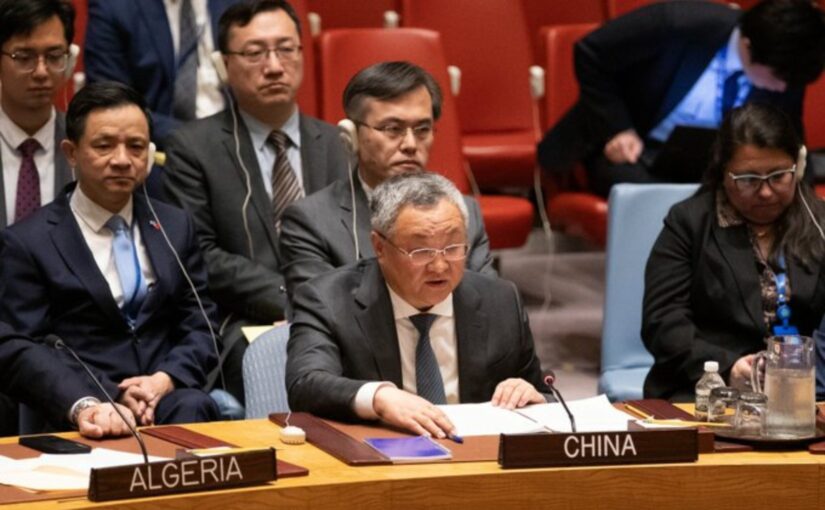
China’s Ambassador to the United Nations Fu Cong made an important statement on his country’s position at a March 13 United Nations Security Council briefing on the Iranian nuclear issue.
Fu began by stating that: “China has just stated its position about the 1737 Committee and its opposition to this meeting and does not intend to comment on the work of the Committee itself. However, as a member of the Security Council, China wishes to emphasise the following points regarding the current situation surrounding the Iranian nuclear issue and the way forward.”
The 1737 Committee was established following the adoption of United Nations Security Council Resolution 1737 on December 23, 2006, which imposed sanctions on Iran.
Having stated this principled opposition, Fu made four key points as follow:
- The use of force is not the right way to resolve international disputes. Iran’s sovereignty, security, and territorial integrity should be respected. The United States and Israel should immediately stop their military operations, refrain from attacking Iranian nuclear facilities under IAEA (International Atomic Energy Agency) safeguards, avoid further escalation, and prevent the conflict from spreading across the entire Middle East.
- The Iranian nuclear issue should ultimately return to the track of a political and diplomatic solution. It was the United States unilateral withdrawal from the JCPOA (Joint Comprehensive Plan of Action) that triggered the Iranian nuclear crisis. The United States has also disregarded its own credibility and, together with Israel, twice resorted to the use of force against Iran during the negotiations, causing diplomatic efforts to collapse. Regarding the root cause of the Iranian nuclear crisis, the United States actions violate international law and the purposes and principles of the UN Charter. China strongly condemns this. Relevant European countries should stop fuelling tensions and instead play a constructive role in easing the situation.
- Fairness and justice must be upheld, and Iran’s right to the peaceful use of nuclear energy, as a State Party to the Treaty on the NPT (nuclear Non-Proliferation Treaty), must be effectively protected. Iran has repeatedly reaffirmed that it does not seek to develop nuclear weapons. Even after its nuclear facilities were attacked, Iran has continued cooperating with the IAEA and engaged in multiple rounds of professional and pragmatic talks with the United States in a constructive spirit. Iran’s sincerity should be taken seriously.
- Any action by the Security Council should be aimed at easing tensions and preserving long-term peace and stability in the Middle East. It must be fair and impartial, and must not become a tool for sanctions, pressure, or the political agenda of any individual state. The Security Council should help build trust among parties, bridge differences, and create favourable conditions for the resumption of negotiations, ensuring that the dialogue process can proceed smoothly and effectively in an environment free from the threat of force. Relevant countries should stop engaging in political manipulation at the Security Council.
Meanwhile, on March 17, at a regular press conference in Beijing, Foreign Ministry spokesperson Lin Jian said that China has decided to offer emergency humanitarian assistance to Iran, Jordan, Lebanon and Iraq in the hope of easing the humanitarian plight faced by local people.
CGTN, China’s foreign language television service, put the following question to Lin:
“The UNHCR (United Nations High Commissioner for Refugees) recently declared the ongoing crisis in the Middle East a major humanitarian emergency. The affected regions already host 25 million people as refugees, a large number of civilians are killed or injured in Iran, nearly 800,000 people are displaced in Lebanon, and countries such as Jordan and Iraq are affected. Does China consider providing relevant countries with humanitarian assistance?”
Lin replied: “China stays committed to the vision of building a community with a shared future for humanity, internationalism and a humanitarian spirit. The ongoing conflict inflicted an excruciating humanitarian disaster on people and countries in the region, including Iran. China deeply sympathises with people in relevant countries and our hearts go out to them.
“China has announced the decision to provide emergency humanitarian assistance to Iran, Jordan, Lebanon and Iraq. We hope this will help ease the difficult humanitarian situation facing the people there. China will continue striving for a ceasefire, an early return of peace and stability to the region, and a stop to the spread of humanitarian crisis.”
The following article was originally published on the website of China’s Permanent Mission to the United Nations.
President,
China has just stated its position about the 1737 Committee and its opposition to this meeting, and does not intend to comment on the work of the Committee itself. However, as a member of the Security Council, China wishes to emphasize the following points regarding the current situation surrounding the Iranian nuclear issue and the way forward.
First, the use of force is not the right way to resolve international disputes. Iran’s sovereignty, security, and territorial integrity should be respected. The United States and Israel should immediately stop their military operations, refrain from attacking Iranian nuclear facilities under IAEA safeguards, avoid further escalation, and prevent the conflict from spreading across the entire Middle East. All parties should remain calm and exercise restraint, fulfill their obligations under international law, and effectively protect civilians and civilian infrastructure. The international community should send a clear and unequivocal message opposing any return of the world to the law of the jungle.
Second, the Iranian nuclear issue should ultimately return to the track of a political and diplomatic solution. I wish to stress that it was the United States unilateral withdrawal from the JCPOA that triggered the Iranian nuclear crisis. The United States has also disregarded its own credibility and, together with Israel, twice resorted to the use of force against Iran during the negotiations, causing diplomatic efforts to collapse. Bearing the root cause of the Iranian nuclear crisis, the United States actions violate international law and the purposes and principles of the UN Charter. China strongly condemns this. We urge the United States to immediately return to diplomatic negotiations, make a clear commitment not to use force again, engage in sincere dialogue with Iran, and reach a solution in line with the expectations of the international community. Relevant European countries should stop fueling tensions and instead play a constructive role in easing the situation. China appreciates the mediation efforts of regional countries and the IAEA, and supports their continued assistance in restoring negotiations to promote the peaceful resolution of the Iranian nuclear issue.
Third, fairness and justice must be upheld, and Iran’s right to the peaceful use of nuclear energy, as a State Party to the Treaty on the NPT, must be effectively protected. Iran has repeatedly reaffirmed that it does not seek to develop nuclear weapons. Even after its nuclear facilities were attacked, Iran has continued cooperating with the IAEA and engaged in multiple rounds of professional and pragmatic talks with the United States in a constructive spirit. Iran’s sincerity should be taken seriously. Both IAEA reports and statements by its Director General indicate that there is no evidence that Iran is planning to manufacture nuclear weapons. The experience of the JCPOA has shown that through comprehensive and stringent safeguards and monitoring, it is entirely possible to ensure the peaceful nature of Iran’s nuclear program.
Fourth, any action by the Security Council should be aimed at easing tensions and preserving long-term peace and stability in the Middle East. It must be fair and impartial, and must not become a tool for sanctions, pressure, or the political agenda of any individual state. The Security Council should help build trust among parties, bridge differences, and create favorable conditions for the resumption of negotiations, ensuring that the dialogue process can proceed smoothly and effectively in an environment free from the threat of force. Relevant countries should stop engaging in political manipulation at the Security Council. Ignoring differences among Council members and forcibly pushing for the re-imposition of sanctions will only intensify confrontation and damage the prospects for a political solution.
President,
A proper resolution of the Iranian nuclear issue bears on the authority and effectiveness of the international non-proliferation regime and is crucial to peace and stability in the Middle East. As a permanent member of the Security Council and a participant in the JCPOA, China will continue to uphold an objective and impartial position, strengthen communication and coordination with all parties, build synergy, uphold justice, and play a constructive role in restoring peace in the Middle East and advancing the political settlement of the Iranian nuclear issue.
Thank you, President.






No war on Iran!
China´s statements in this matter are clear and just.
Israel and Iran are the aggressors and have to cease their aggression.
European govermnents, instead of honestly condamning the aggression are still upholding their sanctions on Iran. Shame on them!
Of course I meant Israel and USA…