China gives emergency aid to Iran

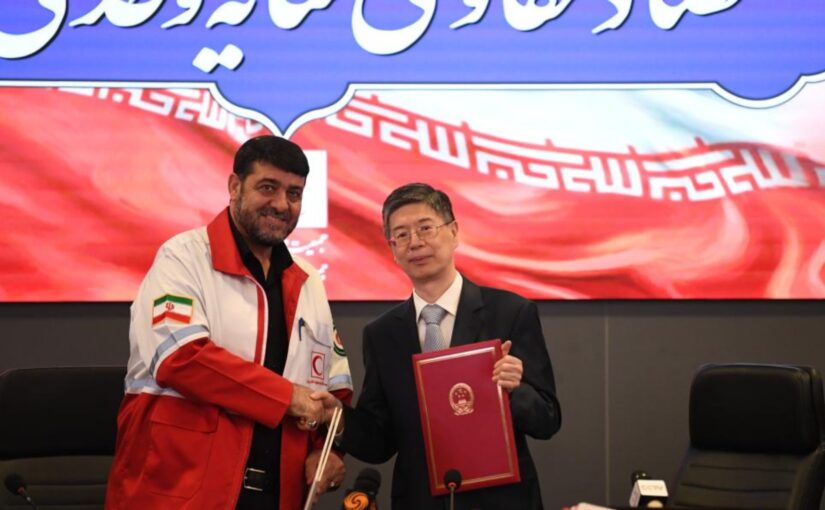
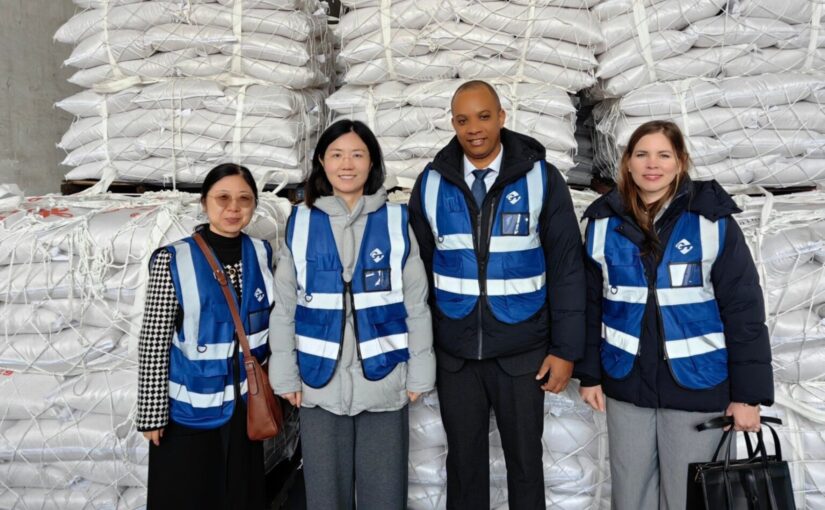
China has decided to provide 58 tons of emergency humanitarian assistance to Iran. This was announced on April 15 by Ambassador Cong Peiwu at the headquarters of the Iranian Red Crescent Society (IRCS).

Cong said China and Iran are good friends and partners with a long-standing friendship between their peoples. He added that China has always been concerned about the Iranian people, noting that China’s assistance reflects its commitment to international humanitarian obligations and the vision of building a community with a shared future for humanity.

IRCS President Pirhossein Kolivand expressed appreciation for China’s continued support and assistance to Iran in difficult times and for firmly supporting Iran in bilateral and multilateral occasions, emphasising that the friendship between the two countries has grown stronger over time. He also noted China’s earlier humanitarian donation following the US attack on the girls’ school in Minab, southern Iran, in which some 175 civilians, the majority of them young schoolgirls, were murdered.

The following article was originally published by the Xinhua News Agency.

TEHRAN, April 17 (Xinhua) — China has decided to provide 58 tons of emergency humanitarian assistance to Iran, a Chinese envoy said recently.

At the headquarters of the Iranian Red Crescent Society (IRCS), Chinese Ambassador to Iran Cong Peiwu announced the decision during a signing ceremony for the handover certificates of China’s emergency humanitarian assistance to Iran on Wednesday, which was also attended by IRCS President Pirhossein Kolivand.

Cong said China and Iran are good friends and partners with a long-standing friendship between their peoples. He added that China has always been concerned about the Iranian people, noting that China’s assistance reflects its commitment to international humanitarian obligations and the vision of building a community with a shared future for humanity.

He said that since the outbreak of the conflict, China has been working to promote regional peace and end hostilities, and will continue to work with the international community to support peace and stability in the Middle East.

Kolivand expressed appreciation for China’s continued support and assistance to Iran in difficult times and for firmly supporting Iran in bilateral and multilateral occasions, emphasizing that the friendship between the two countries has grown stronger over time. He also noted China’s earlier humanitarian donation following an attack on a girls’ school in Minab, southern Iran.

He said that the U.S. and Israeli attacks on Iran have caused extensive damage to over 137,000 infrastructure facilities, including airports, fuel storage facilities, bridges, and railways, all of which violate international humanitarian law. 

Spain opposes a new cold war – Prime Minister Sánchez in Beijing

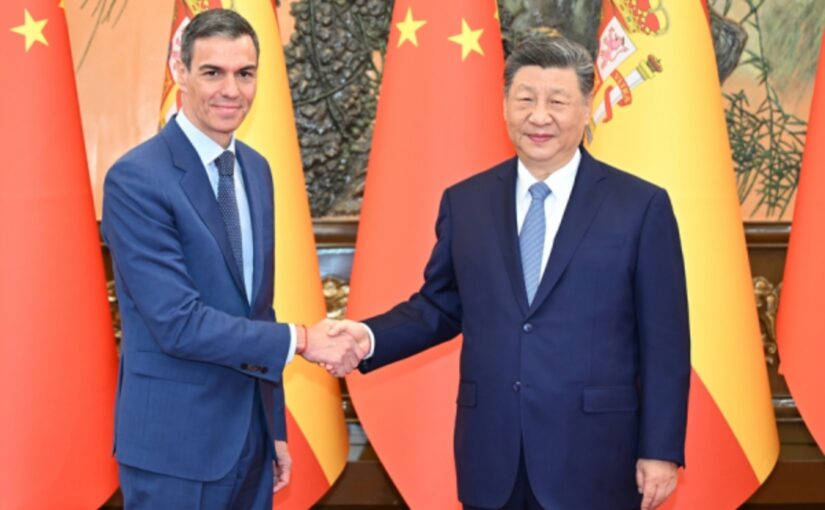
Spanish Prime Minister Pedro Sánchez paid an official visit to China between April 11-15 at the invitation of his Chinese counterpart Li Qiang. It was the fourth visit paid to China by the Spanish head of government in four years and both this symbolism and the substance of the visit served to underline that Spain under its current government is the most friendly country to China in western Europe.

Sánchez’s substantive political meetings were held in Beijing on April 14.

In his meeting with President Xi Jinping, the Chinese leader noted that despite the changing and turbulent international landscape, China-Spain relations have developed steadily, forging a relationship with strategic resolve. An important experience of this lies in the ability to make the right decisions based on common interests. Facts have proven that deepening cooperation serves the interests of both peoples, aligns with the prevailing trend of our times, and bolsters each other’s strength and confidence in pursuing an independent path. China combines its long-term strategic goals with phased objectives, and acts with historical patience to draw up and carry out five-year plans generation after generation. China has firm resolve in advancing Chinese modernisation and the broad-mindedness to share development opportunities with the world through high-standard opening up.

Xi Jinping emphasised that today’s turbulent world faces the struggle between right and might. How a country approaches international law and the international order reflects its views of the world, order, and values, and its sense of responsibility. China and Spain are both countries that value principle and justice. We need to strengthen communication, consolidate mutual trust, and work closely together to reject any backslide into the law of the jungle, jointly uphold true multilateralism, safeguard the UN-centred international system and the international order underpinned by international law, promote an equal and orderly multipolar world and a universally beneficial and inclusive economic globalisation, and foster the building of a community with a shared future for humanity.

Sánchez noted that his four visits to China in four years demonstrate the high importance both sides attach to Spain-China relations. Investment and cooperation by Chinese businesses in Spain have strongly boosted Spain’s economic development. Spain firmly adheres to the one-China principle, highly values China’s status as a major country, and is deeply committed to developing a Spain-China partnership with strategic resolve. Spain hopes to strengthen cooperation in trade, investment, new energy, and other sectors, as well as to enhance people-to-people exchanges. Faced with a complex and challenging international situation and multiple recurring conflicts and disputes, only by adhering to multilateralism and fostering a multipolar world can lasting peace be achieved for humanity. Spain actively supports the four major Global Initiatives proposed by President Xi Jinping and stands ready to maintain close communication and coordination with China to jointly address challenges related to international geopolitics, trade protectionism, and climate change, while upholding international law and multilateralism. Spain opposes a new Cold War and attempts to decouple and sever supply chains, and supports enhanced communication, understanding and cooperation between Europe and China. The sound development of EU-China relations serves the common interests of both sides and contributes to world peace and stability.

In their meeting, Premier Li Qiang said that China is ready to import more high-quality products from Spain and encourages more capable Chinese enterprises to invest in Spain. The more volatile and turbulent the international landscape becomes, the more China and Spain should strengthen practical cooperation, empower each other and achieve mutual success.

China is willing to enhance cooperation with Spain in areas such as new energy vehicles and energy storage to create more highlights of cooperation, Li said, adding that China supports universities, research institutions and enterprises from both sides to strengthen joint research and development, enhance scientific and technological innovation capabilities, and work together to seize future development opportunities.

Sánchez  said the Spanish side is willing to maintain close and high-level political dialogue with China, enhance strategic communication, increase mutual understanding, expand cooperation in trade, investment, science and technology, renewable energy, education, culture and other fields, expand tourism and people-to-people exchanges, continuously enhance the stability and sustainability of bilateral relations, and better benefit the two peoples. Spain is ready to enhance multilateral communication and coordination with China and firmly support the United Nations and multilateralism.

In his meeting with Zhao Leji, chairman of the National People’s Congress (NPC) Standing Committee, Sánchez  said that Spain firmly adheres to the one-China principle and hopes to enhance cooperation with China in trade, investment, culture, education, tourism and other fields, promote exchanges between legislative bodies, uphold multilateralism, and facilitate the healthy and stable development of Spain-China and Europe-China relations.

The following day, the China-Spain innovative enterprises exchange conference brought together over 100 representatives from Chinese and Spanish businesses.

Chinese Commerce Minister Wang Wentao said that China is willing to work with Spain to strengthen strategic alignment and policy coordination, continuously improve the business environment, and promote deeper cooperation among enterprises in technological innovation and industrial and supply chains. The two countries can foster more landmark projects in sectors such as new energy vehicles, intelligent manufacturing, and photovoltaic and wind power, which will benefit enterprises and people of both sides.

Sánchez said that bilateral relations are at their best in history, with deep cooperation in trade, investment, green energy, industrial manufacturing and technological innovation.

Earlier, on April 13, Sánchez delivered a speech at Beijing’s prestigious Tsinghua University.

Beginning by referring to the China visit of the Italian Jesuit Matteo Ricci in the late 16th century, he said:

Continue reading Spain opposes a new cold war – Prime Minister Sánchez in Beijing

Russian Foreign Minister Lavrov visits China

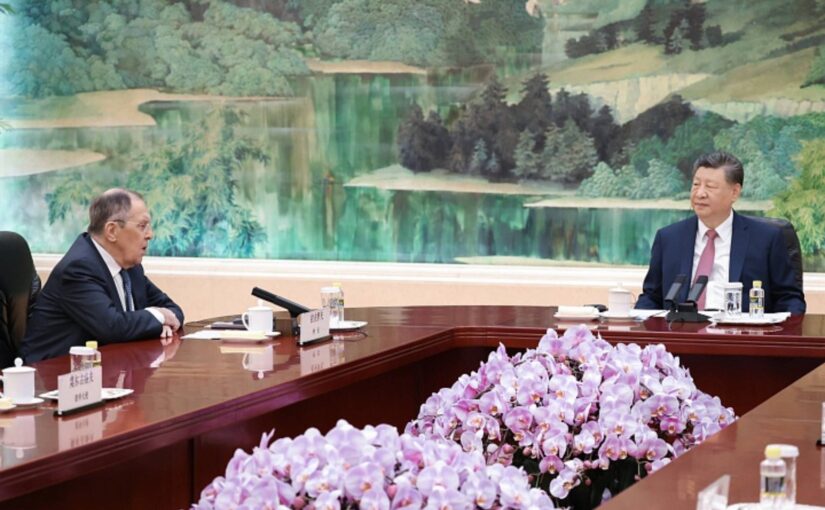
Russian Foreign Minister Sergey Lavrov paid a visit to China, April 14-15, at the invitation of his Chinese counterpart Wang Yi.

Chinese President Xi Jinping met with Lavrov on April 15 and urged closer and stronger strategic coordination between China and Russia to firmly defend their legitimate interests and safeguard the unity of Global South countries.

Xi stressed that China and Russia should maintain strategic resolve, trust and support each other, and pursue common development. It is necessary for the two sides to fully leverage the advantages of proximity and complementarity, deepen cooperation on all fronts, and enhance the resilience of their respective development, he added.

He also urged the two countries to strengthen multilateral cooperation, firmly uphold and practice multilateralism, join hands to revive the authority and vitality of the UN, engage in closer coordination and cooperation within the frameworks of the Shanghai Cooperation Organisation and BRICS countries, and promote the development of the international order in a more just and reasonable direction.

Sergey Lavrov said: “Thanks to the diplomacy pursued by our leaders, you and President Putin, our relations have demonstrated high resilience to the economic and geopolitical shocks that have swept the world, as you have pointed out. Regrettably, these differences are increasingly acquiring a military dimension. In this situation, relations between Russia and China, which are playing a stabilising role in international affairs, are becoming increasingly important for the rest of the world, for the Global Majority, which does not want problems and turbulence but peaceful conditions for sustainable and long-term development.”

Discussions between the Chinese and Russian foreign ministers were held the previous day.

Wang Yi stated that the current international situation is experiencing intense turmoil, with unilateral hegemony inflicting increasing harm, the global governance system facing profound adjustments, and humanity’s cause of peace and development confronting serious challenges. In the face of a complex and volatile external environment, under the personal attention and strategic guidance of President Xi Jinping and President Putin, China-Russia relations remain “unshaken by fleeting clouds”, with cooperation across all fields becoming “stronger through repeated trials”. The two sides coordinate and echo each other on the international stage, sending a clear message to the world that the right path still exists amid headwinds, and there remains steadfast responsibility amid upheaval. 

This year marks the 30th anniversary of the China-Russia strategic partnership of coordination and the 25th anniversary of the signing of the China-Russia Treaty of Good-neighbourliness and Friendly Cooperation. It is also the first year of China’s 15th Five-Year Plan period. China and Russia should seize this historical opportunity, follow the trend of the times, fully implement the important consensus reached by the heads of state of the two countries, and elevate the China-Russia strategic partnership of coordination and mutually beneficial cooperation in various fields to a higher level. The two sides should strengthen cooperation within multilateral frameworks such as the United Nations, take the 25th anniversary of the founding of the Shanghai Cooperation Organisation as an opportunity to implement the consensus of the Tianjin Summit through China-Russia cooperation, and support Kyrgyzstan in hosting a successful summit this year. The two sides should jointly maintain the momentum of unity among BRICS countries and safeguard the legitimate rights and interests of the Global South. The two sides should continue to maintain strategic coordination on major international and regional issues, jointly practice multilateralism and international morality, and jointly advance the process of world multipolarity.

Continue reading Russian Foreign Minister Lavrov visits China

JVP delegation visits China

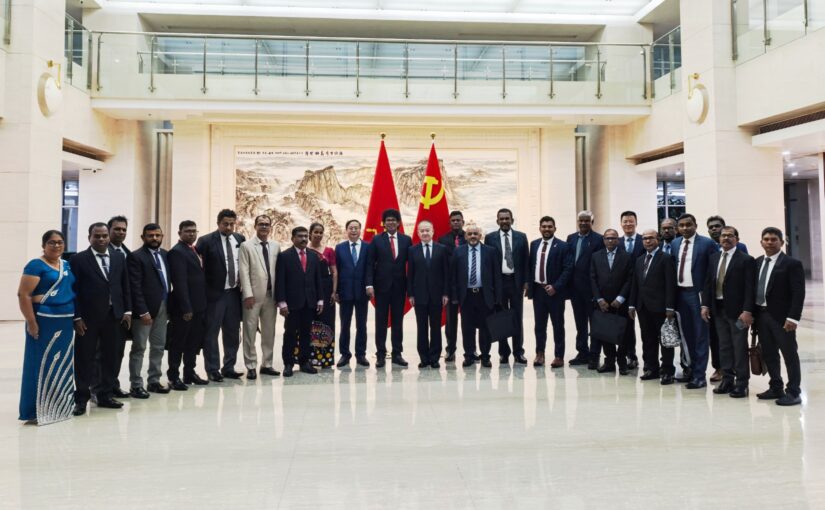
A high-level delegation from the Janatha Vimukthi Peramuna (JVP – People’s Liberation Front) of Sri Lanka recently visited China. The JVP is Sri Lanka’s largest Marxist party and leads the current coalition government.

The delegation was led by Wasantha Samarasinghe, Central Committee Member of the JVP and Minister of Trade, Commerce, Food Security and Cooperative Development of Sri Lanka. On March 31, it met with Liu Haixing, Minister of the International Department of the Communist Party of China (CPC) Central Committee (IDCPC).

Liu said, in January last year, President Xi Jinping held a successful meeting with President Anura Kumara Dissanayake, providing strategic guidance for the development of China-Sri Lanka relations. As Marxist governing parties, the CPC and the JVP have played an important role in promoting China-Sri Lanka relations. Liu shared the CPC’s history of struggle, particularly the achievements and experience since the new era, and said that the CPC stands ready to work with the JVP, guided by the important consensus reached by the two heads of state, to implement the memorandum of exchange and cooperation between the CPC and the JVP, deepen exchanges of experience in state governance and administration, jointly explore development paths suited to respective national conditions, tap the potential of the “political party+” cooperation model, and promote the building of a China-Sri Lanka community with a shared future that carries strategic significance.

Samarasinghe said, China has always been a trustworthy partner and sincere friend of Sri Lanka. In recent years, relations between the JVP and the CPC have been steadily deepened. The remarkable development achievements made by the Chinese people under the leadership of the CPC demonstrate the strong vitality of the path of socialism with Chinese characteristics and provide an important reference for Global South countries, including Sri Lanka. The JVP cherishes its friendly relations with the CPC and stands ready to fully implement the memorandum, learn from China’s experience and practices in strengthening party building and promoting national development, and better enhance its governance capacity.

The following article was originally published on the IDCPC website.

Beijing, March 31st — Liu Haixing, Minister of the International Department of the CPC Central Committee (IDCPC), met here today with a delegation of the Janatha Vimukthi Peramuna (JVP ) of Sri Lanka led by Wasantha Samarasinghe, Central Committee Member of the JVP and Minister of Trade, Commerce, Food Security and Cooperative Development of Sri Lanka.

Continue reading JVP delegation visits China

China’s green development is both anti-imperialist and socialist

Why is it China, and not one of the Western capitalist powers, that’s leading the global green industrial revolution? In 2023, China produced over 80 percent of the world’s solar panels and 60 percent of its electric vehicles. In the first half of 2025, China’s increase in renewable energy generation exceeded that of all other countries combined.

Such accomplishments are not accidental, nor are they a function of the ‘free market’. Rather, they are the product of a socialist developmental state that has, over decades, subordinated capital to social objectives – and in doing so, has transformed the global prospects for a sustainable future.

In this important contribution to the Journal of International Solidarity, A Shantha provides a rigorous political-economic analysis of how and why
China achieved this green industrial revolution, and what it means for the rest of the world.

The argument cuts to the heart of the debate about China’s economic system. As the author puts it: “Put simply, capitalism is the rule of capital. In a capitalist system, social objectives are subordinated to private capital accumulation. In China’s system, the opposite is true – capital accumulation is subordinated to broader social objectives.”

Through five-year planning, state ownership of the commanding heights, technology transfer mandates, the strategic use of subsidies and more, China’s government has been able to construct entire industries from scratch – not because the market demanded it, but because the projects of energy sovereignty, industrialisation and ecological sustainability required it.

Crucially, the author argues that this internal socialist orientation is inseparable from China’s anti-imperialist character. By achieving energy
sovereignty and technological sovereignty, China has directly undermined the mechanisms through which Western imperialism perpetuates uneven
development across the Global South. An energy-independent China cannot be strangled by dollar-denominated oil markets. A technologically sovereign China cannot be contained by Western export controls.

And the implications extend beyond China’s borders. China has now “done the heavy lifting of developing the cutting-edge of green technologies
that no longer have to be ‘discovered’, but can instead be engaged with commercially or through other forms of economic cooperation between
countries.” The dramatic reduction in the cost of solar panels globally is one direct consequence – a gift to every developing nation seeking a
sustainable path forward.

The article concludes:

While Western capitalism’s drive toward uneven development – necessarily involving the absolute cheapening, wasting, and violent destruction of human lives and the natural environment – is what has caused ecological breakdown in the first instance, it is likely no coincidence that socialist China is at the vanguard of developing the prerequisites for a sustainable, ecological civilisation that has major positive implications for the rest of humanity and the planet.

Since the turn of the century, China has been undergoing its own green industrial revolution. In 2023, China was responsible for the production of over 80% of the world’s solar panels and 60% of the world’s electric vehicles.1 China’s domestic New Energy Vehicles (NEVs) — referring to battery/pure electric vehicles, plug-in hybrid electric vehicles, and fuel-cell electric vehicles (of which pure electric vehicles are now the most common) — make up more than 90% of sales, compared to the 50% market share held by gas-powered Chinese-branded vehicles.2 In the first half of 2025, China’s increase in renewable energy generation exceeded that of all other countries combined, with solar power in China accounting for 55% of the global increase in solar output, and wind power in China accounting for 82% of the global increase in wind power output.3

In our era of exponential ecological decline and potential collapse, why hasn’t the Western world — supposedly the vanguard of capitalist ‘innovation’ — been able to make even meagre progress on this question?

How is it that the political and economic system of the People’s Republic of China (PRC) was the one decisive in producing such world-changing outcomes?

The brief answers to these questions lie, first, in the fact that sovereignty — that is, resistance against capitalism’s tendency toward uneven development on a world scale — was a primary factor in pursuing this green development trajectory. And, second, that the pursuit of this sovereign development trajectory within a hostile imperialist world-system was only internally possible through the subordination and disciplining of capital to wider social objectives set out by China’s developmental state led by the Communist Party of China (CPC).

Sovereignty within the Capitalist World-System

The history of capitalist development is one of imposing — via imperialism — uneven development wherein core economies accumulate capital by draining wealth from imperial peripheries (exemplified by Britain’s extraction from India) producing stark disparities in productive capacity.4 In response to this, peripheral states pursue combined development to resist this dynamic, historically by mobilizing the state to build domestic industry and reclaim sovereign productive capacities. While combined development initially took capitalist forms as countries like the US and Germany used their state for infant industry development, this struggle to wrest productive capacity away from the polarizing tendency of capitalism increasingly adopted socialist forms after 1917 — most notably with the Russian and Chinese revolutions.5 What is clear from this is that the nature of combined development is closely linked to the question of national sovereignty, and that the (developmental) state has historically been used in pursuit of those two goals.

Upon founding the PRC in 1949, the CPC confronted a series of challenges: a distorted economy shaped over a century by foreign aggression, a US-led trade embargo, American aggression on its northeastern flank in Korea, and acute industrial underdevelopment. Thus, industrialization and sovereignty became intertwined priorities.

Nearly eight decades after the establishment of the PRC, it is clear that the state and the Communist Party continue to prioritize the mutually reinforcing imperatives of industrialization and sovereignty. Many point to the unleashing of the capital relation by reforms following 1978 as the definitive driver of Chinese industrialization.6 This is certainly true but the achievements of the post-1978 period are directly predicated on the developmental strides made between 1949 and 1976 (the ‘Mao period’) — namely the eradication of feudalism via land reform, human capital investment via education and welfare, and import-substitution industrialization.7

Through the pre- and post-reform development strategies, national sovereignty against imperialism has remained a core objective of the state throughout. This logic — of industry serving the goal of national sovereignty — continues to be apparent in the development of China’s green industries (in this article, NEVs and renewables).

The State-Led Development of China’s Green Industries

How did China mobilize the state to create the success of the NEV and renewable energy sectors?

In both these sectors, the state played an active role in:

  • strategic and long-term national planning;
  • the construction of markets (including both stimulating demand, and also fostering the development of the supply chain);
  • steering and disciplining markets;
  • knowledge production; and
  • technological upgrading.

The Chinese state does not only include the central government — even though it plays a major role in the development of a given industry — but also provincial and local governments who are chiefly responsible for the implementation of nationally-set policies, and whose officials must — alongside this — balance the considerations of their own respective constituencies, including local firms and workers.8 This means that the state-led development of China’s green industries is the result of complex interactions between different levels of government.

China’s NEV Sector

China’s NEV sector is the product of over 20 years of strategic, long-sighted planning.

  • 2001-2005: The 10th Five-Year Plan launched the “863 Program,” allocating 2 billion RMB for NEV research and development (R&D) by manufacturers, universities, and research institutes.9
  • 2010: NEVs were designated a strategic emerging industry
  • 2012: ‘Energy-Saving and New Energy Vehicle Industry Development Plan’;
    • The prioritization of pure electric drive technology (as opposed to that of hybrid vehicles) and introduction of purchase subsidies;
    • Stricter emission standards for internal combustion engine (ICE) vehicles; and
    • Charging infrastructure mandates.10
  • 2015: “Made in China 2025” strategy identified NEVs as one of ten high-tech manufacturing sectors that China aims to promote as a ‘dominant global player’, focusing on:
    • Low-carbon electrification;
    • Digitization; and
    • Autonomous driving.11

More recent advances in the NEV sector are undoubtedly built on the foundations laid by the 1994 Automotive Industry Policy, which leveraged China’s massive market access to secure technology transfer from foreign automotive companies via joint ventures (JVs) with state-owned firms.12 This 1994 policy also gradually introduced more stringent local content requirements (i.e. government-mandated requirements that a certain percentage of inputs are locally derived), thus allowing the automotive supply chain in China to proliferate and modernize.13 The combination of these two factors — technology transfer and the shaping up of the automotive supply chain — allowed the emergence of indigenous automakers (like Chery) in the domestic market by 2004.

However, given the continued dominance of foreign auto brands (such as Volkswagen and General Motors) due to their name brand recognition, one of the few ways domestic auto firms would be able to compete would actually be to “leapfrog” into NEVs to bypass the ICE dominance of foreign auto firms.14 And given state policy and the market signals it produced, these domestic auto firms were well predisposed to doing so.

State intervention operated on both the supply and demand sides of the market. Supply-side support included:

  • An estimated US$25 billion in R&D subsidies between 2009–2023; as well as
  • Local municipal subsidies covering 30% of charging station construction costs in Shenzhen and Suzhou (2014–2015).15

Demand-side measures featured:

  • The “Ten Cities, Thousand Vehicles” program (2009) for public fleet procurement (later expanded to 25 cities);
  • Consumer subsidies up to 60,000 RMB per purchase of a pure EV (between 2010–2020).16
  • The granting of preferential license plates, preferential road access, and free parking for NEVs in cities like Beijing and Shanghai.17

In addition to supply- and demand-side supports from the state (in different forms of subsidies), the NEV sector has also developed qualitatively due to state policy that fosters innovation and technological upgrading.

Beyond just R&D subsidies, consumer subsidies for NEV purchases were made to vary by the driving range of different NEVs (i.e. how many kilometers can be travelled on one full charge of battery). Higher driving range vehicles were subsidized to a greater extent than lower range vehicles, and from 2014 onward, each year saw a progressive reduction in subsidies; this catalyzed automakers to innovate and engage in technological upgrading to maximize their production of NEVs that would receive the greatest subsidies.18

After progressively reducing national subsidies over the years, by 2020, purchase subsidies were replaced by a dual-credit policy requiring automakers to offset ICE emissions with NEV production credits — that is, the policy essentially regulated that a certain proportion of NEVs (relative to ICE vehicles) must be maintained by automakers in the Chinese market. Foreign firms — typically laggards in NEV output — were required to purchase credits from Chinese firms or form JVs, effectively transferring the burden of subsidizing the sector away from the state and toward foreign competitors, all while enabling further technology transfer.19

Innovation was further spurred by the “catfish effect” of Tesla’s inclusion and initial dominance in the market and a shift toward “manufacturing + service” models integrating smart driving technologies, thus also attracting tech capital.20

As a result of these developmental state policies, the NEV sector grew from a market penetration rate of just over 1% in 2015 to just under 26% in 2022, reaching the central government’s target for 2025 three years early.21

China’s Renewables Sector

Just like the NEV sector, China’s renewables sector was a product of long-term planning and sustained developmental state coordination. The 11th Five-Year Plan (2006–2010) designated wind and solar photovoltaic (PV) technologies as strategic industries, complemented by the Renewable Energy Law of 2006 establishing four mechanisms:

  • National renewable targets;
  • Mandatory grid connection and purchase of renewable power (whereby grid companies — that are largely state-owned — are obligated to guarantee a market for power generation companies producing renewable energy, which are also largely state-owned);
  • Feed-in tariffs (whereby grid companies pay an above-market rate to power companies); and
  • A cost-sharing mechanism (charged on end-users of electricity), including a specific fund for renewable energy development.22

The National Development and Reform Commission (NDRC) coordinates sector development, leveraging state dominance in power generation and grid operations —primarily through state-owned enterprises (SOEs) —while private firms concentrate in manufacturing and innovation.23 In this way, private actors are being made to serve the state sector, at the same time as pursuing opportunities for profit. SOEs face binding renewable capacity quotas with penalties for non-compliance, allowing the state to steer sectoral development in a given direction.

The state also played an important role in forging connections with academia and research institutes for knowledge production in the renewable energy sector. For example, the NDRC collaborated with research institutions, such as the China Association for Science and Technology and Jiangsu’s provincial Energy Research Society, to draft energy conservation strategies and execute technology projects.24

Wind power scaled rapidly after the 2002 National Wind Concession Program introduced competitive bidding for the construction of larger-scale farms, which were largely being approved by local governments through the 2000s.25 Critical to the development of a domestic supply chain of wind power manufacturing equipment were a 70% local content requirement (from 2004) and a 17% import tariff on preassembled turbines (from 2007), which spurred technology transfer. For example, Chinese wind power heavyweight Goldwind licensed designs from German firms Jacobs, RE Power, and Vensys.26 Further, bidding criteria evolved from simply ‘lowest price wins’ to progressively account for domestic manufacturing content and technical capability.27 Thus, overall, local content policies, technology transfer, protective tariffs, and the growing stringency and sophistication of bidding requirements allowed the domestic supply chain for wind power equipment to more fully take shape in China during the 2000s, allowing Chinese wind power companies to “[move] quickly up the technological ladder, [win] local market share and, as the sector matured, [strengthen] global competitiveness”.28

Solar development initially differed from the trajectory of wind power development: pre-2009 growth was export-driven (delivering to markets in the global North, primarily Europe), privately-led, and minimally state-supported.29 From 2006, firms purchased turnkey production lines to scale manufacturing, while over 60% of solar company executives in China had studied or worked abroad, facilitating North-to-South knowledge transfer in the sector.30 The 2008–09 financial crisis and subsequent 2011 EU/US ‘anti-dumping’ probes triggered a pivot to the Chinese domestic market, given the collapse of Northern markets where PV cells were traditionally being sold. In 2011, a feed-in tariff catalyzed a 500% surge in PV cell installations that year; growth accelerated further after 2013 when local governments gained approval authority for solar projects.31

These coordinated policies yielded dramatic results: by 2025, China accounted for 55% of global solar power growth and 82% of wind power expansion, cementing its renewable energy leadership through developmental state orchestration of markets, technology transfer, and industrial upgrading.32

Green Industrialization, Sovereignty, and Socialism

China’s green development is both anti-imperialist and socialist. Let us first look at how it is anti-imperialist. It is anti-imperialist in two ways — in its pursuit of 1) energy sovereignty and 2) technological sovereignty.

Energy Sovereignty

The Chinese government views the development of green industries as an important part of guaranteeing national energy sovereignty and security — these connections are explicitly made in state documents.33

Though coal still accounts for approximately 54% of China’s energy consumption, it has come with less-than-desirable consequences, including severe air pollution, which only recently has been reducing. The primary alternative to coal (discounting renewables for now) has been oil and gas, which — though only making up about 27% of China’s total energy consumption — sees an external procurement rate of 72%.34 This means that 72% of oil consumed in China is imported from abroad, amounting to a notable energy vulnerability. In 2015, around 80% of China’s oil consumption was used by vehicles.35

Given that coal-based development causes serious ecological damage, and an extensive reliance on foreign-imported oil and gas poses energy security vulnerabilities, it was squarely in the interest of China’s national energy sovereignty that the state rapidly develop and scale up both the renewable energy sector as well as the NEV sector. Today, China’s energy self-sufficiency rate stands at about 85%, reflecting a deliberate shift away from ecologically damaging coal and geopolitically vulnerable fossil fuel imports.36

China’s growing energy sovereignty means that it has deprived Western imperialism of a crucial point of leverage in determining China’s developmental trajectory. In other words, access to energy is decreasingly a means through which the West can attempt to de-develop China, as it does with the rest of the global South by linking the US dollar to oil purchases, therefore constraining the fiscal space of many governments across Asia, Africa, and Latin America. Samir Amin listed ‘Five Monopolies of the Center’ which are, briefly put, responsible for the continued underdevelopment of the South and overdevelopment of the North, the third of which is the global North’s ‘monopolistic access to the planet’s natural resources’ — that is, the North’s monopolistic access to the earth’s energy resources.37 China’s energy sovereignty directly undermines this monopoly, thus structurally threatening capitalist-imperialism’s drive toward uneven development at a world scale.

Technological Sovereignty

Beyond energy sovereignty, China’s green development prioritized technological sovereignty by indigenizing production.

China’s developmental state actively shaped end-to-end domestic supply chains through local content requirements, JVs (facilitating technology transfer), extensive R&D funding, and the strategic and dynamic use of subsidies. China’s NEV sector, for instance, produced a “self-sufficient and controllable supply chain, without any chokepoints in the supply of critical components that could be constrained by other countries.”38

Crucial to indigenizing production is indigenizing production technologies. This emphasis on indigenizing production is referred to by Chu Wan-wen as the ‘catch-up consensus’ — that is, that production in China should strive to catch up with that of the global North and that it should be indigenized.39 Meng Jie & Zhang Zebin argue that this catch-up consensus is in fact the ‘core of the CPC’s ideology’:

Lu Feng [Emeritus Professor of Economics and former Deputy Dean at Peking University’s National School of Development] has pointed out a deeply rooted political correctness in China about the need for technology to be primarily developed independently in order to be regarded as an outstanding achievement. This stems from the fact that the CPC relied on the popular demand for independence to seize power, and that political independence was a pre-condition for establishing China’s industrial system. Therefore, whenever industrial development faces fundamental strategic choices, the CPC’s ideology will guide policies back toward independence.40

This once again reinforces that, for the CPC, industrialization (and the technological indigenization implied therein) and national sovereignty were dual imperatives intertwined with one another since the establishment of the PRC in 1949 continuing until today. China’s technological sovereignty undermines the global North’s monopoly over advanced technologies, therefore also undermining the structure of capitalist-imperialism by resisting its world-systemic drive toward uneven development.41

Socialist-Oriented Green Development

China’s green industrialization — with sovereignty as a central consideration — depends to a high degree on its ability to ‘govern capital’, both foreign and domestic. In both the NEV and renewables sectors, capital was made to serve national goals set by the government through a combination of carrots and sticks.

It would be incorrect to identify the use of a market economy in China’s developmental trajectory and reductively equate it with (state) capitalism. Put simply, capitalism is the rule of capital — both in particular countries and at a world scale. In a capitalist system, social objectives (such as creating entirely new green industries of the future or reversing severe air pollution via automobile electrification) are subordinated to private capital accumulation. In China’s system, the opposite is true — capital accumulation is subordinated to broader social objectives. This is characteristic of how the CPC understands its own economic system: as a ‘socialist market economy’. As part of this socialist market economy, the commanding heights of the economy (finance, telecommunications, public utilities, infrastructure, etc.) remain in the hands of the state and thus can be steered in favour of social objectives. For China’s Party-State, there is a particular logic in governing capital — this is encapsulated in Meng & Zhang’s concept of ‘constructive markets’:

Constructive markets in the socialist market economy have two main characteristics. First, the state assumes the task of constructing markets on both the supply and demand sides, often acting as a special agent embedded in the market in various ways to continuously guide market development and coordinate the division of labour. Second, the state’s development strategy introduces a use value goal into the market which interacts with the exchange value objectives pursued by enterprises, placing the former in a relatively dominant position.42

The Chinese developmental state governs capital by constraining enterprises’ ‘exchange value objectives’ — the profit motive — within a broader framework of national developmental goals based on ‘use value’. This is largely by using regulatory tools. Foreign automakers were required to form JVs with domestic firms (capped at 50% foreign ownership) to access China’s vast market, facilitating technology transfer. Later, the dual-credit policy disciplined laggard foreign firms into potentially subsidizing domestic NEV producers or forming new JVs to offset negative credits.43 Similarly, the 70% local content requirements and 17% tariffs on imported wind turbines placed constraints on capital that forced it to pursue technological upgrading.44

Therefore, an internal socialist orientation — one that subordinates capital to broader ecologically sustainable and people-centered social objectives — is actually what enables a sovereign development path in China that is able to resist capitalist-imperialism’s drive toward uneven development.

Concluding Remarks

We are currently in a transition from capitalism towards socialism.45 Relatedly, Marx wrote:

At a certain stage of development, the material productive forces of society come into conflict with the existing relations of production or . . . with the property relations within the framework of which they have operated hitherto. From forms of development of the productive forces, these relations turn into their fetters. Then begins an era of social revolution.46

Our current moment of global capitalist crisis and decay is exactly resonant with Marx’s description of the conflict between capitalist social relations and our societies’ productive forces. Capitalist social relations are currently acting as a fetter on — or blocking — the further development of the productive forces in such a direction that can even begin to address the central crisis of our time: capitalist-induced ecological breakdown. It is precisely for this reason that the Western capitalist powers have been unable to innovate and sufficiently scale up green technologies to meet the needs of our moment.

Instead, it is China — whose social revolution (gestured at in the Marx quote) is ongoing — that has begun to break capitalist-imperialism’s polarizing dynamic and, in this context, has been able to innovate, scale up, and widely adopt new green productive forces.47

This green revolution initiated by China has major global significance given that — through its investments in R&D and technological upgrading — China has now done the heavy lifting of developing the cutting-edge of green technologies that now no longer have to be ‘discovered,’ but can instead now (in most cases) be engaged with commercially or through other forms of economic cooperation between countries. Also the rapid development of China’s solar industry and the corresponding magnitude of its productive output have driven the cost of PVs down globally.48 These have major implications for other global South countries looking to pursue alternative development paths that are both ecologically sustainable and that do not further indebt them.

While Western capitalism’s drive toward uneven development — necessarily involving the absolute cheapening, wasting, and violent destruction of human lives and the natural environment — is what has caused ecological breakdown in the first instance, it is likely no coincidence that socialist China is at the vanguard of developing the prerequisites for a sustainable, ecological civilization that has major positive implications for the rest of humanity and the planet.

[1] Ji Siqi, “China’s new green-transition guidelines show how the embattled industry will power on,” South China Morning Post (Hong Kong, China), Aug. 12, 2024. https://www.scmp.com/economy/economic-indicators/article/3274218/chinas-new-green-transition-guidelines-show-how-embattled-industry-will-power. ↩︎

[2] Godfrey Yeung, “‘Made in China 2025’: The development of a new energy vehicle industry in China,” Area Development and Policy 4, no. 1 (2019): 46. ↩︎

[3] “China Steps Up as the Adult in the Room on Climate,” The China Academy, October 10, 2025, https://thechinaacademy.org/china-steps-up-as-the-adult-in-the-room-on-climate/. ↩︎

[4] Radhika Desai, Capitalism, Coronavirus and War: A Geopolitical Economy (New York: Routledge, 2022). ↩︎

[5] Desai, Capitalism, Coronavirus and War. ↩︎

[6] It is important to note that it is not the unleashing of the capital relation in an unguarded way and according to neoliberal logic that occurred in China that was responsible for industrialization, but rather the unleashing of capital within a broader social framework that prioritized holistic national development (Kadri, 2020; Lauesen, 2024). ↩︎

[7] Ali Kadri, “Neoliberalism vs. China as a Model for the Developing World,” The IDEAs Working Paper Series 1 (2020). ↩︎

[8] Chu Wan-wen, “Industry policy with Chinese characteristics: a multi-layered model,” China Economic Journal 10, no. 3 (2017); Meng Jie and Zhang Zibin, “Industrial Policy with Chinese Characteristics: The Political Economy of China’s Intermediary Institutions,” Wenhua Zongheng: A Journal of Contemporary Chinese Thought 3, no. 1 (2025). ↩︎

[9] Liu Yingqi and Ari Kokko, “Who does what in China’s new energy vehicle industry?,” Energy Policy 57 (2013): 22. ↩︎

[10] Feng Kaidong and Chen Junting, “A New Machine to Change the World? The Rise of China’s New Energy Vehicle Industry and its Global Implications,” Wenhua Zongheng: A Journal of Contemporary Chinese Thought 2, no. 2 (2024): 35.; Alexandre De Podestá Gomes, Robert Pauls, and Tobias ten Brink, “Industrial policy and the creation of the electric vehicles market in China: Demand structure, sectoral complementarities and policy coordination,” Cambridge Journal of Economics 47, no.1 (2023). ↩︎

[11] Yeung, ‘Made in China 2025’, 44. ↩︎

[12] Gregory Thomas Chin, China’s Automotive Modernization: The Party-State and Multinational Corporations (Palgrave Macmillan, 2010).; Chu, Industry policy with Chinese characteristics. ↩︎

[13] Chin, China’s Automotive Modernization. ↩︎

[14] Feng & Chen, A New Machine to Change the World?. ↩︎

[15] Stephen Ezell, How Innovative Is China in the Electric Vehicle and Battery Industries? (China Innovation Series), Information Technology & Innovation Foundation – Hamilton Center on Industrial Strategy (2024); Gomes et al., Industrial policy and the creation of the electric vehicles market in China. ↩︎

[16] Feng & Chen, A New Machine to Change the World?.; Liu & Kokko, Who does what in China’s new energy vehicle industry?. ↩︎

[17] Gomes et al., Industrial policy and the creation of the electric vehicles market in China.; Yeung, ‘Made in China 2025’. ↩︎

[18] Yeung, ‘Made in China 2025’. ↩︎

[19] Feng & Chen, A New Machine to Change the World?.; Yeung, ‘Made in China 2025’. ↩︎

[20] Feng & Chen, A New Machine to Change the World?. ↩︎

[21] Ibid. ↩︎

[22] Joanna I. Lewis, Cooperating for the Climate: Learning from International Partnerships in China’s Clean Energy Sector (Cambridge: The MIT Press, 2023).; Sara Schuman, Improving China’s Existing Renewable Energy Legal Framework: Lessons from the International and Domestic Experience, Natural Resources Defense Council (2010), https://www.nrdc.cn/Public/uploads/2016-12-03/5842d7a44bfa2.pdf. ↩︎

[23] Geoffrey C. Chen and Charles Lees, “Growing China’s renewables sector: a developmental state approach,” New Political Economy 21, no. 6 (2016). ↩︎

[24] Chen & Lees, Growing China’s renewables sector, 581. ↩︎

[25] Marius Korsnes, “The emergence of China’s wind and solar industries,” in Wind and Solar Energy Transition in China (Routledge, 2019).; Chu, Industry policy with Chinese characteristics. ↩︎

[26] Chen & Lees, Growing China’s renewables sector, 578. ↩︎

[27] Korsnes, The emergence of China’s wind and solar industries, 72. ↩︎

[28] Chen & Lees, Growing China’s renewables sector, 578. ↩︎

[29] Lewis, Cooperating for the Climate; Korsnes, The emergence of China’s wind and solar industries. ↩︎

[30] Lewis, Cooperating for the Climate, 34. ↩︎

[31] Korsnes, The emergence of China’s wind and solar industries. ↩︎

[32] China Steps Up as the Adult in the Room on Climate, The China Academy. ↩︎

[33] China’s Energy Transition [中华人民共和国国务院新闻办公室], The State Council Information Office of the People’s Republic of China (2024), http://www.scio.gov.cn/zfbps/zfbps_2279/202408/t20240829_860523.html. ↩︎

[34] “China’s Energy Security Realities and Green Ambitions,” The China Academy, July 30, 2025, https://thechinaacademy.org/chinas-energy-security-realities-and-green-ambitions/. ↩︎

[35] Yeung, ‘Made in China 2025’. ↩︎

[36] China’s Energy Security Realities and Green Ambitions, The China Academy. ↩︎

[37] Samir Amin, Capitalism in the age of globalization: The management of contemporary society (Zed Books, 2014). ↩︎

[38] Feng & Chen, A New Machine to Change the World?, 37. ↩︎

[39] Chu, Industry policy with Chinese characteristics. ↩︎

[40] Meng & Zhang, Industrial Policy with Chinese Characteristics, 59. ↩︎

[41] Amin, Capitalism in the age of globalization. ↩︎

[42] Meng & Zhang, Industrial Policy with Chinese Characteristics, 39. ↩︎

[43] Feng & Chen, A New Machine to Change the World?; Yeung, ‘Made in China 2025’. ↩︎

[44] Chen & Lees, Growing China’s renewables sector. ↩︎

[45] Torkil Lauesen, The Long Transition Towards Socialism and the End of Capitalism (Iskra Books, 2024). ↩︎

[46] Lauesen, The Long Transition, 21. ↩︎

[47] Cheng Enfu and Yang Jun, “China’s “Triple Revolution Theory” and Marxist Analysis,” Monthly Review 77, no. 1 (2025). ↩︎

[48] China Steps Up as the Adult in the Room on Climate, The China Academy. ↩︎
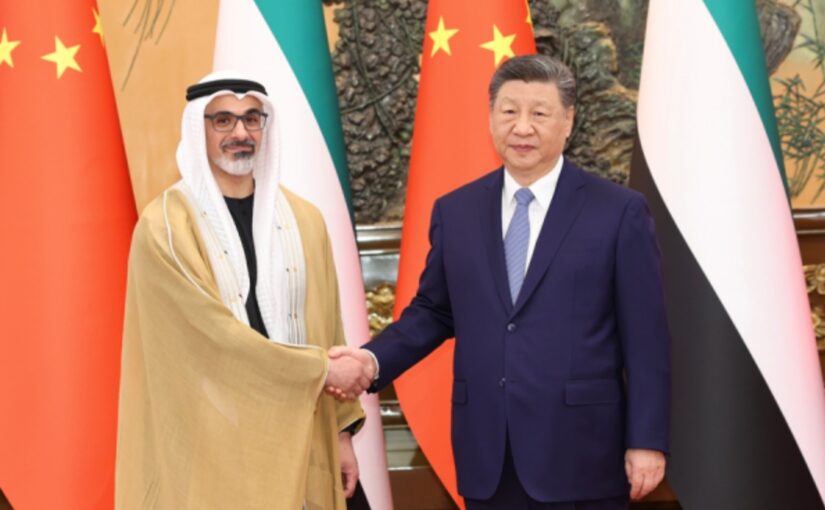
Xi Jinping proposes four-point plan to safeguard and promote Middle East peace and stability

Chinese President Xi Jinping has advanced four propositions aimed at safeguarding and promoting peace and stability in the Middle East.

He outlined these at an April 14 meeting in Beijing with Sheikh Khaled bin Mohamed bin Zayed Al Nahyan, Crown Prince of Abu Dhabi (United Arab Emirates, UAE).

Xi Jinping stressed China’s principled position of promoting peace and facilitating talks and reiterated his country’s readiness to continue playing a constructive role in this regard. His four-point proposition stresses:

  • Stay committed to the principle of peaceful coexistence. The Gulf states in the Middle East are close neighbours that cannot move away. It’s important to support the Gulf states in improving their ties, work to build a common, comprehensive, cooperative and sustainable security architecture of the Middle East and the Gulf region, and consolidate the foundation for peaceful coexistence.
  • Stay committed to the principle of national sovereignty. Sovereignty serves as a foundation for all countries, especially developing countries, to survive and thrive, and it must not be violated.
  • Stay committed to the principle of international rule of law. We should safeguard the authority of international rule of law, reject selective application, and prevent the world from returning to the law of the jungle. It is important to firmly uphold the international system with the United Nations at its core, the international order based on international law, and the basic norms governing international relations underpinned by the purposes and principles of the UN Charter.
  • Stay committed to a balanced approach to development and security. Security is a prerequisite for development and development serves as a safeguard of security.

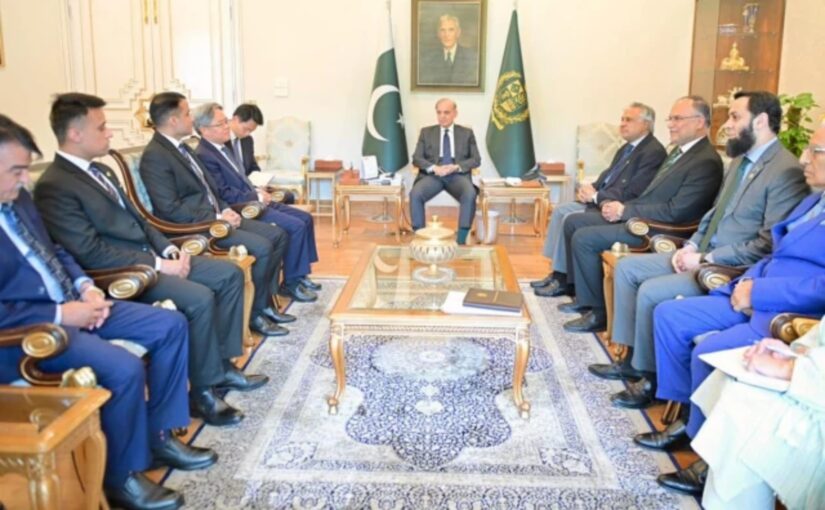
The previous day, Chinese Foreign Minister Wang Yi had met with the Special Envoy of the UAE President to China Khaldoon Khalifa Al Mubarak, who was accompanying Al Nahyan.

Also on April 13, Wang Yi had a phone call with Pakistani Deputy Prime Minister and Foreign Minister Mohammad Ishaq Dar.

Dar gave a comprehensive briefing on Pakistan’s mediation efforts between Iran and the United States and expressed appreciation for China’s endeavours to promote peace. Pakistan stands ready to maintain close communication and coordination with China and jointly play a positive role in realising peace in the region.

Wang reiterated China’s principled position and commended Pakistan for facilitating a temporary ceasefire between the US and Iran and for hosting the Islamabad talks, noting that Pakistan has played a fair and balanced mediating role. He said that the current ceasefire remains highly fragile and the regional situation is at a critical turning point. The pressing priority is to do everything possible to prevent the resumption of hostilities and sustain the hard-won momentum of the ceasefire. The international community should step up efforts to promote peace talks and unequivocally oppose any actions that undermine the ceasefire and escalate confrontation. The Five-Point Initiative of China and Pakistan for Restoring Peace and Stability in the Gulf and Middle East Region reflects the consensus of the international community on promoting peace and can continue to serve as a direction for efforts toward resolving the issue. The Chinese side is pleased to see Pakistan play a greater role and stands ready to work with Pakistan and the rest of the international community to continue making positive contributions to the early restoration of peace and stability in the Middle East.

Continue reading Xi Jinping proposes four-point plan to safeguard and promote Middle East peace and stability

To Lam calls for promoting traditional friendship and enhancing strategic connectivity between Vietnam and China

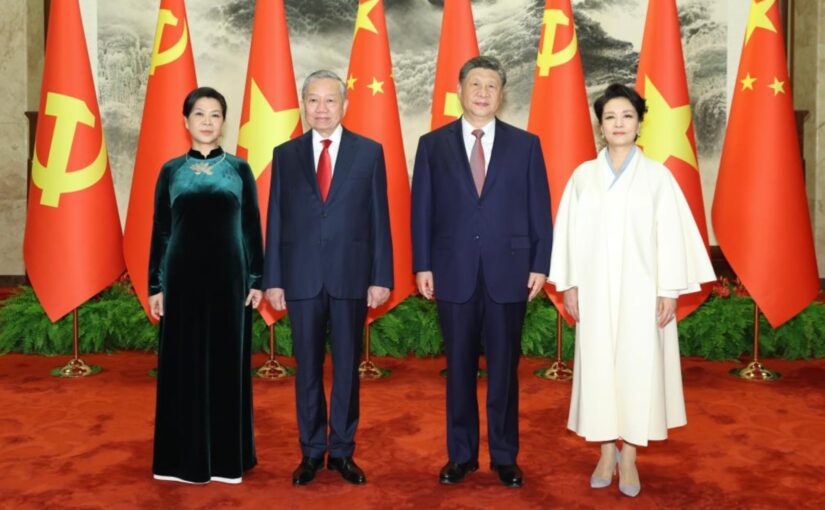
To Lam, general secretary of the Communist Party of Vietnam and president of the Socialist Republic of Vietnam, paid a state visit to China from April 14-17. It was his first overseas visit since his election to the post of head of state, serving alongside his leadership of the communist party, on April 7.

On the day prior to his visit, To Lam contributed an important article to China’s People’s Daily, under the title, Promoting the Tradition of Friendship Between Vietnam and China, Elevating Strategic Connectivity in the New Development Phase.

Among the key points made by To Lam in the article are the following:

  • Vietnam and China are neighbouring countries “with mountains and rivers linked as one,” sharing many cultural similarities. The relationship between the two peoples has been nurtured through long-standing historical exchanges and tested over time. In relations between neighbouring countries, what is most enduring is the ability to view ties from a strategic height with a long-term vision; to cherish the values painstakingly built by previous generations; and to place the fundamental and long-term interests of the people above all else. This is also how Vietnam views and develops its relations with China.
  • Over more than 100 years, the Vietnamese revolution has been closely linked with the Chinese revolution. In 1925, in Guangzhou, China, the beloved leader of the Vietnamese people, Nguyen Ai Quoc [Ho Chi Minh], founded the Vietnam Revolutionary Youth League, laying political, ideological, and organisational groundwork for the establishment of the Communist Party of Vietnam. The League’s headquarters on Wenming street in Guangzhou and the launch of Thanh Nien (Young People) newspaper have become a landmark and a milestone inseparable from Vietnam’s revolutionary history. In early 1941, from Guangxi, Nguyen Ai Quoc returned to Pac Bo in Cao Bang to directly lead the Vietnamese revolution, marking a decisive turning point in the Vietnamese people’s struggle for national independence.
  • The friendship between Vietnam and China has been carefully nurtured by generations of leaders of both countries, from President Ho Chi Minh, Chairman Mao Zedong, and Premier Zhou Enlai to successive generations of communists and people of the two nations. During the period of national liberation struggle, the two sides extended valuable support and assistance to each other. In the period of national construction, both countries have steadfastly pursued development paths suited to their respective conditions, advancing reform, opening-up, and international integration, thereby achieving accomplishments of historical significance. Vietnam always remembers and values the support extended by the Party, State, and people of China during difficult periods.
  • The year 2026 marks the 76th anniversary of diplomatic relations between the two countries. Throughout this journey, Vietnam–China relations have experienced ups and downs, yet friendship and cooperation have remained the mainstream.
  • Vietnam’s Party and State always regard the development of ties with China as a consistent policy, an objective requirement, a strategic choice and a top priority in its foreign policy of independence, self-reliance, multilateralisation and diversification. China’s Party and State also identify Vietnam as a priority direction in its neighbourhood diplomacy and an important component of its broader foreign policy. This is not only a continuation of history, but also a choice rooted in the long-term, fundamental interests of both countries, in line with the aspirations of their peoples and the need to maintain a peaceful and stable environment for development in the new period.
  • People-to-people exchanges have continued to deepen, providing an increasingly solid social foundation for bilateral relations. The Year of Vietnam-China Humanistic Exchange 2025 was implemented through a wide range of activities, with intensified exchanges among youth, scholars, localities and cultural organisations. The “Red study tour” initiative for Vietnamese youth in China, jointly launched in April 2025 by Party General Secretary and President of China Xi Jinping and myself, has been actively carried out and attracted broad participation from young people. Through the initiative, the younger generations of both countries have gained a better understanding of each other, developed a deeper appreciation of the long-standing friendship, and strengthened their sense of responsibility as a successor generation tasked with carrying forward and further nurturing Vietnam–China relations.
  • Against the backdrop of new demands of the times and each country’s new development priorities, both sides, in my view, should focus on four major tasks:
  • It is essential to further consolidate the political foundation of Vietnam–China relations. Strategic orientation from the top leaders of both Parties and countries plays a decisive role in ensuring the stable and healthy development of bilateral ties.
  • A stronger shift is needed in substantive cooperation, using concrete results as a measure. In the coming phase, cooperation between the two countries needs to move strongly from “increasing scale” to “improving quality”; from expanding trade to deeper connections among development strategies, economic corridors, production chains, supply chains, and strategic infrastructure. Science, technology, innovation, and digital transformation should become the new focus of Vietnam-China relations. Vietnam is placing this field at the centre of its national development strategy; China is also strongly propelling high-quality development, scientific and technological self-strengthening and new productive forces. Strengthening cooperation in this area is significant for both economic development and self-reliance of each nation.
  • It is necessary to further deepen the social foundation of relations between the two countries. Bilateral relations can only be truly sustainable when they are nurtured and fostered among the people, especially among the younger generation. Therefore, it is essential to continue promoting the outcomes of the Year of Vietnam – China Humanistic Exchange 2025; to create genuine breakthroughs in tourism development and cooperation for the 2026–2027 period; to further expand youth, education, tourism, culture, media and locality-to-locality exchanges; and to make better use of the “red addresses” of the two countries’ revolutionary history in order to educate about traditions and enhance mutual understanding.
  • Alongside expanding cooperation, both sides should continue to safeguard a peaceful and stable environment, effectively manage differences and properly address outstanding issues. In relations between two neighbouring countries, the value of a sound relationship is reflected not only in areas of favourable cooperation, but also in the capacity to jointly handle differences through dialogue, restraint, mutual respect and responsibility towards the overall bilateral relationship.

This English translation of To Lam’s article is republished from Nhân Dân. Details of To Lam’s important and successful visit to China will be published by us later.

Continue reading To Lam calls for promoting traditional friendship and enhancing strategic connectivity between Vietnam and China

China and the Iran war: creating an environment for peace

In the following article, which was originally published in the Morning Star, Jenny Clegg addresses some of the frequently raised questions regarding China’s stand and role in the context of the current US-Israeli aggression against Iran.

She notes that one should be clear that, “Donald Trump’s strategy has China in its sights. The 2025 US National Security Strategy with its focus on the western hemisphere was thought to shift US strategy from the IndoPacific — in fact the “Donroe” block on Chinese investment in Latin America specifically aimed to shatter the BRICS.”

The current Israeli-US actions, Jenny argues, are dictated by the fact that, “their plans for regional and global hegemony respectively were on the line.

“In June 2025, a new phase of China’s Belt and Road Initiative (BRI) opened with the inauguration of the Iran-China Railway. This direct connection between Iran and central Asia and China offers an alternative economic corridor for oil and mineral exports to navigate around US sanctions and maritime bottlenecks such as the Malacca Straits… Coming onto the horizon now was a new artery between the fast-growing and modernising regions of the Middle East/west Asia and south-east Asia linked by high-speed rail through Western China. The 21st century was being remade.”

In the current situation, she notes, China has been far from inactive: “Following the UN security council failure to rule Trump’s war as illegal, instead placing all the blame on Iran, China doubled down on diplomacy. A special envoy was sent to the region while Foreign Minister Wang Yi made multiple phone calls… China then met with Pakistan which had for its part been conferring with Egypt, Turkey and Saudi Arabia. Together they produced a five-point peace plan covering the cessation of hostilities, protection of civilians, restoration of maritime security and the primacy of international law.”

Looking at the ongoing reconfiguration of the regional geopolitical architecture, Jenny observes: “The Gulf states’ bargain, exchanging security for US bases and huge arms sales, has put them in the firing line… with the US in general decline, new developments have also been influencing the reshaping of the region — the Saudi Arabia-Iran rapprochement brokered by China; the reconciliation between the Palestine groups again mediated by the Chinese, and now with Turkey, Egypt, Saudi Arabia and Pakistan, all members of the BRI, seeking to take greater responsibility for peace.”

Continue reading China and the Iran war: creating an environment for peace

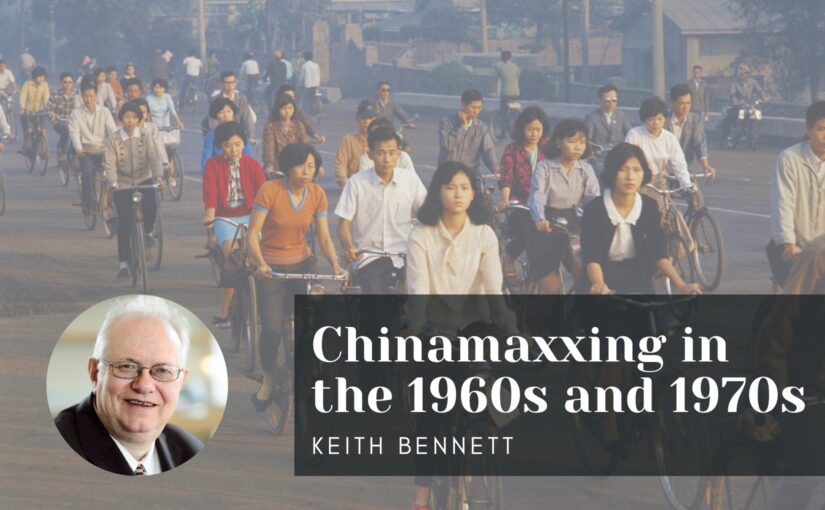
Socialist Chinamaxxing: How China’s achievements are a product of socialism

On Sunday 12 April, Friends of Socialist China hosted a webinar on the subject of Socialist Chinamaxxing: How China’s achievements are a product of socialism.

In spite of several years of intense propaganda and misinformation about China in the media, large numbers of young people in the West are going through “a very Chinese time in their lives”, not least because they are seeing China’s extraordinary achievements in poverty reduction, technological innovation, ecological protection, infrastructure development and more.

This webinar explored how these achievements are a product of China’s social, political and economic system: socialism. The speakers argued that China’s progress would simply not have been possible within a framework of capitalist rule, and that the country’s experience provides a powerful example of the superiority of socialism in terms of delivering for the people and for the planet.

The speakers were:

  • Li Jingjing (Journalist and political commentator, CGTN)
  • Tings Chak (Asia co-coordinator, Tricontinental Institute)
  • George Galloway (Former MP, leader of Workers Party of Britain)
  • Danny Haiphong (Geopolitical analyst and journalist)
  • Ben Norton (Editor, Geopolitical Economy Report)
  • Chen Weihua (Former China Daily EU bureau chief)
  • Qiao Collective (Diaspora Chinese media collective)
  • Ileana Chan (Host of the Global Majority for Peace podcast)
  • Keith Bennett (Co-editor, Friends of Socialist China)
  • Chair: Carlos Martinez (Co-editor, Friends of Socialist China)

Embedded below is the full event stream, followed by the individual speeches.

Film review: Blades of Guardians – People-powered rebellion on the peripheries of Ancient China

Alfie Howis reviews Blades of Guardians, the latest historical action feature film in the wuxia genre from China, and highlights its centring of the struggles and self-organisation of the common people, as well as its strong feminist ethos, at a time of political upheaval and dynastic change.

Blades of Guardians is a 2026 film releasing in Britain on  April 17 to much anticipation and is expected to contribute to the growing market for contemporary Chinese cinema in Europe. The film follows a mercenary in seventh  century (CE) China, living in the Western Regions (Xiyu) during the late Sui Dynasty, and a series of journeys and moral decisions that he is faced with. The heart of the story revolves around the lawless and violent nature of China’s historical periphery regions as a place where struggles for political power play out between the imperial central state, fragmented polities of clans, mercenary groups, and people-powered rebellions. It is an action packed thriller with rapid pacing, overlapping subplots, and copious amounts of fantastical swordfights which make this an exciting and engaging film.

Set against the disintegration of the Sui Dynasty, Blades of the Guardians frames the struggle and self-organisation of common people as a powerful force for change and security during a time of total political collapse. The background of the film’s story is the Flower Rebellion, a fictional uprising referencing real rebellions that occurred during the late Sui Dynasty, contributing to the twilight of the Sui as the central Chinese state weakened. The protagonist Dao Ma is tasked with escorting the leader of this rebellion to Chang’an, the ancient capital (now Xi’an), fighting off imperial troops and mercenaries along the way. Dao Ma is a famed mercenary who is known for living only for money, but he takes on this mission as he is convinced of the worthiness of the rebellion which “stands up for the helpless” and is “for the good of the people”. Through their journey they encounter civilians and soldiers willing to help them for the good of the rebellion, sacrificing their lives to tie down imperial armies and bandits. This is presented as a righteous struggle against a tyrannical and oppressive state, which all the peasants and villagers depicted in the film unequivocally support. In this way, Dao Ma’s transition from a self-interested mercenary to a guardian of the rebellion mirrors the film’s broader message that true righteousness is found in the collective defence of the marginalised rather than fighting for the powerful.

Continue reading Film review: Blades of Guardians – People-powered rebellion on the peripheries of Ancient China

China and Cuba’s solar revolution: solidarity in practice

As Donald Trump tightens his energy stranglehold on Cuba – severing oil supplies, threatening countries that dare to help, and following the Kissinger playbook of “making the economy scream” – a remarkable story of socialist solidarity is unfolding.

Writing in the Morning Star, Carlos Martinez documents how China has stepped into the breach, assisting Cuba with its energy sovereignty and its green transition. Chinese solar exports to Cuba have rocketed from $5 million in 2023 to $117 million in 2025. Beijing has committed to building 92 solar parks on the island by 2028, with a combined capacity equivalent to Cuba’s entire current fossil fuel generation. Already, Cuba’s share of solar power has risen from 5.8 percent to over 20 percent in a single year – a pace of transition that energy analysts describe as one of the fastest ever achieved by a developing nation.

But as this article shows, China’s solidarity extends far beyond megawatts and megaprojects. Ten thousand photovoltaic systems have been donated for rural homes, maternity wards and health clinics. Five thousand solar kits installed across 168 municipalities are keeping medicines refrigerated and families powered through the blackouts. President Xi Jinping personally approved $80 million in emergency aid for electrical equipment. Chinese Ambassador Hua Xin has pledged “firm support under all circumstances.”

This, Carlos argues, is what South-South cooperation looks like in practice: technology, financing and humanitarian assistance with no conditionalities, no structural adjustment, no strings attached. Fidel Castro said in 2004 that China had become “the most promising hope and the best example for all Third World countries.” Cuba’s solar revolution
suggests his assessment has only become more prescient.

    When the lights go out in Havana — as they have done for up to 20 hours a day in the worst months of Cuba’s current energy crisis — the causes are not difficult to identify.

    The United States’ economic blockade, in place since 1962 and systematically tightened under successive administrations, has cost Cuba an estimated $160 billion ($2 trillion in current prices, which is equivalent to around 20 years of Cuba’s annual GDP).

    The latest escalation of this cruel and illegal blockade has involved a full-scale energy embargo, with the US attempting to completely cut off Cuba’s access to oil.

    The kidnapping of Venezuelan President Nicolas Maduro three months ago resulted in the severing of by far Cuba’s most important energy supplier.

    Trump’s tariff threats then forced Mexico to cancel emergency oil shipments.
    The result has been blackouts, fuel shortages and severe disruption to daily life across the island. The Trump regime is following the Kissinger playbook of “making the economy scream” in order to force regime change.

    And life is unquestionably being made difficult. As a Cuban hairdresser told Medea Benjamin of CodePink in February: “You can’t imagine how it touches every part of our lives. With no gasoline, buses don’t run, so we can’t get to work. We have electricity only three to six hours a day. There’s no gas for cooking, so we’re burning wood and charcoal in our apartments. It’s like going back 100 years.”

    Thankfully, at the end of March, a Russian tanker carrying an estimated 730,000 barrels of crude oil docked in Havana, providing some urgently needed relief. But Cuba’s energy import situation continues to be highly precarious and uncertain.

    Nobody can blockade the sun 

    The Cuban people’s response to this siege has not been surrender. It has been transformation — and at the heart of that transformation is a remarkable programme of solar energy development, driven by one of the most significant acts of international solidarity in the history of the global green transition.

    China’s support for the Cuban renewable energy programme has accelerated dramatically in recent years. Chinese solar exports to Cuba rose from $5 million in 2023 to $117m in 2025. A report in the Financial Times on April 6 notes that “thanks to Chinese technology, the Caribbean island has 34 solar parks in operation with a capacity of almost 1.2 gigawatts (GW), a 350 per cent increase on 2024, enabling Cuba to more than quadruple its proportion of solar-powered generation by the end of last year.”

    Beijing has committed to building 92 solar parks in Cuba by 2028, with a combined capacity of approximately 2GW — equivalent to Cuba’s entire current fossil fuel generation capacity. The solar parks already connected to the grid are contributing 1GW. As a result, Cuba’s share of solar in total electricity generation has risen from 5.8 per cent a year ago to over 20 per cent today.

    Energy analysts have described this as one of the most rapid solar transitions ever achieved by a developing nation.

    Cuba has set official targets of generating 24 per cent of its electricity from renewables by 2030, rising to 40 per cent by 2035 and 100 per cent by 2050. At the current pace of buildout, the 2030 target looks well within reach — and may be exceeded considerably sooner.

    Battery storage — currently in place at only four of Cuba’s 55 solar parks — will need to be expanded significantly to address the evening peak demand. Wind energy will also make a growing contribution, with 19 wind farms totaling 415 MW currently being built, again with Chinese support. But the pace of the solar buildout, measured against where Cuba was just months ago, is already extraordinary.

    Chinese support at all levels China’s contribution extends beyond large-scale infrastructure. Beijing has also donated 10,000 photovoltaic systems for deployment in isolated rural homes and critical facilities — including maternity wards and health clinics — ensuring that medical equipment can continue to function and medicines can be refrigerated even during power cuts.

    A further 5,000 solar kits have been installed in health centres across 168 municipalities, each comprising panels, inverters and storage batteries. The head of Cuba’s Electric Union described the household-level systems as life-changing: enabling families to run a refrigerator, a fan and a television, and reducing the rural-to-urban migration that energy poverty drives.

    Furthermore, in January 2026, President Xi Jinping personally approved $80 million in emergency financial aid for electrical equipment, alongside a donation of 60,000 tons of emergency rice aid.

    China has been involved in Cuba’s energy sector for many years — supplying wind turbines since 2018, providing electric buses through Yutong since 2005, and supporting the assembly of Chinese electric cars, scooters and bicycles in Cuba through the Caribbean Electric Vehicles (VEDCA) programme.

    In 2021, Cuba joined the Belt and Road Energy Partnership, the Chinese-led international framework for clean energy investment. But the current programme represents a qualitative leap, driven in large part by the urgency of Cuba’s situation and the depth of the bilateral relationship.

    As Chinese ambassador Hua Xin stated at the handover ceremony for a recent tranche of solar parks: China stands with Cuba in “firm support under all circumstances.” Cuban Energy Minister Vicente de la O Levy stated that the co-operation between the two socialist countries represents “a joint commitment to energy sovereignty.”

    Socialist solidarity 

    What is taking shape in Cuba is a demonstration, in the most concrete terms, of what South-South co-operation and socialist solidarity look like in practice: China is providing technology, financing, expertise, training and humanitarian assistance to a country under siege, with no conditionalities, no structural adjustment requirements, no demand for market access.

    Hugo Chavez one described the flourishing ties between progressive Latin America and China as a “Great Wall against US hegemonism.” Cuba’s solar revolution is a powerful example of that wall in action.

    Fidel Castro said in 2004 that China had become “the most promising hope and the best example for all Third World countries.” Two decades later, the US is raining bombs on Iranian civilian infrastructure, tightening its cruel blockade on Cuba, kidnapping Venezuela’s elected president, and supporting an ongoing genocide in Gaza.

    China meanwhile is emerging as the major trading partner of the vast majority of global South nations; has become the world’s only renewable energy superpower; and consistently demonstrates its commitment to peace, international law and global prosperity.

    Fidel’s assessment looks more prescient than ever.

    Chinese martyrs remembered in Tanzania

    The Qingming Festival, when Chinese people traditionally remember their dead and their ancestors, this year fell on April 5.

    Far away from China, in Tanzania, east Africa, the festival acquired particular poignancy. On its eve, China and Tanzania jointly commemorated the Chinese experts who sacrificed their lives during the construction of the Tanzania-Zambia Railway (TAZARA), the occasion also marking 50 years since the railway’s commercial operations began. Dignitaries from both countries gathered at the Chinese Expert Cemetery in Dar es Salaam, where they solemnly laid wreaths at the graves of the fallen heroes in a gesture of remembrance and respect.

    Chinese Ambassador to Tanzania Chen Mingjian noted that more than 50,000 Chinese workers participated in the railway’s construction in the 1970s, with 70 losing their lives in the process.

    Together with Tanzanian and Zambian counterparts, they carved a railway through mountains, valleys, and wilderness, overcoming immense logistical and environmental challenges.

    “They are heroes who built a monument of China-Tanzania and China-Africa friendship,” she said.

    Reporting the occasion, the Xinhua News Agency wrote: “What emerged was not just infrastructure, but a powerful symbol of solidarity among developing nations… For many in Zambia and Tanzania, TAZARA is not an abstract symbol; it is a lifeline woven into personal and national histories.”

    Bruno Ching’andu, managing director of TAZARA, reflected on its importance to Zambia’s survival during the early years of independence.

    “Without this railway, we would have suffered greatly,” the Zambian national said. “It gave us access to the port of Dar es Salaam when we needed it most.”

    The railway enabled the movement of copper exports, agricultural goods, and essential supplies at a time when all land-locked Zambia’s neighbours to the south were under white racist colonial and apartheid rule, while Zambia, as one of the ‘frontline states’ that had itself just shaken off the yoke of British colonialism, was supporting its sister liberation movements whilst itself facing constant threats of aggression.

    Tanzania’s Deputy Minister for Foreign Affairs and East African Cooperation James Kinyasi Millya highlighted that China’s support came at a time when it was itself still developing.

    “They gave assistance purely as a gesture of friendship,” he said. “No conditions, no demands, just solidarity.”

    He contrasted this with colonial-era railways, which were often built to extract resources rather than empower local populations. That difference, officials said, continues to define the spirit of China-Tanzania relations today.

    A fresh agreement signed between China, Tanzania and Zambia in 2025 aims to revitalise the railway. Millya said:

    “To honour those who sacrificed, we must ensure this railway continues to serve future generations. Generation after generation will remember. This is a friendship written not just in history, but in blood.”

    Continue reading Chinese martyrs remembered in Tanzania

    Kuomintang Chairwoman visits mainland

    Cheng Li-wun, chairwoman of the Chinese Kuomintang (KMT) on China’s Taiwan province visited the mainland of China from April 7-12 at the invitation of the Central Committee of the Communist Party of China (CPC) and General Secretary Xi Jinping.

    Arriving in Shanghai, and also visiting Nanjing and Beijing, this was the first mainland visit by a KMT leader in a decade.

    Welcoming Cheng, Song Tao, head of the Taiwan Work Office of the CPC Central Committee, said that she would certainly feel the deep bond between people on the mainland and their Taiwan compatriots, and her trip would be widely supported by people on both sides of the Strait. He added that by placing the interests of the Chinese nation first and keeping in mind people’s well-being, the CPC and the KMT must work together to promote the peaceful development of cross-Strait relations and strive for national rejuvenation.

    Cheng was elected KMT chairperson in October last year. Since taking office, she has repeatedly expressed her willingness to visit the mainland. After accepting the invitation, Cheng told a press conference in Taipei that the visit is in line with the mainstream public opinion in Taiwan.

    “We have a choice,” she said. “For the sake of both sides of the Taiwan Strait, for regional stability, and for the well-being of the next generation, we must firmly choose the path of peace.”

    At a welcome banquet hosted by Song Tao in Nanjing, Cheng said:

    “First, in terms of the situation in the Asia-Pacific, we are creating a new model—one that shows the world that political differences do not inevitably lead to conflict. The two sides of the Taiwan Strait are not destined, as some in the international community worry, for war. Together, we will demonstrate that both sides have the capability, the determination, and the wisdom to resolve all issues peacefully, and to contribute to regional security and stability. We will not be troublemakers; rather, we will be builders of peace in the region. In today’s turbulent global environment, the significance of this journey for peace is all the more profound.

    Continue reading Kuomintang Chairwoman visits mainland

    Wang Yi visits DPRK

    Chinese Foreign Minister Wang Yi, who is also a member of the Political Bureau of the Central Committee of the Communist Party of China (CPC), visited the Democratic People’s Republic of Korea (DPRK) on April 9-10 at the invitation of his DPRK counterpart Choe Son Hui, who is Foreign Minister and also a member of the Political Bureau of the Central Committee of the Workers’ Party of Korea (WPK).

    In their talks on April 9, Wang said that in early September last year, Xi Jinping, general secretary of the CPC Central Committee, and Kim Jong Un, general secretary of the WPK, held a historic meeting in Beijing, reaching important consensus on the overall, strategic and directional issues concerning bilateral ties.

    Their meeting provides important strategic guidance for further developing China-DPRK relations, pushes bilateral ties into a new stage and opens a new chapter in friendly exchanges between the two countries, which is of great and far-reaching significance, Wang added.

    The past year has witnessed a series of highlights in China-DPRK exchanges, which strongly demonstrated that the two countries’ traditional friendship forged in blood remains everlasting and unbreakable, the Chinese Foreign Minister said, noting that this year marks the 65th anniversary of the signing of the China-DPRK Treaty of Friendship, Cooperation and Mutual Assistance. (The DPRK is the only country with which China has a treaty of this type.)

    Over the past 65 years, Wang said, no matter how the international and regional situations have changed, China and the DPRK, as good neighbours, good friends and good comrades, have always trusted and supported each other, making unremitting efforts to maintain regional and world peace and stability and promote their respective development.

    Wang added that China is willing to work with the DPRK side to hold commemorative events for the 65th anniversary of the signing of the treaty, strengthen high-level exchanges, enhance dialogue and practical cooperation at all levels and in various fields, deepen people-to-people exchanges and mutual understanding, and contribute to their respective economic and social development.

    For her part, Choe said that the DPRK-China friendship is based on the common socialist system and traditional friendship, describing bilateral relations as deep-rooted, solid and sustainable. It is the unwavering position of the WPK and the nation to advance DPRK-China friendship and cooperation following the trend of the times and the will of the two peoples.

    The DPRK, Choe said, fully supports the one-China principle, firmly opposes any interference in China’s internal affairs, and resolutely supports China’s position on safeguarding sovereignty and territorial integrity concerning Taiwan, Xizang [Tibet], Xinjiang, and other issues of China’s core interests.

    She also said that the DPRK side fully endorses the vision of building a community with a shared future for humanity and the four global initiatives proposed by Xi, and highly values China’s just position on and important role in international and regional affairs.

    The DPRK government hosted a reception for Wang Yi and his delegation that evening.

    In her speech, Choe Son Hui said that it is the consistent policy of the WPK and the DPRK government to value and steadily develop the friendly relations with China, which have given steady continuity to the good traditions of unity and cooperation with socialism as their core, overcoming all the tempests of history.

    Continue reading Wang Yi visits DPRK

    China’s peace diplomacy aids defeat of US imperialism

    In what cannot but be described as a humiliating climbdown and significant defeat for US imperialism, on the evening of April 7, barely minutes before his self-set deadline for unleashing a genocide of unprecedented savagery and barbarism aimed at wiping out the millennia long Iranian civilisation, US President Donald Trump suddenly announced that he had accepted a Pakistani proposal for a two-week ceasefire, with negotiations between the two main protagonists set to begin in the Pakistani capital Islamabad on April 10.

    After a month of bestial aggression characterised from the first day by the most egregious war crimes, including the massacre of more than 170 people, the majority of them little girls, in the bombing of a school, along with the murder of the religious and political supreme leader of the Iranian people together with numerous members of his family as well as leading political figures of the country; after a rising crescendo of ever more deranged and psychotic threats of a kind not publicly uttered by a head of state since Adolf Hitler, albeit the nazi leader refrained from using such profane language in public, the US mafia boss performed a volte face and declared that Iran’s 10-point peace proposal, which had been on the table since the start of the aggression, constituted a “workable basis on which to negotiate.”

    According to Iran’s Press TV, these ten points are as follows:

    • No new aggression against Iran
    • Continued Iranian control over the Strait of Hormuz
    • Acceptance of (uranium) enrichment
    • Removal of all primary sanctions
    • Removal of all secondary sanctions
    • Termination of all UN Security Council resolutions
    • Termination of all (International Atomic Energy Agency – IAEA) Board of Governors resolutions
    • Payment of compensation to Iran
    • Withdrawal of US combat forces from the region
    • Cessation of war on all fronts, including against the heroic Islamic Resistance of Lebanon

    Even on the reasonable assumption that any serious negotiation is unlikely to see any side fully realise all its objectives, and irrespective of what the future holds, this climbdown by Trump represents a humiliation for the United States on a scale not seen since the defeats inflicted by the heroic peoples of Vietnam, Laos and Cambodia half a century ago.

    A statement from Iran’s National Security Council said:

    “On the first day, when the criminal enemies of Iran began this oppressive war, they imagined they would succeed in complete military dominance over Iran in a short time and force Iran to surrender by creating political and social instability. They thought Iran’s missile and drone fire would be quickly extinguished and did not believe that Iran could deliver such a powerful response beyond its borders and across the entire region…

    “Iran and the Resistance almost completely destroyed the American military machine in the region; they dealt crushing and profound blows to the vast infrastructure and facilities that the enemy had built and stationed around the region over the years for this war against Iran. In regional dimensions, they imposed extensive casualties on the criminal American army, and within the occupied territories, they delivered heavy and shattering blows to the enemy’s forces, infrastructure, facilities, and assets…

    “Now, the honourable Prime Minister of Pakistan has informed Iran that the American side, despite all outward threats, has accepted these principles as the basis for negotiations and has surrendered to the will of the Iranian nation. Accordingly, at the highest level, it has been decided that Iran will engage in negotiations in Islamabad with the American side for a period of two weeks, based solely on these principles. It is emphasised that this does not mean the end of the war; Iran will only accept the termination of the war once the details—given the acceptance of Iran’s preferred principles in the 10-point plan—are finalised in the negotiations…

    “If the enemy’s surrender on the battlefield is transformed into a decisive political achievement in the negotiations, we will celebrate this massive historical victory together; otherwise, we will fight side-by-side on the battlefield until all the demands of the Iranian nation are met. Our hands are on the trigger, and the moment the slightest error is committed by the enemy, it will be responded to with full power.”

    Continue reading China’s peace diplomacy aids defeat of US imperialism

    Shield of the Americas: The pinnacle of subordination in the silent war against China

    While the world’s attention has been focused on Washington’s wars of aggression in the West Asia, the Trump administration has been quietly advancing a parallel offensive in Latin America – one whose real target, as Oscar Rotundo makes clear in this incisive analysis (originally published in English on the website Internationalist 360), is China.

    The “Shield of the Americas” summit, hosted by Secretary of State Marco Rubio and Kristi Noem at Trump’s Doral golf resort in Miami, brought together twelve compliant Latin American governments and committed them to a Washington-monitored protocol covering security, economic and digital cooperation. As Rotundo shows, this is nothing new: the US has long used regional proxies to advance its interests while making others pay the bill. What’s relatively new is the explicit anti-China dimension.

    Every country invited to Miami has significant economic ties with China – ties that are, in most cases, irreplaceable. China is the largest trading partner of Chile; it is Bolivia’s largest creditor; a key investor in Ecuador; and a key destination for much of the region’s commodity exports. The Chancay megaport in Peru, Chinese EVs and green energy investment are all in Washington’s crosshairs.

    But as Rotundo argues, the US has nothing comparable to offer. It brings no investment, no infrastructure, no technology transfer – only threats, sanctions and hegemonism. China, by contrast, “builds quality infrastructure and incorporates cutting-edge technology” without demanding political submission.

    “The train of the future,” Rotundo concludes, “has left Trump stranded.”

    The so-called “Shield of the Americas,” which includes Argentina, Bolivia, Chile, Costa Rica, the Dominican Republic, Ecuador, El Salvador, Guyana, Honduras, Panama, Paraguay, and Trinidad and Tobago , met at a golf club in Doral, Miami, and was hosted by Secretary of State Marco Rubio and Kristi Noem, former Secretary of Homeland Security, who will now serve as special envoy for the “Shield of the Americas.”

    The idea behind this meeting is to commit those present to a regional control protocol in security, economy, and digital cooperation, monitored from Washington.

    Just as the United States once turned to private contractors such as DynCorp International (now part of Amentum), a US security and aviation contractor for the Pentagon and the State Department, who operated in “Plan Colombia,” it is now turning to the military forces of these countries to act as police officers under its command.

    Sending migrants to prisons in El Salvador or Guantanamo in Cuba, the kidnapping of the sitting constitutional president Nicolás Maduro and the deputy Cilia Flores in Caracas, Venezuela, the threats of invasion or overthrow of the legitimate government of Cuba, the constant extortion against Mexico, are all part of the same package to which the cohort of lackeys is added.

    The United States, with the same zeal with which it bombs boats under the pretext of drug trafficking, taking the lives of people who cannot be held responsible for any crime; under this cloak of suspicion, it intends to implement a regional security policy with military forces paid for by each State to multiply the protection of its interests in the region.

    What is hidden beneath that shield

    Supposedly a shield protects, but not always. We could say that the TIAR (Inter-American Treaty of Reciprocal Assistance) – a mutual defense pact signed in 1947 by countries of America, under the principle that an armed attack against a member state is considered an attack against all, obliging cooperation – was also a shield promoted by the northern hegemon, which, when it came to intervening and discouraging the aggression of an extra-continental force like Great Britain, which since 1833 has illegitimately occupied the Falkland Islands, a territory belonging to Argentina, a member country, did the opposite and joined the aggression by logistically supporting the colonialist force.

    Under this shield, “friendly” countries agree to hand over natural resources and sovereignty over these and over the territories where interoceanic passages are located, so that the United States can exercise control over the movement of goods and military resources that can be moved from one place to another, as Donald Trump has just proposed regarding the Strait of Hormuz, which he is “considering taking control of,” a strategic maritime passage through which 20% of the world’s crude oil and also significant quantities of liquefied natural gas (LNG) circulate.

    Also, as seen in Ecuador with the presence of Erik Prince, founder of the private military company Blackwater, who in 2025 collaborated with the government of Daniel Noboa to combat organized crime and drug trafficking, participating in operations in Guayaquil and in the training of security forces, it would not be surprising if contractors of this nature were to occupy the ground and the operation of this purported fight against Narcoterrorism, under the auspices of this “strategic protection” in the associated countries.

    Continue reading Shield of the Americas: The pinnacle of subordination in the silent war against China

    China strengthens ties with Portugal and Spain

    The speaker of the Portuguese parliament Jose Pedro Aguiar-Branco recently visited China.

    Meeting his guest on April 8, Zhou Leji, Chair of the Standing Committee of the National People’s Congress (NPC), said that China and Portugal are traditional friendly countries and comprehensive strategic partners with mutual respect, mutual trust and win-win cooperation. China is willing to work with Portugal to respect each other’s core interests and major concerns and continuously build and expand consensus on the basis of equality and sincere dialogue.

    Noting that the two sides should deepen cooperation in culture, science and technology, education and tourism, and build a solid public opinion foundation for bilateral ties, Zhao called for making good use of mechanisms such as the Forum for Economic and Trade Cooperation between China and Portuguese-speaking Countries, expand trilateral cooperation with Africa, Latin America and other regions, and jointly practice true multilateralism.

    Aguiar-Branco said Portugal firmly adheres to the one-China policy, adding that deepening the comprehensive strategic partnership between Portugal and China is an important consensus among all political parties in Portugal.

    Chinese Vice President Han Zheng met with Aguiar-Branco the same day. He said China is willing to work with Portugal to jointly expand cooperation using Macao as a platform, promote the China-EU partner positioning, and maintain international unity and cooperation.

    Aguiar-Branco said the Portuguese side appreciates the successful implementation of “one country, two systems” in Macao and hopes to further promote bilateral practical cooperation and multilateral communication and collaboration with China.

    Friendly relations between China and Portugal have developed steadily since the April 1974 revolution overthrew the fascist Caetano regime and especially following the formal establishment of bilateral diplomatic relations in February 1979. What is particularly striking, and indicated above, is the contrast between the Portuguese approach regarding Macao and that of British governments regarding Hong Kong. In the latter case, continual neo-colonial interference and bad faith act as a constant irritant in and impediment to bilateral relations. In stark contrast, Macao acts as a bridge of friendship and practical cooperation not only between China and Portugal, but also between China and all the Portuguese-speaking countries, both bilaterally and multilaterally.

    Additionally, Spanish Prime Minister Pedro Sanchez will pay an official visit to China from April 11 to 15 at the invitation of his counterpart Li Qiang.

    Announcing the visit, Foreign Ministry spokesperson Mao Ning observed that this would be Sanchez’s fourth visit to China in a four-year period, adding that it represents another significant high-level exchange between China and Spain in a short period.

    Noting that Spain is an important partner of China within the European Union, Mao pointed out that in recent years, China-Spain relations have developed at a high level under the strategic guidance of the leaders of both countries, with solid progress made in cooperation across various fields and benefiting the two peoples.

    “China is willing to work with Spain to take Prime Minister Sanchez’s visit as an opportunity to further deepen strategic mutual trust, enhance communication and cooperation, strengthen multilateral coordination, and promote China-Spain relations to a higher level, contributing more to safeguarding world peace and stability,” Mao said.

    Sanchez has stood out as a strong opponent of the US-Israeli war of aggression against Iran, as well as in defence of the rights of the Palestinian and Lebanese peoples, prompting US President Trump to make an escalating series of threats against Spain, including one to sever all trade.

    The following articles were originally published by the Xinhua News Agency.

    Continue reading China strengthens ties with Portugal and Spain

    Vietnam’s new president to visit China

    At its first session, held in Hanoi on April 7, the 16th National Assembly of the Socialist Republic of Vietnam elected To Lam, who is the general secretary of the Central Committee of the Communist Party of Vietnam, to serve concurrently as state president.

    In combining the top posts of the party and state in the same individual, the political arrangements of Vietnam in this regard now mirror those of China, Laos, the Democratic People’s Republic of Korea and Cuba.

    In a message of congratulations sent the same day, To Lam’s Chinese counterpart Xi Jinping noted that China and Vietnam are a community with a shared future that carries strategic significance. In recent years, under the joint guidance and promotion of the leaders of the two parties and the two countries, China-Vietnam relations have achieved leapfrog development, and the comprehensive strategic cooperation has yielded fruitful results, bringing tangible benefits to the people of both countries.

    Xi added that he attaches great importance to the development of relations between the two parties and the two countries, and stands ready to work with To Lam to advance development and national rejuvenation, promote steady progress in the building of a China-Vietnam community with a shared future, continuously strengthen their respective socialist causes, and better benefit the two peoples.

    On April 9, it was announced that To Lam will pay a state visit to China from April 14 to 17. This will be his first foreign visit since becoming head of state.

    Foreign Ministry spokesperson Mao Ning said that: “China hopes that through the visit, the two countries will carry forward the traditional friendship, continue to deepen the comprehensive strategic cooperative partnership, advance the building of an even higher level of community with a shared future that carries strategic significance, jointly promote the socialist cause in the world, and together maintain regional and world peace, stability and development.”

    The following articles were originally published by the Xinhua News Agency.

    Xi congratulates To Lam on election as president of Vietnam

    BEIJING, April 7 (Xinhua) — Chinese President Xi Jinping, also general secretary of the Communist Party of China Central Committee, extended on Tuesday congratulations to To Lam on his election as president of Vietnam.

    Continue reading Vietnam’s new president to visit China

    Afghanistan and Pakistan hold peace talks in Urumqi

    Chinese Foreign Ministry spokesperson Mao Ning announced at a regular press conference on April 8 that representatives from China, Afghanistan and Pakistan held informal talks from April 1 to 7 in Urumqi, capital of northwest China’s Xinjiang Uygur Autonomous Region, in a bid to address and resolve the recent armed clashes between China’s two neighbours.

    She described the discussions as being candid, pragmatic and proceeding in a sound atmosphere, with an approach oriented towards solving problems, striving for results and taking actions.

    Mao further noted that the Afghan and Pakistani delegations spoke highly of the Global Security Initiative and the Asian security model put forward by the Chinese side, in particular the important visions of seeking commonality despite differences, treating each other as equals, and championing dialogue and consultation for peaceful settlement of disputes.

    “The two sides commended and thanked China for the mediation effort and thoughtful arrangement as the host country of the talks.”

    The Afghan and Pakistani sides reiterated that they follow the purposes and spirit of the UN Charter and the Five Principles of Peaceful Coexistence, stay committed to resolving differences as soon as possible, work for the turnaround of Afghanistan-Pakistan relations, and agree to refrain from actions that may escalate or complicate the situation, Afghanistan and Pakistan reiterated that the two countries are Muslim brothers and neighbours.

    The following article was originally published by the Xinhua News Agency. Some recent background may be read here.

    BEIJING, April 8 (Xinhua) — Representatives from China, Afghanistan and Pakistan held informal talks from April 1 to 7 in Urumqi, northwest China’s Xinjiang Uygur Autonomous Region, Chinese foreign ministry spokesperson Mao Ning said on Wednesday.

    Mao told a regular press briefing that the cross-departmental delegations of the three sides include representatives from authorities in charge of foreign affairs, defense and security.

    Based on the common understandings reached between Chinese Foreign Minister Wang Yi, who is also a member of the Political Bureau of the Communist Party of China Central Committee, Pakistani Deputy Prime Minister and Foreign Minister Mohammad Ishaq Dar and Afghan Foreign Minister Mawlawi Amir Khan Muttaqi, the discussions were candid, pragmatic and proceeded in a sound atmosphere, which shows that the talks follow an approach oriented towards solving problems, striving for results and taking actions, said Mao.

    Mao noted that the Afghan and Pakistani delegations spoke highly of the Global Security Initiative and the Asian security model put forward by the Chinese side, in particular the important visions of seeking commonality despite differences, treating each other as equals, and championing dialogue and consultation for peaceful settlement of disputes.

    “The two sides commended and thanked China for the mediation effort and thoughtful arrangement as the host country of the talks,” she said, adding that they also expressed appreciation for China’s fair and just position and utmost effort.

    The Afghan and Pakistani sides reiterated that they follow the purposes and spirit of the UN Charter and the Five Principles of Peaceful Coexistence, stay committed to resolving differences as soon as possible, work for the turnaround of Afghanistan-Pakistan relations, and agree to refrain from actions that may escalate or complicate the situation, Mao pointed out.

    “China expressed readiness to maintain communication with both sides, provide the platform for dialogue, and continue to play a constructive role for improving and developing Afghanistan-Pakistan relations and enhancing practical trilateral cooperation among the three countries,” said the spokesperson.

    Mao said after intensive bilateral and trilateral meetings over the past week, China noted and summed up the talks and common understandings.

    Afghanistan and Pakistan reiterated that the two countries are Muslim brothers and neighbors, Mao said.

    The three sides believed that amid the turbulent and changing international and regional situation, maintaining friendly ties between Afghanistan and Pakistan is of vital importance to peoples in both countries as well as peace and stability in South Asia, she added.

    The three sides stressed that dialogue and consultation is the viable and effective way to resolve complex international disputes, including the disputes between Afghanistan and Pakistan, according to the spokesperson.

    The three sides agreed to discuss a comprehensive plan to resolve issues in the relations between Afghanistan and Pakistan, and identified the core and priority issues, Mao said.

    China stressed that terrorism is the core issue affecting Afghanistan-Pakistan relations, the spokesperson said.

    The three sides believed that the Urumqi process is substantive, and agreed to maintain communication and dialogue on the process, she added.

    China’s solidarity with Venezuela, Iran and Cuba

    The text below is an edited version of a talk given by Alex C during a launch event for the book “China Changes Everything” held at the SHAPE (Self Help for African People Everywhere) Center in Houston and online on March 28, 2026.

    The speech observes that, as the US escalates its wars of aggression against the Global South – invading Venezuela, bombing Iran and tightening its stranglehold on Cuba – the People’s Republic of China has stood firmly alongside the peoples under attack. Alex C traces China’s concrete solidarity with three revolutionary nations on the frontlines of the struggle against imperialism. In Venezuela, China defended Maduro’s government against US-backed coup attempts, and provided critical economic assistance and diplomatic support.

    In Iran, China has been a lifeline, purchasing Iranian oil to offset the impact of sanctions, supplying military components, and building a comprehensive strategic partnership that has fundamentally undermined Washington’s efforts to economically strangle the Islamic Republic.

    In Cuba, China has contributed $80 million toward the island’s electrical grid, forgiven substantial debt, and partnered with Havana on an ambitious transition to renewable energy.

    Drawing on the lessons of Lenin and Mao, the speech reminds us that “nations which embrace revolutionary socialism can and will endure the onslaught of imperialism” – and calls on those of us in the imperial core to stand with the anti-imperialist camp.

    The text of the speech first appeared on Workers World. The text is followed by a video of the full launch event.

    Venezuela — like China, Iran, Cuba and so many other countries under siege by the United States — is one of many links in the chain of international proletarian revolution. To paraphrase China’s Chairman Mao Zedong, the Venezuelan people stood up in 1999, proclaiming that from that day forth, they would be the masters of Venezuela’s destiny, not international capital. 

    Continue reading China’s solidarity with Venezuela, Iran and Cuba