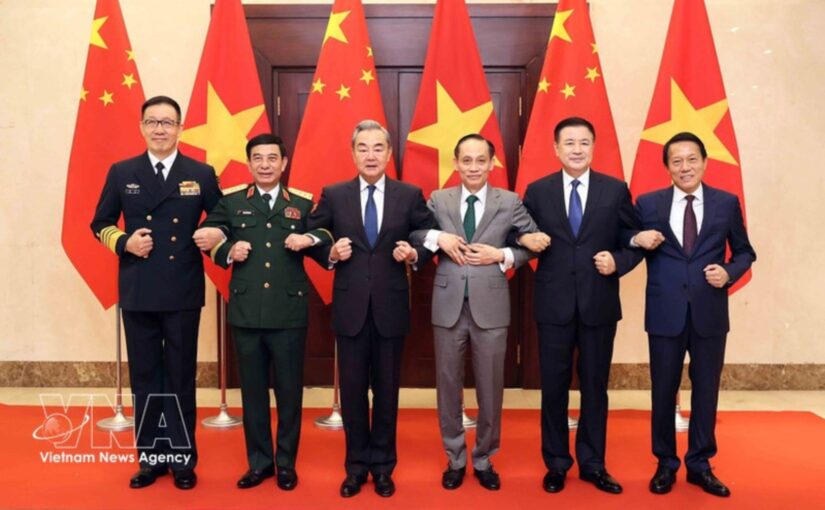
In a highly significant move to strengthen the unity and solidarity between the socialist countries on both a strategic and tactical level in the face of the present capricious international situation, as well as with a view to advancing the global socialist cause, China and Vietnam held the First Ministerial Meeting of the China-Vietnam “3+3” Strategic Dialogue on Diplomacy, Defence and Public Security in the Vietnamese capital Hanoi on March 16.
The meeting was jointly chaired by Foreign Minister Wang Yi, Minister of Public Security Wang Xiaohong, and Minister of National Defence Dong Jun, together with Vietnamese Foreign Minister Le Hoai Trung, Defence Minister Phan Van Giang and Minister of Public Security Luong Tam Quang. Centred on the theme “Coordinating Development and Security, Advancing on the Socialist Road with Unwavering Commitment, and Forging United Fronts to Confront Shared Challenges,” the two sides engaged in an in-depth exchange of views regarding the dynamic shifts in the global landscape, the maintenance of political security, and the advancement of defence and law enforcement cooperation.
Wang Yi remarked that last year, General Secretary and President Xi Jinping paid a state visit to Vietnam, where he forged pivotal consensus with Vietnamese leaders on convening the ministerial meeting of the China-Vietnam “3+3” strategic dialogue. This mechanism stands as a groundbreaking and vital strategic communication platform, jointly pioneered by both nations in the global arena. It is a major measure with strategic significance, designed to safeguard the security of political systems and deepen strategic collaboration. It stands not merely as an intrinsic facet in propelling the building of a China-Vietnam community with a shared future, but also as an indispensable and pivotal move towards rejuvenating the global socialist cause.
Wang Yi stated that the contemporary global landscape is beset by intertwined turmoil and chaos, with the international architecture undergoing accelerated realignment, while unilateral bullying gets more rampant. Conversely, the cause of socialism with Chinese characteristics is advancing with strides, witnessing the smooth commencement of the 15th Five-Year Plan. Simultaneously, Vietnam has ushered in a new epoch of national development, accelerating the implementation of the resolutions of the 14th National Congress of the Communist Party of Vietnam. The stability and development of both China and Vietnam will manifest to the world the distinct superiority of the socialist system, the robust vitality of the socialist cause, and the bright prospects for human development and progress.
Wang Yi emphasised that as friendly socialist neighbours, China and Vietnam must not only focus on the fundamental well-being of their peoples, effectively coordinate the dual imperatives of development and security, and steadfastly pursue their respective development paths, but also keep foremost in mind the shared interests of all humanity, steer the correct direction of historical progress, and jointly promote an equal and orderly multipolar world, and an economic globalisation that is inclusive and beneficial to all through the building of a China-Vietnam community with a shared future carrying strategic significance.
Wang Xiaohong stated that the public security departments of the two nations must focus on the overarching goal of “six mores,” prioritising political security and enhance efforts to prevent and resist “colour revolutions.” Strategic planning should be placed at the forefront, serving as a catalyst to galvanise a formidable and united front. Moreover, we should anchor efforts in the people’s interests, pursuing more tangible and substantive cooperation outcomes to effectively bolster the respective socialist endeavours of the two countries and the construction of a strategically significant China-Vietnam community with a shared future.
Dong Jun stated that, confronted with unprecedented external security risks and challenges, the armed forces of China and Vietnam, steadfastly under the absolute leadership of their respective Communist Parties, shoulder a profound and sacred duty in fortifying the Party’s enduring governance and safeguarding the socialist red regime. Under the guidance of the supreme leaders of both parties, they must unite to forge a strong defence and security shield. China stands ready to collaborate closely with Vietnam, continuously deepening mutual trust in military security, further expand cooperation areas, improve the quality and effectiveness of cooperation, jointly safeguard maritime security and stability through positive interaction, and push bilateral defence exchanges and cooperation to a new level, setting an example of unity and self-reliance for the armed forces of socialist countries.
The Vietnamese side conveyed its congratulations on the triumphant conclusion of China’s national “two sessions”, as well as the approval of the 15th Five-Year Plan outline. They emphasised that the decision by the supreme leaders of the two Parties and nations to institute the “3+3” strategic dialogue mechanism at the ministerial level stands as a landmark decision of far-reaching strategic import. This initiative manifests the extraordinary amity, profound political trust, and close strategic ties between Vietnam and China, aligning perfectly with the positioning of the comprehensive strategic cooperative partnership and a community with a shared future with strategic significance. Amidst the rapidly evolving and increasingly unpredictable international and regional landscape, it has become particularly urgent for the two parties and countries to strengthen solidarity and cooperation in addressing shared challenges. Vietnam unwaveringly considers the consolidation and advancement of relations with China as the priority and strategic choice of its foreign policy, steadfastly upholding the one-China policy and extending resolute support on issues concerning China’s core interests.
The Vietnamese ministers congratulated China on its achievements under the leadership of the Communist Party of China Central Committee with General Secretary and President Xi Jinping as its core. They reaffirmed that developing relations with China remains a consistent policy, an objective requirement, a strategic and natural choice, and a top priority in Vietnam’s foreign policy of independence, self-reliance, diversification and multilateralisation of external relations. Vietnam also reiterated its consistent adherence to the one-China policy and its readiness to participate appropriately in China’s initiatives on development, security, civilisation and global governance.
Both sides acknowledged that the world now enters a period of turbulence and transformation, posing common challenges to the socialist endeavours of both nations. In response, both sides pledged to uphold strategic vigilance and staunchly secure the ideological front; fortify strategic resolve to foster closer unity; enhance strategic resilience, harness institutional strengths and deepen mutually beneficial cooperation; and enhance strategic coordination to resolutely safeguard the international system with the United Nations at its core and the international order based on international law.
Furthermore, both sides agreed to convene the second ministerial meeting of the China-Vietnam “3+3” strategic dialogue in China by fully leveraging the mechanism’s daily liaison functions through senior officials to foster in-depth sectoral exchanges in diplomacy, defence, and public security.
Concurrently, the 9th ministerial conference on collaborative crime combat between the public security ministries of the two countries, along with the 10th border defence friendship exchange, were held during the meeting. We will report on these separately.
Also on March 16, General Secretary of the Communist Party of Vietnam (CPV) Central Committee To Lam met with Foreign Minister Wang Yi, Minister of Public Security Wang Xiaohong, and Minister of National Defence Dong Jun.
To Lam asked Wang Yi to convey his cordial regards to General Secretary Xi Jinping and extended congratulations on the successful convening of China’s national “two sessions” and the adoption of the outline of the 15th Five-Year Plan. He emphasised that the “3+3” strategic dialogue mechanism, an initiative jointly conceived by the leaders of the two Parties, epitomised the profound political mutual trust between the two sides, highlighting that cooperation in key domains has become a vital pillar of bilateral relations. This mechanism, he noted, will vigorously propel the construction of a Vietnam-China community with a shared future to achieve deeper and more substantive progress. To Lam congratulated on the successful convening of the first ministerial meeting of the China-Vietnam “3+3” strategic dialogue, noting that it sent a resounding message of both nations joining forces to foster development and rejuvenation while confronting shared challenges. He expressed gratitude for China’s steadfast political support during the successful convening of the 14th National Congress of the CPV, underscoring the extraordinary significance of this momentous gathering. Vietnam, he affirmed, would remain unwavering in its commitment to the socialist path and continue its relentless pursuit of the centennial milestones of Party and state establishment. Amidst a tumultuous and ever-evolving global landscape, fraught with escalating uncertainties and unpredictabilities, Vietnam and China should strengthen solidarity and cooperation to safeguard their legitimate interests. Vietnam hopes to deepen political mutual trust, fortify strategic alignment, intensify practical cooperation, foster vibrant sub-national and people-to-people exchanges, and enhance multilateral coordination and collaboration with China. Together, they would strive to uphold international and regional stability and development while advancing the cause of world socialism.
Wang Yi remarked that his visit to Vietnam to attend the first ministerial meeting of the China-Vietnam “3+3” strategic dialogue was aimed at implementing the important consensus reached by the top leaders of the two Parties and nations. Through profound and extensive exchanges centred on the theme of “Coordinating Development and Security, Advancing on the Socialist Road with Unwavering Commitment, and Forging United Fronts to Confront Shared Challenges,” both sides forged a broad consensus and sent out an important signal to the world that China and Vietnam, as two major socialist nations, were united in their commitment to safeguarding the security of their political systems and pursuing national development and rejuvenation. This pioneering strategic communication platform, established by China and Vietnam on the global stage, marks a new stage in strategic mutual trust and cooperation between the two sides, making new progress in building a China-Vietnam community with a shared future of strategic significance.
Also on March 16, Vietnamese Prime Minister Pham Minh Chinh met in Hanoi with Minister of Foreign Affairs Wang Yi, Minister of Public Security Wang Xiaohong, and Minister of National Defence Dong Jun.
Pham Minh Chinh asked Wang Yi to convey his cordial greetings to the Chinese leader and congratulated China on the successful convening of the national “two sessions.” He noted that under the strong leadership of the Communist Party of China (CPC) Central Committee with Comrade Xi Jinping at its core, China has made tremendous achievements in its development and its international standing continues to rise. The Vietnamese side has full confidence in China’s success in achieving its Second Centenary Goal. Vietnam and China are neighbours, comrades and brothers. China is the only country that aligns with all the foreign policy priorities of Vietnam, and consolidating and developing relations with China is the top priority and a strategic choice of the Vietnamese Party and Government.
The previous day, Wang Yi met with Member of the Political Bureau of the CPV Central Committee and Foreign Minister Le Hoai Trung.
Wang Yi said that as the saying goes, a whole year’s work depends on a good start in the spring. The fact that the Chinese side paid a visit to Vietnam right after China’s national “Two Sessions” reflects the high level of China-Vietnam relations. After the convening of the 14th National Congress of the CPV in January this year, General Secretary and President Xi Jinping had a phone call with General Secretary To Lam in a timely manner, and both sides agreed to ensure the success of the first ministerial meeting of the China-Vietnam “3+3” strategic dialogue on diplomacy, defence and public security and the 17th meeting of the China-Vietnam Steering Committee for Bilateral Cooperation. Following the strategic consensus of the top leaders of the two parties, the two countries should leverage the two important mechanisms to have in-depth discussions on coordinating the two major issues of development and security, identify important steps for advancing the socialist path, and send a positive signal to the international community that China and Vietnam are united, mutually trusted, and jointly forging ahead.
Wang Yi added that China and Vietnam are both major emerging economies. The development and revitalisation of the two countries not only represents the direction of human development and progress but also provides useful inspirations and a new path for other developing countries.
Le Hoai Trung extended congratulations on the success of China’s national “Two Sessions” and on the new progress in China’s economic and social development. He said that holding the first ministerial meeting of the China-Vietnam “3+3” strategic dialogue on diplomacy, defence and public security and the 17th meeting of the China-Vietnam Steering Committee for Bilateral Cooperation in Vietnam indicates that bilateral relations and political mutual trust have reached new heights. Guided by the spirit of “comrades and brothers”, the two sides are all the more capable of implementing the strategic consensus reached by the top leaders of the two parties. As China’s friendly neighbour, comrade and brother, Vietnam is ready to always stand with China, supports China in its development and growth, in enhancing its international standing, and in making greater contributions to the socialist cause as well as global peace, stability, development and prosperity. Given the complexity and volatility of the current international situation, and as the two countries share extensive common interests and are advancing respective development goals, it is more important than ever for the two sides to strengthen strategic communication, enhance strategic mutual trust and cement strategic coordination.
On March 17, the 17th meeting of the China-Vietnam Steering Committee for Bilateral Cooperation was held in Hanoi. The meeting was co-chaired by Member of the Political Bureau of the CPC Central Committee and Foreign Minister Wang Yi and Vietnamese Deputy Prime Minister Bui Thanh Son.
They highlighted strong progress in bilateral ties as seen in frequent strategic exchanges and high-level visits and contacts. Collaboration between the Communist Party of Vietnam and the Communist Party of China, the Vietnamese National Assembly and the National People’s Congress of China, the Vietnam Fatherland Front and the Chinese People’s Political Consultative Conference, as well as between their ministries and sectors has been increasingly strengthened. Meanwhile, economic, trade, investment, and tourism ties have grown robustly. China remains Vietnam’s largest trading partner, and Vietnam is China’s fourth largest. Strategic connectivity, particularly railway links, have also recorded notable progress, alongside vibrant locality-to-locality cooperation and people-to-people exchanges.
Wang stated that China will actively accelerate the construction of the three railway lines; cooperate in capital, technology, and railway personnel training; and encourage Chinese enterprises to expand investment in Vietnam.
The two sides should strengthen cooperation in emerging fields such as high technology, innovation, and clean energy, he proposed, expressing his hope that they will bolster people-to-people exchanges, as well as cultural, healthcare, and educational cooperation. He affirmed that China will provide more scholarships for Vietnamese students in various forms.
During the meeting, the two sides also discussed sea-related issues, agreeing to continue to seriously implement the high-level common perceptions, better control and resolve differences, and maintain peace and stability in the South China Sea.
The following articles were originally published on the website of the Chinese Foreign Ministry and by Nhân Dân.
China and Viet Nam Hold the First Ministerial Meeting of the China-Viet Nam “3+3” Strategic Dialogue on Diplomacy, Defense and Public Security
March 16 (MFA) – On March 16, 2026, local time, the first ministerial meeting of the China-Viet Nam “3+3” strategic dialogue on diplomacy, defense and public security was convened in Hanoi. The meeting was jointly chaired by Foreign Minister Wang Yi, Minister of Public Security Wang Xiaohong, and Minister of National Defense Dong Jun, together with Vietnamese Foreign Minister Le Hoai Trung, Defense Minister Phan Van Giang and Minister of Public Security Luong Tam Quang. Centered on the theme “Coordinating Development and Security, Advancing on the Socialist Road with Unwavering Commitment, and Forging United Fronts to Confront Shared Challenges,” the two sides engaged in an in-depth exchange of views regarding the dynamic shifts in the global landscape, the maintenance of political security, and the advancement of defense and law enforcement cooperation. The dialogue yielded broad consensus.
Wang Yi remarked that last year, General Secretary and President Xi Jinping paid a state visit to Viet Nam, where he forged pivotal consensus with Vietnamese leaders on convening ministerial meeting of the China-Viet Nam “3+3” strategic dialogue. This mechanism stands as a groundbreaking and vital strategic communication platform, jointly pioneered by both nations in the global arena. It is a major measure with strategic significance, designed to safeguard the security of political systems and deepen strategic collaboration. It stands not merely as an intrinsic facet in propelling the building of a China-Viet Nam community with a shared future, but also as an indispensable and pivotal move towards rejuvenating the global socialist cause. This mechanism epitomizes the elevated level and strategic essence of the relations between the two Parties and countries.
Wang Yi stated that the contemporary global landscape is beset by intertwined turmoil and chaos, with the international architecture undergoing accelerated realignment, while unilateral bullying gets more rampant. Conversely, the cause of socialism with Chinese characteristics is advancing with strides, witnessing the smooth commencement of the 15th Five-Year Plan. Simultaneously, Viet Nam has ushered in a new epoch of national development, accelerating the implementation of the resolutions of the 14th National Congress of the Communist Party of Viet Nam. The stability and development of both China and Viet Nam will manifest to the world the distinct superiority of the socialist system, the robust vitality of the socialist cause, and the bright prospects for human development and progress.
Wang Yi emphasized that as friendly socialist neighbors, China and Viet Nam must not only focus on the fundamental well-being of their peoples, effectively coordinate the dual imperatives of development and security, and steadfastly pursue their respective development paths, but also keep foremost in mind the shared interests of all mankind, steer the correct direction of historical progress, and jointly promote an equal and orderly multi-polar world, and an economic globalization that is inclusive and beneficial to all through the building of a China-Viet Nam community with a shared future carrying strategic significance. Centered on achieving the overarching goal of “six mores” in China-Viet Nam relations, the foreign ministries of the two countries should maintain close multilateral coordination, extend mutual support to each other’s major initiatives and philosophies, engage in strategic communication on diplomatic decision-making and international and regional issues, bolster cooperation on multilateral frameworks such as China-ASEAN, Lancang-Mekong Cooperation, and BRICS, and properly address maritime issues, and thus cultivate an even more conducive international environment for their respective national advancement.
Wang Xiaohong stated that the public security departments of the two nations must focus on the overarching goal of “six mores,” prioritizing political security and enhance efforts to prevent and resist “color revolutions.” Strategic planning should be placed at the forefront, serving as a catalyst to galvanize a formidable and united front. Moreover, we should anchor efforts in the people’s interests, pursuing more tangible and substantive cooperation outcomes to effectively bolster the respective socialist endeavors of the two countries and the construction of a strategically significant China-Viet Nam community with a shared future. Special emphasis should be placed on refining law enforcement and security cooperation mechanisms in critical domains such as cybersecurity, cracking down on online gambling and telecom fraud, drug control, and the pursuit and repatriation of fugitives and illicit assets. Furthermore, we should foster enhanced exchanges and mutual learning in areas like “Safe City” initiatives and leveraging technology to empower the police force. Through these concerted efforts, they can jointly elevate their law enforcement capabilities, adeptly navigate risks and challenges, and conscientiously uphold security and stability.
Dong Jun stated that, confronted with unprecedented external security risks and challenges, the armed forces of China and Viet Nam, steadfastly under the absolute leadership of their respective Communist Parties, shoulder a profound and sacred duty in fortifying the Party’s enduring governance and safeguarding the socialist red regime. Under the guidance of the supreme leaders of both parties, they must unite to forge a strong defense and security shield. China stands ready to collaborate closely with Viet Nam, continuously deepening mutual trust in military security, further expand cooperation areas, improve the quality and effectiveness of cooperation, jointly safeguard maritime security and stability through positive interaction, and push bilateral defense exchanges and cooperation to a new level, setting an example of unity and self-reliance for the armed forces of socialist countries.
The Vietnamese side conveyed its congratulations on the triumphant conclusion of China’s national “two sessions”, as well as the approval of the 15th Five-Year Plan outline. They emphasized that the decision by the supreme leaders of the two Parties and nations to institute the “3+3” strategic dialogue mechanism at the ministerial level stands as a landmark decision of far-reaching strategic import. This initiative manifests the extraordinary amity, profound political trust, and close strategic ties between Viet Nam and China, aligning perfectly with the positioning of the comprehensive strategic cooperative partnership and a community with a shared future with strategic significance. Amidst the rapidly evolving and increasingly unpredictable international and regional landscpae, it has become particularly urgent for the two parties and countries to strengthen solidarity and cooperation in addressing shared challenges. Viet Nam unwaveringly considers the consolidation and advancement of relations with China as the priority and strategic choice of its foreign policy, steadfastly upholding the one-China policy and extending resolute support on issues concerning China’s core interests. Viet Nam is willing to work hand in hand with China to prepare for high-level exchanges, promote cooperation in various fields, and strengthen multilateral coordination to jointly elevate the Vietnam-China comprehensive strategic cooperative partnership to a higher level. Moreover, Viet Nam stands ready to forge closer coordination and collaboration with China to comprehensively safeguard the security of the two nations’ political regimes and institutional frameworks, combat transnational criminal activities through concerted efforts, enhance information dissemination and experience-sharing, bolster military exchanges, deepen defense cooperation, and collectively contribute to the construction of a balanced, effective, and sustainable security architecture in the Asia-Pacific region.
Both sides jointly stated that the first ministerial meeting of the China-Viet Nam “3+3” strategic dialogue had culminated in success, marking the establishment of a new platform, stepping up to a new stage, and elevating to a new level in China-Viet Nam strategic communication and collaboration.
Both sides acknowledged that the world now enters a period of turbulence and transformation, posing common challenges to the socialist endeavors of both nations. In response, both sides pledged to uphold strategic vigilance and staunchly secure the ideological front; fortify strategic resolve to foster closer unity; enhance strategic resilience, harness institutional strengths and deepening mutually beneficial cooperation; and enhance strategic coordination to resolutely safeguard the international system with the United Nations at its core and the international order based on international law.
Furthermore, both sides agreed to convene the second ministerial meeting of the China-Viet Nam “3+3” strategic dialogue in China by fully leveraging the mechanism’s daily liaison functions through senior officials to foster in-depth sectoral exchanges in diplomacy, defense, and public security.
Concurrently, the 9th ministerial conference on collaborative crime combat between the public security ministries of the two countries, along with the 10th border defense friendship exchange, will also be held during the meeting.
Viet Nam, China hold first ministerial-level 3+3 strategic dialogue
March 16 (Nhân Dân) – Viet Nam and China held the first ministerial-level Strategic Dialogue among their foreign affairs, defence and public security ministries, known as the “3+3 Dialogue,” in Ha Noi on March 16.
The meeting was co-chaired by Viet Nam’s Minister of Foreign Affairs Le Hoai Trung, Minister of National Defence Phan Van Giang, and Minister of Public Security Luong Tam Quang, and Chinese Foreign Minister Wang Yi, Minister of National Defence Dong Jun, and Minister of Public Security Wang Xiaohong.
The ministers affirmed the importance of the 3+3 Strategic Dialogue mechanism in implementing high-level common perceptions and promoting the role of key agencies in advancing Viet Nam–China relations as well as sectoral cooperation in various fields, thereby enhancing political trust and contributing to peace, stability and development in the region and the world. The two sides shared the view that bilateral relations have maintained positive momentum in line with the “six major orientations” of bilateral cooperation.
Amid rapid and complex changes in the regional and global landscape, both sides agreed that it is increasingly important for the two countries to enhance solidarity, strengthen political trust, ensure balanced coordination between development and security, and steadfastly pursue the socialist path. They also underscored the need to work together with the international community to address common security and development challenges in accordance with international law and the Charter of the United Nations.
The Chinese ministers congratulated Viet Nam on its development achievements under the leadership of the Communist Party of Viet Nam Central Committee headed by General Secretary To Lam. They expressed confidence in the development prospects of both countries as Viet Nam enters a new stage of development and China prepares to implement its 15th Five-Year Plan. The Chinese side reaffirmed its readiness to work with Viet Nam to effectively implement high-level common understandings, deepen exchanges of experience in Party building and national governance, and safeguard the security and development interests of both countries.
An overview of the first ministerial-level Strategic Dialogue among their foreign affairs, defence and public security ministries. (Photo: VNA)
An overview of the first ministerial-level Strategic Dialogue among their foreign affairs, defence and public security ministries. (Photo: VNA)
The Vietnamese ministers congratulated China on its achievements under the leadership of the Communist Party of China Central Committee with General Secretary and President Xi Jinping as its core. They reaffirmed that developing relations with China remains a consistent policy, an objective requirement, a strategic and natural choice, and a top priority in Viet Nam’s foreign policy of independence, self-reliance, diversification and multilateralisation of external relations, as well as in its defence policy of “four no’s.” Viet Nam also reiterated its consistent adherence to the one-China policy and its readiness to participate appropriately in China’s initiatives on development, security, civilisation and global governance.
The Vietnamese side proposed that the foreign affairs, defence and public security sectors of the two countries further strengthen political trust, effectively implement high-level agreements and promote exchanges between the two Parties and states. They also called for enhanced cooperation in areas such as border management, immigration control and the fight against crime, along with greater sharing of information on issues including energy security, environmental security, information security and data security.
They proposed coordinating and supporting each other in United Nations peacekeeping operations, search and rescue activities, international humanitarian efforts, and regional cooperation forums and initiatives with ASEAN playing a central role.
The ministers also stressed the importance of properly managing and better addressing maritime issues in accordance with the bilateral friendship and international law, thereby contributing to a peaceful and stable environment for development in both countries and the region.
General Secretary of the CPV Central Committee To Lam Meets with Wang Yi and His Accompanying Delegation
March 16 (MFA) – On March 16, 2026, local time, General Secretary of the Communist Party of Viet Nam (CPV) Central Committee To Lam met with Foreign Minister Wang Yi, Minister of Public Security Wang Xiaohong, and Minister of National Defense Dong Jun, who were in Hanoi to attend the first ministerial meeting of the China-Viet Nam “3+3” strategic dialogue on diplomacy, defense and public security.
To Lam asked Wang Yi to convey his cordial regards to General Secretary Xi Jinping and extended congratulations on the successful convening of China’s national “two sessions” and the adoption of the outline of the 15th Five-Year Plan. He emphasized that the “3+3” strategic dialogue mechanism, an initiative jointly conceived by the leaders of the two Parties, epitomized the profound political mutual trust between the two sides, highlighting that cooperation in key domains has become a vital pillar of bilateral relations. This mechanism, he noted, will vigorously propel the construction of a Viet Nam-China community with a shared future to achieve deeper and more substantive progress. To Lam congratulated on the successful convening of the first ministerial meeting of the China-Viet Nam “3+3” strategic dialogue, noting that it sent a resounding message of both nations joining forces to foster development and rejuvenation while confronting shared challenges. He expressed gratitude for China’s steadfast political support during the successful convening of the 14th National Congress of the CPV, underscoring the extraordinary significance of this momentous gathering. Viet Nam, he affirmed, would remain unwavering in its commitment to the socialist path and continue its relentless pursuit of the centennial milestones of Party and state establishment. Amidst a tumultuous and ever-evolving global landscape, fraught with escalating uncertainties and unpredictabilities, Viet Nam and China should strengthen solidarity and cooperation to safeguard their legitimate interests. China is a steadfast anchor of stability amidst global turbulence. Vietnam has always regarded its relations with China as a top priority and strategic choice in its foreign policy, continues to firmly adhere to the one-China policy, and supports the four global initiatives proposed by President Xi Jinping. Looking ahead, Viet Nam hopes to deepen political mutual trust, fortify strategic alignment, intensify practical cooperation, foster vibrant sub-national and people-to-people exchanges, and enhance multilateral coordination and collaboration with China. Together, they would strive to uphold international and regional stability and development while advancing the cause of world socialism. Viet Nam anticipated that the foreign affairs, defense, and public security departments of both nations would lead by example and set the pace in this endeavor.
Wang Yi first conveyed the cordial greetings of General Secretary Xi Jinping to To Lam and once again extended congratulations on the successful convening of the 14th National Congress of the CPV. He remarked that since last year, the top leaders of the two Parties have maintained strategic communication, steering China-Viet Nam relations to forge ahead with resolve amidst the changing world situation. It is believed that under the leadership of the new CPV Central Committee headed by General Secretary To Lam, the Vietnamese people will continuously open up new eras of national development and realize the centennial goals of Party and state building on schedule.
Wang Yi remarked that his visit to Viet Nam to attend the first ministerial meeting of the China-Viet Nam “3+3” strategic dialogue was aimed at implementing the important consensus reached by the top leaders of the two Parties and nations. Through profound and extensive exchanges centered on the theme of “Coordinating Development and Security, Advancing on the Socialist Road with Unwavering Commitment, and Forging United Fronts to Confront Shared Challenges,” both sides forged a broad consensus and sent out an important signal to the world that China and Viet Nam, as two major socialist nations, were united in their commitment to safeguarding the security of their political systems and pursuing national development and rejuvenation. This pioneering strategic communication platform, established by China and Viet Nam on the global stage, marks a new stage in strategic mutual trust and cooperation between the two sides, making new progress in building a China-Vietnam community with a shared future of strategic significance.
Wang Yi said that this year marks the beginning of China’s 15th Five-Year Plan and the implementation of the resolutions of the 14th National Congress of the CPV. China is willing to work with Vietnam to follow the important consensus reached by the top leaders of the two parties, focus on the overarching goals of achieving “six mores”, continuously deepen comprehensive strategic cooperation, unite and collaborate to address common challenges, deepen political mutual trust, promote mutually beneficial cooperation, uphold justice and fairness, accelerate the establishment of a China-Viet Nam community with a shared future with strategic significance, and jointly embark on a new journey towards modernization.
Wang Xiaohong and Dong Jun respectively presented an overview of the bilateral cooperation between the public security and defense sectors of China and Viet Nam.
During the visit, Vietnamese Prime Minister Pham Minh Chinh held a meeting with Wang Yi and his accompanying delegation. Additionally, Wang Yi held bilateral talks with Member of the Political Bureau of the CPV Central Committee and Foreign Minister Le Hoai Trung.
Party chief hosts Chinese ministers of foreign affairs, national defence, public security
March 16 (Nhân Dân) – General Secretary of the Communist Party of Viet Nam (CPV) To Lam received in Ha Noi on March 16 China’s Minister of Foreign Affairs Wang Yi, Minister of National Defence Dong Jun, and Minister of Public Security Wang Xiaohong, who are in Viet Nam for the first ministerial-level strategic dialogue on foreign affairs, national defence and public security, known as the “3+3″ dialogue.
General Secretary Lam conveyed his regards and best wishes to Xi Jinping, General Secretary of the Communist Party of China (CPC) and Chinese President, and thanked the CPC Central Committee and Xi for their strong support for the 14th National Congress of the CPV.
He congratulated China on its recent important achievements and the successful convening of the fourth session of the 14th National People’s Congress, expressing confidence that China will effectively implement its 15th five-year plan for national socio-economic development with a focus on high-quality growth.
He welcomed the Chinese ministers’ joint visit and the inaugural “3+3” dialogue mechanism, stressing its importance in strengthening political trust, enhancing strategic cohesion, and promoting the stable development of Viet Nam–China relations. He said the new mechanism also reflects the two countries’ responsibility in maintaining peace, stability and development in the region and the world.
The Chinese ministers, for their part, conveyed greetings from Xi to the Vietnamese Party leader, and congratulations from the Party and State of China to the Vietnamese Party and State on the successful organisation of the 14th Party Congress of CPV and the 16th National Assembly election, and extended congratulations to To Lam on his re-election as General Secretary.
They expressed confidence that under the leadership of the CPV, Viet Nam will effectively implement the resolution of the 14 National Party Congress, successfully achieve the country’s two centenary goals marking the founding of the CPV and the nation, secure even greater achievements, and firmly advance into a new development era.
Sharing key outcomes of the 14th National Party Congress, the Vietnamese Party leader reaffirmed Viet Nam’s strategic orientation of strengthening national defence and security while promoting foreign affairs and international integration as core and long-term tasks.
Amid complex global developments, he said Viet Nam consistently pursues its foreign policy of independence, self-reliance, multilateralisation and diversification of external relations, as well as its defence policy of “four no’s”.
Viet Nam also maintains a consistent stance of respecting international law and the United Nations Charter, he said, emphasising that disputes and differences must be settled through peaceful measures on the basis of international law.
General Secretary Lam reaffirmed that developing relations with China remains a top priority and a strategic choice in Viet Nam’s foreign policy. He noted that the two Parties and have established a comprehensive system of frameworks and guiding principles, creating a strong political foundation for the Viet Nam–China relationship to continue developing in line with agreed orientations.
He noted that high-level common perceptions, commitments and cooperation agreements have been thoroughly implemented by ministries and sectors of the two sides in a serious and effective manner, with important contributions from the diplomatic, defence and public security sectors of the two countries.
Looking ahead, he emphasised that the two sides should further enhance strategic cohesion to ensure cooperation produces concrete results that benefit both nations. He expressed readiness to maintain close exchanges with Xi to guide the positive development of bilateral relations in the new tenure.
He called on the diplomatic, defence and public security sectors of Viet Nam and China to take the lead in strengthening coordination and effectively implementing high-level common perceptions, while developing the Viet Nam–China “3+3” strategic dialogue into a model cooperation mechanism.
He also urged the two countries’ foreign ministries to coordinate in planning and organising all-level exchanges, and to work with relevant ministries, sectors and localities to promote more substantive cooperation, particularly in railway connectivity, while facilitating economic and trade ties and people-to-people exchanges between the two nations.
The defence ministries of Viet Nam and China should continue effectively implementing existing exchange and cooperation mechanisms while striving to achieve breakthroughs in key areas of collaboration, commensurate with the level of strategic connectivity and trust between the two countries, he said.
The public security ministries were also urged to strengthen law enforcement coordination, enhance cooperation in crime prevention and combat, and share experience in safeguarding political security.
The Vietnamese Party leader called on the two sides to properly manage and handle differences at sea in line with high-level common perceptions, and persist in resolving disputes through peaceful measures in accordance with international law, including the 1982 UN Convention on the Law of the Sea, contributing to building trust and maintaining peace and stability in the region.
Expressing appreciation for and strong agreement with the important guidance and orientations of General Secretary Lam, the Chinese ministers reported key outcomes of the first Viet Nam–China “3+3” strategic dialogue. They affirmed that China consistently regards Viet Nam as a priority in its neighbourhood diplomacy and an important direction in its overall foreign policy, while expressing readiness to share experience and support Viet Nam in implementing its new development goals.
The Chinese ministers affirmed that they will closely coordinate with their Vietnamese counterparts, adhere to high-level common perceptions, and strengthen exchanges of theoretical and practical experience in Party building and state governance.
They also pledged to deepen cooperation in defence, security, law enforcement, crime prevention and joint exercises; while elevating substantive collaboration in key areas such as trade, investment, science and technology, and artificial intelligence; and strengthen the social foundation of bilateral ties by promoting cooperation in tourism, education – training, and people-to-people exchanges.
The two sides will also better manage and resolve differences in line with the new level of bilateral relations, high-level common perception and international law, they said.
Vietnamese Prime Minister Pham Minh Chinh Meets with Wang Yi and His Accompanying Delegation
March 16 (MFA) – On March 16, 2026, local time, Vietnamese Prime Minister Pham Minh Chinh met in Hanoi with Minister of Foreign Affairs Wang Yi, Minister of Public Security Wang Xiaohong, and Minister of National Defense Dong Jun, who were in Viet Nam to attend the first ministerial meeting of the China-Viet Nam “3+3” strategic dialogue on diplomacy, defense and public security.
Pham Minh Chinh asked Wang Yi to convey his cordial greetings to the Chinese leader and congratulated China on the successful convening of the national “two sessions.” He noted that under the strong leadership of the Communist Party of China (CPC) Central Committee with Comrade Xi Jinping at its core, China has made tremendous achievements in its development and its international standing continues to rise. The Vietnamese side is full confidence in China’s success in achieving its Second Centenary Goal. Viet Nam and China are neighbors, comrades and brothers. China is the only country that aligns with all the foreign policy priorities of Viet Nam, and consolidating and developing relations with China is the top priority and a strategic choice of the Vietnamese Party and Government. The successful convening of the first “3+3” ministerial meeting fully reflects the high level of bilateral relations. Viet Nam firmly adheres to the one-China policy and supports the series of global initiatives proposed by President Xi Jinping. Viet Nam is willing to work with China to implement the important common consensus of the top leaders of the two Parties, prepare well for the next phase of high-level exchanges, jointly foster political mutual trust, advance practical cooperation, properly handle differences, and continuously deepen the Viet Nam-China comprehensive strategic cooperative partnership and the building of a Viet Nam-China community with a shared future that carries strategic significance.
Wang Yi first conveyed the cordial greetings of the Chinese leader, stating that since the visit of the General Secretary of the CPC Central Committee and President Xi Jinping to Viet Nam in April last year, all-round cooperation between China and Viet Nam has entered a fast track, fully demonstrating that the development of relations between the two Parties and two countries has strong internal impetus and bright prospects. Following the 14th National Congress of the Communist Party of Viet Nam (CPV) earlier this year, the top leaders of the two Parties had a timely phone call and reached important consensus on deepening the building of the China-Viet Nam community with a shared future. This morning, the first ministerial meeting of the “3+3” strategic dialogue, a joint decision by the top leaders of the two Parties, was successfully convened. This is the first “3+3” mechanism established by China and Viet Nam globally, fully demonstrating the high level and strategic nature of the relations between the two Parties and two countries.
Wang Yi shared insights on the spirit of China’s “two sessions”. He noted that as rapid changes unseen in a century continue to unfold in today’s world, the integration of interests between China and Viet Nam has become more prominent, and their shared future more distinct. Deepening solidarity and cooperation, and enhancing mutual learning are inevitable choices for both sides as they advance their respective modernization processes. China stands ready to work with Viet Nam to jointly implement the important common consensus of the top leaders of the two Parties and two countries, comprehensively deepen the synergy of development strategies, strengthen cooperation in areas such as connectivity, economy, trade and investment, implement more projects that benefit people’s livelihoods, and better deliver benefits to the people of both countries, so as to join hands and forge ahead in a turbulent and changing world.
Wang Xiaohong and Dong Jun briefed on the cooperation between the public security and national defense departments of China and Viet Nam respectively.
Viet Nam places top priority on ties with China: PM
March 16 (Nhân Dân) – Viet Nam always attaches great importance to strengthening its traditional friendship and comprehensive strategic cooperative partnership with China, a consistent priority in its foreign policy of independence, self-reliance, self-strengthening, and multilateralisation and diversification of external relations, Prime Minister Pham Minh Chinh has said.
The PM made the remarks while receiving Chinese Minister of Foreign Affairs Wang Yi, Minister of National Defence Dong Jun, and Minister of Public Security Wang Xiaohong on March 16, on the occasion of the first ministerial-level 3+3 strategic dialogue on foreign affairs, national defence and public security between the two countries.
The Vietnamese leader sent greetings to Party General Secretary and President of China Xi Jinping, Premier Li Qiang, and other key leaders of China. He congratulated China on the successful fourth sessions of the 14th National People’s Congress and the 14th National Committee of the Chinese People’s Political Consultative Conference, with the 15th five-year socio-economic development plan approved for the next phase of development. He voiced confidence that China will achieve the goals set out in the plan and continue contributing to regional and global peace, stability and development.
PM Chinh welcomed the inaugural 3+3 strategic dialogue, held alongside the 17th meeting of the Viet Nam – China Steering Committee for Bilateral Cooperation, describing the events as evidence of both sides’ strong determination to deepen political trust, enhance strategic cohesion and promote substantive cooperation at a higher level between the two Parties and countries.
The Chinese ministers conveyed greetings from Premier Li Qiang and other high-ranking leaders to PM Chinh while congratulating Viet Nam on the success of the 14th National Congress of the Communist Party of Viet Nam as well as its recent development achievements under the leadership of the Party Central Committee, headed by General Secretary To Lam, and the strong and effective governance by the Vietnamese Government and PM.
China always views Viet Nam as a priority in its neighbourhood diplomacy, they affirmed, emphasising its consistent support for and confidence in Viet Nam’s fulfilment of socio-economic development targets for the coming period.
Noting the positive and comprehensive progress in bilateral ties under the “six major orientations”, PM Chinh asked the foreign affairs, defence and public security ministries of both countries to play a more proactive role in unceasingly strengthening political trust and mutual understanding between the two Parties, countries and peoples, and in making full use of existing cooperation mechanisms, particularly the 3+3 strategic dialogue.
He proposed closer coordination between the two foreign ministries to arrange and properly organise visits and meetings at all levels. The two defence ministries should expand friendship exchanges and substantive cooperation in the defence industry and United Nations peacekeeping operations. Meanwhile, the ministries of public security need to enhance collaboration effectiveness in security, law enforcement and crime combat.
The PM also called on the two countries’ ministries to create favourable conditions to join hands with other ministries, sectors, and localities of both sides to foster result-oriented partnerships in areas such as economy – trade – investment, science – technology, culture, tourism, railway connectivity, locality-to-locality ties, and people-to-people exchanges, alongside reinforcing land border management, properly controlling and handling differences, and maintaining peace and stability at sea.
Appreciating their host’s opinions, the Chinese ministers pledged close coordination with the Vietnamese counterparts to increase strategic exchanges, bolster political trust, take the lead in seriously and effectively implement the high-level common perceptions, and further intensify sectoral cooperation in diplomacy, defence, security and law enforcement, thereby making worthy contributions to the Viet Nam – China Comprehensive Strategic Cooperative Partnership and the building of a Viet Nam – China community with a shared future that carries strategic significance.
Wang Yi Meets with Vietnamese Foreign Minister Le Hoai Trung
March 15 (MFA) – On March 15, 2026 local time, Member of the Political Bureau of the CPC Central Committee and Foreign Minister Wang Yi met in Hanoi with Member of the Political Bureau of the CPV Central Committee and Foreign Minister Le Hoai Trung.
Wang Yi said that as the saying goes, a whole year’s work depends on a good start in the spring. The fact that the Chinese side paid a visit to Viet Nam right after China’s national “Two Sessions” reflects the high level of China-Viet Nam relations. After the convening of the 14th National Congress of the CPV in January this year, General Secretary and President Xi Jinping had a phone call with General Secretary To Lam in a timely manner, both sides agreed to ensure the success of the first ministerial meeting of the China-Viet Nam “3+3” strategic dialogue on diplomacy, defense and public security and the 17th meeting of the China-Viet Nam Steering Committee for Bilateral Cooperation. Following the strategic consensus of the top leaders of the two parties, the two countries should leverage the two important mechanisms to have in-depth discussions on coordinating the two major issues of development and security, identify important steps for advancing the socialist path, and send a positive signal to the international community that China and Viet Nam are united, mutually trusted, and jointly forging ahead.
Wang Yi briefed Le Hoai Trung on China’s national “Two Sessions”, and said that this year marks the beginning of the 15th Five-Year Plan period in China and the first year of a new era of national development in Viet Nam, bringing unprecedented opportunities to the socialist causes of the two countries. In today’s turbulent international landscape, the strengths of the socialist systems in China and Viet Nam have become more prominent, and the strategic value of the China-Viet Nam community with a shared future continues to increase. The two countries need to deepen strategic mutual trust, enhance strategic coordination, boost development despite changes, safeguard security amidst crisis, strengthen respective strategic resilience and development impetus, and tackle external uncertainties with the stability of China-Viet Nam cooperation, so as to sustain the effort to improve the well-being of people in both countries, safeguard the socialist cause and build a community with a shared future for humanity.
Wang Yi said that China and Viet Nam are both major emerging economies. The development and revitalization of the two countries not only represents the direction of human development and progress, but also provides useful inspirations and a new path for other developing countries. China is ready to work with Viet Nam to follow the overarching goals characterized by “six mores”, maintain close high-level interactions, deepen practical cooperation, advance people-to-people and cultural exchanges, enhance multilateral coordination, properly handle maritime issues, support each other in hosting APEC in the next two years, and jointly build an Asia-Pacific community.
Le Hoai Trung extended congratulations on the success of China’s national “Two Sessions” and on the new progress in China’s economic and social development. He said that holding the first ministerial meeting of the China-Viet Nam “3+3” strategic dialogue on diplomacy, defense and public security and the 17th meeting of the China-Viet Nam Steering Committee for Bilateral Cooperation in Viet Nam indicates that bilateral relations and political mutual trust have reached new heights. Guided by the spirit of “comrades and brothers”, the two sides are all the more capable of implementing the strategic consensus reached by the top leaders of the two parties. As China’s friendly neighbor, comrade and brother, Viet Nam is ready to always stand with China, supports China in its development and growth, in enhancing its international standing, and in making greater contributions to the socialist cause as well as the global peace, stability, development and prosperity. Given the complexity and volatility of the current international situation, and as the two countries share extensive common interests and are advancing respective development goals, it is more important than ever for the two sides to strengthen strategic communication, enhance strategic mutual trust and cement strategic coordination.
Le Hoai Trung said that Viet Nam remains committed to the one-China principle and supports China’s position on issues related to Xinjiang and Xizang. Viet Nam is ready to work with China to plan for the next phase of high-level interactions, strengthen inter-party exchanges, advance practical cooperation in trade, investment, green development, connectivity and other areas, and implement such people-to-people and cultural exchange programs as tourism cooperation and “Red Study Tour” initiative. Viet Nam stands ready to work with China to jointly uphold peace and stability at sea, support China in hosting this year’s APEC Economic Leaders’ Meeting, and actively participate in the Group of Friends of Global Governance, so as to make joint efforts to solidify and substantiate the China-Viet Nam community with a shared future that is of strategic significance.
The two sides also exchanged views on international and regional issues of mutual interest.
The China-Viet Nam Steering Committee for Bilateral Cooperation Held the 17th Meeting
March 17 (MFA) – On March 17, 2026, local time, the 17th meeting of the China-Viet Nam Steering Committee for Bilateral Cooperation was held in Hanoi, Viet Nam. The meeting was co-chaired by Member of the Political Bureau of the CPC Central Committee and Foreign Minister Wang Yi and Vietnamese Deputy Prime Minister Bui Thanh Son, and attended online and offline by responsible officials of multiple ministries and sub-national departments from both sides.
Wang Yi said that in April last year, General Secretary and President Xi Jinping paid a successful state visit to Viet Nam. Following the 14th National Congress of the Communist Party of Viet Nam (CPV) earlier this year, President Xi again held a phone call with General Secretary To Lam, charting a blueprint for the development of socialism in both countries and China-Viet Nam relations in the new era. Efficient coordination between departments and localities of both countries, along with the quality improvement and upgrading of all-around cooperation, has made the establishment of a China-Viet Nam community with a shared future more substantial, higher in quality, and more dynamic.
Wang Yi stated that this year marks the beginning of China’s 15th Five-Year Plan and the implementation of the resolutions of the 14th National Congress of the CPV. Yesterday, the first ministerial meeting of the China-Viet Nam “3+3” strategic dialogue on diplomacy, defense and public security, decided jointly by the top leaders of the two Parties and countries, was successfully convened, establishing a new platform for strategic communication and cooperation between the two sides. Facing a turbulent and complex international environment, China and Viet Nam should join hands to steadily advance on the path of socialist modernization, continuously open up new prospects for relations between the two Parties and countries, and make new contributions to strengthening the unity and self-reliance of the Global South and promoting peace and stability in the region and the world.
Noting that the China-Viet Nam Steering Committee for Bilateral Cooperation boasts a fine tradition, Wang Yi said that under the strategic guidance of the top leaders of both Parties and countries, it has played an indispensable role in coordinating and advancing pragmatic cooperation across all fields between the two sides. Looking ahead, both sides should elevate strategic mutual trust, maintain high-level exchanges, leverage channels including party-to-party relations, government departments, legislative bodies, and local governments, and support the core interests of each other. The two sides should enrich security cooperation, effectively implement the outcomes of the “3+3” ministerial meeting, and deepen collaboration in counter-terrorism, combating telecom fraud, and national defense security. The two sides should expand pragmatic cooperation, advance transportation connectivity, strengthen cooperation in key areas including agriculture, electricity, finance, critical minerals, and sci-tech innovation, and jointly uphold the multilateral trading system. Both countries should sustain people-to-people exchanges, organize well flagship activities such as the “Red Study Tour” initiative and the Viet Nam-China Tourism Cooperation Year, and promote collaboration in media, press and publication, and broadcasting and film. China and Viet Nam should manage differences better, promote maritime cooperation and strive for an early conclusion of the Code of Conduct in the South China Sea (COC). The two countries should deepen multilateral coordination, jointly safeguard the status of the United Nations, implement the four global initiatives, successively host the APEC meetings for this year and next, and promote the establishment of a fairer and more equitable global governance system.
Bui Thanh Son congratulated China on its tremendous achievements in economic and social development, stating that under the personal guidance of the top leaders of both Parties and countries, Viet Nam-China relations have sustained strong momentum and yielded fruitful results. The two sides have maintained frequent high-level communication, steadily enhanced political mutual trust, deepened practical cooperation, and conducted increasingly active people-to-people and sub-national exchanges, bringing tangible benefits to their peoples. Viet Nam has consistently regarded China as a top priority and strategic choice in its foreign policy, and firmly adheres to the one-China policy and opposes any form of “Taiwan independence” separatist activities. The Vietnamese side agrees with China’s proposed vision for future cooperation and stands ready to uphold the positioning of the Viet Nam-China comprehensive strategic cooperative partnership, further consolidate strategic mutual trust, make solid preparations for high-level exchanges, strengthen party-to-party and parliamentary interactions, deepen cooperation in national defense and security, promote mutually beneficial collaboration in trade, agriculture, finance, green energy, and cultural education, enhance multilateral coordination, properly manage differences, and drive the Viet Nam-China relationship to greater depth and substance.
Furthermore, both sides agreed to continue leveraging the coordinating role of the Steering Committee, focus on the overarching goal of “six mores” in China-Viet Nam relations, consolidate consensus on cooperation across various fields, and promote the building of a China-Viet Nam community with a shared future of strategic significance to constantly reach new heights.
Viet Nam, China hold 17th meeting of steering committee for bilateral cooperation
March 17 (Nhân Dân) – Vietnamese Deputy Prime Minister Bui Thanh Son and Chinese Politburo member, Director of the Office of the Central Commission for Foreign Affairs and Minister of Foreign Affairs Wang Yi co-chaired the 17th meeting of the Viet Nam – China Steering Committee for Bilateral Cooperation in Ha Noi on March 17.
The meeting was attended by representatives of ministries, agencies, border localities, and several provinces and cities from both countries.
During the meeting, both sides expressed satisfaction with the positive development of relations between the two Parties and countries since the 16th meeting in December 2024. They discussed and agreed on many measures to continue effectively implementing the common perceptions reached by the two countries’ high-ranking leaders, and to advance bilateral ties to a new stage of more practical and effective development.
The two sides offered congratulations on each other’s development achievements while emphasising the priority given to bilateral relations in each country’s foreign policy.
They highlighted strong progress in bilateral ties as seen in frequent strategic exchanges and high-level visits and contacts, along with increasingly completed cooperation mechanisms. Collaboration between the Communist Party of Viet Nam and the Communist Party of China, the Vietnamese National Assembly and the National People’s Congress of China, the Viet Nam Fatherland Front and the Chinese People’s Political Consultative Conference, as well as between their ministries and sectors has been increasingly strengthened. Meanwhile, economic, trade, investment, and tourism ties have grown robustly. China remains Vietnam’s largest trading partner, and Viet Nam is China’s fourth-largest.
Strategic connectivity, particularly railway links, has also recorded notable progress, alongside vibrant locality-to-locality cooperation and people-to-people exchanges, they said.
At the meeting, officials also candidly acknowledged certain outstanding issues in cooperation that require joint efforts to promote so as to fully tap the two sides’ potential and strengths.
Looking ahead, both sides agreed to enhance political trust, increase high-level exchanges and those at all levels, bring into full play the general coordinating role of the Steering Committee for Bilateral Cooperation, and improve the effectiveness of substantive cooperation across sectors. They also pledged to expand local-level cooperation, strengthen people-to-people ties, and enhance coordination at multilateral forums.
Deputy PM Son proposed establishing inter-governmental working groups in key areas. High priority should be given to railway cooperation to soon complete three standard-gauge railway projects linking the two countries, he said, suggesting China supply concessional loans, transfer technology, and provide railway workforce training for Viet Nam.
He also called on China to create conditions for Viet Nam to open open trade promotion offices, continue opening its market to Vietnamese agricultural and aquatic products, and step up cooperation in standard-related matters.
Son also expressed his hope for both sides to promote China’s high-quality and high-tech investment in Viet Nam, expedite the resolution of obstacles in some aid projects, and enhance coordination in energy infrastructure and border crossings, including increasing electricity import from China, ensuring fuel supply, expanding the smart border gate model, and building cross-border economic cooperation zones.
The Vietnamese Deputy PM recommended fostering partnerships in agriculture, environment, finance – banking, science – technology, health, and people-to-people exchanges, especially by promptly identifying and implementing activities for the Viet Nam – China tourism cooperation year 2026–2027, and increasing scholarships for Vietnamese students in China.
Agreeing with his host’s proposals, Wang affirmed that China attaches importance to promoting mutually beneficial cooperation with Viet Nam, and that it is ready to share development opportunities, and supports Viet Nam in building an independent and self-reliant economy.
China is ready to expand the import of high-quality goods, especially agricultural products, and promote balanced trade, he added.
Wang stated that China will actively accelerate the construction of the three railway lines; cooperate in capital, technology, and railway personnel training; and encourage Chinese enterprises to expand investment in Viet Nam.
The two sides should strengthen cooperation in emerging fields such as high technology, innovation, and clean energy, the minister proposed, expressing his hope that they will bolster people-to-people exchanges, as well as cultural, healthcare, and educational cooperation. He affirmed that China will provide more scholarships for Vietnamese students in various forms.
During the meeting, the two sides straightforwardly discussed sea-related issues, agreeing to continue to seriously implement the high-level common perceptions, better control and resolve differences, and maintain peace and stability in the East Sea/ South China Sea.
Son asked the two sides put themselves in each other’s shoes; respect each other’s sovereignty and legitimate interests in accordance with international law, especially the 1982 United Nations Convention on the Law of the Sea (UNCLOS); and continue to promote the role of sea-related negotiation mechanisms while accelerating negotiations to soon achieve an efficient and substantive Code of Conduct in the East Sea/ South China Sea.