As the US-Israeli war on Iran enters its second month, a striking vulnerability has emerged that the mainstream media has largely chosen to ignore: the Pentagon’s ability to replenish its rapidly depleting weapons stockpiles is now to a significant degree dependent on China’s rare earth exports, which essential to everything from jet engine coatings to precision guidance systems. Alternative supply chains are three to five years away at best. China’s leading position in critical minerals processing gives important leverage in any confrontation with Washington.
In the following article, Ileana Chan, Director and Producer at Empire Watch, illuminates this contradiction, situating the criminal war on Iran within the broader imperial logic of a system that is simultaneously dependent on China and desperate to contain it – recognising that China will have surpassed the West in most economic and technological measures within the coming years, and calculating that the window for action is closing.
Ileana highlights the role of China’s steady, principled diplomacy as a counterpoint to US belligerence – a model of sovereignty, development and mutual respect that meets the needs of a rising Global South.
While we grieve for lives lost today and those to come, we know the Global South is building something new. A world defined not by bombastic slogans, but by the steady, even-keeled diplomacy China exemplifies, where sovereignty, development, and mutual respect are paramount.
This article was first published on the Empire Watch Patreon.
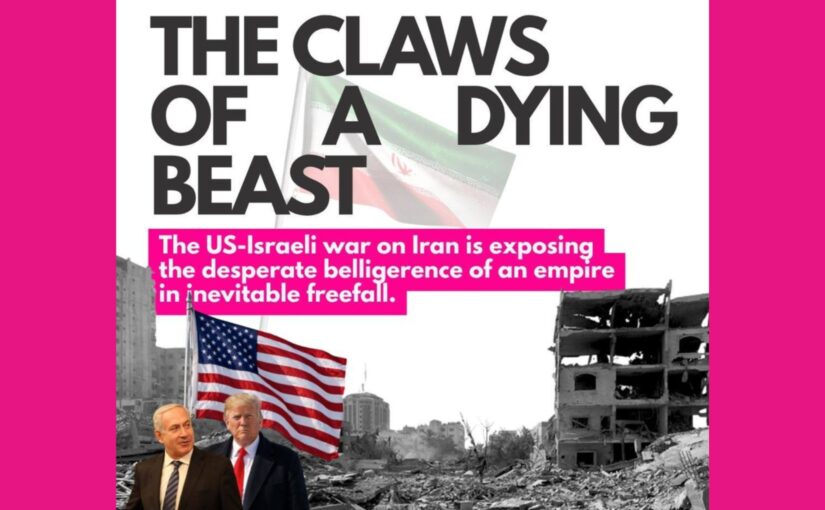
The latest US-Israeli war on Iran exposes the desperate belligerence of an empire in inevitable freefall.
It is a war decades in the making, completely aligned with Washington’s geopolitical maneuvering to perpetuate a unipolar world. This empire demands fealty from its vassal states and allies, without being able to articulate a rational strategy and objective. It claims self-defense while committing war crimes and breaking international law with impunity. Yet, somehow, behind the shock and awe tactics and tired propaganda tropes, the US seems utterly unprepared for the reality it has unleashed.
The joint US-Israel military strikes that began on February 28, 2026, were named “Operation Epic Fury” by the United States and “Operation Lion’s Roar” for Israel’s coordinated part of the attack, and were announced as “preemptive.” The narrative crafted by statements from US and Israeli officials precisely mirrored the US National Defense Strategy released on January 23, 2026. It positioned Iran as a key player in the “axis of resistance,” a threat to Israel and stability in the region, with intent to rebuild its military capacity and obtain nuclear weapons. In other words, this was a well-documented, premeditated “preemptive” strike.
The US trotted out tried-and-true propaganda tropes, weaponising a useful sector of the Iranian diaspora to cry ‘freedom’ as the bombs rained down. On the first day, Iranian media reported that a deadly strike hit a girls’ elementary school in southern Iran, resulting in over 150 casualties, mainly children. Despite this, the US persisted with its manufacturing consent playbook, a paint-by-numbers manipulative tactic any abuse victim would recognize: “Deny, Attack, Reverse Victim and Offender.”
When questioned about the incident, Trump responded, “Based on what I’ve seen, that was done by Iran.” Defense Secretary Pete Hegseth added, “The only side that targets civilians is Iran.”
Chaos ensued when video footage of a US Tomahawk missile hitting the school surfaced. Trump came across as an easily influenced, befuddled fool with a flair for making definitive statements that defy logic. By all accounts, it was a pretty weak attempt at manufacturing consent.
But that’s the point: public consent is not needed, just public confusion. These easily debunked talking points serve another purpose: they provide plausible deniability for world leaders scrambling to pledge allegiance to US imperialism.
Consider Keir Starmer, accused of cowardice by both pro-war and anti-war camps, stuttering into prostration before US imperial interests. Starmer initially blocked US access to British bases, then reversed within 48 hours, granting access for “defensive” operations after Trump attacked him as “no Winston Churchill.”
Mark Carney chose not to heed his own advice from his much-lauded Davos speech, where, while addressing Trump’s threats against Greenland, he urged restraint and warned against “the easy seduction of reckless escalation.” Weeks later, he backed the US war effort, albeit “with regret.”
But cracks are apparent in the imperial system.
The Spanish PM Pedro Sánchez provided a rare exception of dissent. After Trump threatened to cut off all trade with Spain, Sánchez stood firm, telling Portuguese Prime Minister Luis Montenegro: “This war is an extraordinary mistake that we will pay for.”
Trump should heed his words. The US entered the war falsely bolstered by the kidnapping of Venezuelan President Nicolás Maduro and First Lady Cilia Flores, which they perceived as a successful regime change operation. Early official statements asserted that the war would last “four to five weeks,” with Trump proclaiming on Truth Social on March 6, “There will be no deal with Iran except UNCONDITIONAL SURRENDER!” But reality requires a much more sober assessment.
Two wrenches in the US war machine need to be considered.
Despite an official defense budget approaching $1 trillion and plans to reach $1.5 trillion by 2027, the US’s ability to sustain prolonged military engagement is in question, its munitions stockpiles are being rapidly depleted in the Iran conflict, with an estimated $5.6 billion worth of weapons expended in just the first 48 hours of the assault. Military leaders have warned of potential ammunition shortages, even as the White House scrambles to quadruple production and requests a $50 billion supplemental budget to replenish depleted stocks.
The deeper vulnerability, however, lies in the supply chain, which remains dependent on materials controlled by China. Despite a November 2025 trade truce suspending certain export controls, Beijing retained full administrative discretion over rare earth exports and implemented strict rules in March 2026 that effectively block materials destined for US military purposes. Even rare earths mined elsewhere require Chinese approval if processed with Chinese technology or containing Chinese-origin materials. With alternative non-Chinese supply chains three to five years away, the Pentagon’s ability to replenish weapons stockpiles, from jet engine coatings to precision guidance systems, now requires Beijing’s permission.
Meanwhile, Iran, which has withstood decades of sanctions, military escalation, and intelligence interference, has supported Palestine and allied with Russia, China, North Korea, and other sovereign states. Not only has it prepared for this war, but as a key part of the axis of resistance, it has held the anti-imperialist line for the rest of us. Iran is ready.
While the mediasphere fragments the war’s causes into tiny pieces, “it’s really about China,” “the greater Israel plan,” “the Epstein list”, it’s really about the system that links these all together, imperialism.
Iran is fighting for its sovereignty, a fight every country must make if it seeks to exist outside of imperialist domination.
The US imperialist system is in an existential quagmire: capitalism requires imperialism, and imperialism requires unipolarity. The only trajectory is to keep trying to control the world, region by region, weakening China in the process to the point of final confrontation. In short, the empire must fight to survive, but every fight makes survival less likely.
US imperialists know that China will continue to rise; they assess that within five years China will have surpassed the West by every conceivable measure. By their calculation, if they don’t act now and reclaim their imagined rightful place as the master of the universe, they may never have that position again. But the truth is, a unipolar world with the US in prime position was never a natural or sustainable state.
So while those who have not yet accepted the inherent nature of imperialism blame this on just Trump, just Israel, the rest of us recognize that Trump and Netanyahu are merely the claws of a dying beast trapped in a cage of its own design.
The rest of us remember the tens of millions who have died in the name of US imperialism. And while we grieve for lives lost today and those to come, we know the Global South is building something new. A world defined not by bombastic slogans, but by the steady, even-keeled diplomacy China exemplifies, where sovereignty, development, and mutual respect are paramount.
A new world is on the horizon. And we have work to do to build it.