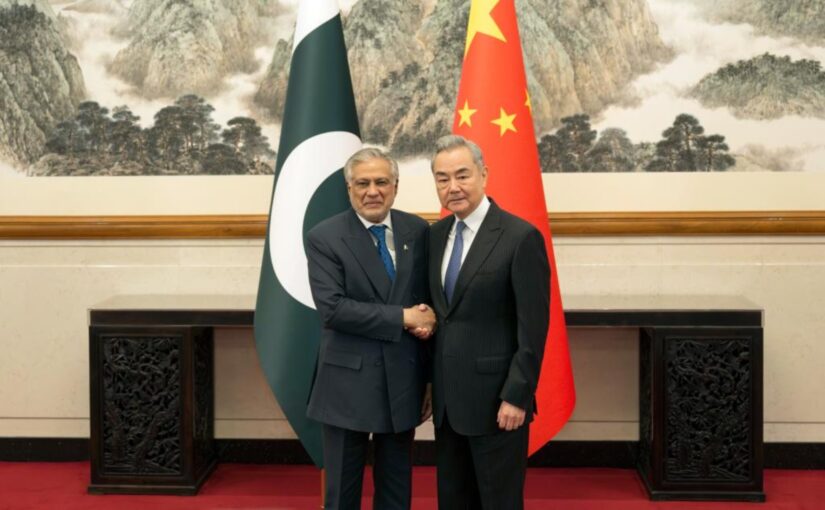
China and Pakistan have jointly launched a five-point peace initiative aimed at ending the US-Israeli war of aggression against Iran.
The move came as the centrepiece of a March 31 visit to Beijing by Pakistani Deputy Prime Minister and Foreign Minister Mohammad Ishaq Dar for talks with his Chinese counterpart Wang Yi.
At their meeting, Wang said that the mediation efforts of the Pakistani side regarding the conflict are in the common interests of all parties. China supports and looks forward to Pakistan playing a unique and important role in easing the situation and resuming peace talks. China is willing to make joint efforts with Pakistan to end the hostilities as soon as possible, create opportunities for peace and open the window for peace talks.
On bilateral ties, Wang said this year marks the 75th anniversary of the establishment of diplomatic relations between China and Pakistan, calling on both sides to implement the important consensus reached by the leaders of the two countries and constantly advance the building of a China-Pakistan community with a shared future.
For his part, Dar said the Pakistan-China friendship is precious and deeply rooted in people’s hearts, adding that Pakistan is willing to work with China to promote the continuous development of the all-weather strategic cooperative partnership between the two countries. He thanked China for supporting Pakistan’s mediation of the situation in Iran, adding that the current conflict has disrupted international energy supplies and caused heavy damage to developing countries.
Dar had earlier visited China, January 3-5. The two foreign ministers also held phone conversations on March 10 and March 27.
The five-point initiative calls for:
- Immediate Cessation of Hostilities. Humanitarian assistance must be allowed to all war-affected areas.
- Start of peace talks as soon as possible. Sovereignty, territorial integrity, national independence and security of Iran and the Gulf states should be safeguarded. China and Pakistan support the relevant parties in initiating talks, with all parties committing to peaceful resolution of disputes, and refraining from the use or the threat of use of force during peace talks.
- Security of nonmilitary targets. The principle of protecting civilians in military conflict should be observed. China and Pakistan call on parties to the conflict to immediately stop attacks on civilians and nonmilitary targets and to fully adhere to International Humanitarian Law (IHL), and stop attacking important infrastructure, including energy, desalination and power facilities, and peaceful nuclear infrastructure, such as nuclear power plants.
- Security of shipping lanes. China and Pakistan call on the parties to protect the security of ships and crew members stranded in the Strait of Hormuz, allow the early and safe passage of civilian and commercial ships, and restore normal passage through the Strait as soon as possible.
- Primacy of the United Nations Charter. China and Pakistan call for efforts to practice true multilateralism, to jointly strengthen the primacy of the UN, and to support the conclusion of an agreement for establishing a comprehensive peace framework and realising lasting peace based on the purposes and principles of the UN Charter and international law.
At a Chinese Foreign Ministry press conference on April 1, spokesperson Mao Ning said that the initiative is open and all countries and international organisations are welcome to respond to and participate in it.
As important countries in the Global South, China and Pakistan have voiced a rational and just position in the hope of building up greater consensus and pooling stronger efforts in the international community to contribute to easing the current tense situation, and restoring peace and tranquility in the Gulf and the Middle East region at an early date, she said, adding:
“China will continue to maintain close communication with Pakistan and all relevant parties to play a constructive role in promoting a ceasefire and ending the hostilities.”
Dar’s latest visit to Beijing follows immediately from a March 29 meeting in the Pakistani capital Islamabad of the foreign ministers of Pakistan, Saudi Arabia, Türkiye and Egypt, which expressed full support for Pakistan’s initiative to host peace talks between the United States and Iran in Islamabad.
In a televised address, Dar said that the meeting also decided to establish a committee comprising senior officials from the four foreign ministries to enhance coordination and explore avenues for deeper cooperation among the participating countries.
Speaking to the media, he said that both the United States and Iran have expressed confidence in Pakistan to facilitate potential talks, describing it as a positive development amid ongoing regional tensions. Pakistan was “very happy” with the trust shown by both sides, he said, adding that he had briefed ministers and delegates from Saudi Arabia, Egypt and Türkiye on the possibility of US-Iran dialogue in the Pakistani capital. Pakistan is willing to host and facilitate meaningful talks between the two sides in the coming days, for a comprehensive and lasting settlement of the ongoing conflict in the Middle East.
The evening before the quadrilateral meeting, Dar had spoken by phone with Iranian Foreign Minister Abbas Araghchi, promising that Pakistan will continue to support efforts aimed at restoring regional peace and stability. He later announced that Iran had agreed to allow 20 additional Pakistani-flagged ships to pass through the Strait of Hormuz, with two vessels scheduled to transit daily.
Friends of Socialist China co-editor Keith Bennett referred to the evolving situation in a speech delivered at the annual lunch of the British Pakistani Mayors Association on March 29. Having referred to the domestic political situation in Britain, he went on to say:
Of course, there is something far more important than whatever might happen on May 7 that I am sure is on the minds of all of us today. Just as it is on the minds of people throughout the world. And that is the intensified conflict in the Middle East, and indeed right on the land and sea borders of Pakistan, triggered by the illegal and unprovoked US-Israeli aggression against Iran.
So many innocent civilians are losing their lives. Not least the more than 170 people, the overwhelming majority of them young schoolgirls, slaughtered in the US bombing of the Shajareh Tayyebeh Elementary School on the first day of the aggression.
The conflict is spilling over throughout the entire region. And it is already wreaking havoc on the global economy. Something that will disproportionately affect the most vulnerable and fragile countries and societies and the poorest people on earth.
I think we should all commend the great efforts that Pakistan is making for peace. At present, Iran and the United States cannot even agree on whether or not they are talking with each other. This is hardly surprising considering that, twice in less than a year, Iran has been attacked in the middle of their negotiating in good faith.
But what we do know is that Pakistan is calmly and patiently liaising with both sides. Just as it did with China and the United States at the start of the 1970s, helping bring to fruition President Nixon’s historic visit to Beijing and Shanghai in February 1972 that changed the world.
Once again, we can see that even if Pakistan faces challenges in its own politics, economy and regional security, it is a responsible mid-level power that commands respect for its skillful diplomacy on the world stage.
Let us hope that Pakistan’s efforts at this time will be successful. And the sooner the better. The alternative may be too awful to contemplate.
The lunch was attended by, among others, British Pakistani Mayors, Deputy Mayors and councillors from the Labour, Conservative, Liberal Democrat and Green parties, and the Minister (Press) from the Pakistan High Commission in London.
The following articles were originally published by the Xinhua News Agency and on the website of the Chinese Foreign Ministry.
Pakistan’s mediation efforts in common interests of all parties: Chinese FM
BEIJING, March 31 (Xinhua) — Chinese Foreign Minister Wang Yi said on Tuesday that mediation efforts of the Pakistani side regarding the Middle East tensions are in the common interests of all parties.
Wang, also a member of the Political Bureau of the Communist Party of China Central Committee, made the remarks in his talks with Pakistani Deputy Prime Minister and Foreign Minister Mohammad Ishaq Dar in Beijing. During their talks, the two sides exchanged views on current international issues and regional conflicts.
Wang welcomed the visit of the Pakistani side to Beijing for discussion on easing tensions in the Middle East, just after its holding of a quadrilateral foreign ministers’ meeting in Islamabad.
He said China supports and looks forward to Pakistan playing a unique and important role in easing the situation and resuming peace talks. This process is no easy task, and Pakistan’s mediation efforts are in line with the common interests of all parties, Wang added.
He noted China is willing to make joint efforts with Pakistan to end the hostilities as soon as possible, create opportunities for peace and open the window for peace talks.
On bilateral ties, Wang said this year marks the 75th anniversary of the establishment of diplomatic relations between China and Pakistan, calling on both sides to implement the important consensus reached by the leaders of the two countries and constantly advance the building of a China-Pakistan community with a shared future.
For his part, Dar said the Pakistan-China friendship is precious and deeply rooted in people’s hearts, adding that Pakistan is willing to work with China to promote the continuous development of the all-weather strategic cooperative partnership between the two countries.
Dar thanked China for supporting Pakistan’s mediation of the situation in Iran, adding that the current conflict has disrupted international energy supplies and caused heavy damage to developing countries.
Noting that solutions can only be found through negotiation, Dar said Pakistan is willing to strengthen communication and coordination with China to push all parties to start peace talks as soon as possible and restore regional peace.
The two sides also put forward a five-point initiative for restoring peace and stability in the Gulf and the Middle East region.
Five-Point Initiative of China and Pakistan For Restoring Peace and Stability in the Gulf and Middle East Region
March 31 (MFA) – Member of the Political Bureau of the CPC Central Committee and the Minister of Foreign Affairs of the People’s Republic of China H.E. Mr. Wang Yi and Deputy Prime Minister/Foreign Minister of the Islamic Republic of Pakistan, Senator Mohammad Ishaq Dar met in Beijing on 31 March 2026 to review the situation in the Gulf and Middle East Region.
The two sides put forward the following:
I. Immediate Cessation of Hostilities: China and Pakistan call for immediate cessation of hostilities and utmost efforts to prevent the conflict from spreading. Humanitarian assistance must be allowed to all war-affected areas.
II. Start of peace talks as soon as possible. Sovereignty, territorial integrity, national independence and security of Iran and the Gulf states should be safeguarded. Dialogue and diplomacy is the only viable option to resolve conflicts. China and Pakistan support the relevant parties in initiating talks, with all parties committing to peaceful resolution of disputes, and refraining from the use or the threat of use of force during peace talks.
III. Security of nonmilitary targets. The principle of protecting civilians in military conflict should be observed. China and Pakistan call on parties to the conflict to immediately stop attacks on civilians and nonmilitary targets, and fully adhere to International Humanitarian Law (IHL), and stop attacking important infrastructure, including energy, desalination and power facilities, and peaceful nuclear infrastructure, such as nuclear power plants.
IV. Security of shipping lanes. The Strait of Hormuz, together with its adjacent waters, is an important global shipping route for goods and energy. China and Pakistan call on the parties to protect the security of ships and crew members stranded in the Strait of Hormuz, allow the early and safe passage of civilian and commercial ships, and restore normal passage through the Strait as soon as possible.
V. Primacy of the United Nations Charter. China and Pakistan call for efforts to practice true multilateralism, to jointly strengthen the primacy of the U.N., and to support the conclusion of an agreement for establishing a comprehensive peace framework and realizing lasting peace based on the purposes and principles of the U.N. Charter and international law.
China welcomes int’l participation in Middle East, Gulf region initiative
BEIJING, April 1 (Xinhua) — The China-Pakistan initiative on the Gulf and Middle East region is open, and all countries and international organizations are welcome to respond to and participate in it, Chinese foreign ministry spokesperson Mao Ning said on Wednesday.
China and Pakistan put forward a five-point initiative for restoring peace and stability in the Gulf and Middle East region during talks between Chinese Foreign Minister Wang Yi and Pakistani Deputy Prime Minister and Foreign Minister Mohammad Ishaq Dar in Beijing on Tuesday.
The five points are: immediate cessation of hostilities, starting peace talks as soon as possible, ensuring the security of nonmilitary targets and shipping lanes, and safeguarding the primacy of the United Nations Charter.
One month into the U.S.-Israeli war with Iran, its spillover effects have continued to spread, dealing an increasingly severe blow to regional and global peace and stability, Mao said at a regular news briefing.
These spillover effects have caused extensive disruptions to the stability of global energy supplies, the unimpeded operations of industrial and supply chains, and the development of the world economy, she said, adding this is not in the interest of regional countries and the wider world.
As important countries in the Global South, China and Pakistan have voiced a rational and just position in the hope of building up greater consensus and pooling stronger efforts in the international community to contribute to easing the current tense situation, and restoring peace and tranquility in the Gulf and the Middle East region at an early date, she said.
“China will continue to maintain close communication with Pakistan and all relevant parties to play a constructive role in promoting a ceasefire and ending the hostilities,” the spokesperson noted.
Quadrilateral FMs meeting backs Pakistan’s initiative to host U.S.-Iran talks
ISLAMABAD, March 29 (Xinhua) — Foreign ministers of Pakistan, Saudi Arabia, Türkiye and Egypt here on Sunday expressed full support for Pakistan’s initiative to host peace talks between the United States and Iran in Islamabad.
Pakistan’s Deputy Prime Minister and Foreign Minister Mohammad Ishaq Dar said in a televised message that participants agreed that dialogue and diplomacy remain the only viable path to achieving lasting peace and emphasized the need to prevent further military escalation in the Middle East.
Dar said he had briefed the visiting foreign ministers on the prospects of potential talks between the United States and Iran, noting that both sides have expressed confidence in Pakistan’s role as a facilitator.
Dar said that the meeting also decided to establish a committee comprising senior officials from the four foreign ministries to enhance coordination and explore avenues for deeper cooperation among the participating countries.
The meeting focused on the evolving regional situation and efforts to de-escalate tensions and end ongoing conflicts, said Dar, adding that the initiative received strong backing from all participating countries.
The ministers voiced concern over the humanitarian and economic impact of ongoing conflicts, saying the continuation of hostilities would only lead to further destruction and instability, said Dar.
Visiting foreign ministers reaffirmed their commitment to supporting efforts aimed at creating conditions for structured negotiations between relevant parties, said the Pakistani foreign minister who hosted the meeting.
U.S., Iran express confidence in Pakistan for talks: Pakistani FM
ISLAMABAD, March 29 (Xinhua) — Pakistan’s Foreign Minister Mohammad Ishaq Dar said here on Sunday that both the United States and Iran have expressed confidence in Pakistan to facilitate potential talks, describing it as a positive development amid ongoing regional tensions.
Speaking to the media after a quadrilateral meeting in Islamabad, Dar said Pakistan was “very happy” with the trust shown by both sides, adding that he had briefed ministers and delegates from Saudi Arabia, Egypt and Türkiye on the possibility of U.S.-Iran dialogue in the Pakistani capital.
Pakistan is willing to host and facilitate meaningful talks between the two sides in the coming days, for a comprehensive and lasting settlement of the ongoing conflict in the Middle East, he said.
He said the foreign ministers decided to constitute a committee of four senior officials from the respective foreign ministries to work out the modalities through mutual understanding and consensus.
Pakistani FM promises continued support to peace efforts in call with Iranian counterpart
ISLAMABAD, March 29 (Xinhua) — Pakistan’s Deputy Prime Minister and Foreign Minister Ishaq Dar held a telephone conversation late Saturday with Iranian Foreign Minister Abbas Araghchi, promising that Pakistan will continue to support efforts aimed at restoring regional peace and stability, the Pakistani foreign office said on Sunday.
The two sides reviewed the situation, with Dar stressing that dialogue and diplomacy remain the only viable path to lasting peace. He called for an end to all attacks and hostilities, reaffirming Pakistan’s commitment to peaceful engagement.
Dar announced on Sunday in a social media post that Tehran had agreed to allow 20 additional Pakistani-flagged ships to pass through the Strait of Hormuz, with two vessels scheduled to transit daily.
He described the move as a constructive gesture that could help ease tensions and promote regional stability.
The Strait of Hormuz, a key global energy corridor, remains under close watch amid heightened geopolitical tensions.