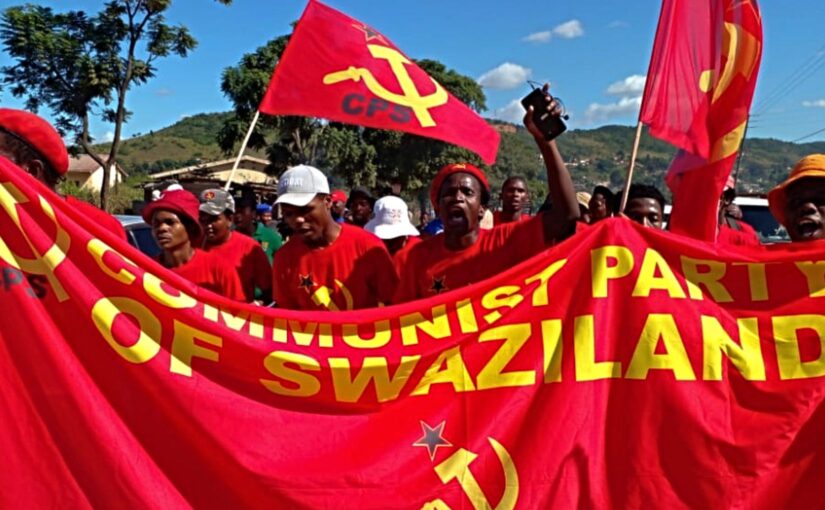
The communist parties of South Africa and Swaziland have strongly condemned the US plan to sell US$ 11 billion worth of arms to the separatist authorities in Taiwan and reaffirmed their full backing for the one-China principle.
In a January 3, 2026, statement, the South African Communist Party (SACP) said that the proposed package would represent one of the largest US weapons sales to Taiwan and the most drastic US imperialistic intervention in China’s domestic political matters in recent history. It would also grossly violate the one-China policy and the three China-US joint communiques, in addition to infringing China’s sovereignty, security and territorial integrity and underming peace and stability in the Taiwan Strait.
It added: “The SACP remains steadfast in its firm support of the one-China principle and China’s inalienable right to safeguard its national sovereignty and territorial integrity.”
In a December 29, 2025, statement, the Communist Party of Swaziland (CPS) noted: “To the Swazi people, the arming of the Taiwan administration represents not only interference in China’s internal affairs but also, direct reinforcement of the Mswati dictatorship. Such military supplies inevitably find their way into the hands of oppressive regimes, strengthening authoritarian rule and perpetuating human rights abuses in our country.”
It declared that the CPS “stands in firm solidarity with the Communist Party of China and the People’s Republic of China in all efforts to mobilise against this provocation.”
As indicated above, the proposed US action is of particular concern to the CPS. Swaziland is an absolute monarchy in which the CPS and other progressive and democratic forces have to struggle under condition of clandestinity and repression. It is also the only country in Africa that maintains so-called ‘diplomatic relations’ with the Taiwan authorities. [NOTE: King Mswati III changed the name of the country to Eswatini in April 2018 but this is not recognised by the CPS and other left-wing and progressive parties.]
Accordingly, on October 23, 2025, the CPS issued a perspectives paper on the Taiwan issue. It states that, “The CPS, as a Marxist-Leninist Party, adheres to principles that emphasise the importance of national sovereignty, anti-imperialism, and the unity of socialist states. The Party views the Taiwan issue through the lens of class struggle… [and] expresses strong solidarity with the PRC [People’s Republic of China], viewing it as a leading force in the global socialist movement.” The party’s support for the PRC’s stance on Taiwan aligns with its broader ideological commitment to socialism and the fight against imperialism. “The CPS strongly criticises any separatist movements in Taiwan, framing them as counter-revolutionary or influenced by foreign interests. We argue that such movements undermine the struggle for socialism and threaten the stability of the region.”
The perspectives note that: “By supporting the PRC’s position on Taiwan, the CPS argues that it contributes to regional stability in Southern Africa and Africa. We advocate for closer ties with other African nations that share similar views on sovereignty and territorial integrity, fostering a united front against perceived imperialist encroachments via the political base which Taiwan is establishing in Swaziland.”
The party’s advocacy for a unified stance on the Taiwan question, it argues, resonates with other political entities in Swaziland, where even ordinary people across ideological divides feel that the relationship with Taiwan, “only serves the interests of the monarchy and political elites. Setting out very well our stand on Taiwan will potentially lead to broader discussions on foreign policy and national identity for the future People’s Republic of Swaziland. This could create a political environment where socialist principles gain more traction in domestic discourse against imperialism.”
The party also highlights the economic implications of aligning with the PRC, emphasising the potential for increased and mutually beneficial investment, trade, and development collaboration with China and adds:
“The Party’s stance reflects a broader commitment to the principles of national sovereignty, anti-colonialism, and the pursuit of socialism on a global scale.”
The following articles were originally published by Solidnet and on the website of the Communist Party of Swaziland.
South African CP, SACP condemns proposed US weapons package to Taiwan, calls for respect of China’s national sovereignty
January 3 (Solidnet) – The South African Communist Party (SACP) condemns the proposed US massive arms package sale to Taiwan, valued at 11 billion dollars. If approved by the US Congress, this package would represent one of the largest US weapons packages to Taiwan and the most drastic US imperialistic intervention in China’s domestic political matters in recent history. It would also constitute one of the most aggressive actions of the US in Taiwan in violation of China’s sovereignty.
The intended arms sale would grossly violate the one-China policy and the three China-US joint communiques, in addition to infringing China’s sovereignty, security and territorial integrity and undermine peace and stability in the Taiwan Strait. The intended arms sale also sends an unfortunate and gravely wrong signal to “Taiwan independence” forces, wrongly interpreting a provincial, domestic internal dispute into an international question with diplomatic implications.
The SACP remains steadfast in its firm support of the one-China principle and China’s inalienable right to safeguard its national sovereignty and territorial integrity.
In the interest of international security and global stability, the SACP calls on all countries to respect the sovereignty of other states and to stand with the Chinese people in this instance where its sovereignty is being undermined by the imperialist US regime.
CPS calls for global mobilisation denouncing USA arms deal with the Taiwan region illegitimate separatists administration.
December 29 (CPS) – The Communist Party of Swaziland (CPS) strongly condemns the recent United States $11.1 billion arms package to the Taiwan
region of China. This provocative act constitutes a blatant violation of the One-China principle and undermines regional
stability and global peace.
It is common cause to believe that the USA is either effectively donating these arms to right-wing forces in Taiwan or
laying the basis for a military presence within Chinese territory. At no point can one be convinced that the bankrupt
and poorly managed separatist administration could sustain an $11.1 billion transaction. This deal will ultimately
become another costly imperialist war burden imposed on the ordinary people of the USA.
Historically, imperialist wars financed through massive US budgets have resulted in severe economic setbacks for working
people while simultaneously undermining global peace, economic stability, and universal justice.
To the Swazi people, the arming of the Taiwan administration represents not only interference in China’s internal affairs
but also direct reinforcement of the Mswati dictatorship. Such military supplies inevitably find their way into the hands
of oppressive regimes, strengthening authoritarian rule and perpetuating human rights abuses in our country.
Whether through so-called high-level diplomatic visits or direct military transfers, these criminal packages embolden
dictatorships at the expense of the people’s freedom. This mirrors US diplomatic trends toward Swaziland that have
consistently prioritised geopolitical interests over democracy and human rights.
The CPS stands in firm solidarity with the Communist Party of China and the People’s Republic of China in all efforts to
mobilise against this provocation. We call upon all progressive forces and peace-loving people worldwide to:
- Denounce US interference in China’s internal affairs.
- Support the One-China principle and China’s territorial integrity.
- Recognise that attacks on China’s sovereignty strengthen dictatorships everywhere.
- Build international solidarity against imperialist policies that arm oppressive and illegitimate regimes.
The struggle for Taiwan’s reunification with mainland China is inseparable from our own struggle for democracy in Swaziland. Imperialism abroad reinforces dictatorship at home. Only international solidarity can bring genuine liberation for all peoples.
Long live international solidarity!
Long live the People’s Republic of China!
Down with imperialism and dictatorship!
Communist Party of Swaziland’s (CPS) Perspectives on the Taiwan Question in Swaziland.
October 23 (CPS) – Overview of the Taiwan Question
The Taiwan question is a significant geopolitical issue that has persisted since the end of the Chinese Civil War in 1949. The island of Taiwan operates under its own government, known as the Republic of China (ROC), while the mainland is governed by the People’s Republic of China (PRC). Taiwan as a breakaway province that must be reunified with the mainland, while the separatist maintains a distinct political identity, with its own so called democratic institutions. The international community remains divided, with some countries recognizing the PRC and others maintaining unofficial relations with Taiwan.
Historical Context
1. Colonial and Post-Colonial Dynamics
Taiwan’s history is marked by periods of colonial rule, first under the Dutch, then the Qing Dynasty, and later Japanese occupation. After World War II, Taiwan was placed under the control of the Nationalist government, which fled to the island following its defeat by the Communists led revolution which needed the civil war. This historical backdrop has shaped Taiwan’s identity and its complex relationship with the mainland
2. Cold War Influences
During the Cold War, Taiwan became a focal point in the struggle between communist and capitalist ideologies. The United States supported the ‘ROC’ as a counterbalance to communist expansion in Asia, leading to a complicated diplomatic landscape. The PRC, in turn, sought to isolate Taiwan diplomatically, promoting the One China principle as a means to reclaim sovereignty over the island.
3. Recent Developments
In recent years, tensions have escalated as Taiwan has moved toward a more assertive identity, with increasing support for independence among some political factions. The PRC has responded with military posturing and diplomatic pressure, to resolve this complicated the situation.
Ideological Foundations of the CPS Position
1. Marxist-Leninist Principles
The CPS, as a Marxist-Leninist Party, adheres to principles that emphasize the importance of national sovereignty, anti-imperialism, and the unity of socialist states. The Party views the Taiwan issue through the lens of class struggle, asserting that any division among socialist movements weakens the global fight against capitalism.
2. Solidarity with the PRC
The CPS expresses strong solidarity with the PRC, viewing it as a leading force in the global socialist movement. Their support for the PRC’s stance on Taiwan aligns with their broader ideological commitment to socialism and the fight against imperialism.
3. Critique of Western Imperialism
The CPS frames its position on Taiwan within a broader critique of Western imperialism, arguing that support for Taiwan’s independence is part of a strategy by imperialist powers to weaken socialist states. This perspective emphasizes the need for unity among socialist and anti Imperialist countries and forces to resist external pressures.
Specific Stances and Advocacy
1. Support for the One China Policy
The CPS actively endorse the One China policy, advocating for international recognition of the PRC’s stand that Taiwan is part of China and there is one China whose only state administration is in Beijing. This stance reflects our commitment to national sovereignty and the belief that Taiwan’s status should be resolved through peaceful means, rather than through foreign interference which practically disrupts the peace process..
2. Criticism of Separatist Movements
The CPS strongly criticizes any separatist movements in Taiwan, framing them as counter-revolutionary or influenced by foreign interests. We argue that such movements undermine the struggle for socialism and threaten the stability of the region.
3. Educational and Cultural Initiatives
The CPS will engage in educational initiatives to raise awareness about the historical context of the Taiwan issue and promote narratives that align with our principled ideological stance. This will include organising seminars, producing publications, and leveraging social media to disseminate their views.
4. Diplomatic Advocacy
The CPS call upon the governments to put pressure to ISOLATE the Mswati regime which is the HARBOUR BASE of Taiwan administration in Africa. These governments must continue to of strengthen its diplomatic ties with the PRC. We will advocate for policies that align with the PRC’s interests in the region, potentially exposing the Swaziland foreign relations with other countries as hypocrite and scandalous.
5. Collaboration with Other Leftist Movements
The CPS seek alliances with other leftist parties and organizations globally and in the country that share a similar stance on the Taiwan question. This collaboration will involve joint statements, coordinated actions, and mutual support in international forums and campaigns for democracy in the country.
Broader Implications for Domestic and Foreign Policy
1. Expose tinkundla and Mswatis Disastrous Foreign Relations
The CPS’s position on the Taiwan question significantly influence the struggle for democracy in Swaziland to assume a posture of One China Policy. This shift will weaken the strong ties that exist between the Mswati dictatorship and Taiwan , particularly given the growing influence of China in Africa whose positive outlook bypasses the people of Swaziland presently.
2. Regional Stability and Cooperation
By supporting the PRC’s position on Taiwan, the CPS argues that it contributes to regional stability in Southern Africa and Africa. We advocate for closer ties with other African nations that share similar views on sovereignty and territorial integrity, fostering a united front against perceived imperialist encroachments via the political base which Taiwan is establishing in Swaziland.
3. Impact on Local Political Dynamics
The CPS’s advocacy for a unified stance on the Taiwan question resonates with other political entities in Swaziland where even ordinary people across ideological divide, feels the Taiwan/tinkundla relationships only serves the interests of the monarchy and political elites. Setting up very well our stand on Taiwan will potentially lead to broader discussions on foreign policy and national identity for the future People’s Republic of Swaziland. This could create a political environment where socialist principles gain more traction in domestic discourse against Imperialism.
4. Economic Considerations
The CPS highlight the economic implications of aligning with the PRC, emphasizing the potential for increased investment, trade, and development mutually benefiting collaboration with China. This economic dimension is our persuasive argument for supporting the PRC’s over Taiwan.
5. Human development and Governance:
While advocating for solidarity with the PRC, the CPS promotes the achievements of the PRC government on improving the lives of ordinary people, ending poverty and improve Human development index with a stable and efficient governance and production ethics and cultural practices. The Party navigates these complexities while maintaining its ideological stance, potentially exposing criticisms of the PRC as part of an imperialist narrative which only entrenches the Mswati dictatorship and Taiwan colonial hegemony in our country.
Conclusion
The Communist Party of Swaziland’s position on the Taiwan question is deeply rooted in its Marxist-Leninist ideology, emphasizing solidarity with the PRC and opposition to perceived imperialist interventions. By advocating for the One China policy and criticizing separatism, the CPS seeks to align the struggle for democracy in Swaziland to the popular anti Imperialist campaigns to influence foreign policy with its ideological commitments, which have significant implications for the future democratic Swaziland diplomatic relations and regional dynamics. The Party’s stance reflects a broader commitment to the principles of national sovereignty, anti-colonialism, and the pursuit of socialism on a global scale. As the situation evolves, the CPS will continue to navigate the complexities of international relations while promoting its ideological clarity to explain with clarity these dynamics to the majority of our population.






Thank you, SACP and CPS!