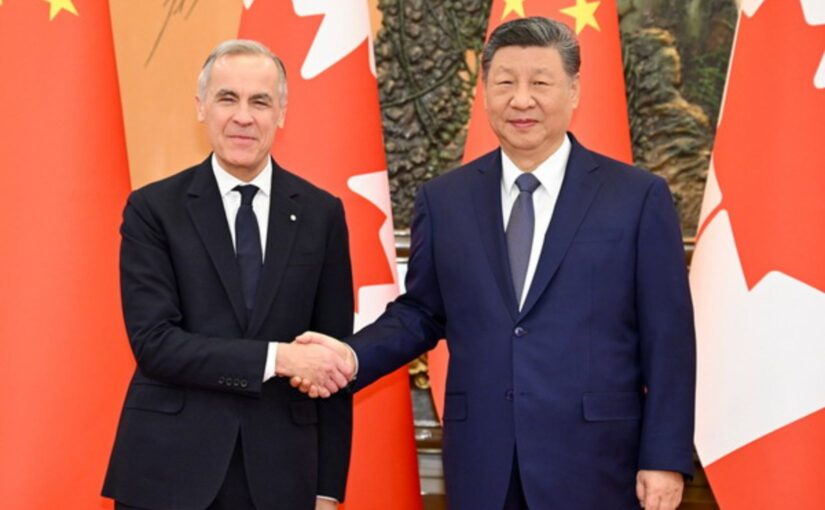
Canadian Prime Minister Mark Carney paid an official visit to China from January 13-17 at the invitation of his Chinese counterpart Li Qiang. It was the first China visit by a Canadian head of government in eight years, and all reports indicate that it may be considered as marking a definitive start to a new chapter in mutually respectful and beneficial relations following a sharp downturn in traditionally friendly ties occasioned by the supine approach taken to US imperialism by Carney’s predecessor Justin Trudeau.
Capitulating to US demands, in December 2018, Canada had arrested Chief Financial Officer of telecommunications firm Huawei, Meng Wanzhou, whilst she was in transit to Mexico. After a persistent struggle, she was finally able to return home in September 2021.
Despite such craven behaviour on the part of his northern neighbour, President Donald Trump’s reward has been to threaten Canada with annexation as the “51st state” and to subject the country to arbitrary and punitive tariffs and other forms of pressure.
Previewing Carney’s Beijing visit, the Chinese newspaper Global Times quoted Li Haidong, a professor at the China Foreign Affairs University, as noting that, “China and Canada have long shared strong economic complementarity and close people-to-people ties, but in recent years under former Prime Minister Justin Trudeau, Canada’s China policy veered off course under ideological influence and excessive alignment with US policy. Since Mark Carney took office, Canada has gone through a process of serious reassessment. As major changes in US policy have shattered Canada’s previous illusions, Ottawa has begun to shed some of the constraints and ideological biases that previously limited its China policy.”
In a 12 January commentary published by CGTN, Professor Radhika Desai of the University of Manitoba noted that Carney, “is visiting China while the US is breathing threateningly and aggressively down Canada’s neck in its Trump II rogue avatar in the most unwelcome way possible.”
She adds that: “Canadians gave Carney’s Liberal Party an overwhelming mandate just last spring to pry Canada loose from the clutches of the US and diversify the country’s economic relations. The logical implication of deepening relations with China would be non-controversial were it not for sections of the political and corporate class which prefer to kowtow to Trump’s bullying.”
At the same time, she cautions that: “Canada remains part of the imperial world. Although without formal colonies, it is a settler-colonial society ensconced for centuries in a very favourable niche in the imperial system. As such, it has difficulty facing up to today’s multipolar world in which non-Western powers, preeminently China, loom large, while at the same time nursing the illusion that closer relations with the UK and the EU could suffice as an alternative to the US.”
Nevertheless, “closer relations between China and Canada will be to the mutual benefit of Canadians and Chinese… While Canada’s very deep entanglement with the US, in economic terms, not to mention security terms, will make progress in advancing China-Canada economic relations difficult, the urgency of diversifying away from the US is unlikely to diminish, and China is Canada’s most attractive option.”
President Xi Jinping met with Prime Minister Carney on the morning of January 16.
According to the report of the Chinese Foreign Ministry, President Xi pointed out that his meeting with Prime Minister Carney in Gyeongju, Republic of Korea (ROK), last October marked a turnaround of the relationship and placed it on a new trajectory of positive development.
The sound and steady growth of China-Canada relations serves the common interests of the two countries and contributes to peace, stability, development and prosperity in the world. With a sense of responsibility for history, for the people and for the world, the two sides should advance the China-Canada new Strategic Partnership, steer their ties onto the track of sound, steady and sustainable development, and bring more benefits to both peoples.
President Xi made four points in this regard:
- The two countries should be partners that respect each other. Since diplomatic ties began 55 years ago, the relationship has weathered storms and gone through ups and downs. History offers valuable lessons and inspiration for the present. While China and Canada have different national circumstances, they should respect each other’s sovereignty and territorial integrity, as well as choice of political system and development path, and adopt the right approach in their interactions.
- The two countries should be partners that pursue shared development. The China-Canada economic and trade relations are characterised by mutual benefit and win-win, and both sides stand to gain from cooperation. China’s pursuit of high-quality development at home and high-standard opening up to the world will continually unlock new opportunities and space for China-Canada cooperation. The two sides should lengthen the list of cooperation while shortening the list of irritants and keep strengthening the bond of common interests with more deep-going and extensive cooperation.
- The two countries should be partners that trust each other. People-to-people understanding is the most foundational, solid and enduring way for countries to build connections. China and Canada should encourage stronger exchanges and cooperation in education, culture, tourism, and sports and at subnational levels, and facilitate two-way travel to entrench public support for strong ties.
- The two countries should be partners that collaborate with each other. A divided world cannot handle the common challenges facing humanity. The true solution lies in upholding and practicing true multilateralism and building a community with a shared future for humanity. China is prepared to strengthen communication and coordination with Canada in the UN, G20, APEC, etc. to tackle various global challenges.
Prime Minister Carney noted that with a long history of friendly engagement and strong economic complementarity, Canada and China enjoy extensive common interests and opportunities. Canada wishes to build with China a new Strategic Partnership that is strong and enduring so as to deliver greater benefits to the two peoples. Under the leadership of President Xi, China has seen rapid economic growth and made significant progress in innovation, which provide strong impetus for global growth. The Canadian side reaffirms the one-China policy. It is committed to working with China in the spirit of mutual respect and partnership to expand and strengthen cooperation in economy and trade, energy, agriculture, finance, education, climate change, etc. Multilateralism underpins global security and stability, and the Global Governance Initiative put forward by President Xi is important. Facing a fast-changing and turbulent world, Canada would like to intensify multilateral coordination with China to uphold multilateralism and the authority of the UN and to promote international peace and stability.
A report on the website of the Canadian Prime Minister said that Prime Minister Carney and President Xi jointly announced a new Canada-China strategic partnership, comprised of five pillars: energy, economic and trade cooperation, public safety and security, multilateralism, and culture and people-to-people ties. The leaders agreed that these are areas where Canada and China can work together constructively to create more stability, security, and prosperity for their peoples. In particular, they acknowledged the strategic opportunities in energy – both conventional and clean – to drive the low-carbon economy, increase energy security, and create high-paying careers.
Prime Minister Carney highlighted the importance of reinforcing economic resilience between the two countries, including through revitalised bilateral mechanisms such as the Economic and Financial Strategic Dialogue and the Ministerial Dialogue on Energy, which will reinforce trade and economic relations.
The leaders also welcomed the significant progress made on resolving trade irritants and market access challenges, including for Canadian agriculture and agri-food products such as canola and seafood, and Chinese electric vehicles.
The Prime Minister and the President affirmed their commitment to multilateralism and to addressing pressing global issues, such as environmental protection and climate change, and the international monetary and financial system.
Both leaders recognised how long-standing people-to-people ties have been foundational to the depth and breadth of Canada-China relations. Prime Minister Carney acknowledged the contribution of those deep roots to Canada’s multicultural fabric and welcomed enhanced cooperation in the areas of culture, tourism, and education.
Prime Minister Carney looks forward to his return visit to China in November for the APEC Leaders’ Summit in Shenzhen and the two leaders agreed to remain in close contact.
A joint Canada-China statement committed the two sides to strengthening exchanges at all levels and to advancing outcomes in the following areas:
- Macroeconomic engagement
- Economic and trade cooperation
- Energy
- Finance – This included an Agreement to Extend and Amend the Chinese Yuan/Canadian Dollar Bilateral Currency Swap Arrangement between the People’s Bank of China and the Bank of Canada.
- People-to-people ties and cultural exchanges. The two sides concurred that people-to-people ties are the foundation of the bilateral relationship and committed to fostering these ties to promote greater mutual understanding and cooperation. The two sides decided to restart the China-Canada Joint Committee on Culture. They also committed to strengthening exchanges and cooperation in areas such as culture, education, arts, heritage, creative industries and to promoting legislative and subnational exchanges; and
- Multilateralism. The two sides reaffirmed their commitment to multilateralism, supporting the central role of the United Nations in international affairs, safeguarding and improving the rulesbased multilateral trading system underpinned by the World Trade Organisation (WTO), and keeping global industrial and supply chains stable and smooth. Canada supports China’s hosting of the 2026 AsiaPacific Economic Cooperation (APEC) meetings and looks forward to a successful APEC year and appreciates China’s support for Canada’s offer to host in 2029. The two sides will look for opportunities to enhance exchanges and cooperation within the G20 and committed to deepening cooperation on climate and the environment, including under the frameworks of the Ministerial on Climate Action (MoCA), the China Council for International Cooperation on Environment and Development (CCICED), and the Kunming-Montreal Global Biodiversity Framework (GBF), as well as under the Memorandum of Understanding on Climate Change Cooperation and the Memorandum of Understanding Concerning Environmental Cooperation.
The previous day, Carney had met separately with Premier Li Qiang and with Chairman of the Standing Committee of the National People’s Congress (NPC) Zhao Leji.
Meeting with Li Qiang, the Chinese Premier said that with the joint efforts of the two sides, the China-Canada relationship has achieved a turnaround, which has been widely welcomed by people from all sectors of both countries. Maintaining the sound and stable development of China-Canada relations serves the common interests of both nations. Standing at a new starting point, China is ready to work with Canada to uphold the strategic partnership, strengthen dialogue and communication, enhance political mutual trust, respect each other’s core interests, seek common ground while shelving and resolving differences, continuously expand practical cooperation, and add more impetus to the development of both countries.
Li Qiang noted that China and Canada enjoy strong economic complementarity, and bilateral cooperation is driven by robust endogenous dynamism and holds vast potential. China is ready to further synergise development strategies with Canada, continue to resume and advance exchanges across various fields and levels, make good use of bilateral governmental dialogue mechanisms in economy, trade, science and technology, agriculture and other areas, promote stable growth in bilateral trade, and enhance trade facilitation. Both sides should deepen cooperation in areas such as clean energy, digital technology, modern agriculture, aviation and aerospace, advanced manufacturing and finance, to foster more new drivers of economic growth. The Chinese side welcomes more Canadian companies to invest in China and hopes that the Canadian side will provide a fair and non-discriminatory business environment for Chinese enterprises investing in Canada. Both sides should continue to actively support exchanges and cooperation in education, culture, tourism, sports, youth affairs, and sub-national interactions, facilitate cross-border travel, and carry forward and deepen the friendship between the peoples of the two countries.
Mark Carney said that the relationship between Canada and China has a long history. Canada was one of the first Western countries to recognise the People’s Republic of China. Since the establishment of diplomatic relations, the Canadian government has always firmly adhered to the one-China policy. Canada is willing to strengthen dialogue with China in various fields on the basis of mutual respect, leverage complementary advantages, and promote cooperation in areas such as economy, trade, energy, green economy, agriculture, and people-to-people exchanges. Chinese companies are welcome to invest and do business in Canada, and Canadian enterprises are fully confident in deepening cooperation with the Chinese side. Amid the profound changes in the current international situation, Canada is willing to enhance communication and collaboration with China, jointly support the United Nations in playing a central role in international affairs, safeguard the multilateral trading system, defend multilateralism, and promote world peace, stability and prosperity.
A short report was also carried on the website of the Canadian Prime Minister.
In his meeting, Zhao Leji said China is willing to work with Canada to implement the important common understandings reached by the leaders of the two countries, respect each other’s core interests and major concerns, strengthen mutually beneficial cooperation and people-to-people exchanges, and promote the sound, stable and sustainable development of bilateral relations. The NPC of China is willing to enhance friendly exchanges with the Parliament of Canada, carry out experience sharing on legislation, supervision and other work, and provide legal safeguards for practical cooperation in various fields.
Mark Carney said that the relations between Canada and China have made considerable progress. Canada firmly adheres to the one-China policy and is willing to deepen cooperation with China in areas such as energy, agriculture, supply chain and people-to-people exchanges, enhance exchanges between the legislative bodies of the two countries, and elevate Canada-China relations to a higher level.
A report on the website of the Canadian Prime Minister noted that they underscored their ongoing support for robust people-to-people relations and cultural exchanges, and welcomed engagement to deepen cooperation, expand trade, and engage pragmatically.
A further article on Carney’s website said that: “In a more divided and uncertain world, Canada is building a stronger, more independent, and more resilient economy. To that end, Canada’s new government is working with urgency and determination to diversify our trade partnerships and catalyse massive new levels of investment. As the world’s second-largest economy, China presents enormous opportunities for Canada in this mission.”
Saying that the visit had created a new bilateral partnership, it continued:
“Central to this new partnership is an agreement to collaborate in energy, clean technology, and climate competitiveness. Canada and China are both energy superpowers focused on expanding two-way energy cooperation – reducing emissions and scaling up investments in batteries, solar, wind, and energy storage. While in Beijing, the Prime Minister met business leaders in energy and clean technology to identify and accelerate Chinese investment opportunities in Canada.
“To help deliver the full potential of these partnerships, and build up our domestic manufacturing sector, Canada will allow up to 49,000 Chinese electric vehicles (EV) into the Canadian market, with the most-favoured-nation tariff rate of 6.1%. This amount corresponds to volumes in the year prior to recent trade frictions on these imports (2023-2024), representing less than 3% of the Canadian market for new vehicles sold in Canada. It is expected that within three years, this agreement will drive considerable new Chinese joint-venture investment in Canada with trusted partners to protect and create new auto manufacturing careers for Canadian workers and ensure a robust build-out of Canada’s EV supply chain. With this agreement, it is also anticipated that, in five years, more than 50% of these vehicles will be affordable EVs with an import price of less than $35,000, creating new lower-cost options for Canadian consumers.”
It further claimed that agreements in the agri-food sector will help unlock nearly $3 billion in export orders for Canadian workers and businesses as they realise the full potential of the massive Chinese market of 1.4 billion people. And Canada has set an ambitious goal to increase exports to China by 50% by 2030.
Additionally, Canada and China will also explore further opportunities for cultural exchanges and partnerships, including supporting museums, digital content creators, and visual artists, to increase travel exchanges and cultural ties. Prime Minister Carney welcomed the agreement between Destination Canada and China Media Group to facilitate further outbound tourism to Canada, especially as Canada prepares to co-host the FIFA World Cup in 2026. The Prime Minister also welcomed President Xi’s commitment to introducing visa-free access for Canadians travelling to China.
Following his China trip, Carney proceeded with a visit to Qatar, to be followed by participation in the World Economic Forum (WEF) in Davos, Switzerland.
The following articles were originally published on CGTN and on the websites of the Chinese Foreign Ministry and the Prime Minister of Canada.
Will Carney reset China-Canada relations?
January 12 (CGTN) – The first visit of a Canadian Prime Minister to Beijing in nearly a decade is, unsurprisingly, given China’s centrality to the world economy, much discussed and debated in the Canadian media. However, it is not just that Mark Carney is visiting the world’s second-largest economy. There are at least a few other reasons.
First, he is visiting China while the U.S. is breathing threateningly and aggressively down Canada’s neck in its Trump II rogue avatar in the most unwelcome way possible, all sticks and no carrots.
Moreover, Canadians gave Carney’s Liberal Party an overwhelming mandate just last spring to pry Canada loose from the clutches of the U.S. and diversify the country’s economic relations. The logical implication of deepening relations with China would be non-controversial were it not for sections of the political and corporate class which prefer to kowtow to Trump’s bullying.
They dress up this abjection in the garb of Canada’s “shared values” with the West, even as the Trump administration rides roughshod over them and portray China as a serial violator of human rights, trade rules and the integrity of Canada’s political process.
Furthermore, Carney’s Beijing trip is a hot topic because, over the past nearly four decades, Canada’s rulers have chosen to cozy up to the U.S. This went against the caution, sounded by many progressive economists as early as the 1960s, that Canada had become too dependent on the U.S., practically a colony hosting U.S. “branch plants” and “silently surrendering” its economic sovereignty.
Unheeding, Canada’s rulers concluded the 1988 U.S.-Canada Free Trade Agreement, and then the 1994 North American Free Trade Agreement (NAFTA). They got a rude shock when, thanks to the U.S.’s internal political crisis, itself prompted by its economic decline, Trump won two elections on an anti-trade, “America First” platform. In his first term, he tore up NAFTA and forced concessions from Canada and Mexico in the new U.S.-Mexico-Canada Agreement.
Carney is visiting China amid a further re-negotiation of that treaty, Trump’s threats about making Canada the 51st U.S. state, taking over Greenland on Canada’s northwestern flank, imposing tariffs and demanding increased military spending.
All this must be faced when, thanks to decades of ever-closer relations with the U.S., Canada has an extremely externalized economy with a 65.18 percent trade to GDP ratio in 2024, and 67.3 percent of its exports going to the U.S. as of October 2025.
Finally, while the issue of the diversification of Canada’s international economic relations has been placed more urgently on the agenda than ever before, and with Canadians truly turned off by the Trump administration, China is among Canada’s best prospects.
However, Canada remains part of the imperial world. Although without formal colonies, it is a settler-colonial society ensconced for centuries in a very favorable niche in the imperial system. As such, it has difficulty facing up to today’s multipolar world in which non-Western powers, preeminently China, loom large, while at the same time nursing the illusion that closer relations with the UK and the EU could suffice as an alternative to the U.S.
While these five weighty reasons make Carney’s visit to China controversial, they also constitute reasons why closer relations between China and Canada will be to the mutual benefit of Canadians and Chinese.
China is not just one of the world’s most important countries; it is the rising one, while the U.S. is the declining one. While the U.S.’s loss of capabilities and options has reduced Trump to increasingly desperate, destructive and dangerous actions, on the world stage generally and towards Canada, China has emerged as an oasis of stability, predictability and economic, financial and technological prowess.
During the last trip by former Canadian Prime Minister Justin Trudeau to Beijing in 2017, while hopes of a free trade agreement were dashed on his liberal hubris about Western values and his government’s evidence-free accusations against China on human rights and trade, the one salutary effect of the Trump presidency has been to undermine and expose such Western hypocrisy. Carney can use the resulting freedom and deal with China openly and objectively.
While Canada’s very deep entanglement with the U.S., in economic terms, not to mention security terms, will make progress in dvancing China-Canada economic relations difficult, the urgency of diversifying away from the U.S. is unlikely to diminish, and China is Canada’s most attractive option.
Hard as it may seem for Canadians to contemplate closer relations with non-Western countries, appearances can be deceptive. Quite apart from China’s many economic attractions, as the world’s oldest continuous civilization, China has much to offer Canada and the world, not just economically but also culturally, a fact that will be easier for today’s highly diverse Canadian population to recognize than ever before.
President Xi Jinping Meets with Canadian Prime Minister Mark Carney
January 16 (MFA) – The first visit of a Canadian Prime Minister to Beijing in nearly a decade is, unsurprisingly, given China’s centrality to the world economy, much discussed and debated in the Canadian media. However, it is not just that Mark Carney is visiting the world’s second-largest economy. There are at least a few other reasons.
First, he is visiting China while the U.S. is breathing threateningly and aggressively down Canada’s neck in its Trump II rogue avatar in the most unwelcome way possible, all sticks and no carrots.
Moreover, Canadians gave Carney’s Liberal Party an overwhelming mandate just last spring to pry Canada loose from the clutches of the U.S. and diversify the country’s economic relations. The logical implication of deepening relations with China would be non-controversial were it not for sections of the political and corporate class which prefer to kowtow to Trump’s bullying.
They dress up this abjection in the garb of Canada’s “shared values” with the West, even as the Trump administration rides roughshod over them and portray China as a serial violator of human rights, trade rules and the integrity of Canada’s political process.
Furthermore, Carney’s Beijing trip is a hot topic because, over the past nearly four decades, Canada’s rulers have chosen to cozy up to the U.S. This went against the caution, sounded by many progressive economists as early as the 1960s, that Canada had become too dependent on the U.S., practically a colony hosting U.S. “branch plants” and “silently surrendering” its economic sovereignty.
Unheeding, Canada’s rulers concluded the 1988 U.S.-Canada Free Trade Agreement, and then the 1994 North American Free Trade Agreement (NAFTA). They got a rude shock when, thanks to the U.S.’s internal political crisis, itself prompted by its economic decline, Trump won two elections on an anti-trade, “America First” platform. In his first term, he tore up NAFTA and forced concessions from Canada and Mexico in the new U.S.-Mexico-Canada Agreement.
Carney is visiting China amid a further re-negotiation of that treaty, Trump’s threats about making Canada the 51st U.S. state, taking over Greenland on Canada’s northwestern flank, imposing tariffs and demanding increased military spending.
All this must be faced when, thanks to decades of ever-closer relations with the U.S., Canada has an extremely externalized economy with a 65.18 percent trade to GDP ratio in 2024, and 67.3 percent of its exports going to the U.S. as of October 2025.
U.S. President Donald Trump (R) meets with Canadian Prime Minister Mark Carney (L) in the Oval Office of the White House in Washington, D.C., the U.S., October 7, 2025. /CFP
U.S. President Donald Trump (R) meets with Canadian Prime Minister Mark Carney (L) in the Oval Office of the White House in Washington, D.C., the U.S., October 7, 2025. /CFP
Finally, while the issue of the diversification of Canada’s international economic relations has been placed more urgently on the agenda than ever before, and with Canadians truly turned off by the Trump administration, China is among Canada’s best prospects.
However, Canada remains part of the imperial world. Although without formal colonies, it is a settler-colonial society ensconced for centuries in a very favorable niche in the imperial system. As such, it has difficulty facing up to today’s multipolar world in which non-Western powers, preeminently China, loom large, while at the same time nursing the illusion that closer relations with the UK and the EU could suffice as an alternative to the U.S.
While these five weighty reasons make Carney’s visit to China controversial, they also constitute reasons why closer relations between China and Canada will be to the mutual benefit of Canadians and Chinese.
China is not just one of the world’s most important countries; it is the rising one, while the U.S. is the declining one. While the U.S.’s loss of capabilities and options has reduced Trump to increasingly desperate, destructive and dangerous actions, on the world stage generally and towards Canada, China has emerged as an oasis of stability, predictability and economic, financial and technological prowess.
During the last trip by former Canadian Prime Minister Justin Trudeau to Beijing in 2017, while hopes of a free trade agreement were dashed on his liberal hubris about Western values and his government’s evidence-free accusations against China on human rights and trade, the one salutary effect of the Trump presidency has been to undermine and expose such Western hypocrisy. Carney can use the resulting freedom and deal with China openly and objectively.
While Canada’s very deep entanglement with the U.S., in economic terms, not to mention security terms, will make progress in dvancing China-Canada economic relations difficult, the urgency of diversifying away from the U.S. is unlikely to diminish, and China is Canada’s most attractive option.
Hard as it may seem for Canadians to contemplate closer relations with non-Western countries, appearances can be deceptive. Quite apart from China’s many economic attractions, as the world’s oldest continuous civilization, China has much to offer Canada and the world, not just economically but also culturally, a fact that will be easier for today’s highly diverse Canadian population to recognize than ever before.
Prime Minister Carney meets with President of the People’s Republic of China Xi Jinping
January 16 (Prime Minister of Canada) – Today, the Prime Minister, Mark Carney, met with the President of the People’s Republic of China, Xi Jinping, as part of his first official visit to China.
The leaders focused on renewing the relationship between Canada and China in the face of a changing global economy and international security challenges.
Prime Minister Carney and President Xi jointly announced a new Canada-China strategic partnership, comprised of five pillars: energy, economic and trade cooperation, public safety and security, multilateralism, and culture and people-to-people ties. The leaders agreed that these are areas where Canada and China can work together constructively to create more stability, security, and prosperity for their peoples. In particular, they acknowledged the strategic opportunities in energy – both conventional and clean – to drive the low-carbon economy, increase energy security, and create high-paying careers.
To this end, the leaders welcomed a series of memorandums of understanding across energy, combatting crime, modern wood construction, culture, and food safety and plant and animal health that provide the foundation for the new strategic partnership.
Prime Minister Carney highlighted the importance of reinforcing economic resilience between the two countries, including through revitalised bilateral mechanisms such as the Economic and Financial Strategic Dialogue and the Ministerial Dialogue on Energy, which will reinforce trade and economic relations.
The leaders also welcomed the significant progress made on resolving trade irritants and market access challenges, including for Canadian agriculture and agri-food products such as canola and seafood, and Chinese electric vehicles.
The Prime Minister and the President affirmed their commitment to multilateralism and to addressing pressing global issues, such as environmental protection and climate change, and the international monetary and financial system.
Both leaders recognised how long-standing people-to-people ties have been foundational to the depth and breadth of Canada-China relations. Prime Minister Carney acknowledged the contribution of those deep roots to Canada’s multicultural fabric and welcomed enhanced cooperation in the areas of culture, tourism, and education.
Prime Minister Carney welcomed plans to deepen engagement on national security issues at senior levels, highlighting opportunities to work together on security issues of mutual concern, including narcotics trafficking and cybercrime.
Prime Minister Carney looks forward to his return visit to China in November for the APEC Leaders’ Summit in Shenzhen.
The leaders agreed to remain in close contact.
Joint Statement of the China-Canada Leaders’ Meeting
January 16 (MFA) – At the invitation of His Excellency Li Qiang, Premier of the State Council of the People’s Republic of China, the Right Honourable Mark Carney, Prime Minister of Canada, paid an official visit to China from 14-17 January 2026. During the visit, His Excellency Xi Jinping, President of the People’s Republic of China, met with Prime Minister Carney. Premier Li Qiang held talks with Prime Minister Mark Carney. His Excellency Zhao Leji, Chairman of the Standing Committee of the National People’s Congress also met with Prime Minister Mark Carney. Leaders exchanged views on China-Canada relations, as well as regional and international issues of common interest in an in-depth, pragmatic and constructive manner.
Leaders reaffirmed the principles and policies that have guided ChinaCanada relations. Canada reaffirmed its long-standing commitment to its One China policy. The two sides committed to advancing the ChinaCanada new Strategic Partnership in the spirit of mutual respect, equality, and mutual benefit to bring more positive outcomes to both peoples.
Leaders welcomed the progress made in recent bilateral dialogues. They committed to strengthening exchanges at all levels and to advancing outcomes in the following areas:
—Macroeconomic engagement. The two sides decided to reinvigorate the highlevel China-Canada Economic and Financial Strategic Dialogue (EFSD) to discuss wide ranging related issues to strengthen bilateral economic relations.
—Economic and trade cooperation. Leaders committed to strengthening economic and trade partnership between China and Canada and welcomed progress in the negotiations to resolve trade issues. The two sides committed to expanding bilateral trade, strengthening two-way investment, and deepening cooperation in diverse sectors of mutual interest. The two sides reaffirmed the importance of a fair and open business environment for enterprises of both countries, and committed to addressing economic and trade issues of mutual concern through constructive consultation, including through a renewed China-Canada Joint Economic and Trade Commission (JETC). Leaders welcomed the signing of the ChinaCanada Economic and Trade Cooperation Roadmap, and instructed officials to advance the work related to the document. The two sides developed a preliminary joint arrangement to address bilateral economic and trade issues. The two sides committed to strengthening agricultural cooperation and food security, including through a revitalized ChinaCanada Joint Agriculture Committee.
—Energy. The two sides concurred to support exchanges and cooperation in clean energy, and strengthen cooperation in conventional energy such as oil and gas resource development. The two sides decided to launch a Ministerial Energy Dialogue to outline key areas to support twoway investment and trade in clean and conventional energy. They also committed to building on existing collaboration for responsible management of bilateral civil nuclear energy and to strengthening cooperation in natural uranium trade in accordance with the highest international standards, including relevant International Atomic Energy Agency instruments.
—Finance. The two sides welcomed the establishment of a Financial Working Group to enhance bilateral engagement on financial issues. The working group will report to the co-chairs of the EFSD. Leaders welcomed the signing of the Third Agreement to Extend and Amend the Chinese Yuan/Canadian Dollar Bilateral Currency Swap Arrangement between the People’s Bank of China and the Bank of Canada.
—Public security and safety. The two sides committed to strengthening law enforcement cooperation to combat corruption and transnational crimes, including telecommunication and cyber fraud and illegal synthetic drugs in accordance with their respective laws. The two sides committed to continuing their bilateral law enforcement cooperation annual working group meeting mechanism, under which a counternarcotics dialogue is a key part, and securing more concrete achievements to ensure the security and safety of the two peoples.
—People-to-people ties and cultural exchanges. The two sides concurred that people-to-people ties are the foundation of the bilateral relationship and committed to fostering these ties to promote greater mutual understanding and cooperation. The two sides decided to restart the China-Canada Joint Committee on Culture. The two sides committed to strengthening exchanges and cooperation in areas such as culture, education, arts, heritage, creative industries and to promoting legislative and subnational exchanges. The two sides consented to provide mutual support and convenience for media to work in each other’s countries, and provide greater convenience for two-way travel. The two sides concurred to provide facilitation for respective diplomatic premises.
—Multilateralism. The two sides reaffirmed their commitment to multilateralism, supporting the central role of the United Nations (UN) in international affairs, safeguarding and improving the rulesbased multilateral trading system underpinned by the World Trade Organization (WTO), and keeping global industrial and supply chains stable and smooth. Canada notes the Global Governance Initiative (GGI) proposed by China. The two sides committed to working to improve global governance, and to strengthening coordination and cooperation in the accelerated implementation of the UN 2030 Agenda for Sustainable Development, and on the reform of the international financial system. Canada supports China’s hosting of the 2026 AsiaPacific Economic Cooperation (APEC) meetings and looks forward to a successful APEC year, and appreciates China’s support for Canada’s offer to host in 2029. The two sides will look for opportunities to enhance exchanges and cooperation within the G20 and committed to deepening cooperation on climate and the environment, including under the frameworks of the Ministerial on Climate Action (MoCA), the China Council for International Cooperation on Environment and Development (CCICED), and the Kunming-Montreal Global Biodiversity Framework (GBF), as well as under the Memorandum of Understanding on Climate Change Cooperation and the Memorandum of Understanding Concerning Environmental Cooperation.
- Prime Minister Mark Carney expressed appreciation to the government and people of the People’s Republic of China for their warm and friendly hospitality. China welcomed the invitation of the Canadian side for Chinese leaders to visit Canada at a mutually convenient time.
- During the visit, the two sides signed the following cooperation documents:
a. Memorandum of Understanding on Cooperation in Combating Crimes Between the Ministry of Public Security of the People’s Republic of China and the Royal Canadian Mounted Police
b. Memorandum of Understanding between the Ministry of Housing and UrbanRural Development of the People’s Republic of China and the Department of Natural Resources of Canada, the Ministry of Forests of the Province of British Columbia on Cooperation on Modern Wood Construction
c. China-Canada Economic and Trade Cooperation Roadmap
d. Memorandum of Understanding between the Ministry of Culture and Tourism of the People’s Republic of China and the Department of Canadian Heritage on the China-Canada Joint Committee on Culture
e. Memorandum of Understanding between the General Administration of Customs of the People’s Republic of China and the Canadian Food Inspection Agency regarding Food Safety and Animal and Plants Health Cooperation
f. Arrangement between the General Administration of Customs of the People’s Republic of China and the Canadian Food Inspection Agency on a Protocol for the Quarantine and Hygiene Requirements for Pet Food to be Exported to the People’s Republic of China
g. Memorandum of Understanding between the China National Energy Administration and the Department of Natural Resources of Canada on Strengthening Energy Cooperation
h. Letter of Intent for Cooperation between China Media Group and Destination Canada
Li Qiang Holds Talks with Canadian Prime Minister Mark Carney
January 15 (MFA) – On the afternoon of January 15, 2026, Premier Li Qiang of the State Council held talks with Canadian Prime Minister Mark Carney, who is on an official visit to China, at the Great Hall of the People in Beijing.
Li Qiang said that with the joint efforts of the two sides, the China-Canada relationship has achieved a turnaround, which has been widely welcomed by people from all sectors of both countries. Maintaining the sound and stable development of China-Canada relations serves the common interests of both nations. President Xi Jinping will hold a meeting with Prime Minister Mark Carney to further chart the course for promoting the stability and improvement of bilateral relations. Standing at a new starting point, China is ready to work with Canada to uphold the strategic partnership, strengthen dialogue and communication, enhance political mutual trust, respect each other’s core interests, seek common ground while shelving and resolving differences, continuously expand practical cooperation, and add more impetus to the development of both countries.
Li Qiang noted that China and Canada enjoy strong economic complementarity, and bilateral cooperation is driven by robust endogenous dynamism and holds vast potential. China is ready to further synergize development strategies with Canada, continue to resume and advance exchanges across various fields and levels, make good use of bilateral governmental dialogue mechanisms in economy, trade, science and technology, agriculture and other areas, promote stable growth in bilateral trade, and enhance trade facilitation. Both sides should deepen cooperation in areas such as clean energy, digital technology, modern agriculture, aviation and aerospace, advanced manufacturing and finance, to foster more new drivers of economic growth. The Chinese side welcomes more Canadian companies to invest in China and hopes that the Canadian side will provide a fair and non-discriminatory business environment for Chinese enterprises investing in Canada. Both sides should continue to actively support exchanges and cooperation in education, culture, tourism, sports, youth affairs, and sub-national interactions, facilitate cross-border travel, and carry forward and deepen the friendship between the peoples of the two countries. China is ready to enhance cooperation with Canada within frameworks such as the United Nations, the World Trade Organization, G20, and the Asia-Pacific Economic Cooperation, jointly uphold multilateralism and free trade, improve global governance, and make the international order more just and equitable.
Mark Carney said that the relationship between Canada and China has a long history. Canada was one of the first Western countries to recognize the People’s Republic of China. Since the establishment of diplomatic relations, the Canadian government has always firmly adhered to the one-China policy. Canada is willing to strengthen dialogue with China in various fields on the basis of mutual respect, leverage complementary advantages, and promote cooperation in areas such as economy, trade, energy, green economy, agriculture, and people-to-people exchanges. Chinese companies are welcome to invest and do business in Canada, and Canadian enterprises are fully confident in deepening cooperation with the Chinese side. Amid the profound changes in the current international situation, Canada is willing to enhance communication and collaboration with China, jointly support the United Nations in playing a central role in international affairs, safeguard the multilateral trading system, defend multilateralism, and promote world peace, stability and prosperity. Canada appreciates China’s application to join the Comprehensive and Progressive Agreement for Trans-Pacific Partnership.
Following the talks, the two heads of government jointly witnessed the signing of multiple cooperation documents covering economy and trade, customs, energy, construction, culture, and public security.
Prior to the talks, Li Qiang held a welcome ceremony for Mark Carney at the North Hall of the Great Hall of the People.
Wu Zhenglong attended the above events.
Zhao Leji Meets with Canadian Prime Minister Mark Carney
January 15 (MFA) – On the afternoon of January 15, 2026, Chairman of the Standing Committee of the National People’s Congress (NPC) Zhao Leji met with Canadian Prime Minister Mark Carney in Beijing.
Zhao Leji noted that in October last year, President Xi Jinping held a meeting with Prime Minister Mark Carney, during which they reached important common understandings on further improving and developing China-Canada relations, leading to a turnaround in bilateral relations. Standing at a new starting point, China is willing to work with Canada to implement the important common understandings reached by the leaders of the two countries, respect each other’s core interests and major concerns, strengthen mutually beneficial cooperation and people-to-people exchanges, and promote the sound, stable and sustainable development of bilateral relations. The NPC of China is willing to enhance friendly exchanges with the Parliament of Canada, carry out experience sharing on legislation, supervision and other work, and provide legal safeguards for practical cooperation in various fields.
Mark Carney said that the relations between Canada and China have made considerable progress. Canada firmly adheres to the one-China policy and is willing to deepen cooperation with China in areas such as energy, agriculture, supply chain and people-to-people exchanges, enhance exchanges between the legislative bodies of the two countries, and elevate Canada-China relations to a higher level.
Prime Minister Carney forges new strategic partnership with the People’s Republic of China focused on energy, agri-food, and trade
January 15 (Prime Minister of Canada) – In a more divided and uncertain world, Canada is building a stronger, more independent, and more resilient economy. To that end, Canada’s new government is working with urgency and determination to diversify our trade partnerships and catalyse massive new levels of investment. As the world’s second-largest economy, China presents enormous opportunities for Canada in this mission.
To forge a new Canada-China partnership, the Prime Minister, Mark Carney, visited Beijing, the People’s Republic of China, this week. This marked the first visit to China by a Canadian Prime Minister since 2017. In Beijing, Prime Minister Carney met with the President of China, Xi Jinping, the Premier of China, Li Qiang, and the Chairman of the Standing Committee of the National People’s Congress of China, Zhao Leji. After their meeting, Prime Minister Carney and President Xi released a joint statement outlining the pillars of Canada and China’s new strategic partnership.
Central to this new partnership is an agreement to collaborate in energy, clean technology, and climate competitiveness. Canada and China are both energy superpowers focused on expanding two-way energy cooperation – reducing emissions and scaling up investments in batteries, solar, wind, and energy storage. While in Beijing, the Prime Minister met business leaders in energy and clean technology to identify and accelerate Chinese investment opportunities in Canada.
To help deliver the full potential of these partnerships, and build up our domestic manufacturing sector, Canada will allow up to 49,000 Chinese electric vehicles (EV) into the Canadian market, with the most-favoured-nation tariff rate of 6.1%. This amount corresponds to volumes in the year prior to recent trade frictions on these imports (2023-2024), representing less than 3% of the Canadian market for new vehicles sold in Canada. It is expected that within three years, this agreement will drive considerable new Chinese joint-venture investment in Canada with trusted partners to protect and create new auto manufacturing careers for Canadian workers, and ensure a robust build-out of Canada’s EV supply chain. With this agreement, it is also anticipated that, in five years, more than 50% of these vehicles will be affordable EVs with an import price of less than $35,000, creating new lower-cost options for Canadian consumers.
Agri-food and trade are foundations of the longstanding relationship between Canada and China – and China continues to be our second-largest export market. To renew and strengthen that relationship, Prime Minister Carney and President Xi secured a preliminary agreement-in-principle with landmark measures to remove trade barriers and reduce tariffs:
By March 1, 2026, Canada expects that China will lower tariffs on Canadian canola seed to a combined rate of approximately 15%. China is a $4 billion canola seed market for Canadian producers, and this change represents a significant drop from current combined tariff levels of approximately 85%.
Canada expects that Canadian canola meal, lobsters, crabs, and peas will not be subject to relevant anti-discrimination tariffs from March 1, 2026, until at least the end of this year.
Together, these results will help unlock nearly $3 billion in export orders for Canadian workers and businesses as they realise the full potential of the massive Chinese market of 1.4 billion people.
Finally, to build on this momentum, Canada has set an ambitious goal to increase exports to China by 50% by 2030. To achieve this outcome, Prime Minister Carney and President Xi discussed increasing two-way investment in clean energy and technology, agri-food, wood products, and other sectors.
Canada and China are both strong advocates of multilateralism. As a key pillar of this partnership, we will deepen our engagement on improved global governance. We will collaborate closely in key areas of shared interest, including climate competitiveness and financial and macroeconomic stability. Canada looks forward to contributing to China’s 2026 Asia-Pacific Economic Cooperation (APEC) Presidency and appreciates China’s support for Canada’s bid to host the 2029 Summit.
Canada and China will also pursue pragmatic and constructive engagement in public safety and security. Our law enforcement agencies will increase cooperation to better combat narcotics trafficking, transnational and cybercrime, synthetic drugs and money laundering – and create safer communities for people in both of our countries.
They will also explore further opportunities for cultural exchanges and partnerships, including supporting museums, digital content creators, visual artists – to increase travel exchanges and cultural ties. Prime Minister Carney welcomed the agreement between Destination Canada and China Media Group to facilitate further outbound tourism to Canada, especially as we prepare to co-host the FIFA World Cup 26™. The Prime Minister welcomed President Xi’s commitment to introducing visa-free access for Canadians travelling to China.
The Prime Minister’s visit to Beijing was the culmination of constructive, pragmatic engagement with the Chinese government over many months by the Prime Minister, members of his cabinet and caucus, and other officials. The Prime Minister looks forward to returning to China for the 2026 APEC Leaders’ Summit.
Canada-China Economic and Trade Cooperation Roadmap
January 16 (Prime Minister of Canada) – During Prime Minister Carney’s official visit to Beijing in January 2026, the leaders of Canada and China have reached consensus on a series of important economic and trade matters.
The Department of Foreign Affairs, Trade and Development of Canada (GAC) and the Ministry of Commerce (MOFCOM) of the People’s Republic of China (hereinafter collectively referred to as “both sides”), welcome the progress made between Canada and China, including commitment to build healthy, stable and sustainable economic and trade relations under the new Strategic Partnership between Canada and China.
Both sides recognize the value in continuing to improve two-way trade and investment and advancing economic cooperation in areas where increased engagement is welcomed and feasible.
Both sides acknowledge that regularized engagement will be important to facilitate positive momentum and manage challenges effectively.
To this end, both sides endeavour to implement the important economic and trade consensus reached by the leaders of both countries and commit to this Roadmap to guide cooperation in the following areas:
I. Strengthen the Joint Economic and Trade Commission
- Both sides commit to revitalizing the Joint Economic and Trade Commission (JETC), led respectively by GAC and MOFCOM, and having the JETC continue to serve as the main channel for promoting economic and trade cooperation and resolving economic and trade differences between the two countries.
- Both sides commit to upgrading the JETC to a mechanism that will be led by the Trade Ministers. Meetings will be held at least annually and on an ad hoc basis as required and may also be chaired by Deputy/Vice Ministers. It may convene experts from other ministries as needed.
- Both sides commit to making effective use of the working groups which report directly to the JETC.
- Both sides commit to holding the Economic Partnership Working Group in person in Canada in Summer/Fall 2026.
- Both sides commit to resuming the Intellectual Property Working Group and commit to discussions towards consensus on terms of reference that could result in the resumption of the Trade Remedies Working Group.
- Both sides recognize that trade issues are a normal part of complex trading relationships and commit to having the JETC facilitate pragmatic and constructive dialogue on future issues.
II. Advance Bilateral Economic and Trade Relations
- Both sides reaffirm the importance of working within the framework of the WTO rules, and addressing challenges through cooperation and constructive consultation, and endeavour to avoid the imposition of unilateral measures in the future.
- Both sides commit to encouraging the counterpart authorities, business associations and enterprises of both countries to strengthen communication, carry out mutual trade and investment promotion activities and actively participate in major international trade and investment exhibitions and professional exhibitions held in both countries to promote their goods and services.
- Both sides commit to supporting the competent authorities of the two countries in strengthening exchanges and cooperation in the field of small and medium-sized enterprises.
- Both sides commit to strengthening two-way investment cooperation in areas of mutual interest.
- The Chinese side welcomes Canadian investments in China and the expansion of investments in service consumption, energy, new materials, aerospace, modern agriculture, advanced manufacturing, and other fields.
- The Canadian side welcomes Chinese investments in Canada in areas such as energy, agriculture, consumer products, and other sectors.
- Both sides commit to further improving the transparency for foreign investments in accordance with their domestic legal frameworks.
- Both sides commit to supporting the competent authorities of the two countries in carrying out customs cooperation, including exploring partnerships to develop innovative solutions for enterprises to reduce costs and improve efficiency.
- Both sides commit to supporting two-way investments and trade in clean and conventional energy.
III. Improve Agrifood Cooperation and Enhance Food Security
- Both sides commit to maintaining open channels of communication to resolve outstanding issues regarding trade in agricultural products.
- Both sides welcome the renewal of the Memorandum of Understanding between the Canadian Food Inspection Agency and the General Administration of Customs of the People’s Republic of China Regarding Food Safety and Animal and Plant Health Cooperation and commit to furthering discussions regarding food safety and animal and plant health issues of mutual interest, to advance the resolution of market access issues and technical cooperation, including zoning arrangements.
- Both sides commit to coordinating the revitalization of the Canada-China Joint Agriculture Committee.
IV. Advance Green and Sustainable Trade
- Both sides commit to jointly promoting sustainable trade and investment, including trade in green products.
- Both sides welcome the signing of the “Memorandum of Understanding between the Department of Natural Resources of Canada, the Ministry of Forests of the Province of British Columbia and the Ministry of Housing and Urban-Rural Development of the People’s Republic of China on Cooperation on Modern Wood Construction” to strengthen technical exchanges and cooperation.
V. Advance E-Commerce Cooperation and Trade Promotion
- Both sides commit to discussing opportunities to enhance dialogue on E-commerce, including through a potential MOU.
- The Chinese side welcomes Canada’s participation in the 6th China International Consumer Products Expo as the Guest Country of Honour.
VI. Promote Facilitation of Personnel Exchanges
- Both sides commit to promoting personnel exchanges, business activities and tourism exchanges and cooperation between the two countries on mutually agreeable terms, and the Canadian side welcomes the resumption of travel agencies to operate group tours for Chinese citizens to Canada.
- Both sides welcome the latest increase in direct flights and commit to facilitating discussions on a further incremental increase to direct flights within the number stipulated in the Agreement Between the Government of Canada and the Government of the People’s Republic of China on Air Transport as soon as possible.
VII. Advance Economic and Financial Engagement
- Both sides commit to establishing a financial working group to enhance bilateral engagement on issues such as financial and monetary policies, financial market, financial stability and regulation, anti-money laundering, cross-border capital flows and global financial governance. The group will report to the co-chairs of the Economic and Financial Strategic Dialogue. The group will aim to hold frequent, professional, and in-depth exchanges on these and other issues of shared interest.
VIII. Strengthen Multilateral and Regional Economic and Trade Cooperation
- Canada appreciates China’s continued interest in joining the Comprehensive and Progressive Agreement for the Trans-Pacific Partnership (CPTPP) and reiterates that CPTPP remains open to accession by economies that can satisfy the three Auckland Principles.
- Both sides reaffirm their support for the rules-based multilateral trading system with the WTO at its core and commit to collaborating on areas of shared interests with the aim of achieving practical outcomes in WTO reform at the 14th Ministerial Conference (MC14) to be held in March 2026. Both sides commit to enhancing direct communication between capitals on WTO issues.
- Both sides commit to working together through the Asia Pacific Economic Cooperation (APEC) to advance mutual objectives including strengthening trade and investment, promoting innovation and fostering sustainable and inclusive growth. Canada supports China’s hosting of the 2026 APEC meetings and looks forward to a successful APEC year, and appreciates China’s support for Canada’s offer to host in 2029.






I hope Canada will continue to adhere to the one-China policy. Also, I hope Canada will support the one-China principle. Taiwan is a part of China.