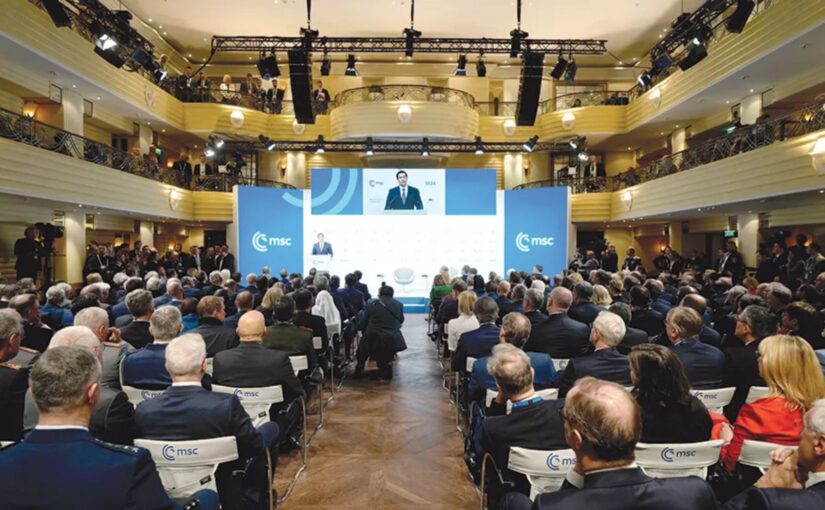
The two articles collected here, by Paweł Wargan and Sevim Dağdelen, approach the same moment in world politics, arriving at a shared conclusion: the international order is entering a period of profound transition, marked by the decline of Western hegemony and an increasingly open struggle over what comes next. Both writers use the recent Munich Security Conference as a lens through which to examine this shift, arguing that the language emerging from parts of the Western establishment reflects not confidence, but profound anxiety about the changing global balance of power.
A central thread running through both analyses is the contrast between two competing visions of international relations.
On one side, they see a US-led Western bloc seeking to preserve its dominance through military power, sanctions, and coercive diplomacy. The speech by Secretary of State Marco Rubio attempts to provide an ideological framework for this posture by openly promoting white supremacism and colonial nostalgia (“We are part of one civilisation – Western civilisation. We are bound to one another by the deepest bonds that nations could share, forged by centuries of shared history, Christian faith, culture, heritage, language, ancestry, and the sacrifices our forefathers made together for the common civilisation to which we have fallen heir”). Rubio flaunted Washington’s willingness to abandon international law and the basic norms of relations between states in support of reviving and furthering Western hegemony.
On the other side stands a different vision, associated above all with China and the broader Global South. Chinese Foreign Minister Wang Yi’s speech represents a contrasting emphasis on multilateralism, sovereign equality and cooperation among states. Both Paweł and Sevim’s articles suggest that China’s growing influence – economically, diplomatically and institutionally – has become central to the emerging multipolar order. Rather than viewing China simply as a rival, these articles frame it as a key actor in building alternative institutions and partnerships that challenge imperialism and uphold the principles of the United Nations Charter.
Together, the two texts explore the stakes of this historical turning point. Is the world moving toward renewed confrontation and bloc politics, or toward a more multipolar and democratic international system? The answer, they imply, will depend not only on the decisions of major powers but on the unity and coordinated action of countries throughout the world, and particularly the Global South.
Paweł Wargan is Political Coordinator at the Progressive International. Sevim Dağdelen was a member of the German Bundestag from 2005 to 2025 and is currently a member of the Federal Executive Board of the German party BSW (Bundnis Sahra Wagenknecht / The Sahra Wagenknecht Alliance).
Adults in the Room
February 20 (Valdai Club) – The 62nd Munich Security Conference concluded with a funereal mood. For three days, heads of state, diplomats, and military officials gathered between the Hotel Bayerischer Hof and the Rosewood Munich to take stock of a world system that is, by their own admission, fracturing. The conference report, titled Under Destruction, acknowledged what has long been obvious to those watching from the periphery of the imperial system: the post-1945 US-led international order is coming apart at the seams.
In more ways than one, the Conference revealed the contours of the world order that is emerging in its place. It exposed a diminishing and desperate Europe and a revanchist and atavistic US — two parts of a weakening bloc determined to rescue its position on the international stage with force. But it also revealed an alternative: a determination to build a new international order that could finally overcome the inequities of a global system structured by centuries of colonial rule and violent domination.
European leaders rehashed a well-worn liturgy of contradictory claims and feeble appeals. War was at the forefront of their minds. Kaja Kallas, the EU’s High Representative for Foreign Affairs, spoke of a Russia that was simultaneously “broken” and “no superpower”, and an omnipotent Russia that could “cripple economies through cyberattacks, disrupt satellites, sabotage undersea cables, fracture alliances with disinformation, [and] coerce countries by weaponising oil and gas” — a narrative designed to shore up support for Europe’s re-militarization.
For Europe, the tone was one of should’s, would’s, and could’s. Kallas spoke of a need “to reclaim European agency.” UK Prime Minister Keir Starmer called Europe a “a sleeping giant”. French President Emmanuel Macron said that “where others see doubts, I want to see opportunities”, adding that “everyone should take inspiration from us and stop criticizing us.” There was little to connect these tepid aspirations to the reality of a continent riven by rising popular dissent, endemic underinvestment, sharpening political fragmentation, and ever-increasing subordination to Washington.
The reasons for Europe’s unconvincing performance are clear. More than eight decades after the end of World War II, Europe remains a security protectorate of the US, its foreign policy tethered to NATO’s institutional logic and its economic model increasingly hollowed out by deindustrialization, austerity, and the fallout from its own sanctions policies. The much-vaunted project of “European strategic autonomy” has produced little more than white papers. And, when confronted with divergences from Washington, as in the case of the Iran nuclear deal or energy relations with Russia, Europe has consistently capitulated. European agency remains nowhere in sight.
But the Conference was not altogether without substance. In fact, two speeches — delivered by US Secretary of State Marco Rubio and Chinese Foreign Minister Wang Yi — offered perhaps the clearest expression of the shape of the bifurcating world order that we have heard from world leaders in this century.
In his remarks, Rubio delivered what may have been the most explicit defense of the colonial tradition by a senior Western official since Winston Churchill and Adolf Hitler’s imperial diatribes nearly a century ago — supremacist views that claimed millions of lives from the fields of Bengal to the streets of Leningrad.
He narrated the history of the West as one of righteous expansion — of missionaries, soldiers, and explorers “pouring out from its shores to cross oceans, settle new continents, build vast empires extending out across the globe.” Rubio set out a white supremacist fantasy: a story of civilizational triumph told by the intrepid sailor, not the African bodies chained in the belly of his ship.
For Rubio, that golden age has lamentably come to an end. After World War II, he said, Western civilization began “contracting” for the first time since Columbus set sail for the Americas. Europe lay in ruins, and its empires were in “terminal decline, accelerated by godless communist revolutions and by anti-colonial uprisings that would transform the world.”
Here, we may lay claim to two points of agreement. First, that the decline is terminal. Second, that it was precipitated by the twin forces to which Rubio refers.
In the 20th century, two potent threats emerged to the sordid imperialist order that Rubio defends. The first was the process of socialist construction that began in Russia in October 1917, which not only foreclosed a vast territory to imperialist expansion, but also enlivened the labor struggle in the West, which won political concessions that would shape Western social democracy for over half a century. The second was the wave of national liberation movements that the October Revolution inspired and supported. These twin processes saw former peasants reach for the stars and gave rise to powerful projects of self-determination across Africa, Asia, and Latin America.
These twin processes also defeated fascism — and this must be emphasized against the tide of revisionism sweeping Western historiography. It was the Soviet Union that bore the decisive burden in defeating Hitler’s regime, losing twenty-seven million of its people in the process. And it was revolutionary China that made the decisive contribution to the defeat of Japanese fascism in a fourteen-year war that claimed over thirty-five million Chinese lives. Together, these efforts remade the international order.
But in Rubio’s retelling, they were catastrophic reversals. For him, the decline of empire was not history’s verdict on a system built on plunder and violence, but a deliberate surrender to a more primitive people. His appeal to the West was clear: Abandon the shackles of “guilt and shame” — abandon, in the process, your social welfare systems — and reclaim the proud mantle of white civilization over the bodies of the wretched of the earth.
The West, Rubio said, should not “maintain the polite pretense that our way of life is just one among many” and must cease “asking for permission before it acts.” He was explicit in his contempt for the United Nations, dismissing it as impotent and boasting of the US interventions that helped undermine it: bombs dropped on Iran and the special forces deployed to kidnap Venezuela’s elected leader.
The implications are sobering. Addressing a military conference in Germany, the US Secretary of State revisited, revised and defended some of the darkest chapters in human history and called for the recolonization of the Global South. For this, he received a standing ovation.
Wang Yi, who took the stage moments after Rubio, offered a profoundly different vision of the international order. Where Rubio celebrated five centuries of Western expansion, Wang Yi recalled the legacy of the World Anti-Fascist War — the war that helped bring the age of colonial domination to a close. He described the founding of the United Nations as “an important outcome of the victory” of that war and “a historic choice made by previous generations after painful reflection on past agonies.”
Where Rubio drew a racial line between the governors and the subjects of the world system, Wang Yi outlined principles for global governance rooted in “sovereign equality, international rule of law, multilateralism, a people-centered approach, and real actions”. He insisted that global affairs “should be discussed by all” and that all countries should be “equal in terms of rights, opportunities and rules.”
Where Rubio attacked global institutions, Wang Yi defended the universality of the United Nations in terms that spoke directly to the imperatives of the Global South: “On the UN platform, each country, regardless of its size or wealth, has a voice and a sacred vote as well as its due obligations and equal rights.” Without the United Nations, he warned, “the world would revert to the law of the jungle where the strong prey on the weak.”
Where Rubio called on the West to be unapologetic and unashamed in imposing its way of life on others, Wang Yi called on major countries to lead by example — recognizing global diversity, “pursuing cooperation instead of conflict or confrontation” and “promoting equality instead of imposing their will onto others.”
Where Rubio insisted on throwing off the fetters of international law, Wang Yi emphasized the importance of “observing rules instead of applying double standards.” He closed with a phrase that will no doubt resonate with many as new frontlines of US intervention flare up around the planet: “The more democratic international relations are, the more reliable world peace will be.”
In 2007, Russian President Vladimir Putin stood at the same podium and declared that the unipolar model was “not only unacceptable but also impossible.” He decried the increasing deployment of unilateral force, and called for “a more democratic, fairer system of global economic relations, a system that would give everyone the chance and the possibility to develop.” In the West, he was widely derided for his statements. The White House expressed itself “surprised and disappointed.” Nineteen years later, the contours of the multipolar world he described are emerging before our eyes.
In fact, Munich 2026 makes devastatingly clear the fork in the road of humanity’s future.
On one side stands a hegemonic vision, rooted in shameless appeals to the genocidal past of the West’s colonial empires. This is a vision that celebrates conquest and plunder from within a thinly-veiled framework of racial supremacy, and insists on the right to act without restraint or accountability.
As we see in Iran and Palestine, Venezuela and Cuba, these are not just rhetorical appeals. They reflect ongoing attempts to dismantle the architecture of the international order through force. It is no overstatement to recognize in these tendencies the structural features of a fascist politics reasserting itself at the core of the Western system.
On the other side stands an appeal for reason, for democracy in international relations, for cooperation among sovereign equals, and for a system in which law — not force — governs the relations between nations.
These contrasting visions brings into sharp relief the stakes and urgency of the enduring contradiction between imperialism and the global majority. As the Western bloc falls further into crisis — unable to resolve its internal contradictions, and unable to sustain the architecture of domination it established in the post-World War II period — it increasingly turns to brute force. In an age of nuclear weapons, this posture carries existential dangers.
But it is important to weight two considerations against the gloom. First, Rubio’s speech was not that of a confident hegemon. It was the language of a system in decline — one that has exhausted its capacity to lead by consent and seeks to define its future by atavistic appeals to a past that no longer exists and can never be brought back. The very need to articulate such a vision before an anxious and fragmenting alliance betrays its weakness.
Second, if we look past the flailing and frenzied leadership in Brussels and Washington, we find that there are also adults in the room, prepared to advance a vision that speaks to the needs of the global majority. Like Rubio’s, Wang Yi’s words were not simply rhetorical. They reflected ongoing processes of construction — alliances, treaties, institutions, infrastructures, and agreements — that are turning the balance of world power away from the West. These include multilateral structures like BRICS and the bilateral partnerships between Russia, China, and other nations in the anti-hegemonic bloc. They include the deepening of South-South financial cooperation through institutions like the New Development Bank and the Asian Infrastructure Investment Bank. They include the emergence of new systems for regional cooperation and development like the Alliance of Sahel States.
The Western system may be Under Destruction, as Munich would have it. To be sure, its collapse will not be without turbulence. But the world as a whole is entering a period of profound and, in many ways, hopeful construction.
Drive to war aims to restore US global hegemony
February 23 (Morning Star) – BRITISH prime minister Winston Churchill commissioned the development of “Operation Unthinkable” as early as May 1945. The British General Staff was instructed to devise a plan for an attack on the Soviet Union, to be carried out jointly with US forces and 100,000 soldiers from the German Wehrmacht as early as July 1 1945.
Due to excessive risks, particularly doubts about whether British soldiers would even obey such an attack order, the plan — which was only made public in 1998 — was abandoned.
However, the plan was entirely in line with a quote falsely attributed to Winston Churchill: “We slaughtered the wrong pig.”
The speech by US Secretary of State Marco Rubio at the Munich Security Conference now stands fully in the tradition of Operation Unthinkable, but on a global political scale.
In Rubio’s Munich speech, the year 1945 is perceived as the year of the West’s defeat. He wants to return to that point in order to erase what he sees as the anti-colonialist defeat of 1945. This is also the real reason why the US administration wants to push the UN into the ditch.
Rubio’s colonial nostalgia
“For five centuries before the end of WWII, the West was expanding — its missionaries, its pilgrims, its soldiers, its explorers streamed from its shores to cross oceans, settle new continents, build vast empires extending across the globe. But in 1945, for the first time since the age of Columbus, the West retreated,” reads Rubio’s historical lesson. Then the decline set in, “accelerated by godless communist revolutions and anti-colonial uprisings.”
The year 1945 is thus understood as a crisis of Western colonialism, with the US seeing itself as its leading power, though it also needs allies. Therefore, the US Secretary of State reaffirmed: “We do not want our allies to be weak, because that makes us weaker.”
Perhaps it was this promise of being needed to contribute to US strength that made the three Germans the first in the room to jump up.
It was Foreign Minister Johann Wadephul, Defence Minister Boris Pistorius, and Bavarian Minister President Markus Soder — all three parties of the governing coalition — who could hardly contain themselves as they stood and applauded.
Rubio’s speech was not only a nostalgia for 500 years of colonialism, involving mass murder, slavery, and exploitation unto death, but also a declaration of war against the powers that, from the US administration’s perspective, stand in the way of a recolonisation of the world in favor of a renewed US imperialism: Russia and, above all, China.
In loyal vassalage, Wadephul positioned himself in Munich within the US battle formation by declaring that he wanted to maintain good relations with all Brics states, except Russia and China.
Farewell to the United Nations
From the US perspective, the UN must be pushed into the ditch because Moscow and Beijing hold veto rights in the UN security council, and in the general assembly, a majority of the global South regularly votes against the US recolonisation policy of renewed imperialism, as in the case of the genocide in Gaza and the blockade against Cuba.
The UN “no longer plays a role,” according to Rubio. At best, they could be reformed.
This is nothing less than the revision of the defeat of Nazi Germany and the Japanese Empire in 1945.
Russia, as the successor state to the Soviet Union, and China should no longer be among the victors, as they are the source of resistance in the global South. Rubio gets very specific about where US imperialism has had to prevail against the UN.
He follows with a list of recent interventions. In complete historical distortion, the American explains: “They could not resolve the war in Gaza. Instead, it was American leadership that freed the hostages from barbarians and brought about a fragile ceasefire.”
Not a word about Israel’s genocide against the Palestinians, supported by the US administration and the German government. Not a word about the fact that the genocide continues.
Then Rubio lists Ukraine, Iran, Venezuela. Since the UN is incapable of action, the Americans must do it. The US violations of international law are meant to show the path to action. In doing so, they want to take the Europeans along. “It will give us back our place in the world,” is Rubio’s Munich promise. But this place must be fought for against all who dare to oppose the US.
War rhetoric for a new world war
Rubio’s speech is a war speech. The promise to wage a world war for the US that will restore its place as a great power.
The Europeans are promised to be taken along on this path, because one does not want to forgo them for strengthening the US.
The starvation of Cuba by the US may be just an initial taste of what is to come, in order to fulfill 500 years of shared colonial history of the West and renew the promise of domination.
Western civilisation, which must be helped to victory, is understood by Rubio both as a racial and as a cultural and faith community. In this sense, the viewing 1945 as a defeat can certainly be assumed to be understandable.
US President Donald Trump and his secretary of state are facing an unthinkable operation on a global scale. The risk of a world war seems to be part of the calculation. Who will stop US imperialism on this path?






Very interesting comments, too discerning to get their writer into our president’s fan club.