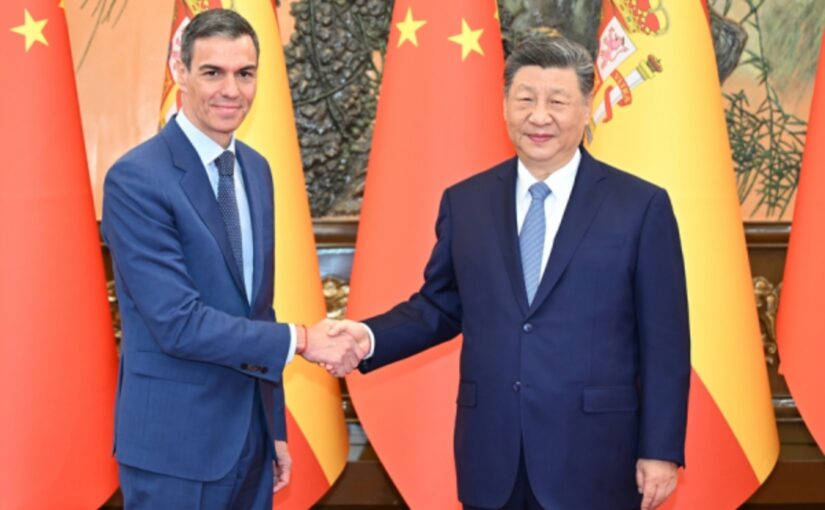
Spanish Prime Minister Pedro Sánchez paid an official visit to China between April 11-15 at the invitation of his Chinese counterpart Li Qiang. It was the fourth visit paid to China by the Spanish head of government in four years and both this symbolism and the substance of the visit served to underline that Spain under its current government is the most friendly country to China in western Europe.
Sánchez’s substantive political meetings were held in Beijing on April 14.
In his meeting with President Xi Jinping, the Chinese leader noted that despite the changing and turbulent international landscape, China-Spain relations have developed steadily, forging a relationship with strategic resolve. An important experience of this lies in the ability to make the right decisions based on common interests. Facts have proven that deepening cooperation serves the interests of both peoples, aligns with the prevailing trend of our times, and bolsters each other’s strength and confidence in pursuing an independent path. China combines its long-term strategic goals with phased objectives, and acts with historical patience to draw up and carry out five-year plans generation after generation. China has firm resolve in advancing Chinese modernisation and the broad-mindedness to share development opportunities with the world through high-standard opening up.
Xi Jinping emphasised that today’s turbulent world faces the struggle between right and might. How a country approaches international law and the international order reflects its views of the world, order, and values, and its sense of responsibility. China and Spain are both countries that value principle and justice. We need to strengthen communication, consolidate mutual trust, and work closely together to reject any backslide into the law of the jungle, jointly uphold true multilateralism, safeguard the UN-centred international system and the international order underpinned by international law, promote an equal and orderly multipolar world and a universally beneficial and inclusive economic globalisation, and foster the building of a community with a shared future for humanity.
Sánchez noted that his four visits to China in four years demonstrate the high importance both sides attach to Spain-China relations. Investment and cooperation by Chinese businesses in Spain have strongly boosted Spain’s economic development. Spain firmly adheres to the one-China principle, highly values China’s status as a major country, and is deeply committed to developing a Spain-China partnership with strategic resolve. Spain hopes to strengthen cooperation in trade, investment, new energy, and other sectors, as well as to enhance people-to-people exchanges. Faced with a complex and challenging international situation and multiple recurring conflicts and disputes, only by adhering to multilateralism and fostering a multipolar world can lasting peace be achieved for humanity. Spain actively supports the four major Global Initiatives proposed by President Xi Jinping and stands ready to maintain close communication and coordination with China to jointly address challenges related to international geopolitics, trade protectionism, and climate change, while upholding international law and multilateralism. Spain opposes a new Cold War and attempts to decouple and sever supply chains, and supports enhanced communication, understanding and cooperation between Europe and China. The sound development of EU-China relations serves the common interests of both sides and contributes to world peace and stability.
In their meeting, Premier Li Qiang said that China is ready to import more high-quality products from Spain and encourages more capable Chinese enterprises to invest in Spain. The more volatile and turbulent the international landscape becomes, the more China and Spain should strengthen practical cooperation, empower each other and achieve mutual success.
China is willing to enhance cooperation with Spain in areas such as new energy vehicles and energy storage to create more highlights of cooperation, Li said, adding that China supports universities, research institutions and enterprises from both sides to strengthen joint research and development, enhance scientific and technological innovation capabilities, and work together to seize future development opportunities.
Sánchez said the Spanish side is willing to maintain close and high-level political dialogue with China, enhance strategic communication, increase mutual understanding, expand cooperation in trade, investment, science and technology, renewable energy, education, culture and other fields, expand tourism and people-to-people exchanges, continuously enhance the stability and sustainability of bilateral relations, and better benefit the two peoples. Spain is ready to enhance multilateral communication and coordination with China and firmly support the United Nations and multilateralism.
In his meeting with Zhao Leji, chairman of the National People’s Congress (NPC) Standing Committee, Sánchez said that Spain firmly adheres to the one-China principle and hopes to enhance cooperation with China in trade, investment, culture, education, tourism and other fields, promote exchanges between legislative bodies, uphold multilateralism, and facilitate the healthy and stable development of Spain-China and Europe-China relations.
The following day, the China-Spain innovative enterprises exchange conference brought together over 100 representatives from Chinese and Spanish businesses.
Chinese Commerce Minister Wang Wentao said that China is willing to work with Spain to strengthen strategic alignment and policy coordination, continuously improve the business environment, and promote deeper cooperation among enterprises in technological innovation and industrial and supply chains. The two countries can foster more landmark projects in sectors such as new energy vehicles, intelligent manufacturing, and photovoltaic and wind power, which will benefit enterprises and people of both sides.
Sánchez said that bilateral relations are at their best in history, with deep cooperation in trade, investment, green energy, industrial manufacturing and technological innovation.
Earlier, on April 13, Sánchez delivered a speech at Beijing’s prestigious Tsinghua University.
Beginning by referring to the China visit of the Italian Jesuit Matteo Ricci in the late 16th century, he said:
“I know that, in 1583, China was already a great power, accounting for a quarter of the world’s population and GDP. That he traded with half the planet. And that he led science and technology in many areas…
“The Spain of that time knew of the greatness of China. He knew that Beijing was not the periphery of the world, but one of its centres.
“And today’s Spain knows it too. He knows that China is rebuilding its greatness. It is already the leading exporter of goods on the planet and the fourth in services. That industry and its science are transforming the fight against global warming and also reducing poverty. And that, as such, China is called upon to play an essential role in the future of the world.”
Elaborating on the evolution of the international situation today, he said:
“In my opinion, what is happening today is not a transfer of hegemonies. It is a multiplication of poles. Not only of power, but also of prosperity. And this is great news for Europe. Because for the first time in contemporary history, progress is germinating simultaneously in many places on the planet. Places, moreover, that do not resemble each other. That they do not have the same culture. Nor the same political system or the same social conditions. And that they don’t need to ask anyone’s permission to grow. That is happening here in China, in Asia. But also on the African continent, or also in a region very close to Spain such as Latin America.
“That multipolarity that I describe is not a hypothesis. Nor is it a wish. It is already a reality. The new reality in which the world lives. And, therefore, we must assume it. We cannot change it. We can only choose between denying it or embracing it.
“And the Government of Spain, the whole of Spanish society chooses to embrace it. It does so from realism, also from pragmatism and, without a doubt, from responsibility. But I would like to emphasise that we also do so from hope. Because we think that, if Spain, Europe and China knew how to prosper together in the past, there is no reason that can make us think that we cannot do it again.”
However: “Obviously, it is not going to be easy. We know it. There are issues, too, that separate us. Matters on which we do not share the same opinion. In which we compete. We also disagree. Points on which we are not going to agree. We may never be able to agree.
“But humanity moves forward when we build on what unites us. Not when we deepen the ditches that divide us. In this spirit, we work from Spain with many other countries such as Brazil, India, South Africa, Mexico. And of course, also in our relations with China.”
The friendship of Spain with China under the Sánchez government is complemented by its also being the west European country to most strongly condemn the savage oppression of the Palestinian people and to oppose the US-Israeli war of aggression against Iran. This has predictably drawn the repeated ire of US President Donald Trump, who has gone so far as to threaten to sever all trade with Madrid, although as yet he has taken no actual steps in that regard.
In this context, it is therefore significant to note that, immediately following his return from China, Sánchez hosted the fourth Summit in Defence of Democracy in the Catalan capital Barcelona, together with Brazilian President Luiz Inácio Lula da Silva. This gathering was also attended by a number of leaders from Europe, Latin America and Africa, including the presidents of Mexico, Colombia, Uruguay, South Africa, Cabo Verde and Ireland; the vice president of Ghana; and the prime ministers of Barbados and Albania.
Al Jazeera reports that at the summit, a joint declaration was adopted by the leaders of Brazil, Mexico and Spain pledging more aid to Cuba and appealing for the nation’s sovereignty to be respected. Referring to the intensified US blockade, they expressed “great concern about the serious humanitarian crisis that the people of Cuba are going through… We are committed to coordinating an increase in our humanitarian response, aimed at alleviating the suffering of the Cuban people.”
Speaking at the summit, without referring to any country or leader by name, Sánchez said:
“They know their vision of how the world should be ordered is falling apart due to the tariffs and wars. Their embrace of climate change denial, of xenophobia, or of sexism is their greatest error.
“They have tried again and again to make us embarrassed of our beliefs. That ends now. From now on, they can be the ones who feel ashamed.”
Simultaneously, from April 17-18, the inaugural Global Progressive Mobilisation was also held in Barcelona, initiated by the Party of European Socialists and Democrats, the Socialist International and the Progressive Alliance, and participated in by a broad range of governmental and non-governmental forces.
The following articles were originally published on the website of the Chinese Foreign Ministry, by the Xinhua News Agency and on La Moncloa, the official website of the Spanish government.
President Xi Jinping Meets with Spanish Prime Minister Pedro Sánchez
April 14 (MFA) – On the morning of April 14, President Xi Jinping met with Spanish Prime Minister Pedro Sánchez, who is on an official visit to China, at the Great Hall of the People in Beijing.
President Xi Jinping noted that despite the changing and turbulent international landscape, China-Spain relations have developed steadily, forging a relationship with strategic resolve. An important experience of this lies in the ability to make the right decisions based on common interests. Facts have proven that deepening cooperation serves the interests of both peoples, aligns with the prevailing trend of our times, and bolsters each other’s strength and confidence in pursuing an independent path. The two sides should always prioritize the development of bilateral relations in their respective foreign policies and support each other in safeguarding national sovereignty and territorial integrity. China combines its long-term strategic goals with phased objectives, and acts with historical patience to draw up and carry out five-year plans generation after generation. China has firm resolve in advancing Chinese modernization and the broad-mindedness to share development opportunities with the world through high-standard opening up. China will inject confidence and momentum into global economic growth through its own development. The two sides should seize opportunities, jointly pursue innovation-driven development, strengthen cooperation in areas such as trade, new energy, and smart economy, and encourage exchanges in culture, education, scientific research, and sports, so as to bring about more outcomes in the comprehensive strategic partnership and deliver greater benefits to the two peoples.
President Xi Jinping emphasized that today’s turbulent world faces the struggle between right and might. How a country approaches international law and the international order reflects its views of the world, order, and values, and its sense of responsibility. China and Spain are both countries that value principle and justice. We need to strengthen communication, consolidate mutual trust, and work closely together to reject any backslide into the law of the jungle, jointly uphold true multilateralism, safeguard the U.N.-centered international system and the international order underpinned by international law, promote an equal and orderly multipolar world and a universally beneficial and inclusive economic globalization, and foster the building of a community with a shared future for humanity.
Sánchez noted that his four visits to China in four years demonstrate the high importance both sides attach to Spain-China relations. Investment and cooperation by Chinese businesses in Spain have strongly boosted Spain’s economic development. Spain firmly adheres to the one-China principle, highly values China’s status as a major country, and is deeply committed to developing a Spain-China partnership with strategic resolve. Spain hopes to strengthen cooperation in trade, investment, new energy, and other sectors, as well as to enhance people-to-people exchanges. Faced with a complex and challenging international situation and multiple recurring conflicts and disputes, only by adhering to multilateralism and fostering a multipolar world can lasting peace be achieved for humanity. Spain actively supports the four major Global Initiatives proposed by President Xi Jinping and stands ready to maintain close communication and coordination with China to jointly address challenges related to international geopolitics, trade protectionism, and climate change, while upholding international law and multilateralism. Spain opposes a new Cold War and attempts to decouple and sever supply chains, and supports enhanced communication, understanding and cooperation between Europe and China. The sound development of EU-China relations serves the common interests of both sides and contributes to world peace and stability.
Wang Yi was present at the meeting.
More capable Chinese enterprises encouraged to invest in Spain: Premier Li
BEIJING, April 14 (Xinhua) — China is ready to import more high-quality products from Spain and encourages more capable Chinese enterprises to invest in Spain, Chinese Premier Li Qiang said on Tuesday.
Li made the remarks when holding talks with Spanish Prime Minister Pedro Sanchez, who is on an official visit to China.
Noting that China and Spain are major economies in the world, Li said the two sides should jointly uphold multilateralism and free trade, and firmly promote openness and cooperation, injecting impetus into the development of both countries and the world at large.
The more volatile and turbulent the international landscape becomes, the more China and Spain should strengthen practical cooperation, empower each other and achieve mutual success, Li said.
Li said China stands ready to further align its development strategies with Spain, promote the continuous deepening and solidification of all-round cooperation, and achieve a higher level of mutual benefit and win-win results.
Li said China is willing to work with Spain to better leverage their complementary economic advantages, deeply explore cooperation potential, and promote the expansion, quality improvement and balanced development of bilateral trade.
China is willing to enhance cooperation with Spain in areas such as new energy vehicles and energy storage to create more highlights of cooperation, Li said, adding that China supports universities, research institutions and enterprises from both sides to strengthen joint research and development, enhance scientific and technological innovation capabilities, and work together to seize future development opportunities.
Li said China is also willing to enhance the level of transportation cooperation with Spain, promote the high-quality development of the China-Europe Railway Express, and jointly build an international green shipping corridor.
It is hoped that Spain will continue to play an important role within the European Union and promote the healthy development of economic and trade relations between China and the EU, Li noted.
Sanchez said the Spanish side is willing to maintain close and high-level political dialogue with China, enhance strategic communication, increase mutual understanding, expand cooperation in trade, investment, science and technology, renewable energy, education, culture and other fields, expand tourism and people-to-people exchanges, continuously enhance the stability and sustainability of bilateral relations, and better benefit the two peoples.
Spain is ready to enhance multilateral communication and coordination with China and firmly support the United Nations and multilateralism, Sanchez said, adding that the Spanish side supports strengthening dialogue and communication between the EU and China, and is willing to play an active role in handling economic and trade differences properly, and in promoting trade and investment cooperation between the EU and China.
After their talks, Li and Sanchez witnessed the signing of cooperation documents in areas such as economy and trade, education, science and technology, and agriculture and food.
China’s top legislator meets with Spanish PM
BEIJING, April 14 (Xinhua) — Zhao Leji, chairman of the National People’s Congress (NPC) Standing Committee, met with Spanish Prime Minister Pedro Sanchez in Beijing on Tuesday.
Zhao stated that President Xi Jinping held a meeting with Prime Minister Sanchez this morning, and the two sides had reached significant consensus, providing guidance for the development of bilateral relations in the next phase.
China is willing to work with Spain to implement the important consensus reached by the leaders of the two countries, consolidate political mutual trust, promote all-around mutually beneficial cooperation, and build a comprehensive strategic partnership that is more strategically resilient, more dynamic, and of greater international influence, Zhao said.
The NPC of China stands ready to work with the Spanish parliament to strengthen exchanges between the legislative bodies, deepen experience sharing in legislation, supervision and governance, and create a favorable legal environment for pragmatic cooperation between the two countries, Zhao noted.
Spain firmly adheres to the one-China principle, Sanchez said.
He said Spain hopes to enhance cooperation with China in trade, investment, culture, education, tourism and other fields, promote exchanges between legislative bodies, uphold multilateralism, and facilitate the healthy and stable development of Spain-China and Europe-China relations.
China, Spain to deepen cooperation in innovation, industrial chains
BEIJING, April 15 (Xinhua) — China is willing to work with Spain to strengthen strategic alignment and policy coordination, continuously improve the business environment, and promote deeper cooperation among enterprises in technological innovation and industrial and supply chains, Chinese Commerce Minister Wang Wentao said on Wednesday.
The two countries can foster more landmark projects in sectors such as new energy vehicles, intelligent manufacturing, and photovoltaic and wind power, which will benefit enterprises and people of both sides, Wang said at the China-Spain innovative enterprises exchange conference.
He added that economic and trade relations between the two countries have grown steadily with deepening industrial chain integration, demonstrating strong complementarity and stability.
Spanish Prime Minister Pedro Sanchez said at the conference that bilateral relations are at their best in history, with deep cooperation in trade, investment, green energy, industrial manufacturing and technological innovation.
Spain welcomes more Chinese companies to invest and do business in Spain, he said, adding that he looks forward to enhanced strategic collaboration between the business communities of the two countries.
The conference brought together over 100 representatives from Chinese and Spanish businesses. Participants shared cooperation experience and held discussions on technology research and development as well as investment cooperation.
Conference by the President of the Government, Pedro Sánchez, at Tsinghua University
April 13 (La Moncloa – machine translation) – Respected president and chancellor of Tsinghua University.
Teachers, professors.
Students of Tsinghua University.
Da jia hao.
It is a true honor to be in this temple of knowledge. A global reference for teaching and research. A place where human beings explore the limits of science and our imagination. And we also find in those limits new ways to cooperate and prosper.
Let me start by talking about precisely that: science and also imagination. With a story that occurred not far from here, more than four centuries ago.
In 1583, an Italian Jesuit named Matteo Ricci arrived in China. In his austere luggage, he brought with him some books, an astrolabe and a map of the world.
It was a European map. Correct in its proportions, very advanced in the level of detail, but biased in its perspective. Because what it did was show the world as the West saw it: with Europe in the center and Asia on its right bank. At the ends of the earth. Upon seeing it, the cartographers of the imperial court asked the Jesuit why China appeared at that end of that map. And the wise European understood for the first time that the Mediterranean Sea was the center of his world, but not that of others. Each world had its center and that is why Matteo Ricci completely redid his map. This time, using the Pacific Ocean as its axis and capturing the entire Eurasian continent.
More than 400 years have passed since that, more than 400 years. But there are still, unfortunately, people who continue to see the world as it appeared on that first map distorted by Ricci. I say distorted because I know the world was not like that. I know that, in 1583, China was already a great power that represented a quarter of the global population and GDP. That traded with half the planet. And that he led science and technology in many areas.
I know this because, at that time, Spain, as the president of the University reminded us, was also a great empire. An empire that exchanged raw materials, manufactured goods with the Ming Dynasty through the Manila corridor. And that crossed the oceans with magnetic compasses, muskets, with elbow rudders. In short, with technologies all of these of Chinese origin.
The Spain of that time knew of the greatness of China. He knew that Beijing was not the periphery of the world, but one of its centers.
And today’s Spain also knows it. He knows that China is rebuilding its greatness. Which is already the leading exporter of goods on the entire planet and the fourth in services. That industry and its science are transforming the fight against global warming and also reducing poverty. And that, as such, China is called to play an essential role in the future of the world.
That is why for me, dear president, professors, it is a true honor to be able to address this center of thought as a Spaniard and also as a European.
There are those who persist in interpreting reality in a zero-sum way. In narrating the growth of some as a loss for the rest. Or in arguing that deepening certain relationships means giving up others.
But I believe that this reading is not only wrong. It is also dangerous, because it is immobile. Because it makes us prisoners of the past and limits the possibilities that the future offers us. Because it makes the mistake of assuming that the world we see, from ancient maps, is the only possible world.
In my opinion, what is happening today is not a transfer of hegemonies. It is a multiplication of poles. Not only of power, but also of prosperity. And this is great news for Europe. Because for the first time in contemporary history, progress germinates simultaneously in many places on the planet. Places, furthermore, that do not resemble each other. That they don’t have the same culture. Neither the same political system nor the same social conditions. And that they don’t need to ask anyone’s permission to grow. That is happening here in China, in Asia. But also on the African continent, or also in a region very close to Spain such as Latin America.
That multipolarity that I describe is not a hypothesis. It is not a wish either. It is already a reality. The new reality in which the world lives. And, therefore, we must assume it. We can’t change it. We can only choose between denying it or embracing it.
And the Government of Spain, the entire Spanish society chooses to embrace it. He does it from realism, also from pragmatism and, without a doubt, from responsibility. But I would like to emphasize that we also do it from hope. Because we think that, if Spain, Europe and China knew how to prosper together in the past, there are no reasons that can make us think that we cannot do it again.
Obviously, it’s not going to be easy. We know. There are issues, too, that separate us. Matters in which we do not share the same opinion. In which we compete. We also disagree. Points on which we will not agree. We may never agree.
But humanity advances when we build on what unites us. Not when we deepen the ditches that divide us. With that spirit we work from Spain with many other countries such as Brazil, India, South Africa, and Mexico. And of course also in our relations with China.
Spain’s proposal, therefore, is clear: it is to build a relationship based on mutual respect. A respect that allows us, among other things, to cooperate in all possible areas. Compete in whatever is necessary. And also manage our differences when they are inevitable.
And Spain defends this same vision in all parts of the world and in all capitals. He does it in Madrid, our capital. In Brussels, the capital of Europe. And it does it in the rest of the world in the same way.
But for that vision to work and for the world to thrive under the new multipolar order, we will need three very important things to develop in the coming months and years. Three elements that I would like to share with all of you.
The first is that efficient multilateralism is not possible without strengthened multilateralism.
There are those who believe that the multilateral system is dead. We are seeing, unfortunately, many cases in the media of crises, of wars that are happening in the world. They think that indeed, that multilateral world is dead, that it is past. And I want to say here that I deeply disagree with that analysis. And I do it energetically.
I think that global governance instruments worked in the 20th century and that they are more necessary today than ever. That rules and cross-border cooperation are the only tools that will allow humanity to overcome the climate emergency and the other challenges of this era.
I believe that the multipolar world needs a robust multilateral system, not to impose a single vision, but to turn the crucible of our gaze into a strength for all humanity. Not to end our differences, but to deal with them peacefully, with respect.
Because multipolarity without rules leads to rivalry and from rivalry only wars, trade conflicts and ruin arise.
That is why from Spain we call for a profound renewal of the multilateral architecture. It must be made more efficient, more transparent, more responsible and also more inclusive and plural.
Because if multilateralism wants to remain useful, it has to change and better reflect the balances of power and sensitivities of today’s world. We cannot allow the past to suffocate the future of multilateral organizations.
That is why I think that the West must renounce part of its representation quotas in favor of global stability and the confidence of southern countries.
That is why I think that we must transform the United Nations as soon as possible with a much stronger General Assembly, with a more representative Security Council and with a more democratic decision-making system in which all regions truly have a voice and vote, and The middle powers can also play a unifying and harmonizing role, which is what is expected of them.
And also from Spain we think that it would be good if for the first time in history a woman led the General Secretariat of the United Nations.
The second element I would need to share with all of you is that this new multipolar order must work and it must work with business relationships that are balanced and reciprocal. We cannot go from the imbalance of the 20th century to a different one in the 21st century.
And for this development to be stable, sustainable, healthy, the multipolar order will need a more horizontal and fairer economy, in which there are no losing regions and other winning ones, but rather truly global supply chains that create employment and wealth in all latitudes. of the planet and share negative externalities in a proportionate way.
Why do I say this? Because the European Union is doing its part. It can be argued whether he does it more or less quickly, with difficulties, without a doubt, I admit, but he is doing his part.
In the last decade alone we have signed trade agreements with 25 countries. We have increased our imports from the so-called global south by 80% and have created more than 25 million jobs annually outside our borders.
We need China to do the same. Let it open so that Europe does not have to close. May it help us correct the current trade deficit we have with it.
A deficit that is not balanced, that grew again by 18% last year alone and that is unsustainable for our societies in the medium and long term. And it is unsustainable due to the isolationist movements it fuels and the grievances and social pain it causes. To give you an idea, our trade deficit with China already represents 74% of our country’s total deficit.
Therefore, I think it is important that we correct it, that we cooperate and that we jointly build a globalized, balanced economy that generates shared prosperity.
The third element we will need for the multipolar order to work is greater involvement by great and medium powers in the management and provision of what academics call global public goods. For example, the fight against climate change, security, defense, the fight against inequality.
In short, emerging powers, consolidated powers, must provide these global public goods.
Size not only implies power, it also carries a responsibility that cannot be delegated. Because the big problems of the 21st century do not require a visa, they cross borders and belong to everyone.
I think, for example, of the fight against climate change or the challenges caused by global health, of the development of responsible artificial intelligence, of the control of nuclear weapons, of the eradication of poverty and of safeguarding, as I said before, of global health. The latter areas in which financing has fallen by 23% in the last year, by 23%.
Without the collaboration of the great powers and, of course, also China, these objectives are not difficult, they are simply unattainable. I know that China is fully aware and doing a lot, and I celebrate that. But I think China can do more. For example, demanding, as it is doing, that international law be complied with and conflicts in Lebanon, Iran, Gaza, the West Bank and also Ukraine cease. Because international law is the basis of everything. Sharing its technology with the most disadvantaged countries, forgiving debt, contributing to the financing of the system through participation in exchange processes.
Naturally, Europe will also have to redouble its efforts especially now that the United States has decided to withdraw from many of these fronts. Europe’s contribution is and will be essential. Therefore, I humbly ask that you also see it so that you do not make Mateo Ricci’s mistake and allow yourself to be fooled by the maps.
Because Europe may seem small on a world map, but in reality it is quite the opposite. The data is this: the European Union is currently the largest trading bloc in the world and the second largest economy. It is also the first recipient of Foreign Direct Investment. It is the second most innovative ecosystem. It also has a qualified population. It is the second most productive economy on the planet and the first in levels of life satisfaction, social cohesion and well-being.
With this I don’t want to brag about anything or hide many of our shortcomings, which we have. By this, what I mean is that Europe is a key actor in the stability, prosperity and peace of the world and that without a united and, therefore, fragmented Europe, there cannot and will not be a stable international order or a prosperous future for humanity, nor can there be one without the participation of this great country that is China. That is why we are called to understand each other and cooperate.
Dear teachers and students, I conclude now. Four centuries after Mateo Ricci arrived in China and had to correct his map, humanity continues to look for the fairest angle to see the world as it is, and not as power or prejudice dictate.
A few days ago, four American astronauts traveled further from Earth than any other human being has. And, from there, maybe they got that angle. From there, they saw the Earth for what it really is: a sphere without extremes or borders.
A unique, unrepeatable blue sphere, in the most hostile environment to life that can exist. Humans are the result of that miracle. Maybe the only one in the universe. And, therefore, our duty is to understand each other and cooperate to make that miracle continue to prosper.
Thank you so much. Xie xie.






One thought on “Spain opposes a new cold war – Prime Minister Sánchez in Beijing”