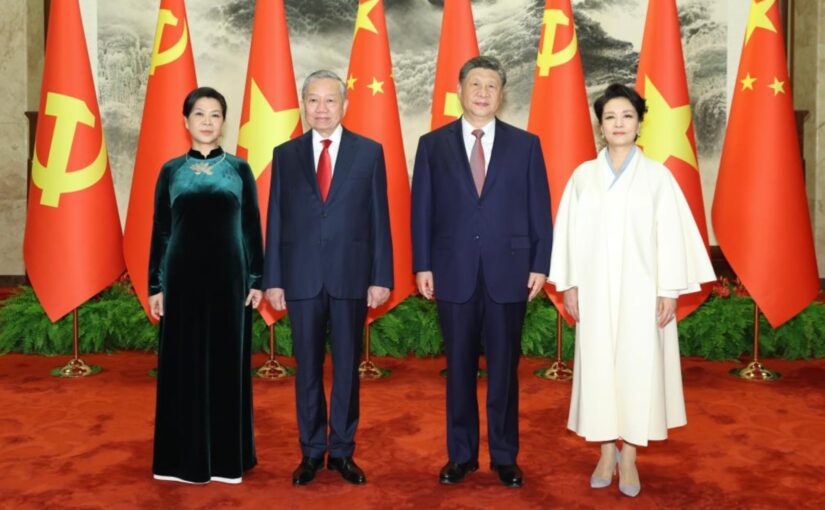
As previously reported by us, To Lam, general secretary of the Communist Party of Vietnam (CPV) and president of the Socialist Republic of Vietnam, paid a state visit to China from April 14-17, his first foreign visit since his recent election as state president.
The majority of his high-level political meetings were held in Beijing on April 15. As reported by the Xinhua News Agency, meeting with General Secretary of the Communist Party of China (CPC) Central Committee and Chinese President Xi Jinping, the Chinese leader said that his country will advance high-quality comprehensive strategic cooperation with Vietnam and accelerate the building of a higher-level China-Vietnam community with a shared future that carries strategic significance.
“Your visit to China at the earliest opportunity after being elected president of Vietnam demonstrates the great importance you have attached to the development of China-Vietnam relations,” Xi said, adding that China has always regarded Vietnam as a priority in its neighbourhood diplomacy.
Xi expressed confidence that under the strong leadership of the CPV Central Committee headed by Lam, Vietnam will firmly follow the path of socialism and strive toward its two centennial goals of transforming Vietnam into a high-income and developed socialist-oriented nation.
Lam said Vietnam congratulates China on the successful completion of its 14th Five-Year Plan and its historic achievements, and believes that China will smoothly implement its 15th Five-Year Plan, continue to advance high-quality development and socialist modernisation, achieve the Second Centenary Goal as scheduled, and become a pillar and primary driving force for world peace and development. Vietnam will firmly regard the development of relations with China as an objective necessity, a strategic choice and a top priority.
Xi said the leadership of the communist party is the most essential feature and the greatest strength of socialism, and defending the socialist system and the ruling position of the communist party is the greatest common strategic interest of the CPC and the CPV. The two sides must maintain a high degree of strategic vigilance and strong strategic resolve, always remain confident in their path and system, and ensure that all reform will not change the direction of the path or the nature of the system.
Lam said Vietnam will work with China to upgrade the level of cooperation in economy, trade, investment, railways and other infrastructure, as well as tourism, and step up cooperation in education, training, science and technology, people-to-people exchanges, and sub-national cooperation, adding that efforts will be made to better manage the land border and maintain maritime peace.
The Vietnamese newspaper Nhân Dân adds that the two leaders expressed their satisfaction with the positive developments in bilateral ties in recent years. Notably, high-level strategic exchanges have become increasingly frequent; cooperation mechanisms have been more comprehensive, diverse, and trustworthy; and defence and security cooperation has evolved from exchanges to more substantive activities. Economic, trade, and investment ties, along with transport connectivity, have seen new breakthroughs, while local-level cooperation and people-to-people exchanges have remained vibrant. Coordination in multilateral frameworks has also grown closer.
Amid the complex global developments, the two leaders affirmed that the two Parties and countries should further strengthen solidarity, enhance strategic trust, and promote policy connectivity, trade, infrastructure, and energy. They agreed to continue deepening and elevating Vietnam–China relations in the new phase, practically contributing to peace, cooperation, and development in the region and the world.
To Lam further called for enhanced theory exchanges and cadre training, stronger substantive cooperation between key agencies, particularly in diplomacy, national defence, and public security, and the effective implementation of the ministerial level “3+3” strategic dialogue mechanism. He also proposed increasing cooperation in security, defence industry, and military trade, along with supporting each other in successfully hosting APEC Year 2026 and 2027 in their respective countries.
Xi said that the two countries should enhance policy coordination in science and technology, promote diverse people-to-people exchanges, actively implement global initiatives on development, security, civilisation, and governance, and jointly contribute to a stable, open and cooperative international environment while together promoting the socialist cause around the word as well as safeguarding peace, stability, and prosperity in the region and beyond.
In his meeting with the Vietnamese guest, Chinese Premier Li Qiang said that China stands ready to work with Vietnam to accelerate the development of infrastructure connectivity in areas such as standard-gauge railways, expressways and smart ports, and to foster secure and stable industrial and supply chains. He expressed the willingness to better synergise development strategies with Vietnam, expand and enhance two-way trade and investment, create more highlights of cooperation in artificial intelligence, new energy, critical minerals and other fields, and jointly cultivate new growth drivers for development, so as to achieve higher-level mutual benefit and win-win outcomes.
He further called on both China and Vietnam, as countries that share similar views on the international order and extensive common interests, to coordinate their positions in multilateral mechanisms like the United Nations and Asia-Pacific Economic Cooperation, and work with all parties to jointly oppose unilateralism and power politics, uphold fairness and justice, and promote openness and win-win outcomes.
To Lam stressed that Vietnam wishes and is determined to work with China to comprehensively advance bilateral ties to a new high, with substantive, mutually beneficial cooperation across sectors serving as a key foundation and driving force for stable, healthy and sustainable relations between the two Parties and nations in the new period.
According to Nhân Dân, the two leaders reviewed the positive outcomes of bilateral cooperation, noting satisfaction with the strong development of relations between the two Parties and countries, particularly in economy, trade, investment, tourism, and railway connectivity, which have seen robust growth and new breakthroughs and created an unprecedentedly vibrant landscape of exchange and cooperation between sectors, levels, and localities of the two countries.
Both sides agreed that the two Parties and countries share broad common interests, while their economies are highly complementary and hold significant untapped potential. They pledged to strengthen solidarity, enhance comprehensive cooperation and mutual support, and further promote political and economic trust, effectively building a Vietnam–China community with a shared future that carries strategic significance, and bringing the bilateral relations into a new phase of development based on the “six major orientations”.
Lam suggested elevating economic, trade, investment and tourism cooperation; promoting more balanced and sustainable trade; and fostering sustainable economic linkages, creating breakthroughs in strategic infrastructure connectivity, with top priority given to railway cooperation and expanded links to Central Asia and Europe.
Expressing agreement with Lam’s proposals, Li proposed that both sides prioritise cooperation in strategic infrastructure connectivity, especially in technology, human resource training, and capital mobilisation in the railway sector; and effectively implement standard-gauge railway projects connecting the two countries, promoting multimodal logistics connectivity.
China, he said, is ready to work with Vietnam to promote bilateral trade in a more balanced manner, will import more high-quality Vietnamese agricultural products, support Vietnam’s participation in the “Big Market for All: Export to China” initiative, and work with the country in building cross-border economic cooperation zones. He suggested that both sides jointly research and promote new advanced areas of cooperation, focusing on science and technology, digital transformation, innovation, and artificial intelligence as new highlights.
In Lam’s meeting with Zhao Leji, chairman of the National People’s Congress (NPC) Standing Committee, both sides expressed satisfaction at the positive momentum in relations between the two Parties and countries, with steady progress in parliamentary exchanges and cooperation.
Zhao described Vietnam and China as neighbouring socialist countries sharing a long-standing tradition of friendship and similar political regimes, development paths, and socio-cultural traditions. China steadfastly supports Vietnam in building socialism suited to its own national conditions.
The previous day, Lam had met with Wang Huning, a member of the Standing Committee of the Political Bureau of the CPC Central Committee and chairman of the Chinese People’s Political Consultative Conference (CPPCC) National Committee.
Wang said that China is willing to work with Vietnam to implement the important consensus reached by the general secretaries of the two parties, carry out in-depth exchanges and mutual learning of theories and experiences in party and state governance, promote the development of a China-Vietnam community with a shared future, and advance the steady and long-term development of bilateral relations, adding that the CPPCC National Committee is willing to make its contributions in this regard.
The Vietnamese leader suggested that the two countries maintain regular high-level exchanges, consolidate political trust and enhance the effectiveness of cooperation across Party, State, Government and legislative channels, as well as between the Vietnam Fatherland Front (VFF) and the CPPCC. He also emphasised the need to strengthen the pillar of defence and security cooperation. He further proposed enhancing the role of the CPPCC and the VFF in encouraging localities and mass organisations of the two countries to improve existing cooperation mechanisms, expand exchanges and step up communications about the Vietnam – China friendship as well as the reform and development achievements of each country.
On April 15, Xi Jinping and To Lam also met with the two countries’ youth participating in the “Red Study Tour” programme, demonstrating the special importance they attach to nurturing and educating younger generations, and to carrying forward the revolutionary traditions of previous generations.
The programme was launched in April 2025 during the state visit to Vietnam by Xi. Since then, thousands of Vietnamese youth have visited historical revolutionary sites called “red addresses” in China, deepening their understanding of shared traditions and bilateral ties.
Addressing the event, Xi expressed his hope that young people of both nations will support each other, uphold revolutionary ideals, and further strengthen the bilateral friendship bearing the spirit of being “both comrades and brothers.” He encouraged them to seize historical opportunities, promote innovation and creativity, and contribute to global development, security, civilisation, and governance initiatives.
For his part, the Vietnamese leader affirmed that participants in the programme should take pride in the long-standing relationship nurtured by past leaders, including President Ho Chi Minh and Chairman Mao Zedong. He stressed that today’s youth remain a core force in national development and a key link in strengthening bilateral friendship and cooperation.
Vietnam and China issued a Joint Statement on further deepening the Comprehensive Strategic Cooperative Partnership and advancing the building of a Vietnam–China community with a shared future that carries strategic significance at a higher level in the new era.
Among its highlights are:
- The two sides exchanged views on their respective Party and national situations, as well as on regional and international issues, reaching broad and important common understandings. Both sides affirmed that the CPV and the CPC share historic missions to advance national development, improve people’s well-being, and contribute to global progress. They emphasised that maintaining and strengthening the comprehensive leadership of the two Parties constitutes a fundamental guarantee for advancing socialist modernisation in each country and for ensuring the long-term, stable and healthy development of bilateral relations.
- The two sides agreed that Vietnam and China, sharing common aspirations and development paths, view the bilateral relationship as a strategic choice of overarching and long-term significance. China reaffirmed its consistent policy of friendship with Vietnam and its priority status in China’s neighbourhood diplomacy, while Vietnam reiterated that relations with China remain an objective requirement, a strategic choice and a top priority in its foreign policy of independence, self-reliance, multilateralisation and diversification.
- Both sides stressed the importance of carrying forward the traditional friendship described as “both comrades and brothers,” nurtured by past leaders, and of adhering to guiding principles of “friendly neighbourliness, comprehensive cooperation, long-term stability and future orientation,” as well as the spirit of being “good neighbours, good friends, good comrades and good partners.” They committed to advancing the overall goal of “six major orientations,” including stronger political trust, more substantive defence and security cooperation, deeper practical collaboration, firmer social foundations, closer multilateral coordination, and more effective management and resolution of differences.
- Vietnam congratulated China on the CPC’s 105th founding anniversary and its recent national achievements, expressing confidence in China’s continued progress toward modernisation. In turn, China congratulated Vietnam on the success of the 14th National Party Congress, the election of deputies to the 16th National Assembly and People’s Councils at all levels for the 2026-2031 term as well as the organisation of the first session of the 16th assembly, expressing support for Vietnam’s ongoing reform, industrialisation and modernisation, and international integration.
- Both sides held that regular contacts between the top leaders of the two Parties and the two countries, which set directions and guide the development of Vietnam – China relations, are of particularly important strategic significance. They agreed to continue maintaining high-level exchanges through forms such as mutual visits, the dispatch of special envoys, hotlines, letters, annual meetings, and meetings on the sidelines of multilateral forums. These will help promptly exchange views on major issues in bilateral ties as well as regional and international situations, thereby steering the Vietnam–China Comprehensive Strategic Cooperative Partnership in the new era toward sound, stable development from a strategic and long-term vision.
- The two sides agreed to fully bring into play the special role of the Party-to-Party channel as a foundation for safeguarding the two Parties and the socialist regimes in each country, while promoting the steady development of bilateral relations. They agreed to continue implementing the new cooperation plan between the two Parties, organise theoretical seminars, and strengthen exchanges and cooperation between corresponding agencies at the central and local levels, especially in border provinces.
- The two sides agreed to enhance high-level and all-level exchanges between their militaries, making full use of mechanisms such as border defence friendship exchanges and defence policy dialogues. Cooperation will be expanded in areas including political work, officer training, joint exercises and training, research, defence industry, naval visits and military inspection. They will also expand cooperation in logistics, military medicine, United Nations peacekeeping operations, and non-traditional security.
- The two sides agreed to step up communication and public education on the traditional friendship of being “both comrades and brothers” between the two Parties and countries, while highlighting exemplary models of people-to-people cooperation. They will expand exchanges and collaboration in cinema, publishing and media, and promote projects to translate and publish classical works from both Vietnam and China.
- Both sides also agreed to enhance exchanges among mass organisations such as trade unions, women’s and youth organisations, as well as between localities with established friendship ties.
- The two countries announced the launch of the “Vietnam–China Tourism Cooperation Years 2026–2027”, agreeing to elevate tourism cooperation as an important bridge for people-to-people exchanges and socio-economic development. Cooperation in sports will also be strengthened, with sporting bodies encouraged to enhance coordination in international events.
- Both sides also reaffirmed their firm commitment to upholding the international system with the United Nations at its core, an international order grounded in international law, and the fundamental norms of international relations based on the purposes and principles of the United Nations Charter. They pledged to jointly safeguard international fairness and justice, uphold solidarity and cooperation within the international community, and promote the shared values of humanity, including peace, development, equity, justice, democracy and freedom. They expressed support for an equal, orderly multipolar world and inclusive economic globalisation that delivers shared benefits, while advancing a more just and equitable global governance system. Both sides reaffirmed their commitment to pursuing independent, self-reliant and peaceful foreign policies, upholding genuine multilateralism, and jointly opposing hegemonism and power politics, as well as unilateralism in all its forms and any actions that undermine regional peace and stability.
- Vietnam spoke highly of the important role of the Shanghai Cooperation Organisation (SCO) in maintaining regional stability and development and expressed its readiness to maintain exchanges on the possibility of becoming a partner of the SCO.
- The two sides noted that the State visit to China by Party General Secretary and State President To Lam was a great success, positively contributing to strengthening the traditional friendship and accelerating the building of the Vietnam–China community with a shared future that carries strategic significance, thus promoting peace, stability, development, and prosperity in the region and the world .On this occasion, the Vietnamese leader invited Party General Secretary and President Xi Jinping to visit Vietnam at an early date, and the Chinese leader gladly accepted.
During his visit, To Lam also took part in a number of other activities and interactions. We report below on a selection of these.
The Vietnamese leader visited the Museum of the Communist Party of China in Beijing. After visiting the museum and listening to presentations on its exhibitions, he noted that Vietnam has recently commenced construction of the Museum of the Communist Party of Vietnam in Hanoi, a project of special significance that reflects deep respect for the CPV’s glorious history.
He said the museum will serve not only as a repository preserving and exhibiting invaluable historical documents and artefacts of the CPV, but also as an important venue for educating officials, Party members and people, especially younger generations, about revolutionary traditions. It will also introduce international friends to the history, role and major contributions of the CPV to national liberation movements worldwide.
He also met with relatives of Chinese generals, experts and others who had supported Vietnam-China friendship.
Lam recalled the support of the Chinese advisors and experts, including General Chen Geng and Senior Lieutenant General Wei Guoqing, for Vietnam during the years of hardship in wartime and once again expressed profound gratitude to China for its invaluable support in both manpower and resources, describing it as a great rear base for Vietnam’s revolution.
He expressed sincere appreciation to the attendees, describing them as close friends and family members of the Vietnamese people and witnesses to the history of bilateral friendship. He affirmed that Vietnam always treasures and remembers the great and wholehearted support of the Chinese Party, State and people and voiced his hope that the relatives of the Chinese generals and experts would continue to preserve and nurture the traditional friendship, inspiring successors to carry forward the enduring ties between the two nations.
Following the conclusion of his programme in Beijing, the Vietnamese leader travelled by high-speed train to Nanning, the capital of the Guangxi Zhuang autonomous region which borders Vietnam.
He met there with Chen Gang, member of the CPC Central Committee, Secretary of the region’s CPC Committee and Chairman of the Standing Committee of its People’s Congress.
Congratulating Guangxi on its development achievements, Lam expressed his confidence that the region will become a modern, prosperous and beautiful socialist autonomous region. He appreciated Guangxi’s role as a “rear base” during Vietnam’s struggle for national independence, noting that 85 years ago President Ho Chi Minh returned to Cao Bang from there to directly lead the Vietnamese revolution.
Lam also attended the launch ceremony of the Vietnam–China Border People’s Festival 2026 on April 17 in Nanning.
In his remarks, he highlighted that the Vietnam–China Border People’s Festival is held in a region rich in shared historical memories. Historical sites in Guangxi bear witness to solidarity and loyalty between the two nations. These include the former secret office of the Communist Party of Vietnam, where President Ho Chi Minh and revolutionary soldiers lived and worked with the support of the Chinese people in Longzhou; the Nanning Yucai School, which trained thousands of outstanding Vietnamese youth; and Nanxishan Hospital, where Vietnamese wounded soldiers were treated during wartime. These places have become enduring symbols of mutual support and shared hardship.
On behalf of the Party, State, and people of Vietnam, Lam expressed sincere gratitude to the Party, State, and people of China, as well as the authorities and people of Guangxi, for preserving sites associated with President Ho Chi Minh, the Vietnamese revolution, and the longstanding friendship between the two nations.
He stressed that the strength and sustainability of the Vietnam–China friendship, founded by President Ho Chi Minh, Chairman Mao Zedong, and earlier generations of revolutionary leaders, are rooted in the longstanding friendship between the two peoples, strategic orientations from generations of high-ranking leaders of the two Parties and States, and broad, comprehensive and substantive cooperation across multiple fields, from economy, trade, and investment to culture, education, national defence, and security.
Above all, it bears the strong imprint of the people – the decisive force forming a solid social foundation for bilateral relations. Throughout history, the people have served as a steadfast bridge and a “source stream” that nurtures and sustains the relationship, enabling Vietnam–China ties to continue advancing and expanding, he noted.
Placing deep trust in the younger generations of both countries, Lam expressed that they are not only successors but also the true future owners of their nations, taking the lead in pioneering new, critical, and strategic fields of the digital era. He encouraged them to nurture great ambitions, continuously innovate, and dare to think and act in order to build their careers and contribute to society. He also expressed his hope that the youth of both countries will “co-create the future,” becoming a bridge of knowledge and a source of strong vitality, helping Vietnam–China relations move steadily forward into the future.
Finally, To Lam visited the relic site of Nanning Yucai School in Guangxi, which trained Vietnamese students and cadres from 1951-1954.
Speaking at the site, the Vietnamese leader described the historic location as a powerful symbol of the “comrades and brothers” friendship between Vietnam and China. He noted that standing there evoked memories of the 1950s, when Vietnam was waging its protracted struggle for national liberation and received valuable support from China, including the training of Vietnamese students. Despite its own difficulties at the time, China prioritised resources to build facilities, ensure security, and care for thousands of Vietnamese students, with many moving teacher-student stories becoming enduring legacies of bilateral friendship.
Recalling President Ho Chi Minh’s visit to the school in 1957, he highlighted the late Vietnamese leader’s call to younger generations to remain grateful for international support, strive in study and self-improvement, and uphold humility, diligence and responsibility to the nation. The motto “Solidarity – Study – Progress – Service,” set by President Ho Chi Minh, continues to serve as a lasting core value.
The school was established in 1951 following a proposal by President Ho Chi Minh to Chairman Mao Zedong to set up a training institution for Vietnamese revolutionary cadres in Nanning. For security reasons, it was named Yucai School. The school was managed by Vietnam, with China providing advisory and logistical support.
Its first intake included 257 students, among them 101 revolutionary cadres. By 1954, the school moved to a new campus (now the west campus of Guangxi University), and in September 1957 it was fully relocated back to Vietnam. During its operation, the school trained around 7,000 cadres, teachers and students, many of whom later became key leaders, diplomats, economists, scientists, musicians, poets and writers.
The following articles were originally published by the Xinhua News Agency and Nhân Dân.
Chinese, Vietnamese top leaders hold talks on advancing wide-ranging cooperation
BEIJING, April 15 (Xinhua) — China will advance high-quality comprehensive strategic cooperation with Vietnam, and accelerate the building of a higher-level China-Vietnam community with a shared future that carries strategic significance, General Secretary of the Communist Party of China (CPC) Central Committee and Chinese President Xi Jinping said on Wednesday.
Xi made the remarks when holding talks with General Secretary of the Communist Party of Vietnam (CPV) Central Committee and Vietnamese President To Lam, who is on a state visit to China.
This marks the first foreign trip Lam made since being elected president of Vietnam earlier this month. The trip also comes a year after Xi’s historic visit to the Southeast Asian country.
SETTING TONE FOR BILATERAL RELATIONS
“Your visit to China at the earliest opportunity after being elected president of Vietnam demonstrates the great importance you have attached to the development of China-Vietnam relations,” Xi said, adding that China has always regarded Vietnam as a priority in its neighborhood diplomacy.
Xi expressed confidence that under the strong leadership of the CPV Central Committee headed by Lam, Vietnam will firmly follow the path of socialism and strive toward its two centennial goals.
Lam said Vietnam congratulates China on the successful completion of its 14th Five-Year Plan and its historic achievements, and believes that China will smoothly implement its 15th Five-Year Plan, continue to advance high-quality development and socialist modernization, achieve the Second Centenary Goal as scheduled, and become a pillar and primary driving force for world peace and development.
Vietnam will firmly regard the development of relations with China as an objective necessity, a strategic choice and a top priority, Lam said, adding that his country will continue to support the one-China policy and stands ready to strengthen strategic communication and high-level strategic coordination with China.
Xi said the leadership of the communist party is the most essential feature and the greatest strength of socialism, and defending the socialist system and the ruling position of the communist party is the greatest common strategic interest of the CPC and the CPV.
Xi said the two sides must maintain a high degree of strategic vigilance and strong strategic resolve, always remain confident in their path and system, and ensure that all reform will not change the direction of the path or the nature of the system.
The two leaders also met with over 300 Chinese and Vietnamese youth representatives participating in the “Red Study Tours,” a program that allows young people to explore the revolutionary heritage that underpins the bilateral friendship. They encouraged the young people to contribute to the friendly ties between the two countries.
“The visit by Lam will continue to promote and give full play to the guiding role of the head-of-state diplomacy between the two countries. It will help further consolidate the development of bilateral friendly relations, and promote industrial alignment, connectivity, and people-to-people exchanges,” said Ge Hongliang, deputy director with the College of ASEAN Studies at the Guangxi Minzu University.
WIDE-RANGING COOPERATION
The two sides should implement the new round of cooperation plan between the CPC and the CPV, conduct in-depth exchanges and mutual learning on theories and experience in party and state governance, and make good use of the China-Vietnam “3+3” strategic dialogue on diplomacy, defense and public security, Xi said.
Xi said both countries should work together in their modernization drive, accelerate the alignment of development strategies and prioritize infrastructure connectivity.
Xi also called on both sides to strengthen cooperation in emerging fields such as artificial intelligence, semiconductors, and the Internet of Things, adding that more high-quality Vietnamese products are welcome to enter the Chinese market.
He encouraged China and Vietnam to continue strengthening friendly exchanges and cooperation in tourism, culture, media, education, health, sports and other fields, announcing the launch of the China-Vietnam tourism cooperation year for 2026-2027.
China and Vietnam should uphold the principles of peace, development, cooperation and mutual benefit, and work together to oppose unilateralism and protectionism, Xi said, adding that both sides should safeguard the global free trade system and keep the industrial and supply chains stable and unimpeded.
Lam said Vietnam will work with China to upgrade the level of cooperation in economy, trade, investment, railways and other infrastructure, as well as tourism, and step up cooperation in education, training, science and technology, people-to-people exchanges, and sub-national cooperation, adding that efforts will be made to better manage the land border and maintain maritime peace.
China has long been the largest trading partner of Vietnam, and Vietnam is China’s largest trading partner in ASEAN and the fourth largest trading partner in the world. During the visit, the two countries signed cooperation documents covering a number of areas including inter-party exchanges, public security, judicial cooperation, economy, industrial and supply chain cooperation, customs cooperation, science and technology, people’s livelihoods, human resources development, media, and sub-national cooperation.
Upon his arrival in Beijing on Tuesday, Lam took a high-speed train to visit Xiong’an New Area, a much-anticipated “city of the future” in north China’s Hebei Province. He will also travel to south China’s Guangxi Zhuang Autonomous Region, which borders Vietnam, for a better understanding of China.
Lei Xiaohua, a researcher with the Guangxi Academy of Social Sciences, said that it is important for both sides to enhance exchanges on development experience, boost cooperation on major projects, and promote mutual learning on modernization paths.
“Vietnam has announced the launch of its first inter-regional high-speed rail project, and it is clear that the Vietnamese side hopes to learn more about China’s mature experience in high-speed rail technology, engineering construction, and operation management,” Lei said.
General Secretary and President of Viet Nam holds talks with Chinese counterpart
April 15 (Nhân Dân) – General Secretary of the Communist Party of Viet Nam (CPV) Central Committee and President of Viet Nam To Lam had talks with General Secretary of the Communist Party of China (CPC) Central Committee and President of China Xi Jinping in Beijing on Apirl 15 morning.
The meeting, part of the Vietnamese leader’s state visit to China, followed a welcome ceremony with the highest protocol reserved for heads of state at the Great Hall of the People.
Welcoming the Vietnamese leader and high-ranking delegation, the host warmly congratulated To Lam on his recent election as President of Viet Nam by the 16th National Assembly. He appreciated his guest choosing China to visit first following the resounding success of the 14th National Congress of the CPV and the consolidation of state leadership positions, considering this as a demonstration of the high regard and top priority given by the Vietnamese Party and State in general, and General Secretary and President Lam in particular, to the traditional friendship and comprehensive strategic cooperation between China and Viet Nam, as well as the strategic nature and high level of bilateral relations.
The Vietnamese leader sincerely thanked General Secretary and President Xi for the warm and thoughtful welcome, and for the strong support shown in various forms for the 14th National Congress of the CPV.
Announcing the new theoretical and practical highlights of the 14th National CPV Congress, General Secretary and President Lam emphasised that the new leadership of the Vietnamese Party and State wishes to work with their Chinese counterparts to continuously nurture the traditional friendship, promote the Comprehensive Strategic Cooperative Partnership and the Viet Nam – China community with a shared future that carries strategic significance.
He congratulated the Chinese Party, State, and people on their epoch-making achievements, and expressed confidence that China will successfully implement its 15th five-year Plan, achieve high-quality development and Chinese-style modernisation, successfully realise the “second centenary goal”, and continue to play an increasingly important role in the region and the world.
Viet Nam always considers developing relations with China as a consistent policy, a strategic choice, and a top priority in its overall foreign policy of independence, self-reliance, self-strengthening, multilateralisation and diversification of external relations, he stated, affirming that Viet Nam supports China’s global initiatives on development, security, civilisation, and governance, and consistently implements the “one China” policy.
Once again congratulating the CPV on its successful 14th National Congress, General Secretary and President Xi highly valued and congratulated Viet Nam’s outstanding achievements in socialism building and the Doi Moi (Renewal) process, which have opened up a new era of development for the country.
He emphasised that China supports Viet Nam in steadfastly upholding the Party’s leadership and promoting the building of socialism, affirming Viet Nam is a priority direction in China’s neighbourhood diplomacy.
The Chinese leader said he believes that under the leadership of the new CPV Central Committee, headed by General Secretary and President To Lam, Viet Nam will successfully achieve the goals and tasks set forth by the 14th National Congress, and soon realise the two centenary goals, transforming Viet Nam into a high-income and developed socialist-oriented nation.
The top leaders held in-depth and comprehensive discussions on their respective national situations, bilateral relations, and regional and international issues of mutual concern.
They expressed their satisfaction with the positive developments in bilateral ties in recent years. Notably, high-level strategic exchanges have become increasingly frequent; cooperation mechanisms have been more comprehensive, diverse, and trustworthy; and defence and security cooperation has evolved from exchanges to more substantive activities. Economic, trade, and investment ties, along with transport connectivity, have seen new breakthroughs, while local-level cooperation and people-to-people exchanges have remained vibrant. Coordination in multilateral frameworks has also grown closer.
Amid complex global developments, the two leaders affirmed that the two Parties and countries should further strengthen solidarity, enhance strategic trust, and promote policy connectivity, trade, infrastructure, and energy. They agreed to continue deepening and elevating Viet Nam–China relations in the new phase, practically contributing to peace, cooperation, and development in the region and the world.
Regarding future directions, they agreed to continue directing relevant agencies to adhere to the overarching “six major orientations”, maintain regular high-level exchanges, and promote the guiding role of Party-to-Party channels. They emphasised the need to expand substantive cooperation across sectors, reinforce the social foundation of bilateral ties, enhance close coordination at multilateral mechanisms, and better manage and resolve differences.
At the talks, the two leaders officially announced the launch of the “Viet Nam–China Tourism Cooperation Year 2026–2027,” agreeing to step up joint promotion activities, improve tourism infrastructure and services, and maintain each country’s position as a leading source of tourists for the other.
General Secretary and President Lam also proposed both sides consider visa exemptions for group tourists at designated destinations on a reciprocal basis.
He proposed that the two sides strengthen political trust and strategic coordination at a new level, step up high-level exchanges, and continue to promote the role and effectiveness of comprehensive cooperation across Party, Government, National Assembly/National People’s Congress, and Viet Nam Fatherland Front/Chinese People’s Political Consultative Conference channels.
The Party and State leader of Viet Nam called for enhanced theory exchanges and cadre training, stronger substantive cooperation between key agencies, particularly in diplomacy, national defence, and public security, and the effective implementation of the ministerial-level “3+3” strategic dialogue mechanism. He also proposed increasing cooperation in security, defence industry, and military trade, along with support each other in successfully hosting APEC Year 2026 and 2027 in each country.
He further suggested elevating economic, trade, investment, and tourism ties to a new height to contribute to the realisation of each country’s development goals. Priority should be given to upgrading strategic infrastructure connectivity, especially railway, shifting from simple trade to deeper economic linkages, and associating bilateral trade with infrastructure, logistics, and market connectivity.
General Secretary and President Lam proposed that China open its market as wide as possible to Vietnamese goods and work toward balanced and heathy trade. He also called for stronger investment, technology transfer, development of supporting industries, and the establishment of complete production and supply chains in Viet Nam, as well as coordination in building mechanisms to ensure strategic energy supply.
In addition, he emphasised expanding cooperation in education and training, science and technology, culture, people-to-people exchanges, and local-level cooperation, including providing more scholarships for Vietnamese students and boosting collaboration between leading universities of the two countries.
Agreeing with and highly valuing the proposals, General Secretary and President Xi suggested that the two sides further intensify political trust and strategic exchanges, maintain the tradition of high-level contacts, and bring into play the special role of Party-to-Party relations. He asked for in-depth exchanges of experience in the Party building and state governance, and for maximising the role of the ministerial-level “3+3” strategic dialogue on foreign affairs, national defence, and public security between Viet Nam and China to firmly advance the socialist cause in both countries.
The host recommended the two sides effectively align the Belt and Road Initiative with the “Two Corridors, One Belt” framework, accelerate strategic infrastructure connectivity, and actively implement the three standard-gauge railway projects linking the two countries.
He welcomed the increasing export of high-quality Vietnamese goods to the Chinese market, and called for deeper cooperation in key sectors, stronger production and supply chain collaboration, and encouragement for Chinese enterprises to invest more in Viet Nam.
The two countries should enhance policy coordination in science and technology, promote diverse people-to-people exchanges, actively implement global initiatives on development, security, civilisation, and governance, and jointly contribute to a stable, open and cooperative international environment while together promoting the socialist cause around the word as well as safeguarding peace, stability, and prosperity in the region and beyond, the Chinese leader added.
At the talks, the two sides agreed to properly resolve differences and promote cooperation in line with the new level of Viet Nam – China relations on the basis of international law, seriously comply with the consensus between the Association of Southeast Asian Nations (ASEAN) and China on the implementation of the Declaration on the Conduct of Parties in the East Sea/South China Sea (DOC), and accelerate negotiations to soon finalise an effective and substantive Code of Conduct (COC) in accordance with international law, particularly the 1982 United Nations Convention on the Law of the Sea (UNCLOS).
The top leader of Viet Nam asked both sides to truly respect each other’s rights and legitimate interests and resolve differences through peaceful means in line with international law, especially the 1982 UNCLOS.
Following the talks, the two leaders witnessed the signing of cooperation documents across Party, public security, judicial, economic, science and technology, production and supply chain, social welfare, media, and local collaboration, reflecting the comprehensive outcomes of the visit.
At noon the same day, General Secretary and President Lam, his spouse Ngo Phuong Ly, and the high-ranking delegation of Viet Nam attended a state banquet hosted by Chinese General Secretary and President Xi and his spouse Peng Liyuan.
After the banquet, the Chinese leader and his spouse hosted a farewell tea reception for the Vietnamese leader and his spouse—a special form of high-level exchange reflecting the close, comradely and brotherly ties between leaders of the two Parties and countries.
In a warm and friendly atmosphere, they reviewed the traditional friendship, shared fond memories, discussed cultural features of each country, and spoke highly of the common perceptions and substantive outcomes achieved during the visit. They agreed to further advance the Comprehensive Strategic Cooperative Partnership and the Viet Nam – China community with a shared future that carries strategic significance into a new era of development.
China to advance connectivity with Vietnam via standard-gauge railways, expressways, smart ports: Premier Li
BEIJING, April 15 (Xinhua) — Chinese Premier Li Qiang on Wednesday said China stands ready to work with Vietnam to accelerate the development of infrastructure connectivity in areas such as standard-gauge railways, expressways and smart ports, and to foster secure and stable industrial and supply chains.
Li made the remarks when meeting with General Secretary of the Communist Party of Vietnam Central Committee and Vietnamese President To Lam in Beijing.
Noting that the world today continues to undergo complex changes with growing instabilities and uncertainties, Li said that as traditional friendly neighbors, China and Vietnam should strengthen solidarity and coordination. He added that China stands ready to work with Vietnam to follow the strategic guidance of the top leaders of the two parties and two countries, firmly support each other and deepen practical cooperation.
The Chinese premier expressed the willingness to better synergize development strategies with Vietnam, expand and enhance two-way trade and investment, create more highlights of cooperation in artificial intelligence, new energy, critical minerals and other fields, and jointly cultivate new growth drivers for development, so as to achieve higher-level mutual benefit and win-win outcomes.
He called on both China and Vietnam, as countries that share similar views on the international order and extensive common interests, to coordinate their positions in multilateral mechanisms like the United Nations and Asia-Pacific Economic Cooperation, and work with all parties to jointly oppose unilateralism and power politics, uphold fairness and justice, and promote openness and win-win outcomes.
For his part, Lam said Vietnam attaches great importance to and regards its relations with China as the top priority in its foreign policy.
He also said Vietnam is ready to work with China to advance sustainable economic connectivity, particularly railway cooperation, enhance the level of economic, trade and investment cooperation, strengthen communication and coordination on the international stage, address issues in bilateral cooperation, maintain maritime security and stability, and enhance resilience against global security risks.
Top Vietnamese leader meets with Chinese Premier in Beijing
April 15 (Nhân Dân) – General Secretary of the Communist Party of Viet Nam (CPV) Central Committee and State President To Lam met with Chinese Premier Li Qiang in Beijing on April 15, as part of his state visit to China.
At the meeting, Premier Li congratulated General Secretary Lam on his recent election as State President, and expressed his appreciation for the Vietnamese leader’s first state visit to China in his capacity as the country’s top leader.
The visit reflects the high regard and top priority that the Party and State of Viet Nam attach to relations with China, he said, expressing confidence that it would inject strong momentum into the development of the Comprehensive Strategic Cooperative Partnership between the two countries and the China-Viet Nam community with a shared future that carries strategic significance.
Highlighting the outcomes of talks and important common perceptions reached between General Secretary and President Lam and his Chinese counterpart Xi Jinping, the Premier affirmed that China consistently pursues a policy of friendship with Viet Nam and considers Viet Nam a priority in its neighbourhood diplomacy.
The Chinese Party and Government consistently support the CPV Central Committee, led by General Secretary and President Lam, to successfully achieve the goals set by the 14th National Party Congress and realise the vision of turning Viet Nam into a developed, high-income country by 2045, he said.
General Secretary and President Lam expressed his sincere thanks to the Party, State, Government and people of China for their warm, respectful and fraternal reception. He reaffirmed that Viet Nam consistently regards the development of neighbourliness, friendship, and comprehensive strategic cooperation with China as an objective requirement and a top strategic choice in its foreign policy.
He stressed that Viet Nam wishes and is determined to work with China to comprehensively advance bilateral ties to a new high, with substantive, mutually beneficial cooperation across sectors serving as a key foundation and driving force for stable, healthy and sustainable relations between the two Parties and nations in the new period.
In a friendly, open and trusting atmosphere, the two leaders reviewed the positive outcomes of bilateral cooperation, noting satisfaction with the strong development of relations between the two Parties and countries, particularly in economy, trade, investment, tourism, and railway connectivity, which have seen robust growth and new breakthroughs and created an unprecedentedly vibrant landscape of exchange and cooperation between sectors, levels, and localities of the two countries.
Both sides agreed that the two Parties and countries share broad common interests, while their economies are highly complementary and hold significant untapped potential. They pledged to strengthen solidarity, enhance comprehensive cooperation and mutual support, and further promote political and economic trust, effectively building a Viet Nam–China community with a shared future that carries strategic significance, and bringing the bilateral relations into a new phase of development based on the “six major orientations”.
General Secretary and President Lam suggested elevating economic, trade, investment and tourism cooperation; promoting more balanced and sustainable trade; and fostering sustainable economic linkages, creating breakthroughs in strategic infrastructure connectivity, with top priority given to railway cooperation and expanded links to Central Asia and Europe.
He also called on China to provide loans, human resources training and technology transfer to help Viet Nam master the operation, maintenance and repair of electrified railways, and called for the expansion of smart border gates and cross-border economic cooperation zones.
The Vietnamese leader proposed that China facilitate Viet Nam’s participation in the “Big Market for All: Export to China” initiative, further open its market to qualified Vietnamese agro-fishery and livestock products, increase electricity imports, and boost high-quality investment and cooperation in science and technology, education, finance, agriculture, environment and technological transfer in advanced sectors such as artificial intelligence, free trade zones, smart cities, smart manufacturing; addressing environmental pollution in major cities; and accelerating the implementation of projects funded by China.
Premier Li expressed his agreement with the proposals by the Vietnamese leader, emphasising that China values substantive and mutually beneficial cooperation with Viet Nam. He proposed that both sides prioritise cooperation in strategic infrastructure connectivity, especially in technology, human resource training, and capital mobilisation in the railway sector; and effectively implement standard-gauge railway projects connecting the two countries, promoting multimodal logistics connectivity.
China is ready to work with Viet Nam to promote bilateral trade in a more balanced manner, will import more high-quality Vietnamese agricultural products, support Viet Nam’s participation in the “Big Market for All: Export to China” initiative, and work with the country in building cross-border economic cooperation zones, he said.
The leader affirmed that China encourages the expansion of bilateral investment and the construction of safe and stable supply and production chains in the region; and supports more and more capable Chinese enterprises expanding high-quality investments in Viet Nam.
He suggested that both sides jointly research and promote new advanced areas of cooperation, focusing on science and technology, digital transformation, innovation, and artificial intelligence as new highlights.
The two sides should maintain vibrant people-to-people exchanges, he said, adding China is ready to work with Viet Nam to implement specific programmes and plans for the 2026-2027 tourism cooperation year; and to strengthen cooperation in education and training, especially in high-quality human resources.
The leader expressed his wish to meet Prime Minister Le Minh Hung in person soon, to build a good working relationship between the two Prime Ministers, and to coordinate efforts to promote cooperation in various fields to achieve tangible results.
The two sides consented to enhance multilateral coordination, better manage differences, and maintain peace and stability at sea, consolidating a favourable environment for each country’s development.
General Secretary and President Lam stressed the importance of adhering to high-level common perceptions, respecting each other’s legitimate rights and interests, resolving disputes through peaceful means and in line with international law, particularly the 1982 United Nations Convention on the Law of the Sea (UNCLOS), and handling issues related to fishing vessels and fishermen satisfactorily.
He also stressed the need to soon conclude negotiations on a substantive, effective and efficient Code of Conduct in the East Sea/South China Sea (COC), in line with international law, including the UNCLOS 1982.
China’s top legislator meets Vietnam’s top leader
BEIJING, April 15 (Xinhua) — Zhao Leji, chairman of the National People’s Congress (NPC) Standing Committee, met with General Secretary of the Communist Party of Vietnam Central Committee and Vietnamese President To Lam in Beijing on Wednesday.
Zhao said the talks held between the top leaders of the two parties and two countries have highlighted the direction for the development of China-Vietnam relations.
He called on both sides to implement the important consensus reached by the two top leaders to consolidate strategic mutual trust, accelerate the alignment of development strategies, and promote the solid development of the China-Vietnam community with a shared future.
Zhao noted that China’s NPC stands ready to deepen exchanges and mutual learning on legislative experience with the National Assembly of Vietnam to boost practical cooperation between the two countries and the development of the rule of law in their respective nations.
Hailing China’s development achievements, To Lam said Vietnam is willing to deepen strategic mutual trust with China, strengthen practical cooperation in various fields and promote legislative exchanges.
Vietnamese Party General Secretary, State President meets with top Chinese legislator
April 15 (Nhân Dân) – General Secretary of the Communist Party of Viet Nam (CPV) Central Committee and State President To Lam met with Zhao Leji, Member of the Standing Committee of the Political Bureau of the Communist Party of China (CPC) Central Committee and Chairman of the Standing Committee of the National People’s Congress of China in Beijing on April 15 as part of his state visit to the neighbouring country.
The two leaders informed each other about the situation of each Party and country, and activities of their respective legislative bodies. They expressed satisfaction at the positive momentum in relations between the two Parties and countries, with steady progress in parliamentary exchanges and cooperation.
The Vietnamese leader affirmed that his visit aims to inherit and carry forward the consistent policy, strategic choice, and top priority of the Vietnamese Party and State regarding Viet Nam–China relations. Together with Chinese leaders, including Zhao, the visit seeks to elevate strategic cohesion between the two Parties and countries to a higher level in the new era.
He congratulated China on its notable achievements and the successful fourth session of the 14th National People’s Congress and the 14th Chinese People’s Political Consultative Conference (CPPCC), praising the country’s theoretical and practical advances in building a socialist rule-of-law state and whole-process people’s democracy. He voiced his confidence that China will effectively realise its 15th five-year socio-economic development plan oriented toward quality development.
Welcoming the Vietnamese leader on his state visit to China, his first following Viet Nam’s recent consolidation of State leadership positions, Zhao congratulated Viet Nam on the success of the 14th National Congress of the CPV and the first session of the 16th National Assembly (NA).
He described Viet Nam and China as neighbouring socialist countries sharing long-standing tradition of friendship and similar political regimes, development paths, and socio-cultural traditions. China steadfastly supports Viet Nam in building socialism suited to its own national conditions, Zhao said.
Underscoring the importance of institutional and legislative work, General Secretary and State President Lam proposed deeper friendly exchanges and cooperation between the two legislatures. He called for effective implementation of the cooperation mechanism between the two legislatures; more frequent exchanges of all-level delegations, particularly among border localities; and stronger collaboration among specialised committees, friendship parliamentary groups, female and young parliamentarians. He also urged mutual support at global and regional inter-parliamentary forums.
He expressed his hope that the two legislatures would uphold their roles in lawmaking and supervision, thereby expanding and improving the effectiveness of substantive cooperation in such key areas as diplomacy, national defence – security, trade, investment, and tourism.
Priority should be given to rebalancing bilateral trade, moving beyond traditional commerce toward deeper integration in supply and production chains, improving transport connectivity, particularly through concrete railway cooperation mechanisms, ensuring energy security and making science-technology a new highlight of the bilateral relationship, he said.
The Vietnamese leader stressed the role of elected bodies in representing the people’s will and aspirations, contributing to enhancing public communication and mutual understanding, as well as promoting better control and settlement of differences at sea in accordance with international law, thereby maintaining a peaceful and stable environment for each country’s development and preserving the bilateral friendship.
Agreeing with the General Secretary and State President’s proposals, Zhao affirmed that the National People’s Congress of China stands ready to further foster friendly exchanges and practical cooperation with the Vietnamese NA.
He extended an invitation to NA Chairman Tran Thanh Man to visit China at an early date to co-chair the second meeting of the joint legislative cooperation committee. This would allow both sides to share legislative and supervision experiences, better align development strategies, and boost cooperation in culture, education, and people-to-people exchanges, actively contributing to building a China–Viet Nam Community with a shared future that carries strategic significance.
China’s top political advisor meets Vietnam’s top leader
BEIJING, April 14 (Xinhua) — China’s top political advisor Wang Huning met with General Secretary of the Communist Party of Vietnam Central Committee and Vietnamese President To Lam in Beijing on Tuesday.
Wang, a member of the Standing Committee of the Political Bureau of the Communist Party of China (CPC) Central Committee and chairman of the National Committee of the Chinese People’s Political Consultative Conference (CPPCC), welcomed To Lam’s visit to China, saying that in recent years, the top leaders of the two parties and countries have maintained close strategic communication, providing fundamental and strategic guidance for the development of China-Vietnam relations.
China is willing to work with Vietnam to implement the important consensus reached by the general secretaries of the two parties, carry out in-depth exchanges and mutual learning of theories and experiences in party and state governance, promote the development of a China-Vietnam community with a shared future, and advance the steady and long-term development of bilateral relations, said Wang, adding that the CPPCC National Committee is willing to make contributions in this regard.
To Lam said Vietnam has always followed and sincerely congratulated China on its theoretical explorations and practical achievements in reform, opening up and socialist modernization.
In the new era, Vietnam stands ready to deepen political mutual trust, strengthen strategic alignment, and consolidate traditional friendship with China to help both sides achieve new development goals, he added.
Viet Nam’s top leader meets with Chairman of Chinese People’s Political Consultative Conference
April 14 (Nhân Dân) – General Secretary of the Communist Party of Viet Nam (CPV) Central Committee and President of Viet Nam To Lam had a meeting with Chairman of the National Committee of the Chinese People’s Political Consultative Conference (CPPCC) Wang Huning in Beijing on April 14, part of his state visit to China.
Both sides expressed satisfaction with the important progress in relations between the two Parties and countries over the recent past while updating each other on the situation of each Party and country. They also discussed major directions for implementing the high-level common perceptions and further advancing bilateral relations.
General Secretary and President Lam congratulated China on its important theory and practical achievements in reform, opening-up and national modernisation, and spoke highly of Wang’s contributions to the country’s development.
For his part, Wang, who is also a member of the Standing Committee of the Political Bureau of the Communist Party of China (CPC) Central Committee, congratulated Viet Nam on the success of the 14th National Congress of the CPV and on the country’s socio-economic development achievements.
The host warmly welcomed the Vietnamese leader’s first visit to China in his new position, describing it as a demonstration of the special importance attached by the Vietnamese Party and State to the Comprehensive Strategic Cooperative Partnership and the Viet Nam – China community with a shared future that carries strategic significance.
General Secretary and President Lam affirmed that Viet Nam hopes the visit will further strengthen political trust and elevate bilateral cooperation to a new level with more comprehensive and in-depth connectivity, thereby helping both countries realise their respective development goals.
To this end, he proposed that the two sides promote three key areas of connectivity – ideals and trust, development interests, and cultural and people-to-people ties.
The Vietnamese leader suggested that the two countries maintain regular high-level exchanges, consolidate political trust and enhance the effectiveness of cooperation across Party, State, Government and legislative channels, as well as between the Viet Nam Fatherland Front (VFF) and the CPPCC. He also emphasised the need to strengthen the pillar of defence and security cooperation.
In addition to promoting traditional areas of cooperation such as trade and investment, General Secretary and President Lam called for joint efforts to create new highlights in emerging fields, including transport infrastructure development, particularly railway connectivity, as well as digital transformation and strategic technologies such as artificial intelligence, quantum technology and semiconductors. Cooperation in education and training for high-quality human resources should also be reinforced so that people in both countries can benefit from tangible outcomes of bilateral cooperation.
He further proposed enhancing the role of the CPPCC and the VFF in encouraging localities and mass organisations of the two countries to improve existing cooperation mechanisms, expand exchanges and step up communications about the Viet Nam – China friendship as well as the reform and development achievements of each country.
Both sides should also work together to better manage and properly address sea-related differences, thereby contributing to greater mutual understanding and stronger friendship between the two peoples, he added.
Wang affirmed that China always regards relations with Viet Nam as a priority in its neighbourhood diplomacy. He spoke highly of Viet Nam’s theoretical innovations and reaffirmed China’s support for Viet Nam in building socialism suited to its conditions.
Agreeing with his guest’s proposals, the Chinese official suggested that the two sides firmly grasp the overall development direction of bilateral relations and jointly promote the cause of socialist modernisation in each country. He called for stronger strategic connectivity, particularly by accelerating infrastructure links and promoting collaboration in artificial intelligence and the digital economy.
China, he said, stands ready to expand the import of goods, especially high-quality agricultural products, from Viet Nam while encouraging Chinese enterprises to increase investment and mutually beneficial cooperation in the country.
Wang also expressed the CPPCC’s readiness to strengthen friendly ties with the VFF, facilitate exchanges among people from all walks of life, especially younger generations, and expand cooperation in education, health care and locality-to-locality connections.
He added that the two sides should continue supporting each other in successfully hosting major multilateral events, including APEC 2026 in China and APEC 2027 in Viet Nam.
Top Vietnamese, Chinese leaders highlight youth’s role in strengthening friendship
April 15 (Nhân Dân) – Viet Nam’s Party General Secretary and State President To Lam and his Chinese counterpart Xi Jinping met with the two countries’ youth participating in the “Red Study Tour” programme in Beijing on April 15, demonstrating the special importance they attach to nurturing and educating younger generations, and to carrying forward the revolutionary traditions of previous generations.
The programme was launched in April 2025 during the state visit to Viet Nam by the top Chinese leader. Since then, thousands of Vietnamese youth have visited historical revolutionary sites called “red addresses” in China, deepening their understanding of shared traditions and bilateral ties.
Addressing the event, General Secretary and President Xi expressed his hope that young people of both nations will support each other, uphold revolutionary ideals, and further strengthen the bilateral friendship bearing the spirit of being “both comrades and brothers.” He encouraged them to seize historical opportunities, promote innovation and creativity, and contribute to global development, security, civilisation, and governance initiatives.
Affirming that the future lies with the younger generation, he showed his confidence that the youth of both countries will always carry forward the friendship passed down from one generation to the next.
For his part, the Vietnamese Party and State leader affirmed that participants in the programme should take pride in the long-standing relationship nurtured by past leaders, including Presidents Ho Chi Minh and Mao Zedong. He stressed that today’s youth remain a core force in national development and a key link in strengthening bilateral friendship and cooperation.
He called on young people to build strong political mettle, enhance awareness of the strategic importance of Viet Nam–China relations, and actively pursue innovation, science, and technology mastery. He also urged them to make significant contributions to national development and bilateral friendship.
To achieve these goals, he proposed relevant agencies and organisations intensify education efforts on traditional ties, improve the quality of youth exchanges, and expand the “Red Study Tour” programme for younger generations. These initiatives, he noted, are strategic steps in nurturing long-term friendship foundations.
Reaffirming that youth represent the vitality and future of a nation, the Vietnamese leader expressed confidence that the younger generations of both countries will continue to write new chapters in Viet Nam–China relations through creativity, dedication, and a strong sense of responsibility.
Vietnam, China issue joint statement on deepening Comprehensive Strategic Cooperative Partnership in new era
April 17 (Nhân Dân) – Viet Nam and China have issued a Joint Statement on further deepening the Comprehensive Strategic Cooperative Partnership and advancing the building of a Viet Nam–China community with a shared future that carries strategic significance at a higher level in the new era.
The joint statement was reached during the state visit to China by General Secretary of the Communist Party of Viet Nam (CPV) Central Committee and State President To Lam, made at the invitation of General Secretary of the Communist Party of China (CPC) Central Committee and President Xi Jinping from April 14-17. During the visit, the Vietnamese leader held talks with his Chinese counterpart and met with Premier Li Qiang, Chairman of the National People’s Congress Standing Committee Zhao Leji, and Chairman of the Chinese People’s Political Consultative Conference Wang Huning.
The two sides exchanged views on their respective Party and national situations, as well as on regional and international issues, reaching broad and important common understandings.Both sides affirmed that the CPV and the CPC share historic missions to advance national development, improve people’s well-being, and contribute to global progress. They emphasised that maintaining and strengthening the comprehensive leadership of the two Parties constitutes a fundamental guarantee for advancing socialist modernisation in each country and for ensuring the long-term, stable and healthy development of bilateral relations.
The two sides agreed that Viet Nam and China, sharing common aspirations and development paths, view the bilateral relationship as a strategic choice of overarching and long-term significance. China reaffirmed its consistent policy of friendship with Viet Nam and its priority status in China’s neighbourhood diplomacy, while Viet Nam reiterated that relations with China remain an objective requirement, a strategic choice and a top priority in its foreign policy of independence, self-reliance, multilateralisation and diversification.
Both sides stressed the importance of carrying forward the traditional friendship described as “both comrades and brothers,” nurtured by past leaders, and of adhering to guiding principles of “friendly neighbourliness, comprehensive cooperation, long-term stability and future orientation,” as well as the spirit of being “good neighbours, good friends, good comrades and good partners.” They committed to advancing the overall goal of “six major orientations,” including stronger political trust, more substantive defence and security cooperation, deeper practical collaboration, firmer social foundations, closer multilateral coordination, and more effective management and resolution of differences.
Viet Nam congratulated China on the CPC’s 105th founding anniversary and its recent national achievements, expressing confidence in China’s continued progress toward modernisation. In turn, China congratulated Viet Nam on the success of the 14th National Party Congress, the election of deputies to the 16th National Assembly and People’s Councils at all levels for the 2026-2031 term as well as the organisation of the first session of the 16th NA, expressing support for Viet Nam’s ongoing reform, industrialisation and modernisation, and international integration.
Both sides agreed that high-level strategic guidance is crucial to bilateral relations, while practical cooperation serves as a driving force and people-to-people friendship as a foundation. They pledged to build on past achievements, further enhance political trust, deepen cooperation across sectors, strengthen social foundations and expand multilateral coordination, while effectively managing and resolving differences.
They agreed that these achievements fully reflect the strategic nature and high level of Viet Nam–China relations, demonstrating the accomplishments of China’s socialist modernisation and Viet Nam’s ‘Doi moi’ (Renewal) process. Both sides also agreed to continue adhering to the overarching goal of the “six major orientations,” and steadily advance the Viet Nam – China community with a shared future toward greater depth, substance and effectiveness.
Both sides held that regular contacts between the top leaders of the two Parties and the two countries, which set directions and guide the development of Viet Nam – China relations, are of particularly important strategic significance. They agreed to continue maintaining high-level exchanges through forms such as mutual visits, the dispatch of special envoys, hotlines, letters, annual meetings, and meetings on the sidelines of multilateral forums. These will help promptly exchange views on major issues in bilateral ties as well as regional and international situations, thereby steering the Viet Nam–China Comprehensive Strategic Cooperative Partnership in the new era toward sound, stable development from a strategic and long-term vision.
The two sides agreed to fully bring into play the special role of the Party-to-Party channel as a foundation for safeguarding the two Parties and the socialist regimes in each country, while promoting the steady development of bilateral relations. They agreed to continue implementing the new cooperation plan between the two Parties, organise theoretical seminars, and strengthen exchanges and cooperation between corresponding agencies at the central and local levels, especially in border provinces.
The two sides also agreed to further strengthen friendly exchanges and cooperation between the National Assembly of Viet Nam and the National People’s Congress of China, the two Governments, and the Viet Nam Fatherland Front and the Chinese People’s Political Consultative Conference. They will continue to effectively organise meetings of the cooperation committee between the two legislatures and exchanges between mass organisations, particularly in border areas. The role of the Viet Nam – China Steering Committee for Bilateral Cooperation and the “3+3” strategic dialogue mechanism at ministerial level among the two countries’ foreign affairs, defence and public security ministries will be further promoted to coordinate development and security, deepen comprehensive strategic cooperation, and advance the building of a Viet Nam–China community with a shared future that carries strategic significance.
Both sides concurred to effectively implement cooperation agreements between the two Ministries of Foreign Affairs, maintain regular contacts between their leaders, and enhance exchanges between departments and agencies, while supporting improved working and living conditions for diplomatic missions in each country.
The Vietnamese side reaffirmed its adherence to the “one China” policy, recognising that there is only one China in the world, that Taiwan is an inseparable part of Chinese territory, and that the Government of the People’s Republic of China is the sole legitimate government representing all of China. Viet Nam supported the peaceful development of cross-strait relations and China’s cause of national unification, firmly opposes any separatist activity seeking “Taiwan independence”, and consistently backed the principle of non-interference in the internal affairs of other countries. The Vietnamese side does not develop any state-level relations with Taiwan. Viet Nam held that the issues of Hong Kong, Xinjiang, and Tibet are China’s internal affairs, and supported China in maintaining the stable development of Hong Kong, Xinjiang, and Tibet. The Chinese side expressed its support for Viet Nam in maintaining social stability, ensuring national security, development, and national unity, and addressing both traditional and non-traditional security challenges.
The two sides agreed to enhance high-level and all-level exchanges between their militaries, making full use of mechanisms such as border defence friendship exchanges and defence policy dialogues. Cooperation will be expanded in areas including political work, officer training, joint exercises and training, research, defence industry, naval visits and military inspection. They will also expand cooperation in logistics, military medicine, United Nations peacekeeping operations, and non-traditional security.
Border defence cooperation will be deepened through strengthened coordination in border management, joint land border patrols, and the encouragement of friendship ties between the two countries’ border guard forces. The two sides will continue to effectively implement joint patrols in the Gulf of Tonkin and deepen exchanges and cooperation between their navies and coast guards, while strengthening multilateral security cooperation to promote regional peace and stability.
Both sides agreed to further deepen cooperation between their security and law enforcement agencies, effectively utilising mechanisms such as the ministerial-level conference on crime prevention, the hotline between the two ministers of Public Security, and deputy ministerial-level security dialogues. They will enhance high-level exchanges and coordination in safeguarding political security, ensuring safety for high-level visits and major political and diplomatic events.
Cooperation will be strengthened in security, intelligence, counter-terrorism, and the fight against cross-border crimes, including telecommunications fraud, online gambling, drug trafficking, human trafficking, economic crimes, illegal migration, and violations of immigration regulations. The two sides will also cooperate in the arrest and handover of wanted persons, recovery of illicit assets, and protection of the legitimate rights and interests of their citizens and organisations in each other’s country.
They agreed to coordinate in international law enforcement campaigns such as the “Mekong Dragon” initiative, while enhancing cooperation against smuggling, trade fraud, illegal cross-border transport of goods, and trafficking of narcotics, precursors, endangered wildlife, explosives, dual-use goods, tobacco and counterfeit products.
Both sides stressed the importance of the deputy ministerial-level strategic security dialogue mechanism, strengthening intelligence sharing and exchanging experience in countering interference, separatism, “colour revolutions” and “peaceful evolution” of hostile forces, while safeguarding economic and technological security and ensuring the safety of key cooperation projects. The Vietnamese side announced its intention to officially join the Lancang-Mekong Integrated Law Enforcement and Security Cooperation Centre and expressed its readiness to participate as a co-founding member of an international alliance against telecommunications fraud.
In the field of law and justice, both sides agreed to intensify cooperation and exchanges between their respective ministries of justice, effectively implement signed memoranda of understanding and cooperation programmes, and strengthen collaboration in resolving civil and commercial disputes in border areas. They will maintain the mechanism of justice conferences among border provinces and enhance exchanges on building a socialist rule-of-law state.
Cooperation between procuracy agencies will also be strengthened through regular exchanges, mutual visits, training programmes, and coordination in protecting public interests and vulnerable groups. Both sides will continue to share experience in anti-corruption efforts, enhance coordination in multilateral frameworks, and promote cooperation in law enforcement in the judicial field regarding corruption combat.
The two sides agreed to step up communication and public education on the traditional friendship of being “both comrades and brothers” between the two Parties and countries, while highlighting exemplary models of people-to-people cooperation. They will expand exchanges and collaboration in cinema, publishing and media, and promote projects to translate and publish classical works from both Viet Nam and China.
Both sides also agreed to enhance exchanges among mass organisations such as trade unions, women’s and youth organisations, as well as between localities with established friendship ties.
They concurred on continuing the effective implementation of their cultural and tourism cooperation plan for 2023–2027 between relevant agencies, while encouraging cultural organisations and art troupes to strengthen exchanges and collaboration. Viet Nam expressed support for the China Cultural Centre in Ha Noi to expand its activities; and China welcomed Viet Nam’s plan to establish a culture centre in Beijing.
The two countries announced the launch of the “Viet Nam–China Tourism Cooperation Years 2026–2027”, agreeing to elevate tourism cooperation as an important bridge for people-to-people exchanges and socio-economic development. Cooperation in sports will also be strengthened, with sporting bodies encouraged to enhance coordination in international events.In education, both sides agreed to effectively implement the Viet Nam–China education cooperation agreement and explore the establishment of a joint committee on education and training cooperation. They will promote exchanges of teachers, students and scholars. China welcomes and encourages more outstanding Vietnamese students to study and conduct research in China, pledging to offer additional scholarships. Vocational training cooperation and language exchange programmes will also be deepened, alongside partnerships between schools, universities and research institutions.
The two sides affirmed support for increased exchanges and cooperation between localities, particularly border provinces/regions, and agreed to continue mechanisms such as spring meetings between Party Secretaries of Quang Ninh, Lang Son, Cao Bang, Tuyen Quang and Hai Phong of Viet Nam and Guangxi of China, as well as an annual meeting involving Party Secretaries of Viet Nam’s Lao Cai, Tuyen Quang, Dien Bien, and Lai Chau, and of China’s Yunnan.
Both sides also reaffirmed their firm commitment to upholding the international system with the United Nations at its core, an international order grounded in international law, and the fundamental norms of international relations based on the purposes and principles of the United Nations Charter. They pledged to jointly safeguard international fairness and justice, uphold solidarity and cooperation within the international community, and promote the shared values of humanity, including peace, development, equity, justice, democracy and freedom. They expressed support for an equal, orderly multipolar world and inclusive economic globalisation that delivers shared benefits, while advancing a more just and equitable global governance system. Both sides reaffirmed their commitment to pursuing independent, self-reliant and peaceful foreign policies, upholding genuine multilateralism, and jointly opposing hegemonism and power politics, as well as unilateralism in all its forms and any actions that undermine regional peace and stability.
They agreed to promote cooperation within major initiatives, including the building of a community with a shared future for mankind, the Global Development Initiative, the Global Security Initiative, the Global Civilization Initiative and the Global Governance Initiative, in order to jointly address global challenges. The sides will continue to enhance coordination and cooperation in international and regional frameworks such as the United Nations, the World Trade Organization (WTO), the Asia-Pacific Economic Cooperation (APEC), BRICS, the Asia-Europe Meeting (ASEM), ASEAN–China and Mekong–Lancang cooperation mechanisms, while supporting each other’s candidacies in international organisations and working together to safeguard peace, stability and prosperity in the region and the world.
Viet Nam spoke highly of the important role of the Shanghai Cooperation Organisation (SCO) in maintaining regional stability and development, and expressed its readiness to maintain exchanges on the possibility of becoming a partner of the SCO.Both countries will continue to advance internal procedures towards the early ratification of the United Nations Convention against Cybercrime (Ha Noi Convention), promote its early entry into force and effective implementation.
The two sides agreed to promote the comprehensive and effective implementation of the Regional Comprehensive Economic Partnership (RCEP), and welcomed the application by the Hong Kong Special Administrative Region to join the agreement.
Viet Nam expressed its support for China’s accession to the Comprehensive and Progressive Agreement for Trans-Pacific Partnership (CPTPP), in line with the agreement’s standards and procedures. Viet Nam also voiced support for China hosting APEC in 2026, while China backed Viet Nam’s hosting of APEC in 2027. The sides further affirmed support for countries to engage in equal negotiations to address trade issues through measures consistent with the rules of the World Trade Organization (WTO).Both sides also agreed to bolster cooperation in the Mekong–Lancang framework, jointly building a community with a shared future for peace and prosperity in the sub-region.
On human rights, they affirmed that promoting and protecting them is a shared goal of humanity. It is necessary to take into account each country’s specific conditions in identifying approaches to human rights development that best meet the needs of its people. The two sides expressed readiness to promote exchanges and cooperation in the field on the basis of equality and mutual respect, while resolutely opposing the politicisation and instrumentalisation of human rights, double standards, and the use of human rights issues as a pretext for interference in the internal affairs of sovereign states.
Both sides emphasised the need to better manage and actively resolve disagreements at sea, while maintaining peace and stability in the East Sea/South China Sea. They agreed to adhere to important common perceptions reached by the senior leaders of the two Parties and countries, based on the agreement on basic principles guiding the settlement of sea-related issues between Viet Nam and China. The two sides will persist in resolving disputes through friendly consultations, actively seek fundamental and long-term solutions acceptable to both parties, in accordance with international law, including the 1982 United Nations Convention on the Law of the Sea, and refrain from actions that could complicate the situation or expand disputes, thereby maintaining stability at sea. They also agreed to promote discussions on delimitation of waters outside the mouth of the Gulf of Tonkin and on maritime cooperation for mutual development, aiming for substantive progress; and to actively expand cooperation in less sensitive maritime areas and enhance coordination in search and rescue at sea.
Both sides reaffirmed their commitment to working with ASEAN countries and China to fully and effectively implement the Declaration on the Conduct of Parties in the East Sea/South China Sea (DOC), and to soon conclude an effective and substantive Code of Conduct in the East Sea/South China Sea (COC), in accordance with international law, including the 1982 United Nations Convention on the Law of the Sea.
Both sides also agreed to continue implementing the three legal documents on the Viet Nam–China land border and to strengthen cooperation in border management and protection as well as cross-border development collaboration.
During the visit, the two countries signed a number of cooperation agreements covering Party channels, security, justice, economy, supply chains, customs, science and technology, social affairs, human resources, media and locality-to-locality cooperation.
The two sides noted that the State visit to China by Party General Secretary and State President To Lam was a great success, positively contributing to strengthening the traditional friendship and accelerating the building of the Viet Nam–China community with a shared future that carries strategic significance, thus promoting peace, stability, development, and prosperity in the region and the world.On this occasion, the Vietnamese leader invited Party General Secretary and President Xi Jinping to visit Viet Nam at an early date, and the Chinese leader gladly accepted.
Vietnamese leader visits Museum of Communist Party of China in Beijing
April 15 (Nhân Dân) – General Secretary of the Communist Party of Viet Nam (CPV) Central Committee and State President To Lam visited the Museum of the Communist Party of China (CPC) in Beijing on April 15, as part of his state visit to the neighbouring country.
The top Vietnamese leader and his high-level delegation were welcomed by Cai Qi, Member of the Standing Committee of the Political Bureau of the CPC Central Committee, Secretary of the CPC Central Committee’s Secretariat and Chief of the CPC Central Committee’s Office.
After visiting the museum and listening to presentations on its exhibitions, General Secretary and President Lam noted that Viet Nam has recently commenced construction of the Museum of the Communist Party of Viet Nam in Ha Noi, a project of special significance that reflects deep respect for the CPV’s glorious history.
He said the museum will serve not only as a repository preserving and exhibiting invaluable historical documents and artefacts of the CPV, but also as an important venue for educating officials, Party members and people, especially younger generations, about revolutionary traditions. It will also introduce international friends to the history, role and major contributions of the CPV to national liberation movements worldwide.
The project is currently being accelerated, alongside the collection of documents and artefacts and the development of detailed exhibition plans, with a view to completing it on schedule, he added.
During the visit, the Vietnamese top leader wrote in the guest book, affirming that the Vietnamese and Chinese Parties and States will continue to preserve and promote the traditional friendship of “both comrades and brothers” while advancing the Comprehensive Strategic Cooperative Partnership and building a Viet Nam–China community with a shared future that carries strategic significance for the happiness of the two nations’ people and for peace, stability and development in the region and the world.
The Museum of the Communist Party of China is a major historical and cultural project showcasing the CPC’s development since its founding in 1921, affirming its leadership role in China’s development.
Construction began in September 2018 and the museum was inaugurated in June 2021, marking the 100th anniversary of the CPC. Covering 147,000 sq.m, it exhibits more than 2,600 photos and 4,500 artefacts, including 420 national treasures, offering a comprehensive overview of the CPC’s century-long history.
Vietnamese leader visits Museum of Communist Party of China in Beijing
April 15 (Nhân Dân) – General Secretary of the Communist Party of Viet Nam (CPV) Central Committee and State President To Lam visited the Museum of the Communist Party of China (CPC) in Beijing on April 15, as part of his state visit to the neighbouring country.
The top Vietnamese leader and his high-level delegation were welcomed by Cai Qi, Member of the Standing Committee of the Political Bureau of the CPC Central Committee, Secretary of the CPC Central Committee’s Secretariat and Chief of the CPC Central Committee’s Office.
After visiting the museum and listening to presentations on its exhibitions, General Secretary and President Lam noted that Viet Nam has recently commenced construction of the Museum of the Communist Party of Viet Nam in Ha Noi, a project of special significance that reflects deep respect for the CPV’s glorious history.
He said the museum will serve not only as a repository preserving and exhibiting invaluable historical documents and artefacts of the CPV, but also as an important venue for educating officials, Party members and people, especially younger generations, about revolutionary traditions. It will also introduce international friends to the history, role and major contributions of the CPV to national liberation movements worldwide.
The project is currently being accelerated, alongside the collection of documents and artefacts and the development of detailed exhibition plans, with a view to completing it on schedule, he added.
During the visit, the Vietnamese top leader wrote in the guest book, affirming that the Vietnamese and Chinese Parties and States will continue to preserve and promote the traditional friendship of “both comrades and brothers” while advancing the Comprehensive Strategic Cooperative Partnership and building a Viet Nam–China community with a shared future that carries strategic significance for the happiness of the two nations’ people and for peace, stability and development in the region and the world.
The Museum of the Communist Party of China is a major historical and cultural project showcasing the CPC’s development since its founding in 1921, affirming its leadership role in China’s development.
Construction began in September 2018 and the museum was inaugurated in June 2021, marking the 100th anniversary of the CPC. Covering 147,000 sq.m, it exhibits more than 2,600 photos and 4,500 artefacts, including 420 national treasures, offering a comprehensive overview of the CPC’s century-long history.
Top leader meets families of Viet Nam-China friendship contributors in Beijing
April 16 (Nhân Dân) – General Secretary of the Communist Party of Viet Nam Central Committee and State President To Lam and his spouse Ngo Phuong Ly met with relatives of Chinese generals, experts and others who had supported Viet Nam-China friendship in Beijing on April 15 evening.
General Secretary and President Lam recalled the support of the Chinese advisors and experts, including General Chen Geng and Senior Lieutenant General Wei Guoqing, for Viet Nam during the years of hardship in wartime.
The leader once again expressed profound gratitude to China for its invaluable support in both manpower and resources, describing it as a great rear base for Viet Nam’s revolution.
He also highlighted the strong and substantive development of Viet Nam–China relations in recent years, noting that alongside regular exchanges between Party leaders, cooperation in defence and security has become increasingly practical, while economic, trade and investment cooperation as well as transport connectivity has seen new breakthroughs.
China is currently Viet Nam’s largest trading partner, while Viet Nam ranks as China’s fourth largest trading partner globally.
In addition, local-level cooperation and people-to-people exchanges have remained vibrant, and it can be said that relations between the two Parties and countries are at their most positive, deep, substantive and comprehensive stage in decades.
Reaffirming that Viet Nam and China are neighbouring countries, traditional friends and comprehensive strategic cooperative partners, jointly building a community with a shared future that carries strategic significance, General Secretary and President Lam stressed that developing relations with China is an objective requirement, a natural and strategic choice, and a top, consistent priority in Viet Nam’s foreign policy.
On this occasion, he expressed sincere appreciation to the attendees, describing them as close friends and family members of the Vietnamese people and witnesses to the history of bilateral friendship. He affirmed that Viet Nam always treasures and remembers the great and wholehearted support of the Chinese Party, State and people.
The leader voiced his hope that the relatives of the Chinese generals and experts would continue to preserve and nurture the traditional friendship, inspiring successors to carry forward the enduring ties between the two nations.
Top Vietnamese leader receives Secretary of Guangxi’s Party Committee
April 17 (Nhân Dân) – Congratulating Guangxi on its development achievements, General Secretary and President Lam expressed his confidence that the region will become a modern, prosperous and beautiful socialist autonomous region. He appreciated Guangxi’s role as a “rear base” during Viet Nam’s struggle for national independence, noting that 85 years ago President Ho Chi Minh returned to Cao Bang from there to directly lead the Vietnamese revolution. He showed his hope that Guangxi will continue to promote its friendly ties, leverage its geographical proximity, play a leading role, and create breakthroughs in strategic connectivity with Vietnamese localities.
Chen, for his part, emphasised that Viet Nam is a close neighbour, trusted friend and one of Guangxi’s most important partners. He affirmed that the Party organisation and authorities of the autonomous region attach great importance to friendship and cooperation with Vietnamese localities; and will continue to take the lead in thoroughly implementing the important common perceptions reached by the two top leaders, thereby deepening cooperation and friendship between China and Viet Nam.
Both sides said they are satisfied with the positive developments in exchanges and collaboration between Vietnamese ministries, sectors and localities, and Guangxi in recent years, particularly the frequent all-level contacts, and growing cooperation in trade, science and technology. Viet Nam has remained Guangxi’s largest trading partner for 27 consecutive years.
Regarding future cooperation, the Vietnamese Party and State leader proposed Guangxi and Vietnamese localities create breakthroughs in five strategic areas of connectivity, including development policies, economic and trade ties, logistics infrastructure, science and technology, and social foundations.
Accordingly, the top Vietnamese leader expressed his hope that Guangxi would effectively promote the “early spring meeting” mechanism among Party Secretaries of border provinces and regions, expand cooperation with other Vietnamese localities, and share experience in local planning and development policies.
He also called for enhanced exchanges and deeper economic linkages, particularly in trade and infrastructure, ensuring smooth customs clearance and aligning bilateral trade with infrastructure, logistics, supply chain and market connectivity. Priority should be given to accelerating multimodal transport links by rail, road and sea, with particular emphasis on railway cooperation, including the Lang Son–Hanoi and Mong Cai–Ha Long–Hai Phong standard-gauge lines.
Regarding science and technology connectivity, the General Secretary and President proposed that both sides strengthen cooperation in the application of artificial intelligence, while implementing projects in Viet Nam in the areas of green agriculture, clean energy, renewable energy and high-tech processing.
He also expressed a desire for closer coordination in effectively managing the land border, promptly addressing outstanding and emerging issues, facilitating people-to-people exchanges, and fully tapping tourism potential in support of the Viet Nam–China Tourism Cooperation Years 2026–2027.
Expressing strong agreement with these key directions, Chen affirmed that Guangxi would develop concrete action plans to implement the shared perceptions by the two top leaders. He noted his hope to further promote substantive cooperation across sectors, particularly in transport infrastructure connectivity, especially railways, and to enhance collaboration with Viet Nam in high-tech fields where Guangxi is focusing on, such as AI and big data.
Highlighting that high-quality Vietnamese agricultural products are well received by consumers in Guangxi, Chen affirmed the region’s readiness to increase imports of such products, not only to meet local demand but also for distribution to other parts of China via Guangxi.
He also proposed accelerating the pilot development of smart border gates to facilitate trade flows, while strengthening friendly exchanges and mutual understanding between the people of Guangxi and Vietnamese localities.
Vietnam’s top leader attends launch of Vietnam–China Border People’s Festival 2026
April 17 (Nhân Dân) – General Secretary of the Communist Party of Viet Nam Central Committee and State President To Lam, together with his spouse and a high-ranking Vietnamese delegation, attended the launch ceremony of the Viet Nam–China Border People’s Festival 2026 on April 17 in Nanning city of Guangxi as part of his state visit to China.
Themed “Strengthening a solid social foundation, enhancing unity and cooperation for shared development,” the event is co-organised by the Viet Nam Union of Friendship Organisations, the Chinese People’s Association for Friendship with Foreign Countries, and the People’s Government of the Guangxi Zhuang Autonomous Region, with the participation of central and local representatives, border residents, and youth from both countries.
Speaking at the ceremony, Chen Gang, member of the Communist Party of China (CPC) Central Committee, Secretary of the CPC Committee and Chairman of the Standing Committee of the People’s Congress of the Guangxi Zhuang Autonomous Region, emphasised that border communities of the two countries have lived harmoniously and supported one another, exemplifying the close bond described as “both comrades and brothers” between Viet Nam and China.
He noted that the presence and remarks of General Secretary and President To Lam at the festival launching ceremony demonstrate strong commitment to preserving traditional friendship and promoting a new chapter in 21st-century China–Viet Nam relations.
He affirmed that Guangxi, the only Chinese region bordering Viet Nam both by land and sea, will continue to work with Vietnamese border provinces, under the guidance of friendship organisations of both countries, to uphold shared aspirations, deepen friendship, solidarity, cooperation, and mutual support, and to together well implement the overarching goal of “six major orientations” from local levels, contributing to building the China–Viet Nam community with a shared future that carries strategic significance at a higher level.
In his remarks, General Secretary and President To Lam highlighted that the Viet Nam–China Border People’s Festival is held in a region rich in shared historical memories. Historical sites in Guangxi bear witness to solidarity and loyalty between the two nations. These include the former secret office of the Communist Party of Viet Nam, where President Ho Chi Minh and revolutionary soldiers lived and worked with the support of the Chinese people in Longzhou; the Nanning Yucai School, which trained thousands of outstanding Vietnamese youth; and Nanxishan Hospital, where Vietnamese wounded soldiers were treated during wartime. These places have become enduring symbols of mutual support and shared hardship.
On behalf of the Party, State, and people of Viet Nam, General Secretary and President To Lam expressed sincere gratitude to the Party, State, and people of China, as well as the authorities and people of Guangxi, for preserving sites associated with President Ho Chi Minh, the Vietnamese revolution, and the longstanding friendship between the two nations.
Reflecting on more than a century of relations, especially over the 76 years since diplomatic ties were established on January 18, 1950, the leader noted that the comprehensive strategic cooperative partnership between the two Parties and countries has developed under the guiding motto of “friendly neighbourliness, comprehensive cooperation, long-term stability, and looking toward the future,” along with the “four goods” spirit: “good neighbours, good friends, good comrades, and good partners.” This has opened a new chapter toward building the Viet Nam–China community with a shared future that carries strategic significance.
He stressed that the strength and sustainability of the Viet Nam–China friendship, founded by President Ho Chi Minh, Chairman Mao Zedong, and earlier generations of revolutionary leaders, are rooted in the longstanding friendship between the two peoples, strategic orientations from generations of high-ranking leaders of the two Parties and States, and broad, comprehensive and substantive cooperation across multiple fields, from economy, trade, and investment to culture, education, national defence, and security.
Above all, it bears the strong imprint of the people – the decisive force forming a solid social foundation for bilateral relations. Throughout history, the people have served as a steadfast bridge and a “source stream” that nurtures and sustains the relationship, enabling Viet Nam–China ties to continue advancing and expanding, he noted.
He called on relevant agencies, mass organisations, and localities of both countries to continue effectively promoting exchanges among all social strata in the spirit of “the more neighbours interact, the closer they become”; to strengthen education on the traditional friendship, turning historical sites into vibrant cultural and historical spaces for youth; and to translate the traditional friendship into concrete, effective cooperation results. Both sides should work together to make science, technology, and innovation key drivers for improving people’s quality of life.
The top leader of Viet Nam also expressed his hope that Guangxi would support Vietnamese localities in implementing digital transformation, artificial intelligence, and smart infrastructure projects so that border residents can easily access modern services; and further promote cultural exchanges, making culture a spiritual foundation and a bridge for development cooperation.
He emphasised the need to innovate cooperation models, not only focusing on traditional festivals and exhibitions, but also advancing cultural industries, heritage preservation linked with sustainable tourism, and training high-quality human resources in culture to meet the demands of the digital age.
Placing deep trust in the younger generations of both countries, General Secretary and President To Lam expressed that they are not only successors but also the true future owners of their nations, taking the lead in pioneering new, critical, and strategic fields of the digital era. He encouraged them to nurture great ambitions, continuously innovate, and dare to think and act in order to build their careers and contribute to society. He also expressed his hope that the youth of both countries will “co-create the future,” becoming a bridge of knowledge and a source of strong vitality, helping Viet Nam–China relations move steadily forward into the future.
With joint efforts from authorities, localities, and people of both countries, he said he believes that the Viet Nam–China friendship will continue to be strengthened, becoming more sustainable, substantive, and effective, for the benefit of both peoples and for peace, stability, and development in the region and the world.
Top Vietnamese leader visits historic Nanning Yucai School in Guangxi
April 17 (Nhân Dân) – General Secretary of the Communist Party of Viet Nam (CPV) Central Committee and State President To Lam and his spouse, along with a high-level Vietnamese delegation, on April 17 visited the relic site of Nanning Yucai School in Guangxi, which trained Vietnamese students and cadres from 1951-1954, as part of his state visit to China.
He and his entourage were welcomed and accompanied by leaders of Guangxi University, who then guided them through an exhibition showcasing the school’s history.
Speaking at the site, the Vietnamese leader described the historic location as a powerful symbol of the “comrades and brothers” friendship between Viet Nam and China. He noted that standing there evoked memories of the 1950s, when Viet Nam was waging its protracted struggle for national liberation and received valuable support from China, including the training of Vietnamese students.
Despite its own difficulties at the time, China prioritised resources to build facilities, ensure security, and care for thousands of Vietnamese students, with many moving teacher-student stories becoming enduring legacies of bilateral friendship.
General Secretary and President Lam affirmed that the Party, State and people of Viet Nam always treasure and remember the valuable support and assistance provided by the Party, State and people of China in the past struggle as well as in the country’s current development. He also thanked the authorities and people of Guangxi for preserving the Yucai School relic and other historical sites associated with President Ho Chi Minh, turning them into “red addresses” symbolising the enduring ties between the two nations.
Recalling President Ho Chi Minh’s visit to the school in 1957, he highlighted the late Vietnamese leader to younger generations to remain grateful for international support, strive in study and self-improvement, and uphold humility, diligence and responsibility to the nation. The motto “Solidarity – Study – Progress – Service,” set by President Ho Chi Minh, continues to serve as a lasting core value.
He expressed his hope that Guangxi University and other educational institutions in the region would continue acting as bridges of knowledge and culture, expanding cooperation with Vietnamese universities and training more talent for both countries, thereby contributing to sustained and fruitful Viet Nam–China relations for the benefit of their peoples and for regional and global peace, stability and development.
The school was established in 1951 following a proposal by President Ho Chi Minh to Chairman Mao Zedong to set up a training institution for Vietnamese revolutionary cadres in Nanning. For security reasons, it was named Yucai School. The school was managed by Viet Nam, with China providing advisory and logistical support.
Its first intake included 257 students, among them 101 revolutionary cadres. By 1954, the school moved to a new campus (now the west campus of Guangxi University), and in September 1957 it was fully relocated back to Viet Nam. During its operation, the school trained around 7,000 cadres, teachers and students, many of whom later became key leaders, diplomats, economists, scientists, musicians, poets and writers.
In November 1963, in recognition of the dedicated support of the school’s Chinese staff and teachers, the Vietnamese Government awarded honours to outstanding contributors.