Why Donald Trump’s obsession with Greenland is all about China

In the following article, which was originally published on TomDispatch, Joshua Frank dissects the reasons behind US President Donald Trump’s repeated threats to seize, possibly by armed force, the Danish colony of Greenland.

Frank looks in some detail at the influence of military bases and strategy, fossil fuels, and minerals, particularly those needed in green technologies, on Trump’s calculations and designs, but his essential conclusion is that, “it’s all about China”:

He wants to boost US mining of critical minerals because he knows that China, his archnemesis, is leading the global charge for their acquisition. [Note: This is one of a couple of places in the article where we believe the argument could have been better phrased. This, however, does not negate its essential validity or importance.] Trump doesn’t seem to understand that it’s hard to stimulate investment in critical minerals if the future appetite for the technologies they support remains uncertain. As a result of his battle against electric vehicles, manufacturing expectations are already being slashed.

While he may not comprehend how contradictory that is or even care, he certainly understands that the US depends on China for many of the critical minerals it consumes. Around 60% of the metals required for renewable technologies come directly from China or Chinese companies. Trump’s tariffs on China have even worried his buddy (and electric car producer) Elon Musk, who’s been working behind the scenes to block additional tariffs on graphite imports. Chinese graphite, an essential component of the lithium-ion batteries in his Teslas, may face new tariffs of as high as – and no, this is not a misprint – 920%. Such pandemonium around imports of critical minerals from China may be the true factor driving Trump’s impetus to steal Greenland from the clutches of Denmark.

Explaining Greenland’s colonial history and status, Frank writes: “Greenland’s Indigenous Inuit people, the Kalaallit, account for 88% of that island’s population of 56,000. They have endured vicious forms of colonisation for centuries. In the 12th century, Norwegians first landed in Greenland and built early colonies that lasted 200 years before they retreated to Iceland. By the 1700s, they returned to take ownership of that vast island, a territory that would be transferred to Denmark in 1814.

“In 1953, the Kalaallit were granted Danish citizenship, which involved a process of forced assimilation in which they were removed from their homes and sent to Demark for reeducation. Recently uncovered documents show that, in the 1960s, Danish authorities forcibly inserted intrauterine devices (IUDs) in Kalaallit women, including children, which post-colonial scholars describe as a ‘silent genocide’.

“In other words, the colonisation of Greenland, like that of the United States, was rooted in violence and still thrives today through ongoing systemic oppression. The Kalaallit want out. In 2016, 68% of Greenlanders supported independence from Denmark, and today, 85% oppose Trump’s neocolonial efforts to steal the territory.”

He quotes the island’s autonomous prime minister, Múte Egede, who leads the democratic socialist Inuit Ataqatigiit party, as saying, “Greenland is ours. We are not for sale and will never be for sale.” [Note: The article mistakenly states that Inuit Ataqatigiit won 80% of the votes in Greenland’s last general election. In fact, whilst pro-independence parties, did win 80% backing, the support for Inuit Ataqatigiit was 36.6%. Siumut, like Inuit Ataqatigiit a left-wing pro-independence party, won 29.4%. Another pro-independence party, Naleraq, came third with 12.0% of the votes. Nunatta Qitornai, which advocates a more rapid transition to independence, won 2.4% of the votes but lost its sole parliamentary representative. These results gave pro-independence parties 26 parliamentary seats against five for the unionist parties. A detailed account of the outcome of the April 2021 election can be found here.]

So, for Frank, Egede’s statement “brings us back to what this imperialist struggle is all about. The island is loaded with critical minerals, including rare earth minerals, lithium, graphite, copper, nickel, zinc, and other materials used in green technologies. Some estimates suggest that Greenland has six million tons of graphite, 106 kilotons of copper, and 235 kilotons of lithium. It holds 25 of the 34 minerals in the European Union’s official list of critical raw materials, all of which exist along its rocky coastline, generally accessible for mining operations.”

He concludes: “Greenland and its resources are merely the latest potential casualty of Trump’s quest for global domination and his fear of China’s economic power. His interest in the green energy sector does not signify a change of heart regarding the dangers of climate chaos or the value of renewables but rather a drive for global financial supremacy. Like the billionaires around him, he desires it all – the oil, the gas, and the critical minerals essential for the global energy transition, while China is pushed aside. Regarding the Kalaallits and their aspirations, he could care less.”

Joshua Frank is the author of Atomic Days: The Untold Story of the Most Toxic Place in America.

A viewpoint from one of Denmark’s communist parties, supporting Greenland’s right to self-determination, may be read here.

In early January, Donald Trump Jr.’s private plane landed on a snowy airfield in Greenland. There was little fanfare upon his arrival, but his 14 million social-media fans were certainly tagging along.

“Greenland coming in hot…well, actually really really cold!!!” President Trump’s eldest son captioned a video he posted on X. It was shot from the cockpit of the plane, where a “Trumpinator” bobblehead (a figurine of his father as the Terminator) rattled on the aircraft’s dashboard as it descended over icy blue seas.

It was a stunt of MAGA proportions. Don Jr. was arriving in Greenland on behalf of his father who, along with his new buddy Elon Musk, had announced a desire to seize that vast Arctic landmass from Denmark through strong will or even, potentially, by force. There’s been plenty of speculation as to why Trump wants to make Greenland, the largest island on this planet, a new territory of the United States. And yes, his inflated ego is undoubtedly part of the reason, but an urge for geopolitical dominance also drives Trump’s ambitions.

His fascination with Greenland can be traced back to his first administration when, in late 2019, he signed the 2020 National Defense Authorization Act establishing the U.S. Space Force. “There are grave threats to our national security,” he said shortly after signing the bill. “American superiority in space is absolutely vital. The Space Force will help us deter aggression and control the ultimate high ground.”

Continue reading Why Donald Trump’s obsession with Greenland is all about China

Wang Yi: China will always be a trustworthy and reliable friend and partner of South Africa

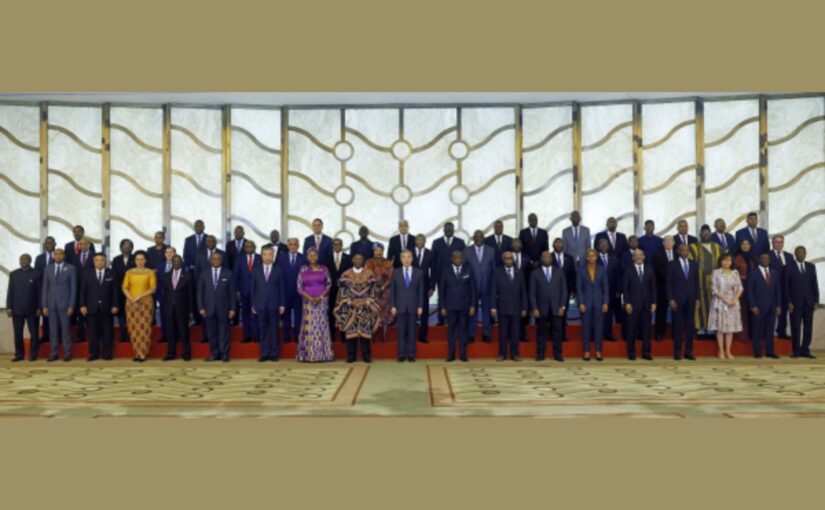
Whilst attending the G20 Foreign Ministers meeting in Johannesburg, South Africa, Chinese Foreign Minister Wang Yi held meetings on the sidelines with South African President Cyril Ramaphosa, Ngozi Okonjo-Iweala, Director-General of the World Trade Organisation (WTO), along with his counterparts from a number of countries.

Wang met with President Ramaphosa on February 20.

Cyril Ramaphosa asked Wang Yi to convey his sincere greetings to President Xi Jinping and expressed his heartfelt thanks to China for its firm support for South Africa’s struggle for national independence and its valuable help in accelerating national development. South Africa cherishes the high-level mutual trust between the two countries, regards China as a reliable friend, and will continue to firmly pursue the one-China policy.

Wang Yi conveyed the cordial greetings from President Xi Jinping, saying that China and South Africa have always understood and supported each other and carried out close exchanges, communication and coordination, which demonstrates the high level of bilateral relations. In the process of South Africa’s development and revitalisation, China will always be a trustworthy and reliable friend and partner of South Africa and is willing to continue to provide assistance within its capacity.

The next day he met with his South African counterpart Ronald Lamola.

Wang said, by assuming the G20 presidency, South Africa represents Africa in making a strong voice on the global stage, which demonstrates the historic shifts in international political and economic landscapes and holds great symbolic significance. As multilateralism faces threats amid the rise of unilateral bullying and protectionism, the foreign ministers’ meeting under the theme ‘Solidarity, Equality, Sustainability’ has reflected the common aspirations of most countries, especially those from the Global South.

Ronald Lamola thanked China for its strong support for South Africa’s G20 presidency. In the face of a volatile international situation, South Africa remains committed to strengthening close coordination and cooperation with China to safeguard the common interests of the Global South countries.

In her meeting with Wang, World Trade Organisation Director-General Ngozi Okonjo-Iweala said that amid the chaos in the world, China has moved in the right direction, achieved the UN poverty reduction target ahead of schedule, advanced industrialisation rapidly and made remarkable achievements in education. China’s success has set an example and provided references for other developing countries.

One of Wang’s first meetings on arriving in South Africa was with Russian Foreign Minister Sergei Lavrov, who had come direct from talks on the Ukraine issue with US Secretary of State Marco Rubio, held in Saudi Arabia.

Wang Yi said that the China-Russia comprehensive strategic partnership of coordination for a new era is advancing to a higher level and broader dimensions. The two sides have maintained steady progress in mutually beneficial cooperation and engaged in close and effective strategic coordination, playing a crucial role in safeguarding the common interests of both countries and their peoples and advancing the multipolarity in the world.

This year, he continued, marks the 80th anniversary of the victory of the World Anti-Fascist War and the founding of the United Nations, which is of great historic significance. During that arduous struggle, the peoples of China and Russia fought valiantly on both the Eastern and Western fronts, enduring tremendous national sacrifices and making significant historical contributions in the effort to save their nations from the brink of destruction and strive for world peace. China and Russia, as major victorious nations of World War II and permanent members of the United Nations Security Council, jointly bear the crucial responsibility of safeguarding the victorious results of World War II and maintaining the post-war international order. No matter how the situation evolves, the foundation of China-Russia friendship remains unshakable. Both sides should take the opportunity of jointly commemorating the 80th anniversary to deepen China-Russia strategic coordination, actively promote the correct view on World War II, firmly defend the international system with the United Nations at its core and safeguard the legitimate rights and interests of Global South countries.

Sergei Lavrov said, President Vladimir Putin and President Xi Jinping charted the course for Russia-China relations and strategic coordination. Russia is also willing to work with China to hold a series of events to commemorate the 80th anniversary of the victory of World War II. Russia also highly recognises the global initiatives put forward by China, highly values the high-level mutual trust between the two countries and is willing to continue to strengthen communication and coordination with China within the BRICS mechanism, the Shanghai Cooperation Organisation, the United Nations, the G20, and other frameworks.

Sergei Lavrov also introduced the latest developments in the Ukraine crisis and Russia’s considerations, saying that his country focuses on solving the root causes of the crisis and is committed to seeking a fair and sustainable plan for peace in line with the UN Charter. Russia attaches importance to China’s objective and just position, and the ‘Friends for Peace’ group China initiated with Brazil and other countries, and is willing to maintain communication with China and strengthen cooperation with the countries of the South.

Wang Yi met with Turkish Minister of Foreign Affairs Hakan Fidan at the latter’s request.

Continue reading Wang Yi: China will always be a trustworthy and reliable friend and partner of South Africa

China: ‘Palestinians governing Palestine’ is an important principle that must be upheld

Following his visit to New York, where he chaired the high-level United Nations Security Council meeting on ‘Practicing Multilateralism, Reforming and Improving Global Governance’, Chinese Foreign Minister Wang Yi flew to South Africa to attend the Johannesburg meeting of G20 foreign ministers, the first such gathering to be held on African soil.

In a deeply racist and hegemonic move, the meeting was boycotted by the United States Secretary of State Marco Rubio, with the US citing South Africa’s tentative moves in land reform aimed to redress the iniquities of the erstwhile racist apartheid system and the legacy of colonial rule as well as the host country highlighting the issues of diversity, equality and tackling climate change, all of which are in the crosshairs of the Trump administration. Trump is also determined to punish South Africa for its courageous and principled leading role in unmasking and opposing Israeli genocide against the Palestinian people. It should further be noted that plutocratic capitalists with intimate ties to Trump, such as Elon Musk and Peter Thiel, have deep ties to the old racist system in South Africa. The US retreat into unilateralism, and attempts at bullying, only served to highlight the unique role of China as the major power putting forward constructive strategies and proposals in the common interest of the vast majority of humanity.

In his speech delivered on February 20, the first day of the conference, Wang Yi said that China would work with all other parties in the following areas:

  • Acting as the guardians of world peace. Countries should respect each other’s sovereignty and territorial integrity and respect the development paths and social systems independently chosen by each other. Countries should persevere with dialogue and negotiation and seek peaceful settlements to differences and political solutions to international and regional hotspot issues. The Five Principles of Peaceful Coexistence, initiated by China and some other Global South countries 70 years ago, remain as relevant as ever under current circumstances.
  • Acting as the builders of universal security. Humanity is a community with a shared future. It is also an indivisible community of shared security. A country must not pursue its own security at the expense of the security of other countries, and the legitimate security concerns of all countries should be taken seriously.
  • Acting as the defenders of multilateralism. This year marks the 80th anniversary of the United Nations. It is also the 80th anniversary of the victory of the World Anti-Fascist War.  

Noting that previous speakers had all spoken about the Ukraine crisis, Wang Yi said: “Although the parties have different positions and it is hard to find simple solutions to complex issues, dialogue is always better than confrontation and peace talks better than fighting… Acting on the wishes of the relevant parties and keeping in mind the concerns of the international community, especially those of the Global South, China will continue playing a constructive role in the political settlement of the crisis.”

And turning to the question of Palestine, he remarked: “The conflict in Gaza has caused an unprecedented humanitarian disaster. The flames of war must not be reignited, and the ceasefire agreement must be implemented in a continuous and effective manner. Gaza and the West Bank are the homeland of the Palestinian people. ‘The Palestinians governing Palestine’ is an important principle that must be upheld in the post-conflict governance of Gaza… The historical injustice on the Palestinian question has remained unaddressed for over seven decades. The issue should not be marginalised once again.”

Wang Yi noted that: “This year represents an ‘African moment’ at the G20. After welcoming the African Union as a full member, the G20 is going to have a summit on the African continent for the first time. We must listen to what Africa has to say, take Africa’s concerns seriously, support Africa’s actions, and work for peace and development in Africa, so as to leave a distinct African mark on the Johannesburg Summit. China firmly supports the African people in independently resolving African problems and opposes external interference in the internal affairs of African countries.”

And in concluding he invoked the words of Nelson Mandela: “It is so easy to break down and destroy. The heroes are those who make peace and build.”

Wang Yi made a further speech the next day, saying, “China is ready to join all sides in embracing the theme of ‘Solidarity, Equality, Sustainability’ proposed by South Africa, ushering in a new chapter of G20 cooperation, and working together for a just world of common development” in the following ways:

  • Through Solidarity we will cement the foundation of G20 cooperation. President Ramaphosa noted that, cooperation has been one of the key markers of human development, which is what the G20 was established for. We should seek common ground, set aside and overcome differences whenever possible, avoid division and discord, and reject bloc confrontation. Major countries should play a leading role in advancing reform of the global economic governance system and improving the representation and voice of the Global South.
  • Through Equality we will empower the G20 on the way forward. In today’s world, technological revolution is progressing apace, presenting us with both opportunities and risks. China supports South Africa’s establishment of an Artificial Intelligence (AI) task force and supports the Global AI Summit on Africa. China also welcomes you all to attend the 2025 World Artificial Intelligence Conference. Together with Brazil, South Africa and the African Union, we have jointly launched an Initiative on International Cooperation in Open Science, and we look forward to more countries and international organisations coming aboard.
  • Through Sustainability we will open up new prospects for the G20. China will take an active part in the two newly established task forces on “Inclusive Economic Growth” and “Food Security” set up by South Africa, and support cooperation in priority areas such as disaster relief, debt sustainability, fair energy transition and key minerals.

He further noted that: “Africa is experiencing a new awakening. The G20 should make the most of South Africa’s Presidency, mobilise more development resources, promote synergy in global development actions, and partner with Africa in industrialisation, infrastructure, green minerals and other areas, to accelerate the continent’s advance toward modernisation.”

The following articles were originally published on the website of the Chinese Foreign Ministry. Additionally, the welcoming speech to the conference by South African President Cyril Ramaphosa may be read here.

Continue reading China: ‘Palestinians governing Palestine’ is an important principle that must be upheld

Trump wants US to ‘partner’ with Russia to weaken China: Divide-and-conquer strategy

In the following article on Geopolitical Economy, Ben Norton explores the complex political dynamics underlying the Trump administration’s move towards ending the conflict in Ukraine.

The summary is that “Trump is trying to divide Russia from China, in an attempt to isolate Beijing”, because “the United States sees China as the number one threat to its global dominance”.

Ben notes that Trump and top members of his cabinet have repeatedly expressed their desire to focus on countering China, and that Trump, in an interview with Tucker Carlson last year, openly stated that “you never want Russia and China uniting… I’m going to have to un-unite them, and I think I can do that, too. I have to un-unite them.”

This plan has been described as a “reverse Nixon/Kissinger strategy”, in that it seeks to revive Kissinger’s “triangular diplomacy”, befriending one of the two major enemies in order to isolate the other. Whereas the Soviet Union was the number one enemy in the 1970s, China is now seen as the main threat, as the world’s largest economy in purchasing power parity (PPP) terms, and the driving force behind the trajectory towards a multipolar world.

Ben further notes that such a strategy is consistent with the ideas laid out in Zbigniew Brzezinski’s 1997 book The Grand Chessboard, which argued that the US should prevent the rise of a Eurasian power that could challenge its global hegemony. Brzezinski wrote that “the most dangerous scenario would be a grand coalition of China, Russia, and perhaps Iran, an ‘anti-hegemonic’ coalition united not by ideology but by complementary grievances. It would be reminiscent in scale and scope of the challenge once posed by the Sino-Soviet bloc, though this time China would likely be the leader and Russia the follower.”

In short, “Trump hopes that by trying to divide Russia and China, he can weaken Beijing, reverse US decline, and save the US empire.” However, given the depth of the strategic partnership between Russia and China, it is unlikely that such a strategy will succeed.

The Donald Trump administration is holding talks between the United States and Russia, and he says he wants to end the war in Ukraine.

Trump’s Secretary of State Marco Rubio has even proposed that the US could “partner with the Russians, geopolitically”.

What is happening here? The simple answer is that this is all about China.

Trump is trying to divide Russia from China, in an attempt to isolate Beijing.

The United States sees China as the number one threat to its global dominance. This has been stated clearly by top officials in both the Trump administration and the previous Joe Biden administration.

Rubio dubbed China “the single greatest challenge this nation has ever faced”. Trump’s CIA Director John Ratcliffe asserted that “China was far and away our top national security threat”.

Trump’s plan to split Russia and China

Trump made this strategy clear in an interview with Tucker Carlson, the right-wing talk show host, on October 31, 2024.

Trump said it was a “shame” and it was “stupid” that the US had pushed China and Russia together.

“I’m going to have to un-unite them, and I think I can do that, too. I have to un-unite them”, Trump stated.

The following is a partial transcript of his remarks (emphasis added):

We are a nation in decline. We are a nation in very serious decline. And look at what these stupid people have done. They’ve allowed Russia, China, Iran, North Korea, and others to get together in a group. This is impossible to think.

When I was a young guy, I loved, I always loved the whole thing, the concept of the history, and all of the things that can happen. The one thing — and I had a professor at the Wharton School of Finance, but we had history classes also.

He said the one thing you never want to happen is you never want Russia and China uniting. We united them, because of the oil. We united them. Biden united them. It’s a shame, the stupidity of what they have done.

I’m going to have to un-unite them, and I think I can do that, too. I have to un-unite them.

But early on I’ve read, and you’ve learned, you never want Russia and China — and they’re natural enemies, because Russia has massive land, and China needs it.

They’re a natural enemy. And we’ve allowed them become, to get together. It’s such a dangerous thing.

Another thing that we’re doing is we’re losing the dollar as the standard, because of these people that are so — if we lose the dollar as the standard, that’s like losing a war. And it’ll never happen with me. There’s no way that will happen with me.

Trump threatens BRICS

What is noteworthy is how Trump immediately linked the close partnership between China and Russia to the issue of de-dollarization, the international drive to create alternatives to the US dollar as the global reserve currency.

China is Russia’s largest trading partner, and the two countries have almost entirely removed the US dollar from their bilateral trade. Instead, they now use their domestic currencies, the renminbi and ruble, in more than 90% of settlements.

Fears of de-dollarization have led Trump to threaten 100% tariffs on BRICS countries and other nations that drop the dollar in international trade and foreign exchange reserves.

Continue reading Trump wants US to ‘partner’ with Russia to weaken China: Divide-and-conquer strategy

Wang Yi meets with António Guterres and foreign ministers of Bolivia, Pakistan, Somalia, Uganda, Hungary, Spain and Austria

While in New York to attend the high-level United Nations Security Council meeting on the theme, ‘Practicing Multilateralism, Reforming and Improving Global Governance’, on February 18, Chinese Foreign Minister Wang Yi met on the sidelines with United Nations Secretary-General António Guterres and foreign ministers of a number of countries also attending the meeting.

António Guterres said that the United Nations highly appreciates China’s adherence to multilateralism and its support for the work of the UN, and positively evaluates China’s proposal for holding this meeting, which injects impetus into reforming global governance and enhancing the voice of developing countries.

Meeting with the Bolivian Foreign Minister Celinda Sosa Lunda, Wang Yi said that last November, President Xi Jinping held a fruitful meeting with President Luis Arce, which enhanced mutual trust and charted the course for the development of bilateral relations. This year marks the 40th anniversary of the establishment of diplomatic relations between China and Bolivia and the 200th anniversary of Bolivia’s independence. Standing at a new historical starting point, China is ready to make joint efforts with Bolivia to deepen mutually beneficial cooperation and take China-Bolivia strategic partnership to new heights. China supports Chinese enterprises to invest and do business in Bolivia to help the country accelerate development and improve people’s livelihood. He congratulated Bolivia on becoming a BRICS partner country and said that China supports Bolivia in playing a greater role in international and regional affairs.

Clearly alluding in particular to the recent brazen threats of US President Donald Trump and his Secretary of State Marco Rubio, Wang added that Latin America is the homeland of the Latin American people, not the backyard of any country. China supports Latin American countries in safeguarding sovereignty, independence and national dignity, and supports Bolivia in safeguarding its legitimate rights and interests. China will always be a reliable friend and partner of Latin America.

Sosa said, Bolivia and China are good brothers and good partners. Bolivia-China cooperation enjoys huge potential and the Bolivian side welcomes China to increase investment in Bolivia to achieve mutual benefit and win-win results. She thanked China for its strong support in enhancing Bolivia’s capacity for independent development and boosting its international influence. Both Bolivia and China are steadfast members of the Global South, and Bolivia looks forward to deepening and expanding cooperation with China under the China-CELAC [Community of Latin American and Caribbean States] Forum (which this year celebrates its 10th anniversary) and BRICS mechanisms.

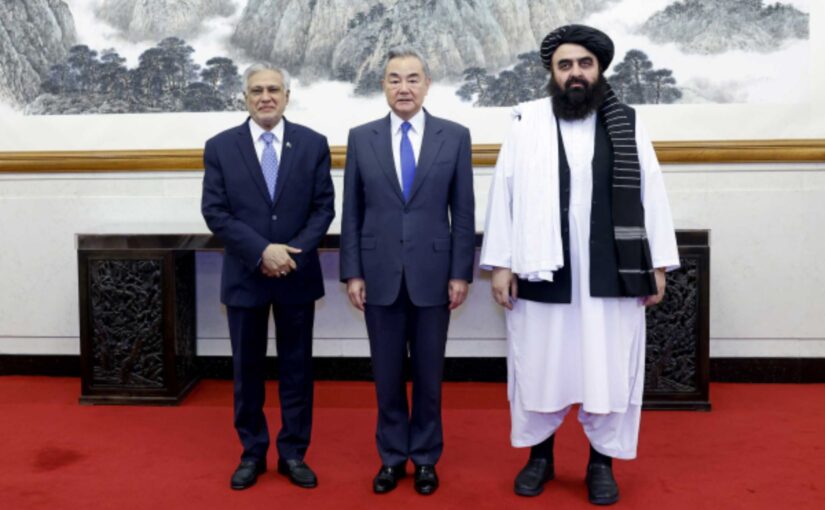
Meeting with Deputy Prime Minister and Foreign Minister of Pakistan Mohammad Ishaq Dar, Wang Yi stated that China and Pakistan are all-weather strategic cooperative partners, and the two sides have always trusted and supported each other. Not long ago, President Xi Jinping and President Asif Ali Zardari held a successful meeting, injecting fresh impetus into the ironclad friendship between China and Pakistan. China prioritises relations with Pakistan in its neighborhood diplomacy and will continue to uphold justice and speak up for Pakistan on international occasions. China will seek greater synergy of development strategies with Pakistan, and in particular, deepen cooperation on agricultural modernisation and industrialisation, and help Pakistan enhance its capacity for independent development.

Dar said that President Asif Ali Zardari’s visit to China was a great success, taking the all-weather strategic cooperative partnership between Pakistan and China to a new height, with cooperation in various fields advancing efficiently. Pakistan admires China’s remarkable progress in the development of modernisation and looks forward to strengthening high-level exchanges with China and seeking greater synergy of development strategies.

Meeting with Somali Foreign Minister Ahmed Moalim Fiqi, Wang Yi said that since the establishment of diplomatic relations between China and Somalia 65 years ago, the two countries have always respected and supported each other and treated each other as equals. Last year, President Xi Jinping and President Hassan Sheikh Mohamud held a meeting on the sidelines of the Beijing Summit of the Forum on China-Africa Cooperation (FOCAC) and decided to upgrade bilateral relations to a strategic partnership, which has drawn a new blueprint for bilateral cooperation. The Chinese side is ready to work with the Somali side to implement the outcomes of the Beijing Summit in Somalia and help Somalia achieve stability and development. Somalia is welcome to actively participate in the ten partnership actions for China and Africa to jointly advance modernisation and effectively use China’s zero-tariff policy for the least-developed African countries.

Ahmed Moalim Fiqi said the friendship between Somalia and China has a solid foundation. He thanked China for upholding justice for Somalia in the international arena and said that Somalia firmly abides by the one-China principle and opposes all words and deeds that undermine China’s sovereignty and territorial integrity.

Meeting with Ugandan Foreign Minister Odongo Jeje Abubakher, Wang Yi said that to promote multilateralism, the voice of Africa should not be absent; to improve global governance, the participation of Africa should not be overlooked. China is ready to work with African partners to build a just and equitable global governance system and make joint efforts for world peace, stability, development and prosperity. China appreciates Uganda’s active role as the rotating chair of the Non-Aligned Movement, congratulates Uganda on becoming a BRICS partner country, and stands ready to work together to promote solidarity and cooperation in the Global South and safeguard international fairness and justice.

Odongo Jeje Abubakher said that in Uganda’s struggle for national independence, China stood with Uganda through thick and thin; in Uganda’s pursuit of independent development, China has provided Uganda with invaluable support. Uganda regards China as a trustworthy and reliable partner, admires the achievements of the Communist Party of China in state governance, and hopes to learn from China’s modernization development path.

Meeting with Hungarian Foreign Minister Péter Szijjártó, Wang Yi said, in a clear reference to Hungary’s relatively balanced and objective position on the Ukraine situation in particular, that China appreciates Hungary’s rational and objective stance on hotspot conflict issues and believes that Hungary will continue to contribute to peace and stability in Europe, and play an important and unique role in this regard. He also commended Hungary for consistently regarding China as an opportunity for development, emphasising that regardless of changes in the international landscape, China will always be a trustworthy partner for Hungary.

Wang Yi also held numerous sideline meetings during his earlier participation in the Munich Security Conference. We report here on two such meetings, which reflect China’s consistent position of striving to find common ground with middle-level European powers which seek to uphold a degree of independence in their policies and actions.

On February 14, Wang Yi met with his Spanish counterpart Jose Manuel Albares Bueno.

Wang said that the development of China-Spain relations has seen many highlights, with close interactions between their leaders, important progress in major new energy cooperation projects, and fresh opportunities emerging in economic, trade, and investment cooperation, adding that China and Spain have maintained sound communication and coordination in international affairs.

With the current international situation in transformation and turbulence and the world facing the risk of a return to ‘the law of the jungle’, China and Spain should jointly practice multilateralism, promote the democratisation of international relations, build broad international consensus, and work together toward equal and orderly multipolarity.

 Albares, for his part, said Spain is willing to work with China to strengthen high-level exchanges, expand mutually beneficial cooperation, and continuously elevate bilateral ties. He noted that China, as a global power with significant influence, plays an indispensable leadership role in key international agendas, such as maintaining world peace and addressing climate change.

The next day, Wang Yi met with Austrian interim Chancellor and Foreign Minister Alexander Schallenberg and said that China is ready to work with Austria to jointly voice support for upholding multilateralism, maintaining the authority of the United Nations, defending the international rule of law and rejecting unilateral bullying. He noted that Austria, as a permanently neutral country [a status adopted on October 26, 1955, the day foreign troops withdrew from the country and its full sovereignty was restored post-World War II], has long played the role of a bridge-builder and mediator in international affairs.

Schallenberg, for his part, said that Austria and China respect each other and have conducted close cooperation on bilateral and multilateral issues. Decoupling and the severing of industrial and supply chains do not conform to the common interests of all parties; instead, open cooperation is key to achieving development and prosperity. Austria appreciates China’s adherence to multilateralism and is willing to work with China to uphold the purposes and principles of the UN Charter and defend the post-World War II international order, he noted, adding that Austria highly values China’s influence as a major country and hopes China will apply Eastern wisdom so as to play an important role in promoting peace.

The following articles were originally published on the website of the Chinese Foreign Ministry and the Xinhua News Agency.

Wang Yi Meets with U.N. Secretary-General António Guterres

Feb. 19 (MFA) — On February 18, 2025 local time, Member of the Political Bureau of the CPC Central Committee and Minister of Foreign Affairs Wang Yi met with Secretary-General of the United Nations (U.N.) António Guterres on the sidelines of the U.N. Security Council high-level meeting which he chaired in New York.

Wang Yi conveyed President Xi Jinping’s cordial greetings to António Guterres, and said that the current international situation is characterized by changes and turbulence as well as intensifying geopolitical games. The more volatile the world is, the more important it is to safeguard the authority and role of the United Nations. This year marks the 80th anniversary of the founding of the United Nations, which is of great significance in building on the past and ushering in the future. As the rotating President of the Security Council for February, China proposed to hold a high-level meeting on “Practicing Multilateralism, Reforming and Improving Global Governance”, which received positive responses from all parties and kicked off the Security Council’s activities to commemorate the 80th anniversary. All parties reached a high degree of consensus during the discussions and sent a strong call for supporting multilateral cooperation and improving global governance. China unswervingly supports the central role of the United Nations and the work of the Secretary-General and the Secretariat. China is willing to continue to work closely with the United Nations to build greater consensus, pool more resources, jointly practice true multilateralism, and advance the cause of world peace and development.

António Guterres asked Wang Yi to convey his sincere greetings to President Xi Jinping, saying that the United Nations highly appreciates China’s adherence to multilateralism and its support for the work of the United Nations, and positively evaluates China’s proposal for holding this meeting, which injects impetus into reforming global governance and enhancing the voice of developing countries. He said that the United Nations attaches great importance to China’s role and fully agrees with and actively supports the three global initiatives put forth by President Xi Jinping. In the face of the current complex challenges, the United Nations will adhere to its established ideals, implement the purposes and principles of its Charter, and call on all countries to strengthen cooperation, jointly uphold international rule of law, and promote peace and sustainable development.

The two sides also had an exchange of views on the Ukraine crisis, the Middle East issue, and the security situation in Africa.


Continue reading Wang Yi meets with António Guterres and foreign ministers of Bolivia, Pakistan, Somalia, Uganda, Hungary, Spain and Austria

Wang Yi: The Global South should remain at the forefront of improving the global governance system

Following his visit to Ireland, Chinese Foreign Minister Wang Yi proceeded to New York, where, on February 18, on the initiative of China, which holds the rotating Chair of the United Nations Security Council (UNSC) for February, the UNSC held a high-level meeting on the theme, ‘Practicing Multilateralism, Reforming and Improving Global Governance’. The meeting was chaired by Wang Yi and representatives from over 100 countries participated.

In his address to the meeting Wang Yi noted:

The year 2025 marks the 80th anniversary of the founding of the United Nations. Eighty years ago, our forefathers, with strenuous struggle and tremendous sacrifice, won the great victory of the Anti-Fascist war; the international community drew painful lessons from the scourge of two world wars; and the United Nations was founded. Multilateralism gradually became the main trend of the times…

The past 80 years is a period of accelerated advancement in world multipolarity and economic globalisation, a period that has witnessed people across the world forging ahead and meeting challenges together, and also a period during which the Global South has been rising and growing in strength. Meanwhile, although human society has emerged from the shadows of the Cold War and moved beyond the bipolar standoff, comprehensive peace and shared prosperity remain elusive. In the third decade of the 21st century, peace and development remains a long-term, arduous task… In the face of the profoundly changing international landscape, the Global South should not only achieve the historic feat of moving toward modernisation together but also remain at the forefront of improving the global governance system.

To this end, he made four proposals:

  • Upholding sovereign equality. All countries are equal, regardless of size or strength. This is the foremost principle in the UN Charter. In advancing global governance, all countries have the right to participate as equals, make decisions as equals, and benefit as equals. We must respect the development paths chosen independently by people of all countries, uphold the principle of non-interference in internal affairs, and not impose one’s will upon others.
  • Upholding fairness and justice. Since the end of World War II, a large number of countries in the Global South have emerged on the world stage, which has revealed growing incompatibility and irrationality in the global governance structure. Under the new circumstances, international affairs should no longer be monopolised by a small number of countries. Countries in the Global South have the right to speak up for and defend their legitimate rights and interests. The fruits of development should no longer be taken by just a few countries. People of all countries have the right to a happy life.
  • Upholding solidarity and coordination. The Security Council must rise above narrow-minded geopolitical considerations, champion the spirit of solidarity and cooperation, fulfil its duties conferred by the UN Charter, and effectually play its role for the maintenance of international peace and security.
  • Upholding an action-oriented approach.  In the face of protracted wars, loss of innocent lives, and challenges brought by new technologies, UN agencies should seek solutions rather than chant slogans. Gaza and the West Bank are the homeland of the Palestinian people, not a bargaining chip in political trade-offs. The Palestinians governing Palestine is an important principle that must be followed in the post-conflict governance of Gaza.

Following the meeting, Wang Yi answered questions from the media. On the issue of Gaza, he said that it is important to recognise that the world is facing more than just the Ukraine crisis. Other hotspots, including the Gaza conflict, also require the international community’s attention and should not be marginalised.

Behind the Gaza conflict lies the unresolved Palestinian question. More than 70 years have passed since the UN adopted the resolution to establish two States, Palestine and Israel, but the two-state solution has only been partially implemented. The State of Israel was established long ago, but the Palestinian people still do not have their own country. Many are displaced, becoming refugees. The Palestinian question remains at the core of the Middle East issue. Palestinian factions should truly implement the Beijing Declaration and achieve unity and self-strength. All parties in the Middle East should transcend their differences and support Palestine’s statehood. The United Nations should take action to admit Palestine as a full member.

The following articles were originally published on the website of the Chinese Foreign Ministry.

Remarks by H.E. Wang Yi at the United Nations Security Council High-Level Meeting “Practicing Multilateralism, Reforming and Improving Global Governance”

Feb. 19 (MFA) — Your Excellency Secretary General António Guterres,
Colleagues,

I would like to thank Secretary General Guterres for attending this meeting and for his briefing.

The year 2025 marks the 80th anniversary of the founding of the United Nations. Eighty years ago, our forefathers, with strenuous struggle and tremendous sacrifice, won the great victory of the Anti-Fascist war; the international community drew painful lessons from the scourge of two world wars; and the United Nations was founded. Multilateralism gradually became the main trend of the times. New historical chapters were opened in global governance.

The past 80 years is a period of accelerated advancement in world multipolarity and economic globalization, a period that has witnessed people across the world forging ahead and meeting challenges together, and also a period during which the Global South has been rising and growing in strength. Meanwhile, although human society has emerged from the shadows of the Cold War and moved beyond the bipolar standoff, comprehensive peace and shared prosperity remain elusive. In the third decade of the 21st century, peace and development remains a long-term, arduous task.

The 80 years of history is enlightenment enough: In the face of the turbulent and changing international landscape, the U.N.-centered international system provides important safeguards for the cause of human progress, and the vision of multilateralism with coordination and cooperation as its cornerstone is the best solution to global issues. In the face of the historical trend of shared future, no country can prosper alone; mutually beneficial cooperation is the right choice. In the face of the profoundly changing international landscape, the Global South should not only achieve the historic feat of moving toward modernization together, but also remain at the forefront of improving the global governance system.

Mr. Secretary General,
Colleagues,

To chart our course for the future, we should not forget why we started out in the beginning. Today, transformation not seen in a century is accelerating across the world, geopolitical conflicts keep escalating, multiple crises are emerging, and instability and uncertainty are increasingly prominent. In a time of intensifying turbulence and transformation, we need, more than ever, to remind ourselves of the founding mission of the U.N., reinvigorate true multilateralism, and speed up the efforts to build a more just and equitable global governance system. In this connection, China proposes the following:

First, upholding sovereign equality. All countries are equal, regardless of size or strength. This is the foremost principle in the U.N. Charter. In advancing global governance, all countries have the right to participate as equals, make decisions as equals, and benefit as equals. We must respect the development paths chosen independently by people of all countries, uphold the principle of non-interference in internal affairs, and not impose one’s will upon others. We must practice international rule of law, ensure the effective implementation of international law, and reject double standards and selective application. Resolutions of the Security Council are binding, and should be observed by all countries. The Security Council is entrusted with authority, and such authority should be upheld by all countries. Any act of bullying, trickery or extortion is a flagrant violation of the basic norms of international relations. Any unilateral sanction that circumvents Security Council authorization lacks legal basis, defies justification and contradicts common sense.

Second, upholding fairness and justice. A critical part of global governance is to ensure that justice prevails. Since the end of World War II, a large number of countries in the Global South have emerged on the world stage, which has revealed growing incompatibility and irrationality in the global governance structure. Under the new circumstances, international affairs should no longer be monopolized by a small number of countries. Countries in the Global South have the right to speak up for and defend their legitimate rights and interests. The fruits of development should no longer be taken by just a few countries. People of all countries have the right to a happy life. The reform of the Security Council should continue to emphasize democratic consultation, increase the representation and say of developing countries, especially African countries, and effectively redress historical injustice.

Third, upholding solidarity and coordination. Promoting international cooperation is an important purpose of the U.N. Charter, and a sure path toward improving global governance. Countries should commit to the principle of extensive consultation and joint contribution for shared benefit, replace confrontation with coordination, prevent lose-lose through win-win cooperation, and break down small circles with greater solidarity. Members cannot just sit by and watch multilateral institutions become dysfunctional and ineffective due to their own failure to cooperate. The Security Council must rise above narrow-minded geopolitical considerations, champion the spirit of solidarity and cooperation, fulfill its duties conferred by the U.N. Charter, and effectually play its role for the maintenance of international peace and security.

Continue reading Wang Yi: The Global South should remain at the forefront of improving the global governance system

China, Ireland pledge closer ties, deeper cooperation

Following his participation in the Munich Security Conference, Chinese Foreign Minister Wang Yi visited Ireland on February 17.

In his meeting with Taoiseach (Prime Minister) Micheal Martin, he said that China is ready to work with Ireland to enhance their mutually beneficial cooperation, making it bigger, stronger, deeper and more concrete, in order to achieve shared development and prosperity.

China appreciates Ireland’s positive, pragmatic, and friendly policy towards China and stands ready to work with Ireland to implement the consensus reached by leaders of the two countries, consolidate high-level mutual trust, and expand high-level cooperation. And China seeks to strengthen dialogue, enhance mutual trust, and properly manage differences with Ireland, Wang said, adding that both sides can serve as a constructive force in the process of global multipolarisation, making joint efforts to safeguard global peace, stability, and development.

Martin, for his part, stated that Ireland and China enjoy a long-standing tradition of friendship, mutual respect and trust, and strong bilateral relations. He noted that Chinese Premier Li Qiang paid a successful visit to Ireland last year. China’s modernisation and accelerated green transformation have brought significant opportunities to the world, he said, adding that Ireland attaches great importance to and cherishes its relations with China, and is willing to develop a closer partnership while continuing to adhere to the one-China policy.

In his meeting with Tanaiste (Deputy Prime Minister) and Minister for Foreign Affairs and Trade Simon Harris, Wang said that amid growing global uncertainties and instabilities, China’s call for building an equal and orderly multipolar world represents the broadest consensus of the international community. China and the EU, he continued, are key forces in a multipolar world and reiterated China’s readiness to collaborate with all parties, including the EU, to uphold the authority of the United Nations, adhere to fundamental norms governing international relations, oppose unilateralism, and reject the resurgence of ‘the law of the jungle’.

Harris said that Ireland values its relationship with China, adheres to the one-China policy, and is committed to strengthening a positive and constructive partnership. He welcomed China’s visa-free policy for Irish citizens and expressed support for launching more direct flights to facilitate people-to-people exchanges. He added that Ireland upholds multilateralism and free trade, opposes ‘decoupling’, and supports deeper cooperation between China and the EU in addressing global challenges.

The two sides also discussed the Ukraine crisis, with Harris sharing his perspective on rebuilding peace in Europe. Wang reaffirmed China’s support for all efforts toward achieving peace and support for a fair, lasting, and binding peace formula acceptable to all parties. He also stressed China’s support for Europe’s role in the peace process, particularly in shaping a new security framework for the region.

Both sides also exchanged views on the situation in Gaza and advancing efforts for a return to the ‘two-state solution’.

Following his visit to Ireland, Wang Yi proceeded to New York, where he chaired the United Nations Security Council High-Level Meeting on “Practicing Multilateralism, Reforming and Improving Global Governance”.

The following articles were originally published by the Xinhua News Agency.

China ready to enhance cooperation with Ireland: FM

DUBLIN, Feb. 17 (Xinhua) — China is ready to work with Ireland to enhance their mutually beneficial cooperation, making it bigger, stronger, deeper and more concrete, in order to achieve shared development and prosperity, Chinese Foreign Minister Wang Yi said here on Monday.

Wang, also a member of the Political Bureau of the Communist Party of China Central Committee, made the remarks during a meeting with Irish Taoiseach Micheal Martin.

He said China-Ireland relations have continuously developed alongside China’s reform and opening-up process. The development of the Shannon Free Zone has served as a valuable reference for China, while China’s development has also, in return, brought benefits to Ireland, he stressed.

The minister said the facts have proved that the mutually beneficial strategic partnership between China and Ireland serves both countries’ interests and brings benefits to their people.

Continue reading China, Ireland pledge closer ties, deeper cooperation

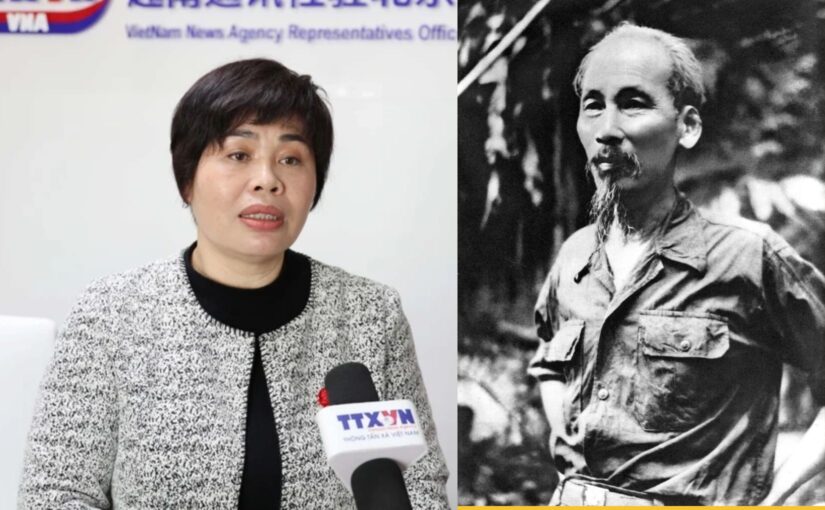
Vietnamese Party chief welcomes Party Secretary of China’s Guangxi

Chen Gang, Secretary of the Communist Party of China (CPC) Committee of the Guangxi Zhuang Autonomous Region and Chairman of the Regional People’s Congress Standing Committee, visited Vietnam to attend a New Year meeting for the secretaries of the Party committees of Vietnam’s Quang Ninh, Lang Son, Cao Bang and Ha Giang provinces and China’s Guangxi Zhuang Autonomous Region, as well as the 16th session of their Joint Working Committee, held in Ha Long city of Quang Ninh from February 19-22. The four Vietnamese provinces all share a border with the Chinese autonomous region.

This was Chen’s first overseas trip since he newly assumed his current position, which reflects the Chinese region’s strong commitment to fostering cooperation with Vietnam. For its part, the Vietnamese side showed the high premium and great importance it attaches to friendship and cooperation with China, with February 18 meetings between Chen and both General Secretary of the Communist Party of Vietnam (CPV) Central Committee To Lam and Prime Minister Pham Minh Chinh, a reception which goes considerably beyond the normal requirements of protocol.

In his meeting, To Lam affirmed that Vietnam consistently regards the development of its relations with China as an objective requirement, a strategic choice, and a top priority in its foreign policy of independence, self-reliance, multilateralism and diversification of external relations. He appreciated the pioneering role and position of Guangxi in promoting the friendship and practical cooperation with Vietnam. He applauded Guangxi and the Vietnamese localities’ effective implementation of the New Year meeting and supported both sides’ idea to invite Vietnam’s Hai Phong city to participate in this annual mechanism.

Both sides should effectively implement mutually beneficial cooperation in various fields, particularly economics and trade, infrastructure, science and technology, innovation, and artificial intelligence (AI); and accelerate the building a pilot model of smart border gates to facilitate customs clearance, especially for Vietnam’s agricultural products entering the Chinese market; as well as cooperate in land border management.

Chen said Vietnam is a close neighbour and a leading partner of Guangxi, affirming that the Party organisation and administration of the Guangxi Zhuang Autonomous Region, as well as himself personally, attach great importance to the friendship and cooperation with Vietnamese localities. Guangxi will continue to take the lead in thoroughly and fruitfully implementing the shared perceptions of the top leaders of both Parties and countries regarding the further enhancement of the Comprehensive Strategic Cooperative Partnership and the building of the Vietnam-China community with a shared future that carries strategic significance.

Welcoming Chen, Prime Minister Chinh highlighted the significance of Guangxi’s Party leaders visiting Vietnam for three consecutive years, which shows Guangxi’s commitment to deepening friendship and cooperation with Vietnamese localities.

He expressed appreciation for Guangxi’s historical ties with Vietnam, noting that it holds many significant landmarks related to President Ho Chi Minh’s revolutionary activities. He also recognised its role as China’s leading province in fostering exchanges and cooperation with Vietnam, serving as a gateway between China and ASEAN (the Association of South-East Asian Nations).

Chen expressed his pleasure at visiting Vietnam for the first time, praising the country’s development and reaffirming Guangxi’s strong focus on reinforcing ties with Vietnamese localities, especially the four provinces bordering Guangxi. He pledged that the Chinese side is determined to effectively implement the high-level common perceptions to practically contribute to relations between the two Parties and countries. He outlined a plan to establish a China-ASEAN artificial intelligence cooperation centre in Guangxi’s capital Nanning to promote collaboration in this area with Vietnam and other member states of ASEAN.

The following articles were originally published by Nhân Dân.

Vietnamese Party chief welcomes Party Secretary of China’s Guangxi

Feb. 18 (Nhân Dân) — General Secretary of the Communist Party of Vietnam (CPV) Central Committee To Lam on February 18 received Chen Gang, member of the Communist Party of China (CPC) Central Committee, Secretary of the CPC Committee of the Guangxi Zhuang Autonomous Region and Chairman of the Regional People’s Congress Standing Committee.

Chen is visiting Vietnam to attend a New Year meeting for the secretaries of the Party committees of Vietnam’s Quang Ninh, Lang Son, Cao Bang and Ha Giang provinces and China’s Guangxi Zhuang Autonomous Region, as well as the 16th session of their Joint Working Committee, which will be held in Ha Long city of Quang Ninh from February 19–22.

Lam affirmed that Vietnam consistently regards the development of its relations with China as an objective requirement, a strategic choice, and a top priority in its foreign policy of independence, self-reliance, multilateralism and diversification of external relations.

Continue reading Vietnamese Party chief welcomes Party Secretary of China’s Guangxi

AI for the people? How China’s AI development challenges US big tech

In the following article for Struggle La Lucha, based on a talk given at our recent webinar DeepSeek and the challenge to US technological hegemony, Gary Wilson makes a number of important points about the US’s tech war on China.

He notes, firstly, that this tech war – part of a broader New Cold War that also involves a significant military component – has been going on for more than a decade. “It really began in 2011 with Barack Obama’s Pivot to Asia, a Cold War-style containment policy. The Pivot to Asia was primarily a military operation but also introduced export controls on advanced technologies… The tech war escalated significantly during Donald Trump’s first presidency with trade restrictions and sanctions on Chinese firms, including Huawei and ZTE. Then, with Joe Biden, even more severe restrictions were imposed.”

Gary goes on to explain that “semiconductors are the foundation of modern technology — enabling the functionality of virtually every device and system we use every day”, and this is the reason the US is so keen to prevent China from becoming a major player in this field. Nevertheless, “despite the restrictions, China has been making significant strides in semiconductor technology. Huawei is developing advanced high-powered chips, and the performance of its new Ascend 910C compares to Nvidia’s H20, the GPU used to build DeepSeek R1. While DeepSeek was trained on the Nvidia H20, it used the Ascend 910C for inference, the process where a trained AI model draws conclusions.”

In general, the West’s attempts to suppress China’s technological rise have been singularly unsuccessful. The author points out that, when the Pivot to Asia began in 2011, the US led in 60 of 64 key technologies globally. By 2022, China had surpassed the US in 52 of those technologies. “China has built entire high-tech industries that now dominate globally: Huawei is the world’s leading 5G telecommunications company. BYD is the world’s top electric vehicle maker. CATL leads in advanced battery technology. Tongwei is tops in solar power. DJI is the world’s largest commercial drone maker.”

The article observes that China’s economic model and political system allow it to dedicate enormous resources to key projects, and to focus on prioritise on meeting human needs. “Unlike the US, which focuses on AI for corporate profits, China sees AI as a driver of economic transformation — a way to modernize its economy.” Furthermore, the Chinese government is dedicated to ensuring that the benefits of AI are shared by the people, rather than being monopolised by a few big corporations. “The potential benefits of treating AI as a public utility are immense. Rather than displacing workers or driving inequality, open-access AI can be used for equitable planning of production and distribution.”

Gary concludes:

Despite US restrictions, China continues to advance in AI, semiconductors, and other high-tech industries. China is shaping the future of global technology, and AI could play a key role in the economic planning of production and services to meet people’s needs.

Let’s start with the U.S. tech war against China. Some call it a New Cold War. A problem with that term is there’s no guarantee it will stay “cold.” There is a major U.S. military buildup around China, with a U.S. Army drone warfare Green Beret unit now stationed in Taiwan, and aircraft carriers from the U.S., France and Japan conducting “war games” in the South China Sea.

Nancy Pelosi’s visit to Taiwan in 2022, the first high-level U.S. official visit since the 1990s, was a provocation challenging China’s sovereignty, that was backed with an unprecedented escalation in U.S. military activity in the region that came dangerously close to sparking a “hot war.” 

Anyway, whatever we call it, a New Cold War, an economic war, trade war or tech war — the U.S. has made China’s science and technology a target. The U.S. has imposed strict limits on technology transfers, restricted access to semiconductors, sanctioned Chinese tech companies, blocked academic and research collaboration, and halted many scientific exchanges.

This tech war didn’t just start. It really began in 2011 with Barack Obama’s Pivot to Asia, a Cold War-style containment policy. The Pivot to Asia was primarily a military operation but also introduced export controls on advanced technologies. 

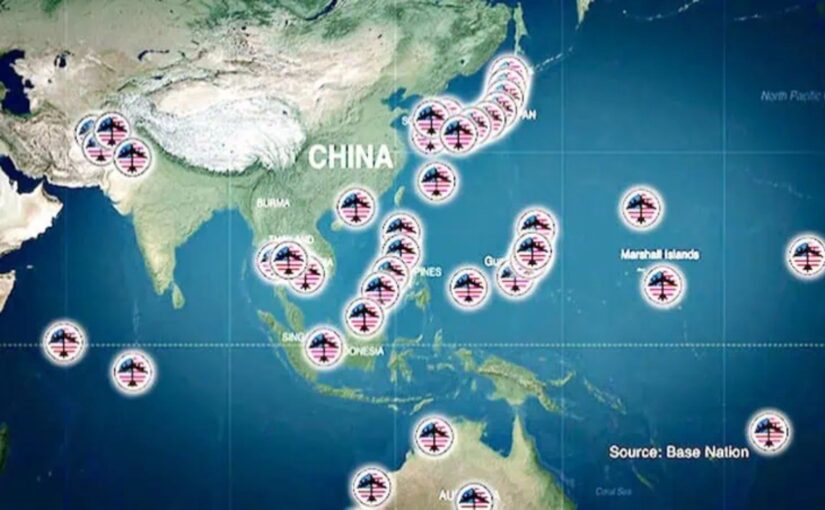
As a military operation, it involved moving 60% of U.S. naval forces into the Asia-Pacific region, militarily surrounding China, and expanding military exercises like RIMPAC, the world’s largest naval war games.

The tech war escalated significantly during Donald Trump’s first presidency with trade restrictions and sanctions on Chinese firms, including Huawei and ZTE. 

Then, with Joe Biden, even more severe restrictions were imposed. The U.S. also expanded military and technology alliances against China, like AUKUS – some call it the Asian NATO — and the U.S.-Japan-South Korea trilateral pact.

Continue reading AI for the people? How China’s AI development challenges US big tech

Strengthening, developing friendship with China consistent position of DPRK

It is a consistent position of the Democratic People’s Republic of Korea (DPRK) to follow the lofty wills of the top leaders of the two parties and countries and continuously strengthen and develop friendly relations between the DPRK and China, according to the DPRK’s Vice Minister of Foreign Affairs Pak Myong Ho. He was speaking at a February 18 meeting with Chinese Ambassador to the DPRK Wang Yajun.

Wishing further success to the socialist construction in the two countries, Pak added that this year marks the 80th anniversary of the founding of the Workers’ Party of Korea (WPK) and the last year to implement the five-year plan put forward by the WPK’s 8th Congress, and it is also the final year of China’s 14th Five-Year Plan.

For his part, Wang said that the Chinese party, government and people have always cherished the friendship between China and the DPRK forged by previous generations of leaders of the two countries, adding that it has always been China’s unswerving policy to maintain, consolidate and develop China-DPRK traditional friendly and cooperative relations.

The following article was originally published by the Xinhua News Agency.

BEIJING, Feb. 19 (Xinhua) — It is a consistent position of the Democratic People’s Republic of Korea (DPRK) to follow the lofty wills of the top leaders of the two parties and countries and continuously strengthen and develop friendly relations between the DPRK and China, the DPRK’s Vice Minister of Foreign Affairs Pak Myong Ho has said.

This year marks the 80th anniversary of the founding of the Workers’ Party of Korea (WPK) and the last year to implement the five-year plan put forward by the WPK’s 8th Congress, and it is also the final year of China’s 14th Five-Year Plan, Pak said while meeting with Chinese Ambassador to the DPRK Wang Yajun at the Chinese embassy on Tuesday.

Pak hoped that the two countries will continue to make new and greater achievements in socialist construction, and the two sides will strengthen exchanges and cooperation to promote DPRK-China relations to a higher level.

For his part, Wang said that over the past year, China-DPRK relations have made new progress under the personal care and strategic guidance of the top leaders of the two parties and countries.

The Chinese party, government and people have always cherished the friendship between China and the DPRK forged by previous generations of leaders of the two countries, Wang said, adding that it has always been China’s unswerving policy to maintain, consolidate and develop China-DPRK traditional friendly and cooperative relations.

In the new year, China is ready to work with the DPRK to implement the important consensus reached by the top leaders of the two parties and countries, follow the trend of the times and the wills of the two peoples, strengthen strategic communication, deepen practical cooperation, and push for new and greater development of China-DPRK relations, so as to better benefit the two peoples and make greater contributions to regional and world peace and stability, the Chinese ambassador said. 

China advocates equality among all countries regardless of size

Chinese Foreign Minister Wang Yi has outlined his country’s view of multipolarisation in his address, delivered on February 14, to the 61st Munich Security Conference.

In four succinct points, without mentioning any country by name, but clearly drawing firm and definite lines of demarcation with the bullying and hegemonic practices of the United States in particular, Wang sets out China’s building blocks for an equal and orderly multipolar world:

  • It is important to advocate equal treatment. Rivalry between big powers had brought disaster to humanity, as evidenced by the lessons of the two world wars in the not-so-distant past. Whether it is the colonial system or the core-periphery structure, unequal orders are bound to meet their demise. Independence and autonomy are sought across the world, and greater democracy in international relations is unstoppable. It is in this principle that China advocates equality among all countries regardless of size and calls for increasing the representation and say of developing countries in the international system.
  • It is important to respect international rule of law.  The world today is witnessing incessant chaos and confusion, and one important reason is that some countries believe might makes right and have opened a Pandora’s box marked the law of the jungle. In reality, all countries, regardless of size or strength, are stakeholders in international rule of law. Without norms and standards, one may be at the table yesterday but end up on the menu tomorrow. Major countries must take the lead in honouring their words and upholding rule of law, and must not say one thing but do another, or engage in zero-sum game.
  • It is important to practice multilateralism. In the face of emerging global challenges, no country can stay unaffected, and the “we first” approach in international relations only leads to a lose-lose result.
  • It is important to pursue openness and mutual benefit. The multipolar world should be one where all countries develop together. Protectionism offers no way out, and arbitrary tariffs produce no winners. Decoupling deprives one of opportunities, and a “small yard with high fences” only ends up constraining oneself.

We reprint the full text of the speech below. It was originally published on the website of the Chinese Foreign Ministry.

Keynote Speech by H.E. Wang Yi
At the 61st Munich Security Conference
Conversation with China

Munich, February 14, 2025

Your Excellency Chairman Christoph Heusgen,
Dear Friends,
Colleagues,

The world we live in is an increasing mix of turbulence and transformation. Many people are asking the same question: Where is it headed? If I may borrow the theme of this year’s Munich Security Report, it is headed toward multipolarization. When the United Nations was founded 80 years ago, it had only 51 member states; today, 193 countries ride in the same big boat. A multipolar world is not only a historical inevitability; it is also becoming a reality.

Will multipolarity bring chaos, conflict and confrontation? Does it mean domination by major countries and the strong bullying the weak? China’s answer is, we should work for an equal and orderly multipolar world. This is another major proposition put forward by President Xi Jinping, and it represents our sincere expectation for a multipolar world. China will surely be a factor of certainty in this multipolar system, and strive to be a steadfast constructive force in a changing world.

Here, I want to make four points. 

First, it is important to advocate equal treatment. Rivalry between big powers had brought disaster to humanity, as evidenced by the lessons of the two world wars in the not-so-distant past. Whether it is the colonial system or the core-periphery structure, unequal orders are bound to meet their demise. Independence and autonomy is sought across the world, and greater democracy in international relations is unstoppable. Equal rights, equal opportunities and equal rules should become the basic principles of a multipolar world.

Continue reading China advocates equality among all countries regardless of size

A new multipolar world or a new cold war? Latin America, China and the rising global South

In the following article, Ben Chacko, Editor of the Morning Star, analyses the position of Latin America as a frontline in the struggle for multipolarity, a struggle which is heavily impacted by the rise of China.

Ben notes that: “Many of the Latin American revolutionary projects that inspire us… are independence struggles as well as class struggles. The two are bound together… Decolonisation remained partial if it was not accompanied by social revolution because formal independence did not necessarily give a country control of its own resources if private property relations, maintaining ultimate Western ownership in many cases, stayed in place… This explains the close association between communist and decolonisation movements through the 20th century.”

The confrontation between the Global North and the Global South runs through the class struggle in country after country in Latin America, reflected not least through the prism of race – the struggle in Venezuela, Peru, Bolivia and other countries of the Afro-descendant and Indigenous oppressed against white supremacism – as well as being key to the continent’s relationship with the United States.

Therefore, Ben argues, “Building a multipolar world is a decolonisation process: one in which countries prevented till now from exercising full sovereignty because their resources are controlled by others are able to ‘stand up,’ as Chairman Mao put it in 1949. They are able to do so because China’s peaceful rise has created an economic counterweight to the West and the network of financial institutions and treaties that maintain Western hegemony.”

The article was originally published in the Morning Star and is based on a talk given by Ben at London’s Latin America Conference held on February 8.  The panel, on ‘A new multipolar world or a new Cold War? Latin America, China and the rising Global South’ was also addressed by Friends of Socialist China co-editor Carlos Martinez and Isaac Saney, Associate Professor and Coordinator of Black and African Diaspora Studies at Canada’s Dalhousie University, and author of  ‘Cuba, Africa, and Apartheid’s End: Africa’s Children Return!’

During the student-led protests that shook Chile a few years ago, a prominent rallying cry was “neoliberalism was born in Chile and will die in Chile.”

It points to the front-line place Latin America has had when it comes to clashes between economic systems and between imperialism and decolonisation. Many of the Latin American revolutionary projects that inspire us, that lots of us come to Adelante! to hear more about, are independence struggles as well as class struggles.

The two are bound together. The poverty and underdevelopment of much of the Third World is down to the domination of economies by Western corporations controlling their natural resources.

Continue reading A new multipolar world or a new cold war? Latin America, China and the rising global South

China open to good ties with Czech Republic provided core interests respected

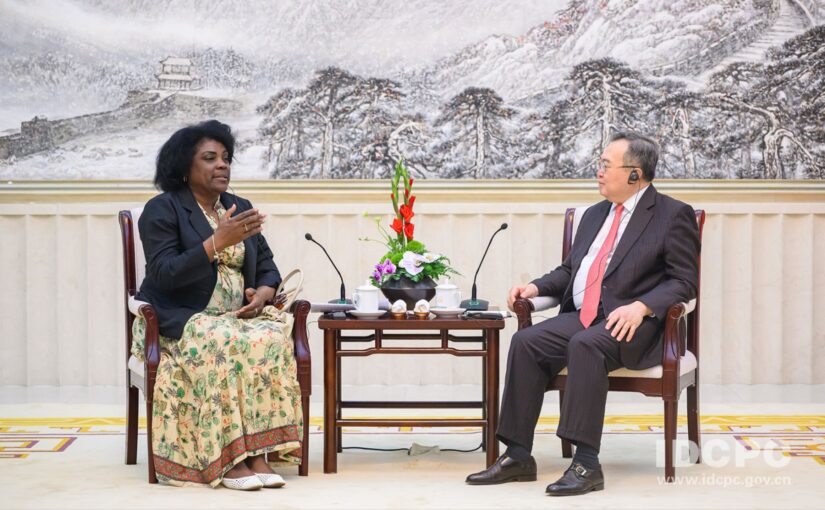
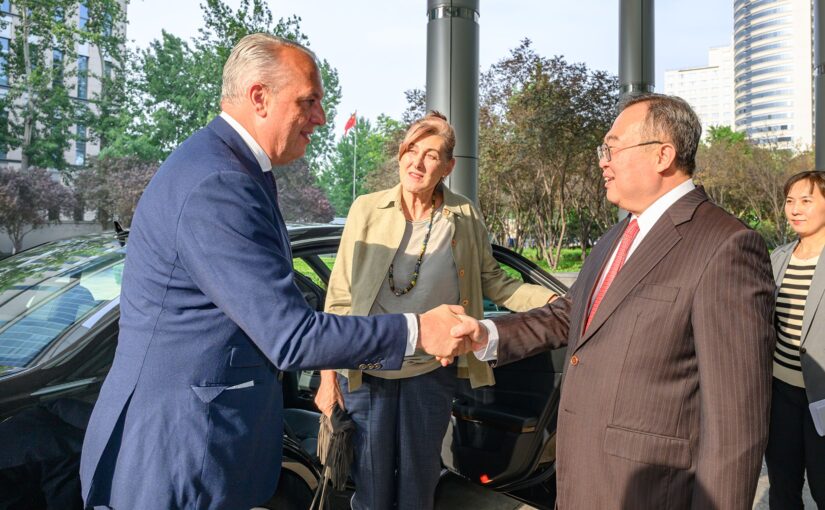
Liu Jianchao, Minister of the International Department of the Communist Party of China (CPC) Central Committee (IDCPC), met on February 17 with a delegation led by Kateřina Konečná, Chairwoman of the Communist Party of Bohemia and Moravia and Member of the European Parliament.

Liu said the Czech Republic was one of the first countries to establish diplomatic relations with the People’s Republic of China. The Chinese side attaches importance to China-Czech relations and maintains a stable policy towards the Czech Republic. It is willing to, together with the Czech side, adhere to win-win cooperation, respect each other’s core interests, transcend ideological differences, and push the relationship between the two countries back to a healthy and stable development track at an early date.

The background to this remark is that in recent years, China-Czech relations, which had been very friendly, have significantly deteriorated, with the pro-western government and some other leading politicians adopting hostile and provocative positions on such core issues for China as Taiwan and Xizang (Tibet).

Liu went on to say that the CPC regards the Communist Party of Bohemia and Moravia as a comrade and friend, appreciates its long-term support for the development of Czech-China and Europe-China relations, and is willing to strengthen exchanges and cooperation in various fields with the party.

Konečná said, at present, Czech-China relations are facing some difficulties, but this is not the mainstream of the relationship between the two countries. The friendship between the Czech and the Chinese people remains unchanged. The Communist Party of Bohemia and Moravia cherishes its friendly relations with the CPC and is willing to strengthen bilateral exchanges and promote the improvement and development of relations between the two countries.

Two days previously, on February 15, Chinese Foreign Minister Wang Yi, held a meeting with his Czech counterpart Jan Lipavsky on the sidelines of the annual Munich Security Conference in Germany.

Wang said that China is willing to enhance mutually beneficial cooperation with the Czech Republic provided that the Czech side respects China’s core interests. The Czech Republic was among the first countries to establish diplomatic ties with the People’s Republic of China and the two peoples have maintained good feelings toward each other. Bilateral relations, however, have experienced a downturn in recent years, a situation that China does not wish to see.

He expressed the hope that the Czech side would engage in earnest self-reflection, develop the right perspective about China, and take concrete actions to rebuild trust with China. The key is to respect China’s core interests, particularly adherence to the one-China principle, and to safeguard the political foundation of China-Czech relations, so as to bring bilateral ties back to a healthy and stable track as soon as possible. Only on this basis would China be willing to strengthen mutually beneficial cooperation in various fields with the Czech side.

Lipavsky acknowledged that, in the context of looming trade wars, maintaining dialogue and cooperation between the Czech Republic and China, as well as between the EU and China, is of great importance. The Czech government, he insisted, pursues a one-China policy and does not support “Taiwan independence.” The Czech Republic is willing to work with China to develop sound political relations and advance bilateral cooperation for better results.

The following articles were originally published on the website of the IDCPC and by the Xinhua News Agency.

Liu Jianchao Meets with a Delegation of the Communist Party of Bohemia and Moravia

Feb. 19 (IDCPC) — Liu Jianchao, Minister of the International Department of the CPC Central Committee (IDCPC), met here today with a delegation led by Kateřina Konečná, Chairwoman of the Communist Party of Bohemia and Moravia and Member of the European Parliament. 

Continue reading China open to good ties with Czech Republic provided core interests respected

Trump’s tariff tantrums

With the Trump administration’s increasingly aggressive tariff measures, economists are warning of the risk of an international trade war, with the US and China as its major antagonists. To provide some much-needed clarity on this issue, we are pleased to republish below two recent articles from British Marxist economist Michael Roberts.

Michael describes the core of Trump’s tariff strategy as aiming to “make America ‘great again’ by raising the cost of importing foreign goods for American companies and households and so reduce demand and the huge trade deficit that the US currently runs with the rest of the world”. According to the US government, this will boost incomes and jobs in the US. Furthermore, the extra tariff revenues will boost Treasury coffers, supporting the administration’s plan to cut income tax and corporation tax.

What will the actual effect of the tariffs be? Michael argues that the tariffs will not reduce the US trade deficit, but will instead raise prices for US consumers and reduce the competitiveness of US companies. Inflation will rise, taxes will be cut, federal spending will be gutted – meaning that the consequences for the US working class will be dire. At a global level, “increased tariffs and other protectionist measures by all sides in retaliation will weaken world trade and economic growth. World trade growth showed some recovery in 2024 after contracting in 2023. Trump’s tariffs will stop that recovery in its tracks.”

Countering those economists who argue that tariffs have always been a valuable tool for nurturing domestic industry, Michael writes: “The US in the 21st century is not an emerging industrial power that needs to protect burgeoning new industries from powerful competitors. Instead, it is a mature economy with a declining industrial sector that will not be restored in any significant way by tariffs on Chinese or European imports.”

Further:

American capital did not invest to sustain its manufacturing superiority because the profitability of that sector had fallen too mcuh. Instead, they switched to investing in financial assets and/or shifting their industrial power abroad. In the last couple of decades they hoped to sustain an advantage in hi-tech and information technology including AI. Now even that is under threat. But this is not the fault of China running an ‘unfair’ industrial trade policy that is based on suppressing the living standards of its people; on the contrary, it is the failure of US capital to sustain its hegemony, just as Britain did in the late 19th century.

The two articles were first published on The Next Recession blog.

Trump’s tariff tantrums

Feb. 4 (The Next Recession) — Over the weekend President Donald Trump announced a batch of tariff increases on US imports of goods from the closest partners of US trade, Canada and Mexico. He proposed a 25% rise in tariffs (with a lower rate for oil imports from Canada). Then he announced a 10% rise in tariffs on all Chinese imports. Thus Trump started his new trade war.

And yet as soon as he started it, he stepped back. Trump announced that he was postponing the tariff increases with Canada and Mexico for a month because their governments had agreed to do something about the smuggling of fenatyl drugs into the US, which he claimed was killing 200,000 Americans every year. This figure is nonsense, of course, because under 100,000 Americans die from drug overdoses from all chemicals each year. As it is, the smuggling of fenatyl over the US-Canadian border is miniscule – certainly compared to the drug cartel operations on the Mexican border. Moreover, as Mexican President Sheinbaum pointed out to Trump, the cartels are able to operate their violent methods because of gun running operated by Americans in the US.

The Canadian and Mexican governments rushed to do a deal with Trump, promising batches of troops on the borders to stop trafficking and more joint anti-drug forces with the US etc. This seems to be enough for Trump to postpone his tariff move, although the tariffs on China will go ahead (no drugs there?). Also small package imports that have been free of import tax up to now will be brought into the customs system – and that will hit internet online purchases made by Americans for goods from abroad.

So what are we to learn from these shenanigans? Are the threatened tariff increases merely being used to browbeat other countries into concessions to Trump? Or is there a coherent economy policy in all this?

There is method in this madness. On the external front, Trump aims to make America ‘great again’ by raising the cost of importing foreign goods for American companies and households and so reduce demand and the huge trade deficit that the US currently runs with the rest of the world. He wants to reduce that and force foreign companies to invest and operate within the US rather than export to it.

He reckons this will boost incomes and jobs for Americans. And with the extra tariff revenues, the government will have sufficient funds to cut income taxes and corporate profit taxes to the bone (indeed, Trump says he wants to abolish income tax altogether). If this is the plan, then the tariffs will eventually be applied fully, with China probably getting an even bigger increase.

Continue reading Trump’s tariff tantrums

Wang Yi: China, Britain need to strengthen dialogue, communication

In a further sign of the relative normalisation of relations between China and Britain, since last year’s UK general election, Chinese Foreign Minister Wang Yi visited London on February 13.

Meeting with Prime Minister Keir Starmer, Wang said that China is willing to collaborate with Britain to consolidate the positive momentum towards stabilising and improving bilateral relations. The successful meeting between President Xi Jinping and Starmer at the end of last year has launched the process of improving and developing China-Britain relations. The recent China-UK Economic and Financial Dialogue has produced fruitful results and exchanges at all levels have been resumed.

This demonstrates the huge potential of practical cooperation between the two countries, and also fully proves that the Labour government’s rational and pragmatic policy towards China is in line with the interests of the country and people and conforms to the trend of the times, Wang said. He added that China stands ready to work with Britain to implement the important consensus reached by the leaders of the two countries, so as to deepen and expand cooperation in infrastructure, trade and investment, clean energy and other fields, bringing more benefits to the people of both countries.

He noted that the world is becoming volatile and changes unseen in a century are unfolding at a faster pace. As permanent members of the United Nations Security Council, China and Britain should strengthen strategic communication, enhance mutual understanding and trust, demonstrate their responsibilities as major countries, and deepen cooperation in key areas concerning the future of humanity, including climate change, artificial intelligence, and green development, thereby contributing to greater certainty and stability in the world.

Wang also met with Jonathan Powell, the British prime minister’s national security adviser and secretary to the National Security Council, and Foreign Secretary David Lammy, with whom he co-chaired the 10th China-UK Strategic Dialogue.

The Chinese Foreign Minister said that the two sides have resumed exchanges in various fields and reestablished mechanisms of communication, with positive outcomes. This has boosted the confidence of the two societies and has sent a positive message to the world. It has been proven that strengthening dialogue and cooperation between China and Britain is the right choice, serves the interests of both sides, and aligns with the global trend. It is only natural that there are differences and disagreements between China and Britain, as the two countries have different political systems, history and culture. What is important is to have an objective and rational perspective and strengthen dialogue and communication in the spirit of mutual respect.

He added that this year marks the 80th anniversary of the victory of the Chinese People’s War of Resistance against Japanese Aggression and the World Anti-Fascist War, as well as the 80th anniversary of the founding of the United Nations. Under the current circumstances, as permanent members of the UN Security Council, China and Britain should demonstrate their responsibility as major powers, practice multilateralism, support free trade, promote the political settlement of hot-spot issues, and jointly promote world peace and stability.

The two sides agreed to strengthen exchanges at various levels, deepen cultural and people-to-people exchanges, enhance mutual understanding, and continue to promote the comprehensive and effective implementation of the Paris Agreement on climate change and enable each other’s green transition.

In a detailed discussion of the Ukraine crisis, Wang stressed that China has always called for “no expansion of the battlefields, no escalation of hostilities and no fanning flames.” The developments on the ground have proved the rationality and constructiveness of China’s position, he said.

The website of the Chinese Foreign Ministry identified six outcomes of the Strategic Dialogue:

  • The UK Secretary of State for Energy Security and Net Zero Emissions (Ed Miliband) will visit China for the China-UK Energy Dialogue.
  • The UK Secretary of State for Science, Innovation and Technology (Peter Kyle) will visit China for a meeting of the China-UK Joint Committee on Science, Technology and Innovation Cooperation.
  • The UK’s Secretary of State for Education (Bridget Phillipson) will visit China for ministerial consultations.
  • Preparations will be accelerated for holding the China-UK Economic and Trade Joint Committee, as well as dialogues on health, industrial cooperation, and other mechanisms.
  • Achievements in cooperation in financial services, clean energy, and AI will be highlighted.
  • Cooperation will be deepened in global governance, development partnerships, climate change response, and cyber security.

Following his departure from London, Wang Yi attended the 2025 annual meeting of the Munich Security Conference.

The following articles were originally published by the Xinhua News Agency.

China ready to work with Britain to consolidate bilateral ties: FM

LONDON, Feb. 13 (Xinhua) — Visiting Chinese Foreign Minister Wang Yi said here on Thursday that China is willing to collaborate with Britain to consolidate the positive momentum towards stabilizing and improving bilateral relations.

Wang, also a member of the Political Bureau of the Communist Party of China Central Committee, said this during a meeting with British Prime Minister Keir Starmer.

Wang first conveyed the cordial greetings from Chinese President Xi Jinping to Starmer, saying the successful meeting between Xi and Starmer at the end of last year has launched the process of improving and developing China-Britain relations.

Under the strategic guidance of the leaders of the two countries, the recent China-UK Economic and Financial Dialogue has produced fruitful results and exchanges at all levels have been resumed, Wang said.

Continue reading Wang Yi: China, Britain need to strengthen dialogue, communication

Ghassan Kanafani, China, and the global struggle against imperialism

We republish below a book review by Friends of Socialist China co-editor Carlos Martinez of Ghassan Kanafani — Selected Political Writings, recently released by Pluto Press.

Best known for his literary works, Ghassan Kanafani was also a leading member and spokesperson of the Popular Front for the Liberation of Palestine (PFLP) and co-author of its program, Strategy for the Liberation of Palestine. Carlos comments: “A powerful and consistent advocate of armed struggle against colonial occupation, and of the centrality of the working class and peasantry in the struggle for national liberation, Kanafani was deeply influenced by the ideas of Lenin, Ho Chi Minh, Mao Zedong and Fidel Castro, and situated the Palestinian liberation struggle within the broader global struggle against imperialism and for socialism. His two visits to China (in 1965 and 66) left a profound mark on his thinking.”

The review further notes that Kanafani “took tremendous inspiration from the construction of ‘actually existing socialism’ and the revolutionary anti-colonial struggles waging around the world, and situated the Palestinian struggle within a global united front against imperialism.”

Carlos concludes:

As Kanafani wrote, “the Palestinian cause is not a cause for Palestinians only, but a cause for every revolutionary, wherever they are, as a cause of the exploited and oppressed masses in our era”. As such, Selected Political Writings deserves to be widely read. The editors have performed a most valuable service in making Kanafani’s political contributions available for readers of English.

This review first appeared in the Morning Star.

This new volume from Pluto Press, edited by Louis Brehony and Tahrir Hamdi, brings together some of the most important essays, manifestos and journalistic reports by the revered Palestinian writer and activist Ghassan Kanafani.

Kanafani is best known for his literary works, all of which are deeply imbued with the spirit of anti-colonial resistance. His novels, short stories and essays, such as Men in the Sun (1962) and Returning to Haifa (1969), vividly depict the experiences of exile, dispossession and resilience, giving voice to the Palestinian collective memory.

Rashid Khalidi, in The Hundred Years’ War on Palestine observes that, “among the literary figures whose ideas and images played a major role in the revival of Palestinian identity, Kanafani was perhaps the most prominent prose writer and the most widely translated”.

Kanafani also made important contributions as a journalist, theorist and political activist. Indeed, the editors of Selected Political Writings consider that he was “Palestine’s greatest Marxist thinker. His ideas – forged in the firepit of war, crisis and armed resistance – are flammable materials, rich in the lessons of the revolutionary sparks which ignited his era.”

Kanafani was spokesperson of the Popular Front for the Liberation of Palestine (PFLP – a Marxist-Leninist organisation that forms part of the resistance front in Gaza today) from the time of its formation in 1969, and co-authored its program, Strategy for the Liberation of Palestine.

A powerful and consistent advocate of armed struggle against colonial occupation, and of the centrality of the working class and peasantry in the struggle for national liberation, Kanafani was deeply influenced by the ideas of Lenin, Ho Chi Minh, Mao Zedong and Fidel Castro, and situated the Palestinian liberation struggle within the broader global struggle against imperialism and for socialism. His two visits to China (in 1965 and 66) “left a comparably profound mark on his thinking”.

Indeed, on page 113 of Selected Political Writings, in an extract from Strategy for the Liberation of Palestine, we find: “The Palestinian and Arab liberation movement in alliance with national liberation movements in all undeveloped and poor countries will, in facing world imperialism led by the USA, find a strong ally to back its forces and augment its power of resistance. This ally is the People’s Republic of China.”

Continue reading Ghassan Kanafani, China, and the global struggle against imperialism

On the history of working-class solidarity and people-to-people friendship between Wales and China

The Morning Star held its first Wales Conference on Saturday February 15, 2025, at the Cardiff offices of the UNISON trade union, with the theme ‘Which way for Wales? Developing progressive policies’ and a stated aim of setting the progressive agenda in Wales to combat the far right ahead of the 2026 Senedd [Welsh Parliament] elections. The Reform Party led by Nigel Farage is predicted to make a major breakthrough in these elections, with no single party securing a majority. This threat was underlined on the eve of the conference with the election of a Reform councillor in a Torfaen Council by-election – the party’s first such election victory in Wales.

In a full day of discussion, Friends of Socialist China co-editor Keith Bennett spoke in an afternoon session on Wales for peace and anti-imperialism. He was joined on the panel by Betty Hunter, Honorary President of the Palestine Solidarity Campaign (PSC); Roger McKenzie, Foreign Editor of the Morning Star; Dylan Lewis-Rowland, National Secretary of CND (Campaign for Nuclear Disarmament) Cymru; and Jim Scott, a PARC Against DARC campaigner. (DARC, or Deep Space Advanced Radar Capability, involves plans to build space radar dishes that would allow the United States “to militarily dominate all of space” from Wales and has a key role in the AUKUS project aimed at China. An update on the campaign can be read here.)

With an opening keynote address by Morning Star editor Ben Chacko, the array of speakers included Shavanah Taj, TUC (Trades Union Congress) Cymru General Secretary; Jess Turner, UNISON Wales Regional Secretary; Pasty Turner, UNITE Wales Political Officer; Steve Skelly, RMT Regional Organiser; Luke Fletcher, Plaid Cymru Member of the Senedd; Robert Griffiths, General Secretary of the Communist Party of Britain (CPB); Beth Winter, former Labour MP who recently resigned from the party; Hussain Said from Black Lives Matter; Jo Galazka, UNITE Wales Equalities Officer; Jenny Rathbone, Labour Member of the Senedd; and Mairead Canavan, national executive member for Wales of the National Education Union (NEU).

In his speech, Keith focused on the history of working-class solidarity, people-to-people friendship and sub-national diplomacy between Wales and China and the benefits that could accrue from a revival and strengthening of such links, including in trade, two-way investment, sustainability and the rural economy, and education.

We reproduce the text of his speech below. A preview of the conference and a subsequent report were carried by the Morning Star.

Thank you for the opportunity to contribute to this discussion on Wales for peace and anti-imperialism.

We established Friends of Socialist China in May 2021 as a platform based on supporting the People’s Republic of China and promoting understanding of Chinese socialism. With China playing an ever more important role in the world, as well as the daily more acute international situation, not least the new Cold War, we believe that the need for an organisation such as ours has never been greater. China is also the most prominent force pushing for the establishment of a multipolar system of international relations and a new international economic order. And it is emerging as the global leader in the struggle to avoid climate catastrophe.

For all these reasons and more, we see the building of people-to-people friendship with China as an important part of the type of overall progressive agenda for peace and socialism that this conference aims to help develop.

The People’s Republic of China has always maintained that there are three types of international relations, defined by the country’s first Prime Minister Zhou Enlai as government-to-government, party-to-party and people-to-people.

Of course, these three strands are inter-related, but they are also distinct and have their own dynamics. And in recent years, along with a renewed emphasis on people-to-people diplomacy, China has also been promoting what it calls sub-national diplomacy. By this they mean engagement with devolved administrations, regional and provincial assemblies and parliaments, and local authorities and local government generally.

Now, in terms of people-to-people friendship and solidarity, on the part of the organised working class in particular, as well as on sub-national diplomacy, Wales already has a good tradition and history which can be inherited and can help to build the future.

In 1983, Cardiff became the first city in the UK to sign a twinning agreement with a Chinese city – with Xiamen, a major port in Fujian province.

In 1987, Swansea signed a friendship agreement with Nantong in Jiangsu province. A double ceremony saw the Welsh red dragon flying over Nantong while in Swansea, then Deputy Council Leader Charles Thomas helped raise the Chinese five star red flag over the Guildhall.

In 2006, a Memorandum of Understanding was signed by First Minister Rhodri Morgan, on behalf of the Welsh government, and the municipal government of Chongqing, in the west of China. (Incidentally, the municipal area of Chongqing is approximately the size of Austria, only with a population of 32 million compared to Austria’s 9 million.) This was followed by a formal cooperation agreement, again signed by Rhodri Morgan in Chongqing, during his second visit in 2008. This agreement had originally been proposed by then Vice Premier (and later Premier) Wen Jiabao when he visited Wales in 2000.

Continue reading On the history of working-class solidarity and people-to-people friendship between Wales and China

Webinar explores how China’s progress in AI is undermining Western tech hegemony and building a model of open cooperation

In January, the Chinese tech startup DeepSeek stunned the world with the release of its R1 artificial intelligence model, which outperforms its major US-based competitors, at a fraction of the cost of development, requiring orders of magnitude less energy, and not relying on the latest and greatest semiconductors. The model is fully open source, and has been made available for free worldwide.

The release of DeepSeek R1 led to an unprecedented drop in share price for several US tech giants, most notably chip-maker Nvidia, which has been attracting enormous investment on the premise that the future of AI relies on faster and better semiconductors.

Just a few weeks earlier, the Chinese mobile app RedNote (Xiaohongshu / Little Red Book) unexpectedly gained a substantial user base in the US in the days running up to the Biden administration’s TikTok ban (which has since been suspended by Trump). The sudden appearance of millions of US users on RedNote led to an unprecedented cultural exchange between particularly young people in China and the US – in spite of the best efforts of the US government to prevent such exchanges.

In this rapidly-changing technology landscape, our webinar of 16 February 2025, organised jointly with the International Manifesto Group, addressed questions such as:

  • Is the release of DeepSeek’s R1 model a “Sputnik moment”, as it has been described?
  • Are we witnessing the decline of US technological hegemony?
  • Why has DeepSeek had such a profound impact on the US tech market?
  • Has Biden’s “chip war” with China been a failure?
  • Can AI be a public good, or is it destined simply to generate profits for Big Tech?
  • Is China’s socialist market economy outperforming Western neoliberalism?
  • In what way is China’s approach to AI different to that of the US?
  • What is China’s Global AI Initiative?
  • How are Chinese technologies such as RedNote and DeepSeek impacting perceptions of China?

Speakers were as follows:

  • Radhika Desai (Convenor, International Manifesto Group, moderator)
  • Alan Freeman (Economist, co-director of the Geopolitical Economy Research Group)
  • Li Jingjing (Journalist and broadcaster, CGTN)
  • Gary Wilson (Author, War and Lenin in the 21st Century)
  • KJ Noh (journalist, political analyst and peace activist)
  • Ben Norton (China-based broadcaster and geopolitical analyst)
  • Michael Roberts (Marxist economist and blogger)
  • Ali Al-Assam (Managing Director of the NewsSocial Cooperative)

We embed below the full event stream and the individual presentations from YouTube.

A multipolar world or a New Cold War?

The following text is based on a presentation given by Friends of Socialist China co-editor Carlos Martinez at the Latin America Conference held in London on 8 February 2025. The panel also included Morning Star editor Ben Chacko and Canadian author and academic Isaac Saney; it was chaired by Carole Regan of the Cuba Solidarity Campaign.

The text attempts to clarify what multipolarity is, as well as addressing the role of China and the rising threat of military confrontation between the US and China.

What is multipolarity?

‘Multipolarity’ is a word that is heard increasingly often, but its meaning is not well or widely understood, including on the left.

There are many people who think that multipolarity simply means a return to the era of intense inter-imperialist rivalry that characterised the period leading up to World War 1. In the early 20th century, the situation was ‘multipolar’ in the sense that there was more than one imperialist country; Britain, the US, Germany, France, Russia and Japan all represented poles of power and were competing fiercely among themselves for control of the world’s land, resources, labour and markets. Needless to say, there was nothing progressive or peaceful about this conjuncture.

However, multipolarity as defined in the modern era does not refer simply to a geopolitical situation with more than one major power; it is more than a shift away from the US-dominated unipolarity of the 1990s. Multipolarity includes the rise of the Global South; it insists on the principle of equality between nations; and it envisions an end to the system of hegemony and domination, whereby one country (or group of countries) can impose its will on others.

In this sense, we could say that the situation in 1914 was actually unipolar: it was a world system where power was concentrated among a small handful of imperialist countries, albeit with significant contradictions and rivalry between them.

Multipolarity sees Latin America as a centre of power. It sees Africa, West Asia, South Asia, Central Asia, East Asia, the Caribbean and the Pacific as centres of power. Its multilateral organisations include not just the G7, NATO and EU, but also BRICS, the Shanghai Cooperation Organisation (SCO), the Association of Southeast Asian Nations (ASEAN), the Community of Latin American and Caribbean States (CELAC), the African Union (AU), the Non-Aligned Movement (NAM), the G77, and so on.

This geopolitical shift reflects a rapidly-changing global economic landscape. For example, BRICS countries now have a larger share of the world’s GDP than the G7 countries when measured by purchasing power parity (PPP). This is a dramatic transformation compared to the beginning of the 21st century, when G7 countries made up 43 percent of global GDP by PPP, compared to the BRICS countries’ 21 percent.

So when we talk about multipolarity, we’re not talking simply about a change of cast in the imperialist world system, such as Spanish/Portuguese colonialism giving way to Dutch colonialism, or Dutch colonialism giving way to British colonialism, or British colonialism giving way to US imperialism. Rather, multipolarity represents an end to the whole system of domination and hegemony; an end to the 500-year-old division of the world into oppressor and oppressed nations. It means undermining imperialism and depriving the imperialist countries of their power to determine the fate of the rest of the world.

Continue reading A multipolar world or a New Cold War?

China deeply mourns the passing of Sam Nujoma

The death of Sam Nujoma, the Founding Father of Namibia and the country’s first President, has been deeply mourned both in his own country as well as throughout Africa and by progressive humanity worldwide.

Comrade Nujoma passed away on 8 February 2025 at the age of 95 in a hospital in the national capital Windhoek, to which he had been admitted three weeks previously. He had led the Namibian struggle for freedom since the 1950s and was the last of the iconic leaders of the liberation struggle in southern Africa. He now joins his comrades-in-arms, Nelson Mandela of South Africa, Robert Mugabe of Zimbabwe, Samora Machel of Mozambique, Agostinho Neto of Angola, Julius Nyerere of Tanzania, and Kenneth Kaunda of Zambia.

Sam Nujoma was a great and lifelong friend of China, who met Mao Zedong and Zhou Enlai and many other Chinese leaders of succeeding generations. Socialist China in turn has consistently supported the people of Namibia and the South West African People’s Organisation (SWAPO), founded by Nujoma, in both the struggle for national liberation and in the building of a new society.

In a message to current Namibian President Nangolo Mbumba, Chinese President Xi Jinping, on behalf of the Chinese government and people, expressed deep condolences over the passing of Nujoma and extended sincere sympathy to the family of Nujoma, the Namibian government and people.

Xi said that Nujoma was a statesman and revolutionary of the older generation in Africa who made historic contributions in leading the Namibian people in their pursuit of national independence and liberation, and a development path suited to the country’s conditions. Throughout his life, he remained a firm friend of China and actively promoted traditional China-Namibia friendship and China-Africa cooperation. Noting that the passing of Nujoma is a tremendous loss for the people of Namibia, Xi said that the Chinese people have also lost an old and dear friend.

Foreign ministry spokesperson Guo Jiakun said that China deeply mourns the passing of former President Nujoma and expresses sincere condolences to Namibian government, people, and Nujoma’s family. He added that Nujoma was a freedom fighter and revolutionary leader who led the Namibian people in their pursuit of national independence and liberation. He was the founding father highly respected and loved by the Namibian people and made positive contributions to the cause of human peace and development.

Guo went on to say that former President Nujoma was one of the founders of the China-Namibia friendship and made important contributions to the development of China-Namibia relations and China-Africa relations. In this time of sorrow, the Chinese people will stand firmly with the Namibian people, turning grief into strength, and jointly promoting the continuous flourishing of China-Namibia and China-Africa friendship and shared development.

A patriot, a Pan-Africanist and an internationalist, the role played by Nujoma can be adduced from the numerous awards bestowed on him, including the Lenin Peace Prize by the Soviet Union, the Ho Chi Minh Peace Prize by Vietnam, the International Kim Il Sung Prize by the DPRK, the Order of José Martí by Cuba, and the Order of the Companions of O. R. Tambo by South Africa.

Declaring three days of national mourning for the Namibian leader, Cuban President Miguel Díaz-Canel, stated: “He demonstrated throughout his life a special affection for Cuba and support for the Cuban Revolution, from the time he led the heroic Namibian people in the struggle for independence, and later, when he assumed the highest leadership of his nascent independent state, and also as an African leader, a symbol of firmness and defence of just causes.

“He was a fervent promoter of solidarity and cooperation with Cuba and never ceased to recognise and appreciate the Cuban contribution to the struggles for the liberation of Africa and the end of apartheid. The Cuban people and government will always be grateful for his support in the struggle against the blockade.”

South African President Cyril Ramaphosa said: “As neighbours and compatriots, South Africa is united in grief with Namibians who have lost the leader of the Namibian revolution, who is inseparable from our own history of struggle and liberation.

“Dr Sam Nujoma was an extraordinary freedom fighter who divided his revolutionary programme between Namibia’s own struggle against South African colonialism and the liberation of South Africa from apartheid.

“In exile and on home soil, he led the Ovambo People’s Organisation, the South West Africa People’s Organisation and the People’s Liberation Army of Namibia against the seemingly unshakeable might of colonial and apartheid authorities and forces.

“Sam Nujoma inspired the Namibian people to pride and resistance that belied the size of the population. Namibia’s attainment of independence from South Africa in 1990 ignited in us the inevitability of our own liberation.

“President Nujoma’s leadership of a free Namibia laid the foundation for the solidarity and partnership our two countries share today – a partnership we will continue to deepen as neighbours and friends.”

The South African Communist Party stated: “In paying tribute to Comrade Sam Nujoma, the SACP reiterates its support for the Namibian people’s efforts to develop their country further, grounded in national sovereignty and self-determination. In this respect, the SACP will strengthen its ties with its historical ally, SWAPO.”

South Africa’s Economic Freedom Fighters party noted of Nujoma’s early struggles: “From working as a railway cleaner while attending night school, to organising black workers against forced removals, he embodied the spirit of defiance that would define his lifelong struggle for justice.”

Former President Thabo Mbeki said he met Nujoma for the first time in Lusaka in 1971. He said they would call Nujoma ‘Uncle Sam’. “President Nujoma was one of our leaders in the true sense of the world. We did not treat him as a leader from another organisation. He was one of our leaders during the struggle, not only Swapo’s leader.”

Speaking to the media, President Nangolo Mbumba said: “This is the man without whom you would still be under colonialism. Don’t forget that… He made ordinary workers – from farm workers to mine workers – trained them and made them brilliant soldiers.”

These sentiments were echoed by survivors of the attacks on the Cassinga and Vietnam camps in Angola, who said Nujoma has left a legacy that is difficult to match.

A statement from the Cassinga and Vietnam Survivors Committee said :“The passing of Comrade Sam Shafiishuna Nujoma marks the end of an epoch … He will always be remembered in Namibia’s history as a great patriot, revolutionary, fearless freedom fighter and a unifying leader.

“For us survivors of the Cassinga massacre barbarically committed by the colonial apartheid regime of South Africa … Comrade Nujoma left us with fond memories of a caring leader. He not only made sure that our wounded compatriots received the required medical treatment, but he also personally visited them at the hospitals in Angola and other countries. Comrade Nujoma also made sure that many children who survived the Cassinga massacre were sent by SWAPO to study in friendly countries, such as Cuba and the German Democratic Republic at the time.”

SWAPO Youth League secretary Ephraim Nekongo said Nujoma has profoundly shaped the country’s identity and values, leaving an enduring legacy that continues to inspire all.

“One of my most cherished memories of Nujoma is his unwavering commitment to the principles of freedom, justice and equality. His resilience during the protracted struggle for independence served as a beacon of hope for countless Namibians, inspiring us to stand firm and united in the face of adversity.”

Nekongo added that Nujoma consistently emphasised that independence was not merely a political victory, but a shared triumph of the Namibian people.

“As a former contract labourer, he experienced labour exploitation and mobilised workers. Nujoma realised that Namibian workers’ plights can only be solved in a conducive political environment, thus he mobilised them to join the armed liberation struggle of Namibia.” Nujoma’s decision to leave the country and garner international support for Namibia’s armed struggle will remain a watershed moment in Namibia’s liberation history.

“Namibians will always cherish Nujoma’s political ideals and his immense leadership strength during the struggle for independence and afterwards.”

Action for Southern Africa (ACTSA), the successor organisation to Britain’s Anti-Apartheid Movement (AAM), commented:

“This achievement [the defeat of apartheid and the winning of national independence] would have been enough to secure Sam Nujoma’s reputation, but he was also a man of great vision.  He argued for and persuaded SWAPO to recognise the rights of women and children, long before they became the government of their country.  He argued for good education and good health services, and his government began to put those things into place.  He took care of his people.”

At the time of writing, Namibia had entered an undeclared period of national mourning with funeral arrangements and related protocols yet to be announced.

The following articles were originally published by the Xinhua News Agency and Global Times.

Xi extends condolences over passing of Namibian founding president

BEIJING, Feb. 10 (Xinhua) — Chinese President Xi Jinping on Monday extended condolences to his Namibian counterpart, Nangolo Mbumba, over the passing of Namibia’s founding President Sam Nujoma.

On behalf of the Chinese government and people, Xi expressed deep condolences over the passing of Nujoma and extended sincere sympathy to the family of Nujoma, the Namibian government and people.

Continue reading China deeply mourns the passing of Sam Nujoma