Wang Yi meets with Arab foreign ministers

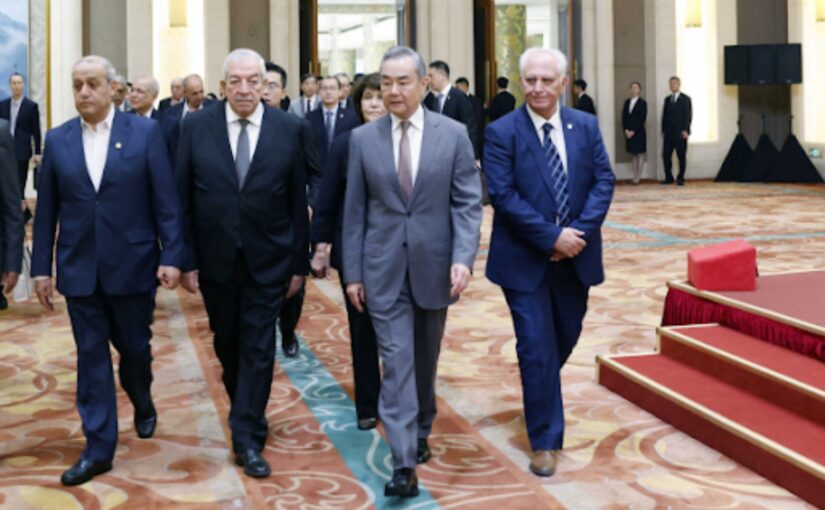
Chinese Foreign Minister Wang Yi held bilateral meetings with a number of Arab foreign ministers who came to Beijing for the 10th conference of the China-Arab States Cooperation Forum, held on May 30.

When meeting with Iraqi deputy prime minister and foreign minister Fouad Hussein, Wang said that China firmly supports Iraq in safeguarding national sovereignty, security, unity and territorial integrity, supports the Iraqi government in developing the economy, improving people’s livelihood and combating terrorism, and opposes external interference in Iraq’s internal affairs.

In his meeting with Algerian Minister of Foreign Affairs and National Community Abroad Ahmed Attaf, Wang said that China and Algeria are sincere friends and natural partners. China is ready to continue to support and cooperate closely with Algeria to safeguard international fairness and justice, as well as the interests of developing countries, and jointly promote an early, full, just and lasting settlement of the Palestinian question.

Meeting with Syrian Foreign Minister Faisal Mekdad, Wang expressed congratulations on Syria’s return to the Arab League family. China supports the Syrian government in safeguarding national security, stability and development. It is believed that Syria’s return to the Arab League will play a constructive role in the development of China-Arab relations, and China-Syria relations will also gain new impetus with the further development of China-Arab relations.

CGTN further noted that Wang  said that China appreciates Syria’s firm support on issues concerning China’s core interests and will, as always, speak out for Syria on multilateral platforms such as the UN Security Council.

Telesur added that both foreign ministers stressed the importance of making progress and intensifying practical cooperation and implementing the agreements reached during President Bashar Al-Assad’s visit to China last year.

Wang Yi also confirmed China’s support for the sovereignty, territorial integrity and legitimate right of Syria to recover its occupied lands in the Golan, as well as the fight against terrorism.

He further called on the United States to respect the territorial sovereignty of Syria and demanded that it stop plundering the wealth of its people and remove illegal unilateral measures that violate the development and welfare of nations.

“The heroic Syrian firmness under the leadership of President Bashar Al-Assad and his keen vision as a great leader will lead Syria to overcome all difficulties and achieve prosperity for the Syrian people,” Wang Yi said.

Meeting Saudi Foreign Minister Prince Faisal bin Farhan Al Saud, Wang said China is ready to work with Saudi Arabia to consolidate the political foundation of bilateral relations, enhance synergy of development strategies, expand cooperation in energy, investment, emerging industries, 5G communications, artificial intelligence, digital economy, aerospace and other fields, and promote green and sustainable development.

During the meeting with Somalian Foreign Minister Ahmed Moallim Fiqi, Wang said that China firmly supports Somalia in safeguarding national sovereignty and territorial integrity, achieving political stability, promoting security transition, and carrying out economic reconstruction.

China is ready to deepen bilateral cooperation in key areas such as agriculture, fisheries and health, and jointly promote Belt and Road cooperation with Somalia.

Fiqi said that Somalia adheres to the one-China principle, firmly supports China’s position on issues related to national reunification, thanks China for its selfless assistance to Somalia’s peace, security, development and revitalisation, hopes to continue to receive China’s support, and looks forward to more cooperation in infrastructure, energy, investment, health, security and other fields under the framework of the Forum on China-Africa Cooperation and the China-Arab States Cooperation Forum.

Wang Yi also met with the foreign ministers of Libya, Mauritania, Morocco and Kuwait, as well as with the Secretary-General of the League of Arab States.

Meanwhile, on May 31, Vice Foreign Minister Deng Li met with Undersecretary of the Foreign Ministry of Oman Sheikh Khalifa Alharthy. Deng said that China supports Oman in safeguarding national sovereignty, security and stability and in advancing economic diversification, and appreciates Oman’s support for China’s just position on issues related to its core interests. China regards Oman as an important partner in the Belt and Road cooperation, and is willing to strengthen strategic synergy with Oman, promote mutually beneficial cooperation in various fields, enhance communication and coordination on regional and international affairs, and achieve more positive progress in China-Oman strategic partnership.

The following articles were originally published by the Xinhua News Agency, CGTN, Telesur and on the website of the Chinese Foreign Ministry.

Top Chinese diplomat meets foreign guests

BEIJING, May 29 (Xinhua) — Chinese Foreign Minister Wang Yi, also a member of the Political Bureau of the Communist Party of China Central Committee, met respectively with foreign guests who came to China to attend the 10th ministerial meeting of the China-Arab States Cooperation Forum, in Beijing on Wednesday.

During the meeting with Abdul-Hamid Dbeibah, prime minister and foreign minister of the Government of National Unity of Libya, Wang said that China has always supported Libya in achieving stable development, and safeguarding its national sovereignty, independence and territorial integrity. China is ready to work jointly with Libya to further consolidate political mutual trust, enhance exchanges, and continuously enrich the connotation of the friendly and cooperative relations between the two sides.

Dbeibah said that Libya attaches great importance to developing relations with China and firmly adheres to the one-China principle. Libya expects China to play a greater role in promoting the early settlement of the Palestinian question.

When meeting with Iraqi deputy prime minister and foreign minister Fouad Hussein, Wang said that China firmly supports Iraq in safeguarding national sovereignty, security, unity and territorial integrity, supports the Iraqi government in developing the economy, improving people’s livelihood and combating terrorism, and opposes external interference in Iraq’s internal affairs.

Hussein said that developing relations with China is a diplomatic priority of the Iraqi government, and Iraq always firmly supports China in safeguarding its core interests. Iraq has been actively participating in the construction of the China-Arab States Cooperation Forum and is willing to continue to expand collective cooperation between the two sides, he added.

During the meeting with Ahmed Aboul Gheit, Secretary-General of the League of Arab States, Wang said that China is ready to work with Arab states, guided by the important consensus reached by the heads of state of China and Arab states, to deepen exchanges and cooperation in various fields, and play a constructive role in maintaining world peace and stability and resolving regional hotspots. China is ready to continue to work with the Arab League and Arab countries to promote an early, full, just and lasting settlement of the Palestinian question.

Gheit said the Arab side is ready to make joint efforts with China to open up broader prospects for richer and more diverse Arab-China relations. The Arab side always firmly adheres to the one-China principle, he added.

During the meeting with Mohamed Salem Ould Merzouk, Mauritania’s minister of foreign affairs, cooperation and Mauritanians abroad, Wang said that China will continue to firmly support Mauritania in pursuing a development path suited to its own national conditions, and oppose external forces interfering in Mauritania’s internal affairs. China is ready to continue to provide assistance within its capacity for Mauritania’s economic and social development, and is ready to cooperate closely with Mauritania to consolidate and expand China-Arab collective cooperation.

Merzouk said Mauritania firmly adheres to the one-China principle, and is ready to work with China to push forward the continuous development of Arab-China and Africa-China relations, and promote the building of a community with a shared future for humanity.

During the meeting with Algerian Minister of Foreign Affairs and National Community Abroad Ahmed Attaf, Wang said that China and Algeria are sincere friends and natural partners. China firmly supports Algeria in safeguarding national sovereignty, independence and territorial integrity, and opposes external forces interfering in Algeria’s internal affairs. China is ready to continue to support and cooperate closely with Algeria to safeguard the international fairness and justice, as well as the interests of developing countries, and jointly promote an early, full, just and lasting settlement of the Palestinian question.

Attaf said that Algeria adheres to the one-China principle, and is ready to further strengthen bilateral cooperation on all fronts and promote greater development of bilateral relations.

When meeting with Syrian Foreign Minister Faisal Mekdad, Wang expressed congratulations on Syria’s return to the Arab League family. China supports the Syrian government in safeguarding national security, stability and development. It is believed that Syria’s return to the Arab League will play a constructive role in the development of China-Arab relations, and China-Syria relations will also gain new impetus with the further development of China-Arab relations, he added.

Mekdad said under the guidance of the two heads of state, Syria is willing to work with China to promote the lasting and in-depth development of bilateral relations.

When meeting with Moroccan Foreign Minister Nasser Bourita, Wang said that China is willing to work with Morocco to deepen exchanges and cooperation in economy, trade, investment, industry, tourism and civil aviation, enhance public support for friendship between the two countries, and open up broader prospects for China-Morocco strategic partnership.

Bourita said Morocco attaches great importance to developing relations with China, and is willing to have close communication and coordination with China under the mechanisms of the China-Arab States Cooperation Forum and the Forum on China-Africa Cooperation.


Wang Yi: China-Syria strategic partnership features mutual trust and support

May 29 (CGTN) — Chinese Foreign Minister Wang Yi on Wednesday said China and Syria have formed a strategic partnership featuring mutual trust and support.

Wang, also a member of the Political Bureau of the Communist Party of China (CPC) Central Committee, made the remarks while meeting with Syrian Foreign Minister Faisal Mekdad, who is in Beijing to attend the 10th Ministerial Conference of the China-Arab States Cooperation Forum.

Congratulating Syria on returning to the League of Arab States (AL), Wang said China and Syria announced the establishment of a strategic partnership last September, drawing a new blueprint for bilateral relations.

China supports Syria in safeguarding its national independence, sovereignty, and territorial integrity, and supports the Syrian government in safeguarding its national security, stability and development, he said.

Wang said China appreciates Syria’s firm support on issues concerning China’s core interests and will, as always, speak out for Syria on multilateral platforms such as the UN Security Council.

It is believed that Syria’s return to the AL will play a constructive role in the development of China-Arab relations, and China-Syria relations will also gain new impetus, he said.

For his part, Mekdad said Syria fully supports all global initiatives proposed by China and is willing to work with China to build an international order featuring mutual respect, equal treatment and opposition to hegemony.

Syria unwaveringly adheres to the one-China principle, he said, adding that Taiwan is an inalienable part of Chinese territory, a fact that cannot be denied or challenged.


Foreign Ministers of Syria and China Hold Bilateral Meeting

May 29 (Telesur) — Syrian Foreign and Expatriate Minister Faisal Al-Mekdad held talks with his Chinese counterpart, Wang Yi, on relations between the two nations and forms of development.

Both foreign ministers stressed the importance of making progress and intensifying practical cooperation and implementing the agreements reached during President Bashar Al-Assad’s visit to China last year.

During the meeting, they discussed the international situation, especially that of the Gaza Strip and the rest of the occupied Palestinian territories, as well as the importance of ending the war and the entry of humanitarian aid and the end of the displacement of Palestinians.

Al-Mekdad underscored Syria’s support for China’s Taiwan, Hong Kong and Xining-related causes, and its responsibility for the one-China principle.

For his part, Wang Yi confirmed China’s support for the sovereignty, territorial integrity and legitimate right of Syria to recover its occupied lands in the Golan, as well as the fight against terrorism.

He also called on the United States to respect the territorial sovereignty of Syria, and demanded that it stop plundering the wealth of its people and remove illegal unilateral measures that violate the development and welfare of nations.

“The heroic Syrian firmness under the leadership of President Bashar Al-Assad and his keen vision as a great leader will lead Syria to overcome all difficulties and achieve prosperity for the Syrian people,” Wang Yi said.

 He added that Syria belongs to the Middle East and there will be no comprehensive solution to the conflict in the region without Damascus.


Chinese FM meets Arab guests

BEIJING, May 31 (Xinhua) — Chinese Foreign Minister Wang Yi on Friday met respectively with some Arab guests who came to China to attend the 10th ministerial meeting of the China-Arab States Cooperation Forum in Beijing.

When meeting with Saudi Foreign Minister Prince Faisal bin Farhan Al Saud, Wang, also a member of the Political Bureau of the Communist Party of China Central Committee, said that China always gives priority to Saudi Arabia in its foreign relations. The leaders of the two countries have established solid mutual trust and friendship, pointing out the direction for the comprehensive strategic partnership between China and Saudi Arabia.

China is ready to work with Saudi Arabia to consolidate the political foundation of bilateral relations, enhance synergy of development strategies, expand cooperation in energy, investment, emerging industries, 5G communications, artificial intelligence, digital economy, aerospace and other fields, and promote green and sustainable development, Wang added.

Faisal said that under the care and guidance of the leaders of the two countries, Saudi Arabia-China cooperation in various fields has yielded fruitful results. Saudi Arabia will continue to be firmly committed to expanding mutually beneficial cooperation between the two countries in various fields and promoting the sustainable development of Saudi Arabia-China comprehensive strategic partnership. Faisal thanked China for upholding a just position on the Palestinian issue.

During the meeting with Somalian Foreign Minister Ahmed Moallim Fiqi, Wang said that China firmly supports Somalia in safeguarding national sovereignty and territorial integrity, achieving political stability, promoting security transition and carrying out economic reconstruction.

China is ready to deepen bilateral cooperation in key areas such as agriculture, fishery and health, jointly promote the implementation of the Belt and Road cooperation and other global initiatives put forward by China in Somalia, Wang added.

Fiqi said that Somalia adheres to the one-China principle, firmly supports China’s position on issues related to national reunification, thanks China for its selfless assistance to Somalia’s peace, security, development and revitalization, hopes to continue to receive China’s support, and looks forward to more cooperation in infrastructure, energy, investment, health, security and other fields under the framework of the Forum on China-Africa Cooperation and the China-Arab States Cooperation Forum.

During the meeting with Comorian Foreign Minister Dhoihir Dhoulkamal, Wang thanked Comoros for supporting China’s legitimate propositions on issues concerning its core interests and major concerns. China is ready to strengthen exchanges with Comoros at all levels, promote high-quality Belt and Road cooperation, deepen cooperation in poverty alleviation, education and training, medical care and other fields, and import more high-quality products from Comoros.

Dhoulkamal said that Comoros firmly supports China in safeguarding its territorial sovereignty. The Belt and Road Initiative helps Arab and African countries achieve common development, and Comoros will continue to actively participate in it.

When meeting with Kuwaiti Foreign Minister Abdullah Ali Al-Yahya, Wang said that China appreciates Kuwait’s active commitment to promoting the solidarity and cooperation between China and Arab states, and supports Kuwait in playing a greater role in international and regional affairs.

China is ready to work with Kuwait to implement the important consensus reached by the two heads of state, actively promote cooperation in renewable energy, sewage treatment, investment, new energy, digital economy, artificial intelligence and other fields, strengthen cultural and people-to-people exchanges, and promote the deepening of China-Kuwait strategic partnership, Wang added.

Al-Yahya said that under the leadership of the two heads of state, Kuwait-China relations have entered the best period in history. Kuwait regards China as a long-term and reliable strategic partner, and looks forward to strengthening high-level exchanges with China, jointly promoting the Belt and Road cooperation, and expanding economic, trade and investment cooperation.

Al-Yahya thanked China for upholding a just position on the Palestinian issue. Kuwait will continue to work to promote the cooperation between Arab states and China to achieve greater results, Al-Yahya said.


Vice Foreign Minister Deng Li Meets with Undersecretary of the Foreign Ministry of Oman Sheikh Khalifa Alharthy

June 1 (FMPRC) — On May 31, 2024, Vice Foreign Minister Deng Li met with Undersecretary of the Foreign Ministry of Oman Sheikh Khalifa Alharthy, who came to China to attend the 10th Ministerial Conference of the China-Arab States Cooperation Forum.

Deng Li said that China and Oman have a traditional friendship, and that in recent years, the political mutual trust between the two countries has been continuously strengthened, and practical cooperation in various fields has been promoted in an orderly manner. China supports Oman in safeguarding national sovereignty, security and stability and in advancing economic diversification, and appreciates Oman’s support for China’s just position on issues related to China’s core interests. China regards Oman as an important partner in the Belt and Road cooperation, and is willing to strengthen strategic synergy with Oman, promote mutually beneficial cooperation in various fields, enhance communication and coordination on regional and international affairs, and achieve more positive progress in China-Oman strategic partnership.

Sheikh Khalifa Alharthy said that Oman and China have a time-honored friendship. Oman attaches great importance to the development of the Oman-China strategic partnership, and will continue to firmly support the one-China principle and deepen friendly cooperation in such fields as economy and trade, investment, energy as well as people-to-people and cultural exchanges. Oman appreciates China’s impartial position as a permanent member of the United Nations on regional and international hotspot issues, and is willing to work with China to make unremitting efforts to maintain regional peace and stability.

The two sides also had an exchange of views on the Palestinian question, among others.

China to work with Niger to deepen cooperation

Our special article on the history of the revolutionary struggle of Niger’s Sawaba Party, published on June 4, concluded that: “Today Niger and China have strong economic and political relations.”

The same day, the website of the Chinese Foreign Ministry reported that Vice Foreign Minister Chen Xiaodong (who prior to his recent appointment served as Ambassador to South Africa) had met in Beijing with the visiting  Nigerien Minister of State for National Defence Salifou Mody and his delegation.

Chen said that no matter how the international situation changes, China and Niger have always firmly trusted and supported each other. China is ready to work with Niger to enhance political mutual trust and deepen practical cooperation in various fields for the benefit of the two peoples.

Mody said that China is a trusted strategic partner of Niger and his country is grateful for China’s assistance in Niger’s national construction.

The below article was first published in English translation on the website of the Chinese Foreign Ministry.

On June 4, 2024, Vice Foreign Minister Chen Xiaodong met with Niger’s Minister of State for National Defense Salifou Mody and his delegation, who are on a visit to China.

Chen Xiaodong said that the friendship between China and Niger has a long history. Regardless of the changes in the international landscape, China and Niger have always firmly trusted and supported each other. China is ready to continuously enhance political mutual trust and deepen practical cooperation in various fields with Niger to benefit the two peoples. The new summit of the Forum on China-Africa Cooperation (FOCAC) will be held in Beijing in September this year. China welcomes Niger’s active participation in the summit to jointly discuss the development plans for China-Africa and China-Niger cooperation.

Salifou Mody said, Niger adheres to the one-China principle and stands ready to work with China to firmly support each other on issues concerning their respective core interests. Noting that China is a trustworthy strategic partner of Niger, he thanked China for its help in Niger’s national development. Niger is willing to take the Beijing Summit of the FOCAC as an opportunity to further deepen cooperation with China in various fields.

On China’s overcapacity

The article below, written for Friends of Socialist China by Shiran Illanperuma, addresses the latest ideological weapon in the Biden-Trump trade war against China: that of ‘overcapacity’. According to Western politicians and neoliberal economists, China’s industrial subsidies and production capacity are to blame for the US’s trade deficit and its apparent inability to reindustrialise its economy.

Shiran, citing fellow Marxist economist Michael Roberts, observes that the US and EU have sustained trade deficits since decades ago, before China’s emergence as an industrial superpower: “In a previous era, it was Japan and Germany that were the source of the US’s protracted trade deficits.” This rather suggests that “the main problem is the decline in the competitiveness and productive capabilities of the US itself rather than China’s (or, for that matter, anyone else’s) industrial policies.”

The article shows that China’s capacity utilisation and inventory levels almost exactly match those of the US. Hence, according to standard metrics, China is no more guilty of ‘overcapacity’ than the US itself. What is true is that China is actively working to contain excess capacity in mature industries such as coal and steel. However, in emerging technologies – particularly those required for solving the climate crisis – China is leveraging its socialist market economy to rapidly innovate and develop its productive forces. It should be noted that this strategy is responsible for a decrease in solar PV and wind energy costs of around 90 percent over the last decade. From the standpoint of maintaining a habitable Earth, the accusations of Chinese ‘overcapacity’ are beyond absurd.

Ultimately, what’s driving these accusations is that “Western imperialism is in crisis and can no longer sustain the position of its old labour aristocracy.”

The thesis of Chinese overcapacity therefore serves a dual purpose. First, it provides the Western ruling class with a means to deflect criticism of its own neoliberal policies in order to scapegoat China for the destruction of its industrial base. Second, it allows that same ruling class to resort to protectionism and subsidies on behalf of monopoly capitalists.

Shiran concludes:

For its part, China is developing technologies that are crucial for the future of mankind. It has done so while the ruling elite in the West gamble away wealth produced by workers through stock buybacks and real estate speculation. It is up to the Western Left to organise workers against imperialism and anti-China chauvinism, and to fight to liberate the productive forces necessary to address the socioeconomic and ecological challenges of this century.

Shiran Illanperuma is an independent journalist and researcher. He is currently reading for a master’s degree in economic policy at SOAS University of London.

In the last few months, there has been an intensified campaign by Western politicians, academics, and mainstream media to popularise the narrative of “Chinese overcapacity.” Like the disproven narrative of the “Chinese debt trap” before it, this appears to be a coordinated attempt by the West to scapegoat China for structural problems and imbalances in the world capitalist economy.

The thesis of China’s manufacturing overcapacity has been in circulation since at least the global financial crisis. In short, the argument goes that China’s investment-driven growth model creates both local and global imbalances. It is argued that higher investment suppresses consumption (as a share of GDP) and drives income inequality and excess production capacity within China. It is further argued that such imbalances are to blame for China’s excessive exports and massive trade surplus, which is said to be at the cost of the United States’ trade deficit.

In academia, this argument has been popularised by Keynesian economist Michael Pettis, who is a Professor of Finance at Peking University. Brad Setser, a former senior advisor to the United States Trade Representative, has also been a champion of this argument. Notably, the overcapacity thesis has also been a consistent theme of the IMF on China.

In May, the IMF Mission to China published a report stating that in order to ensure growth, China’s key priorities should include “rebalancing the economy towards consumption by strengthening the social safety net, liberalising the services sector, and scaling back distortive supply side policies that support the manufacturing sector [emphasis added].”

The IMF is, of course, a Western-dominated institution, where China controls just 6% of voting shares despite contributing to 18% of global GDP.

The overcapacity thesis has been an increasing source of diplomatic tension. US Treasury Secretary Janet Yellen has attempted to rally the G7 on the issue and coax Global South countries such as India and Mexico into the debate. Meanwhile, European Commission President Ursula von der Leyen has argued that Chinese industrial policy is distorting the EU market for electric vehicles (EVs).

The Chinese side has reacted strongly to these allegations. Chinese President Xi Jinping said that there was no such thing as a Chinese overcapacity problem. Meanwhile, Chinese Ministry of Commerce spokesperson He Yadong has said that the accusation of Chinese overcapacity was a typical Western double standard. More recently, Chinese Foreign Ministry Spokesperson Wang Wenbin said, “Overcapacity is just a pretext the US uses to try to coerce G7 members into creating fences and restrictions for Chinese new energy products.”

Following in Trump’s footsteps, the Biden administration recently threw up a slew of new tariffs against Chinese products, including 25% on steel and aluminium, 50% on semiconductors, 50% on solar panels, and a whopping 100% on electric vehicles (EVs). As the US-led trade war against China intensifies, it is worth reflecting on the facts behind the overcapacity thesis.

Measuring China’s overcapacity

French entrepreneur and analyst Arnaud Bertrand has argued that the concept of overcapacity can be measured with a few standard metrics: 1. capacity utilisation rates; and 2. inventory levels.

In economics, capacity utilisation refers to the share of production capacity that is in use at any given time. Generally speaking, a prolonged period of high capacity utilisation can indicate a need to expand productive capacity. In contrast, a prolonged period of low capacity may indicate a need to reduce productive capacity. Bertrand points out that the capacity utilisation rate in China is 76%, which is around the same as in the United States, which is 78%.

Inventory levels are generally used as a measure of how well sales are doing. A growing inventory of goods might mean a combination of sluggish demand or overproduction, while a shrinking inventory might mean growing demand and underproduction. Bertrand points out that the finished good inventory index PMI for China stood at 49, while a similar index for manufacturing inventory for the United States stood at 50.

Neither of the above numbers suggests that China has any more overcapacity than the US. On the contrary, the fact that Chinese industrial profits continue to grow suggests that there is ready demand for Chinese manufactures. Several analysts have also argued that China’s drive to increase production capacity for new energy products makes it indispensable in the global fight for ecological sustainability.

Continue reading On China’s overcapacity

CPC delegation visits Laos, Vietnam and Cambodia to strengthen fraternal ties

A Communist Party of China delegation, headed by Zhao Shitong, Assistant Minister of the Central Committee’s International Department (IDCPC), recently visited Laos, Vietnam and Cambodia to strengthen fraternal ties, at the invitation of the Lao People’s Revolutionary Party (LPRP), Communist Party of Vietnam (CPV) and Cambodian People’s Party (CPP). 

On May 13, the delegation met in Hanoi with Le Hoai Trung, the head of the Vietnamese party’s international commission.

Trung highlighted the sound and practical development in the bilateral relationship and expressed his appreciation for the Chinese people’s assistance to Vietnam’s revolutionary cause, socialist construction and development process through various periods, including the historic Dien Bien Phu Victory, the 70th anniversary of which was recently widely celebrated in Vietnam. He added that the Vietnam-China relationship is a top priority of the Vietnamese party and state.

For his part, Zhao congratulated Vietnam on its great achievements under the leadership of the CPV Central Committee, with General Secretary Nguyen Phu Trong at the helm.

Previously, the delegation visited Laos, from May 9-12, and both sides agreed to implement the important consensus reached by the top leaders of the two parties and the two countries, deepen exchanges and cooperation between the two parties, and work together to build a high-standard, high-quality, and high-level China-Laos community with a shared future.

It visited Cambodia from May 13-16 and the two parties agreed to deepen party-to-party exchanges, actively cooperate in economic, cultural, youth and other fields, and consolidate and carry forward the ironclad friendship between the two countries.

The following articles were originally published by Nhân Dân and the Xinhua News Agency.

Vietnamese, Chinese Party officials pledge stronger cooperation

May 13 (Nhân Dân) — Secretary of the Communist Party of Vietnam (CPV) Central Committee and Chairman of the CPV Central Committee’s Commission for External Relations Le Hoai Trung received Assistant Minister of the Communist Party of China (CPC) Central Committee’s International Department Zhao Shitong in Hanoi on May 13.

The officials highly evaluated positive development steps in the bilateral relations since the two historic visits made by the top leaders of the two Parties.

They agreed that the two strategic advisory bodies on foreign affairs of the CPV and CPC will step up their coordination and will work with relevant agencies and localities in a bid to effectively implement the two countries’ high-level common perceptions, joint statements, and bilateral cooperation documents.

Trung highlighted the sound and practical development in the bilateral relations and expressed his appreciation for the Chinese people’s assistance to Vietnam’s revolutionary cause and socialist construction and development process through various periods, including the historic Dien Bien Phu Victory. He went on noting that the Vietnam-China relationship is a top priority of the Vietnamese Party and State.

For his part, Zhao congratulated Vietnam on its great achievements under the leadership of the CPV Central Committee, with General Secretary Nguyen Phu Trong at the helm.

Zhao led a delegation from the CPC Central Committee’s International Department to pay a working visit to Vietnam on May 12 and 13. Earlier, he held talks with Vice Chairman of the CPV Central Committee’s Commission for External Relations Ngo Le Van, during which the two sides discussed cooperation orientations between the the two agencies and the promotion of exchanges through the Party channel in the time to come.


CPC delegation visits Laos

VIENTIANE, May 12 (Xinhua) — Zhao Shitong, assistant minister of the International Department of the Communist Party of China (CPC) Central Committee, led a CPC delegation on a visit to Laos from May 9 to 12, at the invitation of the Lao People’s Revolutionary Party (LPRP).

During the visit, Zhao met with Bounthong Chitmany, a politburo member of the LPRP Central Committee, a permanent member of the Secretariat of the LPRP Central Committee, and vice president of Laos.

The Chinese delegation held talks with Khamphanh Pheuyavong, a member of the Secretariat of the LPRP Central Committee and head of the Propaganda and Training Board of the LPRP Central Committee.

The delegation also met with Thongsavanh Phomvihane, head of the LPRP Central Committee’s Commission for External Relations and held talks with heads of the Lao party and government departments.

During the visit, the two sides exchanged views on China-Laos relations and issues of common concern.

Both sides agreed to implement the important consensus reached by the top leaders of the two parties and the two countries, deepen exchanges and cooperation between the two parties, and work together to build a high-standard, high-quality, and high-level China-Laos community with a shared future.


CPC delegation visits Cambodia on ties

PHNOM PENH, May 16 (Xinhua) — Zhao Shitong, assistant minister of the International Department of the Communist Party of China (CPC) Central Committee, led a CPC delegation to visit Cambodia from May 13 to 16 at the invitation of the Cambodian People’s Party (CPP).

During the visit, Zhao met with Prak Sokhonn, chairman of the Commission for International Relations of the CPP’s Central Committee and first vice president of the Senate, Hun Many, deputy prime minister, and Suos Yara, vice chairman of the Commission for International Relations of the CPP’s Central Committee, as well as representatives of the Youth House for Cambodia-China Friendship.

The two sides exchanged views on China-Cambodia relations and issues of common concern, and agreed to implement the important consensus reached by leaders of both countries.

Both sides also agreed to deepen party-to-party exchanges, actively carry out exchanges and cooperation in economic, cultural, youth and other fields, and consolidate and carry forward the ironclad friendship between China and Cambodia.

China working with UAE and Bahrain on high-quality Belt and Road cooperation

Chinese President Xi Jinping held talks with President of the United Arab Emirates (UAE) Sheikh Mohamed bin Zayed Al Nahyan on May 30 and with King Hamad bin Isa Al Khalifa of Bahrain on May 31 respectively. The two Gulf heads of state were visiting China coinciding with the 10th conference of the China-Arab States Cooperation Forum, held in Beijing on May 30.

Meeting with Sheikh Mohamed, Xi noted that the UAE is an important comprehensive strategic partner of China. In recent years, China-UAE relations have maintained a sound momentum of development, setting a good example for China-Arab states relations in the new era.

This year marks the 40th anniversary of the establishment of diplomatic relations between China and the UAE, Xi said, adding that it is an important juncture for China-UAE relations to build on past achievements and forge ahead.

He added that China stands ready to work with the UAE to continuously promote high-quality Belt and Road cooperation, strengthen synergy of development strategies, and take the establishment of a high-level committee on China-UAE investment as an opportunity to push for more outcomes in bilateral cooperation.

Noting that at present the trend towards a multipolar world is unstoppable, Xi said multipolarisation in essence should mean mutual respect and peaceful coexistence among different civilisations, systems and paths.

Countries in the Middle East are an important component of the developing countries and an important force in the multipolarisation of the world and China supports countries in the region to continue to follow development paths suited to their national conditions, firmly follow the road of unity and strength, peace and reconciliation, resolve differences through communication and consultation, and hold their future and destiny in their own hands.

Mohamed said that he was very happy to once again visit China, his second hometown. The relations between Arab and Gulf countries and China boast a solid foundation. Deepening and developing relations with China conforms to the common aspiration and fundamental interests of the people of Arab and Gulf countries.

The two sides also exchanged views on the Palestinian-Israeli conflict. Xi stressed that the top priority is a comprehensive ceasefire and cessation of fighting to ease the humanitarian crisis, and the international community should unanimously support an early negotiated settlement of the Palestinian issue on the basis of the two-State solution.

The next day, the UAE head of state met with Chinese Premier Li Qiang. 

Li said China is willing to expand bilateral trade and investment, strengthen cooperation in traditional areas, and explore cooperation in new fields, such as new energy, high technology and artificial intelligence.

China is also willing to improve coordination with the UAE in multilateral mechanisms, such as the United Nations and BRICS, and promote the building of a China-Arab community with a shared future. The UAE joined the BRICS cooperation mechanism on January 1 this year.

Mohamed said the UAE and China enjoy solid and promising relations. He added that the UAE adheres to the one-China principle and will work with China to enhance Belt and Road cooperation.

Also, on May 31, Xi Jinping met with King Hamad of Bahrain. The two leaders announced the establishment of a comprehensive strategic partnership between their two countries, citing it as a new milestone in bilateral relations.

Xi said that, as this year marks the 35th anniversary of the establishment of diplomatic ties between China and Bahrain, China is ready to work together to develop their comprehensive strategic partnership and to bring more benefits to the two peoples. He noted that China advocates mutual respect and peaceful coexistence among countries with different systems and civilisations and supports countries in the Middle East to enhance unity and cooperation, achieve peace and reconciliation, and promote development and revitalisation.

China is willing to work with regional countries, including Bahrain, to develop its relations with the Gulf Cooperation Council (GCC) countries further, host the second China-Arab States Summit successfully, and accelerate the building of a China-Arab states community with a shared future.

King Hamad said that China is a great country and Bahrain is deeply grateful that China has provided significant support for its national construction. Bahrain hopes to take the establishment of this comprehensive strategic partnership as an opportunity to align the development strategies of the two countries, strengthen practical cooperation in various fields, and achieve its own diversified development.  As long as China develops well, other developing countries can do the same, and the process of global multipolarity can continue to advance. Bahrain is firm in its belief that China will realise the great rejuvenation of the Chinese nation and make greater contributions to world peace and prosperity.

The Bahraini King also briefed Xi on the recent 33rd Arab League Summit, which his country had hosted, focusing particularly on the Arab states’ position on the Palestinian question and the efforts they have made to push for an early end to the Gaza conflict. He expressed his appreciation and thanks to China for always upholding justice, and said he looks forward to China’s greater contributions in that regard.

The following articles were originally published by the Xinhua News Agency.

Xi holds talks with UAE president

BEIJING, May 30 (Xinhua) — Chinese President Xi Jinping held talks with President of the United Arab Emirates (UAE) Sheikh Mohamed bin Zayed Al Nahyan in Beijing on Thursday.

Xi noted that the UAE is an important comprehensive strategic partner of China. In recent years, China-UAE relations have maintained a sound momentum of development, setting a good example for China-Arab states relations in the new era.

This year marks the 40th anniversary of the establishment of diplomatic relations between China and the UAE, Xi said, adding that it is an important juncture for China-UAE relations to build on past achievements and forge ahead.

He said China stands ready to work with the UAE to continue to grasp the general direction of bilateral relations from a strategic height and a long-term perspective, and ensure the vigorous development of bilateral comprehensive strategic partnership.

Xi said that China supports the UAE in pursuing an independent development path and safeguarding its national sovereignty, security and development interests, and is willing to consolidate political mutual trust and strengthen cooperation with the UAE to jointly build a community with a shared future for humanity.

He said China stands ready to work with the UAE to continuously promote high-quality Belt and Road cooperation, strengthen synergy of development strategies, and take the establishment of a high-level committee on China-UAE investment and cooperation as an opportunity to push for more outcomes in bilateral cooperation.

Xi called on the two sides to consolidate cooperation in areas such as trade, energy and infrastructure, expand cooperation in high-tech fields such as information technology, artificial intelligence, digital economy and new energy, and strengthen law enforcement and security cooperation.

Xi noted he had recently replied to letters from Chinese language learners in the UAE, encouraging them to master the language, get to know more about China and contribute to promoting friendship between the two countries.

China is willing to continue to support the “Hundred Schools Project” of Chinese language education, push forward the construction of a Chinese culture center in the UAE, enhance people-to-people exchanges, and promote mutual understanding and friendship, he added.

Noting that at present the trend towards a multi-polar world is unstoppable, Xi said multi-polarization in essence should mean mutual respect and peaceful coexistence among different civilizations, systems and paths.

Countries in the Middle East are an important part of developing countries and an important force in the multi-polarization of the world, he said, adding that China supports countries in the region to continue to follow their development paths suited to their national conditions, firmly follow the path of unity and strength, peace and reconciliation, resolve differences through communication and consultation, and hold their future and destiny in their own hands.

Xi said China is ready to work with the UAE and other Arab countries to host the second China-Arab States Summit and promote the building of a community of shared future between China and Arab states.

China is willing to strengthen its strategic partnership with the UAE, expand multilateral cooperation and safeguard the common interests of countries in the Global South, he added.

Mohamed said that he was very happy to once again visit China, his second hometown, and attend the opening ceremony of the 10th ministerial conference of the China-Arab States Cooperation Forum together with President Xi.

He said the relations between Arab and Gulf countries and China boast a solid foundation. Deepening and developing relations with China conforms to the common aspiration and fundamental interests of the people of Arab and Gulf countries.

Mohamed said that UAE-China relations are based on mutual trust, mutual respect and common interests, and cooperation in various fields has reached an extraordinary level.

The UAE attaches great importance to developing relations with China, places China at the top of its diplomatic priority and regards China as a long-term and reliable strategic partner, he said, adding that the UAE is willing to take the 40th anniversary of the establishment of diplomatic ties as an opportunity to further deepen and expand cooperation in such areas as economy, trade, investment, energy, science and technology, education and culture.

The government of the UAE firmly adheres to the one-China policy, opposes “Taiwan independence” in any form and supports China’s efforts to achieve national reunification, he said.

Mohamed added that the UAE highly appreciates and actively supports the Global Development Initiative, the Global Security Initiative and the Global Civilization Initiative proposed by President Xi, will continue to actively participate in the joint construction of the Belt and Road, and is willing to work closely with China in multilateral communication and coordination to promote peace, development and prosperity of the region and the world at large.

The two sides also exchanged views on the Palestinian-Israeli conflict. Xi stressed that the top priority is a comprehensive ceasefire and cessation of fighting to ease the humanitarian crisis, and the international community should unanimously support an early negotiated settlement of the Palestinian issue on the basis of the two-State solution.

Xi said China and the UAE have the same stance on the Palestinian issue and should work together to push for a comprehensive, just and lasting settlement of the issue.

After the talks, the two heads of state witnessed the signing of a number of bilateral cooperation documents in various fields including investment, jointly building the Belt and Road, science and technology, peaceful use of nuclear energy, Chinese education, culture and tourism.


Chinese premier meets UAE president

BEIJING, May 31 (Xinhua) — Chinese Premier Li Qiang met with President of the United Arab Emirates (UAE) Sheikh Mohamed bin Zayed Al Nahyan in Beijing on Friday.

Noting that this year marks the 40th anniversary of the establishment of diplomatic relations between China and the UAE, Li said China is willing to work together with the UAE to implement the important consensus reached by the two heads of state, enhance traditional friendly relations, deepen political mutual trust, advance pragmatic cooperation, and advance bilateral relations to a new level.

Li said China firmly supports the UAE in pursuing an independent development path and in safeguarding national sovereignty, security and stability.

Li said China is willing to expand bilateral trade and investment, strengthen cooperation in traditional areas, and explore cooperation in new fields such as new energy, high technology and artificial intelligence.

He added that both sides should enhance exchanges and cooperation on culture, education and tourism, promote people-to-people exchanges, and jointly host the celebrations for the 40th anniversary of bilateral ties.

China is willing to improve coordination with the UAE in multilateral mechanisms, such as the United Nations and BRICS, and promote the building of a China-Arab community with a shared future, said Li.

Mohamed said the UAE and China enjoy solid and promising relations. He added that the UAE adheres to the one-China principle and will work with China to enhance Belt and Road cooperation.

The UAE congratulated China on successfully hosting the 10th ministerial conference of the China-Arab States Cooperation Forum, said Mohamed, adding that the country is willing to work with China to safeguard the common interests of both sides.


China, Bahrain establish comprehensive strategic partnership

BEIJING, May 31 (Xinhua) — Chinese President Xi Jinping and Bahrain’s King Hamad bin Isa Al Khalifa on Friday announced the establishment of a comprehensive strategic partnership between the two countries, a new milestone in bilateral relations.

The announcement came as Xi held talks with Hamad, who is in China for a state visit. Hamad also attended the opening ceremony of the 10th ministerial conference of the China-Arab States Cooperation Forum in Beijing on Thursday.

Bahrain is a good friend and partner of China in the Gulf region, Xi said, adding that although the two countries have different national conditions, they have always treated each other sincerely and enjoyed friendly relations.

As this year marks the 35th anniversary of the establishment of diplomatic ties between China and Bahrain, Xi said China is ready to work with Bahrain to develop their comprehensive strategic partnership and to bring more benefits to the two peoples.

China firmly supports Bahrain’s efforts to safeguard national sovereignty, security and stability, and supports Bahrain’s path of independent development, as well as Bahrain’s Economic Vision 2030 and its diversified development strategy, he said.

China is willing to strengthen cooperation with Bahrain in the fields of energy, investment, transportation, new energy and digital economy, and achieve more results in high-quality Belt and Road cooperation, Xi said.

Both sides should enhance cultural and people-to-people exchanges, and facilitate personnel exchanges to continuously strengthen public support for the China-Bahrain friendship, Xi said.

He noted that China advocates mutual respect and peaceful coexistence among countries with different systems and civilizations, and supports countries in the Middle East to enhance unity and cooperation, achieve peace and reconciliation, and promote development and revitalization.

China is willing to work with regional countries, including Bahrain, to develop its relations with the Gulf Cooperation Council (GCC) countries further, host the second China-Arab States Summit successfully, and accelerate the building of a China-Arab states community with a shared future, Xi said.

He also called on the two sides to strengthen communication and coordination on multilateral platforms such as the United Nations, practice true multilateralism, and safeguard the common interests of developing countries.

Hamad said that China is a great country, and Bahrain is deeply grateful that China has provided significant support for its national construction. Bahrain hopes to take the establishment of this comprehensive strategic partnership as an opportunity to align the development strategies of the two countries, strengthen practical cooperation in various fields, and achieve its own diversified development, he added.

Bahrain has strong appreciation for and agrees fully with China’s noble values and rational and wise policy propositions, Hamad said. As long as China develops well, other developing countries can do the same, and the process of global multipolarity can continue to advance. Bahrain is firm in its belief that China will realize the great rejuvenation of the Chinese nation and make greater contributions to world peace and prosperity, he added.

He noted that Bahrain abides by the one-China principle, supports China’s peaceful reunification, and is willing to work closely with China through multilateral cooperation to ensure people of all countries enjoy equal rights to subsistence and development. Bahrain is ready to work with China to push for an early completion of the GCC-China Free Trade Agreement, carry forward the spirit of the Arab states-China friendship, and join hands to build an Arab states-China community with a shared future in the new era.

Hamad briefed Xi on the recent 33rd Arab League Summit, focusing particularly on the Arab states’ position on the Palestinian question and the efforts they have made to push for an early end to the Gaza conflict. He expressed his appreciation and thanks to China for always upholding justice, and said he looks forward to China’s greater contributions in that regard.

Xi stressed that China and Bahrain share the same stance on the Palestinian question. China appreciates the common voice the Arab states use to discuss the Palestine-Israel issue at the Arab League Summit, and stands ready to work with Bahrain and other Arab states to push for the early, comprehensive, just and lasting settlement of the Palestinian question.

After their talks, the two heads of state witnessed the signature of a number of bilateral cooperation documents in such fields as investment, green and low-carbon development, and e-commerce and the digital economy.

The two sides also issued a joint statement on the establishment of their comprehensive strategic partnership.

Quiet please! We’re decolonising

Events in the Sahel region of Africa seldom get the international attention they deserve. However, developments in recent years have started to draw greater attention from anti-imperialists. In Mali in 2021, Burkina Faso in 2022, and Niger in 2023, progressive figures from the military have taken power, dealing a blow to the former colonial power France, which has long continued to maintain its effective domination of the region, and arousing renewed hope among the masses of people for independent development and social progress.

On 16 September 2023, these three countries formed the Alliance of Sahel States (AES) as a mutual defence pact when military aggression was threatened against the new government of Niger. The AES joins a growing number of regional and international bodies formed by the countries of the Global South to strengthen their independence against imperialism on the basis of collective self-reliance.

As part of this process, all three countries are strengthening their ties, in the economic, military and other fields, with China, Russia and other anti-imperialist states.

These developments do not occur in a vacuum. Rather, they have deep roots. Many people in the anti-imperialist movement know something of Thomas Sankara, the inspirational Marxist leader of Burkina Faso. Some know of Modibo Keïta, the first, socialist President of Mali. But probably very few know of the Sawaba Party, its leader Djibo Bakary, and the courageous armed struggle they waged in the 1960s for Niger’s true liberation.  

In this special article, written exclusively for Friends of Socialist China, Dr. Sahidi Bilan, Senior Adviser of  London-based Collectif de la Nigérienne Diaspora (Collective of the Nigérien Diaspora – CND), and Rob Lemkin, award-winning filmmaker, whose BBC2/BFI African Apocalypse documents the 1899 French invasion of Niger, bring the hidden history of the Sawaba Party to life, focusing especially on the strong internationalist support and assistance rendered by the People’s Republic of China to the Nigerien revolution – a relationship of solidarity that dates from 1954.

Bringing the story up to date, the authors conclude:

“It may be that the emancipatory force of history that Sawaba fought so hard to release is now beginning to be realised by the people of Niger. Let us hope that long-yearned-for freedom and justice can at last prevail without negative external interference…

“Today Niger and China have strong economic and political relations.  Sawaba’s little-known history and connection with the PRC is an important foundation in the origins of today’s friendship.”

The struggle of the Sawaba Party was suppressed with extreme cruelty. But, facing execution at the hands of Spanish colonialists in 1781, Bolivian national hero, Tupac Katari declared: “I will return and I will be millions.” 

Today, as their countries embark on the difficult road of building a new society, Thomas Sankara, Modibo Keïta and Djibo Bakary have returned. And they are millions.

When Niger’s military government last year expelled the troops and diplomats of the former colonising power France, some Nigeriens saw it as the resumption of a process rudely interrupted in September 1958. Sixty-six years ago, on the eve of independence, Niger’s first African government council was led by the Sawaba party (Sawaba means ‘liberation’ and ‘well-being’ in Niger’s main language Hausa) and its Prime Minister was a charismatic decolonial trade unionist called Djibo Bakary.

Sawaba’s overthrow in 1958 by France was Africa’s first modern coup d’etat. In no time the party was proscribed and driven underground; it went on to create a resistance movement with the support of African anti-imperialist states like Ghana and Algeria and developed a significant guerrilla training programme with help from the socialist bloc notably the People’s Republic of China.

‘Silence! On decolonise!’ is the title of Djibo Bakary’s great book, at once autobiography and manifesto for the radical decolonisation programme of which he was a principal. We use its title to explore a better understanding of the 26 July 2023 military coup and its unilateral  severing of military accords with France and later the United States of America. It is vital to interrogate why no military coup in Niger’s post-independence history (and there have been eight of which five were successful) has had such popular support as that of the CNSP (Conseil national pour la sauvegarde de la patrie, National Council for the Safeguard of the Homeland).

This article gives first a brief introduction to Sawaba’s history and vision for Niger; we then focus on China’s connections, in particular its role in and influence on Sawaba’s remarkably ambitious, but disastrously unsuccessful attempt to invade Niger in 1964; we then outline the intense repression that followed and conclude bringing the story up to the present.

The questions for today include: how aware are Niger’s current rulers of Bakary and Sawaba’s radical decolonial project? Are the recent expulsions of Western military forces part of genuine politics of anti-imperialism or are they merely a populist move by the military government? American and French military presences (Italian and German too) had been justified by the need to combat insurgency. But terror attacks have increased over the last decade. The government is now turning to Russia for military assistance.


 “I believe it is our duty is to inform the representatives of France of the will and thought of the overwhelming majority of the people we claim to work for; to serve the interests of the greatest number and not to use it as a springboard to satisfy desires for luxury and power. For this, we need to grapple with our problems by ourselves and for ourselves and have the will to solve them first on our own, later with the help of others, but always taking account of our African realities (…)

For our part, we have said it again and again: we have been, we are and will remain always for and with the Nigérien “talaka” (peasant)”

Djibo Bakary, Editorial in The Democrat 4 February 1956

Nowadays the history of Sawaba is little known or spoken of in Niger. In fact, it was not until 1991 after the end of the Cold War that the full list could be published of Sawabist political prisoners who had died in detention through the 1960s and 70s. According to Mounkaila Sanda, Djibo Bakary’s nephew and a later leader of Sawaba, there has long been a concerted effort to expunge the memory of Sawaba’s struggle from national consciousness along with the systematic repression of its members.

Continue reading Quiet please! We’re decolonising

Breakthrough by Shanghai doctors uses stem cells to cure diabetes

The following article from China Daily reports on an extremely promising Chinese innovation in the treatment of diabetes: “Doctors in Shanghai have, for the first time in the world, cured a patient’s diabetes through the transplantation of pancreatic cells derived from stem cells.” The patient has been able to function normally without insulin injections for nearly three years.

Up to now, it has been possible to treat severe diabetes patients with pancreatic cell transplantation, but the shortage of donors and the complexity of the technology have meant that clinical needs are not currently being met. The doctors at Shanghai Changzheng Hospital have shown that it is possible to restore normal insulin production using pancreatic cells derived from the patient’s own stem cells – thus not requiring a donor. Yin Hao, director of the hospital’s Organ Transplant Center, commented: “Our technology has matured and it has pushed boundaries in the field of regenerative medicine for the treatment of diabetes.”

Timothy Kieffer, a professor in the department of cellular and physiological sciences at the University of British Columbia, Canada, is cited by South China Morning Post describing the study as “representing an important advance in the field of cell therapy for diabetes.” If the results of the Shanghai study can be reliably reproduced, “it can free patients from the burden of chronic medications, improve health and quality of life, and reduce healthcare expenditures”.

The funding sources for the study were the Chinese Academy of Science, the National Basic Research Program of China, the National Natural Science Foundation of China, the Science and Technology Commission of Shanghai Municipality, and the Shenkang Project. The study has been published in the journal Cell Discovery.

Doctors in Shanghai have, for the first time in the world, cured a patient’s diabetes through the transplantation of pancreatic cells derived from stem cells.

The 59-year-old man, who had Type 2 diabetes for 25 years, has been completely weaned off insulin for 33 months, Shanghai Changzheng Hospital announced on Tuesday.

A paper about the medical breakthrough, achieved after more than a decade of endeavor by a team of doctors at the hospital, was published on the website of the journal Cell Discovery on April 30.

It is the first reported instance in the world of a case of diabetes with severely impaired pancreatic islet function being cured via stem cell-derived autologous, regenerative islet transplantation, the hospital said. The most common pancreatic islet cells produce insulin.

Diabetes poses a serious threat to human health. Medical experts said that poor blood sugar control over a long period can lead to severe complications, including blindness, kidney failure, cardiovascular and cerebrovascular complications, and amputation. Life-threatening situations may also occur due to hypoglycemic coma, and ketoacidosis, which happens when the body begins breaking down fat too quickly.

China is the country with the largest diabetic patient population. There are 140 million diabetes patients in the country, of whom about 40 million depend on lifelong insulin injections, according to the International Diabetes Federation.

Experts said severe diabetes patients struggling with blood sugar control can only be effectively treated by minimally invasive transplantation, which injects islet tissue extracted from the pancreas of a donor.

However, due to factors such as a severe shortage of donors and the complexity of the islet isolation technology, it is hard for such transplantation to meet current clinical needs. That made how to regenerate human pancreatic islet tissue on a large scale in vitro a worldwide academic focus, the team in Shanghai said.

Yin Hao, a leading researcher on the team and director of the hospital’s Organ Transplant Center, said they used the patient’s own peripheral blood mononuclear cells and reprogrammed them into autologous induced pluripotent stem cells. They used technology they devised to transform them into “seed cells” and reconstituted pancreatic islet tissue in an artificial environment.

“Our technology has matured and it has pushed boundaries in the field of regenerative medicine for the treatment of diabetes,” said Yin, whose team conducted the research with scientists from the Center for Excellence in Molecular Cell Science at the Chinese Academy of Sciences.

He said the patient, who was at serious risk of diabetes complications, had a kidney transplant in June 2017 but had lost most pancreatic islet function and relied on multiple insulin injections every day.

The patient received the transplantation in July 2021. Eleven weeks after the surgery, he was weaned off external insulin, and the dose of oral drugs for sugar-level control was gradually reduced and completely withdrawn one year later. “Follow-up examinations showed that the patient’s pancreatic islet function was effectively restored, and his renal function was within normal range,” Yin said. “Such results suggested that the treatment can avoid the progression of diabetic complications.”

China and Tunisia establish strategic partnership

Tunisian President Kais Saied paid a state visit to China coinciding with the 10th conference of the China-Arab States Cooperation Forum, held in Beijing on May 30.

Meeting his Chinese counterpart Xi Jinping on May 31, the two leaders jointly announced the establishment of a strategic partnership between their countries.

Noting that China and Tunisia are good friends and brothers, Xi said that over the past 60 years since the establishment of diplomatic relations, China and Tunisia have always respected and supported each other, and treated each other as equals despite international vicissitudes, writing a vivid chapter of developing countries standing together through thick and thin.

Consolidating and developing China-Tunisia relations conforms to the fundamental interests and common expectations of the two peoples, Xi noted, adding that China is willing to work with Tunisia to continue the traditional friendship, deepen exchanges and cooperation in various fields and push bilateral relations to a new level.

“Today, we announced the establishment of China-Tunisia strategic partnership, which will open up an even brighter future for our relations,” he said.

China is ready to enhance synergy of development strategies with Tunisia, deepen cooperation in such fields as infrastructure construction and new energy, foster new growth engines for cooperation in medical and health care, green development, water resources, agriculture and other fields, and promote high-quality Belt and Road cooperation between the two countries to achieve more results, and China welcomes more high-quality Tunisian products into the Chinese market.

China is willing to continue to send high-calibre medical teams to Tunisia, and to deepen cooperation with Tunisia in education and tourism, and enhance people-to-people exchanges.

Xi urged the two sides to work with countries in the Global South to strengthen solidarity and coordination, practice true multilateralism, advocate an equal and orderly multipolar world and a universally beneficial and inclusive economic globalisation, and achieve common development.

Saied said he is pleased to pay a historic visit to China on the occasion of marking the 60th anniversary of the two countries’ diplomatic ties and to attend the opening ceremony of the 10th ministerial conference of the China-Arab States Cooperation Forum.

Tunisia enjoys profound friendship and fruitful cooperation with China, and the country expects more support from China for its national development and closer cooperation in health, transportation, green development and education, so as to raise bilateral relations to a new level. Every country has the right to independently choose a development path suiting its own national conditions. Tunisia is willing to work with China to uphold the common values of humanity, strengthen unity and coordination, oppose hegemonism and bloc confrontation, and create a more equal and beautiful world, so that people of all countries can enjoy real human rights and freedom, live in harmony, and share peace, security and prosperity.

The previous day, President Saied had met with Chinese Premier Li Qiang.

Li noted that China firmly supports Tunisia in actively exploring a development path with Tunisian characteristics and firmly opposes external interference in Tunisia’s internal affairs.

China is ready to work with Tunisia to deepen practical cooperation guided by high-quality Belt and Road cooperation, make solid progress in key cooperation projects, and expand cooperation in trade and renewable energy. China is ready to work with Tunisia to make every effort to build a China-Arab community with a shared future for the new era and promote the building of a high-level China-Africa community with a shared future, Li added, urging joint efforts from the two sides to strengthen multilateral coordination and cooperation to safeguard the common interests of developing countries.

On May 31, the Tunisian head of state also met with Zhao Leji, Chairman of the National People’s Congress (NPC) Standing Committee.

Zhao said that, taking the 60th anniversary of the establishment of diplomatic relations as an opportunity, the two sides should make good use of important platforms such as the joint construction of the Belt and Road, the China-Arab States Cooperation Forum, and the Forum on China-Africa Cooperation to cultivate new driving forces for bilateral cooperation.

He noted that China and Tunisia are both countries in the Global South, and that they should strengthen their coordination and cooperation on multilateral occasions to promote a more just and equitable global governance system.

Saied said that Tunisia has the unwavering will to develop friendly relations with China. His country adheres to the one-China principle and stands ready to strengthen pragmatic cooperation in various fields, thereby opening broader prospects for bilateral relations. 

The following articles were originally published by the Xinhua News Agency.

China, Tunisia establish strategic partnership

BEIJING, May 31 (Xinhua) — Chinese President Xi Jinping and Tunisian President Kais Saied on Friday announced the establishment of a strategic partnership between the two countries.

The announcement came as Xi held talks with Saied, who is on a state visit to China.

Noting that China and Tunisia are good friends and brothers, Xi said that over the past 60 years since the establishment of diplomatic relations, China and Tunisia have always respected and supported each other, and treated each other as equals despite international vicissitudes, writing a vivid chapter of developing countries standing together through thick and thin.

Consolidating and developing China-Tunisia relations conforms to the fundamental interests and common expectations of the two peoples, Xi noted, adding that China is willing to work with Tunisia to continue the traditional friendship, deepen exchanges and cooperation in various fields and push bilateral relations to a new level.

“Today, we announced the establishment of China-Tunisia strategic partnership, which will open up an even brighter future for our relations,” he said.

China supports Tunisia in pursuing a development path that suits its own national conditions, independently advancing the reform process, and keeping its future firmly in its own hands, Xi said.

China is ready to enhance synergy of development strategies with Tunisia, deepen cooperation in such fields as infrastructure construction and new energy, foster new growth engines for cooperation in medical and health care, green development, water resources, agriculture and other fields, and promote high-quality Belt and Road cooperation between the two countries to achieve more results, Xi said, welcoming more high-quality Tunisian products into the Chinese market.

China is willing to continue to send high-caliber medical teams to Tunisia, deepen cooperation with Tunisia in education and tourism, and enhance people-to-people exchanges, he added.

Continue reading China and Tunisia establish strategic partnership

Contrasting the US’s severe urban decay with China’s extraordinary infrastructure development

In the following article, originally published in the Morning Star, Roger McKenzie contrasts the economic priorities of the US with those of China.

Reporting from Washington DC and New York City, and reflecting on the recent Friends of Socialist China delegation to China, he compares the level of investment in infrastructure in the two countries. A train journey between DC and NYC “revealed a picture of severe urban decay in supposedly the world’s most important and richest nation” – a reflection of the fact that, in the US, “the government, of any colour, prefers to spend immense amounts of money on the military as opposed to the people.”

The article continues:

The US is visibly decaying economically as well as politically, while China is clearly stable, able to act on behalf of the people and on the way up. The transport infrastructure, road, rail and airport systems in China have undergone a massive upgrades in length and quality over the last decade. This is a sentence you simply can’t apply to the US.

In the five cities I visited during my 10-day visit to China I never saw a single homeless person and felt entirely safe to walk the streets and speak with anyone I wanted. Nobody stopped me from doing any of those things. I never felt the same level of safety in DC — or New York for that matter.

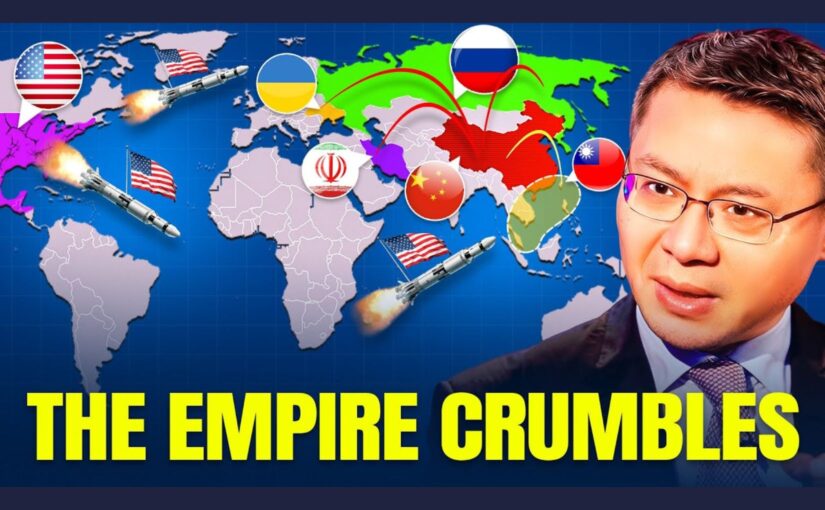
Roger notes that the US could learn a great deal from China. If it were willing to adapt to a multipolar reality and give up on its dream of a New American Century, it could prioritise the needs of its people over those of the military-industrial complex. However, he warns that the current trajectory is towards leveraging the US’s military power to maintain its global dominance, even as its economic power wanes. “The temptation will be for the empire to strike back as its power crumbles. Unfortunately it is something I think we are already seeing in Ukraine and in its attempts to stoke up tensions in the breakaway Chinese province of Taiwan.”

The challenge for the left is therefore to build a powerful mass movement that combines the struggle for socialism at home with the struggle against imperialism and war.

Roger will be among the speakers at the upcoming webinar China proves that a new world is possible! on 16 June.

EMPIRES always end. All of them. The only question is about the nature of that end. We can see this before our eyes as the United States empire reaches its inevitable end, internationally and domestically.

We can see it happening in front of our eyes if we choose to look. One of the advantages of travelling by train instead of flying is you get to see much more of the reality of a country.

The Acela Express train ride of 230 miles or so for three hours from New York City to the US capital, Washington DC, was depressing in so many ways.

The train itself was better and more comfortable than many I have travelled on in Britain, but the journey revealed a picture of severe urban decay in supposedly the world’s most important and richest nation.

You could see the wealth on the skyline represented by the skyscraper office blocks of the major cities we passed through — Philadelpia and Baltimore — but much of the rest was a picture of severe urban decay.

The industrial base of the country has been gutted. It reminded me of the train journey through the once thriving Black Country in Britain. Once a hive of industrial activity, now hollowed out with miles of left-to-rot former factories.

In the US the choice has clearly been made that the government, of any colour, prefers to spend immense amounts of money on the military as opposed to the people.

I can’t believe that the minority of the US population that actually bother to come out and vote don’t understand this. It’s no secret that the US spends by far the largest amount on the military of any country on Earth.

The US spends more on the military than China, Russia, India, Saudi Arabia, Britain, Germany, France and South Korea combined.

Between them China and Russia account for only around 13 per cent of the world’s military spend. Not the vast amounts the corporate media would have you believe.

But while content to project its power abroad, the US is crumbling. One visit to the vast and imposing US embassy in London will show you just how much the US is intent on projecting its power. To the US size really does matter.

Continue reading Contrasting the US’s severe urban decay with China’s extraordinary infrastructure development

Xi Jinping meets with Egyptian President Abdel Fattah El-Sisi

Egyptian President Abdel Fattah El-Sisi was one of four Arab heads of state to pay a state visit to China coinciding with the 10th conference of the China-Arab States Cooperation Forum (CASCF), held in Beijing on May 30.

In a round of bilateral meetings with his counterparts, Chinese President Xi Jinping met first with Sisi on May 29.

Xi noted that, 68 years ago, Egypt was the first Arab and African state to establish diplomatic relations with China. This year marks the 10th anniversary of the establishment of the China-Egypt comprehensive strategic partnership, he said, adding that over the past decade, the two heads of state have worked together to guide the vigorous development of bilateral relations.

China-Egypt relations have become a vivid illustration of China’s solidarity, coordination, and mutually beneficial win-win cooperation with Arab, African, Islamic and developing countries, Xi continued, adding that under the new circumstances, building a more enriched and dynamic China-Egypt relationship meets the common expectations of the two peoples.

China supports Egypt in playing a greater role in international and regional affairs, and stands ready to further strengthen coordination and cooperation on multilateral platforms such as the United Nations, the Shanghai Cooperation Organisation and the BRICS cooperation mechanism, advocate an equal and orderly multipolar world and a universally beneficial and inclusive economic globalisation, and jointly safeguard international fairness and justice, as well as the common interests of developing countries.

The two sides also exchanged views on the Palestinian-Israeli conflict.

Xi said that the current round of Palestinian-Israeli conflict has caused heavy casualties of innocent Palestinian civilians and the humanitarian situation in Gaza is extremely grave, and China is deeply saddened. It is imperative to cease fire and stop the war immediately, avoid the spillover of conflict which will impact regional peace and stability, and prevent a more serious humanitarian crisis.

The following day, Sisi met with Chinese Premier Li Qiang.

Hailing China and Egypt as good friends and partners of solidarity and mutual assistance for joint development, Li said that China is willing to work with Egypt to implement the important consensus reached by the two heads of state, carry forward their traditional friendship, continuously strengthen exchanges and cooperation in various fields, and push the comprehensive strategic partnership between the two countries to a new level.

Sisi expressed willingness to work with China to further expand cooperation in agriculture, trade, new energy, communications, and high technology under the framework of the Belt and Road Initiative so as to achieve mutual benefit and win-win results, and better benefit the two peoples.

The following articles were originally published by the Xinhua News Agency.

Xi holds talks with Egyptian president

BEIJING, May 29 (Xinhua) — Chinese President Xi Jinping held talks with Egyptian President Abdel Fattah El-Sisi in Beijing on Wednesday.

Xi noted that, 68 years ago, Egypt was the first Arab and African state to establish diplomatic relations with China. This year marks the 10th anniversary of the establishment of the China-Egypt comprehensive strategic partnership, he said, adding that over the past decade, the two heads of state have worked together to guide the vigorous development of bilateral relations.

China-Egypt relations have become a vivid illustration of China’s solidarity, coordination, and mutually-beneficial win-win cooperation with Arab, African, Islamic and developing countries, Xi said, adding that under the new circumstances, building a more enriched and dynamic China-Egypt relationship meets the common expectations of the two peoples.

Xi said that China is ready to work with Egypt to deepen mutual trust, advance cooperation, build a China-Egypt community with a shared future in the new era, and contribute to regional and world peace, stability, development and prosperity.

Xi stressed that China is striving in all aspects to build a strong and prosperous country and achieve national rejuvenation, and China and Egypt are facing historic opportunities for exchanges and cooperation in various fields. The two sides should continue to firmly support each other and work together to promote common development, Xi added.

China is ready to work with Egypt to tap the potential of cooperation in traditional areas such as infrastructure, industry, electricity and agriculture, explore cooperation in emerging areas such as health care, information and communications, and renewable energy, deepen economic, trade and investment cooperation, and encourage more Chinese enterprises to invest and do business in Egypt, Xi said.

Xi urged efforts to organize the 2024 China-Egypt year of partnership, expand personnel and cultural exchanges, and make the Luban Workshop in Egypt a benchmark for China-Africa vocational education cooperation.

China supports Egypt in playing a greater role in international and regional affairs, and stands ready to further strengthen coordination and cooperation with Egypt on multilateral platforms such as the United Nations, the Shanghai Cooperation Organization and the BRICS cooperation mechanism, advocate an equal and orderly multi-polar world and a universally beneficial and inclusive economic globalization, and jointly safeguard international fairness and justice, as well as the common interests of developing countries, Xi said.

Continue reading Xi Jinping meets with Egyptian President Abdel Fattah El-Sisi

Joint statement of China and Arab states on the question of Palestine

The tenth ministerial conference of the China-Arab States Cooperation Forum (CASCF) was held in Beijing on May 30. The opening session was attended by four Arab heads of state as well as by Chinese President Xi Jinping, who delivered an opening address. Ministers from China and the 22 members of the League of Arab States attended the conference.

Among the conference outcomes, the most significant was the adoption of a 21-point joint statement on the question of Palestine. Showing a high degree of unity between China and the Arab world, and among the Arab states themselves, the comprehensive joint statement calls, among other things, for the implementation of relevant United Nations resolutions, condemns Israeli aggression, calls for a sustained ceasefire, and for the implementation of the interim measures issued by the International Court of Justice in response to the legal case brought against Israel by the government of South Africa under the Genocide Convention. It supports the admission of Palestine to the United Nations as a full member state, the convening of an international peace conference, and calls for Palestinian national unity under the umbrella of the Palestine Liberation Organisation (PLO). It further calls for an end to Israel’s settlement program in occupied territories and protection of the Arab, Islamic and Christian attributes of the city of Jerusalem.  

We carry below the full text of the joint statement. It has been machine translated and sub-edited by us, including by cross checking with other unofficial translations. The full Chinese language text, as released by the Xinhua News Agency, may be read here.

Joint Statement of China and Arab States on the Question of Palestine

On May 30, 2024, the 10th Ministerial Conference of the China-Arab States Cooperation Forum was held in Beijing, during which the two sides had in-depth discussions on the Palestinian issue.

The two sides believe that the relevant resolutions of the UN Security Council and the UN General Assembly, including UN Security Council Resolution 2728, must be fully and effectively implemented, and that joint efforts should be made to promote an early ceasefire and cessation of hostilities in the Gaza Strip as soon as possible and to achieve a comprehensive, just and lasting settlement of the Palestinian issue at an early date. The parties agreed on the following:

  1. The two sides condemn Israel’s continued aggression against the Palestinian people. More than 125,000 Palestinian civilians have been killed or injured in the Gaza Strip, most of them women and children. The Palestinian population in the Gaza Strip have been forced to suffer deadly famine and blockades, cutting off all their livelihoods, systematically destroying residential areas, hospitals, schools, mosques, churches and infrastructure in the Gaza Strip, and detaining and ill-treating thousands of Palestinian prisoners.
  2. The two sides condemned the invasion of the city of Rafah, the bombing of refugee camps and the control of the Rafah crossing.
  3. The two sides oppose the implementation of plans, intentions and acts of forcibly transfering the Palestinian people outside their national territory, which will destroy the opportunity for peace in the Middle East region and lead to the expansion and deterioration of the conflict in the region.
  4. The two sides call on the Security Council to issue binding resolutions to achieve an immediate, comprehensive and sustained ceasefire, to stop the forcible transfer of the Palestinian people, to ensure the delivery of relief supplies throughout Gaza, and to implement the relevant Security Council resolutions so that life in the Gaza Strip can return to normalcy. Both sides condemn the use of the veto by the United States to prevent Palestine from becoming a full Member of the United Nations.
  5. The two sides support the Interim Measures Orders issued by the International Court of Justice on 26 January, 28 March and 24 May 2024 concerning the case against Israel brought by South Africa for violating the Convention on the Prevention and Punishment of the Crime of Genocide, and hold that Israel should comply with the relevant legal provisions, in particular international humanitarian law. Both sides stressed that Israel, as the occupying power, bears responsibility for the dire humanitarian conditions in Gaza.
  6. The Arab side stresses the importance of implementing the resolutions of the Extraordinary Arab-Islamic Joint Summit held in Riyadh on 11 November 2023, including breaking the Israeli blockade of the Gaza Strip and enabling the immediate access of humanitarian relief supplies from Arab and Islamic countries and the international community to the entire Gaza Strip by land, sea and air. The Chinese side expressed its understanding.
  7. The two sides stress that peace, security and stability cannot be achieved in the region without an end to the occupation of the territory of the State of Palestine, with East Jerusalem as its capital, the occupied Syrian Golan Heights and the occupied Lebanese territory. Calling upon the international community to take irreversible steps towards the independent establishment of Palestine and to achieve a political settlement based on international law and relevant international resolutions, including Security Council resolutions 242 (1967), 338 (1973), 497 (1981), 1515 (2003) and 2334 (2016), as well as all the elements of the 2002 Arab Peace Initiative, so as to enable the Palestinian people to fulfil their legitimate and inalienable rights. These include the right to self-determination, the right to establish an independent State of Palestine based on the 1967 borders, with East Jerusalem as its capital, and the right to return and reparation for Palestinian refugees under United Nations General Assembly resolution 194 (1948). The two sides support the admission of the State of Palestine as a full Member of the United Nations and reaffirmed that the two-State solution is the only realistic way out of the Palestinian question.
  8. The two sides call for the convening of a larger-scale, more authoritative and more effective international peace conference as soon as possible, and the initiation of an authoritative peace process on the basis of recognised international principles. The above process should be carried out within a defined time frame and with international guarantees until the end of the Israeli occupation of the Palestinian territories occupied in 1967, including East Jerusalem, along with the occupied Syrian Golan Heights and the remaining occupied Lebanese territories.
  9. The two sides support the Palestinian Government in carrying out its duties in the Gaza Strip, the West Bank and East Jerusalem in accordance with recognised international principles. The Gaza Strip is an integral part of the State of Palestine. Both sides stressed their support for the relief efforts of the Palestinian Government in Gaza. The two sides reaffirmed that the Palestine Liberation Organisation (PLO) is the sole legitimate representative of the Palestinian people and called on all Palestinian factions to unite under the PLO banner and assume their respective responsibilities in a national partnership under the leadership of the PLO.
  10. The two sides welcome the adoption by the UN General Assembly of resolution A/RES/ES-10/23 on 10 May 2024. The resolution affirmed that the State of Palestine was eligible to become a full Member of the United Nations and requires the Security Council to reconsider supporting Palestine’s accession to the United Nations and to grant more rights and interests to the State of Palestine.
  11. The two sides called for support for the United Nations Relief and Works Agency for Palestine Refugees in the Near East (UNRWA) to avoid its closure. They welcomed the resumption of funding  by some countries to the Agency, and called on countries that had frozen their funding to resume their support for the Agency. They welcomed the results of the independent investigation into the work of the Agency, recognised the neutrality and professionalism of the Agency and believe that it is indispensable and irreplaceable.
  12. The two sides welcome the recent recognition of the State of Palestine by many countries, stressing that this was a driving force for achieving the legitimate rights of the Palestinian people and for international and regional peace, security and stability, and called upon those countries that have not yet recognised the State of Palestine to do so as soon as possible.
  13. The Arab side appreciates China’s long-standing position on supporting the Palestinian issue and the inalienable rights of the Palestinian people in bilateral and multilateral forums, and appreciates Chinese President Xi Jinping’s proposals on resolving the Palestinian question, as well as a series of initiatives and propositions put forward by China on the Palestinian question. It appreciates China’s adherence to fairness and justice on the Palestinian issue and its unremitting efforts to promote the peace process. It appreciates China’s support for Palestine in improving people’s livelihood and developing the economy, providing humanitarian assistance to Palestine, and its commitment to promoting the State of Palestine to become a full member of the United Nations.
  14. Both sides stressed that Israel’s unilateral measures aimed at changing the status quo in Jerusalem are invalid and support the protection of Islamic and Christian monuments in occupied Jerusalem by the Hashemite family and its role in protecting the Arab, Islamic and Christian attributes of the city and maintaining the current historical and legal status of Jerusalem and its holy sites. The two sides stressed the need to uphold the Al-Aqsa Mosque’s current historical and legal status.
  15. The two sides condemn the continued promotion by the government of Israel of the targeted settlement programme aimed at changing the existing historical and legal status of the Occupied Palestinian Territory and the occupied Syrian Golan Heights.
  16. The Parties support the efforts of His Majesty King Mohammed VI of Morocco as Chairman of the Jerusalem Committee. They stressed the important role played by the Chairman of the Jerusalem Committee and the efforts of the Jerusalem Wealth House Agency, an institution under the Committee.
  17. The two sides support Egypt in taking all measures to respond to the impact of the aggression in the Gaza Strip and rely on Egypt’s efforts to deliver relief supplies to the Gaza Strip in an immediate and sustained manner and in sufficient quantities. The two sides expressed their support for the measures taken by Egypt to safeguard its national security, which is also a fundamental component of the security of the Arab nation.
  18. The two sides support the joint efforts of Egypt and Qatar to promote a lasting ceasefire and bring life back to normal in the Gaza Strip. Both sides support the role played by Egypt and Algeria in bringing about reconciliation among the Palestinian factions.
  19. The two sides appreciate the role played by Algeria and the United Arab Emirates (UAE) on the Palestinian issue during their tenure as non-permanent members of the Security Council, including their efforts to promote the adoption of relevant UN Security Council resolutions on the Palestinian-Israeli conflict and to promote the State of Palestine to become a full member of the United Nations.
  20. The two sides appreciate the appeal of the Prime Minister and Minister for Foreign Affairs of Qatar for immediate action to help all Palestinian orphans who have lost their parents and families as a result of the aggression against Gaza. They call on all states and the international community to work together to provide the necessary medical and psychological support to orphans and amputee children within the framework of the relevant efforts of the League of Arab States.
  21. The two sides appreciate Algeria’s efforts to support the question of Palestine at the political and material levels, as well as President Tebboune’s active efforts, in particular the convening of the intra-Palestinian reconciliation conference among the various factions on 13 October 2022 and the adoption of the Algiers Declaration, which is a positive step on the road to national unity in Palestine.

Tariffs, technology and industrial policy

In the following article, well-known Marxist economist Michael Roberts assesses the latest set of protectionist measures taken by the Biden administration against China. Roberts notes that these measures include “a quadrupling of the tariff rate to 100% on Chinese electric vehicle (EV) imports, doubling the levy on solar cells and more than tripling the fee on Chinese lithium-ion EV batteries.” These tariffs constitute a doubling-down by President Biden on the measures introduced by the Trump administration in 2018-19.

The article observes that “Chinese EVs are now better and cheaper than their Western counterparts”, and this reflects China’s rapid advance in several key areas of green technology.

China has scaled up its green industries rapidly. It now produces nearly 80% of the world’s solar PV modules, 60% of wind turbines and 60% of electric vehicles and batteries. In 2023 alone, its solar-power capacity grew by more than the total installed capacity in the US.

Biden’s protectionist measures are being justified on the basis that they will stimulate domestic production of green technology in the US. However, Roberts argues that this is unlikely to be the outcome, given historical precedent. Previous tariffs on solar panels, introduced in 2012 and later expanded, did not revitalise the US solar industry. “On the contrary, the American global market share of the solar industry has considerably decreased since the original tariffs were placed — from 9% in 2010 to 2% today. Meanwhile, China’s share of the industry rose from 59% to 78%. There’s no reason to believe that the recent tariff increase will reverse this trend. There’s even less hope that they will help spur a domestic EV industry.”

The article also points to the irony of the US accusing China of violating WTO rules with its green tech subsidies, whilst simultaneously introducing a substantial package of its own green subsidies. “It seems that China’s industrial policy of subsidies is ‘gaming the system’, while US industrial policy of similar subsidies is just ‘protecting’ US industry.”

Rather than boosting domestic production, the tariffs are likely to have the opposite effect, by raising costs for US consumers and businesses and disrupting supply chains. The article notes that “Trump and Biden’s imposition of tariffs risks hindering the adoption of low-emission technologies by American businesses and consumers.”

In general, the US’s strategy of attempting to stifle China’s development will not be successful and will certainly not benefit the US economy; indeed “the cost to the US economy and the profitability of US industry will be considerable, and even more to the real incomes of Americans.” However, in a context where “the US is losing its imperialist profit extraction from trade with China and increasingly being squeezed out of world markets by Chinese goods”, there appears to be a bipartisan consensus on continuing with these last-ditch attempts at destabilising and weakening China, even if ultimately they prove to be a classic case of “lifting a rock only to drop it on one’s own feet.”

The article was originally published on Michael Roberts’ blog on 20 May 2024.

Last Tuesday, the trade and technology war launched by the US on China back in 2019 took another ratchet up. 

The US government announced a new series of protectionist measures on Chinese goods imported into the US. It included a quadrupling of the tariff rate to 100% on Chinese electric vehicle (EV) imports, doubling the levy on solar cells and more than tripling the fee on Chinese lithium-ion EV batteries.  These tariffs are equivalent to an annual $18bn of Chinese goods on top of the previous $300bn slapped down under Trump. 

The new tariffs specifically target ‘green goods’, most notably EVs, but tariffs on lithium-ion batteries, critical minerals and solar cells will also be substantially increased. The measures are set to take effect this year (with the exception of graphite, where Chinese dominance is most stark, so tariffs begin in 2026).

China is the world leader in EV production and innovation.  Chinese EVs are now better and cheaper than their Western counterparts.  Biden’s intention is to stave off Chinese competition while stimulating domestic EV supply.  But China’s EV imports are only 2% of the US market.  And all the goods that these new tariffs were slapped on constitute only about 7% of US-China trade.  What this shows is that, even the US government recognizes that the US still relies heavily on Chinese goods imports and cannot cut them all dead.

That’s because the tariff and technology war is not just about protecting the ailing US auto industry.  China is totally dominant in EV manufacture because it’s also totally dominant in battery (cell) manufacture. And it’s also totally dominant in the manufacture of the chemicals that go into those cells (cathode & anodes).  

China is also utterly dominant when it comes to the refining of the materials that then go into the chemicals that then go into the cells which go into the EVs.

Continue reading Tariffs, technology and industrial policy

Xi Jinping’s speech at the 10th ministerial conference of the China-Arab States Cooperation Forum

The tenth conference of the China-Arab States Cooperation Forum (CASCF) was held in Beijing on May 30, marking 20 years since the launch of the biannual gathering.

Representatives from the 22 member countries of the League of Arab States participated and the growing importance attached by both sides to their relationship was underscored by President Xi Jinping delivering a keynote speech in the opening session and the presence of the heads of state of Bahrain, Egypt, Tunisia and the United Arab Emirates (UAE), who combined attendance at this ministerial level gathering with state visits to China.

President Xi began his speech in personal vein, stating that, “I always find it heart-warming to meet Arab friends,” adding:

“The friendship between the Chinese and Arab peoples is deeply rooted in our friendly exchanges along the ancient Silk Road, in our joint struggles for national liberation, and in our win-win cooperation in promoting national development.”

He noted that: “As changes unseen in a century unfold rapidly across the world, both China and Arab states strive to accomplish their historical missions of national rejuvenation and faster national development. Building a China-Arab community with a shared future is a strong statement of our common desire for a new era of China-Arab relations and a better future for the world.”

The Chinese leader’s remarks served to underscore the difference between China’s approach to fellow members of the Global South compared to that displayed by the imperialist powers. He observed: “In this turbulent world, peaceful relations come from mutual respect, and lasting security is built on fairness and justice… In a world of growing diversity, more dialogue means less confrontation, and more inclusiveness means less estrangement.

“We are ready to work with the Arab side to jointly champion an equal and orderly multipolar world and a universally beneficial and inclusive economic globalisation and set a model of South-South cooperation on global governance.”

His forward looking spirit was also reflected in the key areas he highlighted for cooperation, which included not only oil and gas, but also trade and infrastructure, along with new growth areas such as artificial intelligence (AI), investment, new energy, and green innovation.

Referring to the first China-Arab States Summit, which was held in Riyadh, Saudi Arabia, in December 2022, and having announced that the second summit will be held in China in 2026, Xi recalled that he had put forward eight major cooperation initiatives in Riyadh, adding:

“New progress has been made in scientific R&D and technology transfer. Trade and energy cooperation have scaled new heights. Small and beautiful livelihood projects are advancing in parallel with signature flagship projects. Cooperation in areas such as food security, green innovation and health is deepening and getting more substantial. Platforms for people-to-people exchanges and cooperation are functioning well.”

To further propel these positive developments, he suggested five cooperation frameworks, aimed at achieving:

  • A more dynamic framework for innovation
  • An expanded framework for investment and finance cooperation (including welcoming Arab banks to join the Cross-border Interbank Payment System, which represents an alternative to the US-controlled SWIFT system)
  • A more multifaceted framework for energy cooperation – embracing renewable energy projects
  • A more balanced framework for mutually beneficial economic and trade ties – including accelerating negotiations on bilateral and regional free trade agreements; and
  • A broader framework for people-to-people exchanges. China will invite 200 leaders of Arab political parties to visit China every year.

Naturally, no dialogue with Arab leaders, especially at the present time, could possibly fail to pay keen attention to the situation facing the embattled Palestinian people in the face of a genocidal Zionist war of aggression.

President Xi noted that, since last October, the people in Gaza had been thrown into tremendous suffering:

“War should not continue indefinitely. Justice should not be absent forever… China firmly supports the establishment of an independent State of Palestine that enjoys full sovereignty based on the 1967 borders and with East Jerusalem as its capital. It supports Palestine’s full membership in the UN, and supports a more broad-based, authoritative and effective international peace conference.”

He further pledged another round of emergency humanitarian aid from China.

The following is the full text of President Xi’s speech. It was originally published by the Xinhua News Agency.

Continue reading Xi Jinping’s speech at the 10th ministerial conference of the China-Arab States Cooperation Forum

Webinar: China proves that a new world is possible! Delegates report back from China

Date Sunday 16 June
Time4pm Britain / 11am US Eastern / 8am US Pacific

The first exclusive Friends of Socialist China delegation to the People’s Republic of China took place from 14 to 24 April 2024. Fourteen comrades (11 from Britain, two from the US and one from Ireland) visited Beijing, Hangzhou and Jiaxing (Zhejiang province), and Changchun and Siping (Jilin province). The packed program featured visits to public service and community facilities, historic revolutionary sites and museums, political, scientific, cultural, industrial, and agricultural organisations, exhibition centres and cooperatives; as well as meetings with academics, publishers and officials.

At this webinar, we’ll hear back from the delegates about their experiences and observations of Chinese socialism.

Speakers

  • Margaret Kimberley (Editor-in-chief, Black Agenda Report)
  • Danny Haiphong (Youtuber; Author, ‘American Exceptionalism and American Innocence’)
  • Roger McKenzie (International editor, Morning Star)
  • Fiona Sim (Black Liberation Alliance)
  • Sage Stanescu (researcher and Friends of Socialist China Britain Committee member)
  • Russel Harland (trade unionist and Friends of Socialist China Britain Committee member)

Organisers

This webinar is jointly organised by Friends of Socialist China and the International Manifesto Group.

Celso Amorim: Brazil-China relations have strategic significance

A recent visit to China by Celso Amorim, special advisor to the president of Brazil, marks a significant milestone not only in bilateral relations but also in the collective international diplomacy and independent position of the Global South.

On May 23, Amorim met China’s top foreign affairs official Wang Yi, who said that that China and Brazil are both major developing countries and emerging economies, as well as major members of BRICS, and their relations go beyond the bilateral scope and have strategic and overall significance.

Noting that this year marks the 50th anniversary of China-Brazil diplomatic ties, Wang said that the two countries should systematically review their successful experience over the last half century. 

He went on to observe that the world today is undergoing profound changes unseen in a century, adding that it is heartening to see that the Global South countries represented by China and Brazil have achieved a collective rise and promoted a more balanced and reasonable structure of world power. 

China will fully support Brazil’s work as the rotating presidency of the G20 this year, adding that China also attaches importance to promoting cooperation with the Southern Common Market (Mercosur) and the Community of Latin American and Caribbean States (CELAC), and is willing to strengthen coordination with Brazil to push for greater development of relations between China and Latin American countries.

Amorim also said that Brazil-China relations go beyond the bilateral scope and have strategic significance, adding that the sound development of Brazil-China relations is not only beneficial to the two countries, but also plays an important role in safeguarding the common interests of developing countries and is conducive to world peace and stability.

He noted that that China is Brazil’s largest market, and the trade volume between the two countries is close to 200 billion US dollars and this still has great potential for further development.

Brazil and China share the same position on many major issues, he continued, and Brazil supports Latin America and China in strengthening cooperation, and is willing to closely coordinate and cooperate with China on multilateral platforms such as the United Nations, the G20 and BRICS to uphold multilateralism and oppose hegemonism.

Most significantly, the two sides exchanged in-depth views on the Ukraine crisis and jointly issued the “Common Understandings Between China and Brazil on Political Settlement of the Ukraine Crisis.”

In contrast to the one-sided and unrealistic initiatives of the imperialist powers and the present Ukrainian government, China and Brazil believe that dialogue and negotiation are the only viable solution to the crisis. All parties should create conditions for the resumption of direct dialogue and push for the de-escalation of the situation until the realisation of a comprehensive ceasefire. China and Brazil support an international peace conference held at a proper time that is recognised by both Russia and Ukraine, with equal participation of all parties as well as fair discussion of all peace plans.

They affirm that the use of weapons of mass destruction, particularly nuclear weapons and chemical and biological weapons, must be opposed. All possible efforts must be made to prevent nuclear proliferation and avoid nuclear crisis. Attacks on nuclear power plants and other peaceful nuclear facilities must be opposed. All parties should comply with international law including the Convention on Nuclear Safety and resolutely prevent man-made nuclear accidents. This last point clearly refers to the repeated, dangerous and irresponsible shelling by Ukrainian armed forces of the Zaporizhzhia Nuclear Power Plant (ZNPP), which is presently controlled by the Russian army. 

This six-point declaration is a vivid illustration of the rise of multipolarity and of the fact that the days when a handful of oppressor nations could dictate world affairs to the exclusion of the global majority are over.

The next day, at the Chinese Foreign Ministry’s regular press conference, spokesperson Wang Wenbin said that more countries are welcome to jointly play a constructive role in de-escalating the Ukraine crisis and promoting talks for peace. These six common understandings reflect not just the joint position of China and Brazil, but also the widespread concern and genuine desire of the vast international community for promoting a political settlement, he added.

“Many developing countries, including China and Brazil, have called for upholding an objective and just position on the Ukraine crisis,” he noted, adding that all of these countries believe that dialogue and negotiation is the only viable way out. The “common understandings”, though jointly initiated by China and Brazil, are meant for the world.

“We welcome more countries, developing and developed countries alike, to support and endorse these common understandings, and jointly play a constructive role in de-escalating the situation and promoting talks for peace.”

The following articles were originally published by the Xinhua News Agency.

Top Chinese diplomat meets special advisor to Brazilian president

BEIJING, May 23 (Xinhua) — Wang Yi, director of the Office of the Foreign Affairs Commission of the Communist Party of China (CPC) Central Committee, met with Celso Amorim, special advisor to the president of Brazil, in Beijing on Thursday.

Wang, also a member of the Political Bureau of the CPC Central Committee, said that China and Brazil are both major developing countries and emerging economies, as well as major members of BRICS, and bilateral relations go beyond the bilateral scope and have strategic and overall significance.

Noting that this year marks the 50th anniversary of China-Brazil diplomatic ties, Wang said that the two sides should systematically review the successful experience of the development of bilateral relations in the past 50 years. They should take into account the changes in the international situation and the respective development strategies of both countries while making strategic plans with a forward-looking vision, so as to inject new connotations into China-Brazil relations, set new development goals, and jointly embrace the next “golden 50 years.”

Wang noted that the world today is undergoing profound changes unseen in a century, with the international situation becoming chaotic and intertwined and hotspot issues emerging one after another.

It is heartening to see that the “Global South” countries represented by China and Brazil have achieved a collective rise and promoted a more balanced and reasonable structure of world power, he said.

China will fully support Brazil’s work as the rotating presidency of the G20 this year, and stands ready to work with Brazil and other G20 members to ensure the success of the G20 Rio Summit, said Wang, noting that China attaches importance to promoting cooperation with the Southern Common Market (Mercosur) and the Community of Latin American and Caribbean States (CELAC), and is willing to strengthen coordination with Brazil to push for greater development of relations between China and Latin American countries.

Noting that Brazil-China relations go beyond the bilateral scope and have strategic significance, Amorim said that the sound development of Brazil-China relations is not only beneficial to the two countries, but also plays an important role in safeguarding the common interests of developing countries and is conducive to world peace and stability.

Amorim said that Brazil attaches great importance to cooperation with China, adding that China is Brazil’s largest market, and the trade volume between the two countries is close to 200 billion U.S. dollars, which still has great potential for development.

Amorim said that Brazil is ready to communicate closely with China, plan cooperation in various fields, expand the scale of trade and investment, expand new fields such as artificial intelligence and the digital economy, and constantly enrich the connotation of Brazil-China comprehensive strategic partnership.

Noting that Brazilian president Luiz Inacio Lula da Silva attaches great importance to poverty eradication, and China has made remarkable achievements in this regard, Amorim said the two sides can strengthen exchanges and cooperation.

Amorim said that Brazil and China share the same position on many major issues. Brazil supports Latin America and China in strengthening cooperation, and is willing to closely coordinate and cooperate with China on multilateral platforms such as the United Nations, the G20 and BRICS to uphold multilateralism and oppose hegemonism.

The two sides exchanged in-depth views on the Ukraine crisis and jointly issued the “Common Understandings Between China and Brazil on Political Settlement of the Ukraine Crisis.” The two sides agreed that dialogue and negotiation are the only viable way out of the crisis, and all parties should create conditions for the resumption of direct dialogue.

The two sides also expressed their support for an international peace conference recognized by Russia and Ukraine at an appropriate time, with the equal participation of all parties, and fair discussion of all peace proposals.

Members of the international community are welcome to support and endorse the common understandings, jointly provide a strong voice to cool the situation, and play a constructive role in promoting peace talks, said the document.


Continue reading Celso Amorim: Brazil-China relations have strategic significance

Kanak people resist French colonial rule in New Caledonia

In this interesting article for Struggle La Lucha, Sharon Black details the recent uprising of the Kanak people in New Caledonia, a French colony in the South Pacific. The immediate trigger for the uprising was a vote by France’s National Assembly on a constitutional amendment that will introduce significant new hurdles on the path towards New Caledonia’s independence; however the underlying cause is longstanding: “the deep economic divide between the wealthy French population and the Kanak people and the unsolved and bitter question of sovereignty and independence for New Caledonia.”

Sharon notes that, in response to the pro-independence rebellion, “France has deployed an additional thousand troops to its overseas territory of New Caledonia, joining the 1,700 police and military personnel already present. The French gendarmes have meant the death of seven and the arrests of hundreds following a declaration of a state of emergency and the imposition of a curfew.”

Aside from the direct economic importance of New Caledonia – which as the article points out produces one-third of the world’s nickel and holds around 11 percent of the world’s total nickel reserves – the struggle of the Kanak people for independence also has geopolitical significance, given that the archipelago is located “in Australia’s backyard, patrolled by the US military, and in the crosshairs of Western capitalist machinations against China’s Belt and Road initiative.”

French opposition to independence has explicitly been framed in terms of the need to prevent China from gaining a foothold in the region. Visiting the capital Nouméa in 2022, French President Emmanuel Macron warned that independence from France would essentially mean handing sovereignty over to China. “If independence means choosing tomorrow to have a Chinese [naval] base here or to be dependent on other fleets, good luck!”

Sharon further cites right-wing French politician Xavier Bertrand as saying that New Caledonia “either stays French or it will become Chinese.”

In other words, the French ruling class is hoping to hold on to their South Pacific colonies as part of the US-led strategy to encircle China. The Kanak people’s struggle for independence is therefore not only a struggle against French colonialism, but is connected to the broader global struggle against imperialism and for a multipolar world.

In response to a popular uprising led by pro-independence Indigenous Kanak youth, France has deployed an additional thousand troops to its overseas territory of New Caledonia, joining the 1,700 police and military personnel already present. The French gendarmes have meant the death of seven and the arrests of hundreds following a declaration of a state of emergency and the imposition of a curfew.

Roadblocks have shut down key arteries to Nouméa, the capital city, and the airport. Australian and New Zealand tourists have hunkered down, and French settlers in wealthy areas in Nouméa have brandished weapons to protect businesses.

The rebellion has followed weeks of major demonstrations and growing frustrations fed by the French parliament’s arrogant passage of a constitutional amendment that would further liquidate the voting power of the country’s Indigenous population and stall independence. 

While the French bourgeoisie may temporarily solve the immediate crisis by force — which remains to be seen — it is a pyrrhic victory. 

Crushing the rebellion will not solve the root cause fueling anger: the deep economic divide between the wealthy French population and the Kanak people and the unsolved and bitter question of sovereignty and independence for New Caledonia. 

At the time of this writing, May 23, French President Emmanuel Macron and Armed Forces Minister Sébastien Lecornu have landed in New Caledonia, and some limited flights have taken out tourists. Macron said he would delay the implementation of the anti-Kanak constitutional amendment (a delay is only temporary) while snarling that French troops would remain “as long as necessary.”

What’s at stake is how long France’s occupation forces remain in the archipelago. 

Continue reading Kanak people resist French colonial rule in New Caledonia

Chinese FM holds talks with Tanzanian counterpart

The long-standing friendship between China and Tanzania was reaffirmed with a recent visit to Beijing by Tanzania’s Minister for Foreign Affairs and East African Cooperation, January Yusuf Makamba.

On May 17, Chinese Foreign Minister Wang Yi welcomed Makamba’s visit to China on the occasion of the 60th anniversary of the establishment of diplomatic ties between the two countries. He said that China-Tanzania relations had always been at the forefront of China-Africa relations over the past six decades, which set a good example for developing countries to seek strength through solidarity and mutual assistance.

He added that China appreciated Tanzania’s long-term valuable support on issues concerning China’s core interests and was willing to continue to firmly support Tanzania in safeguarding its sovereignty, security and development interests, and in independently exploring a development path suited to its national conditions.

Wang went on to say that the Forum on China-Africa Cooperation (FOCAC) is the most important platform and mechanism for strengthening solidarity and cooperation between China and Africa. A new FOCAC summit will be held in Beijing this autumn. China sincerely invites Tanzania to join in this event together with other African countries and make a greater contribution to the building of an even stronger China-Africa community with a shared future.

Noting that Tanzania and China enjoy profound traditional friendship, Makamba said that the two countries had always trusted and supported each other since the establishment of diplomatic ties 60 years ago. Upholding the one-China policy is the cornerstone of Tanzania’s relations with China and Tanzania will continue to unswervingly support China on issues concerning its core interests and major concerns.

The following article was originally published by the Xinhua News Agency.

BEIJING, May 17 (Xinhua) — Chinese Foreign Minister Wang Yi held talks with January Yusuf Makamba, Tanzania’s Minister for Foreign Affairs and East African Cooperation, in Beijing on Friday.

Wang, also a member of the Political Bureau of the Communist Party of China Central Committee, welcomed Makamba’s visit to China on the occasion of the 60th anniversary of the establishment of diplomatic ties between the two countries. He said that China-Tanzania relations had always been at the forefront of China-Africa relations over the past 60 years, which set a good example for developing countries to seek strength through solidarity and mutual assistance.

China is willing to deepen political mutual trust, strengthen strategic alignment, expand practical cooperation and inject new connotation of the era into the China-Tanzania comprehensive strategic cooperative partnership guided by the important consensus reached by the two heads of state, Wang said.

He said that China appreciated Tanzania’s long-term valuable support on issues concerning China’s core interests, and was willing to continue to firmly support Tanzania in safeguarding its sovereignty, security and development interests, and independently exploring a development path suited to its national conditions.

The two sides should expand cooperation in key areas such as trade and infrastructure, and tap potential for cooperation in processing and manufacturing, digital economy, blue economy and new energy, Wang added.

Wang said that the Forum on China-Africa Cooperation (FOCAC) is the most important platform and mechanism for strengthening solidarity and cooperation between China and Africa. A new FOCAC summit will be held in Beijing this autumn. China sincerely invites Tanzania to join in this event together with other African countries and make greater contribution to the building of an even stronger China-Africa community with a shared future.

Noting that Tanzania and China enjoy profound traditional friendship, Makamba said that the two countries had always trusted and supported each other since the establishment of diplomatic ties 60 years ago. Upholding the one-China policy is the cornerstone of Tanzania’s relations with China, and Tanzania will continue to unswervingly support China on issues concerning China’s core interests and major concerns.

Tanzania looks forward to enhancing exchanges of experience on governance, deepening mutually beneficial cooperation in various fields and working closely with China on international and regional issues. Tanzania will actively participate in this year’s FOCAC summit and believes that the summit will achieve greater success, he said.

The two sides also exchanged in-depth views on international and regional issues of common concern.

People, not profit, are at the centre of decision-making in China

We are pleased to republish below three short articles connected with the April 2024 Friends of Socialist China delegation to China, two written by Margaret Kimberley for Black Agenda Report, and one by Graham Harrington for Socialist Voice.

Margaret’s articles – written from China – contrast a confident, forward-looking socialist China with a decadent neoliberal United States. She writes: “The maturity and intelligence of the Chinese state are obvious to anyone who is a serious observer. The recklessness and amateurish nature of the US is also clear to anyone who pays attention.” Domestically, “China feeds its large population, launches satellites, expands a network of high-speed rail, and positions itself as a world leader while the US only knows how to obstruct and steal.” In terms of foreign policy, Margaret compares the US’s reckless devotion to the military-industrial complex with China’s commitment to peace and development. For example, while the US has just committed a further 61 billion dollars to its ill-fated proxy war in Ukraine, “China has offered its services in an effort to end the bloodshed ever since the proxy war began but it has been rebuffed at every turn.”

Margaret encourages people to reject the relentless lies and propaganda about China and instead to see it with their own eyes. “The same system which tries to convince its people that they have no alternative, that there exists nothing else in the world for them to contemplate, vilifies China and any nation which dares to be a good example.”

Graham Harrington’s article, meanwhile, focuses on the delegation’s field trips, including to the Beijing HQ of the 12345 hotline, the Zhejiang Red Boat, the Jiaxing Party-Masses Service Centre and the Siping Battle Memorial Hall. Countering the Western narrative of China as an environmental bad actor, Graham writes: “In all areas, especially Beijing, one could seen the fruits of what the CPC calls ‘Beautiful China’ in the green trees which are almost on every street. Far from the myth of a polluting superpower, China is leading the way in renewable energy. In Jilin province, delegates were told how the province had just developed a hydrogen-powered train, the very first in the world.”

Graham also describes the role of Marxism in Chinese society: “China, the CPC and Chinese people, take Marxism seriously, in the education system, in the state, as well as in public life. People are at the centre of decision-making, not profit. China puts the ‘social’ into socialism with its collective nature, encouraged at all levels.”

We will be hosting a report-back webinar for the delegation on Sunday 16 June. More information will be available soon.

Lessons from China

April 17 (Black Agenda Report) — Socialist China is a powerful economic and diplomatic rival to the United States. Its success must be studied so that liberation may be possible and to prevent the declining U.S. from doing even more damage to humanity. 

On a daily basis the corporate media, members of Congress, and courtier pundits who refuse to do a basic internet search, make reference to the non-existent Chinese Communist Party and to a non-existent abbreviation, CCP. There has been a Communist Party of China (CPC) for more than 100 years. The repetition of easily provable misinformation is just one indication of the degree of manufactured hostility towards the People’s Republic of China and of the extraordinarily high levels of ignorance manufactured by the state in the U.S.

This columnist is currently participating in a delegation organized by Friends of Socialist China at the invitation of the China NGO Network of International Exchanges (CNIE) . In the short time that the delegation has been in Beijing, the maturity and intelligence of the Chinese state are obvious to anyone who is a serious observer. The recklessness and amateurish nature of the U.S. is also clear to anyone who pays attention.

While Congress joins with greedy corporate interests to steal TikTok under the false claim that the platform is under the control of the mythical CCP, Joe Biden calls President Xi Jinping to tell him not to work with Russia, its ally, and sends Treasury Secretary Janet Yellen to request that China end its economic success with complaints about “over capacity” while the misnomer CCP is in regular use.

The Friends of Socialist China delegation has thus far met with CNIE officers, and visited the Red Building at Beijing University which showcases the history of that institution’s role in the development of the CPC, while also engaging with a publishing house seeking international works for its catalog. The most serious subject for discussion is socialism, its history in China, and the means to develop it around the world.

It is both eye-opening and sobering to leave the United States and visit nations in which socialists have attained state power. Especially in this moment, as a presidential election approaches, we are once again reminded that the U.S. political system will permit no requests for change. The most minimal proposals are rejected outright, while the people’s money is used to continue the failed Ukraine project and to support Israel’s ethnic cleansing campaign in Gaza. The precarity experienced by millions of people is explained away as a figment of their collective imagination or the result of their own stupidity.

Socialism is a necessity as the U.S. faces crises of its own making. Ocean temperatures rise because of continued capitalist fossil fuel production, wages stagnate, and the cost of food and housing continue to rise as corporations price gouge the public. Imperialism continues endangering the world as the U.S. has created a region-wide catastrophe in the Middle East.

Continue reading People, not profit, are at the centre of decision-making in China

China’s modernisation is a historic contribution to the global socialist project

What follows is a presentation by Friends of Socialist China co-editor Carlos Martinez for a webinar on China’s modernisation organised by the International Department of the Communist Party USA.

Carlos discusses the meaning and importance of modernisation, going on to describe China’s process of modernising over the course of 75 years and its proposal for “basically realising socialist modernisation by 2035”.

Carlos continues by describing the modernisation process in the advanced capitalist countries – in particular its reliance on colonialism, domination, hegemony, slavery and plunder – and compares that with China’s modernisation trajectory. While China doesn’t have the ‘advantage’ of dominating other countries, it does have the advantage of a socialist system which “enables us to pool resources in a major mission”, as Xi Jinping has put it. China’s modernisation will therefore differ enormously from Western modernisation in that it will not be based on hegemony; it will be a modernisation of common prosperity; and it will be sustainable – the modernisation of harmony between humanity and nature.

The presentation concludes:

China’s modernisation will be a historic contribution to the global socialist project, to the struggle against imperialism, and to humanity’s shared goal of a peaceful, prosperous and sustainable future.

The other presentations submitted to the webinar (by members of the CPUSA and the Communist Party of Australia) can be found on the CPUSA International Department’s Youtube channel: @idcpusa

Today’s webinar is all about modernisation, which is something that’s talked about a great deal in China today, but which is not a concept that’s discussed very much in the West.

Is it something that’s worth talking about? Is it something that’s worth pursuing?

For China and for other developing countries, what modernisation means is higher living standards for the masses of the people.

Modernised industry, greater productivity, modern communication methods, transport systems, energy systems, healthcare strategies and so on add up to the possibility of providing a healthy, meaningful and dignified life to every human being.

That means every single person having reliable access to nutritious food, to good quality housing, guaranteed education and healthcare, modern energy, clean water, and to a vibrant cultural, social, intellectual and working life. So when we talk about modernisation, we’re essentially talking about attending to people’s basic human rights.

It’s called modernisation because it involves leveraging developments in science and technology; it means adapting to the latest, the most advanced ideas and techniques for meeting humanity’s material and cultural needs.

We can broadly think of it as transitioning from ‘developing country’ status to ‘developed country’ status; from a predominantly rural society to a predominantly urban society; from a technologically backward society to a technologically advanced society.

Continue reading China’s modernisation is a historic contribution to the global socialist project

Nepali Prime Minister: Nepal will continue to strengthen cooperation with China

China has moved to further develop its friendly relations with Nepal, particularly with the Communist Party of Nepal (Maoist Centre) (CPNMC), which currently leads the country’s ruling coalition.

On April 27, Nepali Prime Minister Pushpa Kamal Dahal, who is also known as Prachanda and who is the leader of the CPNMC, said in his capital Kathmandu that Nepal will unswervingly support China on issues concerning her core interests and looks forward to continuing to strengthen cooperation with China in various fields. He was meeting with Luo Zhaohui, head of the China International Development Cooperation Agency, who was leading a delegation to the country.

With the exchange of high-level visits and the implementation of bilateral agreements between the two countries, Nepal-China relations have been elevated to a new height, stated the prime minister.

He said that the Nepali side sincerely thanks China for its support and assistance in Nepal’s economic and social development, poverty reduction and anti-epidemic efforts.

Prachanda voiced hope that the two sides will further strengthen cooperation in the fields of infrastructure connectivity, tourism, healthcare, education, agriculture and water conservancy, promote high-quality cooperation under the Belt and Road Initiative (BRI), and implement the Global Development Initiative (GDI).

For his part, Luo noted that China and Nepal are good neighbours connected by mountains and rivers, good partners in mutually beneficial cooperation and good friends helping each other.

He added that the proposal of building a China-Nepal trans-Himalayan multi-dimensional connectivity network in particular charts a strategic direction for the sustainable development of bilateral relations.

Earlier, on April 18, Liu Jianchao, Minister of the International Department of the Communist Party of China Central Committee (IDCPC), met with a delegation of senior cadres of the Communist Party of Nepal (Maoist Centre) led by Dev Prasad Gurung, General Secretary of the party.

Liu said that the Chinese side supports the Nepali side in exploring a development path that suits its national conditions and is willing to help Nepal prosper and develop. The CPC attaches great importance to its friendly relations with the Communist Party of Nepal (Maoist Centre). Under the new situation, it is willing to expand exchanges between the two parties, deepen exchanges and mutual learning of experience in state governance and administration, and promote practical cooperation between the two sides in agriculture, investment, infrastructure, border trade and tourism.

Gurung said, the Nepali side thanks the Chinese side for its long-term support and assistance in safeguarding national sovereignty and independence and achieving economic and social development and hopes to work with the Chinese side to jointly promote Belt and Road cooperation, as well as enhance the level of connectivity between the two countries.

The following articles were originally published by the Xinhua News Agency and on the website of the IDCPC.

Nepali PM voices firm support for China in safeguarding core interests

KATHMANDU, April 27 (Xinhua) — Nepali Prime Minister Pushpa Kamal Dahal said on Friday that Nepal will unswervingly support China on issues concerning China’s core interests and looks forward to continuing to strengthen cooperation with China in various fields.

Dahal, also known as Prachanda, made the remarks while meeting in Kathmandu with Luo Zhaohui, head of the China International Development Cooperation Agency.

With the exchange of high-level visits and the implementation of bilateral agreements between the two countries, Nepal-China relations have been elevated to a new height, stated the prime minister.

He said that the Nepali side sincerely thanks China for its support and assistance in Nepal’s economic and social development, poverty reduction and anti-epidemic efforts.

Dahal voiced hope that the two sides will further strengthen cooperation in the fields of infrastructure connectivity, tourism, healthcare, education, agriculture and water conservancy, promote high-quality cooperation under the Belt and Road Initiative (BRI), and implement the Global Development Initiative.

For his part, Luo noted that China and Nepal are good neighbors connected by mountains and rivers, good partners in mutually beneficial cooperation and good friends helping each other.

Luo said the proposal of building a China-Nepal trans-Himalayan multi-dimensional connectivity network in particular charts a strategic direction for the sustainable development of bilateral relations.

He suggested that both sides should implement the important consensus reached by the leaders of the two countries, strengthen the alignment of strategic plans, deepen practical cooperation and push bilateral relations to a new level.

During his stay in Nepal, Luo also met respectively with Sher Bahadur Deuba, president of the Nepali Congress party and former prime minister, K.P. Sharma Oli, chairman of the Communist Party of Nepal (Unified Marxist Leninist) and former prime minister, and held talks with Nepal’s Finance Minister Barsha Man Pun and signed related cooperation documents.

Chinese Ambassador to Nepal Chen Song was present at the meetings.


Liu Jianchao Meets with a Delegation of Senior Cadres of the Communist Party of Nepal (Maoist Center)

BEIJING, April 18 (IDCPC) — Liu Jianchao, Minister of the International Department of the CPC Central Committee (IDCPC), met here today with a delegation of senior cadres of the Communist Party of Nepal (Maoist Center) led by Dev Prasad Gurung, General Secretary of Communist Party of Nepal (Maoist Center).

Liu said, in recent years, under the joint leadership of President Xi Jinping and Nepali leaders, relations between the two countries have continued to develop. The Chinese side supports the Nepali side in exploring a development path that suits its national conditions, and is willing to help Nepal prosper and develop. The CPC attaches great importance to its friendly relations with the Communist Party of Nepal (Maoist Center). Under the new situation, it is willing to expand exchanges between the two Parties, deepen exchanges and mutual learning of experience in state governance and administration, and promote practical cooperation between the two sides in agriculture, investment, infrastructure, border trade and tourism through “political party +” and other channels, so as to push China-Nepal relations to a new level.  

Gurung said, the Nepali side thanks the Chinese side for the long-term support and assistance in safeguarding national sovereignty and independence and achieving economic and social development, and hopes to work with the Chinese side to jointly promote Belt and Road cooperation, as well as enhance the level of connectivity between the two countries. The Nepali side firmly adheres to the one-China principle and does not allow any force to use Nepal’s territory for anti-China activities. The Communist Party of Nepal (Maoist Center) highly admires the CPC’s governance achievements and governance concepts, and is willing to further strengthen exchanges between the two Parties, deepen theoretical exchanges, promote Nepal-China relations for healthy development, and promote regional peace, development and stability.  

Sun Haiyan, Vice-minister of the IDCPC, was present.