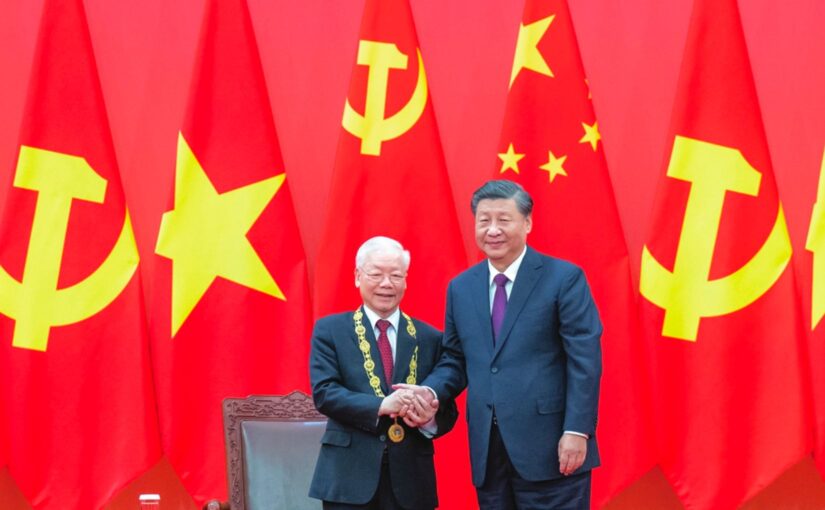
Xi Jinping: the collective punishment of people in Gaza must stop

On November 21, Chinese President Xi Jinping addressed an extraordinary joint meeting of the leaders of the BRICS countries, along with the leaders of those countries who have been invited to join the cooperation mechanism from January 1, 2024, called to discuss the situation in the Middle East with particular reference to Gaza. The meeting was held virtually and was initiated by the current chair of BRICS, President Cyril Ramaphosa of the Republic of South Africa. 

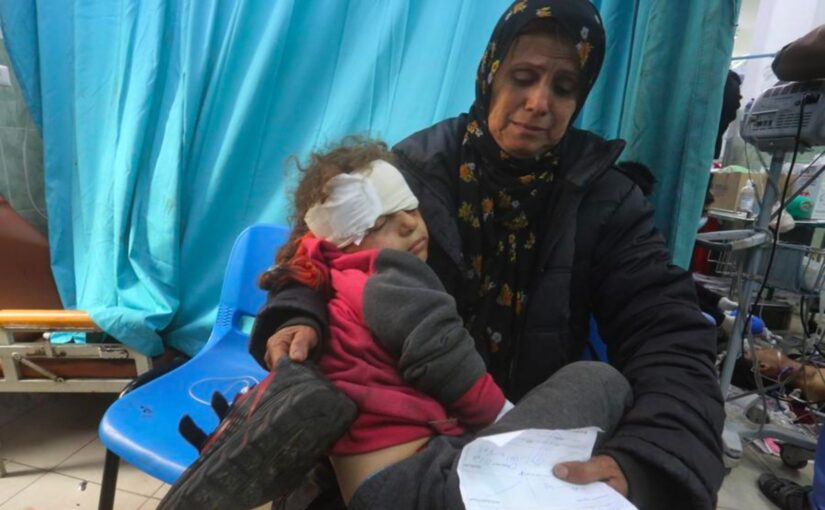
In his address to the meeting, President Xi said that China is gravely concerned that the current conflict is causing enormous civilian casualties and a humanitarian disaster. He stressed that the collective punishment of people in Gaza in the form of forced transfer or water, electricity and fuel deprivation must stop and continued:

“The root cause of the Palestinian-Israeli situation is the fact that the right of the Palestinian people to statehood, their right to existence, and their right of return have long been ignored. I have emphasised on many occasions that the only viable way to break the cycle of Palestinian-Israeli conflict lies in the two-state solution, in the restoration of the legitimate national rights of Palestine, and in the establishment of an independent State of Palestine. There can be no sustainable peace and security in the Middle East without a just solution to the question of Palestine. China calls for early convening of an international peace conference that is more authoritative to build international consensus for peace and work toward an early solution to the question of Palestine that is comprehensive, just and sustainable.”

He also outlined the humanitarian assistance that China has so far provided to the Palestinian people in the current situation, adding that, “China will provide more supplies and assistance according to the needs of the people in Gaza.”

We reprint the full text of President Xi’s remarks below. They were originally published by the Xinhua News Agency.

Working Toward a Ceasefire and Realizing Lasting Peace and Sustainable Security

Remarks by H.E. Xi Jinping
President of the People’s Republic of China
At the Extraordinary Joint Meeting of BRICS Leaders
And Leaders of Invited BRICS Members
On the Situation in the Middle East with Particular Reference to Gaza

November 21, 2023

Your Excellency President Cyril Ramaphosa,

Colleagues,

This is our first summit since the expansion of BRICS. Before I speak about the issue of our discussion, I wish to extend a warm welcome to leaders of new BRICS members and express my thanks to President Ramaphosa and the South African government for your efforts that have made our meeting possible. Given the current circumstances, it is very timely and very important that we meet and speak up for justice and for peace on the Palestinian-Israeli issue.

The conflict in Gaza is raging on into its second month. China is gravely concerned that the conflict is causing enormous civilian casualties and a humanitarian disaster, and tends to expand and spill over. China believes that the following is urgent and imperative: First, the parties to the conflict must end hostilities and achieve a ceasefire immediately, stop all violence and attacks against civilians, release civilians held captive, and act to prevent loss of more lives and spare people from more miseries. Second, humanitarian corridors must be kept secure and unimpeded, and more humanitarian assistance should be provided to the population in Gaza. The collective punishment of people in Gaza in the form of forced transfer or water, electricity and fuel deprivation must stop. Third, the international community must act with practical measures to prevent the conflict from spilling over and endangering stability in the Middle East as a whole. China supports the resolution adopted at the emergency special session of the U.N. General Assembly on October 27. The U.N. Security Council under China’s presidency has adopted Resolution 2712. All the parties must act to deliver on these resolutions through concrete measures on the ground.

The root cause of the Palestinian-Israeli situation is the fact that the right of the Palestinian people to statehood, their right to existence, and their right of return have long been ignored. I have emphasized on many occasions that the only viable way to break the cycle of Palestinian-Israeli conflict lies in the two-state solution, in the restoration of the legitimate national rights of Palestine, and in the establishment of an independent State of Palestine. There can be no sustainable peace and security in the Middle East without a just solution to the question of Palestine. China calls for early convening of an international peace conference that is more authoritative to build international consensus for peace and work toward an early solution to the question of Palestine that is comprehensive, just and sustainable.

Since the outbreak of the latest Palestinian-Israeli conflict, China has been working actively to promote peace talks and a ceasefire. China has provided humanitarian assistance to help ease the humanitarian plight in Gaza. This includes USD 2 million of emergency humanitarian assistance provided through the Palestinian National Authority and U.N. agencies, and emergency humanitarian supplies worth RMB 15 million, such as food and medicine, to the Gaza Strip with the help of Egypt. China will provide more supplies and assistance according to the needs of the people in Gaza. At the U.N. Security Council, China has acted in its capacity as president to facilitate the adoption of the resolution, which calls for extended humanitarian pauses and corridors, the protection of civilians, and the provision of humanitarian assistance.

Colleagues,

The BRICS cooperation mechanism is an important platform for emerging markets and developing countries to strengthen solidarity and cooperation and safeguard common interests. Our meeting today to coordinate positions and actions on the Palestinian-Israeli conflict marks a good start for greater BRICS cooperation following its enlargement. China commends South Africa for its significant contribution as BRICS chair to advancing BRICS development. As Russia will take over BRICS chairmanship next year, China stands ready to work with other members to jointly support Russia’s work as the chair and usher in a new era for BRICS cooperation.

Thank you.

China calls for Gaza ceasefire and an end to collective punishment

A delegation of Arab-Islamic Foreign Ministers began a two-day visit to China on November 20. Comprised of the foreign ministers of Saudi Arabia, Jordan, Egypt, Indonesia, and Palestine, along with the Secretary-General of the Organisation of Islamic Cooperation (OIC), the delegation chose to visit China first on a peace mission where they plan to visit all five permanent members of the United Nations Security Council.

Meeting the delegation, China’s top diplomat, Foreign Minister Wang Yi said the fact that the delegation chose China as the first leg of their tour for international mediation shows deep trust in China and embodies the fine tradition of mutual understanding and support between the two sides. China is a good friend and brother of Arab and Islamic countries. China has always firmly upheld the legitimate rights and interests of Arab and Islamic countries and firmly supported the just cause of the Palestinian people to restore their legitimate national rights and interests. In regard to this conflict, China has firmly stood on the side of justice and fairness, has been working hard to de-escalate the conflict, protect civilians, expand humanitarian aid, and prevent humanitarian disasters. He further noted that today marks the 35th anniversary of the establishment of diplomatic relations between China and Palestine.

Briefing Wang on the Joint Arab-Islamic Extraordinary Summit, which was held in the Saudi city of Riyadh, November 11-12, the visiting ministers, noting the large number of civilian casualties and continued humanitarian disasters in Gaza, said that the international community should take responsible actions as soon as possible to promote an immediate ceasefire and cessation of hostilities, ensure unimpeded delivery of humanitarian aid and supplies to Gaza, protect innocent Palestinian civilians and prevent the forced relocation of civilians in Gaza.

Arab and Islamic countries spoke highly of China’s long-standing just position on the Palestinian question and appreciated China’s efforts as the rotating presidency of the United Nations (UN) Security Council to facilitate the adoption of the first Security Council resolution since the outbreak of the current Palestine-Israel conflict. They look forward to closer coordination with China to prevent the crisis from spreading, restart the peace talks process, promote the establishment of an independent Palestinian state on the basis of the two-state solution, avoid a vicious cycle of violence for violence, and achieve enduring peace and stability in the Middle East. Arab and Islamic countries expect China to play a greater role in ending the Palestine-Israel conflict, resolving the Palestine-Israel issue, and achieving fairness and justice.

Wang Yi said that a pressing task now is to achieve an immediate ceasefire and cessation of hostilities. A ceasefire should not be a diplomatic rhetoric. It is a matter of life and death for the people in Gaza. A ceasefire should be achieved as a top priority. This is the pressing need of the people in Gaza, the wish of the overwhelming majority of countries, and the unanimous voice of all peace-loving people around the world.

China opposes any forced displacement and relocation of Palestinian civilians. Israel should stop its collective punishment of the people in Gaza and open humanitarian corridors as soon as possible to prevent a wider humanitarian disaster. He further stressed that any arrangement concerning the future and destiny of Palestine must be based on the consent of the Palestinian people.

The Chinese Foreign Minister added that the fundamental reason for the cycle of conflict between Palestine and Israel is that the Palestinian people’s right to statehood and survival and their right of return to their homes have been ignored for a long time. The way out is to implement the two-state solution and establish an independent Palestinian state. The Palestinian question is at the heart of the Middle East issue. Without a just settlement of the Palestinian question, there will be no enduring peace and stability in the Middle East. China will continue to stand firmly on the side of Arab and Islamic countries and on the side of international fairness and justice. 

Chinese Vice President Han Zheng also met with the delegation on November 20.

The below article was originally published on the website of the Chinese Foreign Ministry.

On November 20, 2023, Member of the Political Bureau of the CPC Central Committee and Foreign Minister Wang Yi held talks with the delegation of Arab-Islamic foreign ministers consisting of Saudi Foreign Minister Prince Faisal bin Farhan Al Saud, Jordanian Deputy Prime Minister and Foreign Minister Ayman Safadi, Egyptian Foreign Minister Sameh Shoukry, Indonesian Foreign Minister Retno Marsudi, Palestinian Foreign Minister Riyad Al-Maliki and Secretary General of the Organisation of Islamic Cooperation Hissein Brahim Taha in Beijing.

Wang Yi said the fact that the delegation chose China as the first leg of their tour for international mediation shows deep trust in China and embodies the fine tradition of mutual understanding and support between the two sides. China is a good friend and brother of Arab and Islamic countries. China has always firmly upheld the legitimate rights and interests of Arab and Islamic countries and firmly supported the just cause of the Palestinian people to restore their legitimate national rights and interests. In regard to this conflict, China has firmly stood on the side of justice and fairness, has been working hard to de-escalate the conflict, protect civilians, expand humanitarian aid, and prevent humanitarian disasters, and has been calling for a return to the two-state solution and the early settlement of the Palestinian question. Today marks the 35th anniversary of the establishment of diplomatic relations between China and Palestine. China appreciates Arab and Islamic countries for their active mediation efforts for peace, and stands ready to work with them to make unremitting efforts for an early ceasefire in Gaza, the easing of the humanitarian crisis, the release of the detainees and an early, comprehensive, just and enduring settlement of the Palestinian question.

Continue reading China calls for Gaza ceasefire and an end to collective punishment

Amlo: At the height of the pandemic, China was the first to offer assistance

Chinese President Xi Jinping held a number of bilateral meetings with other national leaders during his recent visit to San Francisco to attend the APEC (Asia-Pacific Economic Cooperation) summit and to meet with US President Joe Biden.

On November 16, Xi met with his Mexican counterpart, President Andrés Manuel López Obrador. Popularly known as Amlo, Obrador is generally considered to be Mexico’s first left-wing president since Lázaro Cárdenas del Río, who nationalised the country’s oil industry and mineral resources in 1938. It was the first occasion for the two leaders to meet.

At the meeting, Xi Jinping said that the friendship between China and Mexico has grown stronger over time, noting that last year the two countries celebrated the 50th anniversary of diplomatic ties, and this year marks the 10th anniversary of the establishment of the China-Mexico comprehensive strategic partnership. Mutual understanding and support on issues concerning each other’s core interests and major concerns have become firmer, he added.

The Chinese president stressed that China supports Mexico’s independent development path in line with its national conditions and is willing to strengthen exchanges with Mexico in country governance.

Bilateral trade volume between China and Mexico has increased by more than 7,000 times since the establishment of diplomatic relations, and highlights of cooperation in fields including railways, automobiles and new energy are abundant. 

The two sides should strengthen multilateral coordination, firmly uphold multilateralism and democracy in international relations, and safeguard international fairness and justice as well as the legitimate rights and interests of developing countries, Xi said.

Noting that next year marks the 10th anniversary of the China-CELAC (Community of Latin American and Caribbean States) Forum, he said that China is ready to work with Mexico to promote the steady and long-term development of China-Latin America relations in the new era.

For his part, Obrador said both Mexico and China have splendid civilisations and the two peoples know each other well and treat each other like brothers.

At the height of the COVID-19 pandemic, China was the first to offer assistance, providing a large amount of precious anti-pandemic supplies to Mexico and helping the country tide over the difficulties, he said.

He added that after Mexico was hit by a recent severe hurricane in the Pacific Ocean, China immediately expressed sympathy and support, for which Mexico is grateful.

Both Mexico and China safeguard their own independence and firmly oppose interference in other countries’ internal affairs, he noted, adding that Mexico will, as always, adhere to its friendly policy towards China.

Obrador added that Mexico is willing to closely coordinate with China in multilateral affairs, and actively promote Latin America-China relations.

The following report was originally published by the Xinhua News Agency.

SAN FRANCISCO, Nov. 16 (Xinhua) — Chinese President Xi Jinping on Thursday called for expanding China-Mexico cooperation in finance, electric vehicles and other emerging industries.

Xi made the remarks when meeting his Mexican counterpart, Andres Manuel Lopez Obrador, on the sidelines of the Asia-Pacific Economic Cooperation (APEC) Economic Leaders’ Meeting. He also said that the two sides should make good use of the inter-governmental cooperation mechanism and deepen cooperation in traditional areas such as infrastructure construction.

The friendship between China and Mexico has grown stronger over time, Xi said, noting that last year the two countries celebrated the 50th anniversary of diplomatic ties, and this year marks the 10th anniversary of the establishment of the China-Mexico comprehensive strategic partnership.

Xi said that at present, the strategic, complementary and mutually beneficial nature of China-Mexico relations has become increasingly prominent, and mutual understanding and support on issues concerning each other’s core interests and major concerns have become firmer.

China attaches great importance to China-Mexico relations and is willing to work with Mexico to enhance strategic alignment, tap cooperation potential and leverage complementary advantages to push bilateral relations to a new level, he added.

The Chinese president stressed that China supports Mexico’s independent development path in line with its national conditions and is willing to strengthen exchanges with Mexico in country governance.

Bilateral trade volume between China and Mexico has increased by more than 7,000 times since the establishment of diplomatic relations, and highlights of cooperation in fields including railways, automobiles and new energy are abundant, he said.

Xi said the two sides should deepen counternarcotics law enforcement cooperation, and actively support each other in organizing events for people-to-people exchanges such as cultural performances and exhibitions.

Continue reading Amlo: At the height of the pandemic, China was the first to offer assistance

Xi Jinping: The principles we follow in handling China-US relations are mutual respect, peaceful coexistence and win-win cooperation

During his recent visit to San Francisco, and following his meeting with US President Joe Biden, Chinese President Xi Jinping attended a gala business dinner on the evening of November 15. Organised by the National Committee on US-China Relations (NCUSCR), the US-China Business Council (USCBC), the Asia Society, the Council on Foreign Relations, the US Chamber of Commerce, and other organisatons with a stake in positive US-China relations, the several hundred participants included many of the most powerful figures in US business, including Tim Cook of Apple, Albert Bourla of Pfizer, Steve Schwarzman of Blackstone, Larry Fink of Blackrock, Stan Deal of Boeing, Ray Dalio of Bridgewater Associates, and (at the pre-dinner reception only) Elon Musk of Tesla. They were also joined, at the invitation of the Chinese side, by some US citizens who have made outstanding contributions to friendship between the two peoples and who have enjoyed a personal relationship with President Xi over many decades.

Attending the dinner was not without controversy and risks. Mike Gallagher, the hard right Chairman of the absurdly named congressional Select Committee on the Chinese Communist Party, wrote to the organisers that: “It is unconscionable that American companies might pay thousands of dollars to join a ‘welcome dinner’ hosted by the very same CCP officials who have facilitated a genocide against millions of innocent men, women, and children in Xinjiang.”  

He then insolently and threateningly demanded, with full McCarthyite intimidation tactics, that the organisers should, by no later than November 21:

  • “Please provide a complete list of individuals, companies, financial institutions, and other entities that have purchased tickets to the CCP dinner;
  • Please provide a separate list of individuals and companies that have paid the $40,000 fee to sit at the table with Xi;
  • Please provide a breakdown of how profits from the CCP dinner will be distributed between USCBC, NCUSCR, and other entities, as applicable; and
  • What steps, if any, has USCBC and NCUSCR taken to defend human rights in China and to prevent the genocide of Uyghurs and other ethnic minorities in Xinjiang?”

There can surely be few words adequate to describe the murderous, evil and cynical irony of venal US politicians working themselves up into a state of self-righteous and hypocritical hysteria over a completely non-existent ‘genocide’ in Xinjiang at the very time that they are facilitating and cheering on an all too real genocide in Gaza, having long supported and abetted genocidal US-led wars of aggression in numerous Muslim-majority countries, including Iraq, Afghanistan, Libya, Syria and Somalia.

The success of the dinner was, therefore, a significant rebuttal of the most aggressive, warlike and fascistic circles of US imperialism.

President Xi delivered a warm speech at the dinner, in which he also addressed a number of important issues. He began by recalling that, “my first visit to the United States in 1985 started from San Francisco, which formed my first impression of this country,” and continued:

“San Francisco has borne witness to exchanges between the Chinese and American peoples for over a century. A hundred and fifty-eight years ago, a large number of Chinese workers came all the way to the United States to build the first transcontinental railroad and established in San Francisco the oldest Chinatown in the Western hemisphere.”

Another significant historical tie between San Francisco and China is that: “Seventy-eight years ago, after jointly defeating fascism and militarism, our two countries initiated together with others the San Francisco Conference, which helped found the United Nations, and China was the first country to sign the UN Charter.”

Since that time: “Over 100 countries have gained independence one after another. Several billion people have eventually shaken off poverty. The forces for world peace, development and progress have grown stronger.”

President Xi stressed the people’s role in laying the foundations of China-US relations:

“During World War II, our two countries fought side by side for peace and justice. Headed by General Claire Lee Chennault, a group of American volunteers, known as the Flying Tigers, went to the battlefield in China. They not only engaged in direct combats fighting Japanese aggressors, but also created ‘The Hump’ airlift [from Myanmar] to transport much-needed supplies to China. More than 1,000 Chinese and American airmen lost their lives on this air route. After Japan attacked Pearl Harbor, the United States sent 16 B-25 bombers on an air raid to Japan in 1942. Running low on fuel after completing their mission, Lieutenant Colonel James Doolittle and his fellow pilots parachuted in China. They were rescued by Chinese troops and local civilians. But some 250,000 civilian Chinese were killed by Japanese aggressors in retaliation… I have kept in touch with some of them [the Flying Tigers] through letters. Most recently, 103-year-old Harry Moyer and 98-year-old Mel McMullen, both Flying Tigers veterans, went back to China. They visited the Great Wall and were warmly received by the Chinese people.”

Following this period: “For 22 years, there were estrangement and antagonism between our two countries. But the trend of the times brought us together, converging interests enabled us to rise above differences, and the people’s longing broke the ice between the two countries. In 1971, the US table tennis team visited Beijing – a small ball moved the globe. Not long after that, Mr. Mike Mansfield led the first US Congressional delegation to China.”

Continue reading Xi Jinping: The principles we follow in handling China-US relations are mutual respect, peaceful coexistence and win-win cooperation

Xi-Biden summit offers hope for a de-escalation in the New Cold War

On Wednesday 15 November 2023, Presidents Xi Jinping and Joe Biden held what was described in Xinhua as “a positive, comprehensive and constructive summit, charting the course for improving and developing bilateral ties” during a four hour meeting in which “the two heads of state had a candid and in-depth exchange of views on strategic and overarching issues critical to the direction of China-US relations and on major issues affecting world peace and development.”

The summit hopefully represents an important step forward in terms of reducing tensions – tensions which, it must be said, have been generated exclusively by the US side as part of its New Cold War and its strategy of containing and encircling China and suppressing its rise. The Xinhua report cites Friends of Socialist China co-editor Keith Bennett on President Xi’s agreeing to the summit in spite of a long series of US provocations:

“It is a journey of a peacemaker and of a responsible leader and statesman with a sense of great responsibility to his people, the times, history and humanity as a whole.”

Of particular and urgent importance is the agreement signed between the two countries to step up their cooperation on tackling climate change and protecting the environment. The Global Times article we republish below notes that “China and the US agreed to jointly tackle global warming and operationalize a working group focused on areas including energy transition, methane, the circular economy and resource efficiency, low-carbon development and deforestation.”

However, the article correctly warns that “Washington should also take concrete actions and not walk back its own promises on climate cooperation.” At a time when the US is imposing sanctions and tariffs on Chinese renewable energy materials, and when China has emerged as the world’s leading renewable energy power, the US needs to demonstrate its seriousness when it comes to preventing climate breakdown.

We also republish below an interesting article by John Wojcik in People’s World, written shortly before the Xi-Biden summit, summarising the state of US-China relations and detailing how “those relations have been made unstable by continued U.S. attacks on and propaganda against China’s economic and political interests.” Wojcik calls on the US to work urgently and intensively with China on the pressing issues facing all humanity:

“At home in the US, Biden has to do battle with powerful fossil fuel capitalist interests to realize any of his environmental goals. In China, he could have a great friend with whom to cooperate on these matters.”

Chinese President Xi Jinping trying to repair damage done by Biden

People’s World, 15 November 2023

Presidents Joe Biden and Xi Jinping are meeting near San Francisco Wednesday, a get-together at which Biden claims he hopes to “stabilize” relations with China. He doesn’t mention, of course, that those relations have been made unstable by continued U.S. attacks on and propaganda against China’s economic and political interests.

The Biden administration has consistently tried to dictate to China that it end its friendly relations with Russia and numerous other countries, and it has levied all kinds of sanctions against countries that China deals with and against China itself.

Biden continues to hypocritically express concern about human rights in China even as his administration funds and fuels Israeli-propagated genocide in Gaza.

The two leaders, who are meeting on the sidelines of the Asia-Pacific Cooperation Forum summit, reportedly haven’t even spoken to one another in over a year. The U.S. hasn’t been silent during that period when it comes to China, though, having used every excuse to mount major propaganda campaigns against the Asian nation.

The two countries, for example, have long surveyed the military and other activities of one another, but the U.S. blew into major proportions the issue of a harmless balloon that had wandered off course over U.S. territory.

The U.S. flies armed airplanes over and near Chinese waters and has, on occasion, almost collided into Chinese planes over the South China Sea.

Also, during the year that the two leaders have not spoken, the U.S. has, without any proof, campaigned against what it says are Chinese intentions to “take over” Taiwan, an island off the coast of China that actually does belong to China—a reality even the U.S. recognizes.

Biden has used as justification for his war against Russia in Ukraine the excuse that “winning” in Ukraine is an essential first step in halting Chinese aggression against Taiwan. There has been, needless to say, no such aggression against Taiwan by China.

At the San Francisco meeting, according to the White House PR people, Biden is seeking to show the world that while the U.S. and China are economic competitors, they are not locked in a major battle for supremacy with global implications.

That flies in the face of reality, though, since his administration and hosts of top U.S. lawmakers constantly identify China as the “main security threat” facing the U.S.

Nothing could be further from the truth. The main security threat facing the U.S. is the threat of fascism and right-wing domestic terror coming from within our own borders.

China, unlike the U.S., is not involved in any military conflict anywhere in the world. It is the U.S., not China, that has 800 military bases scattered all around the world. A good chunk of these U.S. bases encircle China, and U.S. nuclear subs constantly patrol waters off China’s east coast. The Chinese have no such equivalent, so the reasonable question to ask is: “Who is a security threat to whom?”

The U.S., determined to be the world’s top gun, has also sought to control what nations China deals with around the world. The U.S. has tried to force China to end its neutrality in the Ukraine-Russia War, and it has condemned Chinese attempts to offer a peace plan to end that war. There, too, the U.S. backed what has now proven to be the blowing up of the Nordstream Pipeline by Ukraine. Imagine how the U.S. would react if China did anything like this.

The Biden administration also sees China, a big buyer of Iranian oil, as having considerable leverage with Tehran, and despite the economic relations between those two countries, it tries to get China to cut all ties with Iran and join its campaign against that country.

Again, imagine how the U.S. would react if China patrolled U.S. waters with nuclear missile submarines, flew its warplanes over Long Island or San Francisco Bay, and told the U.S. to stop backing the countries responsible for genocide in Gaza and the blowing up of international energy infrastructure.

Even as Biden claims he wants improved relations, White House National Security Council spokesman John Kirby said Biden was “not going to be afraid to confront where confrontation is needed on issues where we don’t see eye to eye.”

Continue reading Xi-Biden summit offers hope for a de-escalation in the New Cold War

Inspiring webinar marks ten years of the Belt and Road Initiative

On Saturday 4 November, Friends of Socialist China and International Manifesto Group organised an online event on the theme Building a multipolar world – Ten years of the Belt and Road Initiative, in order to learn more about the implementation, impact and trajectory of the Belt and Road Initiative (BRI). The webinar assessed the role the BRI is playing in a global green transition towards renewal energy systems and biodiversity protection; the situating of the BRI within an overall geopolitical shift towards multipolarity; and the various accusations levelled against the BRI – that it constitutes a “debt trap”, or that it is part of a hegemonic geopolitical strategy being carried out by China.

The webinar was inspiring and hugely informative. The full event and individual speeches can be viewed on our YouTube channel. A brief write-up was published in China Daily.

Professor Zhang Weiwei (Director of the China Institute at Fudan University, and author of several important books about China) was the first speaker. Professor Zhang outlined the founding principles and broad historic significance of the BRI, observing that the foundations for it were laid during the two stages of China’s rise – the first three decades of socialist construction from 1949 to 1978, followed by the accelerated industrialisation and modernisation of the Reform and Opening Up period – and that both these stages were indispensable in allowing China to break from the US-dominated peripheral-central world order and emerge as an economic leader in its own right. The text of Professor Zhang’s speech has been published in full here.

Professor Radhika Desai (convenor of the International Manifesto Group) described the BRI as the flagship program of socialist China’s international engagement, and noted that it is a fundamentally inclusive project that seeks to cooperate on a win-win basis with the countries on the world. Radhika contrasted this with the US’s foreign policy – built on an exclusionary coalition of so-called democracies (in reality the imperialist powers) taking a stance of hostility and aggression towards the so-called authoritarian states (in reality the group of countries that refuse to go along with US hegemony). Radhika spoke powerfully of the horrific war being waged by Israel against the people of Gaza, and pointed out that this fits all too comfortably within the US’s vision of a “rules-based international order”.

Li Jingjing (a reporter for CGTN, and a well-known figure to those that follow Chinese media) discussed her recent trips to Pakistan, Greece and Tanzania – all countries actively pursuing BRI infrastructure projects – where she talked with locals about their attitudes to China and their response to the West’s slanders about the BRI being a “colonialist” project. People replied that they know all too well what colonialism looks like, having experienced it in countries like Pakistan and Tanzania for hundreds of years, and that China’s approach is profoundly different. Speaking about the importance of infrastructure to China’s development model, Li Jingjing made an interesting point connecting China’s role in infrastructure construction in Africa today to its work in the early 1970s building the Tazara railway between Tanzania and Zambia – that project enabled landlocked Zambia to break the isolation and blockade imposed on it by countries to its south then still under white racist and colonial rule. The Tazara railway remains a powerful symbol of China-Africa friendship.

Erik Solheim (former Norwegian Minister for Environment and International Development, and current President of the Green Belt and Road Institute) stated that the BRI has become the most important global project in terms of green development. Indeed China has become “the world leader in everything green” – a fact not widely understood in the West, due to Western arrogance and to obfuscation by the media. Solheim counselled the Western powers to drop their slanders against the BRI, to stop attempting to out-compete China on infrastructure construction and such areas where it has become an undisputed world leader, and instead to focus on complementarity: leveraging its own expertise in various areas to contribute to global development, alongside China’s contributions.

Continue reading Inspiring webinar marks ten years of the Belt and Road Initiative

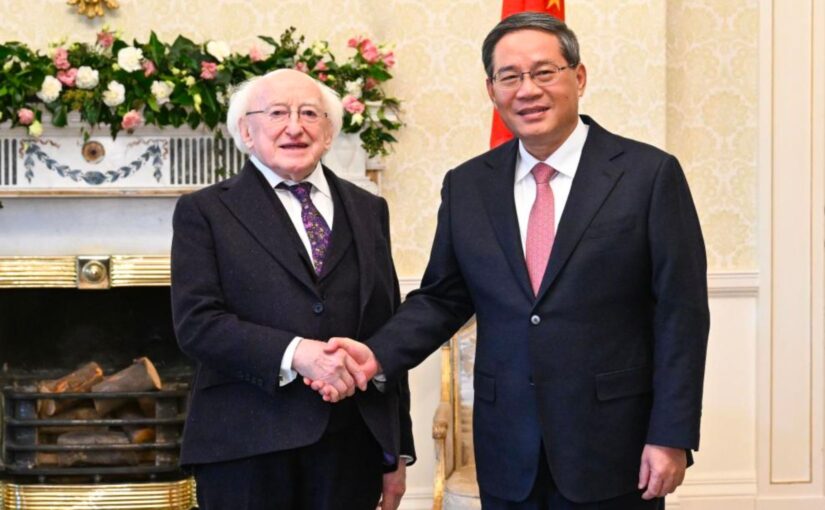
Friendly Ireland-China relations reinforced with visit by Tánaiste Micheál Martin

Friendly relations between Ireland and China have been reinforced with a visit by Micheál Martin, Ireland’s Tánaiste (Deputy Prime Minister), Minister for Foreign Affairs, and Minister for Defence. Martin is also the leader of the Fianna Fáil party, one of the three parties in Ireland’s coalition government.

Martin met with Chinese Vice President Han Zheng on November 6, who said that, under the strategic guidance and promotion of the leaders of the two countries, China and Ireland have become a good example of friendly coexistence and win-win cooperation between countries with different histories, cultures, and political systems. Han added that to develop China-Ireland relations, the foundation is solid and the conditions are sound.

Next year marks the 45th anniversary of the establishment of diplomatic ties between China and Ireland. The two sides should consolidate political mutual trust, tap the potential of practical cooperation, strengthen public support for friendship, and work together to push for new achievements in China-Ireland mutually beneficial strategic partnerships.

For his part, Martin said that Ireland and China enjoy profound friendship, and cooperation in various fields has expanded in recent years. Ireland is willing to take next year’s 45th anniversary of diplomatic ties between Ireland and China as an opportunity to strengthen exchanges with China in various fields.

The following day, at the request of the Irish side, Martin, who also met with Foreign Minister Wang Yi during his stay, met with Liu Jianchao, Minister of the International Department of the Communist Party of China (CPC) International Department (IDCPC). 

Martin said, Ireland-China friendship has a long history. The Irish side attaches importance to developing relations with China, regards China as an important partner, and hopes to strengthen exchanges and cooperation between the two countries in economy, trade, people-to-people exchanges, agriculture and other fields. As an EU member state, the Irish side is committed to developing robust EU-China relations, adheres to free and open economic policies, opposes “decoupling” from China, and hopes to promote closer cooperation between the EU and China in areas such as climate change and sustainable development. 

Liu said that the CPC attaches importance to maintaining various forms of exchanges with major political parties such as the Fianna Fáil and is willing to enhance understanding and mutual trust and promote the further development of China-Ireland strategic partnership for mutually beneficial cooperation. 

In a fascinating article by its China correspondent Denis Staunton, published on November 8, the Irish Times, Ireland’s most prestigious daily newspaper, reported on the Tánaiste’s visit to the Beijing Foreign Studies University (BFSU), home to an Irish Studies Centre, which is China’s comprehensive, multi-disciplinary institute in this field.

Reflecting China’s great interest in Ireland and Irish studies, and the country’s great respect for small nations and the great diversity of human civilisations, BFSU, which is one of China’s most prestigious universities, teaches 101 languages and has educated generations of the country’s diplomats, including three former ambassadors to Ireland. The Irish Studies Centre’s programmes cover Irish language, literature, culture, history, politics, and international relations and one of its senior figures, Wang Zhanpeng, is an expert on Brexit.

Staunton reported Zhang Junhan, one of the centres’s lecturers in the Irish language as saying: “Some of the students [who had turned out to greet Martin] are postgraduates from the Irish Studies Centre and the Gaeilge [the Irish language] is one of the modules they must take because we think it’s a source for them to understand Irish culture and society more deeply. There’s another bunch of graduate students from all over the university, from the law school, the business school, other language faculties. They study Irish as an optional module only because they are interested in this language and this country.”

Staunton’s report added: “Last December, Wang [Zhanpeng] and the centre’s director Chen Li went to Dublin to receive the Presidential Distinguished Service Award. Chen has done more to promote Irish writing in China than any other individual, introducing writers such as Anne Enright and Colin Barrett who are now translated into Chinese, alongside many others including John Banville, Colm Tóibín and Sally Rooney.”

He also noted that Martin had been greeted with the performance on the whistle, flute and bodhrán of a number of famous Irish songs and musical pieces. They included The Foggy Dew, one of Ireland’s most famous rebel songs. It can be seen here performed by The Wolfe Tones, the legendary Irish rebel group who this year celebrate their 60th anniversary.

The following reports were originally published by the Xinhua News Agency and on the IDCPC website.

Chinese VP meets Irish deputy PM

BEIJING, Nov. 6 (Xinhua) — Chinese Vice President Han Zheng met with Micheal Martin, Deputy Prime Minister and Minister for Foreign Affairs of Ireland, in Beijing on Monday.

Under the strategic guidance and promotion of the leaders of the two countries, China and Ireland have become a good example of friendly coexistence and win-win cooperation between countries with different histories, cultures, and political systems, Han said, adding that to develop China-Ireland relations, the foundation is solid and conditions sound.

Next year marks the 45th anniversary of the establishment of diplomatic ties between China and Ireland. The two sides should consolidate political mutual trust, tap the potential of practical cooperation, strengthen public support for friendship, and work together to push for new achievements in China-Ireland mutually beneficial strategic partnerships, said Han.

Continue reading Friendly Ireland-China relations reinforced with visit by Tánaiste Micheál Martin

Liu Jianchao: Working together to build a modern Global South

The following is an important article by Liu Jianchao, Minister of the International Department of the Communist Party of China (CPC) Central Committee (IDCPC), concerning the current state and prospects of the Global South.

Minister Liu begins by noting that the world today is confronted with unprecedented and accelerated changes. An important feature of the changes is that the collective rise of developing countries is gaining momentum. The rise of developing countries, as a whole, is based on and reinforced by their collective modernization.

Thus, he argues, an in-depth discussion on the modernization of the Global South is urgently needed, not only in response to the call of developing countries for peace, development, and progress, but also to meet the aspirations of the people of all countries for modernization and human advancement.

According to Liu, the Global South is where the hope lies today. The term “Global South”, he goes on, has first and foremost a “south” dimension.

“However, the ‘South’ in the Global South is not a geographical term but a byword for emerging markets and developing countries. It is an identity and representative of a community of countries with similar historical experiences, political pursuits, and development goals.

“The term also has a ‘global’ dimension. It symbolizes a prominent worldwide trend of the collective rise of developing countries and reflects their strong wish for solidarity and self-reliance. The countries of the Global South once suffered from aggression, colonization, suppression, and plunder. It is through years of struggle and hard work, along with the evolving changes in this century, that the Global South has gradually become an important force driving the reforms in the world order and seeking political independence, national rejuvenation and international justice.”

Arguing that the Global South is a “a leading champion of a new type of globalization”, Liu writes that, “unilateralism, protectionism and populism are rearing their ugly heads today. Attempts to build ‘small yards with high fences’ to ‘decouple’ from other economies, sever industry and supply chains and stoke bloc confrontation are rampant… At this crucial moment, the countries of the Global South have chosen to confront difficulties head on.”

“In particular,” he continues, “countries of the Global South, upholding the principle of ‘planning together, building together, and benefiting together’, have pressed ahead the Belt and Road cooperation to a new stage of high-quality development, thus injecting new impetus into global growth, creating new opportunities for global development, and building a new platform for international cooperation.”

According to Liu, the Global South is “the source of strength for global multipolarity.” And it is, “a key force promoting greater democracy in international relations. Over the years, the voice of the Global South has been muted on the world stage and the reasonable concerns of developing countries have not been addressed.

“The few traditional powers that have dominated the right to set the international agenda and rules have always put their own interests first. Their hegemonic, domineering, and bullying practices have disturbed the normal international order and undermined international justice and fairness. Under the new circumstances, more and more Global South countries have realized the [reality of the] ideological and institutional yoke of imperialism and colonialism. And they are more determined than ever to seek strategic autonomy, practice true multilateralism, and promote greater democracy in international relations.”

On the question of modernization, he notes that:

“The Global South must take measures to break the myth that modernization equals westernization. For a long time, people believed westernization is modernization. In fact, modernization is not a single answer question. Different historical conditions lead to different choices of paths to modernization. The modernization of the West started with the expansion of capitalism and reached its peak with the help of colonialism, large-scale exploitation of other countries and the use of power politics. It is an unjust path and by no means a viable choice for the Global South.

“To realize modernization, the countries of the Global South must find a path that best suits their respective national condition and is in line with the trend of the times.

“Besides, they should share their useful experiences, rise up to challenges together, and support each other’s exploration of paths in the pursuit of modernization, so that the Global South and the wider world have more options to achieve modernization.”

He adds:

“China is ready to contribute the country’s strength to advancing modernization for the Global South. While addressing the 15th BRICS Summit in Johannesburg, South Africa, in August, President Xi Jinping asserted that China is a member of the Global South. China and most countries of the Global South share similar historical experiences and journeys of struggle. And all of them emerged from the fight against colonialism, hegemony, and power politics… China is rooted in the Global South; it cares about the Global South. It has always stood in solidarity with other countries of the Global South through thick and thin, and has been an advocate for and an important player in South-South cooperation…

“China will never forget its roots and will remain a member of the big family of developing countries and the Global South. No matter how the international situation evolves, China will always be committed to the principles of amity, sincerity, mutual benefit and inclusiveness to develop relations with its neighbors, follow the principles of sincerity, real results, affinity, and good faith to develop relations with African countries, and adhere to the principles of equality, mutual benefit and common development to develop relations with Latin American countries.”

In conclusion the IDCPC minister writes: “We believe the modernization of the Global South will become an unstoppable trend in the near future. A stable, united, strong and prosperous Global South will no longer be a forlorn dream, and humanity will eventually enjoy progress, lasting peace and sustained development.”

Continue reading Liu Jianchao: Working together to build a modern Global South

How the war on Gaza has stalled the India-Middle East-Europe Economic Corridor

In this article, originally published on People’s Dispatch and produced by Globetrotter, Vijay Prashad explains how the Gaza conflict has likely dealt a fatal blow to the proposed India-Middle East-Europe Economic Corridor (IMEC), that was proposed by seven countries along with the European Union (EU) at the G20 Summit held in the Indian capital New Delhi in September.

Prashad explains that: “The United States, which was one of the initiators of the IMEC, pushed it as a means to both isolate China and Iran as well as to hasten the normalization of relations between Israel and Saudi Arabia. It seemed like a perfect instrument for Washington: sequester China and Iran, bring Israel and Saudi Arabia together, and deepen ties with India that seemed to have been weakened by India’s reluctance to join the United States in its policy regarding Russia.” However: “Israel’s war on the Palestinians in Gaza has changed the entire equation and stalled the IMEC.”

He further outlines that, even two years before China first unveiled its Belt and Road Initiative (BRI), in 2011, then US Secretary of State Hillary Clinton had proposed a “new silk road” that would start from India and transit Central Asia. This in turn was part of a wider ‘pivot to Asia’, proposed by President Barack Obama and designed to check the rise of China. 

According to Prashad, even before the Israeli onslaught on Gaza, IMEC was already facing serious challenges:

“The attempt to isolate China appeared illusory, given that the main Greek port in the corridor—at Piraeus—is managed by the China Ocean Shipping Corporation, and that the Dubai Ports have considerable investment from China’s Ningbo-Zhoushan port and the Zhejiang Seaport. Saudi Arabia and the UAE are now members of the BRICS+, and both countries are participants [with the status of Dialogue Partners] in the Shanghai Cooperation Organization.” 

Prashad concludes that IMEC will not progress “from paper to port”, “due to Israel’s bombing of Gaza but also due to Washington’s fantasy that it can ‘defeat’ China in an economic war.”

On September 9, 2023, during the G20 meeting in New Delhi, the governments of seven countries and the European Union signed a memorandum of understanding to create an India-Middle East-Europe Economic Corridor. Only three of the countries (India, Saudi Arabia, and the United Arab Emirates or the UAE) would be directly part of this corridor, which was to begin in India, go through the Gulf, and terminate in Greece. The European countries (France, Germany, and Italy) as well as the European Union joined this endeavor because they expected the IMEC to be a trade route for their goods to go to India and for them to access Indian goods at, what they hoped would be, a reduced cost.

The United States, which was one of the initiators of the IMEC, pushed it as a means to both isolate China and Iran as well as to hasten the normalization of relations between Israel and Saudi Arabia. It seemed like a perfect instrument for Washington: sequester China and Iran, bring Israel and Saudi Arabia together, and deepen ties with India that seemed to have been weakened by India’s reluctance to join the United States in its policy regarding Russia.

Israel’s war on the Palestinians in Gaza has changed the entire equation and stalled the IMEC. It is now inconceivable for Saudi Arabia and the United Arab Emirates to enter such a project with the Israelis. Public opinion in the Arab world is red-hot, with inflamed anger at the indiscriminate bombardment by Israel and the catastrophic loss of civilian life. Regional countries with close relations with Israel—such as Jordan and Turkey—have had to harden their rhetoric against Israel. In the short term, at least, it is impossible to imagine the implementation of the IMEC.

Pivot to Asia

Two years before China inaugurated its “One Belt, One Road” or Belt and Road Initiative (BRI), the United States had already planned a private-sector-funded trade route to link India to Europe and to tighten the links between Washington and New Delhi. In 2011, then US Secretary of State Hillary Clinton gave a speech in Chennai, India, where she spoke of the creation of a New Silk Road that would run from India through Pakistan and into Central Asia. This new “international web and network of economic and transit connections” would be an instrument for the United States to create a new intergovernmental forum and a “free trade zone” in which the United States would be a member (in much the same way as the United States is part of the Asia-Pacific Economic Cooperation or APEC).

The New Silk Road was part of a wider “pivot to Asia,” as US President Barack Obama put it. This “pivot” was designed to check the rise of China and to prevent its influence in Asia. Clinton’s article in Foreign Policy (“America’s Pacific Century,” October 11, 2011) suggested that this New Silk Road was not antagonistic to China. However, this rhetoric of the “pivot” came alongside the U.S. military’s new AirSea Battle concept that was designed around direct conflict between the United States and China (the concept built on a 1999 Pentagon study called “Asia 2025” which noted that “the threats are in Asia”).

Two years later, the Chinese government said that it would build a massive infrastructure and trade project called “One Belt, One Road,” which would later be called the Belt and Road Initiative (BRI). Over the next ten years, from 2013 to 2023, the BRI investments totaled $1.04 trillion spread out over 148 countries (three-quarters of the countries in the world). In this short period, the BRI project has made a considerable mark on the world, particularly on the poorer nations of Africa, Asia, and Latin America, where the BRI has made investments to build infrastructure and industry.

Chastened by the growth of the BRI, the United States attempted to block it through various instruments: the América Crece for Latin America and the Millennium Challenge Corporation for South Asia. The weakness in these attempts was that both relied upon funding from an unenthusiastic private sector.

Complications of the IMEC

Even before the Israeli bombardment of Gaza, IMEC faced several serious challenges.

First, the attempt to isolate China appeared illusory, given that the main Greek port in the corridor—at Piraeus—is managed by the China Ocean Shipping Corporation, and that the Dubai Ports have considerable investment from China’s Ningbo-Zhoushan port and the Zhejiang Seaport. Saudi Arabia and the UAE are now members of the BRICS+, and both countries are participants in the Shanghai Cooperation Organization.

Second, the entire IMEC process is reliant upon private-sector funding. The Adani Group—which has close ties to Indian Prime Minister Narendra Modi and has come under the spotlight for fraudulent practices—already owns the Mundra port (Gujarat, India) and the Haifa port (Israel), and seeks to take a share in the port at Piraeus. In other words, the IMEC corridor is providing geopolitical cover for Adani’s investments from Greece to Gujarat.

Third, the sea lane between Haifa and Piraeus would go through waters contested between Turkey and Greece. This “Aegean Dispute” has provoked the Turkish government to threaten war if Greece goes through with its designs.

Fourth, the entire project relied upon the “normalization” between Saudi Arabia and Israel, an extension of the Abraham Accords that drew Bahrain, Morocco, and the United Arab Emirates to recognize Israel in August 2020. In July 2022, India, Israel, the United Arab Emirates, and the United States formed the I2U2 Group, with the intention, among other things, to “modernize infrastructure” and to “advance low-carbon development pathways” through “private enterprise partnerships.” This was the precursor of IMEC. Neither “normalization” with Saudi Arabia nor advancement of the I2U2 process between the UAE and Israel seem possible in this climate. Israel’s bombardment of the Palestinians in Gaza has frozen this process.

Previous Indian trade route projects, such as the International North-South Trade Corridor (with India, Iran, and Russia) and the Asia-Africa Growth Corridor (led by India and Japan), have not gone from paper to port for a host of reasons. These, at least, had the merit of being viable. IMEC will suffer the same fate as these corridors, to some extent due to Israel’s bombing of Gaza but also due to Washington’s fantasy that it can “defeat” China in an economic war

Xi Jinping meets South African deputy president

The close friendly relations between China and South Africa were recently underlined by a visit from Deputy President Paul Mashatile. 

Chinese President Xi Jinping met with Mashatile on November 6. He said that this year marks the 25th anniversary of the establishment of diplomatic ties between China and South Africa, with their bilateral relationship entering a “golden era.” 

During his fourth state visit to South Africa in August, he and President Cyril Ramaphosa agreed that China and South Africa should be strategic partners with high-level mutual trust, development partners that progress together, friendly partners that enjoy mutual understanding, and global partners with a commitment to justice.

President Xi expressed China’s willingness to work with South Africa and other African countries to implement China’s three initiatives on supporting Africa’s industrialization, agricultural modernization and talent development, as well as the eight major steps to support high-quality Belt and Road cooperation, create a number of high-standard, sustainable cooperation projects that benefit people’s livelihood, work for a more strategic and sustainable China-Africa cooperation, and promote the building of a high-level China-Africa community with a shared future.

He called on the two sides to continue to cooperate closely within the BRICS mechanism, strengthen solidarity and cooperation among developing countries, and promote the development of the global governance system in a direction conducive to developing countries.

Mashatile said President Xi’s successful state visit to South Africa in August further consolidated the traditional friendship between South Africa and China, and injected strong impetus into the future development of relations. President Ramaphosa awarded the country’s highest honor to President Xi, which showed that the South African people highly affirm and appreciate President Xi’s great contribution to promoting South Africa-China friendship.

On the same day, on his request, Mashatile, who is also the Deputy President of the African National Congress (ANC) of South Africa, also met with Liu Jianchao, Minister of the International Department of the Communist Party of China (CPC) Central Committee (IDCPC). 

Mashatile said that the ANC attaches great importance to its relations with the CPC and thanks the CPC for the long-term support and assistance to the ANC. Currently, the African continent, including South Africa, is facing many new challenges. The ANC is willing to strengthen exchanges on state governance and administration with the CPC, learn experience and practices in strengthening party building from the CPC, be more people-oriented, listen to the people, and understand and serve the people’s needs, so as to better realize the Party’s purposes and goals. The ANC is willing to work with the CPC to help the two countries strengthen cooperation in energy and other fields, reinforce coordination in international affairs, and promote the stronger development of relations between the two countries.

Liu said, currently the world has entered a new period of turbulence and change, with increasing uncertainties, instability, and unpredictable factors. The CPC and the ANC, as the ruling parties of their respective countries, should strengthen unity and cooperation and work together to deal with risks and challenges on the way forward. The CPC and the ANC have always supported and helped each other.

A few days previously, on November 3, IDCPC Vice-Minister Li Mingxiang met with a delegation led by Bonginkosi Emmanuel “Blade” Nzimande, Chairperson (and formerly General Secretary) of the South African Communist Party (SACP), and South Africa’s Minister of Higher Education, Science and Technology.

Li said the Chinese side is willing to work with the South African side to implement the important consensus reached by the top leaders of the two countries, further strengthen cooperation between the two countries in all fields, deepen inter-party exchanges and mutual learning, and jointly promote the continuous development of the comradely and brotherly relationship between China and South Africa.

Nzimande thanked the CPC for its long-term and selfless support to the SACP and expected to continuously deepen friendly cooperation with the CPC in various fields.

The following articles were originally published by the Xinhua News Agency and on the website of the IDCPC.

Xi meets South African deputy president

BEIJING, Nov. 6 (Xinhua) — Chinese President Xi Jinping met with South African Deputy President Paul Mashatile in Beijing on Monday.

Xi said this year marks the 25th anniversary of the establishment of diplomatic ties between China and South Africa, with the bilateral relationship entering a “golden era.”

During his fourth state visit to South Africa in August, President Xi and President Cyril Ramaphosa agreed that China and South Africa should be strategic partners with high-level mutual trust, development partners that progress together, friendly partners that enjoy mutual understanding, and global partners with a commitment to justice.

Continue reading Xi Jinping meets South African deputy president

Xi Jinping meets with Cuban and Serbian PMs

Chinese President Xi Jinping recently met with a number of foreign leaders who came to China to attend the Sixth China International Import Expo (CIIE), held in Shanghai.

On November 6, President Xi met with Cuban Prime Minister Manuel Marrero Cruz. Noting that China and Cuba are good friends, good comrades, and good brothers, Xi said that under the guidance and cultivation of the two countries’ leaders, China and Cuba have worked hand in hand on the path of building socialism with their own characteristics, supported each other on issues concerning each other’s core interests, and cooperated closely on international and regional issues, thus forging an unbreakable bond of trust and friendship.

Xi added that China viewed and developed the special friendly relations between the two parties and countries from a strategic and overall perspective, adhered to the policy of long-term friendship between China and Cuba, and was willing to continue to deepen political mutual trust and strategic coordination with Cuba and carry out theoretical discussions and experience exchanges on party and state governance.

“China will continue to firmly support the Cuban people in opposing foreign interference and blockades and safeguarding national sovereignty and dignity,” he said, and went on to note that Cuba successfully hosted the summit of the Group of 77 and China in September this year, making important contributions to promoting solidarity and cooperation among developing countries. China is willing to work with Cuba to continue to jointly safeguard the sovereignty, security, and development interests of developing countries.

While conveying cordial greetings from Comrade Raul Castro and Cuban President and Communist Party leader Miguel Diaz-Canel, Marrero expressed his pleasure to attend the 6th CIIE in China. He said through this visit, he had learned more deeply about the great achievements China had made in its development, adding that President Xi’s important thoughts on governance are of great inspiration and reference to Cuba and the world.

On the same day, President Xi also met with Serbian Prime Minister Ana Brnabic. The Chinese leader said that Serbian President Aleksandar Vucic’s attendance at the third Belt and Road Forum for International Cooperation in China and Brnabic’s attendance at the sixth China International Import Expo demonstrated Serbia’s sincere friendship with the Chinese people and firm belief in developing relations with China.

China and Serbia are “iron friends” who have stood together through thick and thin, Xi said, underscoring the profound historical foundation, solid public support, extensive common interests and strong impetus for cooperation of their bilateral relations.

He called on the two sides to make joint efforts to build and operate major cooperation projects, promote the early entry into force of the China-Serbia free trade agreement, strengthen cooperation in science and technology innovation, deepen cooperation in education, sports, and tourism, expand personnel exchanges, and inherit and carry forward China-Serbia friendship.

Brnabic said that China had become Serbia’s largest investment partner, and bilateral cooperation projects had changed the face of Serbia’s national development. The conclusion of the free trade agreement between the two countries in half a year fully demonstrates the firm determination of both sides to further deepen relations. China has always supported Serbia in safeguarding national sovereignty and dignity, for which the Serbian people are deeply grateful.

The following articles were originally published by the Xinhua News Agency.

Xi meets Cuban prime minister, calling for further strategic coordination

BEIJING, Nov. 6 (Xinhua) — Chinese President Xi Jinping on Monday met with Cuban Prime Minister Manuel Marrero Cruz at the Great Hall of the People in Beijing.

Noting China and Cuba are good friends, good comrades, and good brothers, Xi said under the guidance and cultivation of the two countries’ leaders, China and Cuba had worked hand in hand on the path of building socialism with their own characteristics, supported each other on issues concerning each other’s core interests, and cooperated closely on international and regional issues, thus forging an unbreakable bond of trust and friendship.

Continue reading Xi Jinping meets with Cuban and Serbian PMs

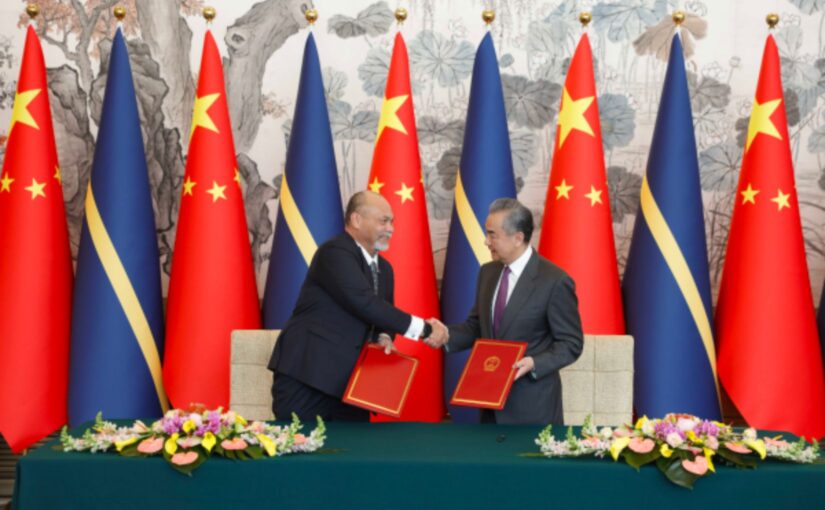
China-Australia relations take major step towards a return to normality

Relations between China and Australia took a major step towards a return to normality with a November 4-7 visit by Prime Minister Anthony Albanese at the invitation of his Chinese counterpart Li Qiang. The visit ended the effective freeze on high-level exchanges between the two countries, as a result of the adoption of anti-China policies by right-wing governments in Canberra, and follows the return to office of the Australian Labor Party, led by Albanese, in the May 2022 general election.

Meeting Prime Minister Albanese on November 6, Chinese President Xi Jinping said that China and Australia have embarked on the right path of improving relations. He noted:

“This year marks the 50th anniversary of the visit by Australian Prime Minister Gough Whitlam. Your visit is a journey to retrace history and plan for the future. Thanks to the joint efforts of both sides, China and Australia have resumed exchanges in various fields and embarked on the right path of improving relations.”

Xi said China and Australia are both Asia-Pacific countries and important members of the G20, with no historical grievances or fundamental conflicts of interest, but every reason to be partners of mutual trust and mutual achievement, calling on the two sides to keep to the right direction of bilateral relations amid the profound changes in the world.

In the stormy waters of the global crisis, countries are not riding on more than 190 small boats, but instead on a big boat with a common destiny, he added.

China and Australia should follow the trend of the times, proceed from the common interests of the two countries, pursue a bilateral relationship that features treating each other on an equal footing, seeking common ground while shelving differences and mutually beneficial cooperation.

In remarks that might be taken as an oblique reference to Australia’s participation in the Quadrilateral Security Dialogue, or Quad, along with the United States, Japan and India, and the AUKUS nuclear submarine deal with the United States and Britain, Xi said that in the Asia-Pacific region, China does not engage in exclusive cliques, bloc politics, or camp confrontation. Small cliques can neither solve the major challenges facing the world nor adapt to the drastic changes in today’s world. He urged vigilance against and opposition to those attempts to throw the region into chaos.

Prime Minister Albanese said it was a great honor to pay an official visit to China on this historic occasion of the 50th anniversary of Mr. Whitlam’s visit to China. In recent years, China has made remarkable achievements in poverty alleviation and development. Australia and the world have benefited significantly from China’s long-term, stable, and sustained development.

Albanese said the two sides should respect each other, be equal and benefit each other, stay in communication, enhance understanding and cooperation, and achieve win-win results. He said the Chinese people have the right to development, and he is always optimistic about China’s economy.

As Australia and China have different political systems, it is normal for differences to occur, but they should not be allowed to define the relationship. Australia and China share extensive common interests, and dialogue and cooperation is the right choice, he said.

He added that Australia adheres to the one-China policy and stands ready to work with China to promote the steady development of bilateral relations.

A joint statement agreed by the two nations likewise noted that Albanese had undertaken an “official visit to China from November 4 to 7, 2023, to mark the 50th anniversary of the first visit to China by an Australian Prime Minister, the Hon. Edward Gough Whitlam.”

Both sides welcomed the successful recommencement of the Annual Leaders’ Meeting between Premier Li and Prime Minister Albanese.

They reaffirmed their support for their Comprehensive Strategic Partnership and reiterated the importance of a stable, constructive bilateral relationship. The two sides reiterated the importance of the 1972 Joint Communique on the Establishment of Diplomatic Relations between the People’s Republic of China and Australia and restated their commitment to their respective national policies and positions contained therein, including mutual respect, equality, mutual benefit, stable development, and Australia’s commitment to its one-China Policy. They agreed that both nations could grow the bilateral relationship and uphold their respective national interests if they navigated their differences wisely.

While Prime Minister Albanese’s visit does not resolve all the issues complicating the relations between Australia and China, and does not represent a fundamental shift on the part of Canberra, it nevertheless represents a noteworthy step forward and a not insignificant breach in the united front of the Anglo-Saxon imperialist powers (or ‘Five Eyes’) against China. This finds symbolic reflection in Australia’s agreement to China’s preferred choice of framing the visit around the 50th anniversary of the first ever visit of an Australian Prime Minister.

Gough Whitlam, who remains a highly respected figure in China, was the longest-serving leader of the Australian Labor Party and served as Australia’s Prime Minister from December 1972 to November 1975. Whitlam established diplomatic relations with the People’s Republic of China within three weeks of his becoming Prime Minister. He also withdrew Australian troops from the Vietnam War and ended military conscription, established diplomatic relations with the Democratic People’s Republic of Korea, ended Australian colonial rule in Papua New Guinea, began the process of land reform for the First Nations (granting the first set of title deeds to lands to the Gurindji people), and introduced universal health care and free university education.

His policies earned him the ire not only of the Australian right wing but also of the British and US imperialists, with the latter especially fearing for the future of their Pine Gap spy base and surveillance centre, after Whitlam learned that he had been deceived as to its true purpose. As a result, he was removed from office in a constitutional coup fronted by Governor-General Sir John Kerr, but with the active involvement of the Nixon-Kissinger administration in the US, the CIA, Britain’s MI6, and key figures in Buckingham Palace, including the present monarch, Charles III.

And whilst it is the anniversary of Whitlam’s China visit as Prime Minister that is presently being marked, one reason why he was able to move towards the establishment of diplomatic relations with China with such rapidity is that, previously, in July 1971, he had already visited the country at the head of an Australian Labor Party delegation, which was also joined by political advisers, China specialists and journalists. This trip, during which he met with Premier Zhou Enlai (he was also to meet with Chairman Mao Zedong on his 1973 visit), was also criticised in some quarters for its potential negative impact on Australia’s relations with the United States. However, it later became known that just as Whitlam’s delegation was leaving Beijing, US National Security Adviser, Henry Kissinger, was arriving to arrange President Nixon’s own visit to China, which took place in February 1972.

The following articles were originally published by the Xinhua News Agency and by the Whitlam Institute, which is housed within Western Sydney University.

China, Australia embark on right path of improving ties: Xi

BEIJING, Nov. 6 (Xinhua) — Chinese President Xi Jinping met with Australian Prime Minister Anthony Albanese in Beijing on Monday, saying China and Australia have embarked on the right path of improving relations.

“This year marks the 50th anniversary of the visit by Australian Prime Minister Gough Whitlam. Your visit is a journey to retrace history and plan for the future. Thanks to the joint efforts of both sides, China and Australia have resumed exchanges in various fields and embarked on the right path of improving relations,” Xi told Albanese.

Xi said China and Australia are both Asia-Pacific countries and important members of the G20, with no historical grievances or fundamental conflicts of interest, but every reason to be partners of mutual trust and mutual achievement, calling on the two sides to keep to the right direction of bilateral relations amid the profound changes in the world.

From the perspective of self-interest, the world is small and crowded, with risks and competition all the time. From the perspective of shared destiny, the world is vast and broad, with opportunities and cooperation everywhere. In the stormy waters of the global crisis, countries are not riding on more than 190 small boats, but instead on a big boat with a common destiny, Xi said.

China and Australia should follow the trend of the times, proceed from the common interests of the two countries, pursue a bilateral relationship that features treating each other on an equal footing, seeking common ground while shelving differences and mutually beneficial cooperation, and push forward the China-Australia comprehensive strategic partnership, Xi said.

This serves the common interests of the two countries and peoples, meets the common expectations of countries in the region, and helps the international community better respond to the risks and challenges brought about by the changes unseen in a century, Xi said.

Xi stressed that at present, the global economy is facing increasingly destabilizing, uncertain, and unpredictable factors, and the economies of all countries are facing considerable challenges. In the face of a complex external environment, the Chinese economy has withstood pressure, stabilized its size, and improved its quality.

“China’s development still has a sound foundation and many favorable conditions. With its steady development, China will bring valuable certainty to the uncertain world economy. China cannot develop in isolation from the world, and the world needs China for its development,” Xi said.

Continue reading China-Australia relations take major step towards a return to normality

China’s impassioned plea for a ceasefire in the Gaza conflict

China, which this month holds the rotating chair of the United Nations Security Council (UNSC), has made a further impassioned plea for a ceasefire in the Gaza conflict. 

Addressing an emergency UNSC meeting on November 10, China’s permanent representative to the UN, Zhang Jun said that the call for a ceasefire was by no means a diplomatic statement, “It is the only hope for the people of Gaza to survive.”

Referring to the United States, in particular, which has repeatedly vetoed calls for a ceasefire, he added that China calls on “all parties, especially the major power that has a unique influence on the parties, to put aside all geopolitical considerations and double standards and focus all efforts on the goal of a ceasefire and an end to the fighting. We urge Israel to curb the intensifying settler violence in the West Bank so as to avoid… the spread of conflict.”

Zhang Jun added that: “When tens of thousands of people, including more than 4,000 children, have lost their lives; when more than 1.6 million people have been forced to flee their homes; when 2.3 million people continue to be cut off from water, electricity, fuel, food and medicine; and when hospitals, schools, refugee camps, and UN facilities have been frequently targeted, this is not only a humanitarian crisis, but, as described by UN Secretary-General Antonio Guterres, a crisis of humanity.” 

He went in to say that earlier in the day he had met with representatives of Palestine and other Arab countries as well as from the Organization of Islamic Cooperation (OIC).

“From our conversation, I was deeply struck by the pain they have deep in their hearts, by their hope for the resumption of peace, and by their expectation for the Council to take effective actions.”

“In the face of all this, the world must speak out together: Enough is enough,” Zhang said, adding that “the Security Council must do away with the obstruction and interference of some members and take immediate, responsible, and meaningful action to uphold justice and maintain peace.”

Zhang also expressed grave concern over and strong opposition to the clear violations of international humanitarian law in Gaza.

“We urge an end to the collective punishment of civilians… We call on Israel to immediately lift the siege and completely remove restrictions on livelihood supplies, especially fuel delivery to humanitarian and medical institutions and livelihood facilities.”

Noting that over the past two weeks, just over 500 trucks had entered Gaza, Zhang described this as “but a drop in the bucket for the people of Gaza who are struggling on the brink of death.”

Turning to the post-conflict scenario, with Israel threatening to reoccupy Gaza, Zhang said: “These days, we also hear frequent discussions about the day after for Gaza. Regarding this, it must be pointed out that no arrangement for Gaza can be imposed on the Palestinian people… The future of Palestine must be and can only be decided by the Palestinian people themselves.”

The following article was originally published by the Xinhua News Agency.

UNITED NATIONS, Nov. 11 (Xinhua) — Chinese permanent representative to the United Nations, Zhang Jun, on Friday called for an immediate ceasefire between Israel and Palestine.

“A ceasefire and an end to the fighting cannot be delayed. A ceasefire is by no means a diplomatic statement. It is the only hope for the people of Gaza to survive,” Zhang told the UN Security Council emergency meeting on the Palestinian-Israeli situation.

Noting that the current round of conflict has been going on for 35 days and the situation continues to deteriorate, he said: “We call on all parties, especially the major power that has a unique influence on the parties, to put aside all geopolitical considerations and double standards and focus all efforts on the goal of a ceasefire and an end to the fight. We urge Israel to curb the intensifying settler violence in the West Bank so as to avoid the concurring hotspot and the spread of conflict.”

“When tens of thousands of people, including more than 4,000 children, have lost their lives; when more than 1.6 million people have been forced to flee their homes; when 2.3 million people continue to be cut off from water, electricity, fuel, food and medicine; and when hospitals, schools, refugee camps, and UN facilities have been frequently targeted, this is not only a humanitarian crisis, but, as described by UN Secretary-General Antonio Guterres, a crisis of humanity,” he added.

Zhang said he met with representatives of Palestine and other Arab countries and those from the Organization of Islamic Cooperation earlier in the day.

“From our conversation, I was deeply struck by the pain they have deep in their hearts, by their hope for the resumption of peace, and by their expectation for the Council to take effective actions,” he said.

“In the face of all this, the world must speak out together: Enough is enough,” Zhang said, adding that “the Security Council must do away with the obstruction and interference of some members and take immediate, responsible, and meaningful action to uphold justice and maintain peace.”

Stressing the importance of protecting civilians, the envoy said, “We condemn all violence and attacks against civilians. We express our grave concern over and strong opposition to the clear violations of international humanitarian law in Gaza.”

“We urge an end to the collective punishment of civilians. We demand the safety and humanitarian needs of hostages be guaranteed and call for diplomatic efforts to facilitate their early release,” he added.

More than 1,300 children and their families are trapped in the rubble with their lives at stake, Zhang said, adding, “We support the Council to take emergency actions in this regard to facilitate a sustained truce of multiple days and an immediate opening of a green corridor for specialized agencies and equipment to enter Gaza to carry out search and rescue operations, so as to do our utmost to save children.”

The Council should also respond to the joint appeal made by the Director-General of the World Health Organization, Tedros Adhanom Ghebreyesus, and Marwan Jilani, Director General of the Palestine Red Crescent Society, to establish a medical evacuation mechanism so that pregnant women and the seriously injured and sick in Gaza can be transferred and treated promptly, he continued.

Zhang also called for the delivery of supplies to resume, noting it “cannot be delayed.”

“We call on Israel to immediately lift the siege and completely remove restrictions on livelihood supplies, especially fuel delivery to humanitarian and medical institutions and livelihood facilities,” he said.

Over the past two weeks, just over 500 trucks have entered Gaza through the Rafah crossing, a drop in the bucket for the people of Gaza who are struggling on the brink of death, Zhang said. “All crossings into Gaza should be utilized, and the Kerem Shalom crossing should be opened as soon as possible.”

“These days, we also hear frequent discussions about the day after for Gaza. Regarding this, it must be pointed out that no arrangement for Gaza can be imposed on the Palestinian people,” said the ambassador, adding that “No solution to the current situation can deviate from the two-state solution. The future of Palestine must be and can only be decided by the Palestinian people themselves.”

The ambassador pledged that China, as president of the Security Council for November, would continue to work with the international community to bring an early end to the fighting and alleviate the humanitarian crisis in Gaza.

China supports a peaceful coexistence between the Palestinians and the Israelis and long-term peace and security in the Middle East, he said. 

The US steps up its ‘chip war’ against socialist China

In this article, which was originally published in Fighting Words, journal of the US Communist Workers League, Chris Fry notes the new anti-China sanctions introduced by US Commerce Secretary Gina Raimondo on October 17, focused on advanced computer chips manufactured by the Nividia company. 

Fry notes that Raimondo claimed that this was directed solely at the Chinese military, yet she also stated that the goal was to limit China’s “access to advanced semiconductors that could fuel breakthroughs in artificial intelligence and sophisticated computers.”

Previously, at an October 15 Senate hearing she had described recent technological breakthroughs by the Chinese telecom giant Huawei as “incredibly disturbing”. 

The article notes: “Up until these imperialist sanctions, socialist China had obtained its semiconductor and other tech designs from a complex global network. Facing this US blockade, the Chinese government began a robust campaign to develop its own semiconductor design capabilities. With this new Huawei success, it appears that socialist China has made a massive breakthrough.”

Turning to the question of Artificial Intelligence (AI), Fry notes that it presents opportunities for greater profits in a capitalist society, but the inherent contradictions of the capitalist mode of production also leads to “the ‘bust’ part of the capitalist cycle – recessions and depressions.”

Moreover, the capitalist class fears that artificial intelligence could be used under socialism to greatly enhance the coordination and accuracy of scientific planning.

The article concludes: “The imperialist ruling class is keenly aware of the danger of this, not only in its economic competition with socialist China, but also with the example of a powerful and prosperous socialist China lighting a revolutionary beacon to the global working class as to the possibilities with a new social system.”

On October 17th, Commerce Secretary Gina Raimondo announced new bans on the giant tech company Nvidia from sales of its advanced computer chips, particularly its advanced H800 and A800 products.

Raimondo claimed that this move was directed solely against the Chinese military. According to an October 18 CNN report, she said in August on her visit to China: “the administration was “laser-focused” on slowing the advancement of China’s military. She emphasized that Washington had opted not to go further in restricting chips for other applications.”

But on October 17 Raimondo made clear that the target of these sanctions against socialist China is much wider:

“… the goal was to limit China’s ‘access to advanced semiconductors that could fuel breakthroughs in artificial intelligence and sophisticated computers’.”

China’s Foreign Ministry quickly responded:

“The US needs to stop politicizing and weaponizing trade and tech issues and stop destabilizing global industrial and supply chains,” spokesperson Mao Ning told a press briefing. “We will closely follow the developments and firmly safeguard our rights and interests.”

China has decided to cut off the U.S. from supplies of germanium and gallium, essential for manufacturing semiconductors.

Continue reading The US steps up its ‘chip war’ against socialist China

Keith Bennett: The Belt and Road Initiative is a key component of Marxist internationalism in the 21st century

The following is the closing speech given by our co-editor Keith Bennett at our webinar held on November 4, marking 10 years of China’s Belt and Road Initiative (BRI).

Keith refers to the recent Third Belt and Road Forum for International Cooperation, held in Beijing, where President Xi Jinping said in his opening speech: “We have learned that humankind is a community with a shared future. China can only do well when the world is doing well. When China does well, the world will get even better.”

The BRI, Keith notes, is concerned with development, modernization and globalization. And there are two fundamentally different approaches to these questions in today’s world. It is not a coincidence that the approach to these questions that represents and embodies the interests of the overwhelming majority of countries, and the overwhelming majority of the people in every country, should be put forward by the world’s leading socialist country. Nor is it a coincidence that it is above all the world’s leading imperialist country that announces a supposed alternative to the BRI every few months, none of which achieve any traction or any concrete result.

Regarding globalization, in the western countries, the prevailing discourse, from much of both the left and the right, tends to assert that China has wholeheartedly embraced the model of globalization advanced by the major capitalist powers. This is so far from reality as to suggest that those who advance it are either ignorant or malicious. 

A White Paper issued by China’s State Council on October 10 makes clear that the fruits of economic globalization have until now been dominated by a small group of developed countries. Rather than contributing to common prosperity at a global level, it continues, globalization has widened the wealth gap between the rich and poor, between developed and developing countries, and within the developed countries themselves. Many developing countries have benefited little from economic globalization and even lost their capacity for independent development. Certain countries, it notes, have practiced unilateralism, protectionism and hegemonism. 

Keith argues that, grounded as it is in the stand, viewpoint, and method of Marxism, the BRI is based on and inherits not only the Silk Roads of antiquity, but also the diplomatic history of socialist China as well as the standpoint and practice of the international working-class movement more generally, particularly since the establishment of workers states. 

First, on behalf of Friends of Socialist China, I’d like to thank all those who registered for, attended, and supported our webinar today.

Special thanks go to our brilliant speakers who, from five continents, have shared their insights with us on the Belt and Road Initiative.

Thanks also to our co-organisers, the International Manifesto Group, as well as our sponsors, Connolly Books, Critical Theory Workshop, Geopolitical Economy Research Group, Geopolitical Economy Report, Hampton Institute, International Action Center, Iskra Books, Kawsachun News, Peace, Land and Bread, Pivot to Peace, and Veterans for Peace – China Working Group.

It is 10 years since President Xi Jinping put forward the Belt and Road Initiative and therefore a good time to take stock and make an initial summing up. Last month, I was privileged to be seated in Beijing’s Great Hall of the People to listen to President Xi open the Third Belt and Road Forum for International Cooperation, his speech being followed by those of President Putin and the Presidents of Kazakhstan, Indonesia and Argentina, the Prime Minister of Ethiopia, and the Secretary-General of the United Nations.

As President Xi noted, in the course of its first decade, Belt and Road cooperation has extended from its initial focus on the Eurasian landmass to Africa, Latin America and elsewhere. Indeed, more than 150 countries and over 30 international organisations have signed Belt and Road cooperation documents. Through this process, he explained, belt and road cooperation has progressed from ‘sketching the outline’ to ‘filling in the details’, and blueprints have been turned into real projects.

Xi Jinping said that over the past decade, “we have learned that humankind is a community with a shared future. China can only do well when the world is doing well. When China does well, the world will get even better.”

President Xi, in my view, expresses things here with such simplicity and clarity, making it sound like obvious common sense, that it might seem that this is acceptable to all and that nobody could possibly disagree with it.

But this is far from the case. The BRI is concerned with development, modernization and globalization. And there are two fundamentally different approaches to these questions in today’s world. It is not a coincidence that the approach to these questions that represents and embodies the interests of the overwhelming majority of countries, and the overwhelming majority of the people in every country, should be put forward by the world’s leading socialist country. Nor is it a coincidence that it is above all the world’s leading imperialist country that announces a supposed alternative to the BRI every few months, none of which achieve any traction or any concrete result.

Comrade Liu Jianchao, the Minister of the International Department of the Communist Party of China’s Central Committee, spelled matters out clearly in a recent article, where he wrote:

“The vision of building a human community with a shared future and the three global initiatives are scientific. They encapsulate the stances, viewpoints, and methods of Marxism, reflecting the hallmarks of Marxism, and demonstrating salient theoretical character. Underpinned by dialectical and historical materialism, the vision and the three global initiatives reveal the laws governing the development of human society and its future direction.”

Careful study of the White Paper released by the Information Office of China’s State Council on October 10, to coincide with the tenth anniversary and the Beijing Forum, can help to understand this more concretely. And all the documents to which I refer may be read in full on our website, along with useful introductions.

The White Paper again makes clear that whilst the BRI has been launched by China, it belongs to the world and benefits the whole of humanity.

“Irrespective of size, strength and wealth, all countries participate on equal terms.”

Making very clear the distinction between the socialist and imperialist approaches to such questions, it notes that the type of development advanced by the BRI diverges from, “the exploitative colonialism of the past, avoids coercive and one-sided transactions, rejects the centre-periphery model of dependency, and refuses to displace crisis onto others or exploit neighbours for self-interest.”

The same point was made even more forcefully by President Xi Jinping in his report to the 20th National Congress of the Communist Party of China in October last year, where he stated:

“In pursuing modernization, China will not tread the old path of war, colonization and plunder taken by some countries. That brutal and blood-stained path of enrichment at the expense of others caused great suffering for the people of developing countries.”

These words of President Xi surely acquire even greater relevance and poignancy today in the face of Israel’s genocidal war in Gaza and the courageous resistance of the Palestinian people, a veritable 21st century Warsaw Ghetto. On one hand, the United States, Britain, France and Germany, aid and abet the genocide and even seek to curtail and deny their own peoples’ right to protest. On the other hand, socialist China, along with the overwhelming majority of the countries of the world, principally the Global South, and as seen in the recent United Nations General Assembly vote, stand for peace, an end to the war of aggression, and for the long overdue realization of the national rights to an independent state of the Palestinian people.

And the same fundamental distinction with regard to which road to take informs socialist China’s approach to globalization. In the western countries, the prevailing discourse, from much of both the left and the right, tends to assert that China has wholeheartedly embraced the model of globalization advanced by the major capitalist powers. This is so far from reality as to suggest that those who advance it are either ignorant or malicious. Or quite possibly both.

The White Paper is clear that the fruits of economic globalization have until now been dominated by a small group of developed countries. Rather than contributing to common prosperity at a global level, it continues, globalization has widened the wealth gap between the rich and poor, between developed and developing countries, and within the developed countries themselves. Many developing countries have benefited little from economic globalization and even lost their capacity for independent development. Certain countries, it notes, have practiced unilateralism, protectionism and hegemonism.

But just as, in their day, Marx and Engels could not endorse, but rather repudiated and stood against, the Luddite approach which, faced with the undoubted depredations and cruelties of the industrial revolution, sought to reverse the objective course of historical progress, China, unlike some, does not reject globalization. But it stands for a different globalization. Economic globalization, the White Paper insists, remains an irreversible trend. It is unthinkable for countries to return to a state of seclusion or isolation. But economic globalization must undergo adjustments in both form and substance.

The focus of BRI, it explains, is precisely on contributing to a form of globalization that generates common prosperity and that brings benefits particularly to developing countries. Thus, while the BRI is open to all, it is neither accident nor coincidence that the majority of its participants are developing countries. The developing countries as a whole all seek to leverage their collective strength to address such challenges as inadequate infrastructure, lagging industrial development, and insufficient capital, technologies and skills, so as to promote their economic and social development.

Grounded as it is therefore in the stand, viewpoint, and method of Marxism, it should be clear that the BRI is based on and inherits not only the Silk Roads of antiquity, but also the diplomatic history of socialist China as well as the international standpoint and practice of the international working-class movement more generally, particularly since the establishment of workers states, the constitution of the working class as the ruling class.

It resonates, for example, with China’s building of the Tazara railway in Zambia and Tanzania in the 1970s. With the Five Principles of Peaceful Coexistence put forward by Premier Zhou Enlai in 1954 and the Ten Principles adopted by the Afro-Asian Conference held in the Indonesian city of Bandung the following year.

As far back as 1921, even before the official formation of the USSR, Lenin’s government concluded treaties with Afghanistan, Persia and Turkiye, which provided for mutual support, aid in the financial, technical, personnel and other fields, and especially for support in their struggles to win and maintain independence from colonial and imperial powers.

This in turn built on the deliberations of the Second Congress of the Communist International, held in 1920, which established the absolute duty of the working-class movement to support the struggles of the colonial and oppressed countries and peoples for liberation and for independence against imperialism.

The Belt and Road Initiative, and the other global initiatives put forward by President Xi Jinping, are the 21st century inheritance and expression of this Marxist theory and practice. The difference is that today it is becoming a material force that is progressively uniting and mobilizing the majority of humanity. This is a major part of why President Xi constantly reminds us that we are presently witnessing changes unseen in a century. That is since the birth of the first workers’ state.

In Friends of Socialist China, we will continue to pay the closest attention to these developments. Thank you again for your support today and we hope to continue working with you.

The US has its own BRI: the Bomb and Ruin Initiative

The following article by Carlos Martinez, originally published in Global Times, compares the records of China and the US in terms of their engagement with the Global South. Specifically, Carlos summarises the impact of the China-led Belt and Road Initiative (BRI) over the course of its first decade, and contrasts this with the effect of the US’s equivalent projects.

While several US-led global infrastructure projects have been announced (such as the Build Back Better World and the India-Middle East-Europe Economic Corridor), none of these have made any meaningful progress as yet. However, “if we look at the actual history and reality of US foreign policy, it becomes clear that the US does actually have its own BRI: the Bomb and Ruin Initiative.”

From Iraq to Palestine to Venezuela to Syria to Ukraine to Zimbabwe and beyond, the US uses war, proxy war, destabilisation, sanctions and coercion, “spreading death and destruction in pursuit of its own selfish economic and political interests,” while China cooperates with the countries of the world on the basis of respect, equality and common interest in pursuit of a global community of shared future.

The article is based on a speech given at a webinar themed Third Belt and Road Forum: Together for Common Development and Shared Prosperity, organised by the Pakistan-based Friends of the Belt and Road Forum, the Institute of Peace and Diplomatic Studies and the Centre for BRI and China Studies, which took place on Tuesday 7 November.

The China-proposed Belt and Road Initiative (BRI) has attracted a great deal of attention recently, particularly with the Third Belt and Road Forum for International Cooperation having taken place in Beijing last month.

Since it was announced a decade ago, the BRI has already become the world’s largest platform for international cooperation, with more than 150 countries and 30 international organizations participating across five continents. A trillion dollars have been spent or committed on projects that are increasingly transforming the development prospects for dozens of countries in Asia, Africa, Latin America, the Middle East, the Caribbean and the Pacific. 

A number of these projects have already been delivered. The Chinese-built Mombasa-Nairobi Standard Gauge Railway, for example, is the largest infrastructure project carried out in Kenya since its independence. The China-Laos Railway, completed in 2021, has turned Laos from a land-locked country into a land-linked country, thereby stimulating trade, employment, economic opportunities and living standards. The Jakarta-Bandung High-Speed Railway – the first high-speed rail system in Indonesia – has reduced the journey time from 3.5 hours to 45 minutes.

The BRI is becoming green. The prominent Norwegian environmentalist Erik Solheim, former minister of the environment, stated at a webinar hosted by Friends of Socialist China on November 4 that the BRI has become the most important global project in terms of green, sustainable development. 

Does the US – the world’s largest economy in nominal GDP terms – have an equivalent to the China-proposed BRI? A few such projects have been announced, to much fanfare. The Build Back Better World (B3W) was unveiled in 2021. The India-Middle East-Europe Economic Corridor (IMEC) was announced in September this year. But these initiatives are yet to experience any manifestation in reality – and it’s tempting to wonder if they ever will.

But if we look at the actual history and reality of US foreign policy, it becomes clear that the US does actually have its own BRI: the Bomb and Ruin Initiative.

The Bomb and Ruin Initiative started in earnest in 1950 with the launch of the Korean War, in which an estimated four million people were killed. The initiative continued with the Vietnam War, the brutal 1965 coup in Indonesia, the coups and proxy wars in Guatemala, Angola, Brazil, Chile, Mozambique, Argentina, Nicaragua, Grenada, just to name a few.

The flagship Bomb and Ruin Initiative project this century so far has been the illegal war on Iraq. Hundreds of thousands of civilians were killed. The country was flattened and its development set back by decades. 

China has taken a significantly different approach with respect to Iraq. Indeed Iraq is one of the major recipients of infrastructure investment under the BRI, with a vast array of bridges, roads and railways being constructed, alongside energy and telecommunications infrastructure. China is committed to building some 7,000 schools in Iraq. 

Iraq of course is best known for its abundance of oil – certainly that has been a central motivating factor for a century of British and American interference – but these days China is leading the investment in Iraq’s growing solar energy industry. The world can look forward to the day when Iraq is an advanced, prosperous country, and a green energy superpower.

In Iraq, the contrast between the BRI and the Bomb and Ruin Initiative is quite stark. So much so that there’s a popular saying: “America bombs, China builds.”

This contrast is emblematic of the US’ and China’s role in the world in general.

The US has brought misery and destruction to Afghanistan, that long-suffering country, with a 20-year war and occupation, and now cruel sanctions put in place to prevent the country from getting back on its feet.

The US and its allies bombed Libya into the Stone Age, turning it from a relatively prosperous country – with the highest Human Development Index in Africa – into a failed state.

The US has been a key player in fomenting and perpetuating the devastating war in Syria, supporting the emergence of terrorist groups in a strategy of regime change, and then using the presence of those same groups as a justification for its own uninvited and unwanted military presence in the country.

About two weeks ago, the US responded to attacks on its illegal Syrian facilities not by dismantling the facilities but by carrying out air strikes against Syrian government sites. 

It’s no secret that the US is the driving force behind the war in Ukraine. The essential character of this conflict is a proxy war to weaken Russia.

With the sponsorship and total support of the US, Israel is showing no regard at all for the people of Gaza. Already more than 10,000 people have been killed. The UN has called it a “children’s graveyard.” The people of the world want a ceasefire; China, Russia, Brazil and many others have called for a ceasefire. But the US – along with its most dependable ally, Britain – is standing in the way.

The US gets criticized for not building enough infrastructure. However, the US is building plenty of infrastructure of war and aggression: 800 overseas military bases; the stationing of nuclear-enabled missiles and warplanes in Japan, Guam and South Korea, along with tens of thousands of US troops; the placement of the THAAD so-called missile defence system in Guam and South Korea; the AUKUS trilateral nuclear pact between the US, UK and Australia. When it comes to the project of containing and encircling China, the US has no problem with building infrastructure.

The stark difference between China’s BRI and the US’ BRI is clear for all to see.

The US is pursuing a hegemonic, imperialist project; a Project for a New American Century. It is spreading death and destruction in pursuit of its own selfish economic and political interests. 

Meanwhile, China is pursuing what it calls a global community of shared future – described by President Xi Jinping as “an open, inclusive, clean and beautiful world that enjoys lasting peace, universal security and common prosperity, charting a bright future for human development.”

This is an inspiring, democratic and inclusive vision that is rapidly gaining broad support around the globe.

Prachanda: China’s successes building socialism provide great encouragement to the peoples of the world

In this episode of the CGTN series Leaders Talk, recorded on September 25, two days after the opening of the Asian Games in Hangzhou, Li Tongtong interviews Pushpa Kamal Dahal, the Prime Minister of Nepal, known as Prachanda.

Noting that Prachanda is now serving his third term as Prime Minister, Li notes that the first of his many visits to China was to attend the closing ceremony of the 2008 Beijing Olympics during his first term. Now, 15 years later, he is in China for the opening of the Asian Games, having moved up his speaking slot at the United Nations General Assembly session in New York to be present. Nepal set a record with more than 250 of its athletes competing in the games this time and Prachanda observes that the 2008 Olympics showcased China’s progress to the world. And now the Asian Games show that China has taken another leap forward. 

Prachanda says that he has met President Xi Jinping five times and finds him a very sincere and visionary leader. Topics he had discussed with him this time included the common interests of the two countries, how to better facilitate China’s support and help to Nepal, for example in aviation, railway, road and transmission line connectivity, as well as climate change, poverty reduction and friendly relations between the two peoples.

The Nepalese Prime Minister, who is also the leader of the Communist Party of Nepal (Maoist Centre), says that the glorious history of the Communist Party of China (CPC), since its founding in 1921, has seen it amass a wealth of experience. As a result, it has achieved a great success in building a new model of socialism, namely socialism with Chinese characteristics. This has provided great encouragement to and made a positive impact on communist parties and people who want development and social justice around the world. They all want to learn from China’s experience.

The friendship between Nepal and China, Prachanda observes, has deep roots and one example of their special relations is that Nepal is the only country to have diplomatic representation in Xizang (Tibet), which Prachanda went on to visit as the last stop of his visit. Its consulate in Lhasa is one of five Nepali consulates in China, more than it has in any other country. 

Whilst the number of people engaged in agricultural production in Nepal is gradually decreasing, Prachanda explains that his country is still primarily an agricultural one. So China’s experience and assistance in the agricultural field is very meaningful and important for Nepal. He always aim to study agricultural matters each time he visits China and this time he is focusing on how Nepal can enhance its agricultural production through the adoption of modern technologies.

Turning Nepal from a landlocked to a land-linked country is another key priority and in this respect Chinese experts are now engaged in active feasibility studies for the construction of a China/Nepal railway. Prachanda dismisses allegations of a ‘debt trap’ or the idea that a rail link could somehow pose a a security threat to other countries as baseless.

Irrespective of international, regional or domestic changes, he insists, his country’s position on relations with China will not change or be allowed to change. Nepal has always pursued a foreign policy of independence and non-alignment. It is resolute in defending its national sovereignty, territorial integrity and independence. Nepal has never wavered or capitulated under pressure and it never will.

Guided by the United Nations Charter and the Five Principles of Peaceful Coexistence, Nepal firmly believes that all countries are equal, that no country should be allowed to interfere in the internal affairs of others, and that all countries have the right to decide on their own affairs.

Asked finally about his use of the name Prachanda, he said he adopted it when he was leading the revolutionary struggle. But he also used it during the peace process. He is more recognised by this name than by his original name and he will continue to use it as it symbolises both revolution and peace.

The full interview is embedded below.

Zhang Weiwei: the BRI is built on socialist concepts of discussing together, building together and benefiting together

The following is the text of a speech given by Professor Zhang Weiwei (Director of the China Institute at Fudan University, and author of several important books about China, including The China Wave: Rise of a Civilizational State) at the webinar Building a multipolar world – Ten years of the Belt and Road Initiative, held on Saturday 4 November.

Professor Zhang outlines the founding principles and broad historic significance of the Belt and Road Initiative (BRI). He notes that the foundations for the BRI were laid during the two stages of China’s rise – the first three decades of socialist construction from 1949 to 1978, followed by the accelerated industrialisation and modernisation of the Reform and Opening Up period – and that both these stages were indispensable in allowing China to break from the US-dominated peripheral-central world order and emerge as an economic leader in its own right.

The BRI is a manifestation of this leadership. It is a “hard power” project, with China providing goods, experience and technologies of the Fourth Industrial Revolution to developing countries, and a “soft power” project, with the socialist principles of “discussing together, building together, and benefiting together” guiding the BRI’s development. Zhang observes that these principles are rooted in China’s consultative democracy and can-do spirit, and have been tested and proven in China’s own modernisation process.

A short report of the webinar can be found on China Daily.

The event stream can be viewed on YouTube.

Hello, comrades and friends,

It’s a great pleasure to speak at this webinar on Building a multipolar world – Ten years of the BRI. I will make three observations:

First, on the rise of socialist China. Indeed, it’s remarkable than with 7 decades of unremitting effort, China has become the world’s largest economy by PPP, and the largest trading nation, with the largest middle income group, and largest consumer market.

This historic transformation can be divided into roughly two stages, the first stage, in the first three decades, under the leadership of Chairman Mao, China laid political, economic and social foundations for its rise.

Then the second stage, from 1978, economic take-off, roughly, “one decade, one Industrial Revolution”. China achieved a miracle of the “Four Industrial Revolutions in One” within four decades or so, and now it is in the premier frontier of the Fourth Industrial Revolution (big data, AI and quantum technologies, etc).

Second, on the Chinese break from the peripheral-central world order and becoming the first super-large socialist country that has meaningfully broken the yoke of dependency on the West.

Internally, China has completely eradicated extreme poverty, achieved medical insurance for all, pension for all, and China now has a higher literacy rate than the US, and higher life expectancy than the US (2 years longer, 2021).

Externally, China has become simultaneously the largest partner for the peripheral countries and center countries in terms of trade, investment, financial resources and technologies. That’s why we rightly predicted in 2018 that US will lose its trade war and tech war against China.

Third, all this has paved the way for the launch of the BRI by President Xi Jinping ten years ago and for its stunning success so far. Its success has to do with what may be called the BRI’s hard power and soft power.

Hard power: China is the only country capable of providing goods, experience and technologies of the Four Industrial Revolutions to the developing countries, and China has helped Africa build 6,000 kilometers of railways and 6,000 kilometers of highways. Many landlocked countries are no longer landlocked, many countries without railways are now with railways. Many people who could not afford smart phones now have smart phones and their countries have 4G or even 5G networks.

China is often capable of providing total solutions to industrialization in developing countries. For instance, China completed a comprehensive petro-chemical production package from scratch for countries like Chad, Sudan and Turkmenistan. Being the world’s largest consumer market, China can accommodate a large number of goods from developing countries. For instance, with the completion of the China-Laotian railway, China has become the largest market for the famous Thai fruit durian, a jump of 65% since the railway was built. Now the durian trade alone created 3 billion dollar business for Thailand and the Chinese consumers benefited from this trade.

Soft power: the motto of the BRI is gòngshāng gòngjiàn gòngxiǎng (共商共建共享) or “discussing together, building together and benefiting together”. These ideas are very socialist and have been tested repeatedly within China’s successful process of modernization.

Discussing together originates from China’s consultative democracy (in both high politics and low politics).

Building together originates from the Chinese can-do spirit. Many Africans described the Western projects in Africa as NATO (No Action, Talk Only) whereas Chinese projects are action-oriented, and once consensus is reached by the parties concerned, actions immediately follow suit.

Benefiting together means, China-aid projects aside, the BRI is not a charity, and most BRI projects are commercially viable ones and win-win for all the parties concerned.

In short, these well tested ideas and practices are guided by a deep-rooted Chinese philosophical belief. If the Western belief can be described as “divide and rule”, then the Chinese one is “unite and prosper”. We practice it at home with stunning success and now we promote it in the BRI, and it’s also working well.

In conclusion, the hard power and the soft power are still gaining momentum as shown in China’s rise and the BRI’s success, and this will surely encourage more and more countries in the Global South to work together in a meaningful way to change the unipolar global order to a multipolar one.

Li Qiang: SCO represents the shared aspiration of regional countries for friendship, security and development

The 22nd Meeting of the Council of Heads of Government of the Member States of the Shanghai Cooperation Organisation (SCO) was held in Bishkek, the capital city of Kyrgyzstan, on October 26.

Chinese Premier Li Qiang joined fellow leaders, including Kazakh Prime Minister Alikhan Smailov, Russian Prime Minister Mikhail Mishustin, Tajik Prime Minister Kokhir Rasulzoda, Uzbek Prime Minister Abdulla Aripov, Iran’s First Vice President Mohammad Mokhber, the Indian foreign minister, and the Pakistani foreign minister from member states, together with Belarusian Prime Minister Roman Golovchenko and Mongolian Prime Minister Luvsannamsrai Oyun-Erdene, from two of the SCO’s observer states. The meeting was hosted by Kyrgyz Prime Minister Akylbek Japarov.

In his speech to the meeting, Premier Li said that looking back at the founding aspiration of the SCO, its members were brought together to ensure that regional affairs are decided by regional countries through consultation, without interference from those outside the region. He added:

“Twenty-two years ago, the SCO was founded in response to the shared aspiration of regional countries for promoting friendship, safeguarding security and pursuing development. Today, the Organisation has grown from the original ‘Shanghai Five’ to nine member states, three observer states, and 14 dialogue partners. SCO member states now account for nearly half of the world’s population and about one quarter of the global GDP.”

Li offered four proposals on deepening SCO cooperation. First, the SCO members should jointly solidify the regional security barrier, firmly reject external interference, improve the organisation’s mechanism of coping with security threats and challenges as soon as possible, and crack down on the ‘three forces of terrorism, separatism and extremism’ as well as transnational organised crimes.

Second, SCO members should jointly promote the speedy economic recovery, cooperate to build safe and efficient transportation systems, continuously promote trade and investment liberalisation and facilitation, and maintain steady and smooth industrial supply chains.

Third, the members should jointly enhance the Belt and Road cooperation. The third Belt and Road Forum for International Cooperation has been successfully held, and the Belt and Road has become the most popular international public goods and the largest international cooperation platform in the past 10 years.

The SCO members should reinforce the alignment of high-quality Belt and Road cooperation with the member states’ respective development strategies, push forward the construction of major economic corridors, and develop well the SCO Development Bank.

Fourth, the SCO member states should jointly promote the understanding and amity among their people, and continue to deepen cooperation in areas including education, culture and tourism, and sports.

Li Qiang also held a series of bilateral meetings on the sidelines of the summit.

Meeting with Russian Prime Minister Mikhail Mishustin on October 25, he said that China is willing to further align its development strategies with Russia, promote synergy between the Belt and Road cooperation and the Eurasian Economic Union (EEU), maintain the growth momentum of cooperation on trade and investment, deepen cooperation in the field of energy, and enhance connectivity and trade liberalisation and facilitation.

On October 26, he met with Mongolian Prime Minister Luvsannamsrai Oyun-Erdene, Iran’s First Vice President Mohammad Mokhber, and Tajik Prime Minister Kokhir Rasulzoda.

In his meeting with Prime Minister Oyun-Erdene, Li said that China stands ready to work with Mongolia to firmly support each other in safeguarding sovereignty, independence, and territorial integrity and to strengthen cooperation with Mongolia in such fields as port connectivity, economy and trade, and green development, to further expand the pie of common interests, so as to achieve win-win results.

China is ready to strengthen cooperation with Mongolia under the SCO and other multilateral frameworks to better safeguard their common interests and build a community with a shared future for humanity, Li added.

For his part, Oyun-Erdene said that Mongolia stands ready to work with China to strengthen border port capacity building and connectivity, promote the Belt and Road cooperation, deepen cooperation in areas including trade, railway, green development, tourism, and culture, and deepen multilateral cooperation, so as to lift Mongolia-China relations to a higher level.

In his meeting with Iran’s First Vice President Mohammad Mokhber, Li noted that President Xi Jinping and Iranian President Ebrahim Raisi met twice this year and reached a series of important consensuses. China, he stressed, will continue to firmly support Iran in safeguarding its national sovereignty, territorial integrity, and national dignity, and will strongly oppose any external forces interfering in Iran’s internal affairs.

Mokhber said that China is a comprehensive strategic partner of Iran and the two countries enjoy a long history of friendship. Iran appreciates China’s assistance for its economic and social development and is firmly committed to deepening Iran-China relations.

Meeting with Tajik Prime Minister Kokhir Rasulzoda, Li said that China is willing to strengthen the synergy of development strategies with Tajikistan, continue to advance high-quality Belt and Road cooperation, give full play to industrial complementarity, expand trade and investment, strengthen cooperation in such fields as transport infrastructure, civil aviation, green economy and digital economy, and deepen people-to-people and cultural exchanges in sports, culture, education and between regions so as to help the development and revitalisation of the two countries.

The two sides, he added, should maintain close coordination in multilateral areas, implement the outcomes of the China-Central Asia Summit, strengthen cooperation within the United Nations, the SCO, and other frameworks, uphold the common interests of the two countries and safeguard international equity and justice.

For his part, Rasulzoda said that Tajikistan-China relations have a long history, profound foundation and rich connotation. Noting that Tajikistan appreciates China’s strong support for its economic and social development over the years, he said that his country is willing to work with China to consolidate traditional friendship, promote the Belt and Road cooperation, deepen cooperation in such fields as industry, agriculture, transportation, energy, infrastructure, and digital economy, and push for further in-depth development of bilateral relations.

Tajikistan stands ready to work with China to promote all-round cooperation between China and Central Asian countries, deepen coordination within the frameworks of the United Nations and the SCO, and promote regional peace and prosperity, he added.

The following day, Li met with the Prime Minister of Belarus, Roman Golovchenko. He said that, under the strategic guidance of Chinese President Xi Jinping and Belarusian President Alexander Lukashenko, bilateral relations have achieved leap-forward development in recent years.

China stands ready to push for deeper synergy between the Belt and Road Initiative and Belarus’ strategy for social and economic development and jointly build the China-Belarus Great Stone Industrial Park and other key projects.

He called on both sides to tap the potential of cooperation in such areas as trade in services and scientific and technological innovation, strengthen people-to-people and cultural cooperation, and push forward their all-weather comprehensive strategic partnership. The two sides should strengthen communication and coordination within the SCO and other multilateral mechanisms to make greater contribution to regional and world peace, stability, and development.

Golovchenko said that Belarus firmly supports China in safeguarding its core interests. Belarus is ready to strengthen cooperation with China within multilateral frameworks such as the SCO to jointly boost the multipolarisation of the world, he added.

Prior to the Heads of Government meeting, Li Qiang also paid a bilateral visit to Kyrgyzstan on October 25. In his meeting with Kyrgyz President Sadyr Japarov, Li said Kyrgyzstan is an important neighbour of China, adding that in May, President Xi Jinping and President Japarov lifted bilateral relations to a comprehensive strategic partnership for a new era and jointly announced the building of a China-Kyrgyzstan community with a shared future of good neighbourliness and shared prosperity, which, constitutes a milestone in their history of bilateral relations and cooperation.

The Chinese side, Li added, is willing to deepen political mutual trust with the Kyrgyz side, always firmly support each other on issues concerning their respective core interest, further align their development strategies, deepen the integration of economic benefits, and continue to improve the quality and efficiency of bilateral cooperation.

And China is also willing to reinforce communication and coordination with the Kyrgyz side on regional and international affairs, speed up the implementation of the outcomes of the China-Central Asia Summit, closely coordinate within such multilateral mechanisms as the United Nations and the Shanghai Cooperation Organisation, and safeguard the common interest of developing countries and international equity and justice, he added.

President Japarov said that the Kyrgyz side stands ready to deepen cooperation with China within the framework of China-Central Asia cooperation and the Shanghai Cooperation Organisation, jointly combat the ‘three forces’ of terrorism, separatism and extremism, effectively address traditional and non-traditional security challenges, and promote regional security and development.

The following reports were originally published by the Xinhua News Agency.

Regional affairs should be decided without external interference: Chinese premier

BISHKEK, Oct. 26 (Xinhua) — Looking back at the founding aspiration of the Shanghai Cooperation Organization (SCO), its members were brought together to ensure that regional affairs are decided by regional countries through consultation, without interference from those outside the region, Chinese Premier Li Qiang said here Thursday.

During his speech at the 22nd Meeting of the Council of Heads of Government of the SCO Member States, Li called for jointly building a security barrier in the region and resolutely resisting external interference.

In his speech, Li said the SCO summit in July this year further reached important consensus, and identified key tasks on carrying forward the Shanghai Spirit and building a closer SCO community with a shared future, adding that China is willing to work with all parties to implement the spirit of the summit.

At the Samarkand summit last year, President Xi Jinping stressed the necessity to uphold political trust, win-win cooperation, equality between nations, openness and inclusiveness and equity and justice, which is the key to the success of the SCO’s development and growth, Li added.

Looking forward to the future, SCO members should keep in mind the founding aspiration and uphold the key to success, Li said, stressing that guided by the vision of building a community with a shared future for mankind, SCO members should work together and make mutual achievements, advance cooperation in various fields in a solid way, and inject more certainty and positive energy into peace and development of the region and the world.

Li offered four proposals on deepening SCO cooperation. First, the SCO members should jointly solidify regional security barrier, firmly reject external interference, improve the organization’s mechanism of coping with security threats and challenges as soon as possible, and crack down on the “three forces” of terrorism, separatism and extremism as well as transnational organized crimes.

Second, SCO members should jointly promote the speedy economic recovery, cooperate to build safe and efficient transportation systems, continuously promote trade and investment liberalization and facilitation, and maintain steady and smooth industrial supply chains.

Third, the members should jointly enhance the Belt and Road cooperation. The third Belt and Road Forum for International Cooperation has been successfully held, and the Belt and Road has become the most popular international public goods and the largest international cooperation platform in the past 10 years.

The SCO members should reinforce the alignment of high-quality Belt and Road cooperation with the member states’ respective development strategies, push forward the construction of major economic corridors, and develop well the SCO Development Bank.

Fourth, the SCO member states should jointly promote the understanding and amity among their people, and continue to deepen cooperation in areas including education, culture and tourism, and sports.

Leaders including Kazakh Prime Minister Alikhan Smailov, Russian Prime Minister Mikhail Mishustin, Tajik Prime Minister Kokhir Rasulzoda, Uzbek Prime Minister Abdulla Aripov, Iran’s First Vice President Mohammad Mokhber, Indian foreign minister, Pakistani foreign minister attended the meeting, together with Belarusian Prime Minister Roman Golovchenko and Mongolian Prime Minister Luvsannamsrai Oyun-Erdene, leaders of two observer states. Kyrgyz Prime Minister Akylbek Japarov hosted the meeting.

The SCO is committed to carrying forward the Shanghai Spirit, said participants of the meeting, adding that since its founding 22 years ago, the SCO has continuously developed, with its global influence ever increasing.

They agreed to implement the consensus reached at the meeting of the Council of Heads of State of the SCO, jointly combat the “three forces” of terrorism, separatism and extremism and transnational organized crimes, strengthen cooperation in such areas as economy and trade, transportation, agriculture, energy, finance, high and new technology, environmental protection and green development, promote Belt and Road cooperation, improve infrastructure connectivity, and deepen people-to-people exchanges in such fields as tourism and education.

They also agreed to strengthen institutional building of the SCO, practice true multilateralism, jointly safeguard regional security and promote regional prosperity, and help make the international system more inclusive and sustainable.

The Chinese premier and other leaders of the SCO member states attending the meeting signed and issued a joint communique, and approved a series of SCO cooperation documents and resolutions on economy and trade, railways and institution building, among other areas. 

Continue reading Li Qiang: SCO represents the shared aspiration of regional countries for friendship, security and development

Humor in the headlines over China in Latin America

The following article by Roger D. Harris, originally published in Orinoco Tribune presents a biting, satirical critique of the Washington Post’s portrayal of China’s growing influence in Latin America, particularly highlighting Honduras’s diplomatic pivot towards Beijing.

The piece contrasts US indignation at Honduras’s recognition of the People’s Republic of China with the US’s own longstanding adherence to the One China policy. The author also observes that China’s engagement with the countries of the region – offering trade, aid and investment, whilst maintaining a strict policy of non-interference and mutual benefit – is a breath of fresh air, certainly compared to the US’s record (which, in the case of Honduras, includes engineering a coup to depose the elected leftist government of Manuel Zelaya in 2009).

Western media and politicians have been warning about the threat of China’s growing influence in Latin America for some time now, and the author cites a Financial Times article warning that a proposed deepwater port in Peru is “large enough to be used by Beijing’s navy to resupply warships.”

Harris responds sarcastically: “If a few hundred more deals like this were transacted and subsequently somehow weaponized, the Chinese could remotely in the distant future be on their way to create the equivalent of what BBC calls the complete arc of US military bases that presently surround China… China may soon export fortune cookies with subversive messages or, more threatening yet, launch another weather balloon over the Pacific.”

In truth, China’s growing engagement with Latin America is a welcome development, and the US’s hostility to it is not based on any concern for the wellbeing of the region’s population, but rather forms part of a systematic campaign of anti-China propaganda.

In a break from its hysterical coverage of the existential threat posed by Donald Trump, the Washington Post – house organ of the Democratic National Committee – cautions us of the other menace, China. “When the leader of this impoverished Central American country visited Beijing in June,” we are warned, “China laid out the warmest of welcomes.”

Apparently in a grave threat to US national security, the president of Honduras attended a state banquet and actually ate Chinese food. What next for the country the Post affectionately describes as “long among the most docile of US regional partners?”

Honduras changes its China policy

In a classic example of do-as-I-say-and-not-as-I-do diplomacy, the US was miffed when Honduras recognized the People’s Republic of China as the sole representative of China in March. Curiously, the US implemented its one-China policy 44 years ago. 

Today, a mere baker’s dozen of the world’s countries still recognize Taiwan as sovereign. Among them, Guatemala will switch Chinas if president-elect Bernardo Arévalo is allowed to assume office in January. Another holdout, Haiti, literally does not have an elected government of its own but may soon be receiving a US-sponsored occupying army

China has emerged as South America’s leading and the wider Latin American region’s second largest trading partner, with over twenty states joining Beijing’s Belt and Road Initiative. This provides a substitute to monopolar dependence on commerce with Uncle Sam. Russia, too, has been pushing under the greenback curtain. The BRICS+ alliance with China and Russia also includes Brazil and Argentina among others.

“US aid and investments throughout the region are historically seen as slow in coming,” the Post explains as the cause for the trade and diplomatic shifts seen in the region and reflected in Honduras.  

The Post hastens to add with a straight face that US investments come with “significant stipulations on human rights and democracy.” Supporting this ridiculous claim, the Post notes: “Honduras, long known for violence and corruption, has been subject to particular US scrutiny.” 

The Post, it should be noted, proudly runs the tagline “Democracy Dies in Darkness.” So they should know what form the “particular” US scrutiny took.  

Tellingly omitted from the Post’s story is mention of the 2009 US-backed coup that deposed the democratically elected president of Honduras, Manual Zelaya. In her memoirs, then US Secretary of State Hillary Clinton took credit for preventing Zelaya’s return to his elected post. That was in the original hardcover version of the vanity book. The subsequent paperback expunged the boast. 

Continue reading Humor in the headlines over China in Latin America