Xi Jinping stresses the importance of culture in building a modern socialist society

A national meeting was held in China on October 7-8, which formally advanced the concept of Xi Jinping Thought on Culture for the first time.

In an instruction sent to the meeting, President Xi Jinping, who is also the General Secretary of the Communist Party of China (CPC) Central Committee, called for breaking new ground to provide a strong ideological guarantee, spiritual strength, and favourable cultural conditions for building a modern socialist country in all respects and advancing the great rejuvenation of the Chinese nation on all fronts.

Culture plays a vital role in inspiring national spirit, maintaining national identity, and promoting economic and social development as well as well-rounded personal development, he said.

President Xi’s instruction listed requirements in seven areas of cultural work as follows:

  • Strengthening the Party’s leadership over the work of public communication and culture;
  • Developing a socialist ideology that has the power to unite and inspire the people;
  • Cultivating and applying core socialist values;
  • Strengthening the penetration and credibility of the media and its ability to guide and influence;
  • Promoting the creative transformation and development of fine traditional Chinese culture;
  • Vigorously developing the cultural sector; and
  • Enhancing international communication capacity and promoting exchanges and mutual learning among civilisations.

The following articles were originally published by the Xinhua News Agency.

Xi Jinping Thought on Culture highlighted at key meeting

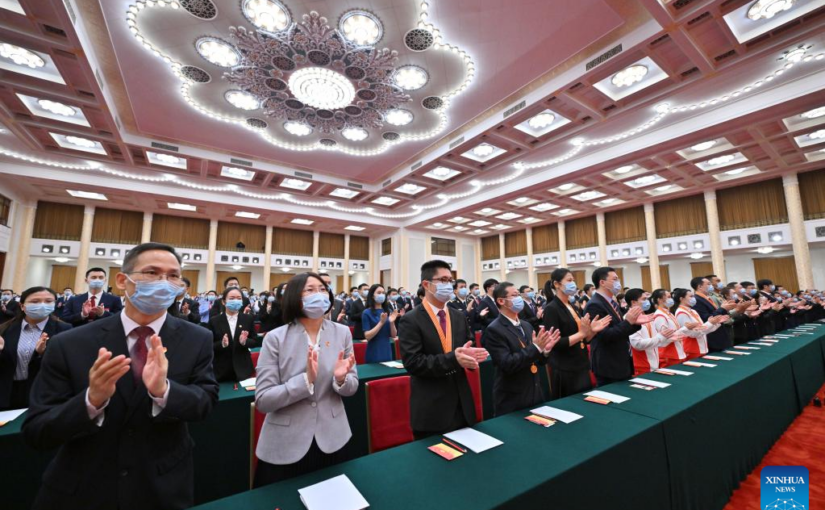
BEIJING, Oct. 9 (Xinhua) — A national meeting on the work of public communication and culture was held in Beijing on Saturday and Sunday. The most important outcome of the meeting is that, for the first time, Xi Jinping Thought on Culture was put forward.

An instruction by President Xi Jinping, also general secretary of the Communist Party of China (CPC) Central Committee and chairman of the Central Military Commission, was conveyed at the meeting.

In the instruction, he stressed building stronger cultural confidence, following the approach of openness and inclusiveness, and upholding fundamental principles while breaking new ground to provide a strong ideological guarantee, spiritual strength and favorable cultural conditions for building a modern socialist country in all respects and advancing the great rejuvenation of the Chinese nation on all fronts.

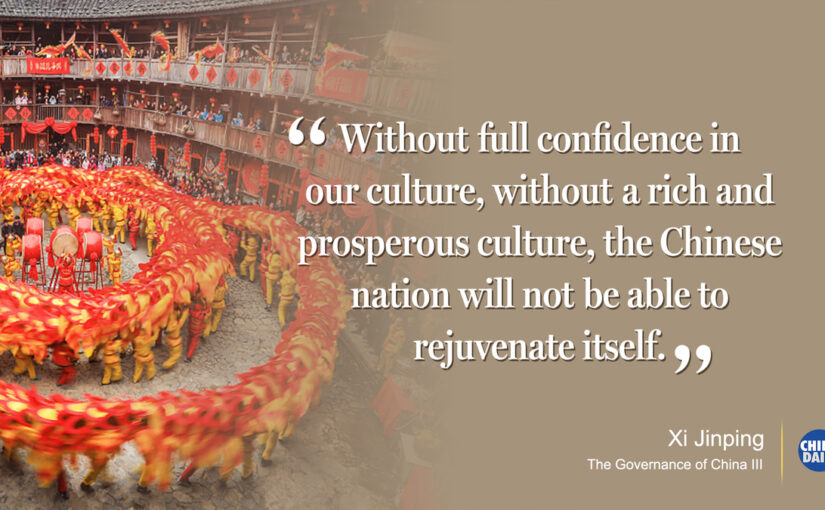
Culture plays a vital role in inspiring national spirit, maintaining national identity, and promoting economic and social development and well-rounded personal development.

Since the 18th National Congress of the CPC in 2012, Xi has placed the work of public communication and culture in a prominent position, giving instructions and guidance in art, journalism, philosophy and social sciences, and culture, among others.

Xi introduced the concept of confidence in culture. He incorporated the core socialist values into the basic policy underpinning the endeavor to uphold and develop socialism with Chinese characteristics in the new era.

He also set clear tasks for public communication and culture: to uphold socialism with Chinese characteristics, rally public support, cultivate generations of young people with sound values and ethics, develop Chinese culture, and better present China to the world.

The new ideas and judgments about cultural development in the new era put forward by Xi are the crystallization of cultural development under the Party’s leadership. They have enriched and developed Marxist cultural theories and formed Xi Jinping Thought on Culture.

Continue reading Xi Jinping stresses the importance of culture in building a modern socialist society
British Museum must return Chinese cultural relics

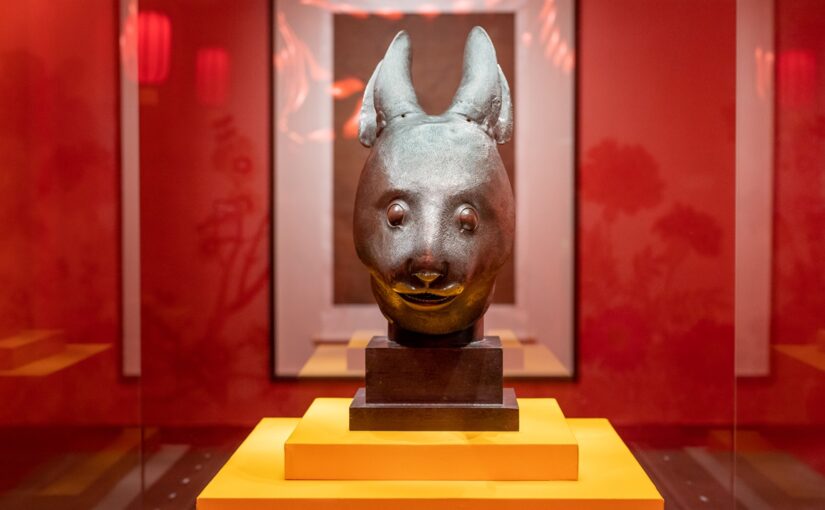
In the two articles we reproduce below – the first an editorial followed by a news item – the influential Chinese newspaper Global Times responds to the recent news that some 2,000 artifacts have been found to be missing, believed stolen, from the British Museum, to demand the return of treasures, artifacts and cultural icons to China and other countries that were once the victims of colonial pillage by British imperialism. The paper estimates that the museum holds 23,000 cultural relics from China.

In its editorial, Global Times states: “We formally request the British Museum to return all Chinese cultural relics acquired through improper channels,” adding, “We also support the claims for the restitution of cultural relics made by other countries that have been looted by Britain, such as India, Nigeria and South Africa. We urge the British government to cooperate in the legal and other procedures to facilitate the process, which will be a test and verification of Britain’s sincerity in clearing the colonial stain and making amends for its historical sins.”

According to Global Times:

“The vast majority of the British Museum’s huge collection of up to 8 million items came from countries other than the UK, and a significant portion of it was acquired through improper channels, even dirty and sinful means. As a result, the British Museum has earned the name of the world’s largest ‘receiver of stolen goods’.”

Faced with growing demands over the years for the return of looted items by countries from Greece to Nigeria, the British Museum and the British government have fallen back on the frankly racist argument that the countries concerned are, unlike apparently the UK, incapable of taking care of their own property. The revelation of mass theft from the museum’s collections has blown that argument, such as it was, out of the water, and Global Times notes:

“The huge loopholes in the management and security of cultural objects in the British Museum exposed by this scandal have led to the collapse of a long-standing and widely circulated claim that ‘foreign cultural objects are better protected in the British Museum.'”

The editorial notes: “The UK, which has a bloody, ugly, and shameful colonial history, has always had a strong sense of moral superiority over others… We really do not know where their sense of moral superiority comes from.”

It also refers to Greece’s long-running campaign for the return of the so-called ‘Elgin Marbles’:

“Recently, Greece once again called for the return of sculptures taken from the Parthenon Temple by Britain in the past, only to be accused by British politicians of ‘blatant opportunism.’ This once again reveals the ‘traditions’ of imperialism and colonialism.”

In one of several news items recently carried by Global Times on this issue, the paper points out that: “It is estimated that 10 million artifacts were stolen from China from the first Opium War (1840-42) to the War of Resistance against Japanese Aggression (1931-45).”

It also cites Abba Isa Tijani, director general of Nigeria’s National Commission for Museums and Monuments, on his country’s demand for the return of the Benin Bronzes, and Zahi Hawass, Egypt’s former minister of state for antiquities affairs, on his country’s campaign for the return of the Rosetta Stone.

And it notes comments made to the Guardian newspaper by Bell Ribeiro-Addy, the left Labour MP for Streatham in south London, that: “What makes it more awful is that they’ve been so lax about the [suspected] theft of other people’s items that they haven’t even bothered to assess what it is that they have.”

British Museum must return Chinese cultural relics for free

Global Times, 28 August 2023

As a Chinese media, we formally request the British Museum to return all Chinese cultural relics acquired through improper channels to China free of charge, and to refrain from adopting a resistant, protracted and perfunctory attitude. First of all, a public commitment should be made to the world for the return of the relics and this long overdue work should begin as soon as possible. We also support the claims for the restitution of cultural relics made by other countries that have been looted by Britain, such as India, Nigeria and South Africa. We urge the British government to cooperate in the legal and other procedures to facilitate the process, which will be a test and verification of Britain’s sincerity in clearing the colonial stain and making amends for its historical sins.

The recent revelation that some 2,000 artifacts from the British Museum’s collection inexplicably went missing has shocked not only the UK, but also all other countries that have collections in the British Museum. The huge number of missing artifacts, the long duration of the case, and the seriousness of the suspected internal thief have made it impossible to connect it with the British Museum, one of the largest museums in the world. People have questioned why the British police and the museum have delayed releasing photos and detailed descriptions of the stolen artifacts. The failure to release photos may indicate that the British Museum still has not been able to find out exactly how much of its vast collection has been lost, probably more than 2,000 pieces.

Continue reading British Museum must return Chinese cultural relics

Xi Jinping’s speech marking the centenary of the Communist Youth League of China 

We are very pleased to publish the full text of the speech given on May 10th 2022 by President Xi Jinping marking the 100th anniversary of the founding of the Communist Youth League of China.

In his comprehensive exposition, President Xi outlines how the youth have always stood in the forefront of the struggles and striving of the Chinese people and nation. The May Fourth Movement of the youth and students in 1919, “promoted the spread of Marxism in China, ushered in the new-democratic revolution, and marked the beginning of the youth’s role as the pioneers advancing social changes in China… As Marxism-Leninism was becoming closely integrated with the Chinese workers’ movement, the Communist Party of China was born. Since the day of its founding, the Party has paid particular attention to the youth and placed the hopes of revolution on them.”

He further outlined the indispensable role of the Communist Youth League and young people generally in the periods of the new-democratic revolution, socialist revolution and construction, reform, opening up and socialist modernisation, and the new era of socialism with Chinese characteristics.

“Inspired by ideals and convictions,” Xi pointed out, “the Communist Youth League has organised and united young people with firm belief and scientific thinking. The first national congress of the League defined building a communist society as its ultimate ideal and made clear its banner of socialism, which has lit the beacon of ideals and convictions among generations of young people. This is the most fundamental and enduring cohesion of the League. History tells us that only by holding high the banner of communism and socialism, can the Communist Youth League form the most solid unity, forge the most effective organisation, and ensure that the youth are united under the banner of the Party’s ideals and convictions.”

Expressing the hope that the League would continue to play its vanguard role, President Xi noted that: “Young people are the most vigorous, enterprising, and least conservative group in society, who possess infinite power to improve the objective world and promote social progress,” adding:

“Revolutionaries are always young. Today, a hundred years on from its founding, the Communist Party of China is still in its prime, and remains as determined as ever to achieve lasting greatness for the Chinese nation. Quoting from Engels, Lenin once said, ‘We are the party of the future, and the future belongs to the youth. We are a party of innovators, and it is always the youth that most eagerly follows the innovators. We are a party that is waging a self-sacrificing struggle against the old rottenness, and youth is always the first to undertake a self-sacrificing struggle.’ Both history and reality have shown that the Communist Party of China is a party that always preserves its youthful features and a party that is worthy of the young people’s trust and worth following.”

Party organisations, the Chinese President said, “must attach great importance to the training and recruitment of outstanding young people and should particularly focus on cultivating and admitting outstanding League members into the Party, so as to ensure our socialist country never changes its nature.”

Members of the Communist Youth League of China (League), young friends, and comrades,

Youth gives rise to infinite hope, and young people are the creators of a bright future. A nation can thrive and prosper only when it places hopes on its youth and maintains its youthful vigor.

Today, we are gathered here at the ceremony marking the centenary of the Communist Youth League of China to encourage League members and young people to forge ahead on the new journey toward realizing the Chinese Dream of national rejuvenation.

Continue reading Xi Jinping’s speech marking the centenary of the Communist Youth League of China 

Film review: The Battle at Lake Changjin

The following review was written by Friends of Socialist China co-editor Keith Bennett.

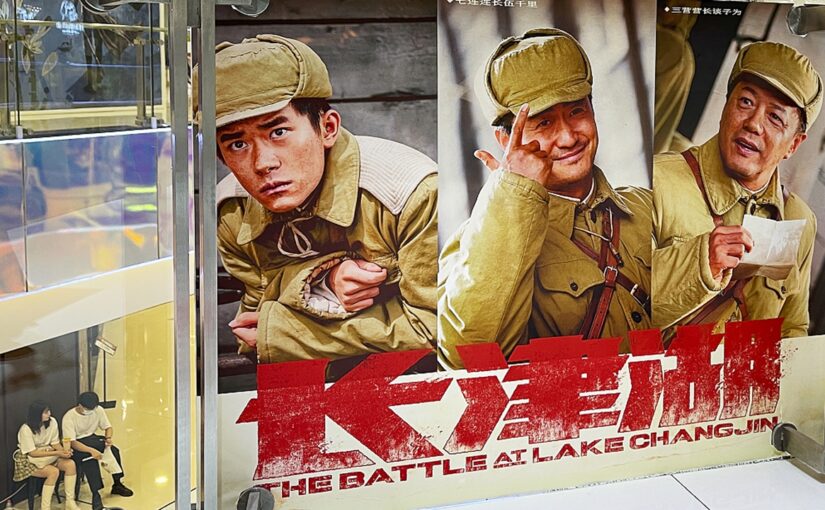
The Battle at Lake Changjin, directed by Chen Kaige, Tsui Hark and Dante Lam, premiered at the Beijing International Film Festival on 21 September 2021 and was released in China on 30 September. As part of its international distribution, it has been showing at selected cinemas in Britain, Ireland, the USA and Canada since 19 November and in Australia since 2 December. With a budget of some US$200 million, it is the most expensive Chinese film ever made. However, the acclaim with which it has been received has also made it the highest grossing film of 2021, the highest grossing film in Chinese history and the highest grossing non-English language film.

At just two minutes under three hours in length, the film is a revolutionary epic, with the main action centred around the Changjin Lake area of the Democratic People’s Republic of Korea (DPRK) in the bitterly cold winter of 1950, shortly after the Chinese People’s Volunteer Army (CPVA) had entered the War to Resist US Aggression and Aid Korea. Confronted with the harshest natural and climatic conditions, forced to survive on starvation rations, and faced with an enemy that was better trained, better equipped, better fed, better armed and with complete mastery of the skies, the Chinese troops “fearing neither hardship nor death”, to use the well-known Chinese expression, continue to forge ahead in the most courageous and ingenious of ways. Armed with the element of surprise, and although making the ultimate sacrifice, by successfully blowing up the Shuimen Bridge, they score the most decisive victory ultimately ensuring the achievement of China’s objectives in the war.

Continue reading Film review: The Battle at Lake Changjin

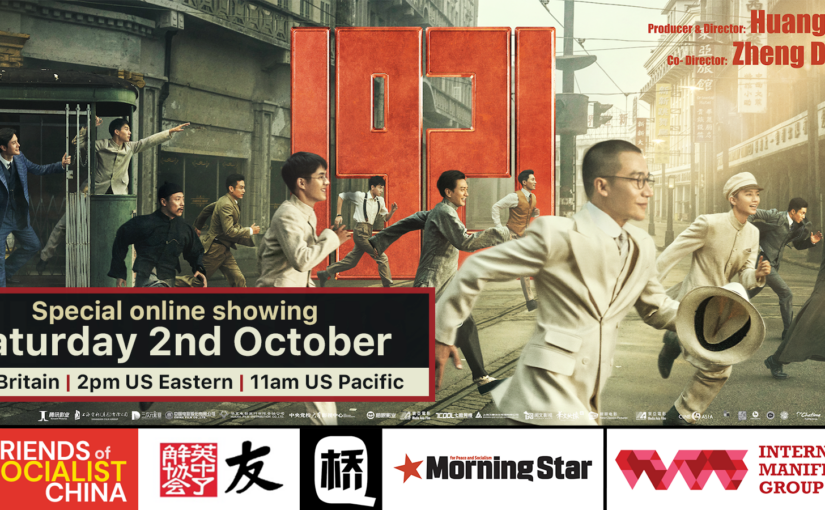
Reminder: Special online showing of ‘1921’ (2 October)

Friends of Socialist China are pleased to offer a rare opportunity to watch the film 1921.

  • Date: Saturday 2 October 2021
  • Time: 7pm Britain / 2pm US Eastern / 11am US Pacific
  • Registration: Eventbrite

About ‘1921’

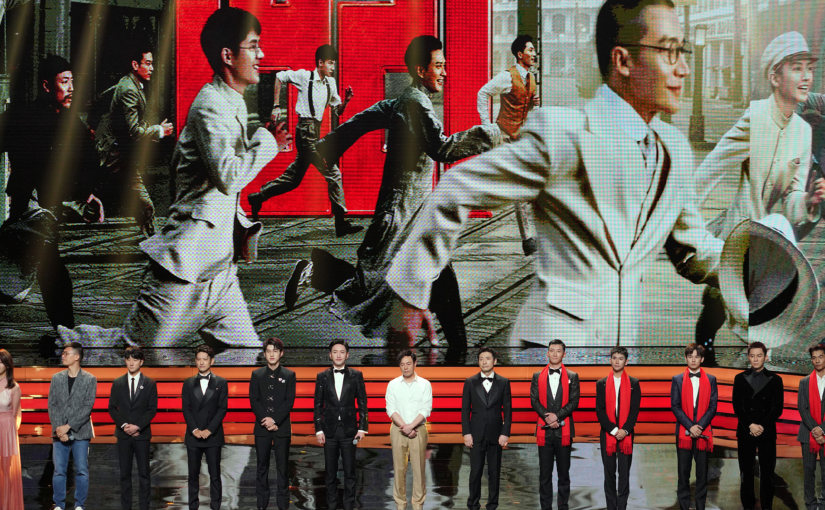
‘1921’ is a full length feature film produced to mark this year’s centenary of the Communist Party of China. It is set against the background of the intense class struggle waged by the young Chinese working class in Shanghai in particular. The action also takes us to Moscow, Paris and elsewhere. Key early Chinese communists like Li Dazhao, Chen Duxiu, Mao Zedong and Deng Xiaoping all feature in this not to be missed film. As gripping as any Hollywood blockbuster, it is also an education and an inspiration.

A review by Friends of Socialist China co-editor Keith Bennett can be read online.

Please note the film is in Mandarin Chinese with English subtitles.

Who is organising the screening?

This event is organised by Friends of Socialist China, in coordination with Trinity Cine Asia. It is co-sponsored by the Society for Anglo-Chinese Understanding, the Morning Star, the Geopolitical Economy Research Group, the International Manifesto Group, and Qiao Collective.

How does the online screening work?

At the start time (7pm Britain, 2pm US Eastern, 11am US Pacific), registered users will receive (by email) a link to stream the film. They will then have a three-hour window in which to watch it.

Why are we charging for this event?

Please note that Friends of Socialist China are not making any money from the showing; our purpose in arranging it is to ensure that its important political and cultural content reaches a wider audience. However, Trinity Cine Asia, with whom we are partnering to organise the screening, have paid the costs of distribution and marketing; therefore all proceeds go to them.

Film review: 1921 – A vivid panorama of revolution

Review written by Friends of Socialist China co-editor Keith Bennett


The 100th anniversary of the founding of the Communist Party of China has been the occasion for many grand and impressive events throughout July. 1921, which has also been playing in selected cinemas in Britain and Ireland, and doubtless elsewhere, is the film for the centenary.

A feature film, with special effects worthy of any Hollywood blockbuster, it also features some documentary footage, skilfully heightening the sense of both drama and realism.

Whilst 1921 is focused on that momentous year, it deploys flashbacks as far as the 1850s, showing China’s degradation to a semi-colonial and semi-feudal ruined nation and then at its conclusion a potted but vivid historical reconstruction of subsequent years, which culminates in Chairman Mao proclaiming the founding of the People’s Republic on October 1st 1949, as well as Young Pioneers visiting the restored site of the first party congress 100 years later.

A similar historical technique is deployed to depict aspects of some of the key characters, including such pioneering Chinese communists as Li Dazhao, Chen Duxiu, Li Da and, of course, Mao Zedong. Particularly moving is the depiction of the tragic and heroic fates of some of the key early martyrs of Chinese communism, including Yang Kaihui, Mao’s first wife and great love. This provides a raw and poignant contrast to the youthful idealism, frenetic activity and infectious optimism of many of the key characters as they throw themselves into the preparations for the founding of the party whilst simultaneously immersing themselves in the surging movement of the young but extremely militant Chinese working class along with the youth and students. Shanghai, in particular, where the party was founded, is accurately depicted as a playground for wealthy Chinese and above all for foreign overlords, but as a living hell for the masses of Chinese people.

Continue reading Film review: 1921 – A vivid panorama of revolution