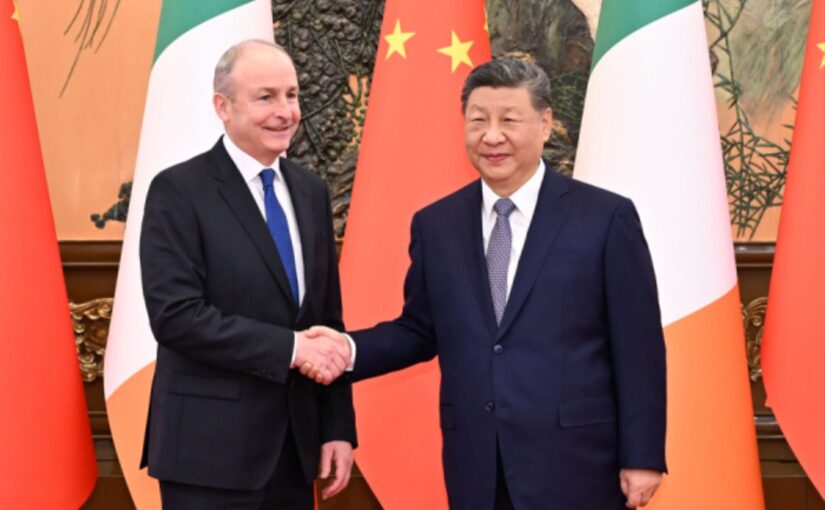
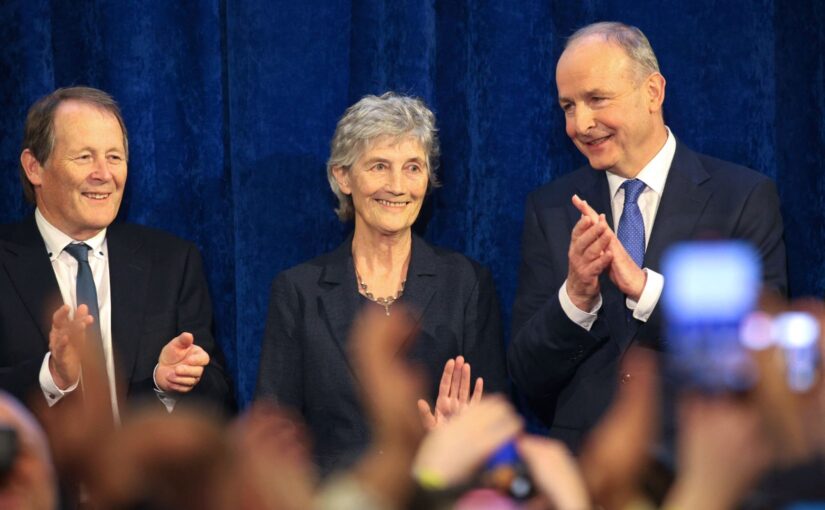
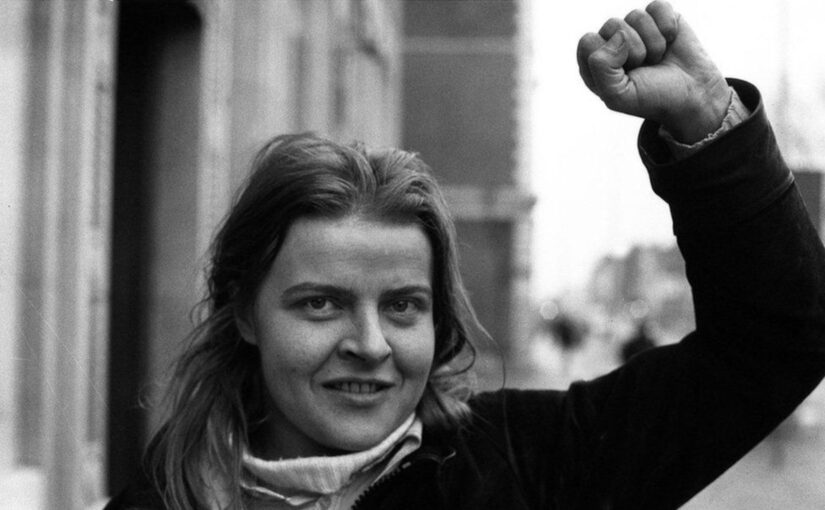
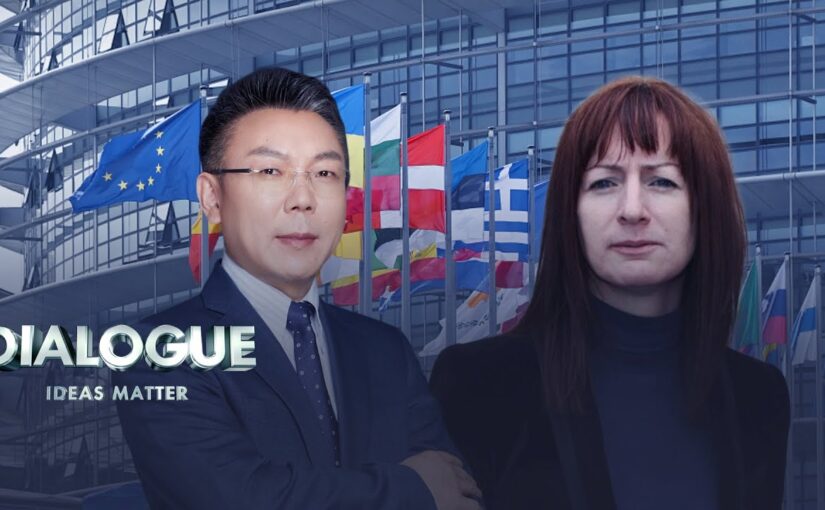
Xi Jinping greets Ireland’s new left-wing President

Catherine Connolly was sworn in as the tenth president (and the third woman president) of the Republic of Ireland on November 11, succeeding Michael D. Higgins, who had completed the constitutionally mandated limit of two terms of office.

Chinese President Xi Jinping sent a congratulatory message to his Irish counterpart on her assumption of office and noted that over the past 46 years since the establishment of diplomatic ties between China and Ireland, the two countries have jointly achieved remarkable development progress through mutual learning and friendly cooperation.

Xi said that he attaches great importance to the development of China-Ireland relations and stands ready to work with Connolly to enhance political mutual trust, carry forward the traditional friendship, jointly support multilateralism and free trade and promote the continuous development of the China-Ireland mutually beneficial strategic partnership to better benefit the two peoples.

Catherine Connolly, an Independent TD (member of the Irish parliament) since 2016, won a landslide victory, taking 63 percent of the vote. Key to her victory was an unprecedented unity among broad sections of the Irish left, something that is already being seen as a template for, and harbinger of, a future left government in Ireland, as well as holding important lessons for the left in Europe and elsewhere.

Seven parties represented in the Irish parliament united to back her campaign, namely Sinn Féin, the Irish Labour Party, the Social Democrats, People Before Profit, 100% Redress, Solidarity, and the Green Party. (Incidentally the first three named parties backing the election of Ireland’s third woman president are also currently led by women.)  They were joined by a number of left and progressive independents (many of whom play significant roles in Irish politics), as well as cultural and other personalities, including Kneecap and (from a previous generation and from Connolly’s own County Galway) the Saw Doctors. A number of smaller left and republican parties, including the Communist Party of Ireland, Éirígí – For A New Republic, the Workers’ Party of Ireland and the Socialist Party of Ireland, also expressed support for her campaign.

Connolly stood on a clear anti-imperialist and pro-working-class platform, which included:

  • Defence of Irish neutrality;
  • Opposition to imperialist war, the militarisation of the European Union and German rearmament;
  • Opposition to the Gaza genocide and clear support for Palestinian self-determination and a Free Palestine;
  • Support for Irish reunification and an end to partition as an inevitable trend;
  • Promotion of the Irish language;
  • Opposition to racism; and
  • Urgent measures to tackle the housing crisis, which is one of the most acute problems currently faced by working people in Ireland.

Her campaign made astute use of social media and won wide support from young people, including through highlighting the 68-year-old’s sporting prowess.

Speaking at her inauguration, President Connolly said:

“The people have spoken and have given their President a powerful mandate to articulate their vision for a new Republic.

“A Republic worthy of its name where everyone is valued and diversity is cherished, where sustainable solutions are urgently implemented and where a home is a fundamental human right.

“The change that led to this joyful day began with a small group of elected representatives and volunteers facing what appeared to be insurmountable challenges.

“We were led to believe that it was too great a leap, that our ideas were too far out, too left, at odds with the prevailing narrative.

“In shared conversations all over the country, however, it became evident that the dominant narrative did not reflect or represent people’s values and concerns… We saw the emergence of hope, we saw the emergence of joy, along with the courage and determination of people to use their voices to shape a country that we can be proud of.”

Continue reading Xi Jinping greets Ireland’s new left-wing President

When a death in Brixton united the Irish and Chinese revolutions

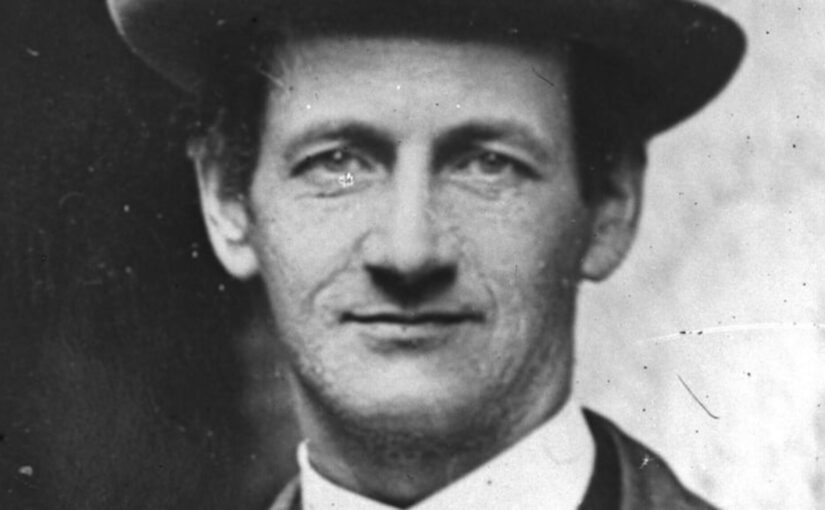
On Sunday 26 October, the Irish community in London, together with friends, gathered outside Brixton Prison for the annual Terence MacSwiney Commemoration. This year’s gathering marked 105 years since the death of the Lord Mayor of Cork, after 74 days on hunger-strike, and was once again organised by the Terence MacSwiney Committee [London].

Committee Chair Frank Glynn welcomed the approximately 60 people gathered outside the south London prison. The day’s keynote speaker was Thomas Gould, Sinn Féin TD (member of the Irish parliament) for Cork North-Central, who delivered a powerful address that appealed to the solidarity and internationalism of those living in London to support the campaign to build a new and united Ireland.

Drawing inspiration from the example of Terence MacSwiney, Gould extended solidarity to the suffering people of Palestine amidst the ongoing occupation of their land and Israel’s genocidal war. He appealed for class unity at this time, noting that the establishment and those in power are desperately seeking to turn poor people against one another. He equally paid tribute to those Irishmen and women who were forced to leave their country over the past decades, assuring them that their sacrifice is not forgotten back home.

The commemoration also heard from Pat Reynolds of the Irish in Britain Representation Group (IBRG); Pam Blakelock, who spoke about her husband’s descendance from Muriel MacSwiney (Terence MacSwiney’s widow); and the Palestinian activist, Samar Maquishi, who spoke about the unwavering support of the Irish people for the cause of Palestine. As Samar observed, “Even if the whole world was quiet, the Irish won’t be silenced!”

Longstanding London-based Irish republican Denis Grace read the Proclamation of Easter Week 1916 on behalf of the Commemoration Committee. Music was provided by the stalwart London-Irish balladeer Seán Brady and Achill Island’s own Tom Lynch on the Uilleann Pipes. Special mention was also made of the election of Catherine Connolly as the next President of Ireland. There was overwhelming support expressed for Ms Connolly, whose campaign was supported by a broad range of left-wing and progressive forces in Ireland, particularly as a candidate who placed voting rights for Irish citizens outside of the twenty-six-county state and the ongoing struggle for Irish reunification at the centre of her election platform.

(The above is an edited version of the press statement issued by the Terence MacSwiney Committee [London].)

McSwiney’s 1920 death on hunger strike, during the 1919-1921 Irish war of independence, had a profound international impact, including on such leaders of the Indian freedom movement as Jawaharlal Nehru and Mahatma Gandhi. A young Ho Chi Minh, who was working in London at the time, was profoundly moved, saying: “He died for his country. How courageous! How heroic ! A nation which has such citizens will never surrender.”

But whilst Ho Chi Minh could see for himself the very public outpouring of grief on the part of London’s Irish community, another young progressive, who was later to become an important Asian communist leader, was following the news from Japan, where he was studying at the time.

That student was Guo Moro, who was to become a senior leader of the People’s Republic of China and a close comrade of Mao Zedong. He served as Chairman of both the Chinese Academy of Sciences and the China Federation of Literary and Art Circles from their inception after liberation in 1949 to his death in 1978.

In a 2020 article written for Raidió Teilifís Éireann (RTÉ, the Irish broadcasting service), Francis Kane, a lecturer at Ulster University, explains:

“In 1920, China was in chaos, a divided country dominated by foreigners and warlords, its ancient empire having finally collapsed in 1911. In his idealistic youth, the poet Guo Moruo cannot have known that one day he would become a man of enormous power and prestige… He died not long after his comrade and friend Chairman Mao, whom he praised relentlessly.”

Kane writes that Guo penned “an astonishing poem, an emotional ‘in real time’ commemoration of fellow writer MacSwiney in 1920, usually translated as ‘Victorious in Death’.”

Continue reading When a death in Brixton united the Irish and Chinese revolutions

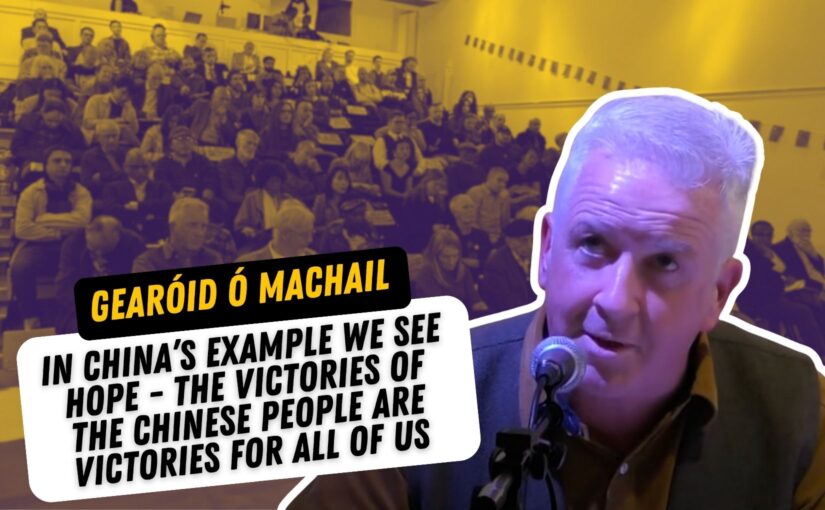
In China’s example we see hope – the victories of the Chinese people are victories for all of us

The following is the text of the speech delivered by Gearóid Ó Machail, Member of the National Executive Committee of the Communist Party of Ireland (CPI), to the closing rally of our China Conference 2025, held on Saturday September 27.

Gearóid’s talk touches on a number of important topics, including the importance of the fraternal relations between the CPI and the Communist Party of China (CPC), the Irish and Chinese struggles against imperialism, and the importance of people-to-people ties.

Comrades and friends,

Ar dtús báire ba mhaith liom a rá gur mór an onóir dom labhairt libh inniu ag an chruinniú tábhachtach seo atá á óstáil ag Cairde na Síne Sóisialaí. Cuirim beannachtaí réabhlóideacha ó chroí ó Pháirtí Cumannach na hÉireann agus cuirim ár ndlúthpháirtíocht in iúl le muintir na Síne agus le Páirtí Cumannach na Síne.

I begin my speech today with some words in my native language not least in honour of Kneecap and their tremendous victory this week.

It is a great honour to address you today at this important gathering of esteemed company hosted by my dear comrades in Friends of Socialist China. I bring warm revolutionary greetings from the Communist Party of Ireland and express our deep solidarity with the People’s Republic of China, with the Chinese people, with the Communist Party of China and with all Friends of Socialist China.

The Communist Party of Ireland deeply values its fraternal relations with the Communist Party of China. These ties are not transactional – they are built on mutual respect, shared ideological foundations, and a commitment to building socialism in our respective contexts. Over the 46 years since the establishment of diplomatic relations, China and Ireland have deepened exchanges and cooperation across politics, economy, science and technology, and culture, bringing tangible benefits to both peoples.

We meet here at a time when the achievements of Chinese socialism are not only undeniable but are increasingly vital to the future of human civilisation and the survival of our delicate, global eco-system. From lifting hundreds of millions of people out of poverty to leading the world in green development and technological innovation, China stands as a beacon of what is possible when a proud and resilient people chart their own course, guided by socialist principles and a commitment to national sovereignty.

Continue reading In China’s example we see hope – the victories of the Chinese people are victories for all of us

Chinese Ambassador recalls Galway Bishop’s wartime support for China

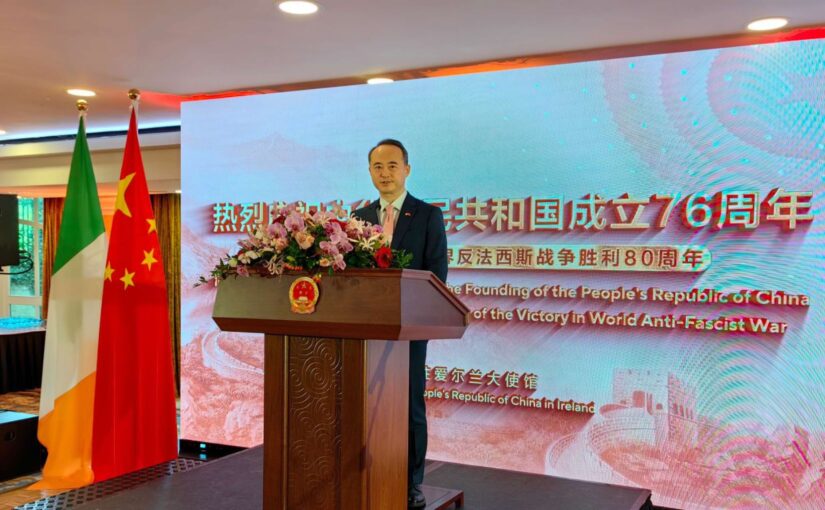
On September 22, the Chinese Embassy in Ireland hosted a reception to celebrate the 76th anniversary of the founding of the People’s Republic of China, and to commemorate the 80th anniversary of the victory of the Chinese People’s War of Resistance Against Japanese Aggression and the World Anti-Fascist War. Chinese Ambassador Zhao Xiyuan and Ceann Comhairle [Speaker of Dáil Éireann, the lower house of the Irish parliament] Verona Murphy delivered speeches.

In his speech, Ambassador Zhao Xiyuan said: “Over the past 76 years, under the strong leadership of the Communist Party of China, the Chinese people have forged ahead with determination, continuously advancing Chinese modernisation. These 76 years have also seen China making increasingly significant contributions to world peace, global development, and the progress of humanity. China has historically eradicated absolute poverty, lifting over 800 million people out of destitution and achieving the UN 2030 Agenda for Sustainable Development’s poverty reduction goal a full decade ahead of schedule, contributing more than 70% to global poverty alleviation. Since the launch of the Belt and Road Initiative, over 40 million people in developing countries have been lifted out of poverty.”

He added that: “While celebrating these achievements, China will never forget its journey. Eighty years ago, China was a war-torn and impoverished nation just extricating itself from foreign aggression. China had borne 35 million casualties, accounting for one third of total lost lives in the Second World War. The Western front of the Second World War is often marked by Nazi Germany’s invasion of Poland in 1939. Yet even earlier, on September 18, 1931, the Chinese people fired the first shot of resistance against Japanese aggression in Northeast China, marking the beginning of the Eastern front. China’s War of Resistance Against Japanese Aggression was the earliest, longest, and most costly campaign of the global Anti-Fascist War. China’s victory on the Eastern front prevented Japanese militarism from joining forces with European fascists, making a vital contribution to the final victory of the Second World War.

“China, though ravaged by war, was never isolated. Doctors, journalists, merchants, and artists from around the world came to China, transforming scalpels, typewriters, and cameras into instruments of rescue. Chinese people will always remember Father Patrick Maurice Connaughton, an Irish bishop born in Galway, who actively raised funds for Chinese people during the war, provided relief to displaced civilians, and supported the education of children amid the devastation of war.”

He also said that: “Over the 46 years since the establishment of diplomatic relations, China and Ireland have deepened exchanges and cooperation across politics, economy, science and technology, and culture, bringing tangible benefits to both peoples. China appreciates Ireland’s commitment to the one-China policy and is ready to work together to implement the consensus reached by the two state leaders, strengthen high-level mutual trust, deepen high-quality cooperation, and advance our Strategic Partnership of Mutual Benefit, jointly contributing to a more peaceful, stable, and prosperous future.

Continue reading Chinese Ambassador recalls Galway Bishop’s wartime support for China

Chinese Consulate marks a decade of building friendship with Northern Ireland

On July 21, China’s Consul General in Belfast, Northern Ireland, Li Nan published a signed article entitled ‘A Fruitful Decade Marks a New Phase of China-NI Relationship’ in the Irish News newspaper, celebrating the consulate’s 10th anniversary.

Li Nan acknowledges the important role played by the late senior Sinn Féin leader Martin McGuinness in the establishment of the consulate:

“Ten years ago, Chinese Foreign Minister Wang Yi visited Northern Ireland and together with then Deputy Minister Martin McGuinness and Finance Minister Arlene Foster, witnessed the inauguration of the Chinese Consulate General in Belfast… Since then, the relationship between China and Northern Ireland has entered a new chapter.

“Over the past decade, from sincere mutual trust and pragmatic cooperation to strong people-to-people exchanges, the Consulate General has worked hand in hand with all sectors of NI society to continuously elevate local exchanges and cooperation.”

Updating the story, Li Nan writes: “In recent years, H.E. Zheng Zeguang, the Chinese Ambassador to the UK, has visited Northern Ireland twice, meeting with the First Minister, the Deputy First Minister, the Speaker of the Assembly, and representatives from various sectors. He also attended China–UK/NI forums on new energy and education in 2023 and 2024 respectively, promoting the deepening of practical bilateral cooperation. In 2024, H.E. Qibatu, Vice Chairman of the Inner Mongolia Autonomous Region, visited Northern Ireland to explore opportunities for expanding agricultural cooperation. In 2025, H.E. Wu Yan, Vice Minister of Education of China, led a delegation to Northern Ireland and held in-depth discussions on enhancing high-level educational cooperation.”

Northern Ireland has established sister-province relations with Hubei and Liaoning, along with seven sister-city relations, including those between Belfast and Shenyang, Derry/Londonderry and Dalian, and Fermanagh and Huangshi.

On the economic front, China is Northern Ireland’s second-largest import market and its 12th-largest export market. Bilateral trade has reached and stabilised at around £1 billion for several consecutive years, demonstrating strong resilience and vitality.

“Well-known companies, including Lakeland Dairies, Cranswick Country Foods Ballymena, Old Bushmills Distillery, and Mallaghan Engineering Ltd, have maintained close ties with the Chinese market, with their exports continuing to grow steadily. Chinese brand BYD’s electric vehicles can now be seen on the streets of Northern Ireland, while specialty products from Northern Ireland, like whiskey, pork, and dairy products are making their way onto Chinese dining tables.”

Continue reading Chinese Consulate marks a decade of building friendship with Northern Ireland

Strengthening ties between Irish and Chinese Marxists

A delegation from the Academy of Marxism of the Chinese Academy of Social Sciences recently visited Ireland as part of a European tour that also took them to Britain and Portugal.

In the following article, Gearóid Ó Machail outlines the delegation’s program in Ireland. Gearóid is a member of the National Executive Committee of the Communist Party of Ireland (CPI) as well as of the Advisory Group of Friends of Socialist China.

We previously published a report of the delegation’s time in London. While in Britain, they also visited Cambridge and Manchester.

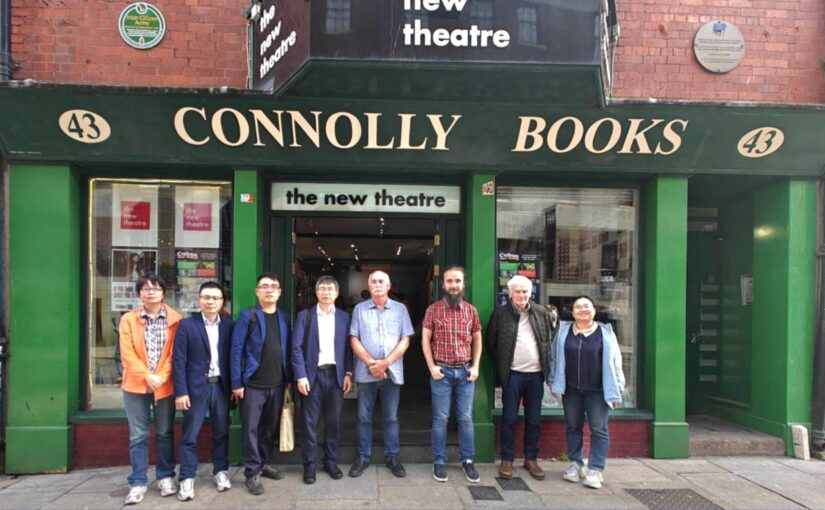
The Communist Party of Ireland (CPI) recently welcomed a visiting delegation from the Institute of Marxism at the Chinese Academy of Social Sciences (CASS) to Dublin for a series of bilateral engagements and discussions.

The Chinese delegation arrived on the afternoon of Friday July 18 and began their program with discussions at their country’s Dublin embassy.

The next day they engaged with a group of Marxist academics at Trinity College Dublin (TCD). This dialogue brought together academics from three Dublin universities and was facilitated by Assistant Professor Harun Šiljak of the CPI. The Irish delegation also included Emeritus Professor at Dublin City University Helena Sheehan who has recently returned from a teaching post at Peking University.

The Irish hosts engaged with the Chinese comrades to discuss Irish academia and Marxism, perspectives on Chinese modernisation, ecology, the contradictions of capitalism, ‘Socialism with Chinese Characteristics’ and other topics.

The visiting delegation comprised researchers and professors from the Institute of Marxism at the Chinese Academy of Social Sciences (CASS) – a research institution established by the Communist Party of China (CPC) in 2005.

Comrade Professor Chen Zhigang, Vice President of the Institute, led the discussion from the Chinese side, offering valuable insights into the workings of the CPC and its role in China’s development. He addressed the challenges facing rural development in China and elaborated on the concept of socialism with Chinese characteristics, the guiding principles of Xi Jinping Thought and its fundamental opposition to the Western model of globalisation and imperialist agendas. Professor Chen advocated for a model of inclusive globalisation that benefits all nations.

Throughout the discussion, he also reiterated China’s commitment to building an ecological civilisation grounded in world peace and inclusive development.

Comrade Han Dongjun translated Professor Chen’s remarks, while comrades Liu Yan, Fang Tao, and Zhuo Mingliang highlighted various achievements of China under the leadership of the CPC.

Following their meeting with the academics on Saturday morning, the CASS representatives had a bilateral meeting with leading representatives from the Communist Party of Ireland at their Party premises in Temple Bar, Dublin.

Former General Secretary of the CPI and member of the National Executive Committee of the party, Comrade Eugene McCartan was accompanied by Comrade Tommy McKearney of the Betty Sinclair Branch and Dublin Branch Secretary Comrade Harun Šiljak. Both delegations exchanged political experiences and views.

The CPI outlined its class-based, anti-imperialist approach to key political questions. Discussions focussed on ending British rule in Ireland, the defence of Irish neutrality and opposition to the growing threat posed by increased EU militarisation.

The CPI comrades highlighted their strategy to break the “Triple Lock of Imperialism” -the financial, diplomatic and military controls and instruments deployed by the USA, the EU and Britain aimed at restricting and undermining the political and economic sovereignty and destiny of the Irish people.

They also outlined to the visiting Chinese delegation how the Irish nation’s interests are currently subordinated to the needs of imperialism as a result of the political and economic subservience arising from the class interests of the comprador Irish ruling class.

Professor Chen Zhigang provided a detailed presentation on the development of Chinese Marxism, stating that it’s because of Marxism that China has been able to achieve remarkable successes. Comrade Chen discussed the meaning and relevance of Xi Jinping Thought, as the latest development of Marxism in China; a Marxism adapted to the conditions prevailing in the 21st century and the array of new challenges that present themselves.

He further pointed to what should be a well-understood and obvious truth: that as society develops, theory must develop along with it. “If Marxism does not evolve, its vitality will be limited.” He also noted that Socialism with Chinese Characteristics has developed and thrived by combining Marxist ideas with Chinese culture and traditions, hence Chinese people do not think of Marxism as a foreign phenomenon.

Regarding the global applicability of Xi Jinping Thought, Comrade Chen said that China seeks to offer Chinese wisdom towards the solution of problems of global governance. The concept of a Global Community of Shared Future, the Belt and Road Initiative, the Global Development Initiative, the Global Civilisation Initiative and the Global Security Initiative are all based on the principles of mutual learning, exchanges and dialogue, and all seek to promote peace, sustainability, development, cooperation and friendship.

The meeting provided another opportunity to consolidate and strengthen the bonds of friendship between Irish and Chinese communists.

China’s development demonstrates that there is a viable alternative to capitalism and imperialism, and their hegemonic control over people and the planet. Yet, imperialist powers and their capitalist regimes remain determined and are working actively every day to try to undermine China, its people, and their revolutionary achievements.

The comrades from Ireland and China reaffirmed their belief in Marxism’s potential to offer a genuine alternative to capitalism and its warmongering, imperialist hegemony, which undermines peace and disempowers people across the globe. A better world is possible.

Sports and culture promote Ireland-China people’s friendship

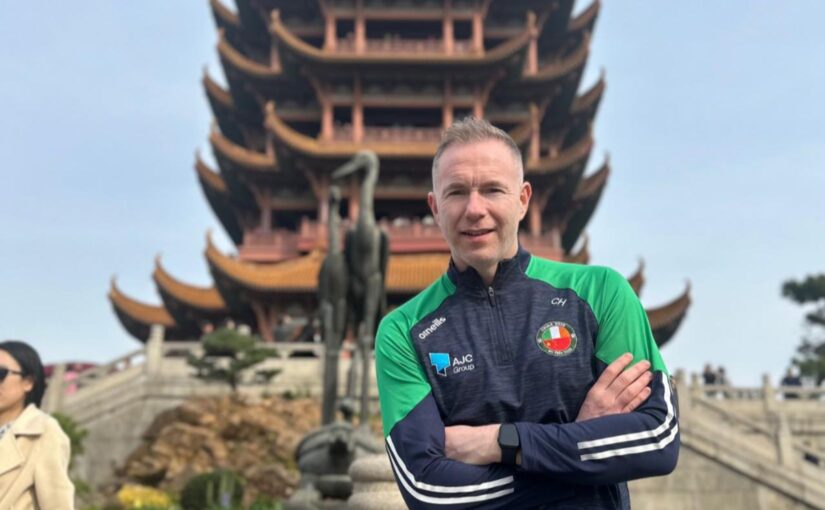
We previously reported the visit to China in March by members of two Gaelic Athletic Association (GAA) clubs in the north of Ireland,  St Johns GAA and Naomh Cholmaín Droím an Easa Drumaness GAC, led by Sinn Féin Member of Parliament for South Down, Chris Hazzard.

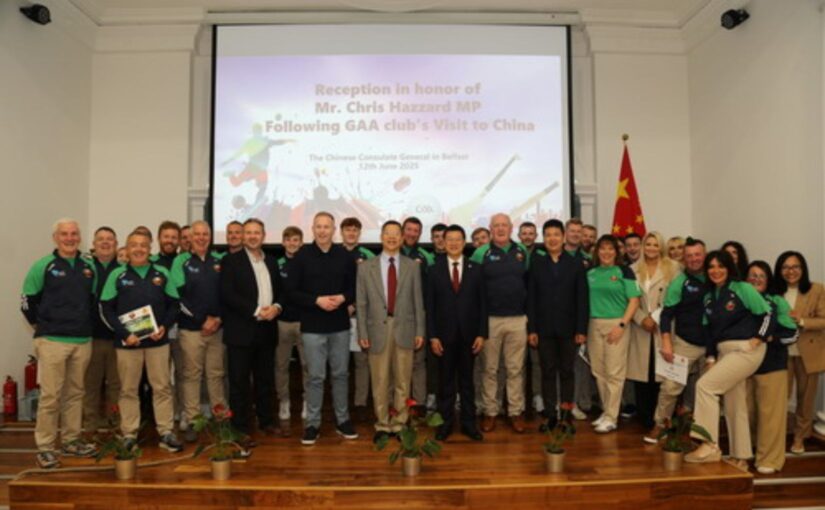
Following this very successful visit, the Chinese Consul General in Belfast, Li Nan organised a friendship gathering with Chris and members of the two clubs on June 12.

Li emphasised that culture and sports help bring people closer and foster mutual understanding. He expressed the hope that club members would actively serve as inheritors of the friendship between China and Northern Ireland, promoters of friendly cooperation, and builders of shared development.

Chris Hazzard shared his experiences from visiting China and expressed his desire to further expand dialogue, cooperation, and exchanges in areas such as culture, education, and sports. Club members also took turns sharing their thoughts and reflections from their time in China.

Meanwhile, on June 16, at the invitation of the James Joyce Centre, Chinese Ambassador to Ireland Zhao Xiyuan attended the Bloomsday celebration at Belvedere College S.J. in Dublin.

Bloomsday is an annual celebration held on June 16 to commemorate James Joyce’s novel Ulysses, which is set on that specific date in 1904. It is named after the novel’s central character, Leopold Bloom. Joyce’s experience studying at the Belvedere College informed much of the writing of the novel.  In 2012, President Xi Jinping, then Vice President of China, visited the Confucius Classroom at Belvedere College.

With the help of the Chinese Embassy in Ireland, the three Chinese versions of Ulysses that have been published, have been donated to the National Library of Ireland, the James Joyce Centre and the Museum of Literature Ireland for their collections.

Ulysses is widely considered to be one of the most complex and difficult works of world literature to translate. Translation into Chinese required many years of devoted effort and painstaking work. This comparative study of the three Chinese versions was published by the James Joyce Society of Korea.

The following articles were originally published on the websites of the Chinese Consulate General in Belfast and the Chinese Embassy in Ireland and are republished here from that of the Chinese Foreign Ministry.

Chinese Consulate General in Belfast Holds GAA Club Visit to China Sharing Session and Consulate General Open Day

June 14 (MFA) — On 12 June, the Chinese Consulate General in Belfast hosted a sharing session following the GAA Club’s visit to China and the Consulate’s Open Day. Consul General Mr. Li Nan attended and delivered a speech. Over 50 guests participated in the event, including Mr. Christopher Hazzard MP; the President and members of Drumaness and St John’s Club; and Professor Yu Xiang, Vice President of Hubei Normal University.

Consul General Li welcomed all guests to the Consulate and highlighted China’s latest achievements in economic and social development. He noted that Chinese-style modernization is progressing steadily, and a prosperous, open, and friendly China is creating new opportunities for the world. Mr. Li emphasized that culture and sports help bring people closer and foster mutual understanding. He expressed hope that club members would actively serve as inheritors of the friendship between China and Northern Ireland, promoters of friendly cooperation, and builders of shared development.

Mr. Hazzard shared his experiences from visiting China and expressed his desire to further expand dialogue, cooperation, and exchanges in areas such as culture, education, and sports. Club members also took turns sharing their thoughts and reflections from their time in China. The atmosphere was warm and engaging.


Chinese Ambassador to Ireland Zhao Xiyuan Attends the Bloomsday Celebration

June 18 (MFA) — On June 16th, at the invitation of the James Joyce Centre, Ambassador Zhao Xiyuan and Madam Li Yi, together with ambassadors from other countries to Ireland and officials from Dublin, attended the Bloomsday celebration at Belvedere College S.J. in Dublin.

Bloomsday is an annual celebration held on June 16th to commemorate James Joyce’s novel Ulysses, which is set on that specific date in 1904. It is named after the novel’s central character, Leopold Bloom. Joyce’s studying experience at the Belvedere College was applied many times in his writings. In 2012, President Xi Jinping, then Vice President of China, visited the Confucius Classroom at Belvedere College.

Every June 16th, literature lovers hold various festivities in Dublin, Ireland, and elsewhere including China, through readings, performances, and re-enactments of scenes from the book, often with participants dressed in Edwardian attire. With the coordination of the Embassy of the People’s Republic of China in Ireland, the three Chinese versions of Ulysses that have been published, were donated to the National Library of Ireland, the James Joyce Centre and the Museum of Literature Ireland for collection.

Chris Hazzard MP leads cultural exchange visit to China

Chris Hazzard, the Sinn Féin Member of Parliament for South Down in the north of Ireland, led a delegation from two local Gaelic Athletic Association (GAA) clubs in his constituency to visit China in March.

Local newspaper The Down Recorder said it was “a cultural exchange visit which has been described as ‘an experience they will cherish forever’”, adding: “Members of Drumaness GAC and St John’s GAC are now back home following a very special St Patrick’s [Day] cultural exchange visit to the Far East.”

The delegation included 30 players, coaches and officials from the two clubs and Hazzard, who is also a Drumaness GAC member, “said it was a ‘fantastic privilege’ to lead a delegation of Down Gaels to showcase the very best of what the GAA has to offer across China.

“He said from Huangshi and Wuhan in the… province of Hubei, and finishing off in the megacity of Beijing, the delegation visited schools, universities, Chinese civic society organisations and various cultural and sporting clubs.

“‘The delegation also visited some of China’s national sporting facilities, including the iconic ‘bird’s nest stadium’ in Beijing and the National Ping Pong Training Centre where we were put through our paces by the next generation of Olympic champions.’”

He thanked all the individuals and organisations who helped make the delegation possible, including the Confucius Institute at Ulster University, Down GAA County Board, Beijing GAA, the AJC Group, JJ Donnelly Menswear and the Breedon Construction Group.

Drumaness GAC chairperson Damien McEvoy said: “We were completely blown away by the hospitality, kindness and generosity of the Chinese students, teachers and organisations we met throughout China during our visit. It was truly a once in a lifetime opportunity and I’m especially delighted a great group of young people from Co Down were able to have such an extraordinary experience.”

St John’s GAC chairperson Mary Boyle described the trip as a “fantastic opportunity” for club members to profile everything that is good about the GAA and “our community, games and culture to inquisitive minds more than 5,000 miles away in China. From putting on GAA training for school pupils in Hubei, playing Beijing GAC under the lights in China’s capital, to climbing the Great Wall with new friends from Drumaness GAC, this was truly an amazing experience that we will cherish forever.”

The following article was originally published in the Down Recorder. You can also follow the delegation’s progress around China on the Facebook pages of Chris Hazzard MP, St Johns GAA and Naomh Cholmaín Droím an Easa Drumaness GAC.

A delegation from two local GAA clubs travelled to China recently for a cultural exchange visit which has been described as “an experience they will cherish forever”.

Members of Drumaness GAC and St John’s GAC are now back home following a very special St Patrick’s cultural exchange visit to the Far East.

The delegation was led by Drumaness GAC member and South Down MP Chris Hazzard and included 30 players, coaches and officials from the two local clubs. 

Mr Hazzard said it was a “fantastic privilege” to lead a delegation of Down gaels to showcase the very best of what the GAA has to offer across China. 

He said from Huangshi and Wuhan in the rural province of Hubei, and finishing off in the megacity of Beijing, the delegation visited schools, universities, Chinese civic society organisations and various cultural and sporting clubs. 

“The delegation also visited some of China’s national sporting facilities, including the iconic ‘bird’s nest stadium’ in Beijing and the National Ping Pong Training Centre where we were put through our paces by the next generation of Olympic champions,” he said.

“In their meticulous planning and delivery of GAA training sessions, the delegates from Drumaness and St John’s were a real credit to their clubs, county and country.”

The MP has thanked all the individuals and organisations who helped make the delegation possible, including the Confucius Institute at Ulster University, Down GAA County Board, Beijing GAA, the AJC Group, JJ Donnelly Menswear and the Breedon Construction Group.

Drumaness GAC chairperson Damien McEvoy said it was “such a privilege” to travel to China to promote the skills, ethos and values of the GAA “and share what it means to our community here in Ireland”.

He continued: “We were completely blown away by the hospitality, kindness and generosity of the Chinese students, teachers and organisations we met throughout China during our visit.

“It was truly a once in a lifetime opportunity and I’m especially delighted a great group of young people from Co Down were able to have such an extraordinary experience.

“I have no doubt it will help broaden their horizons as they continue on with their studies and plot out their careers in the years ahead.”

Damien added: “A huge thank you to everybody who made this unforgettable trip possible from everybody at Drumaness GAC.” 

St John’s GAC chairperson Mary Boyle described the trip as a “fantastic opportunity” for club members to profile everything that is good about the GAA and “our community, games and culture to inquisitive minds more than 5,000 miles away in China”.

She continued: “Crucially, the visit also gave our members the opportunity to experience Chinese culture and traditions. It was a truly unique exchange that will stay with us forever. 

“From putting on GAA training for school pupils in Hubei, playing Beijing GAC under the lights in China’s capital, to climbing the Great Wall with new friends from Drumaness GAC, this was truly an amazing experience that we will cherish forever.”

Mary added: “We are extremely grateful to the Confucius Institute at Ulster University and local MP Chris Hazzard for extending an invite to our members to participate in this truly unforgettable delegation.”

Friendship between China and Ireland rooted in history and culture

The following is a brief commentary written by our co-editor Keith Bennett following the recent visit to Ireland by Chinese Foreign Minister Wang Yi, in which he draws attention to the long history of friendly relations between the peoples of Ireland and China, rooted in shared experiences of struggling for national liberation, economic ties, culture and sports.

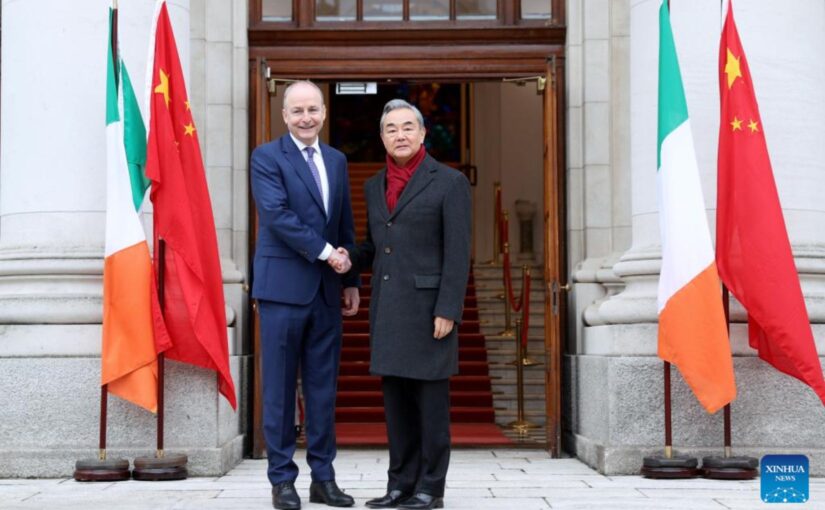
Chinese Foreign Minister Wang Yi recently reaffirmed his country’s strong commitment to friendship with Ireland, saying that Beijing is committed to enhancing mutually beneficial cooperation with Dublin so as to achieve shared development and prosperity.

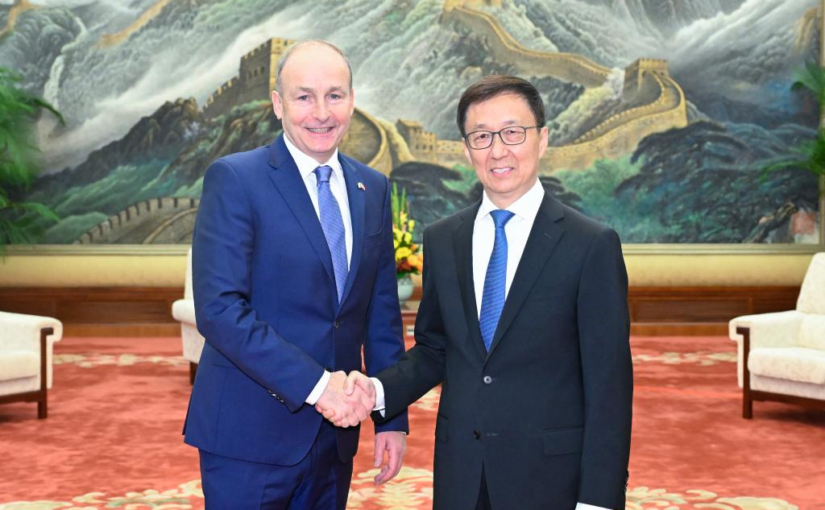
Wang made these remarks at a February 17 meeting with Irish Taoiseach (Prime Minister) Michael Martin. Although Ireland is a small country, it evidently enjoys an important place in Chinese diplomacy. Wang’s visit came just 13 months after that by Premier Li Qiang, which marked 45 years of bilateral diplomatic relations.

With its welcoming attitude to foreign investment, a number of Chinese companies have chosen Ireland for their European headquarters. They include TikTok, Huawei, Temu and Shein. As Wang observed, relations with Ireland have developed in tandem with China’s reform and opening up.  In 1980, late President Jiang Zemin, then holding vice-ministerial rank, took part in a three-week training program in the Shannon free trade zone. China’s first special economic zone, in Shenzhen, was established that same year.

However, the friendship between the Chinese and Irish peoples is also underpinned by their common history of struggling against foreign aggression and occupation and to achieve national liberation and reunification.

During his stay in Europe, of the fifty-seven articles that China’s future Premier Zhou Enlai wrote between 1921-22 for the progressive newspaper Yi Shibao, a number were on the brutality of British attempts to suppress the Irish war of independence.

From Japan, Guo Moruo, subsequently famous for his poetic dialogue with Mao Zedong, had followed the 1920 hunger strike of the Sinn Féin Lord Mayor of Cork Terence MacSwiney in south London’s Brixton prison with four poems, later included in his ‘Selected Poems from The Goddesses’.

Indeed, culture has played a significant part in the people-to-people friendship between China and Ireland.

In 1890, the Irish poet and playwright Oscar Wilde, whose own works were first translated into Chinese in 1909, wrote a review of the first complete translation into English of Zhuangzi (Zhuang Zhou), the Daoist scholar from the Warring States period (4th century BCE). In Zhuangzi, Wilde is said to have discovered a kindred spirit, one whose ideas resonate in his own only explicitly political essay, ‘The Soul of Man under Socialism’.

During his December 2014 state visit to China, Irish President Michael D. Higgins, in a speech delivered at the former Shanghai residence of Sun Yat Sen, the leader of China’s 1911 democratic revolution, and his wife Song Qingling, later the Honorary President of the People’s Republic of China, recalled the 1933 visit to the same house of the great Irish playwright George Bernard Shaw:

“Today’s gathering… is not just an opportunity to recall the seminal role played by these three figures in the history of Ireland and China. Commemorating Shaw’s encounter with Song Qingling and several other Chinese writers and intellectuals [who included Lu Xun] also provides a valuable occasion to celebrate and assert, together, the value and abiding importance of international exchanges of ideas.”

Describing Shaw as “an essayist and polemicist, a free-thinker and a stout defender of the rights of the working classes and the marginalised,” President Higgins added that his “visit to Shanghai coincided with an era of great turbulence globally – a period when foreign powers were pushing rival claims onto China, as the Chinese people struggled to assert national sovereignty and define both an appropriate form of government and a new model of society for themselves.

“As a Fabian, Shaw was undoubtedly alive to the possibilities of a wider socialist awakening in China. As an Irishman, he would have been sensitive to the Chinese calls for national sovereignty. At the same time, he was mindful not to be prescriptive in his conversation with his Chinese counterparts… In the message he addressed to the Chinese people on the occasion of his visit, Shaw thus wrote:

“‘It is not for me, belonging as I do to a quarter of the globe which is mismanaging its affairs in a ruinous fashion to pretend to advise an ancient people striving to set its house in order.’”

Words which surely have lost none of their contemporary resonance.

The following day, speaking at Fudan University, Higgins noted that Marco Polo’s chronicles of his adventures in China had been translated into the Irish language within a century and around 150 years before an English translation.  And although diplomatic relations were not established until 1979: “Ireland was one of a small number of Western countries who, between 1957 and 1971, was anxious to support the process which led to the representation of the People’s Republic of China at the United Nations… In 1971, Ireland therefore supported the People’s Republic of China’s recognition and admission to the UN.”

The build up to the establishment of diplomatic relations saw an intensification of people-to-people ties in which sport also played a significant part.

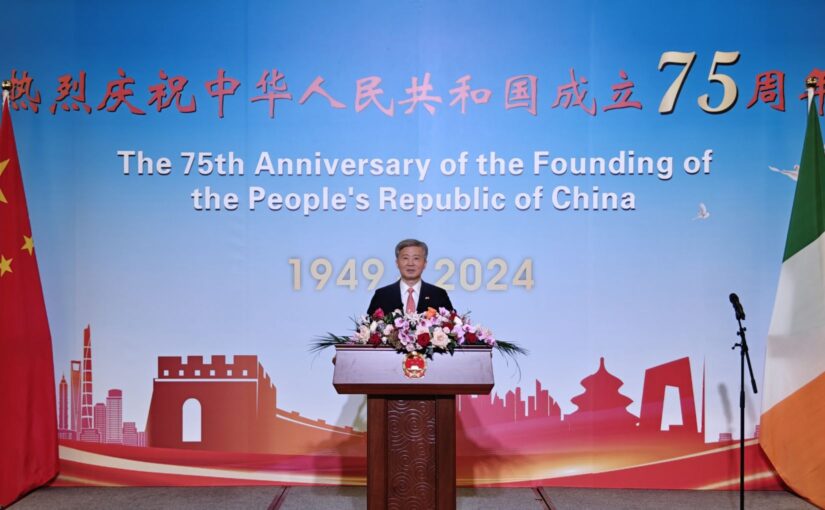
At his reception to celebrate the 75th anniversary of the founding of the People’s Republic, then Chinese Ambassador to Ireland He Xiangdong gave a special welcome to Kevin Carey, Patrick Dwyer, John McGrath, Norman Plunkett, Brian Purcell and Martin Moran, describing them as among the earliest Irish ” envoys” to the new China. In 1976, three years before the establishment of diplomatic relations, together with their teammates of the University College Dublin (UCD) football team, they had paid a three-week visit to six cities in China and had “shared their experiences in Irish newspapers, opening a window for the Irish people at that time to know something about China.”

On his February 2012 visit to Ireland, Xi Jinping, then Vice-President of China, displayed his skills at both Gaelic football and hurling at Dublin’s Croke Park. The home to Ireland’s Gaelic Athletic Association (GAA), Croke Park is also a hallowed place in the Irish people’s struggle for independence, being the scene of the November 21, 1920 ‘Bloody Sunday’ massacre of 13 spectators and one player by paramilitary police.

Xi Jinping’s passion for sport, and particularly his respect for Ireland’s indigenous games, made a tremendous impression on people in Ireland (although in the British media it was generally misreported as soccer), and years later keen observers of his New Year message noted the photo of his kicking off displayed in his office. It remains a powerful and touching symbol of the deep-rooted friendship and mutual respect between the peoples of China and Ireland – one that has the potential to make their bilateral relationship a model for those between countries of different sizes and with different social systems.

Céad Míle Fáilte [100,000 Welcomes] for New Chinese Ambassador to Ireland

In the following article, Gearóid Ó Machail, a member of the National Executive Committee of the Communist Party of Ireland (CPI), as well as of the Friends of Socialist China Advisory Group, reports on the welcome extended to the new Chinese Ambassador to his country against a backdrop of high-level bilateral exchanges and an increasingly fraught international situation.

The Chinese Embassy in Ireland  hosted a grand reception on February 17 to welcome newly appointed Ambassador Zhao Xiyu an and Madame Li Yi and to celebrate the Chinese New Year with a vibrant Spring Festival Gala. The event brought together more than 400 dignitaries, government officials, political and community representatives to mark the occasion in a spirit of friendship and cooperation.

2025 sees the 46th anniversary of diplomatic ties between China and Ireland, with Chinese Premier Li Qiang’s visit in January 2024 injecting new momentum into their strategic partnership for mutually beneficial cooperation based on mutual trust, respect and support. Ireland was the only EU stop for China’s No 2 official on a trip that also took in a speaking slot at the World Economic Forum in Davos, Switzerland.

The Reception and Gala at The Helix in Dublin City University followed Ambassador Zhao Xinyuan’s presentation of his credentials to President Michael D. Higgins at Áras an Uachtaráin [The Presidential Residence] in Phoenix Park, Dublin. Following the ceremony, he inspected the Irish Defence Forces Guard of Honour. The event was attended by Secretary General to the President Orla O’Hanrahan, Minister of State Emer Higgins, and Minister Counsellor Yang Tong of the Chinese Embassy.

Ambassador Zhao conveyed Chinese President Xi Jinping’s warm greetings and best wishes to President Higgins and the Irish people. He noted that, under the strategic guidance of both countries’ leaders, China-Ireland relations have steadily advanced in recent years, yielding fruitful cooperation. He emphasised China’s commitment to national rejuvenation through Chinese-style modernisation and reaffirmed Ireland’s role as an important partner, expressing hope for stronger bilateral ties.

President Higgins asked Ambassador Zhao to extend his sincere greetings to President Xi Jinping and the Chinese people. He fondly recalled hosting President Xi during his visit to Ireland in 2012 [as China’s Vice President] and his own state visit to China in 2014. President Higgins reiterated Ireland’s commitment to deepening cooperation with China, upholding multilateralism, and fostering the continued growth of Ireland-China relations.

The evening reception for Ambassador Zhao Xiyuan and Madame Li Yi showcased a stunning variety of musicians, dancers, singers and performers who had travelled from the People’s Republic of China to welcome the arrival of Spring and the Chinese New Year of the Snake in Ireland. It took place on the same day that Chinese Foreign Minister Wang Yi had been in Dublin to meet his Irish counterpart Simon Harris TD and Taoiseach (Prime Minister) Micheál Martin.

In his address, Ambassador Zhao reflected on China’s remarkable achievements in economic growth, scientific innovation, and modernisation over the past year. He emphasised his country’s commitment to advancing the great rejuvenation of the Chinese nation through a Chinese path to modernisation, which will generate new opportunities for global partners, including Ireland. Highlighting Foreign Minister Wang Yi’s visit to Ireland that day, he reaffirmed China’s dedication to strengthening high-level mutual trust, expanding cooperation, and fostering deeper, more practical, and mutually beneficial relations between the two nations.

The reception and gala were attended by Ceann Comhairle Verona Murphy TD (Chairperson of Dáil Éireann, the lower house of the Irish parliament), former Taoiseach Bertie Ahern, representatives of major political parties, including Micheál Mac Donncha of  Sinn Féin, and other distinguished guests from the Irish government, the Communist Party of Ireland (CPI), county and city councils, the diplomatic corps, and various local communities. Along with the Chinese artists, attendees also enjoyed captivating performances from their Irish counterparts,, collectively making for a vivid celebration of the rich cultural ties between the two nations. In a warm and friendly atmosphere, guests engaged in meaningful discussions about China’s development and the promising future of China-Ireland relations.

Continue reading Céad Míle Fáilte [100,000 Welcomes] for New Chinese Ambassador to Ireland

China, Ireland pledge closer ties, deeper cooperation

Following his participation in the Munich Security Conference, Chinese Foreign Minister Wang Yi visited Ireland on February 17.

In his meeting with Taoiseach (Prime Minister) Micheal Martin, he said that China is ready to work with Ireland to enhance their mutually beneficial cooperation, making it bigger, stronger, deeper and more concrete, in order to achieve shared development and prosperity.

China appreciates Ireland’s positive, pragmatic, and friendly policy towards China and stands ready to work with Ireland to implement the consensus reached by leaders of the two countries, consolidate high-level mutual trust, and expand high-level cooperation. And China seeks to strengthen dialogue, enhance mutual trust, and properly manage differences with Ireland, Wang said, adding that both sides can serve as a constructive force in the process of global multipolarisation, making joint efforts to safeguard global peace, stability, and development.

Martin, for his part, stated that Ireland and China enjoy a long-standing tradition of friendship, mutual respect and trust, and strong bilateral relations. He noted that Chinese Premier Li Qiang paid a successful visit to Ireland last year. China’s modernisation and accelerated green transformation have brought significant opportunities to the world, he said, adding that Ireland attaches great importance to and cherishes its relations with China, and is willing to develop a closer partnership while continuing to adhere to the one-China policy.

In his meeting with Tanaiste (Deputy Prime Minister) and Minister for Foreign Affairs and Trade Simon Harris, Wang said that amid growing global uncertainties and instabilities, China’s call for building an equal and orderly multipolar world represents the broadest consensus of the international community. China and the EU, he continued, are key forces in a multipolar world and reiterated China’s readiness to collaborate with all parties, including the EU, to uphold the authority of the United Nations, adhere to fundamental norms governing international relations, oppose unilateralism, and reject the resurgence of ‘the law of the jungle’.

Harris said that Ireland values its relationship with China, adheres to the one-China policy, and is committed to strengthening a positive and constructive partnership. He welcomed China’s visa-free policy for Irish citizens and expressed support for launching more direct flights to facilitate people-to-people exchanges. He added that Ireland upholds multilateralism and free trade, opposes ‘decoupling’, and supports deeper cooperation between China and the EU in addressing global challenges.

The two sides also discussed the Ukraine crisis, with Harris sharing his perspective on rebuilding peace in Europe. Wang reaffirmed China’s support for all efforts toward achieving peace and support for a fair, lasting, and binding peace formula acceptable to all parties. He also stressed China’s support for Europe’s role in the peace process, particularly in shaping a new security framework for the region.

Both sides also exchanged views on the situation in Gaza and advancing efforts for a return to the ‘two-state solution’.

Following his visit to Ireland, Wang Yi proceeded to New York, where he chaired the United Nations Security Council High-Level Meeting on “Practicing Multilateralism, Reforming and Improving Global Governance”.

The following articles were originally published by the Xinhua News Agency.

China ready to enhance cooperation with Ireland: FM

DUBLIN, Feb. 17 (Xinhua) — China is ready to work with Ireland to enhance their mutually beneficial cooperation, making it bigger, stronger, deeper and more concrete, in order to achieve shared development and prosperity, Chinese Foreign Minister Wang Yi said here on Monday.

Wang, also a member of the Political Bureau of the Communist Party of China Central Committee, made the remarks during a meeting with Irish Taoiseach Micheal Martin.

He said China-Ireland relations have continuously developed alongside China’s reform and opening-up process. The development of the Shannon Free Zone has served as a valuable reference for China, while China’s development has also, in return, brought benefits to Ireland, he stressed.

The minister said the facts have proved that the mutually beneficial strategic partnership between China and Ireland serves both countries’ interests and brings benefits to their people.

Continue reading China, Ireland pledge closer ties, deeper cooperation

75th anniversary of the founding of the People’s Republic of China marked in Ireland

The 75th anniversary of the founding of the People’s Republic of China, on October 1, was marked in Ireland with a reception hosted by the Chinese Embassy in Dublin as well as with a statement issued by the Communist Party of Ireland (CPI).

Ambassador He Xiangdong, together with his wife Xia Lining, hosted a reception for more than 300 people on the evening of September 26.

Early in his speech, Ambassador He underlined the importance of people-to-people diplomacy by recalling a special moment in China-Ireland relations:

“Here, I would like to pay special tribute to a few special guests. Mr. Kevin Carey, Mr. Patrick Dwyer, Mr. John McGrath, Mr. Norman Plunkett, Mr. Brian Purcell and Mr. Martin Moran. They are among the earliest Irish ‘envoys’ to the new China. In 1976, three years before the establishment of diplomatic relations between China and Ireland, these five gentlemen and their teammates of the UCD [University College Dublin] football team paid a three-week visit to China. They visited Beijing, Shanghai, Changsha, Nanchang, Hangzhou and Guangzhou, and shared their experiences in Irish newspapers, opening a window for the Irish people at that time to know something about China. The spirit of curiosity, exploration and inclusiveness of these young people is still the source of power for the continuing development of China-Ireland relations.”

The Ambassador summarised 75 years of achievements in socialist nation building as follows:

“The past 75 years have witnessed the tremendous development and progress that China has made under the leadership of the Communist Party of China and by the hard-working Chinese people.

–We have historically solved the problem of absolute poverty, and more than 1.4 billion Chinese people have entered a well-off society.

–We have continuously developed the whole-process people’s democracy, and the people’s right to be masters of their own lives and their own country has been more fully realised.

–We have deepened the reform of the judicial system, strengthened the construction of a safe and law-abiding China, and made China one of the safest and most peaceful countries in the world.

–We have built the world’s largest education system, social security system, and medical and health system, and continuously enhanced the people’s sense of gain, happiness, and security.

–We have contributed 25% of the world’s new green area since the beginning of this century, built the world’s largest clean power generation network, with the largest installed capacity of hydropower, wind and solar power in the world. With an average annual energy consumption growth rate of 3%, we have supported an average annual economic growth of more than 6% and contributed to the global response to climate change and green transformation.

–We are committed to promoting the building of a community with a shared future for mankind. While achieving our own development, we provide assistance to more than 160 countries and international organisations to the best of our ability to help many other countries improve their people’s livelihood and move towards the goal of common development.”

He added: “We live in a world of interdependence where the destinies of nations are intertwined. China’s growth and development have been closely linked to its engagement with the global community, including Ireland. Looking into the past, China has proven itself as a partner to Europe and Ireland, not a rival, not a challenger, let alone a threat.

“For China, Ireland is a friend worthy of respect and trust, a bridge for China-EU cooperation and a partner in promoting globalisation. China’s further comprehensive deepening of reform and promotion of Chinese-style modernisation will bring new opportunities for China-Ireland practical cooperation and play a constructive role in maintaining the competitiveness of Irish companies. Let us join hands to promote the sustained and stable development of bilateral relations and build a bright future for Ireland and China.”

Former Taoiseach (Prime Minister) and Co-Chair of the Inter Action Council Bertie Ahern responded, speaking highly of China’s development achievements and praising the country for always being a builder of world peace, a contributor to global development, and a defender of international order. Ireland looks forward to the new high of Ireland-China relations and better benefits for the two countries and two peoples.

Meanwhile, in a statement published on social media, the Communist Party of Ireland sent, “revolutionary greetings to the Communist Party of China and to the Chinese people on the 75th anniversary of the establishment of the People’s Republic of China.”

The CPI noted that: “The victory of the Chinese Revolution shook the foundations of the system of colonial exploitation and sounded the death knell for the old European colonial empires. China’s example inspired other subject peoples in their struggles against colonialism and imperialism… In the 75 years since its foundation, the People’s Republic serves as an example to millions suffering under capitalist and imperialist exploitation.”

The following articles were originally published on the website of the Chinese Embassy in Dublin and on Instagram by the CPI.

The Chinese Embassy in Ireland held a Reception to Celebrate the 75th Anniversary of the Founding of the People’s Republic of China

Sep 27 (Chinese Embassy in Ireland) — On September 26, Ambassador He Xiangdong and Madame Xia Lining held a reception to celebrate the 75th anniversary of the founding of the People’s Republic of China. Ambassador He,  former Taoiseach and Co-Chair of Inter Action Council Bertie Ahern delivered speeches at the reception.

Ambassador He briefed the great achievements China has made in politics, economy, social security, green development, and international cooperation since the founding of the People’s Republic of China, and emphasized that the Third Plenary Session of the 20th CPC Central Committee made systematic arrangements for further deepening reform and promoting Chinese-style modernization, which will bring new opportunities for China-Ireland practical cooperation.

Mr. Bertie Ahern spoke highly of China’s development achievements and praised China for always being a builder of world peace, a contributor to global development, and a defender of international order. Ireland look forward to the new high of Ireland-China relations and better benefits for the two countries and two peoples.

More than 300 guests from the Irish Government, Houses of the Oireachtas, Defense Forces, County and City councils, Diplomatic Corps, and various local communities attended the reception.

Continue reading 75th anniversary of the founding of the People’s Republic of China marked in Ireland

Fruitful visit to Northern Ireland by Ambassador Zheng Zeguang

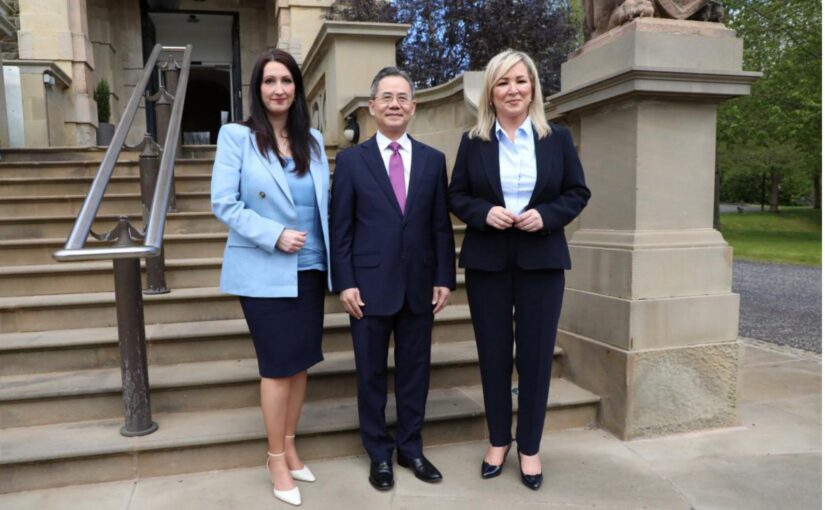
Chinese Ambassador to the United Kingdom Zheng Zeguang paid the second visit of his tenure to Northern Ireland at the beginning of May, meeting with First Minister Michelle O’Neill and Deputy First Minister Emma Little-Pengelly on May 1. 

O’Neill is a leading member of Sinn Féin and the first nationalist and republican to serve as First Minister. Emma Little-Pengelly belongs to Northern Ireland’s second largest party, the Democratic Unionist Party (DUP). 

According to the Chinese Embassy in London, the two sides had an in-depth exchange of views on further developing the friendship and cooperation between China and Northern Ireland.

Ambassador Zheng congratulated the two major political parties in Northern Ireland on successfully forming a new Northern Ireland Executive and introduced China’s economic and social development.

China’s economy grew by 5.2% last year and expanded by 5.3% in the first quarter of this year. Facts show that the fundamentals of China’s economy stay unchanged and will not change in the future. This will continue to provide more opportunities for practical cooperation in various fields between China and Northern Ireland.

He noted that local cooperation is an important foundation for state-to-state relations. China appreciates Northern Ireland’s long-standing commitment to exchanges and cooperation with China. Collaboration between the two sides in fields such as business, trade, education, culture, and tourism have yielded fruitful outcomes.

Northern Ireland enjoys excellent natural conditions and great potentials for development. China encourages Chinese businesses, students, and tourists to invest, study, and travel in Northern Ireland and welcomes more Northern Ireland investment, quality products and students in China.

First Minister Michelle O’Neill and Deputy First Minister Emma Little-Pengelly welcomed Ambassador Zheng on his second visit to Northern Ireland. They said that the Northern Ireland government attaches importance to developing its relationship with China.

In recent years, Northern Ireland and China had close cooperation in business, trade, education, agriculture, and tourism, bringing tangible benefits to both sides. Northern Ireland welcomes more Chinese investments, supports broader education collaboration between universities in Northern Ireland and China, welcomes Chinese students and tourists to study and vacation in Northern Ireland, and hopes to strengthen personnel exchanges and deepen mutually beneficial cooperation with China.

The same day, Ambassador Zheng Zeguang attended and addressed the first China-UK/Northern Ireland Education Cooperation Forum held at Ulster University in Belfast at invitation and delivered a keynote speech titled “Openness and cooperation is the right way forward.”

Over the 75 years since the founding of New China, he said, great accomplishments have been achieved in education. China has put in place the world’s largest education system, with more than 510,000 education institutions of different types at all levels, 293 million university, secondary and primary school students, and more than 18.8 million full-time teachers. The popularity of China’s basic education at different stages has reached or exceeded the OECD [a grouping of mostly developed countries] average and China is now upgrading its higher education to achieve greater quality. Education advancement has in turn accelerated technological innovation. By the end of 2023, China owned close to five million valid invention patents, ranking first in the world.

In recent years, however, there have been constant noises from some politicians in the West, using “national security” as an excuse to push for “decoupling” of economies, severing of industrial and supply chains, and creation of “small yards with high fences”, while pointing fingers at China and obstructing exchanges and collaboration. This must be firmly rejected. Facts have and will continue to prove that China-UK educational collaboration is mutually beneficial and has broad prospects.

Dr Colin Davidson, Chancellor of Ulster University, said that his university is proud of its extensive collaboration with universities such as Hubei Normal University and the National Academy of Chinese Theatre Arts. It is committed to building a sustainable future for the world and will continue to work with its Chinese partners to deepen cooperation in culture, education and scientific research towards shared goals.

The following articles were originally published on the website of the Chinese Embassy in London.

Ambassador Zheng Zeguang meets with First Minister Michelle O’Neill and Deputy First Minister Emma Little-Pengelly of Northern Ireland

May 3 (Chinese Embassy in the UK) — On 1 May 2024, during his visit to Northern Ireland, H.E. Ambassador Zheng Zeguang met with  First Minister Michelle O’Neill and Deputy First Minister Emma Little-Pengelly of Northern Ireland.

The two sides had an in-depth exchange of views on further developing the friendship and cooperation between China and Northern Ireland.

Ambassador Zheng congratulated the two major political parties in Northern Ireland on successfully forming a new  Northern Ireland Executive, and introduced China’s economic and social development.

Ambassador Zheng said that China,  committed to modernisation through a Chinese path, is striving for high-quality development, faster growth of new quality productive forces, greater domestic demand, and opening up at a higher level.

China’s economy grew by 5.2% last year and expanded by 5.3% in the first quarter of this year. Facts show that the fundamentals of China’s economy stay unchanged and will not change in the future. This will continue to provide more opportunities for practical cooperation in various fields between China and Northern Ireland.

Ambassador Zheng noted that local cooperation is an important foundation for state-to-state relations. China appreciates Northern Ireland’s long-standing commitment to exchanges and cooperation with China. Collaboration between the two sides in fields such as business, trade, education, culture, and tourism have yielded fruitful outcomes.

Northern Ireland enjoys excellent natural conditions and great potentials for development. China encourages Chinese businesses, students, and tourists to invest, study, and travel in Northern Ireland and welcomes more Northern Ireland investment, quality products and students in China.

First Minister Michelle O’Neill and Deputy First Minister Emma Little-Pengelly  welcomed Ambassador Zheng on his second visit to Northern Ireland.  They said that the Northern Ireland government attaches importance to developing its relationship with China.

In recent years, Northern Ireland and China had close cooperation in business, trade, education, agriculture, and tourism, bringing tangible benefits to both sides. Northern Ireland welcomes more Chinese investments, supports broader  education collaboration between universities in Northern Ireland and China, welcomes Chinese students and tourists to study and vacation in Northern Ireland, and hopes to strengthen personnel exchanges and deepen mutually beneficial cooperation with China.

They wish the China-UK/Northern Ireland Education Cooperation Forum to be held on the day full success.

The meeting was also attended by Chinese Consul General in Belfast Zhang Meifang, and Counsellor for Political Affairs Kong Xiangwen.


Ambassador Zheng Zeguang attended the first China-UK/Northern Ireland Education Cooperation Forum and delivered a keynote speech

May 4 (Chinese Embassy in the UK) — On 1 May 2024, H.E. Ambassador Zheng Zeguang attended and addressed the first China-UK/Northern Ireland Education Cooperation Forum held at Ulster University in Belfast at invitation and delivered a keynote speech titled “Openness and cooperation is the right way forward”. 

Ambassador Zheng commended Ulster University for itsstrong sense of openness and fully recognised its fruitful cooperation with Hubei Normal University, the National Academy of Chinese Theatre Arts and other Chinese institutions.

Ambassador Zheng pointed out thatitis China’s long-standing tradition to value education and respect teachers, and that education has always been a priority for the Chinese government. Over the 75 years since the founding of New China, great accomplishments have been achievedon education. China has put in place the world’s largest education system, with more than 510,000 education institutions of different types at all levels, 293 million university, secondary and primary school students, and more than 18.8 million full-time teachers. The popularity of China’s basic education at different stages has reached or exceeded the OECD average, and China is now upgrading its higher education to greater quality. Education advancement has in turn accelerated technological innovation. By the end of 2023, China owned close to 5 million valid invention patents, ranking first in the world. China’s total input in R&D and investment in the high-tech sector has been growing at double-digit rates for several years running. China now has around 400,000 high-tech enterprises and ranks second globally in the number of unicorn companies.

Ambassador Zheng pointed out that China is taking concrete steps to promote high-quality development and accelerate the creation of new-quality productive forces. In this process, China is further prioritising education, science and technology, and talent cultivation. China remains committed to openness and international exchanges in education. China has carried out educational exchanges with more than 180 countries, signed agreements on mutual recognition of qualifications and academic degrees with 58 countries and regions. 85 countries have incorporated Chinese language teaching into their national education curricula, and more than 30 million people outside of China are studying the language.

Ambassador Zheng pointed out that the world today is undergoing deep transformation and increasing volatility, humanity is facing multiple common challenges, and a new round of industrial and technological revolution is unfolding at pace. Now more than ever, countries need to enhance education cooperation, work together to cultivate more talent with a global vision, and find solutions to common challenges. In recent years, however, there have been constant noises against it from some politicians in the West, using “national security” as an excuse to push for “decoupling” of economies, severing of industrial and supply chains, and creation of small yards with high fences, while pointing fingers at China and obstructing exchanges and collaboration. This must be firmly rejected. Facts have and will continue to prove that China-UK educational collaboration is mutually beneficial and has broad prospects. China is committed to a steady and mutually beneficial China-UK relationship on the basis of mutual respect and equality. It is hoped that people from all walks of life in both countries will not be swayed by noises or disturbed by obstructions, and will continue to promote mutual learning and mutually beneficial collaboration between the two countries. The Chinese Embassy and Consulates in the UK will, as always, provide support and facilitation for UK’s educational exchanges and collaboration with China.

Dr Colin Davidson, Chancellor of Ulster University, said that Ulster is proud of its extensive collaboration with universities such as Hubei Normal University and the National Academy of Chinese Theatre Arts. It is committed to building a sustainable future for the world and will continue to work with its Chinese partners to deepen cooperation in culture, education and scientific research towards shared goals.

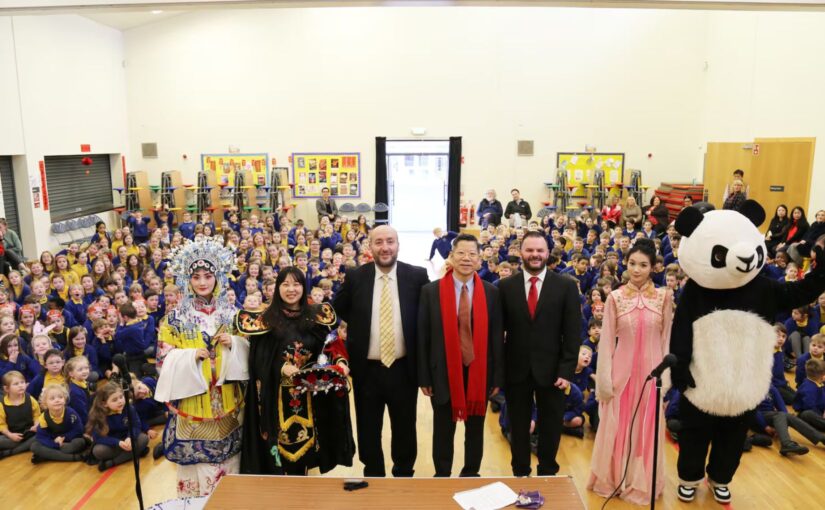
Speaker of the Northern Ireland Assembly Mr Edwin Poots, Consul General of China in Belfast Ms Zhang Meifang, and President of Hubei Normal University Professor Lei Rujin also delivered remarks. The event was attended by around 200 people, including Deputy Lieutenant of the County Borough of Belfast Professor Alastair Adair, and Minister Counsellor for EducationMs Zhang Jin,Minister Counsellor for Press and Public Affairs Mr Bi Haibo, and Political CounsellorMr Kong Xiangwen at the Chinese Embassy, as well as representatives from cities and counties and headteachers from primary and secondary schools in Northern Ireland. Chinese and British students presentedfantastic cultural and artistic programmes with ethnic characteristics.

During the Forum, Ambassador Zheng and Chancellor Davidson witnessed the signing of an agreement between Hubei Normal University and Ulster University to establish a Centre for Education, Culture and Language Exchange andjointly unveiled the plagued of the Centre.

Dr Rose Dugdale – fighter for Irish freedom, student of Chairman Mao

A huge crowd gathered at Dublin’s Glasnevin Cemetery on March 27th 2024 to bid farewell to Dr. Rose Dugdale, a fighter for Irish freedom for more than half a century, who passed away on March 18 at the age of 82.

Rose was born into immense wealth and privilege in England but gave it all up to devote her life to the working and oppressed people of the world and to the liberation of Ireland and the fight for a socialist republic in particular.

Former Sinn Féin president Gerry Adams joined some 10 Sinn Féin TDs (members of the Dublin parliament), a TD from People Before Profit, veterans of the Republican struggle, including Jim Monaghan, her partner of many decades, and her close friend and comrade Marion Coyle, as well as her son  Ruairí, and many others, at the non-religious ceremony.

Former Sinn Féin Assembly member and MEP Martina Anderson presided over the service and said that her friend had a “pivotal role” in the republican movement.

“I stand here with a sore yet proud heart, reminded of the remarkable journey I and so many others shared together with Rose in the depths of the Irish republican struggle.

“Through her, intellectually, politically and personally, I learned invaluable lessons, as did many others, about resilience, dedication, speaking up, speaking out and the power of conviction.

“Rose’s path from a privileged upbringing to the heart of the republican struggle was marked by her insatiable and unwavering commitment to economic equality, social justice and human rights.”

She added: “Rose’s legacy will forever be intertwined with the tapestry of Ireland’s fight for freedom.”

Rose’s partner, Jim Monaghan, one of the ‘Colombia Three’ Irish republicans who were jailed in the South American country after having spent time in the liberated areas then administered by the FARC liberation movement, spoke from his wheelchair, remembering Rose as “a force of nature.”

“Rose was a highly educated woman in politics, philosophy and economics [the subjects she had studied at Oxford University]. We both had a great interest in socialist politics and she taught me a lot.”

Jim was appointed as the head of Sinn Féin’s Education Department and Rose became his Deputy.

He described his partner as “an all-rounder in revolution, politics and education; a woman of many talents, she was well known as an IRA volunteer, but she was also a noted academic and gifted teacher, who taught economics, politics and philosophy.”

He referred to how Rose’s political awakening had been triggered not least by what she learned of the oppression and exploitation of Africa through her work as an economist and continued:

“She also taught English classes when she was in Limerick Prison. The women that were there, some of them couldn’t read, couldn’t write.

 “She helped them through and she helped them read their letters and helped them write letters.”

Continue reading Dr Rose Dugdale – fighter for Irish freedom, student of Chairman Mao

Premier Li Qiang holds talks with Irish President and Taoiseach

In his first overseas visit of 2024, China’s Premier Li Qiang attended the annual meeting of the World Economic Forum (WEF) in the Swiss resort of Davos and paid official visits to Switzerland and Ireland.

The visit to Ireland coincides with the 45th anniversary of the two countries’ establishment of diplomatic relations, but more generally, as the only other European destination chosen by Premier Li around his attendance at Davos, it represents a significant statement by China regarding its friendly sentiments towards Ireland and its keen desire to promote that relationship.

This was further underlined by two unilateral gestures announced during the visit. With immediate effect, China has reopened its market to Irish beef. China suspended imports last year after a routine check detected an atypical BSE (bovine spongiform encephalopathy, commonly known as ‘mad cow disease’) case in a cow. China is Ireland’s fourth largest trade partner, and this move was greatly welcomed by the country’s farming community. 

In addition, China added Ireland to its list of countries whose citizens will enjoy visa-free entry.

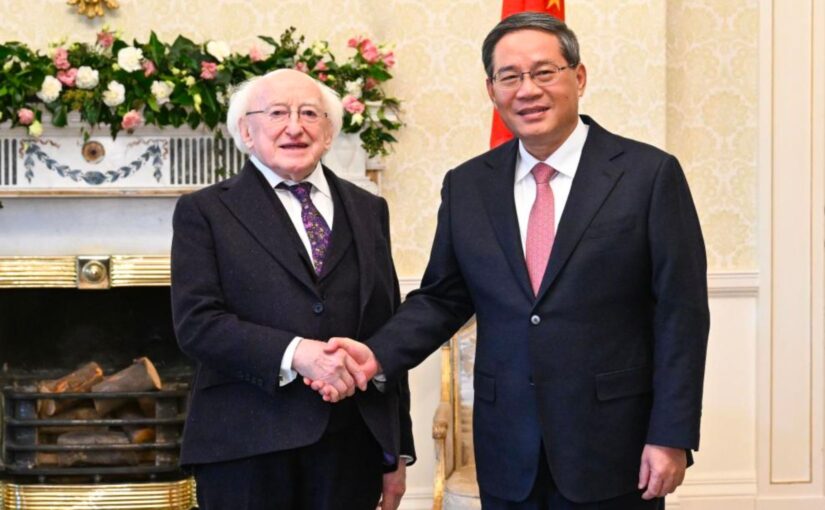
Following his arrival on January 16, Premier Li held meetings with Irish President Michael D. Higgins and Taoiseach (Prime Minister) Leo Varadkar on the 17th.

Premier Li told President Higgins that, although China and Ireland are geographically far apart with different national conditions, they have enjoyed enduring friendship. 

In recent years, he added, under the strategic guidance of President Xi Jinping and President Michael D. Higgins, China-Ireland relations have developed steadily, and bilateral practical cooperation has yielded fruitful results. 

The Irish Times further reported that Li praised Higgins as “a seasoned political leader in Ireland [who has] all along attached importance to Ireland-China relations and followed China’s development.”

China, Li said, stands ready to work with Ireland to adhere to mutual respect and equality, and take the opportunity of the 45th anniversary of China-Ireland diplomatic ties this year to further implement the important consensuses reached by the heads of state of the two countries, continuously enhance mutual understanding and trust, fully accommodate each other’s major interests and core concerns, continuously advance the level and boost the effects of cooperation in various fields, and push for greater development of the China-Ireland strategic partnership for mutually beneficial cooperation.

He added that both sides should practice genuine multilateralism, bridge differences through dialogue and resolve disputes through cooperation, so as to push for better global governance, promote common development and inject greater stability and energy into a world rocked by changes and chaos.

President Higgins recalled his state visit to China in December 2014 and his discussions with President Xi Jinping both during that visit and when President Xi visited Ireland as China’s Vice-President in 2012.

The two statesmen agreed on the need for science and technology to be shared where they have the greatest effect, without borders, and that the test for this should be where it can have the greatest benefit for humanity.

In their discussions, the President also recalled conversations which he had with President Xi in 2014 with regard to the interacting crises of climate change, global poverty, food security, global conflict, and the need to recast development to take account of debt.

In his meeting with Leo Varadkar, Li said that China and Ireland have maintained healthy and stable development of their ties since their establishment of diplomatic relations. China is ready to work with Ireland to carry forward traditional friendship, consolidate political mutual trust, deepen mutually beneficial cooperation and share development opportunities more fully, in a bid to bring more benefits to the two countries and the two peoples.

The Chinese Premier expressed his country’s willingness to work with the Irish side to adhere to mutual respect and trust, strive to seek common ground while shelving and resolving differences, deepen mutual understanding, and support each other on major issues.

China and Ireland should continuously expand trade, strengthen cooperation in green and low-carbon development, sustainable agriculture, finance, and other fields, and expand innovation cooperation in digital economy, biomedicine, and artificial intelligence, he added.

Varadkar said that Ireland appreciates China’s great achievements in economic and social development, always abides by the one-China policy, and hopes that China will achieve peaceful reunification at an early date.

Ireland, he added, stands ready to expand two-way investment with China, strengthen bilateral cooperation in such fields as agriculture, food, innovation, and green development, and deepen people-to-people exchanges in education and culture.

The following articles were originally published by the Xinhua News Agency and the website of the President of Ireland.

China, Ireland should jointly practice genuine multilateralism: Chinese premier

DUBLIN, Jan. 17 (Xinhua) — Visiting Chinese Premier Li Qiang on Wednesday called on China and Ireland to work together to uphold a free and open international trading system and practice genuine multilateralism.

Li made the call while meeting with Irish President Michael D. Higgins here in Aras an Uachtarain, the official residence of the Irish president.

Though China and Ireland are geographically apart with different national conditions, they have enjoyed enduring friendship as well as highly compatible development concepts, Li noted.

In recent years, under the strategic guidance of President Xi Jinping and President Michael D. Higgins, China-Ireland relations have developed steadily and bilateral practical cooperation has yielded fruitful results, he said.

China stands ready to work with Ireland to adhere to mutual respect and equality, and take the opportunity of the 45th anniversary of China-Ireland diplomatic ties this year to further implement the important consensuses reached by the heads of state of the two countries, continuously enhance mutual understanding and trust, fully accommodate each other’s major interests and core concerns, continuously advance the level and boost the effects of cooperation in various fields, and push for greater development of the China-Ireland strategic partnership for mutually beneficial cooperation, Li said.


The Chinese premier also pointed out that mutually beneficial cooperation between China and Ireland is promising.

Li said China is willing to deepen cooperation with Ireland in such fields as economy, trade and investment, green development as well as scientific and technological innovation.

He also pledged strengthening people-to-people exchanges in education, culture and other fields to facilitate personnel exchanges between the two countries.

Both sides should work together to uphold a free and open international trading system and maintain the stable and smooth flow of global industrial and supply chains, Li noted.

He said that both sides should practice genuine multilateralism, bridge differences through dialogue and resolve disputes through cooperation, so as to push for better global governance, promote common development and inject greater stability and energy into a world rocked by changes and chaos.

For his part, Higgins said that relations between Ireland and China have maintained a sound momentum of development and both sides have always adhered to mutual understanding and respect.

Ireland stands ready to strengthen friendly communications with China to deepen mutually beneficial cooperation, jointly meet climate change, food security, sustainable development and other global challenges, and deepen the friendship between the two peoples so as to promote the continuous and in-depth development of bilateral ties, he said. 


President meets Premier Li Qiang of the People’s Republic of China

Jan. 17 (President of Ireland) — Uachtarán na hÉireann, President Michael D. Higgins received H.E. Mr Li Qiang, Premier of the State Council of the People’s Republic of China, on a courtesy call at Áras an Uachtaráin. Premier Li relayed warm greetings to the President from President Xi Jinping, which were reciprocated by the President.

At their meeting, President Higgins recalled his State Visit to China in December 2014 and his discussions with President Xi Jinping both during that State Visit and when President Xi visited Ireland as China’s Vice-President in 2012.

In their discussions, the President resumed conversations which he had with President Xi in 2014 with regard to the interacting crises of climate change, global poverty, food security, global conflict, and recasting development to take account of debt.

President Higgins further took up some of the points on the five macro-economic principles which Premier Li advanced in his recent special address in Davos. There was agreement between the President and the Premier on the need for science and technology to be shared where they have the greatest effect without borders and there was common agreement that the test for this should be where it can have the greatest benefit for humanity.

The President referred to the 45th anniversary of diplomatic relations between Ireland and China, and in that context noted the value of enabling straightforward dialogue on issues between countries with friendly relations to the benefit of all in a fundamental and long-term sense.

In this regard, the President referenced the forthcoming meetings of the Universal Periodic Review taking place in Geneva, the points that are likely to arise during that process, and gave the background to the Irish position on those matters.


Chinese premier says China, Ireland should regard each other as key cooperative partners

DUBLIN, Jan. 17 (Xinhua) — China and Ireland should adhere to mutual benefit, and always regard each other as key cooperative partners and development opportunities, Chinese Premier Li Qiang said here Wednesday.

Li made the remarks when meeting with Irish Prime Minister Leo Varadkar at Farmleigh House, the official Irish state guest house, in the Irish capital of Dublin.

During their talks, Li said China and Ireland have maintained healthy and stable development of their ties since the establishment of their diplomatic relations 45 years ago.

In recent years, particularly, under the strategic guidance of President Xi Jinping and President Michael D. Higgins, the China-Ireland strategic partnership for mutually beneficial cooperation has increasingly deepened, and exchanges and cooperation in various fields have continuously expanded, bringing tangible benefits to the two peoples, Li said.

China is ready to work with Ireland to carry forward traditional friendship, consolidate political mutual trust, deepen mutually beneficial cooperation and share development opportunities more fully, in a bid to bring more benefits to the two countries and the two peoples, Li noted.

Li expressed China’s willingness to work with the Irish side to adhere to mutual respect and trust, strive to seek common ground while shelving and resolving differences, deepen mutual understanding, and support each other on major issues.

China and Ireland should continuously expand trade, strengthen cooperation in green and low-carbon development, sustainable agriculture, finance and other fields, and expand innovation cooperation in digital economy, biomedicine and artificial intelligence, making the pie of cooperation bigger, he said.

China will apply unilateral visa-free policy to Ireland to facilitate personnel exchanges between the two countries, Li said, voicing the expectation that Ireland will provide an open, fair and non-discriminatory business environment for Chinese enterprises.

China is willing to strengthen coordination and cooperation with Ireland within the United Nations and other multilateral frameworks, practice genuine multilateralism, jointly tackle global challenges and promote the building of a community with a shared future for mankind, he said.

It is hoped that Ireland will play a greater role in promoting the sound and stable development of China-Europe relations, said Li.

For his part, Varadkar said that China is an important cooperative partner of Ireland, and the two countries have always adhered to mutual respect and trust.

Ireland appreciates China’s great achievements in economic and social development, always abides by the one-China principle, and hopes that China will achieve peaceful reunification at an early date, he added.

Ireland stands ready to expand two-way investment with China, strengthen bilateral cooperation in such fields as agriculture, food, innovation, and green development, and deepen people-to-people exchanges in education and culture, Varadkar continued.

The Irish side is willing to actively consider providing more convenience for Chinese citizens to visit Ireland, and welcomes more Chinese enterprises to invest and do business in Ireland, he noted, adding that Ireland supports further deepening Europe-China cooperation.

Prior to the talks, Li attended a grand welcome ceremony held by Varadkar and reviewed the Irish Guard of Honor. 
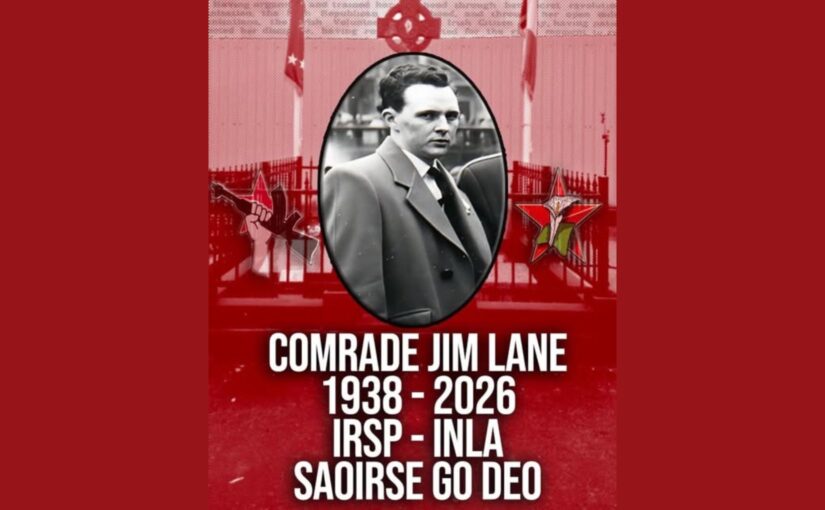
Friendly Ireland-China relations reinforced with visit by Tánaiste Micheál Martin

Friendly relations between Ireland and China have been reinforced with a visit by Micheál Martin, Ireland’s Tánaiste (Deputy Prime Minister), Minister for Foreign Affairs, and Minister for Defence. Martin is also the leader of the Fianna Fáil party, one of the three parties in Ireland’s coalition government.

Martin met with Chinese Vice President Han Zheng on November 6, who said that, under the strategic guidance and promotion of the leaders of the two countries, China and Ireland have become a good example of friendly coexistence and win-win cooperation between countries with different histories, cultures, and political systems. Han added that to develop China-Ireland relations, the foundation is solid and the conditions are sound.

Next year marks the 45th anniversary of the establishment of diplomatic ties between China and Ireland. The two sides should consolidate political mutual trust, tap the potential of practical cooperation, strengthen public support for friendship, and work together to push for new achievements in China-Ireland mutually beneficial strategic partnerships.

For his part, Martin said that Ireland and China enjoy profound friendship, and cooperation in various fields has expanded in recent years. Ireland is willing to take next year’s 45th anniversary of diplomatic ties between Ireland and China as an opportunity to strengthen exchanges with China in various fields.

The following day, at the request of the Irish side, Martin, who also met with Foreign Minister Wang Yi during his stay, met with Liu Jianchao, Minister of the International Department of the Communist Party of China (CPC) International Department (IDCPC). 

Martin said, Ireland-China friendship has a long history. The Irish side attaches importance to developing relations with China, regards China as an important partner, and hopes to strengthen exchanges and cooperation between the two countries in economy, trade, people-to-people exchanges, agriculture and other fields. As an EU member state, the Irish side is committed to developing robust EU-China relations, adheres to free and open economic policies, opposes “decoupling” from China, and hopes to promote closer cooperation between the EU and China in areas such as climate change and sustainable development. 

Liu said that the CPC attaches importance to maintaining various forms of exchanges with major political parties such as the Fianna Fáil and is willing to enhance understanding and mutual trust and promote the further development of China-Ireland strategic partnership for mutually beneficial cooperation. 

In a fascinating article by its China correspondent Denis Staunton, published on November 8, the Irish Times, Ireland’s most prestigious daily newspaper, reported on the Tánaiste’s visit to the Beijing Foreign Studies University (BFSU), home to an Irish Studies Centre, which is China’s comprehensive, multi-disciplinary institute in this field.

Reflecting China’s great interest in Ireland and Irish studies, and the country’s great respect for small nations and the great diversity of human civilisations, BFSU, which is one of China’s most prestigious universities, teaches 101 languages and has educated generations of the country’s diplomats, including three former ambassadors to Ireland. The Irish Studies Centre’s programmes cover Irish language, literature, culture, history, politics, and international relations and one of its senior figures, Wang Zhanpeng, is an expert on Brexit.

Staunton reported Zhang Junhan, one of the centres’s lecturers in the Irish language as saying: “Some of the students [who had turned out to greet Martin] are postgraduates from the Irish Studies Centre and the Gaeilge [the Irish language] is one of the modules they must take because we think it’s a source for them to understand Irish culture and society more deeply. There’s another bunch of graduate students from all over the university, from the law school, the business school, other language faculties. They study Irish as an optional module only because they are interested in this language and this country.”

Staunton’s report added: “Last December, Wang [Zhanpeng] and the centre’s director Chen Li went to Dublin to receive the Presidential Distinguished Service Award. Chen has done more to promote Irish writing in China than any other individual, introducing writers such as Anne Enright and Colin Barrett who are now translated into Chinese, alongside many others including John Banville, Colm Tóibín and Sally Rooney.”

He also noted that Martin had been greeted with the performance on the whistle, flute and bodhrán of a number of famous Irish songs and musical pieces. They included The Foggy Dew, one of Ireland’s most famous rebel songs. It can be seen here performed by The Wolfe Tones, the legendary Irish rebel group who this year celebrate their 60th anniversary.

The following reports were originally published by the Xinhua News Agency and on the IDCPC website.

Chinese VP meets Irish deputy PM

BEIJING, Nov. 6 (Xinhua) — Chinese Vice President Han Zheng met with Micheal Martin, Deputy Prime Minister and Minister for Foreign Affairs of Ireland, in Beijing on Monday.

Under the strategic guidance and promotion of the leaders of the two countries, China and Ireland have become a good example of friendly coexistence and win-win cooperation between countries with different histories, cultures, and political systems, Han said, adding that to develop China-Ireland relations, the foundation is solid and conditions sound.

Next year marks the 45th anniversary of the establishment of diplomatic ties between China and Ireland. The two sides should consolidate political mutual trust, tap the potential of practical cooperation, strengthen public support for friendship, and work together to push for new achievements in China-Ireland mutually beneficial strategic partnerships, said Han.

Continue reading Friendly Ireland-China relations reinforced with visit by Tánaiste Micheál Martin

Clare Daly: ‘derisking’ from China would be suicidal for European industry

In this episode of the CGTN program Dialogue, Xu Qinduo interviews Clare Daly, the outspoken, anti-imperialist member of the European Parliament (MEP) from Ireland on the EU’s attitude towards the conflicts in Gaza and Ukraine, as well as on China.

Clare notes that the recent resolution on Gaza adopted by the European parliament, which she and her colleague Mick Wallace voted against, did not address the root causes of the conflict or the crimes, including ethnic cleansing and genocide, perpetrated by the Israeli apartheid state. The EU and the United States, she notes, are complicit in Israeli genocide and that makes them equally culpable in international law.

On Ukraine, she is not presently hopeful of prospects for peace. Rather she fears that working class Ukrainian men will continue to be killed in the interests of western arms companies who seek to perpetuate the conflict. 

Asked about the moves to expand NATO to Asia, possibly starting with the establishment of an office in Tokyo, Clare responds that she has said before that the last bite of a dying snake is the most dangerous. US hegemony is in decline and there is no going back on this. But in its lashing out in desperation it is very dangerous. In this regard, she cites President Biden’s recent demand for US$100 bn for not only Israel and Ukraine but Taiwan as well. She feels that the US managed to provoke Russia and now seeks to do the same to China over Taiwan. However, she believes that Chinese diplomacy is more measured and the country will not walk into a similar trap.

Asked what impressed her most on her recent visit to China, she says there is not enough time to recount all the amazing things she saw. China, she notes, has built whole cities, but in Dublin it has not been possible to build even one metro station in 30 years. Ireland does not have a single high-speed train and neither does the US. Unfortunately, the EU has been following the US in seeking to restrict relations with China under the guise of ‘derisking’ and similar terms. Such a policy, she notes, if followed through, would be suicidal for European industry. In the face of these provocations, Clare advises China to continue with its diplomatic overtures and says she can think of nothing that China should be doing differently.

Within this situation, Clare asserts that Ireland has a special role to play. The EU is largely made up of former colonising powers or former socialist countries. Ireland, however, was colonised. It knows what it is like to be oppressed. Therefore, Ireland can be a voice for neutrality, non-alignment, multilateral cooperation and international solidarity.

The full interview with Clare Daly MEP is embedded below.

Ireland’s neutrality is at stake

In this article, originally published by Socialist Voice, Jimmy Corcoran, who is the General Secretary of the Communist Party of Ireland (CPI), takes up the new and increasing danger to what remains of Irish neutrality.

Neutrality is enshrined in the Irish constitution, but has been considerably undermined over recent years. That process has been further expedited with both the conflict in Ukraine and the new cold war against China, despite the principled position in defence of neutrality put forward by Irish President Michael D Higgins.

So far, Higgins’ public stance has prevented a formal application for NATO membership, but Micheál Martin, leader of the Fianna Fáil party and Tánaiste (Deputy Prime Minister), Minister for Foreign Affairs, and Minister for Defence in the Irish government, is now seeking to weaken the constraints on the deployment of Irish troops overseas as a thin end of the wedge. Hitherto, Irish troops have essentially been confined to United Nations peacekeeping duties overseas.

Corcoran notes that: “In the event of Sinn Féin becoming the major party in the next 26-County government [as is currently highly likely] they will be faced with this pro-imperialist bias [on the part of the Irish ruling class].”

The possibility of a revision or modification in Sinn Féin’s historically strong position on neutrality is currently a matter of public debate both within and outside the party. The CPI General Secretary poses the questions: “How will they react? Will they remain true to their anti-colonial and anti-imperialist tradition, or will they don the Atlanticist clothing of official Ireland?”

His article continues:

“They need to look beyond the world of US, EU and British imperialism towards the developing world. The Chinese share of the world economy is growing, while that of the United States is in relative decline. China is the main trading partner of more than 150 countries. Unlike Ireland, when China embarked on its path of modernising its economy the state remained in control, and it lifted 800 million people out of absolute poverty.”

Making an important call to Sinn Féin, Corcoran concludes:

“One doesn’t have to accept China’s self-designation as a socialist society to recognise that its development strategy has produced far better results than that pursued by the Irish ruling class since the late 1950s. If a Sinn Féin-led government is to develop Irish political and economic sovereignty and tilt the balance of forces towards the working class, it will need to counter the arguments of the Atlanticists. It could start by sending a high-level delegation to the People’s Republic of China to look at its path to modernisation and see what can be adapted to Irish conditions.”

The threat to completely abandon what remains of Irish neutrality is a continuing and increasing one. The recent intervention of President Higgins may have slowed down Micheál Martin’s march to NATO, but the threat remains.

Rather than applying for NATO membership immediately, the ruling class have set their sights as an interim step on removing the “triple lock” on the deployment of Irish troops. The capitalist parties and media claim that the triple lock is no longer tenable, because both Russia and China have a veto in the Security Council, which they can use to stop military aggression by the United States and its satellites. This ignores the fact that three NATO members—the United States, Britain, and France—also have a veto, which they use to protect imperialist aggression. The United States uses its veto against any condemnation of apartheid Israel’s continued colonisation in Palestine.

The report of the Commission on the Defence Forces demonstrates the continuing EU threat to Irish neutrality and sovereignty. It cites the EU Commission’s position that the rise of China must be seen as a threat to EU security.¹ This is reinforced regularly in the “news” media, to the extent that one would imagine that the Chinese military lie just over the horizon. The real political situation in Ireland consists of British (NATO) forces in the Six Counties and a US (NATO) base in Shannon Airport.

The Atlanticist ideology is deeply ingrained in the political class, the media, the higher echelons of the civil service, and the officer corps of the Defence Forces. Irish politicians and “journalists” ape the NATO line that China, Russia, Cuba, North Korea, Nicaragua and Venezuela are a threat to the “rules-based order” upon which “our” economic, political and military security is based.

But exactly what are these rules, who drafted them, and who approved them? Despite what many people may believe, the aforementioned rules are not the UN Charter or the various international agreements drafted under the aegis of the United Nations, or regional bodies such as the Council of Europe (not to be confused with the EU’s European Council) and then agreed by individual member-states: the “rules-based order” amounts to no more than the United States assuming the right to determine the economic and political path of all countries.

Any country that seeks to break with imperialism is automatically held to be in breach of the rules; and the United States reserves the right to punish them by economic or military intervention, or both.

In the event of Sinn Féin becoming the major party in the next 26-County government they will be faced with this pro-imperialist bias. How will they react? Will they remain true to their anti-colonial and anti-imperialist tradition, or will they don the Atlanticist clothing of official Ireland? The realpolitik gurus within the party will no doubt urge them to accept the Atlanticist position (they already have a welcome in the White House), as they will need the tax from American corporations to implement their social policies.

However, they need to look beyond the world of US, EU and British imperialism towards the developing world. The Chinese share of the world economy is growing, while that of the United States is in relative decline. China is the main trading partner of more than 150 countries. Unlike Ireland, when China embarked on its path of modernising its economy the state remained in control, and it lifted 800 million people out of absolute poverty.² It has an internal economy of 1.4 billion people, and government policies are concentrated on increasing the purchasing power of the poorest sections over the next decade. China spends far less on its military than the United States does; and China has not been at war for more than forty years.

One doesn’t have to accept China’s self-designation as a socialist society to recognise that its development strategy has produced far better results than that pursued by the Irish ruling class since the late 1950s. If a Sinn Féin-led government is to develop Irish political and economic sovereignty and tilt the balance of forces towards the working class, it will need to counter the arguments of the Atlanticists. It could start by sending a high-level delegation to the People’s Republic of China to look at its path to modernisation and see what can be adapted to Irish conditions. They would also see that China has no material benefit to gain from war, but that on the contrary a war could set its development back decades.

  1. Report of the Commission on the Defence Forces (2022), p. 6.
  2. World Bank press statement, 1 April 2022.