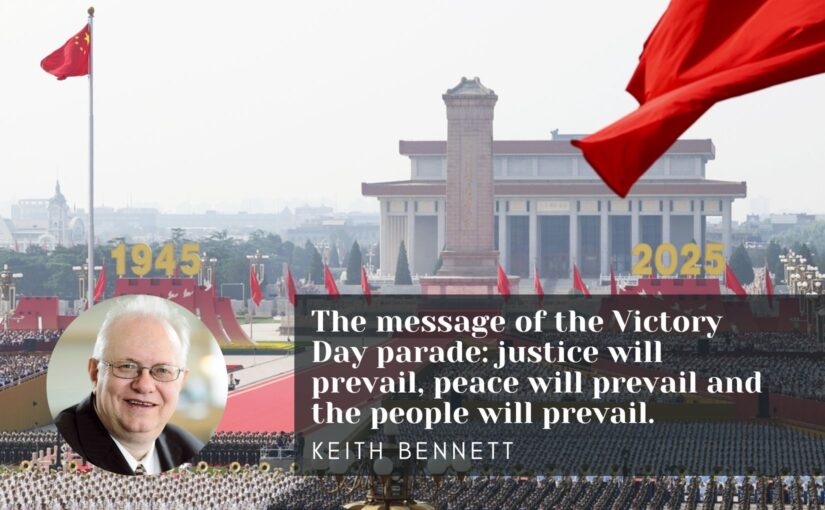
The message of the Victory Day parade: justice will prevail, peace will prevail and the people will prevail

In the following report, our co-editor Keith Bennett reflects on witnessing the grand parade in Beijing marking the 80th anniversary of China’s victory in the War of Resistance Against Japanese Aggression and the Global Anti-Fascist War.

Keith notes that the parade impressively showcased advanced military technology—ranging from hypersonic missiles and drones to nuclear-capable systems—demonstrating China’s defensive strength. Yet, the article stresses, China’s military power is not for domination but to safeguard the Chinese people and contribute to world peace.

President Xi’s address summed up the principal lesson of China’s victory: that justice will prevail, peace will prevail and the people will prevail. Keith observes:

That this vision enjoys ever greater support was shown by the presence of more than two dozen heads of state and government, along with numerous other dignitaries, the majority of them from the Global South, or Global Majority. This underlined, as did the largest ever gathering of the Shanghai Cooperation Organisation just two days previously, that the days when a handful of colonialist, imperialist or hegemonist powers could dominate world affairs have gone forever. If some countries choose to stay away from or seek to undermine this inexorable multipolar dynamic it will only precipitate their decline.

The article was also published by China Today and Morning Star, and is quoted extensively in China Daily.

To be able to witness the grand military parade marking the 80th anniversary of the victory of the Chinese People’s War of Resistance Against Japanese Aggression and the World Anti-Fascist War was an unforgettable experience.

As President Xi pointed out, this was the first complete victory won by the Chinese people in their struggle against foreign aggression and also made a major contribution to the triumph of the people of the world against fascism.

China had promised to show the world the advances in its defensive capabilities. And with an array of new equipment displayed for the first time, including nuclear-capable intercontinental ballistic missiles; a land, sea and air nuclear triad; all-weather hypersonic missiles; reconnaissance and strike drones; unmanned ship-based helicopters; advanced electronic counter-measure equipment; cyberspace warfare equipment; unmanned aerial vehicles; hypersonic anti-ship missiles; long range artillery and new generation tanks, among others, it certainly didn’t disappoint on that front.

But that was not all that left a lasting impression. Unlike some other countries, China’s military might is not there to dominate others, not to bully, oppress, occupy or exploit, but solely to provide a secure basis, a great wall of iron and steel, for the Chinese people to live a peaceful and happy life and to help secure, preserve and defend world peace.

In stark contrast to those who grotesquely speak of other countries being “on the menu”, President Xi again pledged his country to peaceful development. Only when nations across the world treat each other as equals and mutually support one another, he pointed out, can the root cause of war be eliminated, and can we prevent historical tragedies from recurring, by building a community of shared future for humanity.

The lesson of the great victory, he pointed out, was that justice will prevail, peace will prevail and the people will prevail.

That this vision enjoys ever greater support was shown by the presence of more than two dozen heads of state and government, along with numerous other dignitaries, the majority of them from the Global South, or Global Majority. This underlined, as did the largest ever gathering of the Shanghai Cooperation Organisation just two days previously, that the days when a handful of colonialist, imperialist or hegemonist powers could dominate world affairs have gone forever. If some countries choose to stay away from or seek to undermine this inexorable multipolar dynamic it will only precipitate their decline.

The western media may express consternation, whether real or feigned, at the foregrounding of Russian President Vladimir Putin and DPRK leader Kim Jong Un among the honoured foreign guests. They choose to overlook the undeniable fact that it was the peoples of China and the Soviet Union who made the greatest national sacrifice to rid the world of fascist barbarism and save human civilisation. And they equally choose to overlook that Kim Jong Un’s own grandfather fought shoulder-to-shoulder with his Chinese comrades-in-arms against the Japanese aggressors in northeast China. All this found poignant expression as the three leaders greeted war veterans together at the start of the ceremony.

Many other things touched me today. The culmination featuring the release of 80,000 doves and 80,000 multicoloured balloons, reminding us that everything China does is for the sake of peace.

The pride, passion and patriotism with which service men and women and civilians alike joined in singing the national anthem and the Ode to the Motherland.

As you would expect for an event of this scale, organisation was meticulous and logistics were complex but flawless. Security was, of course, necessarily tight. But unlike in any capitalist country none of the security personnel carried arms. And whilst they were there to assist people as much as anything else, they were by far outnumbered by the kind, self-confident and enthusiastic young women and men volunteers one encountered every few steps, on hand to offer whatever help anyone might need. Every one of them a credit to socialist China and a guarantee of its bright future. Every one of them able to realise their dreams thanks to the heroes and martyrs who laid down their lives 80 years ago.

Hawaiian independence party resists US war drive against China

The following is an interview by People’s Dispatch with Kawenaʻulaokalā Kapahua, of the Hawaiian independence party Hui Aloha ʻĀina (Hawaiian Patriotic League).

Kawena spoke to People’s Dispatch ahead of the People’s Summit for Korea, which took place in New York City, July 25-26.

“Our nations are caught in the middle,” of the massive US escalation in aggression towards China, said Kawena, who is the Political Education Chair for Hui Aloha ʻĀina. The party was founded in 1893 to resist the US occupation of Hawai’i. He says that the US drive towards war can in fact present “a major opportunity to start building, not just with ourselves in Hawai’i, but also with our Pacific comrades, neighbors, and cousins, to start fighting back… Our ocean is the frontline in this Cold War between China and the United States.”

Referring to the deleterious effect on his country of the escalating US confrontation with China, he adds: “Now as the military pivots towards confrontation with China, it’s also at the same time trying to extend and even expand its control of Hawaiian land through new land acquisitions, through the retention of current leases that are expiring.”

He also links the struggle of his people to that of the Palestinians:

“Israel cannot exist without the support of the United States. One of the ways that they offer support in addition to the military and stuff they get is training and military exercise involvement through the United States. RIMPAC is a great example of that. The largest military wargames that take place in the entire region, the largest naval war games on the planet, they’re called the Rim of the Pacific exercises. And yet Israel is always invited and always takes part… Contrary to whatever Zionist expansionist belief, Israel doesn’t have a Pacific coast. They have no tie to the region and yet are involved in this.”

Peoples Dispatch: What is the significance of anti-imperialism to the independence movement in Hawai’i?

Kawenaʻulaokalā Kapahua: US violence against the rest of the world is funneled through the Pacific. Not just Hawai’i, but Guam, and the Micronesian nations like Marshall Islands and Palau, as well as the Philippines. These end up becoming launching points for US imperialism. We’re operating both as a frontline and behind enemy lines, because the US military’s presence within our region is so massive.

The Indo-Pacific Command (INDOPACOM) is the largest military command on the planet. The US is pouring more and more resources into the Pacific every day. They’re moving more troops into the Pacific, more military equipment, and more weapons. This offers us an opportunity in the Pacific battle against that, because there are so many new weaknesses in their logistics supply chains that are being unveiled, and they’re starting to stretch themselves thin.

Military recruitment has been down for years at this point. It’s not going to go back up anytime soon, unless the US institutes a mandatory draft. We’re watching the fraying at the edges of this military apparatus.

Especially in Hawai’i, you’re starting to see the tide turn against this. The military has never been more unpopular, then maybe when they first invaded and took over, and the poisoning of the water via the Red Hill Bulk Fuel Storage Facility.

Continue reading Hawaiian independence party resists US war drive against China

British Defence Secretary threatens war with China

Britain’s  Defence Minister, the largely and justifiably unknown John Healey, has made an extraordinary threat to go to war with China over the question of Taiwan, an island province that Britain legally recognises – not least according to the bilateral agreement concluded in 1972 between the two countries that elevated their diplomatic relations to ambassadorial level – as part of China.

Speaking on board the HMS Prince of Wales aircraft carrier, after it had docked in the north Australian port of Darwin, where it is to join the United States and other countries in the warmongering Talisman Sabre exercises largely aimed at China, Healey was asked by the right wing Telegraph newspaper, “what the UK is doing to help countries like Taiwan to prepare for potential escalation from China, Mr Healey said: ‘If we have to fight, as we have done in the past, Australia and the UK are nations that will fight together. We exercise together and by exercising together and being more ready to fight, we deter better together.’”

The HMS Prince of Wales is on a nine-month deployment to the Pacific region and is widely expected to sail through the Taiwan Strait around upcoming visits to Japan and South Korea. Already, the Royal Navy provocatively sailed the HMS Spey warship through China’s Taiwan Strait on June 18. It was the first such incident in four years.

Never one to miss out on a free trip, David Lammy, Britain’s equally preposterous Foreign Secretary, accompanied Healey. He has previously said that the UK plans to conduct more so-called “freedom of navigation operations” in the Taiwan Strait.

Further underlining the gravity of the situation, the Labour supporting Mirror newspaper noted:

“In April, Keir Starmer met the crew onboard HMS Prince of Wales during an overnight stay ahead of their voyage. The PM said the mission showed the UK’s ‘leadership on global issues and security and defence’.

“‘We all know that the world is more uncertain than it felt a few months or years before – we’re in a new era,’ Mr Starmer said at the time. ‘We are sending a clear message of strength to our adversaries, and a message of unity and purpose to our allies.’”

As with most, if not all, members of the current British government, it is difficult to fathom whether Healey’s outburst represents blood-curdling bellicosity, strategic myopia, rank ignorance and stupidity, gross irresponsibility, or just plain inexperience. However, the smart money is likely to be on any combination of all of the above.

In an editorial response, the Morning Star noted that: “British troops will be engaged in provocative manoeuvres viewed by Beijing as part of Washington’s bid to encircle it militarily. That is itself part of a wider US strategy to derail China’s rise… That is the overarching war game in which Operation Talisman Sabre takes place. Britain should have no part in it.”

China’s Global Times was more hard-hitting, noting that: “Chinese observers slammed the blatant remarks over China’s internal affair, saying it was a show of residual British colonial mentality.”

It added: “Observers also pointed out that, amid warming China-Australia relations highlighted by the Australian Prime Minister’s successful July visit to China, the British defence official’s remarks attempt to place Canberra in a difficult position. Full alignment with the UK and the US is not a wise choice.”

A spokesperson for the Chinese Embassy in London was direct and to the point:

“If the said report is true, I am sure the UK official will regret having said that. China will never allow anyone to separate Taiwan from China in any way. Nor will China allow any external forces, the UK and Australia included, to undermine our efforts for complete reunification.”

Earlier, on July 25, the spokesperson responded to Foreign Secretary Lammy and Yvette Cooper, the tinpot totalitarian Home Secretary, having issued a joint statement making unwarranted comments on the law enforcement action taken by the Hong Kong SAR police against anti-China disruptors who have fled abroad:

“Hong Kong is China’s Hong Kong, and Hong Kong affairs are purely China’s internal affairs. China urges the UK to abandon its colonial mentality, stop interfering in Hong Kong affairs, cease meddling in China’s internal affairs, stop shielding criminals, and refrain from going further down the wrong path.”

Prior to Healey’s outburst, on 25 July 2025, the Chinese Embassy in the UK held a reception celebrating the 98th anniversary of the founding of the People’s Liberation Army of China. Ambassador Zheng Zeguang pointed out in his speech that this year marks the 80th anniversary of the recovery of Taiwan. Taiwan has been an inalienable part of China’s territory since ancient times. Both the Cairo Declaration and the Potsdam Proclamation, issued by major victorious nations of WWII, including China and the UK, stated in explicit terms that Taiwan is a territory that Japan had stolen from the Chinese, and shall be restored to China. All these instruments have confirmed China’s sovereignty over Taiwan and formed an important part of the post-WWII international order. 

The Ambassador further emphasised that the Chinese people and their armed forces will never allow anyone to separate Taiwan from China in any way. Nor will they allow any external forces to undermine their efforts for complete reunification. All countries having diplomatic ties with China must properly handle Taiwan-related issues, which is key to the smooth development of bilateral relations with China.

Zheng Zeguang also noted that this year marks the 80th anniversary of the victory in the Chinese People’s War of Resistance Against Japanese Aggression and the World Anti-Fascist War. More than 80 years ago, the peoples of China and the UK fought valiantly against fascist aggression on the main Eastern Front and the European battlefield, making enormous contributions to the global victory against fascism. China’s fight was the earliest to begin, and the longest-lasting. The Chinese people suffered the most significant human and material losses before ultimately defeating Japanese aggressors.

Ambassador Zheng emphasised that it should never be forgotten that China and the UK were allies and fought shoulder to shoulder during the war. That part of history has left behind many touching stories of solidarity and mutual support in the flames of war. In 1942, Chinese fishermen from Zhoushan risked their own lives under Japanese gunfire to save 384 British prisoners of war on board Lisbon Maru, which was mistakenly torpedoed by a US submarine. Also in 1942, the Chinese Expeditionary Force successfully rescued British troops besieged by the Japanese army in Myanmar. In 1938, George Hogg, a young Briton, travelled thousands of miles to China, where he established schools, aided orphaned children and gave his life for the Chinese people’s righteous cause. We should remember history, honour those fallen heroes, cherish peace and strive for a better future.

The reception was attended by nearly 300 guests.

In characteristically pugilistic terms, George Galloway responded to Healey in his MOATS (Mother of all Talk Shows) broadcast.

Denouncing his remarks as madness, George noted that Britain, a bankrupt and broken country that has given billions to the ‘thief of Kiev’ and spends millions on reconnaissance flights to facilitate the Gaza genocide, was now threatening China with war. Referring to the 1949 Amethyst Incident, George recalled that the last time Britain had ‘sailed a gunboat up the Yangzi [river]’, the Chinese had sunk it. And China is now a far more powerful country than it was 76 years ago.

Noting the contempt shown for democracy, as highlighted by the fact that Britain’s rubber stamp parliament had not even been consulted or informed, George addressed Healey: “You little runt are threatening China with war.” A man who had never heard a shot fired in anger in his miserable life was threatening a war to be waged at the expense of the British people “and with the blood of your sons and daughters.”

Continue reading British Defence Secretary threatens war with China
Hegseth demands Indo-Pacific allies escalate military spending, prepare for war on China

In this article for Struggle La Lucha, Gary Wilson critiques US Defence Secretary Pete Hegseth’s speech at the recent Shangri-La Dialogue, in which Hegseth urged the US’s regional allies to ramp up military spending in preparation for possible war with China.

Hegseth claimed in his speech that Beijing is preparing to wage war in order to reunite Taiwan Province with the mainland, declaring that “the threat China poses is real, and it could be imminent”. Gary writes:

Hegseth and the Trump administration are attempting to recast China’s efforts to maintain national sovereignty as “aggression,” while portraying US military escalation in China’s immediate periphery as defensive. It’s a textbook example of how imperialism inverts reality.

The article notes that Washington in recent years has been persistently undermining the One China policy, through arms sales, military training, naval patrols, intelligence sharing, and diplomatic efforts that treat Taiwan as an independent state. “All of this raises the stakes deliberately. The US is trying to provoke a response from China, just as it did with Russia over NATO’s expansion to Ukraine. In essence, what Hegseth is demanding is a US military takeover of China’s Taiwan — disguised as ‘defending democracy.'”

The article situates these moves within a broader trend: the US’s global war strategy, including support for war in Ukraine and Israel’s assault on Gaza, all components of the US-led response to the crisis of capitalism. As China’s technological and economic rise challenges US hegemony, Gary warns the US is increasingly willing to risk catastrophic war — including nuclear confrontation — to maintain its dominance.

Listing the numerous ways in which the US is escalating its longstanding campaign of encirclement and containment of China, the article concludes:

The Trump administration is determined to strangle China’s rise — by war if necessary. This is not a defensive strategy. It is a conscious plan to preserve U.S. global supremacy, even if it risks nuclear war.

At the annual Shangri-La Dialogue in Singapore on May 31, U.S. Defense Secretary Pete Hegseth delivered an ultimatum to Washington’s Indo-Pacific allies: Escalate your military spending and prepare for imminent war with China.

Framing China as the aggressor, Hegseth accused Beijing of seeking “hegemony in Asia” and warned that a Chinese move on Taiwan would bring “devastating consequences for the Indo-Pacific and the world.” “There’s no reason to sugarcoat it,” he declared. “The threat China poses is real. And it could be imminent.”

Please note that Taiwan is internationally recognized as part of the People’s Republic of China. Under the One China policy, the United States officially acknowledges this. Since the 1970s, the U.S. has agreed not to recognize Taiwan as a separate state. 

So when U.S. Defense Secretary Pete Hegseth speaks of preparing for war over Taiwan, what he’s really advocating is: a U.S. military intervention to take away a province of China.

This is akin to China threatening war if the U.S. deployed troops to Long Island, N.Y. or Isle Royale in Lake Superior on Canada’s border. 

Hegseth and the Trump administration are attempting to recast China’s efforts to maintain national sovereignty as “aggression,” while portraying U.S. military escalation in China’s immediate periphery as defensive. It’s a textbook example of how imperialism inverts reality.

Furthermore, the U.S. has systematically undermined the One China framework by increasing arms sales to Taiwan, sending high-level officials to visit the island’s capital, Taipei, stationing American troops and conducting joint military training there, and encouraging Taiwanese political figures who flirt with formal declarations of independence.

In addition to arms sales and military visits, the U.S. has steadily undermined the One China policy through a range of provocative actions. These include expanding intelligence sharing and joint military planning with Taiwan, increasing naval and air patrols near the island, and passing legislation to deepen official ties. The U.S. has also promoted Taiwan’s participation in international organizations, supported the development of its domestic arms industry, and formalized trade agreements that treat Taiwan as a separate entity. Collectively, these moves aim to transform Taiwan into a U.S. military and economic outpost, escalating tensions with China and pushing the region closer to open conflict.

All of this raises the stakes deliberately. The U.S. is trying to provoke a response from China, just as it did with Russia over NATO’s expansion to Ukraine. In essence, what Hegseth is demanding is a U.S. military takeover of China’s Taiwan — disguised as “defending democracy.”

Continue reading Hegseth demands Indo-Pacific allies escalate military spending, prepare for war on China

From containment to confrontation, from cold to hot: the US drive to war on China

In the following article, Friends of Socialist China co-editor Carlos Martinez argues that the US-led New Cold War against China is failing. Despite extensive efforts to contain China’s rise – through tariffs, sanctions, and attempts at economic decoupling – China continues to grow economically and technologically. It now leads globally in multiple areas including renewable energy, electric vehicles, and advanced manufacturing. Its global reach is expanding, as evidenced by its central role in BRICS, the Belt and Road Initiative, and its status as the top trading partner for three-quarters of the world’s countries.

The West’s tariffs and sanctions have clearly backfired, invigorating China’s domestic industries rather than weakening them.

However, Carlos warns that the failure of “cold” methods could well provoke a shift toward direct military confrontation. The article identifies Taiwan as the most likely flashpoint, with the US escalating arms sales to the island and increasing its military deployments in the region. In the last two decades, successive US administrations, Democratic and Republican alike, have undermined the One China policy and fanned separatist sentiment, in defiance of international law.

Military preparations, including AUKUS, the rearmament of Japan, and new US bases in the Philippines, reflect a growing bipartisan consensus in Washington in favour of war planning.

This all adds up to accelerating preparations for war with China – a war with the objective of dismantling Chinese socialism, establishing a comprador regime (or set of regimes), privatising China’s economy, rolling back the extraordinary advances of the Chinese working class and peasantry, and replacing common prosperity with common destitution. Needless to say, this would be disastrous not just for the Chinese people but for the entire global working class.

Carlos calls for resolute opposition to this dangerous escalation.

The New Cold War is not working

The US-led ‘cold’ war against China is manifestly failing in its objectives of suppressing China’s rise and weakening its global influence.

China’s economy continues to grow steadily. In purchasing power parity (PPP) terms, it is by now the largest in the world. Its mobilisation of extraordinary resources to break out of underdevelopment and become a science and technology superpower appears to be paying substantial dividends, with the country establishing a clear lead globally in renewable energy, electric vehicles, telecommunications, advanced manufacturing, infrastructure construction and more. It is by far the global leader in poverty alleviation and sustainable development. Sanctions on semiconductor exports have not slowed down China’s progress in computing, and indeed have had an enzymatic effect on its domestic chip industry. The spectacular success of DeepSeek’s open-source R1 large language model indicates that the US can no longer take its leadership in the digital realm for granted.

Meanwhile, the West’s attempts to ‘decouple’ from China have yielded precious little fruit. While a handful of imperialist countries have promised to remove Huawei from their network infrastructure, and while sanctions on Chinese electric vehicles mean that consumers in the West have to pay obscene sums for inferior quality cars, China’s integration and mutually-beneficial cooperation with the world has continued to expand. China is the largest trading partner of approximately two-thirds of the world’s countries. Over 150 states are signed up to the Belt and Road Initiative. China lies at the core of BRICS and the Shanghai Cooperation Organisation.

Trump’s tariffs were meant to coerce China into accepting the US’s trade terms and to force other countries to unambiguously join Washington’s economic and geopolitical ‘camp’, thereby alienating China. Nothing of the sort has taken place. Even the normally supine European Union has denounced the tariffs and signalled its intention to expand trade with China.

In summary, the Project for a New American Century is not going well. Zbigniew Brzezinski famously wrote in his The Grand Chessboard: American Primacy and its Geostrategic Imperatives (1997) that “the most dangerous scenario would be a grand coalition of China, Russia, and perhaps Iran, an ‘anti-hegemonic’ coalition united not by ideology but by complementary grievances.” Precisely such an anti-hegemonic coalition exists, and is uniting the countries of Asia, Africa, Latin America, the Caribbean and the Pacific in a project of building a multipolar future, thereby posing an existential challenge to the so-called ‘rules-based international order’ based on the principles of unilateralism, war, destabilisation, coercion and unequal exchange.

Continue reading From containment to confrontation, from cold to hot: the US drive to war on China

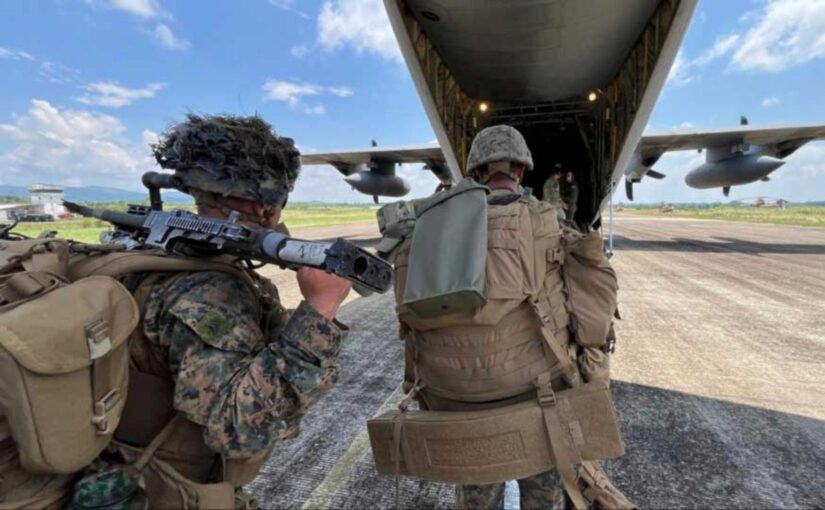
US war on China, a long time coming

The following article by W. T. Whitney Jr, originally published in People’s World, connects the Trump administration’s hostility towards China back to the US-led campaign of containment and encirclement starting in 1949 with the proclamation of the People’s Republic.

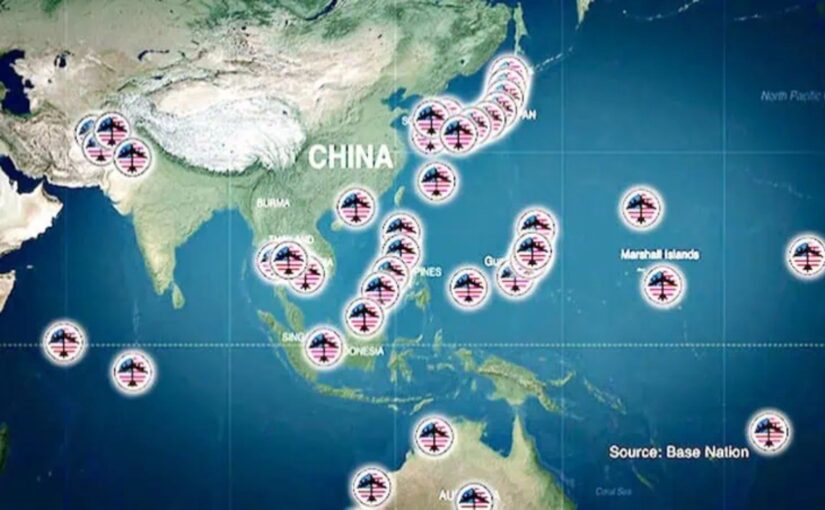
While the current state of relations between the two countries is often described as a New Cold War, Whitney points out that it has a significant military component, with 400 US bases surrounding China with ships, missiles and troops. Furthermore, “US allies in the Western Pacific—Japan and South Korea in the North, Australia and Indonesia in the South, and The Philippines and various islands in between—have long hosted U.S. military installations and/or troop deployments. Nuclear-capable planes and vessels are at the ready. US Navy and Air Force units regularly carry out joint training exercises with the militaries of other nations.”

Vast investment is being ploughed into weapons development in the US, and Trump-supporting producers of advanced modern weaponry (such as Peter Thiel) “exert sufficient influence over government decision-making to ensure happy times for the new breed of weapon producers”.

The article concludes with a call for the anti-war movement in the West to step up in its opposition to war on China, and its efforts to build stronger people-to-people links between the West and China:

Will resistance to war against China end up stronger and more effective than earlier anti-war mobilizations in the post-Vietnam War era?  A first step toward resisting would be to build awareness of the reality that war with China may come soon. General knowledge of relevant history should be broadened, with emphasis on how U.S. imperialism works and on its capitalist origins. Anyone standing up for peace and no war ought to be reaching out in solidarity with socialist China.

Despite all the hype about a possible “breakthrough” in the U.S.’ trade war with China due to Trump’s tariff retreats, the reality is that the movement toward an actual war with China accelerates.

The public, focused on troubles currently upending U.S. politics, does not pay much attention to a war that has actually been on the way for decades.

The watershed moment of course came all the way back in 1949 with the victory of China’s socialist revolution. Amid resurgent anti-communism in the United States, accusations flourished of “who ‘lost’ China.”

Loss in U.S. eyes happened in China with the dawning of national independence and promise of social change. In 1946, a year after the Japanese war ended, U.S. Marines, allied with Chinese Nationalist forces, the Kuomintang, were fighting the People’s Liberation Army in Northeast China.

The U.S. government that year was delaying the return home of troops who fought against Japan. Soldier Erwin Marquit, participant in “mutinies” opposing the delay, explained that the U.S. wanted to “keep open the option of intervention by U.S. troops … [to support] the determination of imperialist powers to hold on to their colonies and neocolonies,” China being one of these.

Continue reading US war on China, a long time coming