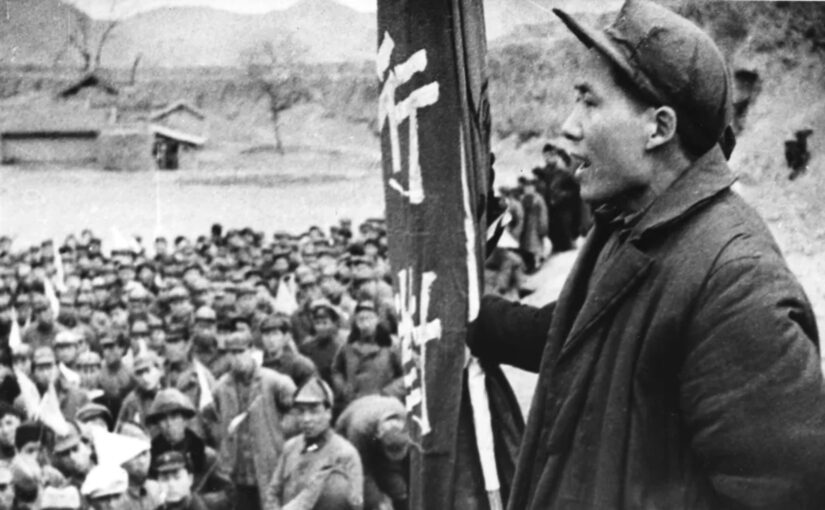
The following is a series of five articles, originally published in the Morning Star, and written by Jenny Clegg to introduce her recently published book, ‘Storming the Heavens: Peasants and Revolution in China, 1925-1949 Viewed Through a Marxist Lens’.
Introducing the key themes of the book, which began life as her PhD thesis some decades previously, Jenny notes that: “The first step was to establish the condition of the peasants and the nature of their exploitation so as to identify their revolutionary character. This meant challenging the Western misconception of China as a society of owner-cultivators, farming small parcels of land. In the absence of the large landed estates of European feudalism, it was assumed that traditional China had a peculiar Oriental or Asiatic structure under a centralised bureaucratic state.
“Chinese Marxists, Chen Boda and Chen Hanseng, however, both put the landlord system at the centre as the determining factor in China’s economic stagnation and the peasants’ acute impoverishment. Whilst Chen Hanseng’s focus was on the fusion of the political and economic power of the landlords at the base of society, highlighting the grassroots nature of a revolutionary transformation, Chen Boda’s analysis of monopoly rent highlighted the concentration of land in the hands of a minority, the landlords and rich peasants, with the increasing dispossession and land hunger of the majority of rural households. In so doing, he identified the main force for revolution as the poor and middle peasant majority.”
She goes on to argue that the key question was therefore, given the small size of China’s working class, how was the Communist Party of China (CPC), as a proletarian party, able to lead the revolution?
Here she sees her argument as confronting the misconceptions of both Stalin and Trotsky who interpreted China’s peasant struggle along the lines of the Russian and European model where a rural bourgeoisie and proletariat emerged to challenge feudal power, when rather, as shown by Chen Boda, it was land hunger — subsistence — that drove the rural majority to revolution.
In her second article, Jenny tackles the inter-related questions of was China feudal and what made the peasants revolutionary.
Having noted the work of contemporary Western scholars such as RH Tawney, who saw a way out through reforms, she argues:
“To support the argument of revolution over reform, it was first necessary to establish the centrality of the landlord-peasant relationship with feudal relations as the major constraint of growth. This would then demonstrate the centrality of the peasant movement as the main force in China’s democratic revolution, in a grassroots transformation of Chinese society through radical land reform to completely eradicate feudal relations.
“The problem of the reform approach lies in the failure to identity those power structures and interests hostile to its agenda for change and at the same time to find allies capable of driving reforms forward.”
Jenny further tackles the twin issues of why was capitalism unable to develop in China as it had in Europe and why did peasant rebellions tend to end in failure:
“The answer lies in the way Chinese feudalism was shaped by Asiatic characteristics: while landlords served as mediators between the centralised bureaucratic state and the patriarchal villages, these features served equally to maintain their privileged position from above and below…
“In China then, unlike Europe, where commerce confronted landed interests from the cities, economic power accumulated in the hands of a trinity of urban-based landlord-merchant-officials and the development of market relations instead of releasing peasant independence led to increasing rural impoverishment. A parasitic relationship between town and country suffocated the ‘sprouts of capitalism’ ensnaring a potentially entrepreneurial rich peasantry in feudal relations.
“Imperialism accelerated commercialisation but this only strengthened the landlord economy, while in turn the imperialist powers, to secure the drain of the surplus to the world capitalist core, depended on the landlords both to extract the surplus by extra-economic means and to control the countryside.”
Through trial and error, she concludes, “the CPC came to grasp [that] the forces of revolutionary change were not a rising petty bourgeoise but the impoverished mass of poor and middle peasants, more interested in the confiscation of landlords’ land to meet their needs than in the preservation of private property.”
In her third article, Jenny looks at debates on the role of peasants in revolution starting with Russian revolutionary leader VI Lenin.
She explains that Lenin saw the peasants, as a whole, as a force against landlordism but with the bourgeoisie and proletariat struggling for leadership of the movement. The role of the vanguard proletarian party was then to mobilise the poor peasants so as to pave the way to socialism. For the neo-narodniks on the other hand it was the traditional village organisation, the mir, that provided the basis for a Russian-style socialism, and continues:
“In China, the question of how to build a Communist Party in a country predominantly of peasants with a weak working-class base, is clearly a challenging one to answer. Was Mao just a peasant leader, and the CPC a populist party which rode to power on a wave of peasant unrest, as many in the West, both Sinologists and Marxists, have argued?”
On the contrary: “Mao, following Lenin, was to argue in his early ‘Analysis of Classes in Chinese Society’ (1926) that the peasants were the largest ally of the proletariat. Observing the peasants organising in Hunan just months later, he was the first to grasp the significance of peasant power: although at first their demands for rent reductions were not that radical, he saw, as they paraded the landlords up and down in dunces’ caps, a bold challenge to the authority of landlord power.”
Continue reading Storming the heavens – a master class in revolution