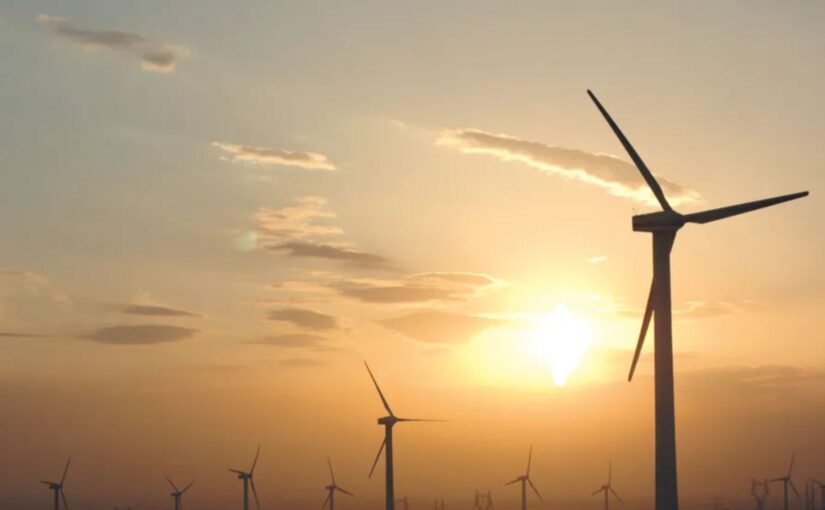
In the following article written for the Morning Star, Nick Matthews highlights a major breakthrough in the battle against climate catastrophe: China’s clean energy transition has led to a net reduction in carbon emissions, in spite of the fact that China’s economy and its energy demand continue to grow.
Drawing on data from the well-regarded Carbon Brief website, he reports that in the first quarter of 2025, China’s CO₂ emissions fell by 1.6 percent year-on-year, driven largely by a 5.8 percent drop in emissions from the power sector. This marks the first time China’s emissions have decreased due to expanded clean energy capacity, rather than reduced energy demand (as happened during the Covid-19 pandemic).
Nick notes that electrification of transport and heating is accelerating, with electricity demand from EV charging and battery swapping services growing by 78 percent in 2023 – 3.5 times more than the rest of the world combined. China now leads globally not only in electric cars, but also in electric vans, buses, two-wheelers and heat pumps.
This energy shift has taken many experts by surprise, and has a clear global impact. Nick cites the historian Adam Tooze as saying: “China’s huge surge in renewable energy, above all in solar power, actually puts us on track for the first time to meet these objectives”
Major challenges remain for China’s project of ecological civilisation – especially grid restructuring and balancing renewable supply – but reaching the goal of peak emissions several years ahead of the 2030 target can be considered a turning point. The country’s rapid clean energy development shows that with the political will – which is of course a function of a socialist political structure – a sustainable future is entirely possible.
While most news this year has been nothing short of bleak, we have had a piece of news that is of world historical significance. I am not sure how many Morning Star readers are regular readers of the Carbon Brief, a British website that covers the latest developments in climate science, climate policy and energy policy.
The news I am referring to not that the British output of solar energy this year has increased by 42 per cent due to the driest spring on record, welcome as that is. The even better news was: “For the first time, the growth in China’s clean power generation has caused the nation’s carbon dioxide (CO2) emissions to fall despite rapid power demand growth.
“The new analysis for Carbon Brief shows that China’s emissions were down 1.6 per cent year-on-year in the first quarter of 2025 and by 1 per cent in the latest 12 months. Electricity supply from new wind, solar and nuclear capacity was enough to cut coal-power output even as demand surged, whereas previous falls were due to weak growth.”
The reduction in China’s first-quarter CO2 emissions in 2025 was due to a 5.8 per cent drop in the power sector. While power demand grew by 2.5 per cent overall, there was a 4.7 per cent drop in thermal power generation, mainly coal and gas.
Increases in solar, wind and nuclear power generation, driven by investments in new generating capacity, more than covered the growth in demand. The increase in hydropower, which is more related to seasonal variation, helped push down fossil power generation.
This is not some small country making the clean energy transition. This is the world’s largest manufacturing economy.
China is way ahead in electrifying heating and transport, and building electrolyser capacity. In 2023, China’s electricity demand from the charging and battery swapping service industry grew by 78 per cent and added an estimated 56 TWh to China’s electricity demand, 3.5 times more than the rest of the world.
What that means is measured in terms of power consumed. China’s electrification of road transport is 3.5 times larger than that of the rest of the world put together.
It is this revolution that has Western governments and automakers in a panic. China accounts for 60 per cent of the world’s electric light-vehicle sales, but this segment represents only an estimated 18 TWh of the 56 TWh demand increase, with the rest coming from electric vans, trucks, buses and two-wheelers, which China dominates globally. It is also the largest heat pump market in the world, with more installations per year than any other country.
The significance of this news is hard to overestimate. At Cop28 in 2023, many countries around the world committed to tripling global renewable electricity capacity by 2030. If undertaken, this has the potential to almost halve power sector emissions by 2030, as coal-fired power generation will be replaced first. Furthermore, it will provide enough new electricity to drive forward the electrification of transport, home and industrial heating with a 32 per cent increase in electricity demand.
Many thought that this was something of a pipedream. But as leading economic historian Adam Tooze has said: “China’s huge surge in renewable energy, above all in solar power, actually puts us on track for the first time to meet these objectives.”
As the clean energy think tank Ember reports, it has taken experts around the world by surprise. What we are witnessing is the most rapid take-up of a significant energy technology in history.
It’s worth looking in detail at what China is achieving. The Carbon Brief report by Lauri Myllyvirta, lead analyst at the Centre for Research on Energy and Clean Air and senior fellow at the Asia Society Policy Institute, goes into a lot of detail and is well evidenced.
We are not quite on the road to a carbon-neutral world, as Ember points out, the drama of green electrification is only just beginning. It is one thing to replace dirty power generation for existing uses with solar and wind. It is another to build out the entire electricity system to meet the new demands for electricity in data-processing, transport, domestic and industrial uses.
The challenges of switching to renewables and the restructuring of energy grids have only just begun, and balancing supply across a myriad of renewable sources clearly represents a significant challenge. China’s example, however, shows that with political will, it is possible. So mark May 2025 in your calendar; thanks to China, we can now see the outline of what a carbon-free energy future looks like.





