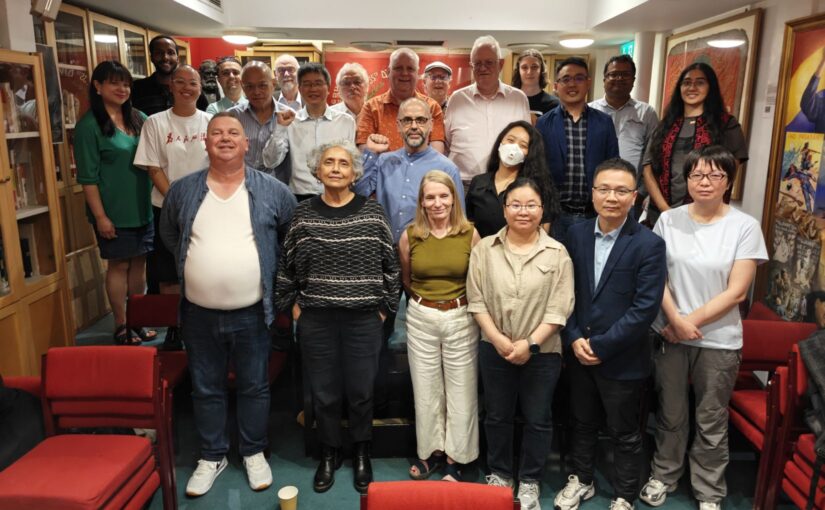
On 15 July 2025, Friends of Socialist China, in collaboration with the International Manifesto Group and the Communist Party of Britain, hosted a round-table discussion with a delegation from the Academy of Marxism at the Chinese Academy of Social Sciences (CASS) at London’s Marx Memorial Library.
Introducing the discussion, Friends of Socialist China co-editor Carlos Martinez noted that the Academy of Marxism is the leading Marxist think tank in China, and that it plays an important role in developing the ideological principles underpinning policymaking in China. He emphasised the importance of engaging with Chinese Marxists, who are making some of the most important contributions to the development of Marxism in the 21st century. Carlos also highlighted the need for people-to-people ties, at a time when Western governments are pursuing policies of containment, encirclement, decoupling and New Cold War.
The five delegates from CASS were led by Professor Chen Zhigang, Vice President of the Academy of Marxism, who gave a detailed presentation on the development of Chinese Marxism, stating that it’s because of Marxism that China has been able to achieve remarkable successes. Chen discussed the meaning and relevance of Xi Jinping Thought, as the latest development of Marxism in China; a Marxism adapted to the conditions prevailing in the 21st century and the array of new challenges that present themselves.
Professor Chen pointed to what should be a well-understood and obvious truth: that as society develops, theory must develop along with it. “If Marxism does not evolve, its vitality will be limited”. He also noted that Socialism with Chinese Characteristics has thrived by combining Marxist ideas with Chinese culture and traditions, hence Chinese people do not think of Marxism as a foreign phenomenon.
Regarding the global applicability of Xi Jinping Thought, Chen said that China seeks to offer Chinese wisdom towards the solution of problems of global governance. The concept of a Global Community of Shared Future, the Belt and Road Initiative, the Global Development Initiative, the Global Civilisation Initiative and the Global Security Initiative are all based on the principles of mutual learning, exchanges and dialogue, and all seek to promote peace, sustainability, development, cooperation and friendship.
The discussion then opened up to the 20 British participants. There was a rich and lively exchange of ideas, with contributions on topics including how to cultivate a new generation of Marxist thinkers; the need to overcome dollar hegemony; the significance of the concept of Common Prosperity; the relevance of China’s development model for the Global South; China’s foreign policy; the need to develop a more profound understanding of Chinese socialism in the West; and the reasons why socialist revolution has succeeded first in relatively underdeveloped countries rather than the advanced capitalist countries of Western Europe and North America.
Following the discussion, the CASS delegation was given a tour of the Marx Memorial Library, after which the delegates joined the British comrades for a dinner at Hiba Palestinian restaurant in London.
The following is a short report by Bhabani Shankar Nayak, who participated in the discussion.
An Evening with Chinese Comrades in London
As dusk settled over the cloudy British sky above London, summer humidity lingered in the air, clinging to the busy streets and concrete jungle of a decadent city shaped by colonial legacies, capitalist wealth and imperialist power. A few drops of rain brought a sense of calm to a mind otherwise clouded by the busyness of the day. Comrades gathered to reflect on developments in China, aiming to demystify the anti-Chinese propaganda that seeks to undermine the revolutionary achievements of the Chinese people and to expose the hypocrisy of Western capitalist development models, which prioritise profit over people.
The media trials and various forms of anti-Chinese propaganda reveal the racist, colonial, capitalist and imperialist character of American, British and European capitalism and their ruling elites. They prefer to see China as merely the world’s factory and the Chinese people as passive workers, incapable of developing revolutionary consciousness for their own emancipation. As a result, Western media and its backers promote fraudulent and illiberal visions of democracy, wrapped in the illusion of individual freedom and the delirium of the American Dream. In contrast, the Chinese system promotes a form of decentralised working-class democracy that guides China’s unique path of democratic, socialist and peaceful development. At the heart of this system—led by the Communist Party of China—is the pursuit of human emancipation from poverty, hunger, homelessness, illiteracy, unemployment, insecurity, and everyday risks.
On 15th of July 2025, Friends of Socialist China in the UK, led by Comrade Carlos Martinez and Comrade Keith Bennett, organised a roundtable at the Marx Memorial Library in London. The event brought together comrades, researchers, and professors from the Institute of Marxism at the Chinese Academy of Social Sciences (CASS)—a research institution established by the Communist Party of China (CPC) in 2005. Comrade Professor Chen Zhigang, Vice President of the Institute, led the discussion, offering valuable insights into the workings of the CPC and its role in China’s development. He addressed the challenges facing rural development in China and elaborated on the concept of socialism with Chinese characteristics, the guiding principles of Xi Jinping thoughts, and its fundamental opposition to the Western model of globalisation and imperialist agendas. Professor Chen advocated for a model of inclusive globalisation that benefits all nations.
Throughout the discussion, he reiterated China’s commitment to building an ecological civilisation grounded in world peace and inclusive development. Comrade Han Dongjun translated Professor Chen’s remarks, while comrades Liu Yan, Fang Tao, and Zhuo Mingliang highlighted various achievements of China under the leadership of the CPC.
During the roundtable, comrades from the UK posed a range of ideological questions on various issues, which were thoughtfully addressed by the delegates from CASS. The discussion concluded with a shared commitment to developing and coordinating a new generation of Marxist thinkers, intellectuals, and organisations dedicated to the empowerment and emancipation of working people around the world. It was agreed that more such exchanges should be organised to help the Western left gain a deeper understanding of Chinese socialism and its revolutionary praxis.
The roundtable concluded at the Hiba Restaurant in Holborn, where the Chinese comrades shared their revolutionary praxis in a relaxed social setting over generous portions of Palestinian and Lebanese food, accompanied by Gaza Cola drinks, real ales, and a few bottles of white and red wine. The Chinese comrades represented a range of age groups and held various political and professional positions within their organisational hierarchy. Yet, there was absolutely no observable power distance among them. They interacted with one another as equals—with warmth, confidence, and camaraderie—sharing food and conversation as comrades and friends. This experience laid bare the hollowness of Hofstede’s cultural dimensions, which are widely taught in universities around the world. These frameworks are not only flawed but stem from a supercilious, Eurocentric misreading of Chinese society, politics, and culture. The revolutionary praxis of the Communist Party of China has transformed a historically feudal, unequal and poverty ridden society into one that is modern, progressive, prosperous, and fundamentally egalitarian.
This revolutionary praxis has enabled China to emerge as a bankable state for the working poor in both rural and urban areas, while offering emancipatory hope to working people around the world. From toys to supercomputers, from agricultural science to space technology, from needles to iPhones, and from modern medicine to traditional and alternative health practices, China’s development demonstrates that there is a viable alternative to capitalism, imperialism, and their hegemonic control over people and the planet. Yet, imperialist powers and their capitalist regimes remain determined and working actively every day to undermine China, its people, and their revolutionary achievements.
As the evening came to an end and we prepared to leave Hiba Restaurant, Comrade Professor Chen and Comrade Zhuo Mingliang warmly wished, “Goodbye, comrade,” followed by the words, “Long live Indo-China friendship.” This self-reflective, harmonious and memorable evening with Chinese comrades in London renewed the collective commitment to the revolutionary and emancipatory politics of the working class—and to the belief in its potential to offer a genuine alternative to racialised capitalism and its warmongering, imperialist hegemony, which undermine peace and disempower people. In contrast, China stands as a model of peaceful and progressive development, dedicated to the empowerment and emancipation of working people.






Thank you FOSC, for this inspiring gathering cum story. It is good to remind ourselves how China has been able to overcome adversity and one hundred years of humiliation.
Throughout our human journey, being communistic was our primal material cum spiritual condition and being communistic will by definition be the material and spiritual condition of our individual cum species’ grand finale. More simply put, at the beginning of our human journey we are born into the commons, while at the end of our human journey we return to the commons. Everything within these two communistic epochs of our human story is but a constant, progressive struggle with resistance; a struggle that was rigorously studied and scientifically described by Marx and Engels as a material dialectic evolution of human development and consciousness; a constant process of struggle that we humans must consistently learn from in order to overcome all sort of artificial geo-political tensions, ideologies, religions and illusions along the way. Thanks to the likes of Confucius, Marx, Lenin and Mao, China knows this better than most.
I am a big fan of modern China and try to learn as much as possible. But I need to hear more in-depth discussion about labor relations, domestic and foreign. Western media heavily report abuses and I miss responses to that. I want to know about Marxist-oriented struggles on the matter of private capital in the Chinese economy. Why has the Party allowed capitalists to enter it? It seems like a contradiction. Some readings specifically on the internal struggle would be helpful.