China and Senegal reaffirm solidarity

Prime Minister of Senegal Ousmane Sonko met separately in Beijing on June 27 with Chinese President Xi Jinping and Premier Li Qiang. Sonko was visiting China to attend the 2025 ‘Summer Davos’ in Tianjin.

Xi said that last September, he co-chaired the 2024 Summit of the Forum on China-Africa Cooperation (FOCAC) in Beijing, together with Senegalese President Bassirou Diomaye Faye, leading China-Africa relations into a new phase of jointly building an all-weather China-Africa community with a shared future for the new era.

Noting that China and Senegal are companions on the path to development and revitalisation as well as good brothers, he added that China is willing to work with Senegal to strengthen solidarity and cooperation, deepen their comprehensive strategic cooperative partnership, bring more benefits to the two peoples, and inject fresh impetus into China-Africa friendship and Global South cooperation. China and Senegal should firmly support each other in pursuing independent development paths and enhance exchanges among the two countries’ political parties. China stands ready to work closely with Senegal to advance the 10 China-Africa partnership actions for jointly advancing modernisation and implement more projects for people’s well-being.

Sonko conveyed President Faye’s sincere greetings to Xi. He said China is a reliable partner for Senegal, and the bilateral ties have featured mutual respect, mutual support, resilience and stability, with sound progress made in various fields of cooperation. Noting that the two countries, both as members of the Global South, share common values and aspirations, Sonko said Senegal is willing to closely coordinate with China in international and regional affairs, steadfastly act as China’s strategic partner to jointly promote international fairness and justice, and uphold the common interests of the Global South.

Li Qiang said that over the years, China and Senegal have respected each other, treated each other as equals, and carried out mutually beneficial cooperation in a sincere and friendly manner, achieving fruitful results. China encourages Chinese enterprises to invest and start businesses in Senegal and welcomes Senegalese enterprises making good use of platforms such as the China International Import Expo to enhance the promotion of their products in the Chinese market.

Sonko said Senegal admires the tremendous achievements made in China’s economic and social development and sincerely appreciates China for the vigorous assistance it has provided to Senegal over a long period of time. Senegal is willing to maintain close high-level exchanges with China, promote cooperation on economy and trade, energy and mineral resources, finance, and agriculture under the framework of the Belt and Road Initiative, and deepen people-to-people exchanges.

Sonko, who is also the Leader of PASTEF, the progressive ruling party in Senegal, also met with Liu Jianchao, Minister of the International Department of the Communist Party of China (CPC) Central Committee (IDCPC), at the former’s request.

Sonko said that Senegal and China enjoy a profound friendship, and China has always treated Senegal with equality and respect. The PASTEF administration looks forward to strengthening exchanges and cooperation with China in various fields such as politics, economy and society. PASTEF has gained a lot of inspiration from the endeavour of the CPC, and looks forward to cooperating with China in institutionalised inter-party exchanges, cadre training and youth exchanges, learning from the successful experience of the CPC in party building and state governance, and improving its own governing capacity.

Liu noted that the CPC and the PASTEF party share similar ideas and missions. China is willing to work with Senegal to intensify exchanges between the ruling parties, strengthen political dialogue and strategic integration, deepen mutual learning of experience in state governance and administration, expand exchanges in cadre training, exchanges at local level, and exchanges between youth and women’s organisations, as well as advance practical cooperation in various fields.

Continue reading China and Senegal reaffirm solidarity
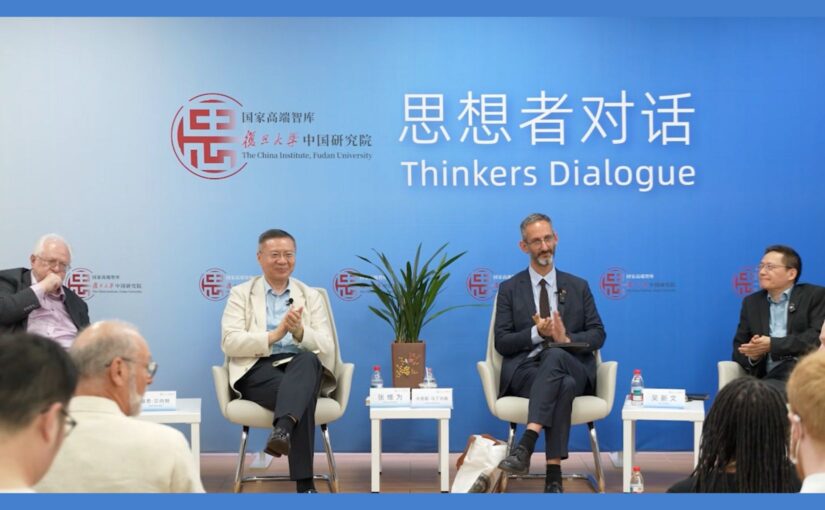
Dialogue with Fudan University’s China Institute: videos

As previously reported, on Monday 3 June 2025, the recent Friends of Socialist China delegation participated in a dialogue with the China Institute of Shanghai’s Fudan University, consisting of a panel discussion featuring Professor Zhang Weiwei, Professor Wu Xinwen, and Friends of Socialist China co-editors Carlos Martinez and Keith Bennett, followed by a wide-ranging discussion with the audience.

We have now posted the videos of the full event, plus introductory speeches, on our YouTube channel. These are embedded below.

Witnessing China’s socialist transformation

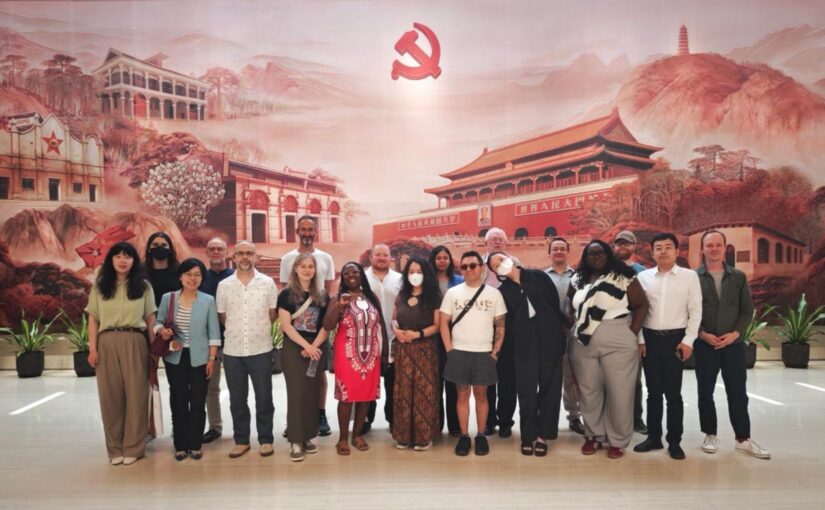
In the following report for Workers World, Ché Marino reflects on the recent delegation to China, organised by Friends of Socialist China and hosted by the China NGO Network for International Exchanges. Travelling through Shaanxi, Gansu, and Shanghai, the delegation explored China’s development, cultural heritage, and political system.

Ché contrasts the remarkable improvements in living standards and development level in China since his first visit in 2009 – from Shanghai’s modern infrastructure to expansive public amenities and smart technologies. Indeed, China’s development “stands in stark contrast to the crumbling infrastructure and growing inequality I see in New York City”.

Ché emphasises that these changes stem not from a capitalist approach but from China’s socialist model, where policies are shaped by the Communist Party to serve the public good. He cites the lifting of 800 million people from poverty, leadership in renewable energy, and peaceful diplomacy as evidence of socialism’s success. Detailed discussions with scholars such as Professor Zhang Weiwei reinforced the idea that Chinese socialism has global relevance, offering an alternative to imperialism and neoliberalism.

The article also highlights China’s Belt and Road Initiative and Global Civilisation Initiative as examples of international cooperation rooted in mutual benefit and respect, especially in China’s relations with Africa. Ché notes the Western media’s distortions about China, contrasting them with what he witnessed firsthand: a people-centred society focused on ecological sustainability and global solidarity.

Ché concludes that China’s socialist path offers vital lessons for the global left, particularly for youth disillusioned by Western capitalism.

In a world facing multiple crises, from climate change to growing inequality, China’s socialist path illuminates a way forward — not as a template to be mechanically copied but as a source of inspiration for all who seek a more just, peaceful and sustainable world.

In May 2025, I had the privilege of joining a delegation organized by Friends of Socialist China, a collective dedicated to fostering international solidarity and understanding of China’s socialist model. Our journey, hosted by the China NGO Network for International Exchanges (CNIE), took us across several regions, including Shaanxi, Gansu and Shanghai. 

The purpose of our trip was to engage in dialogues on civilizational exchange, witness China’s remarkable socio-economic transformations and deepen our understanding of the principles underpinning its development. Through visits to historic revolutionary sites, discussions with local leaders and participation in cultural events, we aimed to explore the realities of Chinese socialism and its implications for global solidarity.

As I stepped off the plane in Shanghai in 2025, memories of my first visit in 2009 came flooding back. Sixteen years ago, I arrived as a college student seeking the cheapest study abroad option available. What I found then was unmistakably a developing nation: streets that flooded when it rained, large swaths of underdeveloped public infrastructure and transportation that consisted of hitching rides on motorcycles to reach the nearest train station.

The transformation I witnessed upon my return is nothing short of remarkable. Where once stood only the Oriental Pearl Tower on the Bund now rises a skyline of architectural marvels. The face-scanning technology that allows commuters to enter subway stations with just a glance would have seemed like science fiction during my first visit, when my university ID was merely a laminated photo. 

This dramatic metamorphosis represents more than just economic growth; it embodies the success of China’s socialist project with Chinese characteristics. As I traveled through residential areas of Shanghai, I was struck by the quality of life afforded to ordinary citizens: beautiful parks, running tracks with specialized materials that protect joints and extensive bicycle paths. “We don’t have this in New York City,” I found myself repeatedly saying.

Continue reading Witnessing China’s socialist transformation

Vietnam boosts China friendship at Summer Davos

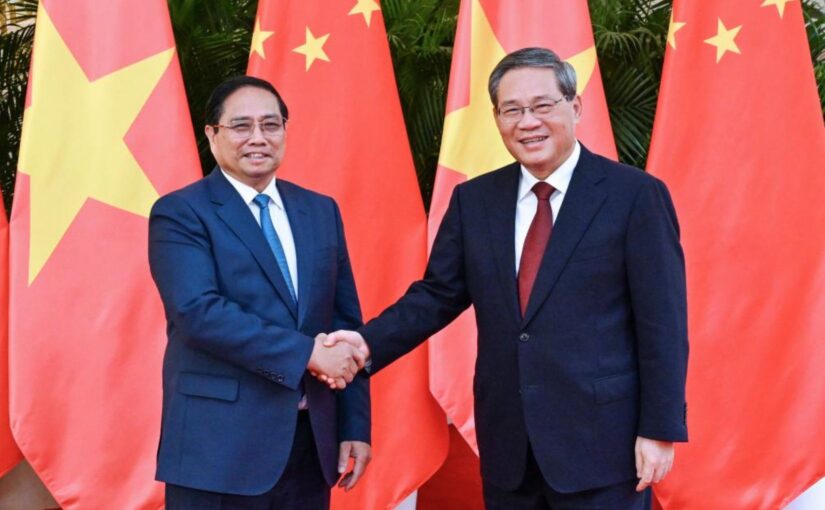
Vietnamese Prime Minister Pham Minh Chinh paid a working visit to China, June 24-27, at the invitation of his Chinese counterpart Li Qiang. The centrepiece of his visit was his participation in the 16th Annual Meeting of the New Champions of the World Economic Forum (WEF) in Tianjin at the co-invitation of WEF President and CEO Børge Brende. Known as the ‘Summer Davos’, the event in Tianjin is the second most important annual WEF activity after the gathering in the Swiss resort of Davos itself. Uniquely among foreign leaders, this was the third consecutive year for the Vietnamese Prime Minister to take part. It was also the first visit by a key Vietnamese leader to China in 2025, taking place shortly after the state visit to Vietnam by General Secretary of the Communist Party of China and Chinese President Xi Jinping in April.

Pham Minh Chinh met with Li Qiang on June 24, shortly after his arrival in Tianjin.

Noting that this year marks the 75th anniversary of the establishment of diplomatic relations between China and Vietnam, Li said the deep friendship of “comrades and brothers” has remained firm and fresh over time. Since the successful visit of Xi Jinping to Vietnam in April, the comprehensive strategic cooperation between China and Vietnam has been further advanced. China is willing to continue to implement the outcomes of President Xi’s visit with Vietnam to bring more benefits to the two peoples.

China welcomes Vietnam to become a BRICS partner country and is willing to work with Vietnam to safeguard free trade and the multilateral trading system, promote an equal and orderly multipolar world and a universally beneficial and inclusive economic globalisation, and inject more stability and positive energy into world peace and development.

Chinh said that Vietnam always considers developing its relationship with China a strategic choice, an objective necessity, and a top priority in its foreign policy and expressed confidence that China will continue to grow and play an increasingly important role in global development, security, and civilisation.

He proposed that both sides further promote the key role of security and defence cooperation in the overall bilateral relationship; improve the quality and effectiveness of practical cooperation across various fields; and maintain regular operations of the intergovernmental working groups on land-based infrastructure, monetary issues, and maritime cooperation, as well as the joint committees on economic-trade and scientific-technological cooperation. He also suggested studying the establishment of new working groups in education, training, finance, culture, and people-to-people exchanges.

Pham Minh Chinh also met with other foreign leaders attending the forum, namely Ecuadorian President Daniel Noboa, Singapore Prime Minister Lawrence Wong,  Kyrgyzstan Prime Minister Adylbek Kasimalyev, and Prime Minister of Senegal Ousmane Sonko.

Thanking Vietnam for its agricultural assistance, Sonko hoped for continued support in rice and cashew cultivation. He praised the success of Vietnam’s agricultural cooperation model in other countries and voiced interest in expanding that model to benefit Senegal and other Global South nations.

The Vietnamese and Senegalese leaders agreed to increase high-level exchanges and mutual visits, boost trade and investment promotion activities, facilitate business connections, and foster market access for each other’s key export products, with a strong focus on agriculture. Chinh invited Sonko to visit Vietnam, an invitation the Senegalese leader accepted with pleasure.

Also, as part of his working trip to China, on June 26 Chinh visited the Memorial Hall of the First National Congress of the Communist Party of China (CPC) and Pudong district, considered a development model in the new era of Shanghai as well as China.

Writing in the memorial hall’s guestbook, Chinh expressed his admiration and congratulations on the remarkable achievements of the CPC in leading the revolution and building a civilised, prosperous, harmonious, and modern nation.

The following articles were originally published by the Xinhua News Agency and Nhân Dân.

Chinese premier meets PM of Vietnam

TIANJIN, June 24 (Xinhua) — Chinese Premier Li Qiang on Tuesday met with Prime Minister of Vietnam Pham Minh Chinh, who is in north China’s Tianjin Municipality for the 2025 Summer Davos.

Noting that this year marks the 75th anniversary of the establishment of diplomatic relations between China and Vietnam, Li said the deep friendship of “comrades and brothers” has remained firm and fresh over time. Since the successful visit of Xi Jinping, general secretary of the Communist Party of China Central Committee and Chinese president, to Vietnam in April, the comprehensive strategic cooperation between China and Vietnam has been further advanced.

Continue reading Vietnam boosts China friendship at Summer Davos

NATO backs the anti-China war drive – Diane Abbott

In the following article, which was originally published by the Morning Star, Diane Abbott sounds a warning that, “Europe is acquiescing in Trump’s manoeuvrings – where Europe takes over the US forever war in Ukraine while Washington gets ready for a future fight with China. And it’s working people who will be left paying the price.”

Noting that the recent NATO Summit saw members commit to spending five percent of GDP on “defence”, Diane explains: “This is more than we were spending during the Gulf war and much more than when this country was waging war on Iraq and Afghanistan. We have not seen such a rapid expansion of military spending in this country since the beginning of the second world war.”

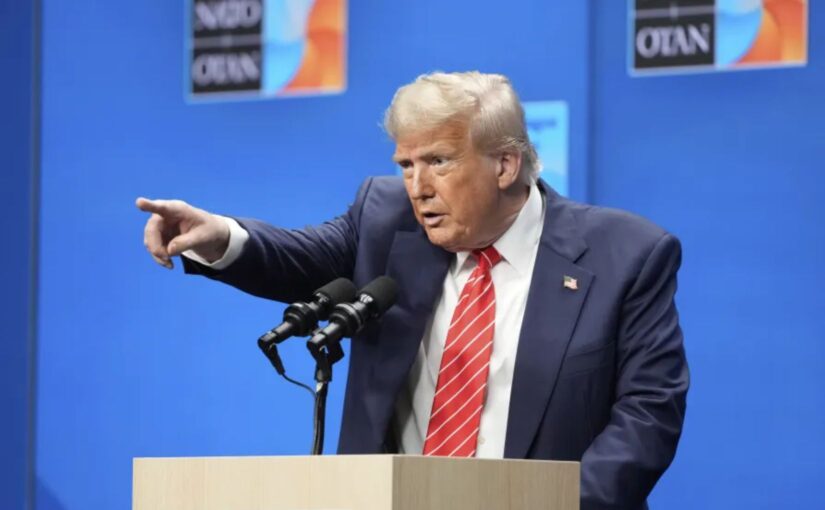
Explaining what lies behind this, she writes: “The US president described the outcome of the Nato summit as ‘a great victory.’ For once, he was telling the truth. It was a great personal victory for him and for the US war machine.

“Trump’s plan, as he said himself, is to ‘un-unite’ Russia and China, so that he can pursue a confrontation with the latter. All of his recent manoeuvrings in imposing tariffs on the world have clearly had that as a central objective, including trying to dictate that other countries are not allowed to trade with China, under threat of even more tariffs.

“Europe’s role in all this is to replace the US resources (under the Nato banner) in Europe that are being used to fight Russia. Those US resources can then be freed up and redeployed to south-east Asia and the coming fight with China.”

She notes that one exception to this policy is the Socialist government in Spain led by Pedro Sánchez. “He is no left-wing firebrand and verbally he makes all the warmongers’ noises about the threats we face and the need for a military upgrade and reform. The essential difference is that he refuses to fund Trump’s war machine and argues that the current level of 2.1 per cent of GDP in the military is quite sufficient. Actions are more important than rhetoric.”

She exposes NATO’s warmongering record: “Despite widespread claims to the contrary, it is not as if the NATO members have a record of demonstrating peaceful intent. NATO was part of the aggression against Serbia, Afghanistan and Libya. Currently, its members have been helping the Israeli genocide, bombing Yemen, installing terrorists in Syria and fighting a nuclear-armed Russia. The latest illegal act is the bombing of Iran. As much-discussed scenarios for the start of World War III go, that is almost the complete set.”

Finally, she clearly draws the link between imperialist war abroad and attacks on the working class at home:

“From the government’s perspective, very large welfare and other cuts are necessary to deliver on the promises to increase the military budget. The war drive and the austerity drive go hand-in-hand. But the sheer scale of the planned rise in the MoD [Ministry of Defence] budget means that austerity, in a number of forms, will go much wider and deeper than it has already. We must be prepared to fight them both.”

Diane Abbott is the Labour MP for Hackney North and Stoke Newington in East London. In 1987, she became the first ever black woman to be elected to the British parliament. She is now the ‘Mother of the House’, the longest continuously serving female member of the House of Commons. Consistently on the left of the party, she served as Shadow Home Secretary during Jeremy Corbyn’s leadership and subsequently defeated a vicious campaign spearheaded by Keir Starmer to drive her out of the Labour Party.

At the recent Nato summit most member countries committed themselves to a target of spending 5 per cent of GDP on the military budget. This is more than we were spending during the Gulf war and much more than when this country was waging war on Iraq and Afghanistan. We have not seen such a rapid expansion of military spending in this country since the beginning of the second world war.

The consequences for the safety and security of this country will be very grave and there will be very significant, negative consequences for most other areas of government spending as a result. The government plans to shift us to a wartime economy, with all the serious consequences that implies.

The US president described the outcome of the Nato summit as “a great victory.” For once, he was telling the truth. It was a great personal victory for him and for the US war machine.

Continue reading NATO backs the anti-China war drive – Diane Abbott

Planned obsolescence of capitalism versus sustainable Chinese alternatives: a clash of ideologies

We are pleased to republish below an interesting opinion piece by Bhabani Shankar Nayak, arguing that the fierce hostility of Western elites toward China stems to a significant degree from an ideological clash between neoliberal capitalism and China’s alternative development model. Unlike the US system – driven by profit and sustained through planned obsolescence – China promotes long-term, sustainable, people-centred development aimed at public well-being and common prosperity.

Bhabani includes examples such as China’s breakthrough in nuclear battery technology by Betavolt, with a 50-year lifespan that threatens the Western consumer electronics model reliant on constant upgrades. Similarly, China’s Cross-Border Interbank Payment System (CIPS) challenges US financial dominance by providing an alternative to the SWIFT network. These innovations, alongside China’s space program and infrastructure development, reflect a vision rooted in durability and public interest rather than profit.

The article critiques the Schumpeterian notion of ‘creative destruction’ as a myth that masks the exploitative nature of innovation under capitalism, whereby the creative potential of labour is entirely subordinated to private profit. It argues that capitalism commodifies both material goods and human emotions, perpetuating waste and insecurity.

In contrast, China offers a civilisational alternative that fundamentally threatens both the economic viability and ideological foundations of capitalism. This dynamic is a major part of what drives the ongoing campaign to contain and encircle China and to suppress its rise.

Bhabani Shankar Nayak is a Professor of Business Management at London Metropolitan University. He is the author or editor of numerous books and articles on China and other issues related to development in the Global South. This article was first published in Countercurrents.

Why do the American ruling elites, both in the Republican and Democratic parties, oppose China so strongly?


Since taking office, President Donald Trump imposed tariffs of up to 145% on Chinese goods. But it doesn’t stop at trade and tariffs. The American imperialist strategy—marked by political, economic, and military bullying—continues in an unprecedented scale in an effort to pressure China into submission under imperialist hegemony. The core objective is to undermine China’s development and its alternative path, which challenges the foundations of the capitalist system.

What has China achieved that fundamentally challenges the very foundation of American capitalism?

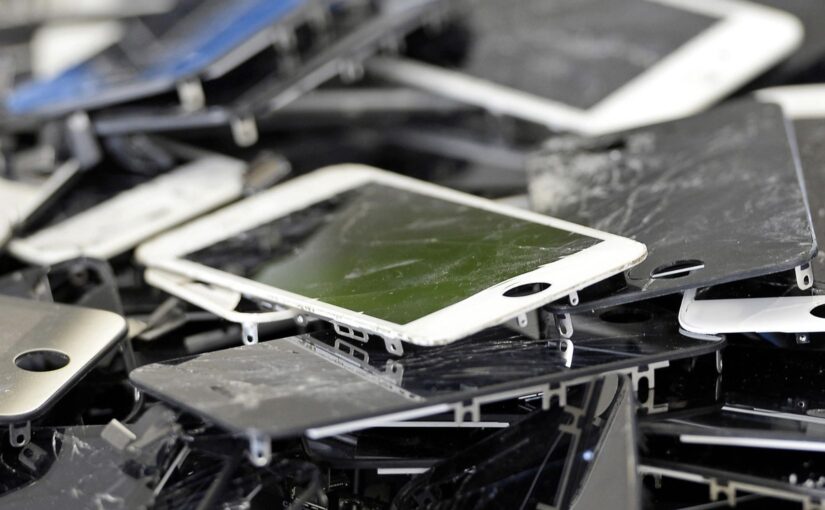
One striking example is the development of a miniature nuclear battery by the Chinese company Betavolt, with support from the Chinese government. This battery boasts a lifespan of 50 years, eliminating the need for recharging in devices such as mobile phones and electric vehicles. Such a breakthrough not only renders frequent charging obsolete but also disrupts the business models of American and European electronics companies, which rely heavily on planned obsolescence—a strategy that encourages repeated consumption through short-lived products and continual upgrades. For example, Apple Inc. products like iPhones continuously changes every year.

China has not only developed its own space station and lunar exploration program but has also created an international transaction system known as the Cross-Border Interbank Payment System (CIPS). This system has the potential to completely bypass the Western-dominated SWIFT (Society for Worldwide Interbank Financial Telecommunication) network used for global banking and international transactions.

These are just a few examples of the achievements stemming from China’s scientific, political and economic system, which fundamentally contrasts with the American and European capitalist model. Unlike the Western approach, which is largely driven by profit, China’s scientific and technological advancements are geared toward improving the well-being of its people and promoting sustainable development and long-term prosperity. Such alternatives pose a direct challenge to the American-led imperialist capitalist order—one that the ruling elites find deeply threatening and, therefore, unacceptable to their capitalist hegemony.

The Schumpeterian notion of capitalism as a process of “creative destruction”—where innovation leads to the replacement of outdated industries by newer, more efficient ones—is, in reality, a myth. The Schumpeterian sympathy for capitalism stems from its lenient understanding of capitalist innovation. What is truly creative and innovative is labour itself. However, under capitalism, the creative potential of labour is not liberated but rather controlled and exploited to sustain and expand a profit-driven system. Capitalism continually restructures itself to either accommodate or dominate the productive and creative capacities of labour. This dynamic reinforces the strategy of planned obsolescence, accelerating the exploitation of both nature and human beings—as producers and consumers.

Rapid technological advancement, rather than serving human progress, is often harnessed to sustain this exploitative system. The capitalist logic of planned obsolescence deliberately designs products with artificially limited lifespans, ensuring they become quickly outdated. This fuels a “use-and-throw” culture—one that perpetuates constant consumption and reinforces commodity dependency. Far from promoting genuine innovation, this cycle serves to undermine it, replacing durable progress with short-term profitability.

Technological progress under American and European capitalism is primarily driven by the logic of planned obsolescence. It functions not to meet genuine human needs, but to manufacture ever-new desires for commodity-based consumption. Products and services are deliberately designed with short lifespans, encouraging constant replacement and repeat purchases—strategies rooted in corporate interests aimed at sustaining perpetual profit. This cycle not only accelerates the depletion of natural resources but also fuels consumer anxiety, particularly through the psychological pressure of the “fear of missing out.” In this way, capitalism commodifies both material goods and emotional experience, reinforcing a culture of disposability and dependency.

However, China’s scientific and economic progress is guided by a long-term vision centered on the well-being of its people—an approach fundamentally opposed to the capitalist strategy of planned obsolescence. Unlike the American and European market-led systems, which prioritise profit based on exploitation, the Chinese model places public welfare at the core of its technological and developmental agenda. This alternative model threatens the very foundations of Western capitalism by offering a path rooted in sustainability, resilience, and durability—countering the wasteful “use-and-throw” culture that has emerged from capitalist cycles of consumption and planned obsolescence.

In this context, China presents not just a geopolitical rival, but a civilisational alternative—one that challenges the dominance of profit over people. It is precisely because of this that American imperialism, along with its European allies, relentlessly seeks to undermine and weaken China and its achievements. The fear is not merely rooted in economic competition, but in the example that China sets: a political model of planned economic development grounded in peace, progress, and prosperity—one that dares to envision a future beyond capitalist exploitation and its foundation in planned obsolescence.

Iran and the new cold war

The following article by Carlos Martinez, originally published in the Morning Star, argues that the criminal Israeli-US strikes on Iran are not credibly rooted in concerns over the latter’s alleged nuclear weapons program, but rather in its consistent anti-imperialist stance and its far-reaching material support for the cause of Palestinian freedom.

The article also links the attacks to broader geopolitical dynamics, especially Iran’s deepening alliance with China. Since signing a 25-year cooperation agreement with China in 2021, Iran has become integral to the Belt and Road Initiative, in addition to joining BRICS and the Shanghai Cooperation Organisation, and emerging as China’s primary trading partner in West Asia.

This growing partnership makes Iran a strategic obstacle to US-led imperialism, especially in the context of the New Cold War against China. Carlos draws parallels with the 1953 coup against Iran’s Prime Minister Mossadegh, orchestrated by the CIA and MI6 to protect Western oil interests in the context of the original Cold War.

Today, the New Cold War, centred on US efforts to encircle and contain the People’s Republic of China, is adding urgency to the US’s bid for regime change in Iran. Iran’s deepening integration into the Belt and Road Initiative, and its close coordination with China and Russia, mark it as a frontline state in the struggle between the Project for a New American Century and the Global Community of Shared Future…

The installation of a US proxy regime in Tehran would be a major blow to the Belt and Road Initiative, and it would potentially compromise China’s energy security, giving the US de facto control over the flow of oil and other resources through the Persian Gulf.

The article concludes by urging Western anti-war movements to oppose this escalating campaign to preserve and expand imperialist hegemony.

There has been a great deal of speculation as to the reasons for the criminal Israeli-US attack on Iran.

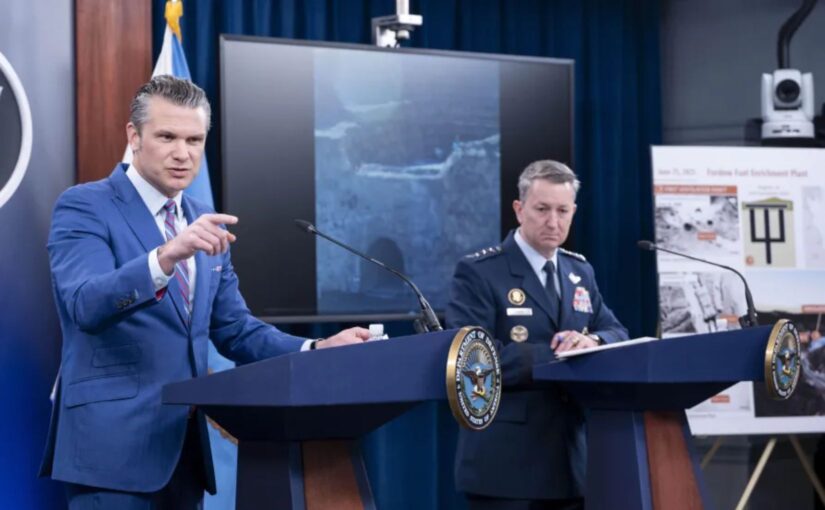
The reason proffered by Israeli Prime Minister Benjamin Netanyahu and US President Donald Trump is that Iran is on the cusp of acquiring a nuclear weapon, and that therefore the forcible dismantling of its nuclear infrastructure is a matter of great urgency.

Obviously, no reasonable person believes this; certainly nobody who remembers Tony Blair’s cynical 2003 claim that Iraq could deploy weapons of mass destruction within 45 minutes.

After all, Netanyahu first publicly accused Iran of developing nuclear weapons back in 1992 – 33 years ago – when, in a speech to the Knesset as Deputy Foreign Minister, he declared that Iran was three to five years away from acquiring a nuclear weapon and argued for preemptive action.

Netanyahu was later subjected to widespread mockery in September 2012 when, holding up a cartoonish drawing of a bomb during his speech at the UN, he claimed that Iran was 90 percent of the way to the level of uranium enrichment needed for weaponisation.

Meanwhile, Iran continues to deny seeking nuclear weapons and is a longstanding signatory to the Treaty on the Non-Proliferation of Nuclear Weapons (NPT). The country’s government maintains a strict edict against the development, production, stockpiling and use of nuclear weapons or indeed any weapons of mass destruction – contrasting rather starkly with Israel, an undeclared nuclear weapons state and non-signatory to the NPT. Furthermore, there has been no credible intelligence validating Netanyahu and Trump’s claims about Iran’s weapons program.

Continue reading Iran and the new cold war