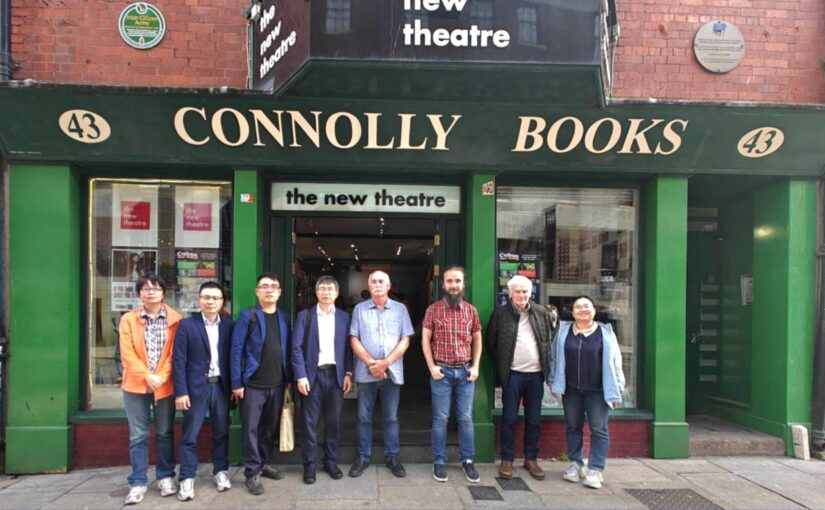
A delegation from the Academy of Marxism of the Chinese Academy of Social Sciences recently visited Ireland as part of a European tour that also took them to Britain and Portugal.
In the following article, Gearóid Ó Machail outlines the delegation’s program in Ireland. Gearóid is a member of the National Executive Committee of the Communist Party of Ireland (CPI) as well as of the Advisory Group of Friends of Socialist China.
We previously published a report of the delegation’s time in London. While in Britain, they also visited Cambridge and Manchester.
The Communist Party of Ireland (CPI) recently welcomed a visiting delegation from the Institute of Marxism at the Chinese Academy of Social Sciences (CASS) to Dublin for a series of bilateral engagements and discussions.
The Chinese delegation arrived on the afternoon of Friday July 18 and began their program with discussions at their country’s Dublin embassy.
The next day they engaged with a group of Marxist academics at Trinity College Dublin (TCD). This dialogue brought together academics from three Dublin universities and was facilitated by Assistant Professor Harun Šiljak of the CPI. The Irish delegation also included Emeritus Professor at Dublin City University Helena Sheehan who has recently returned from a teaching post at Peking University.
The Irish hosts engaged with the Chinese comrades to discuss Irish academia and Marxism, perspectives on Chinese modernisation, ecology, the contradictions of capitalism, ‘Socialism with Chinese Characteristics’ and other topics.
The visiting delegation comprised researchers and professors from the Institute of Marxism at the Chinese Academy of Social Sciences (CASS) – a research institution established by the Communist Party of China (CPC) in 2005.
Comrade Professor Chen Zhigang, Vice President of the Institute, led the discussion from the Chinese side, offering valuable insights into the workings of the CPC and its role in China’s development. He addressed the challenges facing rural development in China and elaborated on the concept of socialism with Chinese characteristics, the guiding principles of Xi Jinping Thought and its fundamental opposition to the Western model of globalisation and imperialist agendas. Professor Chen advocated for a model of inclusive globalisation that benefits all nations.
Throughout the discussion, he also reiterated China’s commitment to building an ecological civilisation grounded in world peace and inclusive development.
Comrade Han Dongjun translated Professor Chen’s remarks, while comrades Liu Yan, Fang Tao, and Zhuo Mingliang highlighted various achievements of China under the leadership of the CPC.
Following their meeting with the academics on Saturday morning, the CASS representatives had a bilateral meeting with leading representatives from the Communist Party of Ireland at their Party premises in Temple Bar, Dublin.
Former General Secretary of the CPI and member of the National Executive Committee of the party, Comrade Eugene McCartan was accompanied by Comrade Tommy McKearney of the Betty Sinclair Branch and Dublin Branch Secretary Comrade Harun Šiljak. Both delegations exchanged political experiences and views.
The CPI outlined its class-based, anti-imperialist approach to key political questions. Discussions focussed on ending British rule in Ireland, the defence of Irish neutrality and opposition to the growing threat posed by increased EU militarisation.
The CPI comrades highlighted their strategy to break the “Triple Lock of Imperialism” -the financial, diplomatic and military controls and instruments deployed by the USA, the EU and Britain aimed at restricting and undermining the political and economic sovereignty and destiny of the Irish people.
They also outlined to the visiting Chinese delegation how the Irish nation’s interests are currently subordinated to the needs of imperialism as a result of the political and economic subservience arising from the class interests of the comprador Irish ruling class.
Professor Chen Zhigang provided a detailed presentation on the development of Chinese Marxism, stating that it’s because of Marxism that China has been able to achieve remarkable successes. Comrade Chen discussed the meaning and relevance of Xi Jinping Thought, as the latest development of Marxism in China; a Marxism adapted to the conditions prevailing in the 21st century and the array of new challenges that present themselves.
He further pointed to what should be a well-understood and obvious truth: that as society develops, theory must develop along with it. “If Marxism does not evolve, its vitality will be limited.” He also noted that Socialism with Chinese Characteristics has developed and thrived by combining Marxist ideas with Chinese culture and traditions, hence Chinese people do not think of Marxism as a foreign phenomenon.
Regarding the global applicability of Xi Jinping Thought, Comrade Chen said that China seeks to offer Chinese wisdom towards the solution of problems of global governance. The concept of a Global Community of Shared Future, the Belt and Road Initiative, the Global Development Initiative, the Global Civilisation Initiative and the Global Security Initiative are all based on the principles of mutual learning, exchanges and dialogue, and all seek to promote peace, sustainability, development, cooperation and friendship.
The meeting provided another opportunity to consolidate and strengthen the bonds of friendship between Irish and Chinese communists.
China’s development demonstrates that there is a viable alternative to capitalism and imperialism, and their hegemonic control over people and the planet. Yet, imperialist powers and their capitalist regimes remain determined and are working actively every day to try to undermine China, its people, and their revolutionary achievements.
The comrades from Ireland and China reaffirmed their belief in Marxism’s potential to offer a genuine alternative to capitalism and its warmongering, imperialist hegemony, which undermines peace and disempowers people across the globe. A better world is possible.






I would have appreciated more substantive detail. I need to contend with opponents in debate.