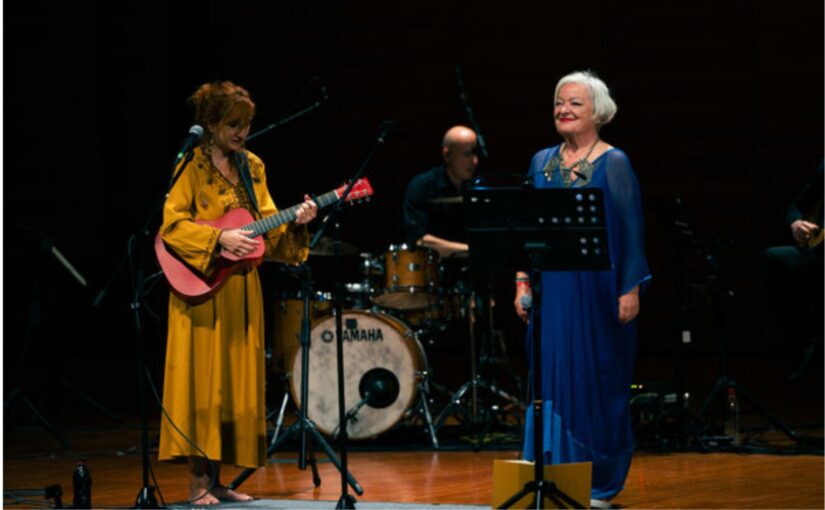
Special concerts celebrating the 100th anniversary of the birth of legendary Greek communist composer Mikis Theodorakis were held in three Chinese cities from July 29 to August 2. They marked the first time for the composer’s work to be performed in China, a country he had long wished to visit but failed to realise before his death on September 2, 2021.
Known for his film scores, including the iconic music for ‘Zorba the Greek’, Theodorakis’ compositions often blend traditional Greek music with classical and contemporary styles, creating a unique and powerful sound.
Minister Counselor and Chargé d’Affaires ad interim of the Greek Embassy in Beijing Alexandros Vidouris told Global Times that the loud applause during the performance was way beyond his expectations.
“It was a dream of composer Theodorakis to have his work performed in China. Unfortunately, he could not come before he passed away. So, this was a very significant moment in his memory commemorated yesterday [July 29], a hundred years since the day he was born,” he said.
Maria Papageorgiou, a classical and classical crossover performer, added: “Theodorakis was a global composer, because he had strength and was willing to bring all people together in peace and protest for their rights, or for their love and their country.”
The Greek Reporter also reported on the concerts.
In a separate article, it reviewed the composer’s life: “The shadow of war, however, soon fell over his formative years. The German occupation during World War II and the subsequent Greek Civil War were not just historical events; they were lived experiences that forged his unwavering commitment to justice and human rights. He joined the resistance, faced arrests, torture, and exile – trials that would forever infuse his music with raw, visceral power.”
Noting how his music combined classical techniques while remaining true to his roots, the article continued: “It was this unique synthesis that allowed him to bridge the gap between popular music and high art. He took the poetry of Greece’s greatest literary figures – Nobel laureates like George Seferis and Odysseas Elytis, and the revered Yannis Ritsos – and set them to music, making complex verses accessible to the masses.
“His scores for films like ‘Zorba the Greek’ (1964) introduced the iconic sirtaki dance to the world, making him an international sensation. Yet, it was the epic oratorio ‘Axion Esti’ (1960), based on Elytis’s poem, that truly cemented his place as a national treasure, a work that became an anthem for Greek identity.
“Nevertheless, Theodorakis was more than a composer; he was a revolutionary. When the military junta seized power in Greece in 1967, his music was banned, and he was once again imprisoned. From his cell, his melodies became the clandestine soundtrack of defiance.
“Smuggled out of the country, his songs became anthems for protesters worldwide, a powerful symbol of the Greek people’s struggle against tyranny. His international renown, fueled by artists and intellectuals who championed his cause, eventually led to his release and exile, but his voice remained unbroken.
“Upon his return to Greece after the fall of the junta, Theodorakis continued to compose prolifically, always with an eye towards social justice and peace.”
Greek City Times published a round up on global plans to mark the centenary. In 2021, after his death, the website In Defence of Marxism published an obituary that, despite certain formulations with which the editors of this website do not agree, contains much useful information on Theodorakis’ life and work. It notes:
“Mikis Theodorakis dedicated his life to the musical rebirth of post-war Greece. His musical compositions combined an incredible artistic prowess with a remarkable expression of the Greek working class’ mood, aspirations and struggles against poverty and oppression.
“Mikis was a fighter for the liberation of Greek peoples in EAM (Greece’s National Liberation Front) and ELAS (the Greek People’s Liberation Army). During the years of Nazi Occupation, he became a member of the KKE (Communist Party), and later a leading figure of the left in post-war Greece. He fought in the frontlines against the authoritarian regimes imposed on Greece by the ruling class and its allies, and against the Regime of the Colonels in particular. In those dark years of the Greek junta, Mikis became a symbol of resistance through his music and organising.”
It recalls: “In 1981, the leader of the Palestine Liberation Organisation (PLO), Yasser Arafat, visited Greece. During his stay, he met Theodorakis, who was at this time an MP, and asked him to compose an anthem for the PLO, which would be proposed as the official anthem of the Palestinian State once the goal of achieving such a state had been achieved! At the beginning of 1982, Mikis Theodorakis accepted Arafat’s invitation and visited Beirut as a guest of the Lebanese Minister of Culture and of the PLO to present the anthem. The latter was ratified by the Palestinian Parliament, with Arafat and Palestinian lawmakers giving a standing ovation.”
The article also recounts his friendship with Fidel Castro and his winning the Lenin Peace Prize in 1983.
The Communist Party of Greece (KKE) organised a major centenary concert, together with the Theodorakis family, on June 25. KKE General Secretary Dimitris Koutsoumbas said: “We miss his thunderous presence, as at the magnificent concert-rally against the NATO and EU bombing of Yugoslavia in 1999, which he initiated, bringing together all the great performers.
“We picture him wearing a Palestinian keffiyeh on his shoulders, urging us to take action to prevent the crime of the century from being committed in Palestine, as he did throughout his life.”
A report of the speech – along with a video clip of the concert – may be found on the KKE website.
The following articles were originally published by China Daily, Global Times and Greek Reporter.
Greek composer’s works come to China for the first time
August 4 (China Daily) – In celebration of the 100th anniversary of the birth of legendary Greek composer Mikis Theodorakis, a special concert featuring his lyrical works toured three Chinese cities from July 29 to Aug 2, marking the first time that the esteemed composer’s works were performed in China.
The tour included Shanghai and Beijing and was held to honor Theodorakis’ wish to have his works performed in China, a country he never got a chance to visit, before he died in 2021.
The concert featured renowned Greek singer Tania Tsanaklidou, vocalist and musician Maria Papageorgiou, and six other Greek musicians, who performed songs written by Theodorakis. To help audiences better understand his music, song lyrics were translated into Chinese and projected onto screens.
The two women performed the illustrious composer’s songs, with arrangements by Papageorgiou, following her creative partnership with Theodorakis on the album Correspondence. A portion of the performance honored Nobel Prize-winning Greek poets George Seferis and Odysseus Elytis, who inspired Theodorakis.
After the performance at the National Museum of China in Beijing, singer Tsanaklidou said, “Listening to Mikis Theodorakis’ works can unite us. We can regain the feeling that we are a group of people, rather than individuals going through life alone. Mikis’ songs are written for people to sing with their friends, comrades and fellow citizens.”
The concert also made a stop in Nanchang, Jiangxi province.
Born in 1925, Theodorakis was a renowned Greek composer and political activist celebrated for his significant contributions to music and his role in Greece’s cultural and political history. Known for his film scores, including the iconic music for Zorba the Greek, Theodorakis’ compositions often blend traditional Greek music with classical and contemporary styles, creating a unique and powerful sound.
‘Correspondence,’ people’s music from Greece at NMC
July 31 (Global Times) – The Embassy of the Hellenic Republic in China inaugurated a two-week tour commemorating 100 years of the birth of Mikis Theodorakis (July 29, 1925 – September 2, 2021). For its second leg, the musical performance reached Beijing on July 30, offering Chinese audiences a unique opportunity to experience his extraordinary works. Greek musicians told the Global Times that they look forward to enhancing cooperation with their Chinese counterparts.
The lyrical works of Theodorakis, the most significant Greek composer, as captured in the album Correspondence by Maria Papageorgiou, is being presented for the first time in China. The concert features two remarkable voices personally recognized by the composer: Tania Tsanaklidou, a performer who has left her mark with her voice and sensitivity on some of the most beloved songs of contemporary Greek repertoire, and Maria Papageorgiou, a classical and classical crossover performer.
Minister Counselor Chargé d’affaires ad interim Alexandros Vidouris told the Global Times that loud applause during the performance in sync with the beats of the music was way beyond his expectations.
“Tonight was a very impressive evening,” he said, expressing his gratitude to the director of the National Museum of China (NMC) for hosting the concert.
“It was a dream of composer Theodorakis to have his work performed in China. Unfortunately he could not come before he passed away. So this was a very significant moment in his memory commemorated yesterday [July 29], a hundred years since the day he was born,” he said.
Vidouris also said that the performance showed the very close links between the two civilizations, that culture transcends time and space, and it complemented the already existing exhibition here that embodies many aspects of beauty. “This was a musical aspect of beauty, bringing together Greek culture and Greek civilization that combines the past, the present, and the future,” he said.
Music is the universal language in and of itself, Minister Counsellor Chargé d’affaires ad interim Vidouris pointed out.
“No matter what part of the world you’re from, musical notes depend on how they are combined to create melodies, and each culture and each civilization has a different way of combining the same notes, the sounds that emerge from this combination are what create the DNA of each culture. However, we can find the connections between each culture and civilization,” he said.
He also evaluated the performance. “Even tonight we heard some melodies that were very close to melodies we can hear here in China as well.” Distance is not a factor in musical expression, the diplomat concluded.
“I was not only pleased but also very emotional about the participation of the Chinese audience, because they were also very active during the performance. Hopefully we might host Chinese artists in Greece as well,” he added.
Having performed his duty in China for several months, the diplomat has been exploring Chinese TV. “I can hear the sound of the language and music, especially in the music; I think there is some common ground between the two,” Vidouris said.
The music tour fulfills one of Theodorakis’ final wishes: “To have his music heard in China, a country he was never able to visit, but always hoped to reach.”
The renowned performer Tsanaklidou bridges the Greece of great poets with the anguish of exiles and the blue of the seas, creating – alongside Papageorgiou – a circle of songs that resound as a global outcry, beyond the Greek language, through Theodorakis’ deeply instinctive melodies. Theodorakis was a global revolutionary and visionary of a free and equal world.
After the performance, Tsanaklidou told the Global Times that the music Theodorakis left behind is not only a rich musical legacy for Greece, but also an invaluable cultural contribution to the world.
Against the backdrop of a turbulent and changing world, “the music [we played] is people’s music. Audience can gain the power of democracy, equity, and solidarity from it,” said Tsanaklidou, who is in her 70s but very energetic.
Papageorgiou told the Global Times that “Theodorakis was a global composer, because he had strength and was willing to bring all people together in peace and protest for their rights, or for their love and their country.”
Talking about the common ground of Greek and Chinese music, Papageorgiou said the two countries share the same passion, the same roots, knowledge, and myths that is about how to stand in life and have integrity.
As for Chinese music, Papageorgiou said that when she hears Chinese music, she thinks of one word – respect. “When I hear Chinese music, as with Greek music, I respect what I’m hearing.”
Papageorgiou even sang a song in Chinese. It took her one month to learn and sing it in Chinese. “It is a very very difficult language for us,” she said, noting that she looks forward to cooperating with Chinese musicians.
Three generations unite under the artistic legacy of the unparalleled Mikis Theodorakis, who – through his popular style – brought poets into the homes of the people, unified a nation tormented by dictatorships, and upheld the Greek cultural standard through his multifaceted global work.
In the first part of the performance, the album Correspondence is presented, featuring songs by Theodorakis with new arrangements by Papageorgiou. During their creative collaboration, the two artists exchanged emails containing notes, thoughts, and progress updates on the project, which inspired the album’s title.
The second part pays tribute – through songs and narrative texts – to the two Greek Nobel Prize-winning poets George Seferis and Odysseas Elytis, whose verses inspired some of Theodorakis’ most powerful compositions.
The year 2025 marks the centenary of the birth of the great Greek creator, who left an indelible mark on Greek and global musical heritage. As part of the celebration of 100 years of his birth, the two performers honor his legacy with a tour across three major cities in China – Shanghai, Beijing, and Nanchang.
Mikis Theodorakis: 100 Years Since His Birth
July 29 (Greek Reporter) – One hundred years ago, on July 29, 1925, Mikis Theodorakis was born on the island of Chios; he would go on to compose the very heartbeat of a nation.
Theodorakis—a name synonymous with Greece’s struggles, triumphs, and enduring spirit—wove melodies that transcended borders, embodying both profound beauty and fierce resistance. As we mark a century since his birth, his legacy resonates not only as a composer but as a towering symbol of human dignity and freedom.
From his earliest days, he was steeped in the rich tapestry of Greek life, yet also acutely aware of its tumultuous history. Theodorakis’ childhood, marked by frequent relocations due to his civil servant father’s postings, exposed him to diverse regional sounds and the vibrant folk traditions that would later become the bedrock of his monumental compositions.
The shadow of war, however, soon fell over his formative years. The German occupation during World War II and the subsequent Greek Civil War were not just historical events; they were lived experiences that forged his unwavering commitment to justice and human rights. He joined the resistance, faced arrests, torture, and exile—trials that would forever infuse his music with raw, visceral power.
Mikis Theodorakis’ musical journey
Theodorakis’ musical journey was a relentless pursuit of expression. He studied at the Athens Conservatory and later in Paris, absorbing classical techniques while remaining true to his roots.
It was this unique synthesis that allowed him to bridge the gap between popular music and high art. He took the poetry of Greece’s greatest literary figures—Nobel laureates like George Seferis and Odysseas Elytis, and the revered Yannis Ritsos—and set them to music, making complex verses accessible to the masses.
His scores for films like Zorba the Greek (1964) introduced the iconic sirtaki dance to the world, making him an international sensation. Yet, it was the epic oratorio “Axion Esti” (1960), based on Elytis’s poem, that truly cemented his place as a national treasure, a work that became an anthem for Greek identity.
Theodorakis was a revolutionary
Nevertheless, Theodorakis was more than a composer; he was a revolutionary. When the military junta seized power in Greece in 1967, his music was banned, and he was once again imprisoned. From his cell, his melodies became the clandestine soundtrack of defiance.
Smuggled out of the country, his songs became anthems for protesters worldwide, a powerful symbol of the Greek people’s struggle against tyranny. His international renown, fueled by artists and intellectuals who championed his cause, eventually led to his release and exile, but his voice remained unbroken.
Upon his return to Greece after the fall of the junta, Theodorakis continued to compose prolifically, always with an eye towards social justice and peace. He served in parliament, advocated for environmental causes, and spoke out against global injustices, proving that his commitment extended far beyond the realm of music. His later works continued to explore grand themes, often reflecting on the human condition and the future of Greece.
Today, 100 years since his birth, Mikis Theodorakis’ music remains as vital and resonant as ever. It is played at protests, celebrated in concert halls, and hummed in homes across Greece and beyond. His melodies evoke the sun-drenched landscapes, deep historical wounds, and unyielding hope of a people.
He taught us that music is not merely entertainment; it is a weapon, a balm, a voice for the voiceless, and a timeless expression of the human spirit. His life was a symphony of courage, conviction, and unparalleled artistry, a testament to the enduring power of a single individual to inspire generations.
The legendary composer died on September 2, 2021.