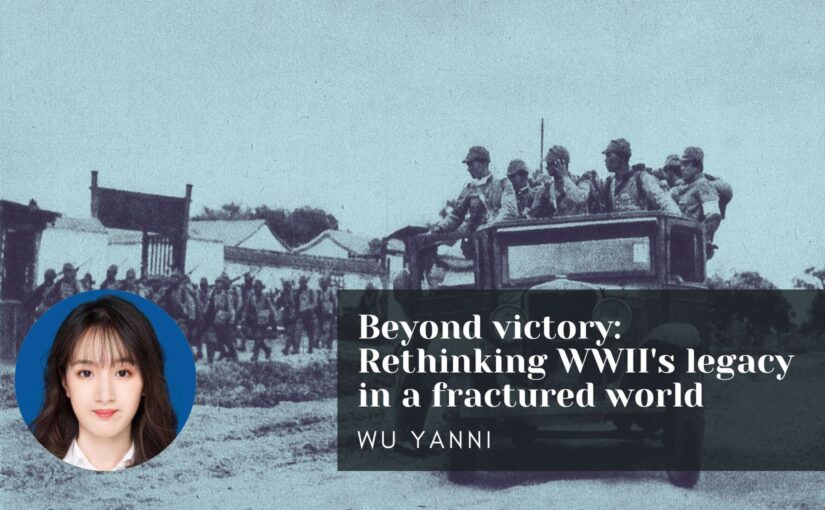
We are pleased to publish below an original article by Wu Yanni, a Beijing-based political commentator and contributor to Chinese and international media, arguing that the lessons of World War II remain relevant – and indeed urgent – in today’s geopolitical context.
Marking the 80th anniversary of the victory over fascism and the founding of the United Nations, Wu stresses that the war’s devastation—100 million casualties worldwide, including 35 million Chinese lives—is a sobering reminder that militarism “leads not to greatness, but to ruin.” For China, the 14-year resistance against Japan became both a struggle for survival and part of the foundation of its modern nationhood.
A central theme is the danger of selective memory. Wu critiques attempts in Japan to downplay atrocities such as the Nanjing Massacre or Unit 731, a secret research facility in Heilongjiang, northeast China, where criminal and inhumane experiments were carried out on Chinese, Russian, Korean and other prisoners. Globally, she warns, invoking distorted history to justify present-day militarism and aggression undermines the spirit of the UN Charter and runs counter to the multipolar trend.
The article highlights the overlooked role of the Global South in the war: India’s 2.5 million volunteer soldiers, African and Latin American contributions, and Brazil’s combat role. These experiences have been marginalised and largely ignored in Western historical accounts. Wu writes:
As soldiers returned home, many questioned why they had fought for freedom abroad while being denied basic rights at home. From Vietnam to Ghana to Indonesia, national liberation movements accelerated. The 1955 Bandung Conference, where newly independent nations charted a path toward nonalignment and sovereignty, marked a turning point.
Today, however, “the Global South is no longer a silent object of history. From BRICS cooperation to African-led development frameworks and Latin American regionalism, formerly marginalised voices are demanding a say in shaping global rules.”
Wu Yanni concludes by recounting China’s peaceful rise and its consistent orientation towards inclusive development and multilateral cooperation. As such, China is helping to truly apply the lessons of WWII, “building a future where peace is sustained not by dominance but by cooperation, equity, and respect”.
War and peace have always shaped the trajectory of human civilization. This year marks the 80th anniversary of the victory in the Chinese People’s War of Resistance Against Japanese Aggression and the broader World Anti-Fascist War, as well as the founding of the United Nations.
Eighty years ago, nations came together in the wake of unprecedented devastation to chart a new path for global peace. China, along with the Soviet Union, was among the first to sign the UN Charter, an act symbolizing a shared hope that the horrors of fascism would never be repeated.
The price of that hope was staggering: over 100 million casualties, with half of humanity drawn into the conflict. For China, the war was not just a battleground against foreign invasion; it was a pivotal moment in its modern nationhood. The 14-year resistance against Japanese aggression, which cost 35 million Chinese military and civilian lives, held the Eastern Front and helped shape the moral foundation of the postwar international order.
Looking back from today’s fractured and uncertain world, the lessons of that war remain painfully relevant. Militarism, no matter how technologically advanced or ideologically justified, inevitably breeds destruction. Dominant narratives that claim moral superiority cannot contain the rising currents of multipolarity. Real peace cannot be achieved through alliances defined by exclusion. It requires a shared commitment to inclusion, fairness, and mutual respect.
Militarism and the dangers of selective memory
The defeat of fascism is perhaps the clearest reminder that aggressive militarism leads not to greatness, but to ruin. Japan offers a sobering example. After militarism took root in the early 20th century, Japan initiated wars almost every five years, culminating in a catastrophic defeat. Following the 1931 “September 18 Incident,” the civilian government became subservient to military interests. Japan’s war machine expanded from northeast China to the entire country, leaving behind a trail of destruction and atrocities.
One of the most chilling examples was Unit 731, which conducted inhumane medical experiments on Chinese civilians. These acts remain among the darkest chapters of modern history.
Yet today, some factions within Japanese society continue to frame Japan primarily as a victim of war, highlighting the bombings of Hiroshima and Tokyo while downplaying or omitting events such as the Nanjing Massacre or the use of forced “comfort women.” This selective memory neither heals nor educates. Instead, it obscures accountability and hinders reconciliation.
The same caution applies globally. When historical narratives are used to justify present-day militarism, protectionism, or ideological confrontation, the world moves further from the peace the UN Charter envisioned.
The Global South: From overlooked participants to active shapers
While the Global South was often treated as a passive backdrop to the war, its people played vital roles. India contributed 2.5 million soldiers to the Allied effort, one of the largest volunteer forces in history. African and Latin American nations supplied essential resources and manpower. Brazil not only exported rubber and minerals but also sent troops to fight in Europe.
Yet the postwar order largely reflected the priorities of the victorious colonial powers. The contributions of colonized peoples were marginalized, even as their sacrifices laid the groundwork for the anti-colonial movements that followed.
As soldiers returned home, many questioned why they had fought for freedom abroad while being denied basic rights at home. From Vietnam to Ghana to Indonesia, national liberation movements accelerated. The 1955 Bandung Conference, where newly independent nations charted a path toward nonalignment and sovereignty, marked a turning point.
Today, the Global South is no longer a silent object of history. From BRICS cooperation to African-led development frameworks and Latin American regionalism, formerly marginalized voices are demanding a say in shaping global rules. And yet, many advanced economies continue to frame global politics in binary terms: democracy versus authoritarianism, open versus closed societies.
This has translated into a wave of sanctions, tech restrictions, and unilateral tariffs. These policies often target emerging economies and echo older forms of structural inequality. Trade should not be wielded as a weapon to enforce ideological conformity. If the world’s leading powers continue to resist calls for fairer institutions and shared governance, they risk repeating the fragmentation that once doomed the League of Nations.
China, a steadfast force for peace
China’s postwar journey is inseparable from the Global South’s broader rise. From a country struggling to survive invasion and civil conflict, China has emerged as a nation advocating for inclusive development and multilateral cooperation.
Its record reflects this. China remains the second-largest contributor to the UN peacekeeping budget and has deployed more than 50,000 peacekeepers to missions around the world. Rather than pursuing military intervention, China promotes political dialogue and the peaceful resolution of disputes.
This principle also shapes China’s response to economic coercion. Faced with rising tariffs, tech decoupling efforts, and geopolitical pressure, particularly from the United States, Beijing has largely responded with pragmatism, restraint, and a focus on self-reliance and resilience. Instead of retaliating with isolationism, China has strengthened ties with the Global South, invested in innovation, and reaffirmed its commitment to multilateral trade systems.
Eighty years ago, the preamble to the UN Charter committed nations “to save succeeding generations from the scourge of war.” That mission remains just as vital today. Real victory is not simply about defeating an enemy. It lies in building a future where peace is sustained not by dominance but by cooperation, equity, and respect.
As new challenges test the global system, revisiting the full legacy of World War II, including the sacrifices of the Global South and the lessons of China’s experience, is more than historical reflection. It is a necessary act of clarity and resolve in uncertain times.