As we recently noted, relations between China and India have lately been seeing significant improvement. This process has now been qualitatively accelerated with the August 18-20 New Delhi visit by Chinese Foreign Minister Wang Yi.
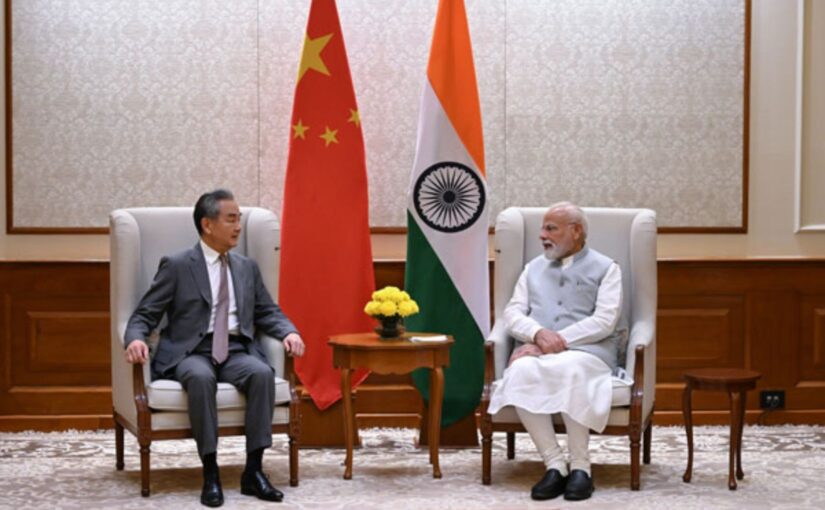
On August 19, Wang Yi met with Indian Prime Minister Narendra Modi.
Prime Minister Modi asked Wang Yi to convey his cordial greetings to President Xi Jinping and Premier Li Qiang and expressed his anticipation of visiting China to attend the Shanghai Cooperation Organisation (SCO) Tianjin Summit, to be held end August, and meet with President Xi Jinping. (This will be Modi’s first visit to China in seven years.) India will fully support China’s work as the rotating chair of the SCO to ensure the complete success of the Summit.
The Prime Minister said that both India and China are ancient civilisations, and they have enjoyed a long history of friendly exchanges. The meeting between the leaders of the two countries at the BRICS Summit in Kazan, Russia, last October marked a turning point for the improvement and development of bilateral relations. India and China are partners, not rivals, and are facing the common task of accelerating development. The two sides should also properly manage and settle boundary questions, so that differences will not evolve into disputes.
Modi added that that this year marks the 75th anniversary of the establishment of diplomatic relations between India and China. Both sides should view bilateral relations from a long-term perspective. India-China cooperation is indispensable for the advent of an Asian century. Working hand in hand, the two sides will contribute to world development and benefit all humanity.
Wang Yi said that the successful meeting between the leaders of the two countries in Kazan last October has provided guidance for the resumption and a new start for China-India relations. This has not come by easily and should be cherished. He added that his visit to India, upon invitation, to attend the Talks Between the Special Representatives of China and India on the Boundary Question also serves to prepare for high-level exchanges between the two countries. Through comprehensive and in-depth communication, in terms of bilateral relations, the two sides have agreed on restarting dialogue mechanisms across various fields, deepening mutually beneficial cooperation, upholding multilateralism, jointly addressing global challenges, and opposing unilateralism and bullying acts. On boundary questions, the two sides reached new consensus on conducting normalised management and control, maintaining peace and tranquility in the border areas, properly handling sensitive issues, and initiating boundary delimitation negotiations in areas where the conditions are met.
The Chinese Foreign Minister emphasised that China-India relations have experienced ups and downs, and the lessons learned are worth remembering. Regardless of the circumstances, both sides should adhere to the correct positioning of being partners, not rivals, and prudently manage differences to ensure that boundary disputes do not affect the overall relationship between the two countries. In the current international situation, the strategic significance of China-India relations is increasingly prominent, and the strategic value of China-India cooperation is even more notable.
The previous day Wang Yi held talks with Indian External Affairs Minister Subrahmanyam Jaishankar.
He stated that in today’s world, unprecedented changes are unfolding at a faster pace, unilateralism and bullying acts are rampant, and free trade and the international order face severe challenges. On the occasion of the 80th anniversary of the founding of the United Nations, humanity has reached a critical crossroads in determining the direction of the future. As the two largest developing countries with a combined population of more than 2.8 billion, China and India should demonstrate a sense of global responsibility, act as major countries, set an example for developing countries in pursuit of strength through unity, and contribute to advancing a multipolar world and greater democracy in international relations.
This year marks the 75th anniversary of the establishment of diplomatic relations between China and India. Both sides should earnestly draw lessons from the past 75 years, form a correct strategic perception, view each other as partners and opportunities rather than rivals or threats, invest their valuable resources in development and revitalisation, and explore right ways for neighbouring major countries to get along with each other, which are characterised by mutual respect and trust, peaceful coexistence, pursuit of common development, and win-win cooperation.
Subrahmanyam Jaishankar said that under the joint guidance of leaders of both countries, India-China relations have moved from the bottom and are continuously improving and developing, with exchanges and cooperation between the two sides across various fields moving toward normalisation. He expressed gratitude to China for facilitating Indian pilgrims’ visits to the sacred mountains and lakes in China’s Xizang (Tibet). As the two largest developing countries, both India and China uphold multilateralism and are committed to promoting a fair and balanced multipolar world. The two countries should also jointly maintain the stability of the world economy.
According to the Chinese Foreign Ministry, 10 outcomes were agreed at the meeting. They included:
- The Chinese side welcomed Indian Prime Minister Narendra Modi’s attendance at the Shanghai Cooperation Organisation (SCO) Summit to be held in Tianjin. The Indian side reaffirmed its full support to the Chinese SCO Presidency and looked forward to a successful SCO Summit with fruitful outcomes.
- The Chinese side will support India in hosting the 2026 BRICS Summit. The Indian side will support China in hosting the 2027 BRICS Summit.
- Both sides agreed to resume direct flight connectivity between Chinese mainland and India at the earliest and finalise an updated Air Services Agreement.
- Both sides agreed to continue and further expand the scale of Indian pilgrimage to Mount Gang Renpoche/Mt. Kailash and Lake Mapam Yun Tso/Manasarovar in Xizang (Tibet) Autonomous Region of China in 2026.
- Both sides agreed to jointly maintain peace and tranquility in the border areas through friendly consultations.
- Both sides agreed to uphold multilateralism, enhance communication on major international and regional issues, maintain a rules-based multilateral trading system with the WTO at its core, and promote a multipolar world that safeguards the interest of developing countries.
On April 19, the 24th Round of Talks Between the Special Representatives of China and India on the Boundary Question was held in New Delhi, attended by Wang Yi and India’s Special Representative and National Security Advisor Ajit Doval.
Wang Yi said that since the beginning of this year, bilateral relations have moved onto a track of steady development, and the boundary situation has continued to stabilise and improve. As two major neighbouring countries and large developing nations, China and India share similar visions and broad common interests, and the two nations should trust and support each other, which is the proper state for two emerging major countries. China attaches great importance to Prime Minister Narendra Modi’s visit to China to attend the Shanghai Cooperation Organisation (SCO) Tianjin Summit and looks forward to India’s active contribution to its success. He emphasised that history and reality have repeatedly proven that the sound and stable development of China-India relations serves the fundamental interests of both peoples and also meets the common expectation of the vast number of developing countries.
Ajit Doval said the meeting between the leaders of the two countries in Kazan served as a turning point in the improvement and development of India-China relations, with positive changes made in mutual understanding between the two sides, peace and tranquility maintained in the boundary regions, and breakthroughs made in bilateral relations. Given the current turbulent international situation, India and China face a series of common challenges, and it is necessary to enhance understanding, deepen trust, and strengthen cooperation, as this concerns the well-being of the people of both countries and the peace and development of the world. India has consistently upheld the one-China policy. This year marks the 75th anniversary of the establishment of diplomatic relations between India and China. Prime Minister Narendra Modi looks forward to attending the SCO Tianjin Summit in China, and he believes that this will promote new developments in bilateral relations.
The two sides also agreed to hold the 25th Round of Talks Between the Special Representatives of China and India on the Boundary Question in China next year and agreed ten points of consensus.
The significant progress in relations between India and China is matched by an equally notable deterioration in the Modi government’s hitherto warm relations with the United States. In an August 19 article, the financial news service Bloomberg wrote that, “New Delhi is recalibrating its foreign policy by strengthening engagement with China as well as other members of the BRICS group, a shift that underscores its increasingly tense ties with the US under Trump.”
It added: “Trump has slapped India with 25% tariffs on exports to the US and threatened to double that to 50% by Aug. 27 to penalise New Delhi for buying oil from Russia. Trump administration officials accuse India of aiding Russia’s war in Ukraine through the oil purchases, undermining efforts by the West to end the conflict.
“US Treasury Secretary Scott Bessent on Tuesday repeated the US’s threat to raise import duties on Indian goods, saying it was ‘secondary tariffs for buying the sanctioned Russian oil.’ He said India was ‘profiteering’ from the oil purchases, and ‘some of the richest families in India’ were benefiting.”
It might be noted that for a senior member of the Trump administration to decry a policy on the grounds that it allegedly benefits the richest families in the country would suggest that the speaker is entirely devoid of any sense of shame, irony or self-awareness.
On concluding his India visit, Wang Yi flew to Kabul, to visit Afghanistan and attend the sixth China-Afghanistan-Pakistan Foreign Ministers’ Dialogue. It was previously announced that he would visit Pakistan from August 20-22 and hold the Sixth Round of China-Pakistan Foreign Ministers’ Strategic Dialogue with Mohammad Ishaq Dar, Pakistani Deputy Prime Minister and Foreign Minister. The visit to Afghanistan was not announced in advance, presumably for security reasons.
The following articles were originally published on the website of the Chinese Foreign Ministry.
Indian Prime Minister Narendra Modi Meets with Wang Yi
August 19 (MFA) – On August 19, 2025 local time, Indian Prime Minister Narendra Modi met with Member of the Political Bureau of the CPC Central Committee and Director of the Office of the Central Commission for Foreign Affairs Wang Yi at the Prime Minister’s Office in New Delhi.
Narendra Modi asked Wang Yi to convey his cordial greetings to President Xi Jinping and Premier Li Qiang, and expressed his anticipation of visiting China to attend the Shanghai Cooperation Organization (SCO) Tianjin Summit and meet with President Xi Jinping. India will fully support China’s work as the rotating chair of the SCO to ensure the complete success of the Summit.
Narendra Modi said that both India and China are ancient civilizations, and they have enjoyed a long history of friendly exchanges. The meeting between the leaders of the two countries in Kazan last October marked a turning point for the improvement and development of bilateral relations. India and China are partners, not rivals, and are facing the common task of accelerating development. Both sides should strengthen exchanges, enhance understanding, and expand cooperation to demonstrate to the world the great potential and bright prospects of India-China cooperation. The two sides should also properly manage and settle boundary questions, so that differences will not evolve into disputes.
Narendra Modi said that this year marks the 75th anniversary of the establishment of diplomatic relations between India and China. Both sides should view bilateral relations from a long-term perspective. India-China cooperation is indispensable for the advent of an Asian century. Working hand in hand, the two sides will contribute to world development and benefit all humanity.
Wang Yi conveyed President Xi Jinping’s and Premier Li Qiang’s warm greetings to Prime Minister Narendra Modi, and welcomed his visit to China for the SCO Tianjin Summit. Wang Yi said that the successful meeting between the leaders of the two countries in Kazan last October has provided guidance for the resumption and a new start for China-India relations. Both sides have been earnestly implementing the common understandings reached by the leaders of the two countries, promoting bilateral relations to enter a new course of improvement and development. This has not come by easily, and should be cherished. Wang Yi said that his visit to India, upon invitation, to attend the Talks Between the Special Representatives of China and India on the Boundary Question also serves to prepare for high-level exchanges between the two countries. Through comprehensive and in-depth communication, in terms of bilateral relations, the two sides have agreed on restarting dialogue mechanisms across various fields, deepening mutually beneficial cooperation, upholding multilateralism, jointly addressing global challenges, and opposing unilateralism and bullying acts. On boundary questions, the two sides reached new consensus on conducting normalized management and control, maintaining peace and tranquility in the border areas, properly handling sensitive issues, and initiating boundary delimitation negotiations in areas where conditions are met.
Wang Yi emphasized that China-India relations have experienced ups and downs, and the lessons learned are worth remembering. Regardless of the circumstances, both sides should adhere to the correct positioning of being partners, not rivals, and prudently manage differences to ensure that boundary disputes do not affect the overall relationship between the two countries. In the current international situation, the strategic significance of China-India relations is increasingly prominent, and the strategic value of China-India cooperation is even more notable. Both sides will earnestly implement the important common understandings reached by the leaders of the two countries, strengthen exchanges and cooperation across various fields, promote the steady and long-term development of China-India relations, bring greater benefits to the people of both countries, and make due contributions to the cause of human progress as two major civilizations.
During the visit, Wang Yi held Special Representatives’ Talks on the Boundary Question with Indian National Security Advisor Ajit Doval , and held talks with Indian External Affairs Minister Subrahmanyam Jaishankar.
Wang Yi Holds Talks with Indian External Affairs Minister Subrahmanyam Jaishankar
August 19 (MFA) – On August 18, 2025 local time, Member of the Political Bureau of the CPC Central Committee and Foreign Minister Wang Yi held talks with Indian External Affairs Minister Subrahmanyam Jaishankar in New Delhi.
Wang Yi stated that in today’s world, unprecedented changes are unfolding at a faster pace, unilateralism and bullying acts are rampant, and free trade and the international order face severe challenges. On the occasion of the 80th anniversary of the founding of the United Nations, humanity has reached a critical crossroads in determining the direction of the future. As the two largest developing countries with a combined population of more than 2.8 billion, China and India should demonstrate a sense of global responsibility, act as major countries, set an example for developing countries in pursuit of strength through unity, and contribute to advancing a multipolar world and greater democracy in international relations.
Wang Yi said that the successful meeting between President Xi Jinping and Prime Minister Narendra Modi in Kazan has provided guidance for the resumption and a new start for China-India relations. Both sides have been earnestly implementing the common understandings reached by the leaders of the two countries, gradually resuming exchanges and dialogues at various levels, maintaining peace and tranquility in border areas, and enabling Indian pilgrims to resume their pilgrimages to the sacred mountains and lakes in China’s Xizang. China-India relations are showing a positive trend toward returning to the main course of cooperation. This year marks the 75th anniversary of the establishment of diplomatic relations between China and India. Both sides should earnestly draw lessons from the past 75 years, form a correct strategic perception, view each other as partners and opportunities rather than rivals or threats, invest their valuable resources in development and revitalization, and explore right ways for neighboring major countries to get along with each other, which are characterized by mutual respect and trust, peaceful coexistence, pursuit of common development, and win-win cooperation.
Wang Yi emphasized that China is ready to uphold the principle of amity, sincerity, mutual benefit and inclusiveness and the vision of a shared future, and work with neighboring countries, including India, to build a peaceful, safe and secure, prosperous, beautiful and amicable home. China and India should remain confident, move in the same direction, avoid disruptions, expand cooperation, and consolidate the improvement momentum of bilateral relations, so that revitalization processes of the two great eastern civilizations can reinforce each other and achieve mutual success, providing the most needed certainty and stability for Asia and the world at large.
Subrahmanyam Jaishankar said that under the joint guidance of leaders of both countries, India-China relations have moved from the bottom and are continuously improving and developing, with exchanges and cooperation between the two sides across various fields moving toward normalization. He expressed gratitude to China for facilitating Indian pilgrims’ visits to the sacred mountains and lakes in China’s Xizang. It is crucial for India and China to improve their strategic perceptions of each other. As the two largest developing countries, both India and China uphold multilateralism and are committed to promoting a fair and balanced multi-polar world. The two countries should also jointly maintain the stability of the world economy. Stable, cooperative, and forward-looking India-China relations serve the interests of both countries. Taiwan is part of China. India is willing to take the 75th anniversary of the establishment of diplomatic relations between the two countries as an opportunity to deepen political mutual trust with China, strengthen mutually beneficial cooperation in economy, trade and other fields, enhance people-to-people and cultural exchanges, and jointly maintain peace and tranquility in border areas. India fully supports China in hosting the Shanghai Cooperation Organization Tianjin Summit and is willing to strengthen coordination and cooperation with China in BRICS and other multilateral mechanisms.
Both sides also exchanged views on international and regional issues of common interest and concern.
List of Outcomes of the Meeting between the Foreign Ministers of China and India
August 18 (MFA) – On 18 August 2025, H.E. Mr. Wang Yi, Member of the Political Bureau of the Communist Party of China (CPC) Central Committee and Minister of Foreign Affairs of the People’s Republic of China held bilateral talks with H.E. Dr. S.Jaishankar, External Affairs Minister of the Republic of India in New Delhi. The two sides had positive, constructive and forward-looking discussions on bilateral, regional and international issues of common interest and agreed on the following understandings and outcomes:
1.Both sides underscored that the strategic guidance of the leaders of India and China plays an irreplaceable and crucial role in the development of India-China relations. They agreed that a stable, cooperative and forward-looking bilateral relationship is in their mutual interest to realize their development potential fully. They further agreed that both sides should earnestly implement the important common understandings reached between the two leaders and promote the sustained, sound and steady development of India-China relations.
2.The Chinese side welcomed Indian Prime Minister Narendra Modi’s attendance at the Shanghai Cooperation Organization (SCO) Summit to be held in Tianjin. The Indian side reaffirmed its full support to the Chinese SCO Presidency, and looked forward to a successful SCO Summit with fruitful outcomes.
3.Both sides agreed to support each other in hosting successful diplomatic events. The Chinese side will support India in hosting the 2026 BRICS Summit. The Indian side will support China in hosting the 2027 BRICS Summit.
4.Both sides agreed to explore and resume various official bilateral dialogue mechanisms and exchanges to enhance cooperation and address each other’s concerns and properly manage differences, including holding the Third Meeting of the India-China High-level Mechanism on People-to-People Exchanges in India in 2026.
5.Both sides agreed to continue supporting each other in holding events in 2025 to commemorate the 75th anniversary of the establishment of diplomatic relations between India and China.
6.Both sides agreed to resume direct flight connectivity between Chinese mainland and India at the earliest and finalize an updated Air Services Agreement. Both sides also agreed on the facilitation of visas to tourists, businesses, media and other visitors in both directions.
7.Both sides agreed to continue and further expand the scale of Indian pilgrimage to Mount Gang Renpoche/Mt. Kailash and Lake Mapam Yun Tso/Manasarovar in Xizang Autonomous Region of China in 2026.
8.Both sides agreed to facilitate trade and investment flows between the two countries through concrete measures.
9.Both sides agreed to jointly maintain peace and tranquility in the border areas through friendly consultations.
10.Both sides agreed to uphold multilateralism, enhance communication on major international and regional issues, maintain a rules-based multilateral trading system with the WTO at its core, and promote a multipolar world that safeguards the interest of developing countries.
China and India Hold Special Representatives’ Talks on the Boundary Question
August 19 (MFA) – On August 19, 2025 local time, the 24th Round of Talks Between the Special Representatives of China and India on the Boundary Question was held in New Delhi. China’s Special Representative, Member of the Political Bureau of the CPC Central Committee, and Director of the Office of the Central Commission for Foreign Affairs Wang Yi had comprehensive, in-depth, and productive communication with India’s Special Representative and National Security Advisor Ajit Doval on the China-India boundary question and bilateral relations, among others.
Wang Yi stated that President Xi Jinping and Prime Minister Narendra Modi reached important common understandings during their meeting in Kazan, which have charted the course and provided impetus for the improvement of China-India relations and the proper handling of the boundary question. Since the beginning of this year, bilateral relations have moved onto a track of steady development, and the boundary situation has continued to stabilize and improve. As two major neighboring countries and large developing nations, China and India share similar visions and broad common interests, and the two nations should trust and support each other, which is the proper state for two emerging major countries. China attaches great importance to Prime Minister Narendra Modi’s visit to China to attend the Shanghai Cooperation Organization (SCO) Tianjin Summit, and looks forward to India’s active contribution to the success of the summit.
Wang Yi emphasized that history and reality have repeatedly proven that the sound and stable development of China-India relations serves the fundamental interests of both peoples and also meets the common expectation of the vast number of developing countries. The two sides should follow the strategic guidance of the leaders of both countries, and adopt a dual-track approach that promotes mutual advancement and fosters a virtuous cycle in viewing and addressing bilateral relations and boundary questions. Both sides should also enhance mutual trust through dialogue and communication, expand exchanges and cooperation, jointly work to build consensus, clarify directions, and set goals in areas such as boundary management and control, negotiations on boundary delimitation, and cross-boundary exchanges, properly resolve specific questions, achieve more positive progress, and continuously create favorable conditions for the improvement and development of bilateral relations.
Ajit Doval said the meeting between the leaders of the two countries in Kazan served as a turning point in the improvement and development of India-China relations, with positive changes made in mutual understanding between the two sides, peace and tranquility maintained in the boundary regions, and breakthroughs made in bilateral relations. Given the current turbulent international situation, India and China face a series of common challenges, and it is necessary to enhance understanding, deepen trust, and strengthen cooperation, as this concerns the well-being of the people of both countries and the peace and development of the world. India has consistently upheld the one-China policy. This year marks the 75th anniversary of the establishment of diplomatic relations between India and China. Prime Minister Narendra Modi looks forward to attending the SCO Tianjin Summit in China, and he believes that this will promote new developments in bilateral relations. India supports China, as the rotating chair of the SCO, in successfully hosting the summit. The Indian side is willing to maintain communication and dialogue with the Chinese side in a positive and pragmatic manner, continuously accumulating conditions for the final resolution of the boundary question.
The two sides exchanged views on early harvests of boundary negotiations, reaffirming their willingness to give full play to the role of the Special Representatives meeting mechanism, and explore fair, reasonable, and mutually acceptable solutions based on mutual respect and mutual understanding in accordance with the political parameters and guiding principles agreed in 2005. At the same time, the two sides agreed to strengthen normalized boundary management and control, and jointly maintain peace and tranquility in the border areas. The two sides also agreed to hold the 25th Round of Talks Between the Special Representatives of China and India on the Boundary Question in China next year.
The two sides also exchanged views on major international and regional issues of common interest and concern.
Ten points of consensus for the 24th Round of Talks Between the Special Representatives of China and India on the Boundary Question
August 20 (MFA) – On August 19, 2025, the 24th Round of Talks Between the Special Representatives (SR) of China and India on the Boundary Question was held in New Delhi, India. The talks were co-chaired by H.E. Mr. Wang Yi, Special Representative of China, Member of the Political Bureau of the CPC Central Committee and Director of the Office of the Central Commission for Foreign Affairs, and H.E. Mr. Ajit Doval, Special Representative of India and National Security Advisor.
Under the strategic guidance of the leaders of the two countries and in a positive and constructive spirit, the two sides had a candid and in-depth exchange of views on the China-India boundary question, and reached ten points of consensus as follows:
- Spoke positively of the progress made in the implementation of the important leader-level consensus in Kazan, and shared the view that peace and tranquility has been maintained in the China-India border areas since the 23rd Round of SR Talks.
- The two sides reiterated the importance of maintaining peace and tranquility in the border areas, emphasized handling the issue properly through friendly consultations, to promote overall development of the China-India bilateral relationship.
- Agreed to hold the 25th Round of SR Talks in China in 2026.
- Agreed on the need to take a political perspective of the overall bilateral relationship while seeking a fair, reasonable and mutually acceptable framework for settlement of the boundary question in accordance with the Agreement on Political Parameters and Guiding Principles for Settlement of the China-India Boundary Question signed in 2005.
- Agreed to set up an Expert Group, under the Working Mechanism for Consultation and Coordination on the China-India border affairs (WMCC) framework, to explore Early Harvest of boundary delimitation on appropriate Sectors.
- Agreed to set up a Working Group, under the WMCC framework, to advance effective border management in order to maintain peace and tranquility in the border areas.
- Agreed to create General-Level Mechanisms in the Eastern and Middle Sectors, in addition to the existing General-Level Mechanism in the Western Sector, and hold the next round of General-Level Mechanism meeting in the Western Sector at an early date.
- Agreed to use the border management mechanisms at diplomatic and military levels to carry forward the process of border management, and discuss de-escalation, beginning with the principles and modalities thereof.
- Exchanged views on trans-border rivers cooperation and agreed to give full play to the role of the China-India Expert Level Mechanism on Trans-border Rivers and keep communication on the renewal of relevant MoUs. The Chinese side agreed to share hydrological information during emergency situations based on humanitarian considerations.
- Agreed to re-open the three traditional border trading markets, namely Renqinggang-Changgu, Pulan-Gunji and Jiuba-Namgya.






Please correct the spelling of BRICS in this piece:
“The Prime Minister said that both India and China are ancient civilisations, and they have enjoyed a long history of friendly exchanges. The meeting between the leaders of the two countries at the BRUCS Summit in Kazan, Russia, last October marked a turning point for the improvement and development of bilateral relations. India and China are partners, not rivals, and are facing the common task of accelerating development. The two sides should also properly manage and settle boundary questions, so that differences will not evolve into disputes.”