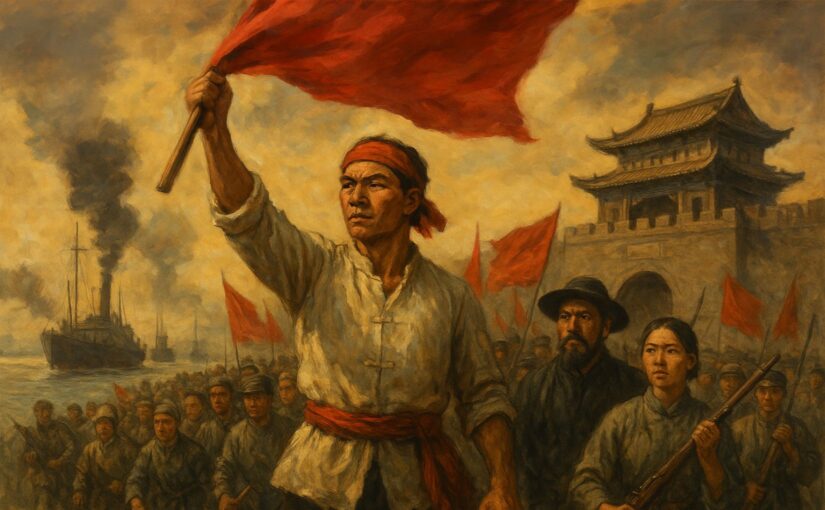
In the following article, originally published on his website Weaponized Information, Prince Kapone gives an acute analysis and mounts a trenchant defence of China’s Taiping Rebellion (1850-1864), generally regarded as one of the greatest peasant rebellions, as well as bloodiest conflicts, in human history.
Describing it as the “spectre of peasant communism”, Kapone situates the rebellion against the background of the stagnation and decline of China’s feudal system, of the Qing dynasty in particular, and the way this opened up the country to imperialist depredations, most notably the British Opium Wars (1839-1842; 1856-1860).
He explains: “The opium-induced decomposition of Chinese society was no accident; it was policy. This narcotic primitive accumulation did not represent the entry of capitalism through ‘natural’ development, but its violent imposition through military discipline. As in India, Ireland, and Egypt, the arrival of the capitalist world market meant the annihilation of local metabolic rationality in favour of cash crop logic, debt servitude, and currency crisis. The Qing state, no matter its robes or rituals, had become a tributary of London finance.
“It is within this furnace of contradiction that the Taiping Rebellion arose – not as an aberration, nor a reactionary nostalgia for a vanished harmony, but as the spontaneous combustion of a people compressed between imperial plunder and domestic parasitism. In this sense, the Taiping were the dialectical consequence of a global contradiction: the fusion of foreign capital’s devastation with the internal bankruptcy of a feudal order. What followed was not simply rebellion, but the premature birth of a proletarian-peasant war in the belly of a still-feudal dragon.”
He goes on to outline the form and essence of peasant revolt: “When the peasantry takes up arms, it does not quote Hegel – it dreams. But the dream, far from being false, is the condensed expression of real suffering, organised into symbolic form. The bourgeois mind, unable to see beyond its own secular fetishisms, calls this ‘madness,’ ‘fanaticism,’ ‘superstition.’ Yet just as the commodity hides labour beneath its surface, so too does ideology conceal class. The gods of the Taiping did not descend from heaven – they rose from the rice paddies.
“Hong Xiuquan, the failed scholar who declared himself the younger brother of Christ, has been mocked by European scribes as a deluded zealot. But what is delusion in a world where imperial capital arrives by gunship? In the dream of paradise, in the vision of a Heavenly Kingdom on earth, the Chinese peasantry gave voice to their deepest material yearnings: land, bread, justice, revenge. That this expression wore the garb of biblical apocalypse is no stranger than the French Revolution quoting Rome or the English Levellers citing scripture. The form is borrowed; the content is real…
“This was a weaponised syncretism: a theology forged in the crucible of examination failure, landlord extortion, opium hunger, and state decay. Christ, repurposed by Hong, was not a redeemer of souls but a hammer of kings. The Taiping gospel was less a catechism than a call to arms, less sermon than strategy.”
Expounding further on what he sees as the communistic essence of the Taipings, he writes: “In their ‘Ten Heavenly Commandments,’ one finds the residue of real struggle: no private property, no sexual exploitation, no opium, no idle rich. A moral economy reasserts itself as divine law. The Taiping did not hallucinate utopia; they resurrected it from memory. Beneath the Christian veneer lay a peasant communism older than the cross… When Hong Xiuquan declared himself a divine son, he was not asserting divinity but abolishing hierarchy. The imperial dragon worships its ancestors; the Taiping peasant made himself the ancestor of a new order. This is not madness – it is revolution in mythic form… The European bourgeoisie feared it not because it was mad, but because it was lucid. It recognised in the fire of that rebellion a world that could not be bought or sold, a society where silver did not rule, and a people who no longer begged for mercy but demanded the kingdom of heaven – and meant it literally… Their program proposed no less than the abolition of private property in land. ‘All under heaven belongs to all,’ they declared. Let the landlords howl: this was the most advanced agrarian communism attempted in the modern world before the birth of the proletariat proper.”
Giving his study an international comparative framework (one that, at least in the case of the Russian mir, Marx also reflected on in his later years), Kapone observes: “The Taiping system resembles, in embryonic form, the Andean ayllu, the Indian village commune, and the Russian mir – not because of racial affinity or cultural parallel, but because the peasant, when unleashed from tribute and market, tends always toward collectivism. Not because he is noble, but because he is practical. No one survives a famine alone.”
He also dwells on the objective and subjective limitations of the movement:
“The greatest strength of the Taiping commune was also its weakness: its material basis in the peasantry. Without capital, they abolished capital; without a proletariat, they foreshadowed its necessity… Surrounded by the Qing state, the British gunboat, and the comprador merchant, the Taiping were forced to militarise every aspect of life. Men and women laboured in regiments. Food was rationed, movement regulated, property collectivised. Agriculture was synchronised with logistics; supply lines replaced markets. What bourgeois economists later condemned as ‘despotism’ was, in truth, war communism avant la letter – a crude, yet necessary form of centralised planning under siege conditions…
“The peasantry, in this moment, seized political power – not as a class destined to rule eternally, but as a class thrust into the breach of history. Their rule was heroic and partial, tragic and luminous. They raised the banner of equality but could not destroy the wage form. They abolished landlordism but lacked the means to abolish scarcity. Their communes fed millions, but could not withstand the famine induced by blockade, siege, and scorched earth. Their dictatorship was real – but it was transitional, incomplete, and ultimately unsustainable under the pressure of global capital.
“Still, the Taiping regime stands as proof that the peasantry, when properly awakened and disciplined by war, can become the bearer of world-historic rupture. Not because it represents the future in itself, but because it clears the ground for one… The Heavenly Kingdom may have ruled by sword and sermon, but at its core stood a truth too dangerous to live: the people can govern themselves.”
Insisting on the revolutionary prescience of the Taiping movement, and its continued lessons and resonance, not just for and in China, but on a global scale, Kapone sums up:
“The Taiping Commune, though annihilated by steel and fire, did not vanish. It smolders still beneath the surface of Chinese history, not as a failed rebellion, but as a premature rupture – an aborted synthesis of agrarian revolution and anti-imperialist war.
“Bourgeois historians, ever eager to sterilise revolt, have embalmed the Taiping in narratives of chaos, fanaticism, and failure. But to analyse them in the dialectic reveals something deeper: the first great attempt in the modern world to overthrow landlordism, expel foreign domination, and construct a social order based not on commodity exchange, but communal distribution. They were not anachronisms – they were anticipations.
“The Taiping vision did not die in Nanjing – it migrated. In the Boxer Uprising, we find their militancy renewed; in the anti-imperialist revolts of the early republic, their hatred of compradorism reemerges; and in 1949, their agrarian egalitarianism is reborn in the revolutionary land reform of the Chinese People’s War. The Communist Party of China, whatever its subsequent transformations, built upon the ruins the Taiping left behind.”
He moves to his conclusion with words pregnant with meaning and lessons for both successful and failed revolutions, from China to Korea, to Cambodia, to Mozambique, to Peru, and to Haiti, and for the prospects and trajectory of genuine and fundamental change on a world scale:
“Let us be precise. The Taiping did not possess the material conditions to complete a socialist revolution: they lacked a proletariat, an industrial base, and the scientific theory of Marxism. But they possessed something else – the spontaneous clarity of the oppressed in motion, the instinctual collectivism of the village, and the class hatred born of hunger. They embodied what we may call revolutionary intuition – the raw, pre-theoretical negation of an unlivable world.
“Their commune was riddled with contradictions. Gender equality was proclaimed but constrained. Property was abolished, but scarcity persisted. Centralisation was necessary but stifling. Yet these contradictions were not signs of backwardness – they were the very symptoms of a people reaching beyond their historical moment, stretching toward a horizon their epoch could not yet sustain. They were building socialism with the tools of feudalism and the ruins of empire.
“It is easy to mourn the Taiping as martyrs, but it is more correct to remember them as pathbreakers. In their downfall we find not only tragedy, but instruction. That no revolution can survive in isolation from the global class struggle. That the peasantry, while capable of igniting the fire, cannot carry it alone to completion. That spiritual fervour, while mobilising, must give way to material planning. And yet, we also learn this: that the soil of revolution is not found only in the factory, but in the furrowed fields and broken backs of the peasantry.
“The history of revolution is not a linear ascent, but a spiral. The Taiping insurrection marked one such turn – a searing prelude to the coming wars of national liberation and agrarian socialism. They were not the end; they were a beginning denied. Their banners torn, their capital burned, their king dead – but the village memory persists. The whisper that land can be held in common. That production can serve need. That heaven can be brought down to earth – not by prayer, but by class war.
“There is a spectre haunting world history – not the spectre of communism as imagined by the salons of Europe, but its peasant form: barefoot, bloodied, and armed with a hoe. The Taiping Rebellion was the most advanced expression of this spectre in the nineteenth century, a rising of the rural masses who, long before the industrial proletariat matured into its revolutionary role, had already begun to construct the negation of property, class, and imperial subjugation from below. Their commune did not await the development of capitalism – it attempted to destroy it before it fully arrived.”
An important study, unique in the English language, of this historic movement is the late Dr. Charles Curwen’s ‘Taiping Rebel: The Deposition of Li Hsiu-ch’eng’, awarded a PhD by SOAS University of London in 1968 and published by Cambridge University Press in 1977. Curwen, who lived and worked in China, 1946-1954, and was a staunch supporter of both the Taiping Rebellion and the Chinese revolution led by Mao Zedong, was also a co-founder (in 1973) and editor with Terrence (Terry) J. Byres and Teodor Shanin of the Journal of Peasant Studies. An interesting essay on the journal may be read here, as published in the inaugural edition of its offshoot, the Journal of Agrarian Change.
I. The Blood Price of Tea and Silver: How China Was Dragged into the World Market
The so-called “independence” of nations under feudal kings and emperors didn’t survive the rise of capitalism. In the 19th century, sovereignty meant nothing if your ports could be shelled open by gunboats. China learned this lesson the hard way. The Qing Empire was forced into the world market not through peaceful exchange, but by narcotics and cannon fire.
Britain had a problem: it loved Chinese tea, but China didn’t care for British wool or iron. Silver was draining out of London and into Canton. To plug this hemorrhage, the East India Company flooded China with opium grown by coerced labor in Bengal. What followed wasn’t trade; it was a drug war packaged as free trade.
When Chinese officials tried to stop the poisoning of their people, Britain sent warships. The Opium Wars were not “misunderstandings” or “diplomatic clashes.” They were wars of primitive accumulation—capitalism battering down the door of a society that had neither parliaments nor stock exchanges, but plenty of peasants to ruin.
The 1842 Treaty of Nanking formalized the robbery: silver indemnities, foreign-controlled treaty ports, and the ceding of territory like Hong Kong. “Free trade” meant something very precise: China would be shackled, bled of its silver, and flooded with dope.
This drained not just silver but life from the countryside. Taxes were still demanded in silver even though peasants lived by barter and grain. As specie drained outward, the Qing state squeezed its own peasantry harder. Families starved not because of drought, but because London bankers needed their cut.
China was not “opened up.” It was cracked open. Its villages—self-sufficient, kin-based, rhythmic—were hooked to the violent circuits of global capital. Opium in, silver out. Land taxes up, rebellion in the making.
This wasn’t a tragic accident. It was policy. The British bourgeoisie weren’t just balancing accounts; they were addicting millions to keep the silver flowing and the empire intact. As in India, Ireland, and Egypt, “modernization” meant dispossession, famine, and military occupation. The Qing emperor still wore dragon robes, but his treasury now served London.
Out of this contradiction—the foreign plunder from without and the bureaucratic parasitism from within—came the Taiping Rebellion. It wasn’t nostalgia for an “old order.” It was the uprising of millions against the twin jaws of landlord and empire. A premature revolution, yes—but one that showed how global capitalism created its own gravediggers even in places it had only just invaded.
II. Of God and Guns: The Fetishism of the Rebel Specter
When peasants rise, they don’t carry Hegel under their arms. They carry dreams. But dreams are not illusions—they are the compressed form of real hunger, real rage, real need. The bourgeoisie, trapped in its own idols of profit and “rationality,” dismisses this as “fanaticism.” Yet the gods of the Taiping did not fall from heaven; they were born in the rice fields, in debt, in the humiliation of failed exams, and in villages drained of silver by foreign dope peddlers.
Hong Xiuquan, mocked endlessly as a lunatic who called himself Christ’s younger brother, was no more “deluded” than the French revolutionaries quoting ancient Rome. In a world where British gunboats enforced opium addiction as free trade, who is the real fanatic? Hong’s visions gave the peasants a language for what they already knew they wanted: land, food, dignity, vengeance. The form was Christian, the content was revolutionary.
The Taiping’s Christianity was not the opium of European missionaries. It was a forged weapon, shaped by exam failure, landlord plunder, and imperial humiliation. Hong’s Christ was no meek shepherd; he was a hammer for smashing kings. The gospel of the Taiping was not about saving souls—it was about abolishing landlords, Manchu elites, foreign merchants, and every parasite who fattened on peasant misery.
Their “Ten Heavenly Commandments” outlawed private property, prostitution, opium, and idle wealth. In them you hear not theology but memory: a moral economy of the village, turned into divine law. They did not hallucinate equality; they reasserted it. Christianity was only the costume—underneath was peasant communism, older than both the cross and the crown. This is why the movement spread not in ports or cities, but in villages of labor. The poor saw themselves in it.
Bourgeois historians still call the Taiping “irrational,” as if rebellion against misery requires footnotes. They say religion doomed them. But who are the mystics here? The peasants who used myth as a weapon—or the professors who insist that markets are eternal, property sacred, and silver divine? To call the Taiping irrational is to call revolt irrational in a world that starves children for profit.
The Heavenly Kingdom was not some bizarre mistake in history. It was the logical outcome of a society ripped apart by landlords and foreign capital, with no industrial proletariat to lead the charge. The peasants reached for revolution with what they had: memory, myth, muskets. Their ideology was contradictory, improvised, uneven—but it pointed in the right direction: against empire, against the state, against the rich. That made it more radical than any liberal reform or missionary sermon.
When Hong declared himself the son of God, he was not simply chasing delusion. He was abolishing hierarchy itself—saying that a poor man from Guangdong could claim heaven as his inheritance. The emperor demanded worship as the “Son of Heaven.” Hong turned the title upside down and gave heaven to the peasantry. That is not madness—it is class war in the language of dreams.
The specter of the Taiping lingers, not as a tragic folly but as a reminder of possibility. The European bourgeoisie feared them not because they were irrational, but because they were precise. In the Taiping fire they saw something unforgivable: a society where land could not be bought or sold, where silver had no throne, and where peasants refused to beg for mercy but demanded heaven—and meant it on earth.
III. The Agrarian Question in the Taiping Program: Communal Land, Abolition of Private Property, and the Peasant Commune
Every peasant war carries the same ghost—the ghost of the commune. The Taiping were no exception. Like the German peasants before them or the Haitian maroons beside them, they rose not out of some abstract manifesto but from hunger, debt, and the unbearable weight of taxes. Their “Land System of the Heavenly Dynasty” was not dreamed up by philosophers; it was hammered out of misery. When the belly is empty, theory follows the stomach.
Their declaration was simple and terrifying to landlords everywhere: “All under heaven belongs to all.” No private property in land, equal plots for every family according to capacity, grouped in cooperative households. A society of use, not profit. A village organized around the granary, not the market. In other words: agrarian communism—far ahead of its time, and far more radical than any liberal tinkering the Qing court or British missionaries ever dared.
Here, the commune reappeared not as a relic of the past but as a revolutionary form. Each household tilled, each household shared. Granaries replaced merchants, cooperation replaced rent. Silver—the toxic currency of British traders and Qing tax collectors—was to be abolished. The parasites of the old order—gamblers, concubine traders, opium pushers—were struck down with the full weight of revolutionary morality. This was not backwardness; it was an attempt to build a rational, collective metabolism in the ashes of empire.
There is nothing mystical here. Peasants everywhere, when freed from the grip of landlords and markets, move instinctively toward collective survival. The Andean ayllu, the Indian village commune, the Russian mir—all testify to the same truth: when famine stalks, no one survives alone. Communism begins as necessity long before it becomes theory.
The Taiping system carried contradictions, as all revolutions do. Women were brought into the collective field, freed from some patriarchal burdens but still fenced off from men. Urban workers and artisans were scarcely integrated. Their program was ambitious but confined; visionary but hemmed in by the limits of a peasant base. They could abolish rent, but not the gunboats offshore. They could plan harvests, but not the global markets already dictating silver, opium, and cotton. Their commune, however heroic, remained cornered by empire.
This is both their strength and their weakness. Without capital, they abolished capital. Without a proletariat, they foreshadowed its necessity. They fought to purify the land, not to industrialize it. They sought justice in the village even while injustice ruled the seas. That contradiction is not a moral failing—it is structural. A peasant insurrection alone cannot overthrow a society already bound in the chains of the world market.
Yet their vision endures. Land without landlords, labor without wages, surplus without profit—these were not fantasies. They were real measures, briefly lived, that showed a different road. And that is why capital and empire crushed them with such ferocity. Not because the commune was “inefficient,” but because it worked. Because it proved, however briefly, that another world was possible—a world where land is valued not as rent, but as life.
IV. War Communism and the Revolutionary Dictatorship of the Peasantry
Every class carries its own signature when it seizes power. The bourgeoisie builds its republic in stock exchanges and coffee houses. The proletariat, when it matures, takes the factory as its fortress. The peasantry, by contrast, builds its revolution knee-deep in mud and blood. The Taiping were no exception. Having declared the end of landlordism, they found themselves surrounded—by the Qing court, by British and French gunboats, by the comprador merchants fattened on silver and opium. Under siege, their commune had no choice but to become an army, and their army no choice but to become the state.
This was not betrayal—it was necessity. In the face of encirclement, the Taiping militarized every aspect of life. Villages became regiments, farms became supply depots, households were synchronized with logistics. Rations replaced markets; distribution replaced exchange. Bourgeois historians later sneered at this as “despotism,” but that is ideology speaking. In reality, it was war communism before the term existed: a crude, improvised, but rational attempt to subordinate production to collective survival under siege.
Each Taiping unit tilled its own fields, supplied its own mess halls, and defended its own land. Agriculture was reorganized around the needs of the war machine, and the military hierarchy became the nervous system of the revolution. When rigidity and authoritarianism crept in, they were not the fruit of ideology but of survival. A revolution cannot play by the rules of liberal parliaments when it is fighting for its life against cannon fire and famine.
Here lies the contradiction of the peasant revolution: it must centralize to survive, but in centralizing it begins to resemble the very verticality it once sought to abolish. Without industry to escape scarcity, without a proletariat to socialize production beyond the village, the commune hardens into a barracks. The dictatorship of the Taiping was not a dictatorship of one class over another, but the dictatorship of survival over all else.
And yet, even under the pressure of war, the Taiping military bore revolutionary features that terrified the ruling classes. This was no feudal host bound by lineage, no mercenary army bought by silver. It was a people’s army, organized through common grievance and collective discipline. Women not only served, but commanded. Rank was earned, not inherited. Redistribution was enforced by soldiers who themselves had lived as tenants and debtors. This was not simply a war in the countryside—it was war of the countryside, aimed squarely at the cities of silk, silver, and subordination.
For a moment, the peasantry seized political power. Not as a class destined to rule, but as a class thrust forward by history. Their rule abolished rent but could not abolish scarcity. Their communes sustained millions but could not withstand siege and blockade. Their dictatorship was real, but provisional—heroic, luminous, and ultimately unsustainable in a world already dominated by global capital.
Still, the Taiping regime remains proof of possibility. It showed that the peasantry, disciplined by war and animated by vision, could rupture the old order on a continental scale. Not because the peasantry carries the future in its plough, but because it clears the ground for one. Theirs was not a dictatorship of ignorance, but of clarity: the knowledge that peace under empire is nothing but slow death, and that land without justice is slavery. In the end, the Taiping’s crime was not their fanaticism, but their lucidity—they showed, for a brief moment, that the people could govern themselves.
V. The Counterrevolution: Qing Restoration, Anglo-French Intervention, and the Global Bourgeoisie
No ruling class in history has ever surrendered its power to righteousness. And no empire, once bloodied, simply collapses—it is propped up, patched, and refinanced by its creditors. The fall of the Taiping was not a matter of excess zeal or naïve vision, nor reducible to internal contradictions. It was strangled in its cradle by the marriage of a dying feudalism to a rising capitalism. The Qing dynasty, hollowed of legitimacy, survived not by its own strength but by mortgaging sovereignty to the world market and selling the peasantry as collateral to Western finance.
British and French arms, tested already in the Opium Wars, returned to China—not to topple a state, but to preserve one against its own subjects. The European bourgeoisie, confronted with the specter of landless peasants seizing the soil, rushed to the Qing court’s defense. London’s bankers knew nothing of Hong Xiuquan, but they knew the danger of his program: the abolition of rent, of silver, of commerce itself. Where free trade failed, cannon spoke. The suppression of the Taiping was among the first modern counterinsurgency campaigns: foreign capital, comprador elites, and imperial armies converging to extinguish revolution from below.
The mechanism was material, not mystical. The “Ever Victorious Army,” led by Anglo-American mercenaries and financed by Shanghai merchants, was a prototype of imperial subcontracting: privatized violence deployed for public repression. Alongside came the instruments of capitalist war—breech-loading rifles, steam transports, war loans, and intelligence networks. Behind them followed missionaries, opium traders, and consular treaties. Europe’s Christian empires did not fear the Taiping’s theology; they feared its economics.
The Taiping faced not merely a dynasty, but a system. A system that could absorb any reform but land redistribution, tolerate any creed but the abolition of property. Capital recognizes no flag but profit, no morality but accumulation. Once humiliated by foreign gunboats, the Qing court was refashioned as junior partner in global accumulation: furnished with loans, weapons, and diplomatic recognition in exchange for repression. In this role, the dynasty became less a sovereign than the armed wing of international capital draped in Confucian silk.
The massacres that followed—tens of millions dead, villages erased, harvests burned—were not incidental. They were the price of restoring order to disrupted circuits of value. Depopulation was not simply vengeance; it was counterinsurgency by famine. Landlordism was reimposed with bayonets, markets reopened over ashes, labor driven back into submission by terror. For the world system, the ultimate imperative was the uninterrupted flow of commodities—and if this required oceans of blood, so be it.
The true horror lies not in the cruelty itself, which history has seen before, but in its orchestration. The very powers that preached liberty in Europe financed extermination in Asia. British liberals toasted “peace restored” in China while their merchants trafficked opium for silver and silver for tea. Civilization advanced on rails laid across corpses.
The Taiping fell not for lack of courage, but because they stood alone at the juncture of feudal collapse and capitalist expansion—an impossible station for any one class. Without urban allies, without proletarian solidarity abroad, they were encircled. Their defeat is a bitter lesson in internationalism: the enemies of revolution cooperate across oceans, and the revolution must do the same if it is to endure.
Yet their annihilation is also a warning to the victors. For every commune razed, memory persists. The Taiping revealed to the peasantry that empires bleed, that landlords can fall, and that even thrones tremble before barefoot insurgents with hoes and sacred visions. This is why they were not merely defeated but erased, slandered, and entombed in imperial historiography. Their danger was not only in what they did, but in what they proved possible. And it is why their resurrection—in memory, in struggle, in spirit—remains inevitable.
VI. Ruins and Embers: The Historical Legacy of the Taiping Commune
History does not advance in triumphal processions—it lurches through ruins. And in those ruins, the revolutionary class finds inheritance, not in marble memorials, but in unburied bones. The Taiping Commune, though drowned in steel and fire, did not vanish. It smolders beneath the surface of Chinese history, less a “failed rebellion” than a premature rupture: an aborted synthesis of agrarian revolution and anti-imperialist war.
Bourgeois historians, eager to sterilize revolt, have embalmed the Taiping as chaos, fanaticism, or folly. But a dialectical reading reveals something else: the first great modern attempt to overthrow landlordism, expel imperial domination, and build a social order grounded not in commodity exchange but communal distribution. They were not anachronistic relics—they were anticipations.
The Taiping vision did not perish at Nanjing. It migrated. In the Boxer Uprising, their militancy resurfaced. In the anti-imperialist revolts of the early republic, their hatred of comprador elites reemerged. And in 1949, their agrarian egalitarianism was reborn in the revolutionary land reform of the People’s War. The Communist Party, whatever its later mutations, inherited the terrain cleared by the Taiping. The dialectic marched forward—but carried their ashes in its teeth.
Let us be precise: the Taiping lacked the material conditions for socialist revolution. They had no proletariat, no industrial base, no scientific Marxism. But they possessed something else—the spontaneous clarity of the oppressed in motion, the collectivist instinct of the village, the class hatred of famine. They embodied what might be called revolutionary intuition: a raw, pre-theoretical negation of a world that could not be lived in.
Their commune bore contradictions. Gender equality was proclaimed, yet constrained. Property was abolished, yet scarcity endured. Centralization was necessary, yet suffocating. But these were not signs of failure—they were the marks of a people reaching beyond their epoch, building with tools of feudalism amid the rubble of empire. They stretched toward a horizon history had not yet furnished.
It is easy to mourn the Taiping as martyrs, but truer to remember them as pathbreakers. Their defeat instructs: no revolution survives in isolation from global class struggle; the peasantry can ignite revolt but cannot alone carry it to completion; spiritual fervor may mobilize, but must yield to material planning. Yet their struggle also teaches that revolution’s soil is not only the factory floor—it lies too in the furrowed fields, in the broken backs of peasants who dream of justice.
Revolutionary history is not a straight ascent but a spiral. The Taiping insurrection marked a violent turn of that spiral—a prelude to the great wars of national liberation and agrarian socialism to come. They were not an end, but a beginning denied. Their banners torn, their capital burned, their king slain—yet village memory endures. The whisper persists: that land can be held in common, that production can serve need, that heaven can be brought to earth—not through prayer, but through class war.
VII. Concluding Reflection: On the Specter of Peasant Communism
There is a specter haunting world history—not the salon-communism of Europe’s theorists, but its peasant form: barefoot, bloodied, hoe in hand. The Taiping Rebellion was the most advanced expression of this specter in the nineteenth century, a rising of the rural masses who, long before the industrial proletariat matured into its revolutionary role, had already begun to negate property, hierarchy, and empire from below. Their commune did not await capitalism’s development—it sought to abolish it before it fully arrived.
Here lies the contradiction bourgeois history cannot resolve: if capitalism is the supposed precondition for socialism, how do we explain those eruptions—Taiping, Haiti, the Paris Commune—where the oppressed attempted to leap over it? The answer is not to dismiss them as premature, but to recognize them as foreshadowings: anticipatory revolts against the order yet to come. Their so-called “failure” does not confirm capitalism’s inevitability—it proves that the oppressed will always attempt to make history before history permits it.
Primitive accumulation is not an event confined to capitalism’s birth; it is a permanent process—ceaseless dispossession, extortion, and destruction of non-capitalist life. The Taiping arose not in spite of this, but because of it. They were its negation, crystallized into motion. What the factory did to the worker, the treaty port and tax collector did to the peasant. And like the worker, the peasant rebelled—armed not with machines, but with memory, faith, and collective hunger.
To reduce the Taiping to zealotry or chaos is not mere academic error—it is ideology in service of counterinsurgency. It obscures the revolutionary kernel within the revolt, rendering its threat illegible. The European bourgeoisie did not fear the Heavenly Kingdom’s theology; they feared its abolition of rent, its expulsion of merchants, its rejection of landlords and bankers. It was not heresy—it was communism in embryo.
The commune reappears across history—in China, in the Andes, in Russia, in the insurgent villages of Vietnam and Algeria—not as relic, but as recurring nightmare for capital. It emerges wherever the soil remembers common use, wherever labor retains collective rhythm, wherever people recall feeding themselves outside markets. These survivals are precisely what capital must extinguish to claim it is the only future.
Yet the commune does not die. It returns—in revolt and in memory, in insurgency and imagination. Its fire can be drowned, but its embers smolder, breathing beneath the asphalt of empire. The Taiping were no accident; they were history’s refusal to submit. Their commune was not an endpoint, but a prologue.
Thus we conclude not in mourning, but in preparation. For the specter walks still. It haunts dams built over ancestral rivers, stirs in soil poisoned by foreign mines, lingers in the hunger of those who labor yet do not eat. And the next time it rises, it will not rise alone—but with allies in every factory, every port, every village and city. Not as rebellion, but as revolution complete.






Is it possible that Mao studied this event and came up with the strategy of “the countryside encircling the city” based on the revolutionary potential of millions of peasants?
I wondered of Mao’s strategy of “the countryside encircling the city” has its roots on studying the history of the many peasant rebellions that happened in China?