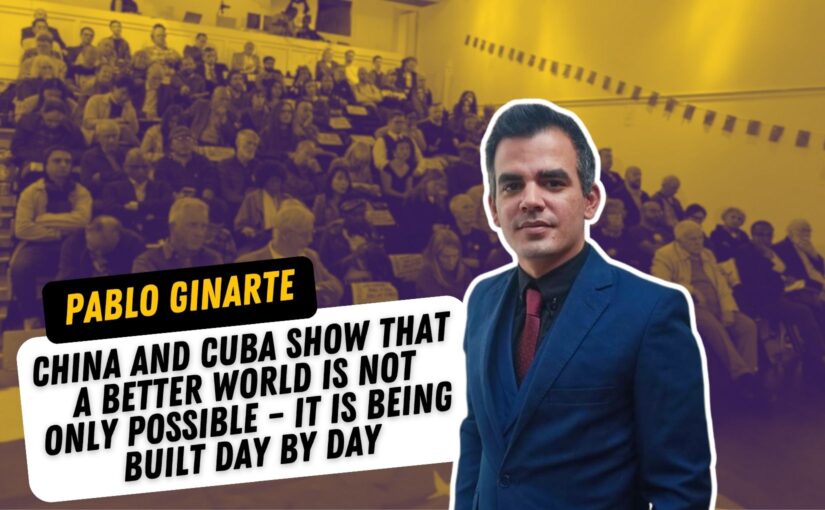
China and Cuba show that a better world is not only possible – it is being built day by day

The opening session of our China Conference 2025, held in London on September 27, was addressed by senior diplomats from the embassies of the People’s Republic of China, Republic of Cuba, Russian Federation, Bolivarian Republic of Venezuela and Lao People’s Democratic Republic.

Below we reprint the main body of the inspiring speech delivered by Pablo Arturo Ginarte Sampedro, First Secretary of the Embassy of the Republic of Cuba. He notes that: “This year we celebrate a momentous milestone: the 65th anniversary of diplomatic relations between Cuba and the People’s Republic of China. In 1960, revolutionary Cuba became the first nation in the Western Hemisphere to recognise the People’s Republic. That decision was an act of sovereignty and principle, and it laid the foundation for what has become an unbreakable, ironclad friendship. That friendship was forged by the historic leaders of our revolutions, Commander in Chief Fidel Castro Ruz and Chairman Mao Zedong.”

It is a profound honor to address you today from this historic place, Bolívar Hall, a beacon of Latin American culture and resistance here in London, graciously hosted by our dear Venezuelan comrades. On behalf of the people and government of the Republic of Cuba, I bring you the warmest, most fraternal greetings.

This year we celebrate a momentous milestone: the 65th anniversary of diplomatic relations between Cuba and the People’s Republic of China. In 1960, revolutionary Cuba became the first nation in the Western Hemisphere to recognise the People’s Republic. That decision was an act of sovereignty and principle, and it laid the foundation for what has become an unbreakable, ironclad friendship.

That friendship was forged by the historic leaders of our revolutions, Commander in Chief Fidel Castro Ruz and Chairman Mao Zedong. From those early days it has grown into a comprehensive strategic partnership. Today we work hand in hand to build a China-Cuba community with a shared future.

Our partnership extends well beyond trade and infrastructure. Equally important is our collaboration in science and technology. Together we are building sovereign scientific capacity in the Global South so the benefits of the fourth industrial revolution serve people, not only the profits of a few multinational corporations. This scientific solidarity is essential for achieving genuine independence in the 21st century.

For Cuba, these are not abstract ideals. For more than 60 years my country has resisted the most brutal and prolonged economic, commercial, and financial blockade in human history, a criminal policy imposed by the United States. In that struggle our friendship with China has been a vital pillar of support. Through trade, investment, and solidarity, China has offered a crucial lifeline and shown the world a model of relations based on sincere mutual assistance rather than imperial domination.

Continue reading China and Cuba show that a better world is not only possible – it is being built day by day

China’s Premier champions peace, justice and development at UN General Assembly

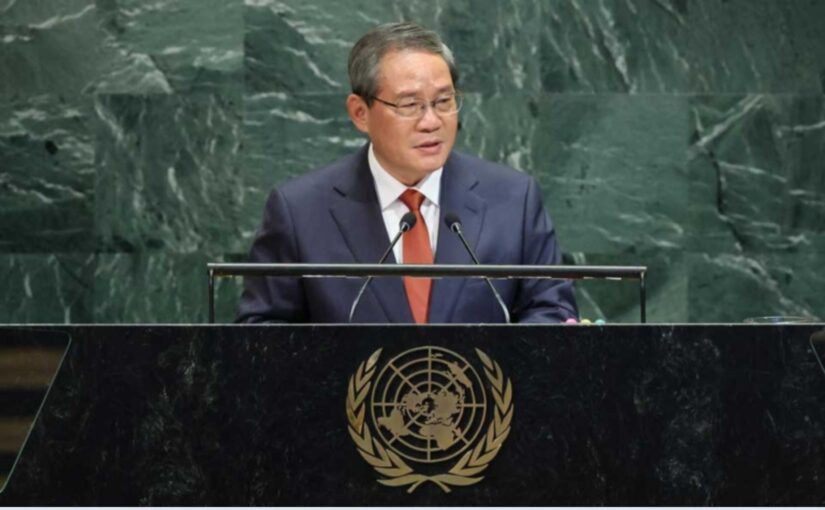
Chinese Premier Li Qiang spoke in the general debate of the 80th session of the United Nations General Assembly in New York on September 26.

He began by noting that: “This year marks the 80th anniversary of the victory of the World Anti-Fascist War. It is also the 80th anniversary of the founding of the United Nations (UN). Eighty years ago, fascism was defeated in fearless battles by countless heroic men and women around the world, and the UN was created upon their ideal of a world free of war.

“An important outcome of the victory of the World Anti-Fascist War, the UN was born out of a deep reflection on the scourge of two world wars. Its founding initiated a historic experiment to escape the law of the jungle, and marked the beginning of an extraordinary journey, i.e. building the postwar international order and pursuing peace and development. The past 80 years have been tortuous but purposeful.”

The last eight decades, he continued, have seen, “human society leapfrog from the age of electricity and computers into a digital intelligence era. While the world we live in has changed enormously, the ideal of making it a better place remains unchanged.”

In this regard he identified three key aspects:

  • Peace and development are the strongest aspirations shared by the people of all countries. Throughout history, while the shadows of war and conflict have never fully gone away, no force has ever stopped humanity in its quest for peace and development. Having gone through two world wars, we must never forget the bitter lessons learned through bloodshed and loss of lives.
  • Solidarity and cooperation are the most powerful drivers for human progress. In the ferocious years of the World Anti-Fascist War, countries with different social systems, histories and cultures rose above their differences, fought side by side, and prevailed together. All this proves a simple yet powerful point – solidarity lifts everyone up, while division drags all down.
  • Fairness and justice are the most important values pursued by the international community. In the past 80 years, the world saw the demise of the old colonial system, the establishment of the existing international order, and the strengthening of international rule of law. History keeps reminding us that when might dictates right, the world risks division and regression; when fairness and justice prevail, societies enjoy stability and thrive. Should the era of the law of the jungle return and the weak be left as prey to the strong, human society would face even more bloodshed and brutality.

Turning to the present situation, he made this appeal:

“At present, the world has entered a new period of turbulence and transformation. Unilateralism and Cold War mentality are resurfacing, the international rules and order built over the past 80 years are under serious challenge, and the once-effective international system is constantly disrupted. The various problems induced are distressing and worrying. Humanity has once again come to a crossroads. Anyone who cares about the state of affairs in the world would want to ask: Why couldn’t we humans, having emerged from tribulations, adopt a greater sense of conscience and rationality, and treat each other with kindness and coexist in peace? How could we, in the face of deplorable incidents such as humanitarian disasters, turn a blind eye to atrocities that trample blatantly on fairness and justice and sit on our hands? How could we, when confronted with unscrupulous acts of hegemonism and bullying, remain silent and submissive for fear of might?”

Li explained that the Global Governance Initiative proposed at the Shanghai Cooperation Organisation’s Tianjin Summit at the beginning of September underscores the principles of adhering to sovereign equality, abiding by international rule of law, practicing multilateralism, advocating the people-centred approach and focusing on taking real actions. China, he said, is ready to take coordinated and effective actions together with all sides to offer more concrete solutions and promote world peace and development.

Continue reading China’s Premier champions peace, justice and development at UN General Assembly

History of Hong Kong’s communist guerrillas reclaimed

The following article, originally published by China Daily, movingly describes the little known but heroic story of the guerrilla struggle waged under the leadership of the Communist Party of China against the Japanese occupation of Hong Kong.

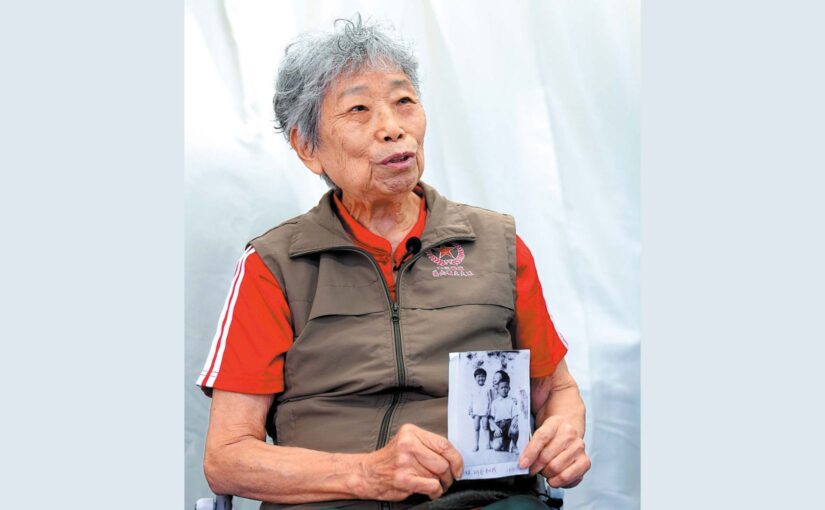
Journalist Li Xiang writes: “The agonised cry, ‘If I die, avenge me!’ has echoed in Lam Chun’s mind for 82 years. It was May 1943 in Kowloon City, when Japanese soldiers dragged her 23-year-old sister, Lam Chin, into their home. The accusation was theft – a charge fabricated after she rejected a soldier’s advances. A laundry worker at the Japanese barracks, Lam Chin was subjected to a relentless beating, with rifle butts smashing against her bones.”

“That day left a deep impression on me,” Lam Chun, now 90, recalled. “It wasn’t a day for just our family’s shame, but also the nation’s suffering.”

What her tormentors didn’t know was that Lam Chin was secretly smuggling intelligence for guerrillas led by the Communist Party of China in their fight to liberate Hong Kong.

That night, as her family dressed her wounds, Lam Chin revealed her secret. A former leader in the student movement supporting the Chinese People’s War of Resistance Against Japanese Aggression (1931-45), she had long been fighting back. Her suffering, coupled with this revelation, became a call to arms – not just for vengeance, but for victory.

“If we’re beaten for no reason at home, we might as well fight,” Lam Chun remembered her mother declaring.

Within months, Lam Chun, her mother, and her brother joined the Hong Kong Independent Battalion – her sister’s unit. Nearly 1,000 strong and composed almost entirely of locals, the battalion became a relentless foe to Japan after its December 8, 1941, invasion of Hong Kong.

The then-British colony’s defences collapsed in just 18 days – a swift defeat that historians see as emblematic of Britain’s halfhearted commitment to defending the colony.

Now, as the last survivors fade, their stories – once buried under colonial and wartime politics – have resurfaced. Their resistance played a crucial role in the broader Allied effort to defeat fascism and weaken the Japanese war machine.

“Many Hong Kong families joined the resistance together – fighting as one,” said Lam Chun, now President of the Society of the Veterans of the Original Hong Kong Independent Battalion of the Dongjiang Column, which documents this wartime heroism.

Few embodied this spirit more than the Law family of Sha Tau Kok, with nine of its 11 members taking up arms as guerrillas. Born in 1930, Law King-fai grew up amid the resistance efforts. His childhood was defined by the cause and even as a toddler he was taught patriotic songs.

“Fight the Japanese, fight the Japanese! Down with Japanese imperialism, protect our homeland!” the 95-year-old recalled, singing along.

Hong Kong is launching a series of events to educate its youth on national history and commemorate the 80th anniversary of the victory in the war. The initiative includes exhibitions, workshops, film screenings, and exchange tours to historical sites on the Chinese mainland. “It’s not fair for those who gave their lives decades ago that today’s Hong Kong youth don’t even know the history,” Chan Hoi-lun said, citing the colonial-era authorities’ neglect of local efforts to fight Japanese aggression. Chan Hoi-lun is the daughter of Tsau Sheung-ling, who played a key role in one of the war’s boldest missions, in which over 800 Chinese cultural figures, their relatives, and soldiers of international allies were smuggled out of occupied Hong Kong.

At a recent forum, Hong Kong Special Administrative Region Chief Executive John Lee Ka-chiu underscored the city’s significant role in China’s war efforts. He cited the city’s work in shipping war supplies, rescue operations, and front-line defence, embodied by brave groups like the Hong Kong Independent Battalion.

In a recent interview with China Daily, Hong Kong lawmaker Chan Yung, Vice Chair of the Democratic Alliance for the Betterment and Progress of Hong Kong (DAB), said that while history education has improved significantly since the 1997 handover, more must be done to strengthen the understanding of national history, particularly amid current global tensions.

The agonized cry, “If I die, avenge me!” has echoed in Lam Chun’s mind for 82 years.

It was May 1943 in Kowloon City, when Japanese soldiers dragged her 23-year-old sister, Lam Chin, into their home. The accusation was theft — a charge fabricated after she rejected a soldier’s advances.

Continue reading History of Hong Kong’s communist guerrillas reclaimed

George Galloway prevented from speaking at FoSC China Conference by airport detention

Friends of Socialist China successfully held its second annual China Conference on Saturday September 27. More than 100 people gathered in London’s Bolivar Hall to hear expert presentations from a broad range of progressive scholars and activists on such topics as 80 years since the defeat of fascism: China as a force for peace and multipolarity; China’s achievements in overcoming poverty and building socialism; and How China is leading the fight against climate breakdown.

We were honoured to be addressed in our opening session by senior diplomats from the embassies of China, Russia, Cuba, Laos and Venezuela. The closing session was addressed by leaders of the Communist Party of Britain, Communist Party of Ireland and the Association of Indian Communists (the UK and Ireland organisation of members of the Communist Party of India (Marxist)).

We will be carrying more material on the conference in coming days.

But most immediately, we draw attention to the fact that our opening session was also due to be addressed by George Galloway, leader of the Workers Party of Britain (WPB) and former Member of Parliament (1987-2005 – Glasgow Hillhead and Kelvin; 2005-2010 – Bethnal Green; 2012-2015 – Bradford West; and 2024 – Rochdale). However, that morning George and his wife, Gayatri Galloway, also a leading member of the Workers Party, were detained by Sussex Police on their arrival at Gatwick Airport under Schedule 3 of the Counter Terrorism and Border Security Act 2019. This draconian, anti-democratic law, as the BBC reported, “allows an officer to stop, question, search and detain a person at a port or the border area in the UK to determine if they have engaged in hostile activity. Those being detained can be required to provide information including passwords to devices.”

In other words, in terms of the right to remain silent, access to legal representation, and in other ways, detention under this law accords its victims even fewer rights than those enjoyed by those formally arrested. It has increasingly been used by the repressive Starmer government against journalists, activists and now a prominent political figure, who oppose its reactionary and war-mongering policies at home and abroad.

The WPB released two statements on their Telegram channel and other social media regarding the detention of George and Gayatri in the afternoon of September 27 and on their release without charge in early evening. They stated:

“Our party condemns the attempt to intimidate those who seek amity rather than enmity with the rest of the world… We were obstructed from providing legal support and the conduct of the affair has been designed to intimidate political opponents of the drive towards war with Russia and China.”

Friends of Socialist China vehemently condemns this further brazen assault on democratic rights by the British state and its attacks on anti-imperialists. We extend our full support and solidarity to George and Gayatri and to the comrades of the Workers Party, as we do to all those subject to state repression on account of their political work against imperialism and war and in support of peace, democracy and social progress.

At time of writing, George Galloway was due to make a full statement on the detention of himself and Gayatri at 7pm BST, Sunday September 28 on his Mother of All Talk Shows (MOATS).

URGENT STATEMENT BY THE WORKERS PARTY

At 11am we were informed by police officers in Gatwick that our party leader George Galloway and his wife have been detained at the airport @sussex_police @BTP .

The police agreed that they would pass a message to our comrades from us and pass back a reply from them.

Despite repeated attempts to gather further information, and despite repeated calls to the police, we have no further information on their wellbeing, nor on the observation of their Rights.

There is no information on charges or alleged offences. Therefore we may conclude this is politically motivated intimidation.

We call on all supporters and friends to amplify this message and demand the IMMEDIATE RELEASE of our leaders.


PARTY STATEMENT ON RELEASE OF GEORGE AND GAYATRI GALLOWAY

Our party condemns the attempt to intimidate those who seek amity rather than enmity with the rest of the world.

Our leader George Galloway and our deputy chair Gayatri Galloway have now been released without charge.

There was never any chance of an offence.

We were obstructed from providing legal support and the conduct of the affair has been designed to intimidate political opponents of the drive towards war with Russia and China.

A fuller account will be given, tomorrow night so be sure to watch and follow @MoatsTV for the full account.

ENDS

Xi Jinping at the UN Climate Summit: Green and low-carbon transition is the trend of the time

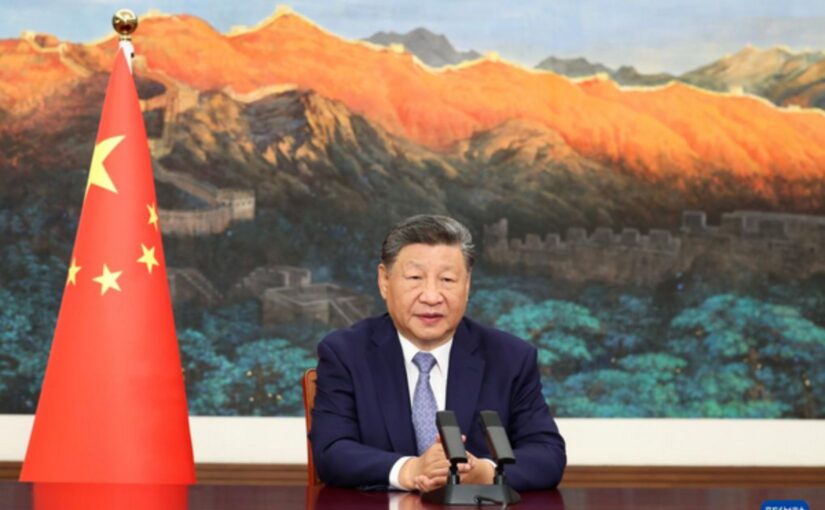
In video remarks to the United Nations Climate Summit on 24 September 2025, Chinese President Xi Jinping called for a renewed global commitment to climate action. He stressed that green and low-carbon transition is the “trend of our time”, urging countries not to be swayed by the backsliding of “some country” (presumably referring to the United States) and to deliver ambitious Nationally Determined Contributions (NDCs).

Xi outlined three key principles. First, confidence: the world must stay resolute and consistent in its climate efforts. Second, responsibility: fairness requires that developed nations lead in emissions cuts while providing financial and technological support to developing countries, respecting their right to development. Third, cooperation: countries should strengthen coordination in green technology and industry, ensure open trade in green products, and share the benefits of sustainable growth worldwide.

Announcing China’s new NDCs, Xi pledged that by 2035 China will: reduce net greenhouse gas emissions by 7 to 10 percent from peak levels; raise non-fossil fuels to over 30 percent of energy consumption; expand wind and solar capacity to 3,600 GW (six times 2020 levels); increase forest stock to 24 billion cubic meters; make new energy vehicles dominant in new sales; extend its carbon trading market; and basically establish a climate-adaptive society. He concluded:

Great visions require concrete actions. Climate response is an urgent yet long-term task. Let’s all step up our actions to realize the beautiful vision of harmony between man and nature, and preserve planet Earth—the place we call home.

In a blog post, veteran educator and activist Mike Klonsky contrasted President Xi’s vision with Donald Trump’s speech at the UN General Assembly – “a long and humiliating rant, filled with personal grievances and attacks on the UN, European leaders, migration policies, and clean energy.” Mike observes that Trump “spent about a quarter of his speech undermining UN-led efforts to address climate change and ridiculing renewable energy policies”. Meanwhile, “China is quietly rewriting the global energy script. The numbers aren’t just staggering—they’re humiliating for any nation like the US, still tethered to fossil-fuelled delusions”.

A Morning Star report of 25 September quotes UN climate chief Simon Stiell saying that plan announced by President Xi “is a clear signal that the future global economy will run on clean energy.”

In a separate opinion piece for the Morning Star on 25 September, London-based climate activist Paul Atkin describes the extraordinary progress China is making in relation to green energy:

• China has 17.2 per cent of the world’s people but half of the world’s solar, wind power and EVs.
• Last year, China installed as much renewable power as the US has in its entire history.
• Three out of four offshore wind turbines in 2025 are being installed in China.
• This April, China installed solar power at a rate equivalent to a new power station every eight minutes.
• Enormous solar and wind farms are being built. One of these, in Tibet, is the size of Chicago.

Paul points to the urgent necessity of working closely with China in pursuit of a sustainable future: “As the climate crisis deepens, the cost of being shackled to the US and its cold war stance against China will become more and more apparent — a point we have to make in and through the unions, Labour, the Greens and Your Party.”

Paul is among the speakers at the Socialist China Conference on Saturday 27 September.

We republish below President Xi’s speech at the UN Climate Summit, followed by the text of Paul Atkin’s article.

Honoring Commitments with Concrete Actions and Jointly Writing a New Chapter in Global Climate Governance

Remarks by H.E. Xi Jinping, President of the People’s Republic of China
At the United Nations Climate Summit
September 24, 2025

Your Excellency Secretary General António Guterres,

Your Excellency President Luiz Inácio Lula da Silva,

Colleagues,

This year marks the 10th anniversary of the Paris Agreement, a pivotal year for countries to submit their new Nationally Determined Contributions (NDCs). Global climate governance is entering a key stage.

I wish to share with you three points.

First, we must firm up confidence. Green and low-carbon transition is the trend of our time. While some country is acting against it, the international community should stay focused on the right direction, remain unwavering in confidence, unremitting in actions and unrelenting in intensity, and push for formulation and delivery on NDCs, with a view to providing more positive energy to the cooperation on global climate governance.

Second, we must live up to responsibilities. In the course of global green transition, fairness and equity should be upheld and the right to development of developing countries fully respected. The transition should serve to narrow rather than widen the North-South gap. Countries need to honor the principle of common but differentiated responsibilities, whereby developed countries should take the lead in fulfilling emission reduction obligations and provide more financial and technological support to developing countries.

Third, we must deepen cooperation. The world now faces a huge demand for green development. It is important that countries strengthen international coordination in green technologies and industries to address the shortfall in green production capacity and ensure free flow of quality green products globally, so that the benefits of green development can reach all corners of the world.

Colleagues,

Let me take this opportunity to announce China’s new NDCs as follows: China will, by 2035, reduce economy-wide net greenhouse gas emissions by 7% to 10% from peak levels, striving to do better; increase the share of non-fossil fuels in total energy consumption to over 30%; expand the installed capacity of wind and solar power to over six times the 2020 levels, striving to bring the total to 3,600 gigawatts; scale up the total forest stock volume to over 24 billion cubic meters; make new energy vehicles the mainstream in the sales of new vehicles; expand the National Carbon Emissions Trading Market to cover major high-emission sectors; and basically establish a climate adaptive society.

These targets represent China’s best efforts based on the requirements of the Paris Agreement. Meeting these targets requires both painstaking efforts by China itself and a supportive and open international environment. We have the resolve and confidence to deliver on our commitments.

Colleagues,

Great visions require concrete actions. Climate response is an urgent yet long-term task. Let’s all step up our actions to realize the beautiful vision of harmony between man and nature, and preserve planet Earth—the place we call home.

Thank you.


Time to follow China’s climate leadership

The climate crisis is happening now. We are in a crucial decade in the century that will make or break human civilisation. 

It will not follow a path of Fabian gradualism. In physics as in politics, long periods of apparent stasis, in which forces build, hit a tipping point, setting off sudden, dramatic shifts; unimaginable until they happen, but making the previous period unimaginable once they have. 

China aims to build a moderately prosperous socialist society as an ecological civilisation, expressed in the “Two Mountains” proposition — that green mountains with clear water are as valuable as mountains of gold. 

So, as China grows, it will be green; not socialism with a green component, but green socialism. As one Canadian commentator put it: “China is pushing power sector transformation through central planning. It can build clean infrastructure quickly.” 

So, if you have socialist planning, you can put social and ecological priorities in command in a way that the West can’t. 

“China sees the old fossil fuel growth model as … unable to sustain long-term prosperity.” 

If the socialism that’s built isn’t green, it can’t survive. Investment in solar power, electric vehicles, batteries, and wind power is now the core driver of China’s economy.

• China has 17.2 per cent of the world’s people but half of the world’s solar, wind power and EVs. 
• Last year, China installed as much renewable power as the US has in its entire history.
• Three out of four offshore wind turbines in 2025 are being installed in China.
• This April, China installed solar power at a rate equivalent to a new power station every eight minutes.
• Enormous solar and wind farms are being built. One of these, in Tibet, is the size of Chicago.

China now has 57 per cent of its electricity generated by renewables, compared to 50.8 per cent for Britain. China’s domestic emissions are peaking, even as demand for energy increases. Emissions were down 1.6 per cent, and coal consumption dropped by 2.6 per cent, in the first half of this year. 

The International Energy Agency expects China to hit peak oil in 2027. As China had driven two-thirds of global oil demand growth from 2013 to 2023, it is set to plateau then drop before 2030.

This makes investment in fossil fuel exploration or power plants increasingly risky. Banks that have traditionally put huge resources into them are beginning to get cold feet. This is putting the US fossil fuel drive at odds with markets. China’s decision to stop coal investment overseas has been pivotal. 

• China’s clean energy exports in 2024 shaved 1 per cent off global emissions outside of China.
• Three-quarters of global fossil fuel demand is now in nations where this has already peaked.
• More than 60 per cent of emerging and developing economies like Brazil and Vietnam are leapfrogging the US and Europe in clean electrification.
• Pakistan doubled its previous grid capacity with new rooftop solar last year.
• Solar panel exports from China to Africa are up 60 per cent this year. 

Three factors underlie this. 

Physics: fossil fuels are wasteful. Two-thirds of their energy is lost to heat or inefficiency. Solar, electric motors, and heat pumps are two to four times as efficient. 

Economics: as fossil fuel reserves deplete, they become more expensive to access. The more electric technology is manufactured, the cheaper and better it becomes.

Geopolitics: the old energy system left three-quarters of humanity dependent on expensive, imported fuels. Electric technologies unlock local resources. 

So, the Western model of development is outmoded, and the future does not, and cannot, look like the US. China is not following the US in a race to the bottom. Ma Zhaoxu, China’s vice-foreign minister, says: “Regardless of how the international situation evolves, China’s proactive actions to address climate change will not slow down.”

In rolling back Joe Biden’s attempt to suck green investment into the US, Donald Trump has abandoned the future. 

This doesn’t simply involve domestic economic self-sabotage, with more expensive fossil fuel plants pushing up bills, offshore wind farms cancelled, imperilling supply in regions like New England, but also a wrecking ball taken to disaster emergency relief and scientific research monitoring the climate.

As the world’s leading petrostate, US policy now actively suppresses the truth about climate change. Their aim is to lock as much of the world as possible into fossil fuel bondage.

Success for the US would lock the world, and the US itself, into climate collapse. But, while the US still makes some of the weather — literally in this case — it’s no longer able to determine the direction of the world.

As climate scientist and 350.org founder Bill McKibben puts it in his article Here Comes the Sun: “Big Oil spent more money on last year’s election cycle in my country than they’ve ever done before. And it’s why they’re now being rewarded with a whole variety of measures designed to slow this transition down, which may succeed.

“I mean, it’s possible that 20 years from now, the US will be a kind of museum of internal combustion that other people will visit to see what the olden days were like. But it’s not going to slow the rest of the world down much, I don’t think.” 

There is a tension in the British government, with its attempt to dodge tariffs by bending the knee and committing to an annual £77 billion black hole in “defence” spending, and the stated direction of the Department for Energy Security and Net Zero to make Britain an “electrostate.” This involves some co-operation with China, but would require more investment than the military spend will allow. 

Reform UK and the Conservative Party aim at consolidating energy dependence on the US, no matter how ruinous the cost. As the climate crisis deepens, the cost of being shackled to the US and its cold war stance against China will become more and more apparent — a point we have to make in and through the unions, Labour, the Greens and Your Party.
Is China a threat?

On 24 September 2025, Friends of Socialist China supporters in Yorkshire, Britain, organised a webinar on the theme of Is China Really a Threat?

The main speakers at the webinar were Jacquie Luqman (activist, journalist, radio host, and Coordinating Committee Chair of Black Alliance for Peace) and Carlos Martinez (author, and co-editor of Friends of Socialist China).

In her contribution, Jacquie argues that China’s achievements building socialism and a better life for the Chinese people are an outstanding example of what can be achieved when power is taken away from the exploiting class. China shows that it’s possible to achieve development and modernisation without recourse to colonialism and imperialism. She notes that China is vilified by the Western media because it provides the “threat of a good example”, disproving the lie which constitutes the whole foundation of capitalist ideology: that socialism doesn’t work.

Carlos’s contribution addresses the accusations that China is an aggressive, expansionist power intent on disrupting the “rules-based international order”, and compares the reality of China’s peaceful rise with that of the imperialist powers. He concludes that, rather than being a threat, China stands at the core of a multipolar trajectory providing a desperately needed alternative to the destructive hegemony of the United States — an alternative based on peace, co-operation, friendship and sustainable development.

The two speeches are embedded below, along with an article based on Carlos’s contribution, which appeared in the Morning Star on 26 September, in advance of the Socialist China Conference being held in London on Saturday 27 September.

Continue reading Is China a threat?

Chinese Ambassador recalls Galway Bishop’s wartime support for China

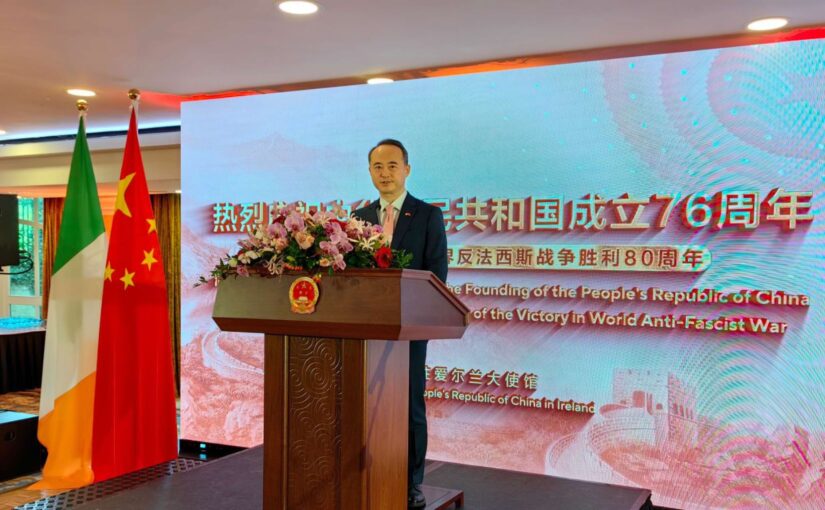
On September 22, the Chinese Embassy in Ireland hosted a reception to celebrate the 76th anniversary of the founding of the People’s Republic of China, and to commemorate the 80th anniversary of the victory of the Chinese People’s War of Resistance Against Japanese Aggression and the World Anti-Fascist War. Chinese Ambassador Zhao Xiyuan and Ceann Comhairle [Speaker of Dáil Éireann, the lower house of the Irish parliament] Verona Murphy delivered speeches.

In his speech, Ambassador Zhao Xiyuan said: “Over the past 76 years, under the strong leadership of the Communist Party of China, the Chinese people have forged ahead with determination, continuously advancing Chinese modernisation. These 76 years have also seen China making increasingly significant contributions to world peace, global development, and the progress of humanity. China has historically eradicated absolute poverty, lifting over 800 million people out of destitution and achieving the UN 2030 Agenda for Sustainable Development’s poverty reduction goal a full decade ahead of schedule, contributing more than 70% to global poverty alleviation. Since the launch of the Belt and Road Initiative, over 40 million people in developing countries have been lifted out of poverty.”

He added that: “While celebrating these achievements, China will never forget its journey. Eighty years ago, China was a war-torn and impoverished nation just extricating itself from foreign aggression. China had borne 35 million casualties, accounting for one third of total lost lives in the Second World War. The Western front of the Second World War is often marked by Nazi Germany’s invasion of Poland in 1939. Yet even earlier, on September 18, 1931, the Chinese people fired the first shot of resistance against Japanese aggression in Northeast China, marking the beginning of the Eastern front. China’s War of Resistance Against Japanese Aggression was the earliest, longest, and most costly campaign of the global Anti-Fascist War. China’s victory on the Eastern front prevented Japanese militarism from joining forces with European fascists, making a vital contribution to the final victory of the Second World War.

“China, though ravaged by war, was never isolated. Doctors, journalists, merchants, and artists from around the world came to China, transforming scalpels, typewriters, and cameras into instruments of rescue. Chinese people will always remember Father Patrick Maurice Connaughton, an Irish bishop born in Galway, who actively raised funds for Chinese people during the war, provided relief to displaced civilians, and supported the education of children amid the devastation of war.”

He also said that: “Over the 46 years since the establishment of diplomatic relations, China and Ireland have deepened exchanges and cooperation across politics, economy, science and technology, and culture, bringing tangible benefits to both peoples. China appreciates Ireland’s commitment to the one-China policy and is ready to work together to implement the consensus reached by the two state leaders, strengthen high-level mutual trust, deepen high-quality cooperation, and advance our Strategic Partnership of Mutual Benefit, jointly contributing to a more peaceful, stable, and prosperous future.

Continue reading Chinese Ambassador recalls Galway Bishop’s wartime support for China

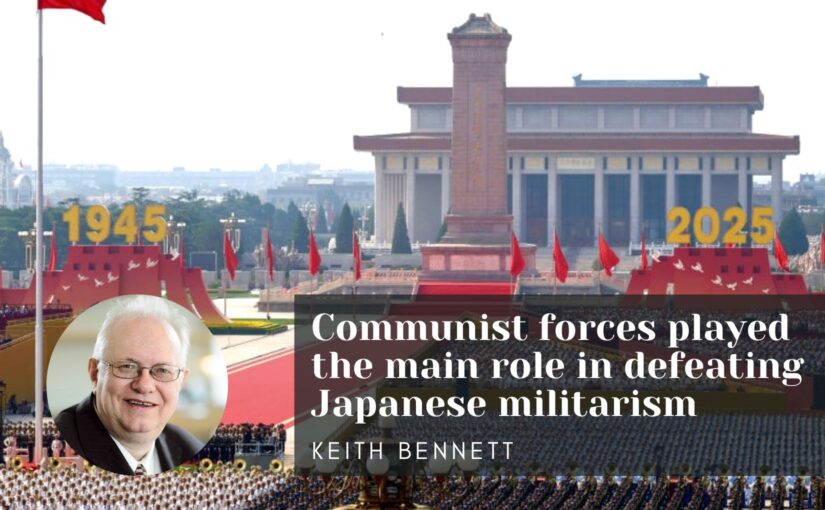
Communist forces played the main role in defeating Japanese militarism

On Sunday 21 September, Friends of Socialist China (FoSC) and the International Manifesto Group (IMG) jointly organised a webinar on the theme, ‘World War Against Fascism: Remembering China’s Role in Victory 80 Years On’.

Speakers were:

  • Ken Hammond (Historian and China scholar)
  • Chen Weihua (Former EU bureau chief of China Daily)
  • Jodie Evans (Co-founder of Code Pink)
  • Jenny Clegg (Author and peace activist)
  • Keith Bennett (Co-editor of Friends of Socialist China)
  • KJ Noh (Journalist, writer and educator)
  • Radhika Desai (International Manifesto Group), Moderator.

Below we carry the full text of Keith’s contribution. (It was shortened somewhat on delivery due to time constraints.)

The livestream of the webinar may be viewed here. And all the individual speeches as delivered may be found on the IMG’s YouTube channel.

On May 8, 1945, people in Britain celebrated VE Day. Six years of all-out war in Europe against Nazi and fascist tyranny had come to a victorious conclusion.

But whilst the nation struggled with a collective hangover the next day, it did so with the knowledge that the war in East and Southeast Asia, and in the Pacific, continued. And, at that point, nobody could be sure for how long.

Given the circumstances of the time, the war in the East may have seemed remote to many. But not to those whose loved ones were fighting in Burma or elsewhere or worse still were enduring the dreadful cruelty that characterised being a Japanese Prisoner of War.

While, as events transpired, the war in Asia-Pacific was to last just a few more months – due not least to the decisive intervention of the Soviet Red Army rather than to the criminal bombing of Hiroshima and Nagasaki – this does serve to underline that the world anti-fascist war began first in the East, specifically in China, and that it lasted the longest.

Conventional British history would have us believe that the war began on September 3, 1939. Although it may not have seemed that way to the peoples of Spain, whose courageous fight against fascism began in 1936. Or to the people of Ethiopia – their country invaded by fascist Italy the previous year.

But the Chinese people’s war of resistance against Japanese aggression began in 1931, after Japan rigged up the puppet state of Manchukuo in northeast China.

This in turn became a nationwide war of resistance in 1937, with the Marco Polo, or Lugou, Bridge Incident heralding Japan’s all out invasion.

At that time, while progressive people around the world rallied to the support of China, the only state to take a clear stand in support of the Chinese people’s resistance was the USSR. And this clearly impacted on the entire geopolitical pattern in the region.

As President Xi Jinping noted in his article for the Russian media, published just prior to his state visit to attend the victory celebrations in Moscow this May: “In the darkest hours of the Chinese People’s War of Resistance Against Japanese Aggression, the Soviet Volunteer Group, which was part of the Soviet Air Force, came to Nanjing, Wuhan and Chongqing to fight alongside the Chinese people, bravely engaging Japanese invaders in aerial combat—many sacrificing their precious lives.”

Continue reading Communist forces played the main role in defeating Japanese militarism

The Seventh Comintern Congress and China’s Anti-Japanese United Front

In the following article, Salvatore Tinè makes a comparative analysis of the theory of the popular front against fascism, advanced by the Bulgarian communist Georgi Dimitrov at the Seventh Congress of the Communist International (Comintern) in 1935, and China’s united front against Japanese aggression developed principally by Mao Zedong.

Arguing for a linkage between the two, he explains that this strategy laid the foundation for a new understanding of the nexus between the struggle for democracy and the struggle for socialism, as well as that between the struggle against capitalism and the struggle against imperialism on the part of colonial and semi-colonial nations. It is Mao Zedong, with his theory of new democracy, who develops in the most organic, and also most original way, the united front strategy by adapting it to the special conditions of a semi-feudal and semi-colonial country like China. This new democracy, the state form of the joint dictatorship of all the anti-imperialist classes united in the anti-Japanese united front, corresponds to the bourgeois democratic stage of the Chinese revolution, distinct from but at the same time organically connected to the proletarian socialist revolution. It is a resumption of the united front tactic that had already characterised the Chinese revolution in the years 1924-1927, but on a much broader mass basis and under social and political conditions much more conducive to the development of the alliance among all anti-imperialist classes, not least, as Dimitrov argued in his report due to, “the creation of Soviet territories in a considerable part of the country and the organisation of a powerful Red Army… Only the Chinese Soviets can act as the unifying centre of the struggle against the subjugation and partition of China by the imperialists, as the centre that rallies all anti-imperialist forces for the national struggle of the Chinese people.”

The Chinese communists’ brilliant theoretical and strategic elaboration has acquired universal value and meaning – both within the international communist movement and in the broader global struggle against capitalism and imperialism.

Salvatore Tinè is a Researcher in Modern History at the Department of Humanities of the University of Catania, in Sicily, Italy. The article is the text of a paper he presented at two international symposia held in Beijing in early September marking the 80th anniversary of victory in the Chinese People’s War of Resistance Against Japanese Aggression and the World Anti-Fascist War.

The Chinese Communist Party’s adoption of the anti-Japanese united front strategy is closely connected to the development, in the mid-1930s, of the Communist International’s (Comintern’s) policy aimed at creating broad anti-fascist popular fronts in the more advanced capitalist countries. The link between the formation of a new anti-imperialist united front in China and the policy of anti-fascist unity in action in the European communist movement lies primarily in the fact that the revolutionary struggle of the international proletariat had, by then, assumed a genuinely global dimension, no longer merely Eurocentric. This was due to the rapid development of anti-colonial and national revolutions in Asia—particularly in China.

In his landmark report to the 7th Congress of the Comintern, Georgi Dimitrov emphasised that the revolutionary struggle of the proletariat against the offensive of capital and the threat of war was unfolding within the broader framework of “international unity in action,” that is, a “world anti-imperialist front” made up of oppressed nationalities in colonies and semi-colonies fighting for national liberation. Not by chance, in the same report, the Bulgarian leader underlined that “in light of changes in both the domestic and international situation, in all colonial and semi-colonial countries, the issue of the anti-imperialist united front assumes exceptional importance.” Dimitrov praised the initiative of the Chinese communists to establish a broad national front against Japanese imperialism, founded on a solid and united popular and mass base, both politically and militarily.

Continue reading The Seventh Comintern Congress and China’s Anti-Japanese United Front

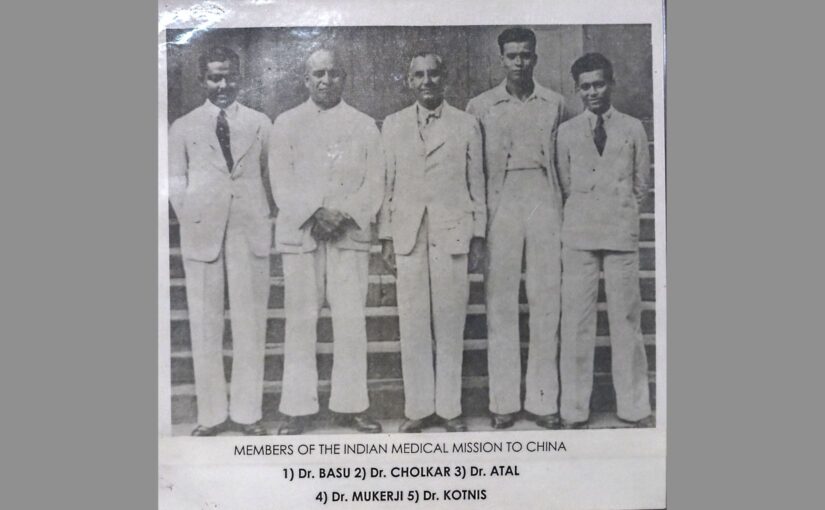
Madan Mohan Lal Atal: Indian revolutionary doctor who served in Spain and China

We are pleased to publish the below article by Ajay Kamalakaran, which was originally carried by Mumbai’s Free Press Journal, on the life of Dr. Madan Mohan Lal Atal, who led the five-member Indian Medical Mission sent by the Indian National Congress to help the Chinese people in their war of resistance against Japanese aggression, after General Zhu De made a personal request to Jawaharlal Nehru.

Ajay explains that Atal was attracted to left-wing ideas from his days as a medical student in Edinburgh, Scotland. An anti-colonialist and staunch believer in the right of self-determination of peoples, he got involved in causes that went well beyond the borders of British India.

In 1937 he joined the Spanish Medical Aid Committee, a British organisation that supported the Republican Popular Front government in the war against the fascist uprising led by General Franco.

Details of the ‘Spanish Doctors’, from many nations, may be found in this article, published by The Volunteer, founded by the veterans of the Abraham Lincoln Brigade, the US section of the International Brigades who fought fascism in Spain.

A year later, Atal was asked to return to India from Spain in order to lead the medical mission to China. He was 50-years-old and well aware of the risks involved:

“How long we stay in China depends on the accuracy of Japanese aviators,” he told international correspondents in October 1938. “I interviewed [Mahatma] Gandhi before I left India. I told him we would stay until the end of the war, and if we were slaughtered by the Japanese, another unit would take our place.”

In fact, over 700 people applied to join the mission in China when a special committee called for volunteers. These included over 100 doctors, including two women. The applications came from all across the Indian subcontinent, as well as from Mauritius, East Africa, Syria and England.

As the head of the mission, Atal worked in China for 21 months under the most challenging of circumstances. He addressed the local press when he arrived in Hong Kong in August 1940: “From all accounts the Chinese soldiers are fighting well. If China continues to resist, I think she will emerge victorious, provided of course Chinese leaders remain united.”

He also spoke of the other foreign doctors he had met in China, including German Jewish Dr. Hans Müller, “who did splendid work among the war wounded.”

Müller was indeed another extraordinary figure. Coming to China at the age of 24, Müller fought side by side with the Communist Party of China and the Chinese people in the War of Resistance Against Japanese Aggression and later in the War of Liberation (1946-49). A 2021 article in China Daily explained:

“Born into a Jewish family in Dusseldorf, a city on the River Rhine in western Germany, in 1915, Müller, upon finishing high school, found it difficult to stay on in Germany due to the anti-Semitism at the time. He left to continue his studies at the University of Basel, the oldest university in Switzerland, until he earned his PhD in medical science in 1939.”

In order to fight fascism, he made his way to China, sailing from the French port of Marseilles to Hong Kong:

“Following introductions to revolutionary figure Liao Chengzhi and Polish-born Chinese journalist and writer Israel Epstein, Müller was able to reach Yan’an along with the supplies. In Yan’an, Müller met top CPC leaders, including Chairman Mao Zedong and Zhu De, then commander-in-chief of the Eighth Route Army, and joined the Eighth Route Army. A month later, he followed an Indian medical team to the Taihang Mountains. The trip came just a few days after the death of the Canadian doctor Norman Bethune.”

Continue reading Madan Mohan Lal Atal: Indian revolutionary doctor who served in Spain and China

Wang Yi recalls Austrian communists who joined the Chinese revolution on European visit

Chinese Foreign Minister Wang Yi visited Austria, Slovenia and Poland from September 12-16 at the invitation of Austrian Federal Minister for European and International Affairs Beate Meinl-Reisinger, Slovenian Deputy Prime Minister and Minister of Foreign and European Affairs Tanja Fajon, and Polish Deputy Prime Minister and Foreign Minister Radosław Sikorski.

Meeting with Wang in Warsaw on September 15, Polish President Karol Nawrocki said that Poland was among the first countries to establish diplomatic relations with China, and the two countries have maintained a good friendship. He said that as a historian, he is particularly aware of China’s tremendous sacrifices and contributions to secure victory in the Chinese People’s War of Resistance against Japanese Aggression. Poland values its traditional friendship with China and is willing to enhance exchanges and deepen cooperation with China, draw lessons from history, promote the sustained development of bilateral relations, and jointly safeguard world peace and security.

Wang Yi said that Poland was among the first countries to establish diplomatic relations with the People’s Republic of China. For more than half a century, friendship has always been the main theme and cooperation the dominant trend in China-Poland relations, despite changes in the international landscape. China values Poland’s position and influence in Europe and the world and is ready to continue to deepen strategic mutual trust, enhance strategic cooperation, and jointly advance the sustained development of the China-Poland comprehensive strategic partnership. He expressed the hope that Poland will play an active role in encouraging the European Union to develop an objective and rational understanding of China.

Wang Yi added that as the main battlefield in Asia during World War II, China was the first to resist Japanese militarism, fought the longest, and made the greatest national sacrifices, making a tremendous historic contribution to the victory of the World Anti-Fascist War. Not long ago, China held a commemoration, aiming to remember history, honour fallen heroes, cherish peace, and create a better future. Both China and Poland are independent countries that firmly safeguard national sovereignty and territorial integrity. The separatist activities of “Taiwan independence” forces, which attempt to split the country and challenge the outcomes of the victory of World War II, run counter to the tide of history and are doomed to fail. Wang Yi expressed his confidence that Poland will continue to uphold the one-China policy and support China’s great cause of national reunification. Karol Nawrocki said that since 1949, the Polish government has recognised the Government of the People’s Republic of China as the sole legal government representing the whole of China and will continue to firmly abide by the one-China principle.

On September 14, Wang Yi met with President of the National Council of Slovenia Marko Lotrič in Ljubljana.

Wang Yi briefed Marko Lotrič on China’s development path and philosophy, saying that history has shown that the most important thing for a country’s development is to find a path that suits its own national conditions. China has found a path of socialism with Chinese characteristics that integrates the basic tenets of Marxism with China’s specific realities and fine traditional Chinese culture. The path is deeply rooted in the people while keeping pace with the trends of the times, receiving firm support and endorsement from the Chinese people. This is a successful path of peace, development, openness, and win-win cooperation and China will continue to unswervingly move forward along this path. China is committed to expanding high-standard opening up, promoting green, low-carbon and sustainable development and realising Chinese modernisation. In international relations, China advocates mutual respect, mutual accommodation, and win-win cooperation, striving to build a community with a shared future for humanity. China’s sustained development will offer opportunities to countries around the world, including Slovenia.

Continue reading Wang Yi recalls Austrian communists who joined the Chinese revolution on European visit

Japanese scholar on the continuing struggle for peace and justice

We are pleased to republish the below article by Ishida Ryuji, a Japanese scholar at the School of Humanities at Shanghai Jiaotong University, which was originally published by Global Times on September 2.

In the article, Ryuji makes a profound comparative study of China’s protracted struggle against Japanese fascism in the 1930s and 1940s and the country’s protracted struggle against imperialist powers led by the United States and including Japan today.

The author notes that: “Eighty years ago, after 14 years of arduous struggle and tremendous sacrifice, China finally defeated the war of aggression launched by Japanese fascists. Eighty years later, Japan still seems unable to cast off the shadow of fascism.”

He gives an explanation of fascism that resonates today with regard to other capitalist powers besides Japan: “A typical fascist regime is characterised by the following features: instead of addressing economic stagnation and the resulting political and social unrest through domestic reform or narrowing class disparities, it seeks to shift the crisis outward under the pretext of ‘racial superiority’ through external aggression and expansion.”

He warns that: “Beginning in the 1990s, a generational shift among researchers coincided with the rise of historical revisionist currents and movements. As a result, tendencies to blur or deny the facts of aggression – and even to glorify war through distortions of history – have spread increasingly throughout Japanese society. Whether in reference to wartime Japan or today’s rightward shift, the scholarly atmosphere of analysing these phenomena through the lens of fascism has grown exceedingly faint in the country.”

This is related to the historical trajectory of the Cold War: “After WWII, Western countries led by the US – including Japan, which had once been a fascist state – forcibly imposed the Cold War system… After the collapse of the Soviet Union, the Japan-US security alliance was redefined as a military one targeting China.”

Bringing things up to the present, Ryuji writes: “Despite comprehensive inferiority in military, economic and technological domains, the Chinese people ultimately defeated the invaders. Many Japanese to this day remain trapped in the illusion of ‘might makes right,’ with some even clinging to the absurd claim that ‘the Japanese army never lost in China.’ Those who hold such views fail to grasp how the Communist Party of China, armed with theoretical innovation and practical experience, developed the strategies of protracted war and guerrilla warfare that mobilised the immense strength of the entire nation in resisting aggression. Such a strategy of undermining the enemy’s rule from within not only secured China’s victory but also offered invaluable and lasting inspiration for the subsequent global anti-colonial and national liberation movements.

“Today, China is facing interference and coercion from countries such as Japan and the US. Yet China will neither yield nor compromise; instead, it is committed to waging a protracted war full of hardships.

Continue reading Japanese scholar on the continuing struggle for peace and justice

Discovery in Manchester Museum sheds light on Hong Kong guerrillas contribution to allied victory

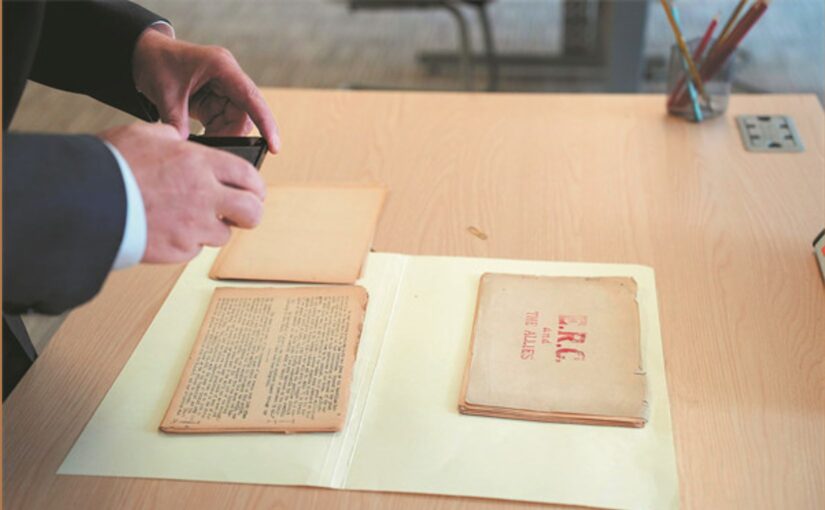
The Xinhua News Agency recently carried an article on how a discovery, “tucked away in Manchester’s People’s History Museum, a fragile, yellowing notebook – its cover emblazoned with bold red letters reading ‘E.R.C (The East River Column) and the Allies’ – bears witness to one of the World Anti-Fascist War’s most extraordinary partnerships.”

“It is the first time that an archive drafted and collected by Raymond Wong, or Huang Zuomei, has been discovered by Xinhua. This rare document sheds new light on the story of the East River Column, a resistance force led by the Communist Party of China in southern China that fought Japanese aggressors… Its rediscovery offers a vivid reminder of how Chinese and other allied forces once stood shoulder to shoulder against fascism.”

The East River Column was primarily active in Guangdong Province and in Hong Kong, including the New Territories.

In June 1947, the London Gazette listed Wong as one of the recipients of the Order of the British Empire (OBE), awarded by King George VI, “for services to the Forces during military operations in South-East Asia prior to 2nd September 1945.”

One entry in the notebook recalls February 11, 1944, when US pilot Donald Kerr from the Chinese-American Composite Wing was shot down by Japanese forces over Hong Kong. Two female guerrillas from the East River Column found him in the New Territories and escorted him to safety. Kerr later penned a heartfelt letter of gratitude, which is now part of the collection.

The records detail at least 80 allied servicemen rescued by the East River Column, including British soldiers, Indian troops and American pilots. General Claire Lee Chennault, commander of the US 14th Air Force, reportedly cabled that “without your utmost cooperation, the result of this war would be very difficult to accomplish.”

In 1947, Wong was a co-founder of the London Bureau of the Xinhua News Agency. Its first office was in Soho’s Gerard Street, which today is the centre of London’s Chinatown. However, at the time, Gerard Street had no Chinese connections, with London’s first Chinatown being in East London’s Limehouse.

It is interesting to note that the Hong Kong branch of the Chinese Seamen’s Union (CSU) was instrumental in the formation of the East River Column. One of Wong’s co-founders of the Xinhua London Bureau was the Jamaican-born Sam Chinque ( Chen Tiansheng; Sam Chen), who had organised and led the CSU’s Liverpool Branch.

Sam Chinque’s archives were deposited with the London Metropolitan Archives in 2008.

The Xinhua article continues: “Wong’s devotion to his country was indeed profound. After founding Xinhua’s London Bureau in 1947, he returned to Hong Kong and served as the director of the Hong Kong branch of Xinhua News Agency in 1949. In April 1955, Huang was killed aboard the Kashmir Princess, the aircraft destroyed by a bomb planted by Kuomintang agents en route to Indonesia’s Bandung Conference.”

It is widely believed that the aircraft was bombed in the mistaken belief that Premier Zhou Enlai was to travel on it to Bandung.

A detailed study of the East River Column, ‘East River Column – Hong Kong Guerrillas in the Second World War and After’ by Chan Sui-jeung was published by Hong Kong University Press in 2009 and is distributed by The University of Chicago Press.

The following article was originally published by the Xinhua News Agency.

Tucked away in Manchester’s People’s History Museum, a fragile, yellowing notebook — its cover emblazoned with bold red letters reading “E.R.C (The East River Column) and the Allies” — bears witness to one of the World Anti-Fascist War’s most extraordinary partnerships.

Continue reading Discovery in Manchester Museum sheds light on Hong Kong guerrillas contribution to allied victory

How China’s victory in the War of Resistance Against Japanese Aggression inspired Africa

We are pleased to republish below two items from the Xinhua News Agency exploring the connections between China’s victory in the War of Resistance Against Japanese Aggression and the African liberation struggles of the second half of the 20th century.

Harare-based political commentator Dereck Goto notes that for Zimbabweans, the history of the Global Anti-Fascist War “resonates with our own odyssey from colonial subjugation to independence, from marginalisation to self-assertion”.

The article recalls some important and little-known wartime encounters: “Connections to Africa during the war were real. In 1942, Chinese troops in Myanmar carried out the daring rescue at Yenangyaung, freeing thousands of encircled Allied soldiers. Among accounts from that period are memories of Africans serving in British colonial formations who encountered Chinese troops. One such story, passed down in veterans’ circles, tells of a Rhodesian soldier – Sergeant James Moyo – who wrote that Chinese troops who saved him and his comrades were brothers in the fight for freedom. The story captures the essence of solidarity: strangers recognising in each other a shared destiny of resistance. That spirit prefigured the later bonds between China and Africa in liberation struggles.”

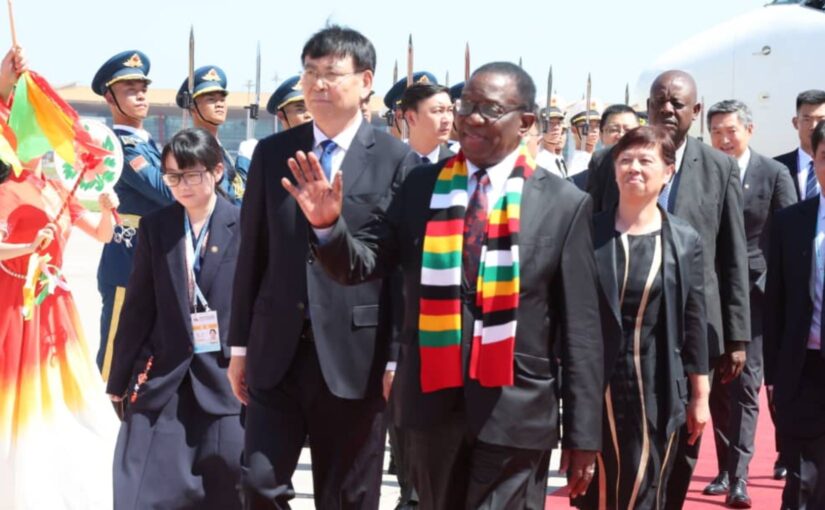
Goto observes that President Emmerson Mnangagwa’s presence in Beijing at the parade marking the 80th anniversary of China’s victory, alongside Chinese President Xi Jinping, underscores a friendship rooted not in convenience but in shared sacrifice.

The article goes on to describe various ways in which China is contributing to Zimbabwe’s ongoing development process.

The Kariba South hydropower station expansion, the Hwange Thermal Power Station Unit 7 and Unit 8 project, the new Parliament Building in Mount Hampden, and Zimbabwe’s 5G rollout through Huawei all carry Chinese fingerprints. During the COVID-19 pandemic, when vaccine nationalism exposed the fragility of global solidarity, it was Chinese vaccines that reached our shores in time. These acts are not transactional; they flow from a philosophy forged in struggle — that security and prosperity must be collective, not individual.

Manuel Pinto da Costa, former president of Sao Tome and Principe, said in an interview with Xinhua that “China’s victory in the war not only profoundly changed the international landscape, but also forged deep bonds of friendship between Africa and China along the path of pursuing independence and national development”.

He added that the rise of emerging forces such as the BRICS countries has created new opportunities for Global South countries to pursue equality and development, and that China’s engagement with Africa is fundamentally different to that historically pursued by the West.

China’s model of cooperation with African countries is fundamentally different from the approaches we experienced in the past. China has demonstrated a path of equality and mutual benefit.

He concludes that “by working hand in hand under the new international landscape, China, Africa and the wider developing world will open up broader opportunities for peace and development”.

To remember history is to carry its torch forward

Sept. 14 (Xinhua) – Eighty years ago, the Chinese people stood battered but unbroken after a 14-year struggle against brutal aggression. During the War of Resistance against Japanese Aggression, China suffered over 35 million casualties and saw its cities and villages devastated. Yet from those ashes emerged not only a military victory, but a moral triumph. It was China’s declaration that sovereignty could be reclaimed and that a united people could defeat an enemy that appeared indomitable.

For Zimbabwe, this anniversary is not a distant page in another nation’s story — it is a mirror. China’s path resonates with our own odyssey from colonial subjugation to independence, from marginalisation to self-assertion.

Continue reading How China’s victory in the War of Resistance Against Japanese Aggression inspired Africa

Canadian communists honour Chinese people’s victory

The Communist Party of Canada (Marxist-Leninist) (CPCML) issued a special supplement of their online newspaper on September 6 to mark the 80th anniversary of the victory of the Chinese People’s War of Resistance Against Japanese Aggression and the World Anti-Fascist War.

In its opening article, CPC(ML) writes: “The contribution made by the peoples of China to the cause of liberating humankind from the scourge of Nazi fascism and Japanese militarism and ending World War II was colossal.

“On the occasion of the 80th anniversary of the Chinese people’s war of resistance against Japanese aggression and the victory of the worldwide Anti-Fascist War, the peoples of the world pay homage to the 35 million Chinese who died in that war and all the heroes who faced the Japanese onslaught and its unprecedented brutality. They join the Chinese people in recalling the events of the war, the leadership of Mao Zedong, one of the outstanding revolutionary anti-imperialist fighters of the 20th century, and in recognising their contributions.”

The party notes that, “Events have recalled the events which took place and the heroism of the people, fully aware that their exceptional courage and ingenuity pinned down some 1.86 million Japanese soldiers, 50 per cent of its total force, preventing their deployment elsewhere,” adding, “Japan has never recognised the heinous crimes it committed in China during its 14 years of occupation.”

But as the article, notes, between 1942 and 1945, the Japanese military carried out the ‘Three-Alls’ Policy against the Chinese people: kill all, burn all and loot all. Besides committing massacres of civilians like the Rape of Nanjing and using biological and germ warfare against the people, the Japanese abducted close to 200,000 Chinese women and girls, forcing them into sex-slavery for the Japanese military. Close to 100 million people were displaced and became refugees.

On the auspicious occasion of the 80th anniversary of the Chinese people’s victory, the Communist Party of Canada (Marxist-Leninist) pays its deepest respects to the heroic Chinese people and the peoples of Asia who, organised and led by the communists, stopped the Japanese aggressors in their tracks. Along with the Soviet Red Army and the anti-fascist forces of the world, they secured the peace.

  • CPC(M-L) salutes the Chinese people and their stunning accomplishments in liberating China and turning it into a modern nation, second to none.
  • CPC(M-L) also pays tribute to the Canadian communist, Dr. Norman Bethune, whose internationalism and selfless medical services to the Chinese people’s war of resistance are the foundation of the fraternal ties of peace and friendship between the Canadian and Chinese people. This friendship is bound to prevail as together the peoples of the world rise to the challenge of coming revolutionary storms.
  • CPC(M-L) decries the absence of a high-level Canadian delegation in Beijing for China’s Victory Day Celebrations.  Canada has joined the US and NATO countries in boycotting the celebrations, thus refusing to acknowledge China’s contributions to the fight against Nazi fascism and Japanese militarism. So too, these warmongering governments boycotted this year’s Victory Day celebrations in Russia on the 80th anniversary of the defeat of Nazi fascism in Europe.
  • CPC(M-L) also condemns Canada’s participation in war exercises the US is holding in the Asia-Pacific to threaten China. Particularly shameful are the war exercises held on the occasion of the V-Day celebrations, with Japan playing a leading role.

“For Canada to condone this and refuse to join the celebrations, is unacceptable. While the government boycotts the 80th Anniversary events, the peoples of Canada and worldwide join the Chinese peoples in celebrating these victories.

Continue reading Canadian communists honour Chinese people’s victory

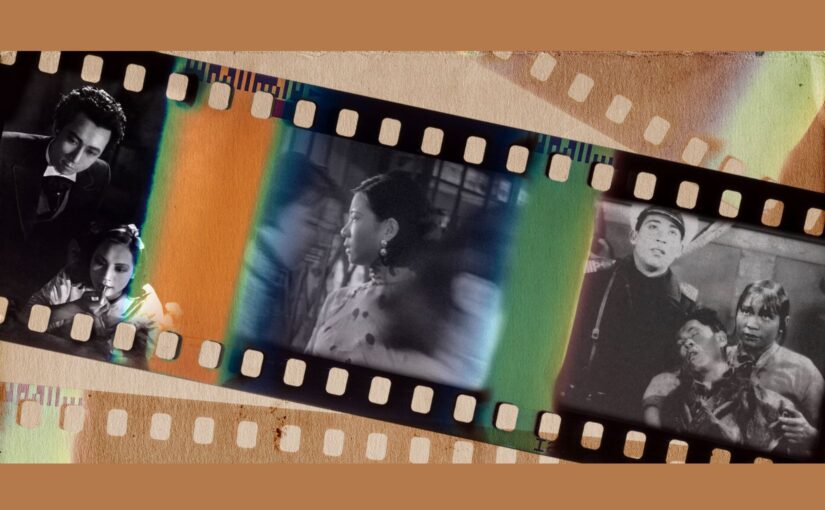
The Revolutionary Reel: How Chinese cinema sustains the struggle

The power of storytelling to sustain revolutionary enthusiasm and struggle is well-known. Stories both true and fictional have encouraged fighters in times both good and bad. Vladimir Lenin loved to read novels and took particular inspiration (and the title of one of his most famous works) from Chernyshevsky’s What is to be Done?. This novel continues to inspire, with Chinese President Xi Jinping citing it at the 2024 BRICS Conference, noting how the protagonist’s “unwavering determination and ardent struggle encapsulate exactly the kind of spiritual power we need today. The bigger the storms of our times are, the more we must stand firm at the forefront with unbending determination and pioneering courage.”

As the times have moved on, so have the formats of storytelling, and the moving image has come to replace the written word over the 20th century as the dominant form of narrative. In the same way as novels, the medium responds directly to the social contexts in which it is produced. In the Chinese revolutionary era, and the years leading up to the Chinese People’s War of Resistance against Japanese Aggression, this was evident in the burgeoning film industry of the time, located mostly in Shanghai. The importance of many of these films and the extent to which they played an ideological role in sustaining the Chinese people’s resistance is charted in the below Sixth Tone article, which notes that the films “evolved from cultural commentary into a medium of resistance, help[ed] to shape public opinion and mobilize support for the war effort.” In place of some of the traditional melodramas or fantasy epics, the early Communist Party of China played a direct role in advocating stories which portrayed everyday people’s struggles, women’s struggles, and other tales that raised social awareness.

This year marks the 80th anniversary of the Chinese people’s victory against Japanese Aggression, and their inestimable contribution to the victory in the World Anti-Fascist War, and once again cinema is making an important ideological contribution. 2025 has seen numerous films depicting this victory and the Chinese people’s experiences and contributions: Dead to Rights (a story in the context of the Nanjing Massacre), both fictional and documentary films covering the Dongji Island incident (where Chinese fisherfolk saved drowning British POWs), as well as the upcoming Evil Unbound, a story covering the notorious germ warfare human experiments carried out by the Japanese Imperial army. 

In addition to re-establishing the proper historical contributions of the Chinese people in the history books, which for too long have been downplayed in the West, these narratives and documentaries also remind the Chinese people, and the peoples of the Global South at large, of the importance of protecting one’s own sovereignty and their capacity for resistance and victory.

Kim Jong Il noted in 1973 that “the task set before the cinema today is one of contributing to people’s development into true communists and assisting in the revolutionising and remodelling of the whole of society on the working-class pattern.” And whether you prefer the black and white classics, or the modern blockbusters, the leftist cinema of the People’s Republic of China continues to play this role.

The following article was first published by Sixth Tone.

In the years leading up to Chinese People’s War of Resistance against Japanese Aggression, Chinese cinema had already begun preparing for it. Following the Mukden Incident in 1931, a false flag attack by Japanese troops on a railway line in northeastern China as pretense to invade Manchuria, Chinese filmmakers began incorporating themes of social crisis, injustice, and national survival into their work.

Continue reading The Revolutionary Reel: How Chinese cinema sustains the struggle

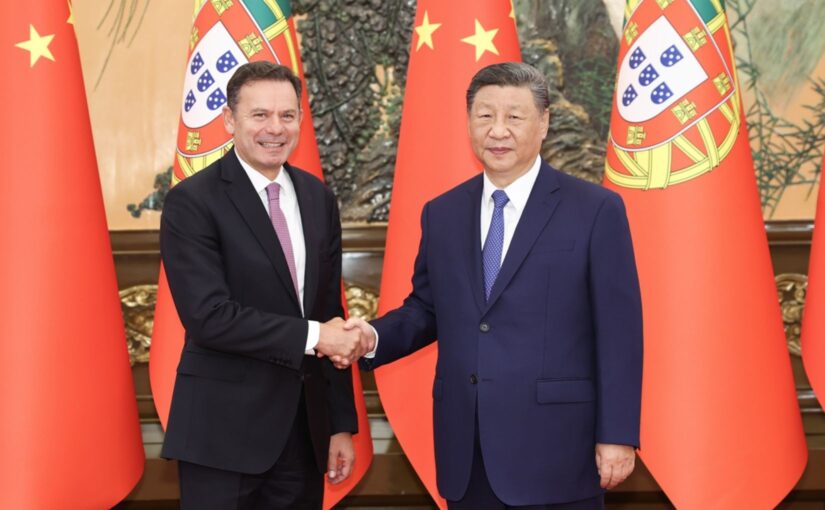
Chinese leaders meet guests from Brazil, Timor-Leste, Hungary, Bulgaria, Romania and Greece

Besides the 26 heads of state and government, China’s September 3 commemoration of the 80th anniversary of the victory in the Chinese people’s war of resistance against Japanese aggression and the world anti-fascist war, was also attended by many other prominent current and former state leaders from around the world, including those from Brazil, Timor-Leste, Hungary, Bulgaria, Romania and Greece.

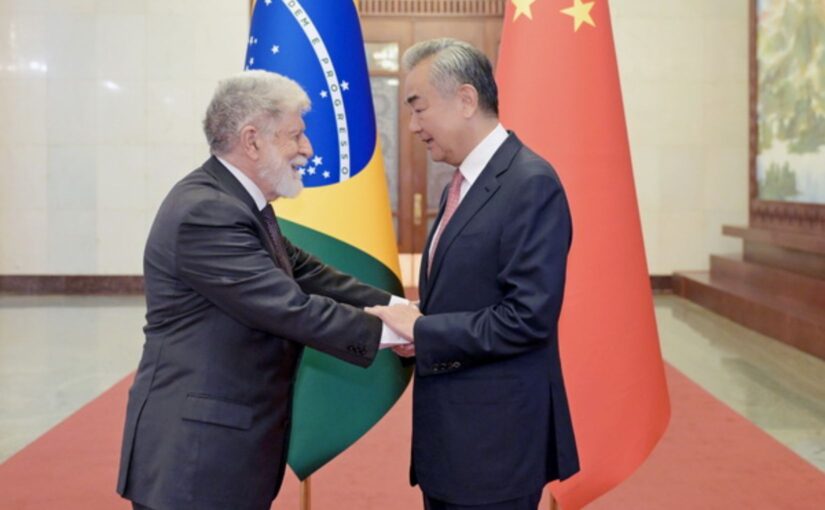
On September 4, Chinese Foreign Minister Wang Yi met with Chief Advisor to the Presidency of Brazil Celso Luiz Nunes Amorim.

Wang Yi expressed welcome for Celso Luiz Nunes Amorim’s attendance at the commemoration on behalf of the Brazilian government. Under the strategic guidance of the two heads of state, China-Brazil relations have continuously reached new heights. Both sides should steadfastly work together to build a China-Brazil community with a shared future for a more just world and a more sustainable planet, setting an example of the strength through unity among major countries of the Global South.

He said that the current world landscape is undergoing complex changes, with the resurgence of unilateralism undermining the foundation of multilateralism and posing severe challenges to the vast number of developing countries. President Xi Jinping proposed the Global Governance Initiative (GGI), at the Shanghai Cooperation Organisation Plus meeting on September 1,  in response to the new changes in the international situation, aiming to address global challenges more effectively.

China appreciates Brazil’s earnest performance of its duties as the BRICS chair and is ready to work with Brazil to consolidate the positive momentum of BRICS, promote greater communication and coordination among BRICS countries on major issues, and stand firm on common positions.

Celso Luiz Nunes Amorim handed over the letter from President Luiz Inácio Lula da Silva to President Xi Jinping, expressing that the commemoration of the 80th anniversary of the victory of the Chinese People’s War of Resistance Against Japanese Aggression and the World Anti-Fascist War was deeply moving, and that releasing pigeons is to convey the message of peace. He congratulated China on the complete success of the event. The Chinese people, faced with foreign aggression, showed unyielding resilience and rose to fight back, making significant historical contributions to the victory of the World Anti-Fascist War. Given the current context in which certain countries disregard international rules, abuse tariffs, and undermine the multilateral trading system, the importance of strengthening unity and cooperation among the Global South and BRICS countries is becoming increasingly prominent. Against this backdrop, China’s proposal of the GGI is of great significance.

On September 5, Zhao Leji, Chairman of the National People’s Congress (NPC) Standing Committee, held talks with Maria Fernanda Lay, President of the National Parliament of Timor-Leste. He said that China firmly supports Timor-Leste in following a development path suited to its own national conditions while safeguarding its national sovereignty, security and development interests.

Noting that the NPC of China and the National Parliament of Timor-Leste have maintained friendly exchanges for a long time, Zhao said the NPC is willing to further enhance exchanges and cooperation among senior members of the legislative bodies and lawmakers of the two countries, deepen experience sharing on topics such as state governance, legislation and supervision, and strengthen coordination within multilateral frameworks to present a common voice of the Global South.

Continue reading Chinese leaders meet guests from Brazil, Timor-Leste, Hungary, Bulgaria, Romania and Greece

Review: Dead to Rights

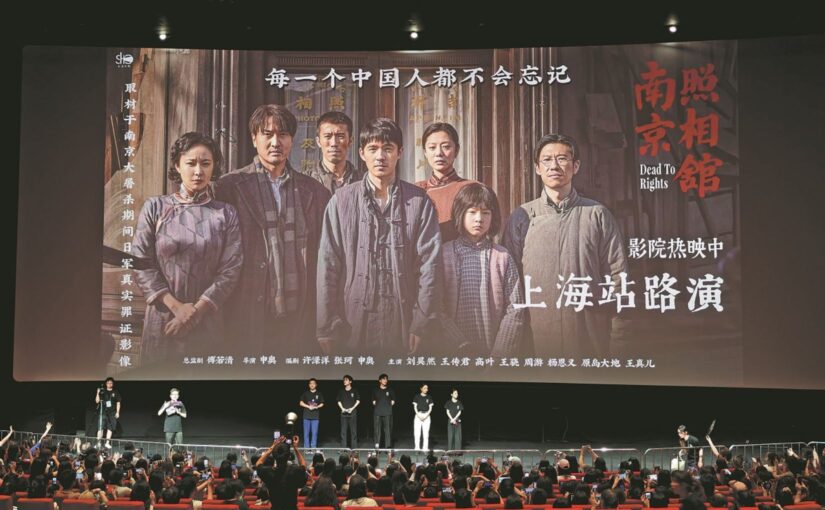
The Chinese film Dead to Rights, a moving depiction of the 1937-38 Nanjing Massacre, went on general release in London on September 5, distributed by the Cultural Centre of Nouvelles d’Europe UK.

Carlos Martinez reviews the film, arguing that: “Although harrowing to watch, Dead to Rights is not a film of despair. It restores to memory the countless unnamed heroes who resisted occupation. And it reaffirms the principle that only truth can prevent history from being distorted or erased.”

Shen Ao’s Dead to Rights (released domestically as Nanjing Photo Studio) is a Chinese film of searing power and urgency. Set during the Nanjing Massacre of December 1937, it combines meticulous historical detail with a sweeping human drama that is resonating deeply with audiences around the world. Since its release in July, the film has smashed box office records and helped to reignite the discussion about one of the darkest chapters of the twentieth century.

The story follows A Chang (Liu Haoran), a humble postman who is mistaken for a photo studio employee by occupying Japanese soldiers. Realising that their mistake offers an opportunity for survival, Chang plays along. Inside the photo studio, he encounters the owner and his family sheltering in the basement, as well as an actress taking refuge.

The group’s uneasy survival hinges on developing photographs for a Japanese army photographer, Lieutenant Hideo Ito, who is documenting Japanese activities in the city for propaganda purposes. Yet the images they process – of torture, murder and rape – become an unbearable testament to the horrors engulfing their city. Together, the group risks everything to preserve these negatives and smuggle them to the outside world, convinced that only by exposing the truth can justice be served.

The drama draws inspiration from real events. In 1938, a teenage apprentice in Nanjing did indeed copy photographs brought in by Japanese soldiers, creating an album that would later serve as crucial evidence in war crimes trials. The English title, Dead to Rights, underscores the central motif: incontrovertible proof of wrongdoing that ultimately condemned the perpetrators.

The film’s release is especially poignant given its timing, just a few weeks before the 80th anniversary of Japan’s surrender and the end of the Global Anti-Fascist War. As I observed in a recent article, “China’s role in the war, and indeed the very existence of the Pacific Theatre, has to a significant degree been written out of history… However, China was the first country to wage war against fascist occupation, and the Chinese People’s War of Resistance Against Japanese Aggression was of decisive importance to the overall global victory over fascism. In the course of 14 years of war (1931-45), China suffered over 35 million casualties, and around 20 percent of its people were made refugees.”

While the war crimes carried out by Nazi Germany are etched indelibly into global consciousness, the Nanjing Massacre and other atrocities committed by the Japanese armed forces remain far less well known outside China. The Tokyo War Crimes Tribunal, the Eastern counterpart to the Nuremberg trials, estimated that over 260,000 people were killed in the weeks following Japan’s seizure of the city. Tens of thousands of women were raped in what the late historian Iris Chang described as “an orgy of cruelty seldom if ever matched in world history”.

Films like Dead to Rights serve to set the record straight, telling the truth about the occupation’s crimes and reasserting China’s place in the Global Anti-Fascist War. Shen’s film insists that China’s sacrifices, resistance and heroism be remembered.

But the film also arrives at a moment when this history feels painfully alive, with Israel’s genocidal assault on Gaza generating horrifying images of indiscriminate bombing, destroyed hospitals and civilian massacres. Indeed, the film’s central theme – the imperative to document the crimes of an occupying force – is being replayed today by courageous journalists and citizens in Gaza, whose cameras and pens are transformed into weapons of truth. As the director has commented: “A photo was a bullet on that battlefield. The click of a shutter echoed the crack of gun. The negatives pierced invaders’ lies.”

Wherever atrocities are denied or minimised – whether the Nazi Holocaust, the Nanjing Massacre, or today’s unfolding tragedies – the work of bearing witness becomes a form of resistance. The film’s characters embody that conviction. Facing daily terror, they nevertheless refuse compromise. They echo the patriotic spirit of a generation that insisted, “We will win this war,” and demanded “not one inch less” than the full liberation of China.

Artistically, the film is striking. The opening sequence cuts between bullets firing and camera shutters clicking, equating the act of shooting with both violence and documentation. The production design recreates Nanjing’s wartime devastation with harrowing realism, while the cast delivers performances of quiet dignity and depth. Liu Haoran’s A Chang is an unlikely hero – fearful but ultimately courageous – whose humanity anchors the narrative.

Although harrowing to watch, Dead to Rights is not a film of despair. It restores to memory the countless unnamed heroes who resisted occupation. And it reaffirms the principle that only truth can prevent history from being distorted or erased. In an era when denial and revisionism persist — whether from Japanese right-wing politicians or from those who seek to obscure the atrocities being perpetrated right now by Israel — this is a powerful and important message.

Dead to Rights is an epic of historical cinema, challenging audiences to confront uncomfortable truths, remember forgotten histories, and to connect to the shared global struggle against fascism and imperialism. To remember is to resist. And to honour those who preserved the truth in Nanjing is to stand in solidarity with those who risk everything today to show the world what must not be denied.

  • At time of writing, Dead to Rights is showing in cinemas in London, Birmingham and Manchester in the UK. Details may be found here.

Portugal reinforces sound relations with China

Portuguese Prime Minister Luis Montenegro was the first foreign head of government to visit China following the September 3 commemoration of the 80th anniversary of the victory in the Chinese People’s War of Resistance Against Japanese Aggression and the World Anti-Fascist War.

On September 9 he met with President Xi Jinping, who said that China and Portugal have achieved fruitful outcomes in cooperation across various fields in recent years, setting a model of mutual respect and mutual benefit for countries with different social systems and national conditions. Xi called on the two sides to carry forward the traditional friendship, maintain mutual trust and support, deepen the alignment of development strategies, and expand practical cooperation in areas such as innovation, green development, maritime affairs and healthcare.

He noted that the two sides should give full play to Macao’s unique role as a bridge and make good use of mechanisms like the Forum for Economic and Trade Cooperation between China and Portuguese-speaking Countries to achieve mutually beneficial outcomes at a higher level. [In addition to China and Portugal this Forum, with its headquarters in Macao, also includes Angola, Brazil, Cabo Verde, Guinea-Bissau, Equatorial Guinea, Mozambique, São Tomé and Príncipe and Timor-Leste.) They should also encourage exchanges in culture, education, tourism and scientific research, as well as deepen people-to-people and cultural exchanges.

Montenegro said the successful practice in Macao over the past 25 years fully demonstrates that the Portuguese government made the right decision. Portugal will continue to adhere to the one-China policy and will not forget the valuable support and assistance provided by China during the most difficult period of Portugal’s economy. (This refers to the economic support that China extended to Portugal during the 2009 Eurozone crisis.)

Despite periodic changes in its domestic political situation, Portugal stands out as a European country that consistently maintains positive relations with China. Moreover, the amicable way in which the issue of the former Portuguese colony of Macao has been resolved, and the way this special administrative region of the People’s Republic continues to act as a bridge not only between China and Portugal, but also to all Portuguese speaking countries, stands in stark contrast to British imperialism’s persistent if futile meddling in Hong Kong.

This understanding permeated the reactions of a number of Chinese scholars to Montenegro’s visit.

Continue reading Portugal reinforces sound relations with China

China condemns Israel’s brazen attack on Qatar

China has strongly condemned the Israeli bombing of Qatar on September 9.

Speaking at a September 11 meeting of the United Nations Security Council called by Algeria, Pakistan and Somalia, and held in the presence of the Prime Minister of Qatar as well as senior representatives of Jordan and the United Arab Emirates (UAE), Ambassador Fu Cong described the attack as being, “in flagrant violation of Qatar’s territorial sovereignty and national security, international law and the UN Charter, and efforts to achieve peace. China resolutely opposes this and strongly condemns such an act.”

He added: “It is well known that Qatar, as an important mediator in the ceasefire negotiations, has made great efforts to promote the ceasefire and restore peace in Gaza, which has been highly appreciated by the international community. We note that on September 7, the US put forward a new ceasefire proposal and claimed that Israel had agreed to it. However, just two days later, a Hamas delegation discussing the ceasefire proposal was attacked by Israel. Such an act of bad faith, irresponsibility, and deliberate sabotage of the negotiations is indeed despicable.”

Referring to the United States in particular, Ambassador Fu stated: “We would like to advise these major countries, in the interest of regional peace and stability, to take a fair and responsible stance and play a constructive role along with the international community in promoting a ceasefire and cessation of hostilities and in easing tensions in the region.”

He also said that: “The Gaza conflict has been going on for almost two years, resulting in a humanitarian catastrophe that is appalling and unprecedented in nature. During this period, we have witnessed over and over again the violation of international law and the undermining of the basic norms of international relations. The world should not return to the law of the jungle, and the Middle East should not remain in a state of perpetual war.”

The previous day, at the regular press conference given by the Foreign Ministry in Beijing, Spokesperson Lin Jian was asked by China-Arab TV for China’s response to the attack. He replied:

“China strongly condemns the attack yesterday in Doha, Qatar and firmly opposes Israel’s violation of Qatar’s territorial integrity and national security. We are deeply concerned that the attack could lead to further escalation in the region and disapprove of the actions taken by relevant parties to deliberately jeopardise Gaza ceasefire talks. Use of force will not bring peace to the Middle East. Dialogue and negotiation is the fundamental way out. It will soon be two years since the conflict broke out in Gaza. China strongly calls on relevant sides, especially Israel, to make an effort to end the fighting and resume talks, instead of the other way around.”

As a follow up, Global Times requested comment on reports that Israel gave the United States prior notice of its attack. Lin Jian replied:

“We are deeply concerned over relevant reports. Israel’s air strike on Hamas targets in Doha severely violated Qatar’s territorial sovereignty and national security and will escalate the tensions in the region. This has everything to do with the deeply tilted position of certain non-regional country on the Middle East issue. We urge certain major country to act in the interest of regional peace and stability, adopt a just and responsible stance, and work with the international community to play a constructive role for stopping the conflict and easing the tensions.”

A few days later, on Tuesday 16 September, the 60th session of the UN Human Rights Council held an urgent debate regarding Israel’s attack, at the request of the Organisation of Islamic Cooperation (OIC). Chen Xu, China’s permanent representative to the UN Office in Geneva and other international organizations in Switzerland, delivered a speech pointing out that Israel’s attack on Qatar constitutes a blatant violation of Qatar’s territorial sovereignty and national security, contravenes international law and the UN Charter and undermines peace efforts. Global Times reports:

“Chen emphasized that the abuse of force is not the solution to resolving issues. China calls on all relevant parties, especially Israel, to make more positive efforts to cease hostilities and resume negotiations, earnestly fulfill their obligations under international human rights law and humanitarian law, and respect the right to life of people in neighboring countries. China stands ready to work with the international community to play a constructive role in promoting a ceasefire, ending the conflict, and easing regional tensions, Chen stated.”

The following article was originally published on the website of China’s Permanent Mission to the United Nations.

Remarks on the Situation in the Middle East by Ambassador Fu Cong at the UN Security Council Emergency Briefing

President,

Continue reading China condemns Israel’s brazen attack on Qatar