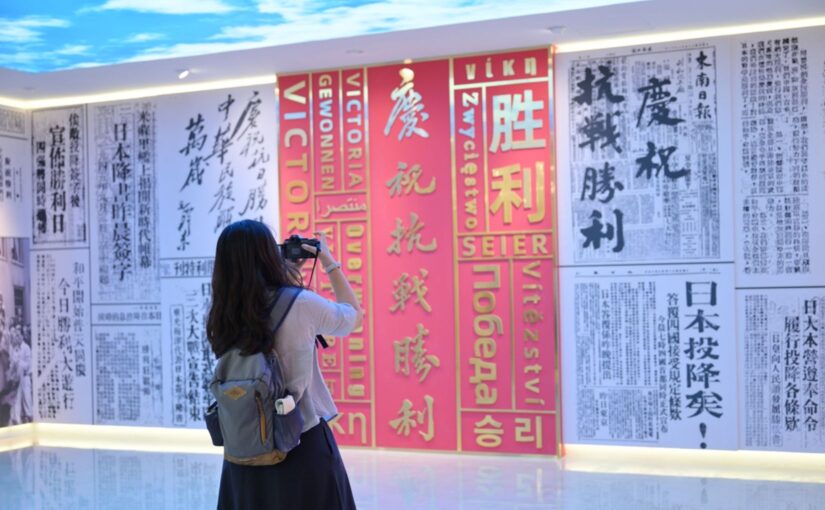
September 3rd marks the 80th anniversary of the victory in the Chinese People’s War of Resistance Against Japanese Aggression. In the following article, originally published in Global Times on 14 August, Spanish geopolitical analyst H. Gomez notes that the history of international solidarity in the World Anti-Fascist War “did not begin in 1939, nor did it end with the fall of the Nazi Germany”.
He highlights the Spanish Civil War of 1936 as an early front in this global fight:
In 1936, when the Spanish Civil War erupted, a little-known but powerful gesture of internationalism took place. Among the first foreign volunteers to arrive in Spain was Xie Weijin, a Chinese Marxist and journalist who had studied in France and was deeply moved by the Republican cause. As bombs fell over Madrid and Barcelona, Xie risked his life to stand with the Spanish people in their resistance against interventions by fascist forces. He was soon followed by other Chinese volunteers who formed part of the International Brigades – multi-national units made up of workers, students and intellectuals from over 50 countries.
At the same time, China itself was resisting Japanese invasion. The horrors of Nanjing and the bombings of Chongqing became symbols of global anti-fascist resolve, and China too received international solidarity: Canadian doctor Norman Bethune, American aviators of the Flying Tigers, Soviet advisors, and volunteers from across Asia and beyond came to China’s assistance. Indeed, 20 medical doctors serving in the International Brigades went from Spain to China to help defend against Japanese aggression.
These acts of transnational support, Gomez stresses, were not about profit or geopolitics but about a shared moral cause. China has preserved this history through monuments, museums, and remembrance of comrades-in-arms. Yet, he warns, historical revisionism and amnesia in parts of the world threaten to distort or erase these sacrifices, particularly China’s role in the Allied victory.
The author writes that commemorating the war is not only remembrance but a moral imperative. In today’s world—facing pandemics, climate change, and geopolitical tensions—the same spirit of solidarity is urgently needed. China, he concludes, upholds this legacy through peace, cooperation, and its vision of a shared future for humanity:
As China commemorates the victory in the Chinese People’s War of Resistance Against Japanese Aggression and the World Anti-Fascist War, it does so not in isolation but as part of a global family that once stood together in resistance, and must now stand together in rebuilding global trust and cooperation. This is not only a tribute to the past – it is a blueprint for the future.
Commenting on Gomez’s article, Jim Jump, Chair of Britain’s International Brigade Memorial Trust, remarked:
Global Times is to be congratulated for recognising the links between the Spanish Civil War and China’s resistance to Japanese militarism in the long Anti-Fascist War of the 1930s and 40s.
The fight against Franco, Hitler and Mussolini in Spain and against Japanese aggression in China was seen by many people in Britain and around the world as one and the same struggle.
The International Brigade Memorial Trust salutes the memory of all those who sent aid to the people of Spain and China and of the volunteers in the International Brigades who went from Spain to China to continue the epic struggle against fascism.
As China and the world prepare to mark the 80th anniversary of the victory in the Chinese People’s War of Resistance Against Japanese Aggression on September 3, it is a fitting moment to revisit the long arc of international solidarity in the World Anti-Fascist War, a history that did not begin in 1939, nor did it end with the fall of the Nazi Germany.
From the dusty battlefields of Spain in the late 1930s to the united resistance against Japanese militarism in Asia, people of conscience crossed borders and ideologies to stand against fascism. Their stories offer enduring lessons for today’s fractured world and reflect the fundamental spirit behind the vision of a community with a shared future for humanity.
In 1936, when the Spanish Civil War erupted, a little-known but powerful gesture of internationalism took place. Among the first foreign volunteers to arrive in Spain was Xie Weijin, a Chinese Marxist and journalist who had studied in France and was deeply moved by the Republican cause. As bombs fell over Madrid and Barcelona, Xie risked his life to stand with the Spanish people in their resistance against interventions by fascist forces. He was soon followed by other Chinese volunteers who formed part of the International Brigades – multi-national units made up of workers, students and intellectuals from over 50 countries.
These Chinese fighters, though few in number, carried with them the weight of a nation already under brutal assault from Japanese imperialism. By 1937, the Lugou Bridge Incident had ignited full-scale war in China. The horrors of the Nanjing Massacre, the bombings of Chongqing and the tenacity of the Chinese people during their eight-year resistance became a symbol of global anti-fascist resolve. Just as Chinese sons and daughters had stood in solidarity with Spain, international volunteers had also stood with China.
From Canada, the US and the Soviet Union, to India, Korea and even Germany, volunteers, journalists, doctors and military advisors came to China – not for profit or conquest, but for a moral cause. Some came under the banner of the Communist International; others, like Canadian doctor Norman Bethune, were sent to China by the Communist Party of Canada, where he provided life-saving medical care near the front lines. American aviators formed the famed “Flying Tigers,” risking their lives to defend Chinese skies.
This transnational solidarity was not driven by geopolitics – it was grounded in a shared belief that the fight against fascism was a fight for all of humanity. The global anti-fascist war left scars that remain to this day, but it also forged bonds that continue to inspire. In China, this chapter of international cooperation is not forgotten. The Chinese people remember with reverence the sacrifices of foreign friends who joined their cause. Monuments stand in places like Shijiazhuang, North China’s Hebei Province, honoring Bethune and other internationals. Museums preserve the stories of shared struggle. Chinese scholars study the lives of those who fought side by side with them – not as foreign heroes, but as comrades in arms.
Yet, in some parts of the world, there is a disturbing trend of historical amnesia or even historical revisionism. Some attempt to downplay or distort the nature of fascist aggression. Others ignore the role of China in the broader Allied victory. Still others conflate the anti-fascist cause with Cold War politics, thereby erasing the genuine human solidarity that marked that era.
It is precisely for this reason that commemorating the victory in the Chinese People’s War of Resistance Against Japanese Aggression and the World Anti-Fascist War today is not merely an act of remembrance – it is a moral and strategic imperative. As China rises peacefully and contributes to global development through initiatives like the Belt and Road Initiative, some Western forces seek to revive ideological confrontation, sow division and promote unilateralism. But history offers an antidote: unity in the face of global challenges.
The same spirit that brought Chinese volunteers to Spain and foreign fighters to China’s resistance should guide our collective efforts in today’s world. In the face of climate change, pandemics, terrorism and hegemonic power politics, no country can stand alone. As the COVID-19 pandemic made clear, viruses do not respect borders, nor do economic crises or ecological disasters. Building a shared future is not an idealistic slogan; it is a practical necessity.
China has repeatedly emphasized its commitment to peace, development and mutual respect. Whether through peacekeeping missions, humanitarian aid or South-South cooperation, Beijing is putting these principles into action. And just as the Chinese people have never forgotten their friends in times of darkness, China today extends a hand to the Global South and beyond – not to impose, but to cooperate.
On this 80th anniversary of victory, we must ask ourselves: What kind of world are we building? Are we honoring the sacrifices of those who stood up to fascism by fostering division, or by nurturing solidarity? The memory of Xie Weijin and the International Brigades, of Bethune and the Flying Tigers, calls us to choose the latter.
The world is once again at a crossroads. Economic instability, ideological extremism and geopolitical tension threaten to erode the fragile bonds of international cooperation. But if history teaches us anything, it is that solidarity can prevail even in the darkest of times. It is time to reaffirm, in words and deeds, our shared commitment to peace, justice and mutual support.
As China commemorates the victory in the Chinese People’s War of Resistance Against Japanese Aggression and the World Anti-Fascist War, it does so not in isolation but as part of a global family that once stood together in resistance, and must now stand together in rebuilding global trust and cooperation. This is not only a tribute to the past – it is a blueprint for the future.