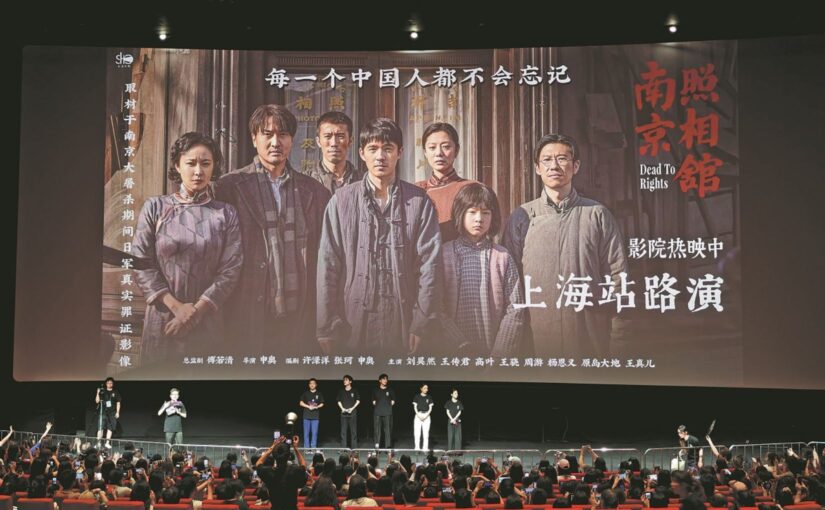
The Chinese film Dead to Rights, a moving depiction of the 1937-38 Nanjing Massacre, went on general release in London on September 5, distributed by the Cultural Centre of Nouvelles d’Europe UK.
Carlos Martinez reviews the film, arguing that: “Although harrowing to watch, Dead to Rights is not a film of despair. It restores to memory the countless unnamed heroes who resisted occupation. And it reaffirms the principle that only truth can prevent history from being distorted or erased.”
Shen Ao’s Dead to Rights (released domestically as Nanjing Photo Studio) is a Chinese film of searing power and urgency. Set during the Nanjing Massacre of December 1937, it combines meticulous historical detail with a sweeping human drama that is resonating deeply with audiences around the world. Since its release in July, the film has smashed box office records and helped to reignite the discussion about one of the darkest chapters of the twentieth century.
The story follows A Chang (Liu Haoran), a humble postman who is mistaken for a photo studio employee by occupying Japanese soldiers. Realising that their mistake offers an opportunity for survival, Chang plays along. Inside the photo studio, he encounters the owner and his family sheltering in the basement, as well as an actress taking refuge.
The group’s uneasy survival hinges on developing photographs for a Japanese army photographer, Lieutenant Hideo Ito, who is documenting Japanese activities in the city for propaganda purposes. Yet the images they process – of torture, murder and rape – become an unbearable testament to the horrors engulfing their city. Together, the group risks everything to preserve these negatives and smuggle them to the outside world, convinced that only by exposing the truth can justice be served.
The drama draws inspiration from real events. In 1938, a teenage apprentice in Nanjing did indeed copy photographs brought in by Japanese soldiers, creating an album that would later serve as crucial evidence in war crimes trials. The English title, Dead to Rights, underscores the central motif: incontrovertible proof of wrongdoing that ultimately condemned the perpetrators.
The film’s release is especially poignant given its timing, just a few weeks before the 80th anniversary of Japan’s surrender and the end of the Global Anti-Fascist War. As I observed in a recent article, “China’s role in the war, and indeed the very existence of the Pacific Theatre, has to a significant degree been written out of history… However, China was the first country to wage war against fascist occupation, and the Chinese People’s War of Resistance Against Japanese Aggression was of decisive importance to the overall global victory over fascism. In the course of 14 years of war (1931-45), China suffered over 35 million casualties, and around 20 percent of its people were made refugees.”
While the war crimes carried out by Nazi Germany are etched indelibly into global consciousness, the Nanjing Massacre and other atrocities committed by the Japanese armed forces remain far less well known outside China. The Tokyo War Crimes Tribunal, the Eastern counterpart to the Nuremberg trials, estimated that over 260,000 people were killed in the weeks following Japan’s seizure of the city. Tens of thousands of women were raped in what the late historian Iris Chang described as “an orgy of cruelty seldom if ever matched in world history”.
Films like Dead to Rights serve to set the record straight, telling the truth about the occupation’s crimes and reasserting China’s place in the Global Anti-Fascist War. Shen’s film insists that China’s sacrifices, resistance and heroism be remembered.
But the film also arrives at a moment when this history feels painfully alive, with Israel’s genocidal assault on Gaza generating horrifying images of indiscriminate bombing, destroyed hospitals and civilian massacres. Indeed, the film’s central theme – the imperative to document the crimes of an occupying force – is being replayed today by courageous journalists and citizens in Gaza, whose cameras and pens are transformed into weapons of truth. As the director has commented: “A photo was a bullet on that battlefield. The click of a shutter echoed the crack of gun. The negatives pierced invaders’ lies.”
Wherever atrocities are denied or minimised – whether the Nazi Holocaust, the Nanjing Massacre, or today’s unfolding tragedies – the work of bearing witness becomes a form of resistance. The film’s characters embody that conviction. Facing daily terror, they nevertheless refuse compromise. They echo the patriotic spirit of a generation that insisted, “We will win this war,” and demanded “not one inch less” than the full liberation of China.
Artistically, the film is striking. The opening sequence cuts between bullets firing and camera shutters clicking, equating the act of shooting with both violence and documentation. The production design recreates Nanjing’s wartime devastation with harrowing realism, while the cast delivers performances of quiet dignity and depth. Liu Haoran’s A Chang is an unlikely hero – fearful but ultimately courageous – whose humanity anchors the narrative.
Although harrowing to watch, Dead to Rights is not a film of despair. It restores to memory the countless unnamed heroes who resisted occupation. And it reaffirms the principle that only truth can prevent history from being distorted or erased. In an era when denial and revisionism persist — whether from Japanese right-wing politicians or from those who seek to obscure the atrocities being perpetrated right now by Israel — this is a powerful and important message.
Dead to Rights is an epic of historical cinema, challenging audiences to confront uncomfortable truths, remember forgotten histories, and to connect to the shared global struggle against fascism and imperialism. To remember is to resist. And to honour those who preserved the truth in Nanjing is to stand in solidarity with those who risk everything today to show the world what must not be denied.
- At time of writing, Dead to Rights is showing in cinemas in London, Birmingham and Manchester in the UK. Details may be found here.






2 thoughts on “Review: Dead to Rights”