We are pleased to republish below two items from the Xinhua News Agency exploring the connections between China’s victory in the War of Resistance Against Japanese Aggression and the African liberation struggles of the second half of the 20th century.
Harare-based political commentator Dereck Goto notes that for Zimbabweans, the history of the Global Anti-Fascist War “resonates with our own odyssey from colonial subjugation to independence, from marginalisation to self-assertion”.
The article recalls some important and little-known wartime encounters: “Connections to Africa during the war were real. In 1942, Chinese troops in Myanmar carried out the daring rescue at Yenangyaung, freeing thousands of encircled Allied soldiers. Among accounts from that period are memories of Africans serving in British colonial formations who encountered Chinese troops. One such story, passed down in veterans’ circles, tells of a Rhodesian soldier – Sergeant James Moyo – who wrote that Chinese troops who saved him and his comrades were brothers in the fight for freedom. The story captures the essence of solidarity: strangers recognising in each other a shared destiny of resistance. That spirit prefigured the later bonds between China and Africa in liberation struggles.”
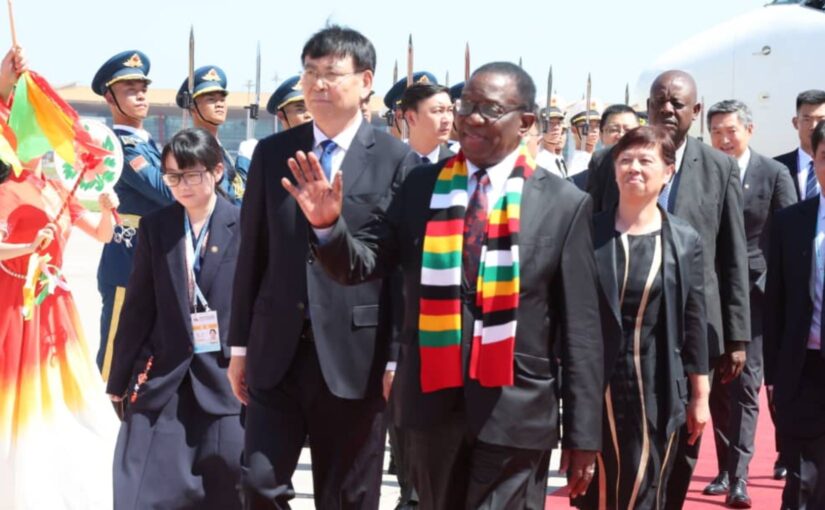
Goto observes that President Emmerson Mnangagwa’s presence in Beijing at the parade marking the 80th anniversary of China’s victory, alongside Chinese President Xi Jinping, underscores a friendship rooted not in convenience but in shared sacrifice.
The article goes on to describe various ways in which China is contributing to Zimbabwe’s ongoing development process.
The Kariba South hydropower station expansion, the Hwange Thermal Power Station Unit 7 and Unit 8 project, the new Parliament Building in Mount Hampden, and Zimbabwe’s 5G rollout through Huawei all carry Chinese fingerprints. During the COVID-19 pandemic, when vaccine nationalism exposed the fragility of global solidarity, it was Chinese vaccines that reached our shores in time. These acts are not transactional; they flow from a philosophy forged in struggle — that security and prosperity must be collective, not individual.
Manuel Pinto da Costa, former president of Sao Tome and Principe, said in an interview with Xinhua that “China’s victory in the war not only profoundly changed the international landscape, but also forged deep bonds of friendship between Africa and China along the path of pursuing independence and national development”.
He added that the rise of emerging forces such as the BRICS countries has created new opportunities for Global South countries to pursue equality and development, and that China’s engagement with Africa is fundamentally different to that historically pursued by the West.
China’s model of cooperation with African countries is fundamentally different from the approaches we experienced in the past. China has demonstrated a path of equality and mutual benefit.
He concludes that “by working hand in hand under the new international landscape, China, Africa and the wider developing world will open up broader opportunities for peace and development”.
To remember history is to carry its torch forward
Sept. 14 (Xinhua) – Eighty years ago, the Chinese people stood battered but unbroken after a 14-year struggle against brutal aggression. During the War of Resistance against Japanese Aggression, China suffered over 35 million casualties and saw its cities and villages devastated. Yet from those ashes emerged not only a military victory, but a moral triumph. It was China’s declaration that sovereignty could be reclaimed and that a united people could defeat an enemy that appeared indomitable.
For Zimbabwe, this anniversary is not a distant page in another nation’s story — it is a mirror. China’s path resonates with our own odyssey from colonial subjugation to independence, from marginalisation to self-assertion.
It is therefore fitting that President Emmerson Mnangagwa stood in Beijing on Sept. 3 alongside Chinese President Xi Jinping, commemorating the victory that reshaped Asia and, by extension, the world. His presence testifies to a friendship forged not merely in diplomacy but through shared philosophies of resistance, resilience and reconstruction.
This year’s commemoration was no ordinary gathering. On this grand occasion, President Mnangagwa was one of only two African leaders invited.
The guest list itself conveyed a distinct geopolitical significance: a convergence of nations united by shared histories of striving for national sovereignty — often portrayed differently in Western narratives — yet collectively dedicated to shaping a global order more just, equitable and responsive to the needs and aspirations of the majority of countries in the international community.
What made China’s victory so consequential was not just the endurance of its people, but also the strategic ripple effects that changed the course of World War II. More than two-thirds of Japan’s ground forces were tied down in China for years, suffering hundreds of thousands of casualties on Chinese soil. In truth, without Chinese resistance, the Allied victory in Europe would have been far less certain.
Connections to Africa during the war were real. In 1942, Chinese troops in Myanmar carried out the daring rescue at Yenangyaung, freeing thousands of encircled Allied soldiers. Among accounts from that period are memories of Africans serving in British colonial formations who encountered Chinese troops.
One such story, passed down in veterans’ circles, tells of a Rhodesian soldier — Sergeant James Moyo — who wrote that Chinese troops who saved him and his comrades were “brothers in the fight for freedom.” The story captures the essence of solidarity: strangers recognizing in each other a shared destiny of resistance. That spirit prefigured the later bonds between China and Africa in liberation struggles.
President Mnangagwa has rightly observed that “our friendship with China is written in the blood of shared struggle, and in the sweat of shared reconstruction.” This explains why, when Zimbabwe gained independence in 1980, China was among the first to recognize and support us. From supporting liberation fighters to providing scholarships and technical expertise that built our early infrastructure, China’s ethic of solidarity proved enduring. Over the decades, the China-Zimbabwe relationship has matured into partnerships spanning energy, agriculture, telecommunications and health.
The Kariba South hydropower station expansion, the Hwange Thermal Power Station Unit 7 and Unit 8 project, the new Parliament Building in Mount Hampden, and Zimbabwe’s 5G rollout through Huawei all carry Chinese fingerprints. During the COVID-19 pandemic, when vaccine nationalism exposed the fragility of global solidarity, it was Chinese vaccines that reached our shores in time. These acts are not transactional; they flow from a philosophy forged in struggle — that security and prosperity must be collective, not individual.
There is also a symbolic detail that enriches this year’s commemoration. Japan signed its instrument of surrender on Sept. 2, 1945, yet China observes Sept. 3 as its Victory Day. Why? Because China announced the victory the following day, and three days of celebration began on Sept. 3, a date later formalized by the People’s Republic of China in 2014.
The symbolism is profound: peace is not a signature on parchment, but a sunrise witnessed by the living. Zimbabwe also knows that freedom is not proclaimed once but lived daily — in the soil, in the economy, and in the dignity of sovereignty.
The lessons of this history remain urgent. In an era where the world again teeters between cooperation and confrontation, the legacy of 1945 reminds us that the fate of nations is intertwined. “War is like a mirror. Looking at it helps us better appreciate the value of peace,” President Xi has observed. Tanzania’s founding President Julius Nyerere once warned that “without unity, there is no future for Africa.” Both statements converge on the same truth: security cannot be sustained by dominance, coercion or exclusion. It must rest on dialogue, justice and mutual respect.
And yet, Zimbabwe and China today face familiar tactics. Zimbabwe endures Western sanctions designed to weaponize finance against our sovereignty. China confronts foreign containment — trade wars, technology bans and military encirclement — meant to stall its rise. These are not new; they are modern forms of the same historical efforts to deny independent nations their rightful place in the world.
The late former Zimbabwean President Robert Gabriel Mugabe once reminded the world that “our friendship with China was not born out of convenience, but out of principle.” Those principles — sovereignty, dignity and self-determination — remain under pressure in the 21st century.
As Zimbabwe looks to its Vision 2030, the Chinese experience offers inspiration. It proves that national rejuvenation is possible even after devastation, but only with unity, strategic patience and disciplined self-reliance. China rebuilt not through dependency on external powers, but through self-driven transformation. For Zimbabwe, still navigating sanctions, economic headwinds and global volatility, the lesson is clear — adversity can be fuel for renewal.
When President Mnangagwa stood in Beijing on Sept. 3, 2025, he did not simply mark a foreign anniversary. He was honoring a shared inheritance of struggle and a shared responsibility for the future. The Great Wall of China and the Great Zimbabwe, though thousands of kilometers apart, carry the same message: civilizations endure. They may be tested, but they do not vanish. They adapt, rebuild and rise again.
History is not a museum piece. It is a compass. The victory of 1945 reminds us that peace is not the absence of war, but the presence of justice, sovereignty and solidarity. For Zimbabwe and China alike, to remember is not only to honor the past but to carry its torch forward.
The world still waits for a new dawn, and it falls to us — the inheritors of sacrifice — to ensure that dawn shines with dignity, equality and shared prosperity.
Interview: China’s victory in War of Resistance against Japanese Aggression inspired African independence, says Sao Tome and Principe’s former president
SAO TOME, Sept. 15 (Xinhua) – The Chinese People’s War of Resistance Against Japanese Aggression tremendously inspired African nations in their struggles for independence and national liberation, said Manuel Pinto da Costa, the 88-year-old former president of Sao Tome and Principe.
In an interview with Xinhua, Pinto da Costa said that China’s victory in the war not only profoundly changed the international landscape, but also forged deep bonds of friendship between Africa and China along the path of pursuing independence and national development.
China’s victory demonstrated to the world that when people yearn for freedom and liberation, no force can stand in their way, he said. “This victory convinced the African people that as long as the people stand united, the pursuit of independence and liberation is always possible.”
Pinto da Costa, Sao Tome and Principe’s first president after independence, noted that China strongly supported African nations in their pursuit of independence and liberation, which continuously strengthened the political friendship between China and Africa.
He recalled that Sao Tome and Principe endured a long period of colonial rule, noting that starting in the 1950s and 1960s, the African liberation movement flourished, and an increasing number of African countries, including Sao Tome and Principe, gained independence.
However, he stressed, independence did not mean the end of the struggle, as colonial powers continued to pursue neocolonialism by installing puppet governments, inciting coups, and controlling resources and markets.
Although 80 years have passed since the victory of the World Anti-Fascist War, wars, hegemonism and interference persist today, he noted, adding that for a long time, international affairs have been dominated by a few Western countries while the interests of developing nations were neglected.
He highlighted that China-proposed global initiatives, which emphasize mutual benefit and common development, are providing developing countries with an important platform to secure a greater voice in reforming the international governance system.
The rise of emerging forces such as the BRICS countries has created new opportunities for Global South countries to pursue equality, opening up broader development prospects, he said.
He stressed that African countries must strengthen unity and advance integration in areas such as currencies, markets, industries and infrastructure, while enhancing cooperation with partners, including China.
“China’s development experience offers valuable inspiration to Africa,” he said, noting that Sao Tome and Principe, strategically located in the Gulf of Guinea, hopes to further strengthen cooperation with China in infrastructure, such as deep-water ports and airports, under the frameworks of the Belt and Road Initiative and the Forum on China-Africa Cooperation.
“China’s model of cooperation with African countries is fundamentally different from the approaches we experienced in the past. China has demonstrated a path of equality and mutual benefit,” he said.
By working hand in hand under the new international landscape, China, Africa and the wider developing world will open up broader opportunities for peace and development, he added.