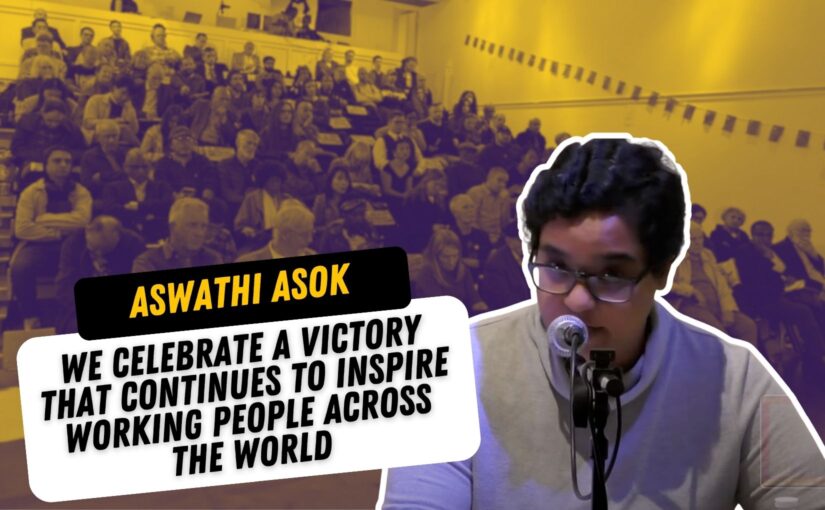
We are very pleased to publish below the speech delivered by Comrade Aswathi Asok, Executive Committee member of the Association of Indian Communists (AIC), during the closing rally of our China Conference 2025, held on Saturday September 27.
Aswathi notes that: “The Chinese revolution of 1949 was more than a change of government. It showed that the oppressed can rise, organise and shape their own future,” and goes on to outline how, from the earliest days, progressive movements in India, “looked to the Chinese people’s bravery with admiration and with a sense of kinship.”
She also outlines the social and developmental achievements of her home state of Kerala under elected communist governments:
“I grew up in a tradition, where in many homes the photograph of Chairman Mao still hangs on the wall, not as decoration but as a reminder that ordinary people can make history… Let us carry forward the banner of socialism with courage, unity, discipline, and hope. And I believe that China, with its rich experience, will support and lead the awakening of the working class around the globe.”
The AIC is the overseas wing of the Communist Party of India (Marxist), India’s largest communist party.
Dear comrades, friends and distinguished guests,
On this seventy sixth anniversary of the founding of the People’s Republic of China, I am honoured to be here and bring greetings from the Association of Indian Communists, the overseas wing of the Communist Party of India (Marxist). As someone born and raised in a neighbouring country of China, it is with great pride and joy that I join you to celebrate a victory that continues to inspire working people across the world. As we all know, the Chinese revolution of 1949 was more than a change of government. It showed that the oppressed can rise, organise and shape their own future.
Dear friends, it feels like poetic justice that we gather today here in London, the heart of the old colonial empire, to celebrate the resilience of a nation that defied colonialism and imperialism. From the opium wars to the century of humiliation, Western powers tried to break China, and even today they continue to do so. Yet China stands unbroken, emerging as a beacon of sovereignty and socialist development.
China’s development path was never smooth. After war and invasion, it had to feed and educate hundreds of millions. Yet the scale of transformation the country has achieved in just seventy-six years is undeniable; not only in terms of economic growth, but in advances in health, education and social equality. For those of us who struggle for an equitable and just social order these are not abstract statistics. They are living proof that a society led by workers and peasants can plan, build and rise without bowing to the dictates of imperial powers.
From the earliest days onwards, progressive movements in India looked to the Chinese people’s bravery with admiration and with a sense of kinship. Even before the People’s Republic was proclaimed, there were bonds of solidarity. During the Chinese people’s war of resistance against Japanese aggression, an Indian doctor, Dwarkanath Kotnis, travelled to China with a team of Indian physicians to serve the wounded. Dr Kotnis is still remembered with deep affection in China as a symbol of internationalist fraternity. Rabindranath Tagore, the Nobel laureate and India’s national poet, gave another expression to this friendship. When he first set foot on Chinese soil in 1924, he noted with emotion, “I do not know why coming to China seems to me like returning to my native soil.”
After India’s independence from the British colonial rule, India’s Prime Minister Jawaharlal Nehru sought to nurture this fraternity. Together with Comrade Zhou Enlai he gave the world the Panchsheel principles of peaceful coexistence. The popular slogan in the 1950s of Hindi Chini Bhai Bhai (which means India and China are brothers) captured the spirit of that time when two ancient civilisations emerging from colonial rule envisioned a future of cooperation and non-alignment.
That vision of fraternity is even more relevant today. We are facing new threats from Western powers, especially US imperialism, through tariff wars and policies designed to weaken and divide the Global South. This is a time that calls for unity among the nations of the Global South to resist such authoritarian impositions. As two countries that jointly represent more than one third of the world’s population, India and China together should be able to give leadership to such a solidarity. Sadly, the present right-wing government in India under Narendra Modi does not recognise this imperative need. Instead, it chooses to subjugate our country to the dictates of Trump and Washington.
China’s own path shows that power need not be built on threats or conquest. Unlike the old imperial states that grew rich through centuries of war and plunder, China has risen to global prominence without invading others and without building a network of military bases. Its strength comes from the commitment of its people, its inclusive development trajectory, advancement in science and technology, and lifting hundreds of millions out of poverty.
Dear friends, let me share a very personal note. I come from Kerala, a small state in southern India, where a communist government was elected to power through the ballot for the first time in the history. I grew up in a tradition, where in many homes the photograph of Chairman Mao still hangs on the wall, not as decoration but as a reminder that ordinary people can make history. Like China achieved development success when compared to other countries at a similar stage, Kerala’s record stands far higher than most Indian states and is even comparable to some economically advanced nations. I am proud to say that Kerala’s achievements, marked by universal literacy, strong public health systems, decentralised planning, and eradication of extreme poverty were shaped in part by lessons we learned from China. We can draw many parallels between the Kerala model and the Chinese model. Just as China created an alternative development path in a world dominated by neoliberalism and finance capital, Kerala has opened its own path within the constraints of Indian federalism and bourgeois democracy. The success stories of China and Kerala prove a fundamental socialist principle: that even under every challenge it is possible to put human needs before private profit.
Comrades, the world today is threatened by wars and aggression carried out by imperial powers, by unjustifiable trade wars, by the rise of the far right, and by the reemergence of racism and anti-migrant sentiments. We face cost-of-living crises, climate injustices, and deep economic instability. In such a moment, forging unity among the working class, the oppressed, and all those who face imperial aggression and exploitation is a necessity for peace and human survival. We must resist the propaganda that demonises China. We must speak clearly for Palestine. We must stand with Cuba. And we must defend the right of every nation to choose its own path of development without coercion.
We should also remember that the independence of one socialist country is not enough in a world where imperialism seeks to divide, dominate, and exploit. The liberation of the working class in India and in the UK is bound up with the liberation of Asia, Africa, and Latin America. Let us build a world where working people everywhere enjoy dignity, equality, and peace. Let us carry forward the banner of socialism with courage, unity, discipline, and hope. And I believe that China, with its rich experience, will support and lead the awakening of the working class around the globe.
We salute all who sacrificed for the Chinese revolution, and all who continue the work of building a socialist society. On behalf of the Indian working class and peasantry, the Association of Indian Communists extend our hands in friendship and in struggle to all who strive for a fairer, just and peaceful world.
Solidarity and revolutionary greetings!!!