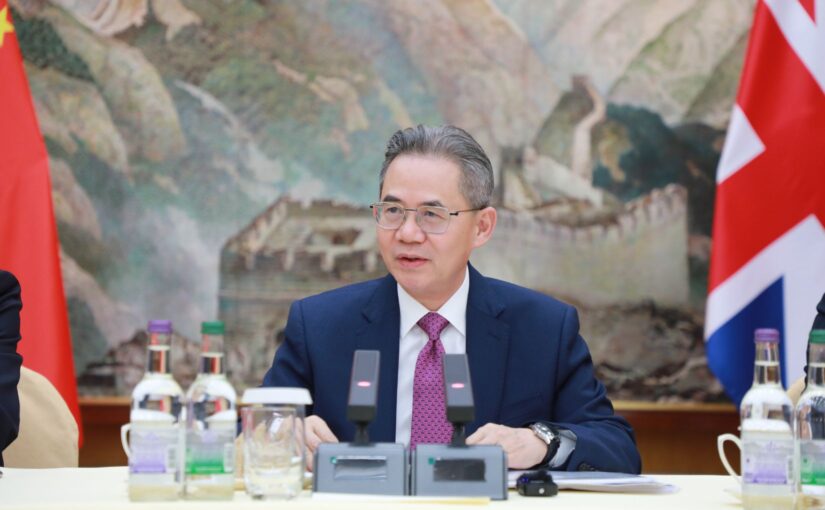
On Friday 24 October 2025, the Chinese Embassy in the UK organised a symposium on the topic New Development of China, New Opportunities for the World. The symposium was focused on the complex and ever-changing international situation; the challenges facing the United Nations and multilateralism; and China’s recently-proposed Global Governance Initiative, which addresses itself to the critical issue of “how to build a global governance system and how to reform and improve global governance”.
The event introduced by Minister Zhao Fei, followed by a keynote speech by Ambassador Zheng Zeguang. Counsellor Mu Yongpeng provided an introduction to the Global Governance Initiative, and Counsellor Kong Xiangwen introduced China’s position on the questions of Taiwan and UN Resolution 2758.
British participants were then invited to contribute remarks:
- Robert Griffiths, General Secretary of the Communist Party of Britain
- Andy Brooks, General Secretary of the New Communist Party of Britain
- Stephen Perry, Honorary President of the 48 Group Club
- Martin Albrow, Fellow of the British Academy of Social Sciences
- Kerry Brown, Director of the Lau China Institute at Kings College, London
- Ollie Shiell, CEO of UK National Committee on China
- Frances Wood, Sinologist
- Keith Bennett, Co-editor of Friends of Socialist China
- Hugh Goodacre, Managing Director of Xi Jinping Thought Study Group
- Max Browning, Schwarzman Scholar at Tsinghua University
- Janet St John-Austen, Director of Xi Jinping Thought Study Group
- Carlos Martinez, Co-editor of Friends of Socialist China
- George Korkovelos, Central Committee Member of the Communist Party of Great Britain (Marxist-Leninist)
We reproduce below the Embassy’s report of the event, followed by the contributions by Keith Bennett and Carlos Martinez.
Ambassador Zheng Zeguang Briefs Representatives of Different Sectors in the UK on the Fourth Plenary Session of the 20th CPC Central Committee
On 24 October 2025, the Chinese Embassy in the UK held a symposium on “New Development of China, New Opportunities for the World” to brief participants on the important decisions made by the Fourth Plenary Session of the 20th CPC Central Committee. Chinese Ambassador to the UK Zheng Zeguang delivered a keynote speech at the symposium. Representatives of several UK political parties and those from different sectors attended the symposium and joined in the discussions.
In his speech, Ambassador Zheng noted that the Fourth Plenary Session of the 20th CPC Central Committee comes at a time when China is marching towards the second Centenary Goal and represents a call to action for the entire country to seize the momentum and advance Chinese modernisation.
With this meeting, the CPC Central Committee with Comrade Xi Jinping at its core sets to unite and lead the Chinese people to write yet another chapter on the miracles of rapid economic growth and long-term social stability and to open up new horizons for Chinese modernisation.
Ambassador Zheng pointed out that the meeting has identified the critical role the next five years will play in China’s development. During the 14th Five-Year Plan period, China has achieved pioneering progress, breakthrough transformation, and historic accomplishments in its economic and social development. Over these five years, China has reached new heights in terms of economic, scientific and technological capabilities, and composite national strength. China’s economy will grow by about 4 trillion pounds.
In the upcoming 15th Five-Year Plan period, China’s economy will remain on solid foundations, demonstrating advantages in many areas, strong resilience and great potential. The conditions and underlying trends supporting long-term growth remain unchanged. China will fully leverage its strengths of social system, enormous market, complete industrial system, and abundant human resources. All of these will translate into tangible results for China’s high-quality development.
Ambassador Zheng noted that the meeting has outlined a new blueprint for the ongoing advancement of Chinese modernisation. The most important outcome of the meeting is the adoption of the Recommendations of the CPC Central Committee for Formulating the 15th Five-Year Plan for Economic and Social Development, which identified the guiding principles and laid out the major objectives for the next five years. In meeting these objectives, 12 major strategic plans were made. Overall, a top-level design has been put in place.
Ambassador Zheng pointed out that the meeting has sent out a positive message of China’s readiness to share opportunities and seek common development with the world. The meeting made clear that China will expand institutional opening up, safeguard the multilateral trading system, and promote broader international economic flows. China will take the initiative to open wider, promote innovative development of trade, create greater space for two-way investment cooperation, and pursue high-quality Belt and Road cooperation. With these initiatives, China has shown its determination and confidence in expanding high-standard opening up. China’s development will surely continue to inject certainty and positive energy into the world.
Ambassador Zheng emphasised that China cannot develop in isolation from the world, while the world cannot prosper without China. While pursuing Chinese modernisation, China will strive to safeguard world peace and development. The modernisation of China itself is a major contribution to human progress. President Xi Jinping has put forward the vision of building a community with a shared future for humanity. Following that, President Xi has proposed the Belt and Road Initiative, the Global Development Initiative (GDI), the Global Security Initiative (GSI), the Global Civilisation Initiative (GCI), and most recently, the Global Governance Initiative (GGI). Together, these initiatives form a complete scientific system and demonstrate the CPC’s global vision. They also represent China’s sense of responsibility as a major country for global peace, development and human progress. China stands ready to strengthen communication and coordination with countries around the world to implement these initiatives and build a community with a shared future for humanity.
Ambassador Zheng pointed out that since last year, under the strategic guidance of leaders from both countries, positive progress has been made in China-UK relations. Meanwhile, from time to time, this relationship has also been disturbed and undermined by anti-China forces. The improvement and development of China-UK relations is in the fundamental interest of people in both countries, and it requires the concerted efforts of both sides.
The UK side should have the right perspective. Those who attack China by touting “China threat” and fabricating lies are ignorant and arrogant. They do not represent the mainstream of the UK, and their attempts are doomed to failure. Both sides should uphold mutual respect and non-interference in each other’s internal affairs. The UK must honour its commitment, and properly handle Taiwan-related issues in accordance with the one-China principle. The two sides should commit to mutually-beneficial cooperation, create new highlights of cooperation and bring more benefits to the two peoples.
Other diplomats from the Embassy elaborated on the core principles and global significance of the GGI. They also recounted the historical and legal facts surrounding the Taiwan question and the importance of UNGA Resolution 2758.
The British participants expressed sincere admiration for China’s development achievements, noting that the blueprint for the next five years outlined at the Fourth Plenary Session demonstrates China’s unique advantages and will have profound and positive impacts on both China and the world. They look forward to China continuing to inject new momentum and positive energy into world peace and development, and stand ready to continue supporting practical cooperation and people-to-people exchanges between the UK and China, thus contributing to the steady and sustained development of China-UK relations.
Keith Bennett: China’s contribution to global governance
I think that the full significance of the just concluded 4th Plenum will become clearer over time. Just as was the case with the 3rd plenum held at the end of 1978 or indeed with the 3rd plenum of the current Central Committee.
But clearly it is of great importance. Not least as it comes at a crucial time, both internally and externally.
Internally, it represents a key stepping-stone to the second centenary goal and particularly to its intermediate target of basically realising a modernised socialist country by 2035. Therefore, the next five years have a crucial role to play in China’s development.
Both the opportunities and challenges clearly have an important external component, particularly the latter at the present time, with the ‘tariff wars’ for example.
The emphasis on the importance of planning is significant. As President Xi Jinping has pointed out, a key strength of socialism with Chinese characteristics is manifested in its ability to mobilise the whole state and society in pursuit of agreed key objectives.
Other key elements in my view are the emphasis on scientific and technological self-reliance – something clearly influenced by external factors; addressing environmental issues through the ‘Beautiful China’ initiative; high quality development – rather than simply quantitative growth; and related to this, the development of new high quality productive forces.
All these and more flow from and embody Xi Jinping’s thesis on the change in the main contradiction in Chinese society, with its emphasis on the people’s ever rising needs and expectations, which of course very much includes cultural and ethical progress as well.
With regards to the Global Governance Initiative (GGI), which was unveiled at the SCO+ summit in Tianjin, I was privileged to be in China at that time for the 80th anniversary of the victory of the Chinese People’s War of Resistance Against Japanese Aggression and the Global Anti-Fascist War. What I saw was to me like witnessing the rolling out and the reality of the GGI in real time.
The admission of the Lao People’s Democratic Republic (LPDR) as a partner country brought the membership of the SCO family to 27. And it is still growing.
The SCO meetings saw the presence of some key leaders of the Global South, such as Prime Minister Narendra Modi of India and President Recep Tayyip Erdoğan of Türkiye. This is not simply important because of the size of these countries, the potential of their economies and their weight and influence in regional, Global South and world affairs. For example, it was Prime Minister Modi’s first China visit in seven years and followed his constructive meeting with President Xi in Kazan, Russia last year.
Then, on September 3rd, President Xi was joined by 26 heads of state or government, as well as senior leaders and public figures from many other countries, at the 80th anniversary commemoration.
For the first time, the heads of state of all five socialist countries were together.
Top leaders were present from nine of the 15 former republics of the USSR. As were heads of state or government from six out of the then 10 members of ASEAN. (Timor Leste formally became the 11th member on October 26th.)
Pakistan, Nepal and the Maldives represented South Asia. And so on.
The famous and popular CGTN journalist Li Jingjing responded to western charges of supposed Chinese aggressiveness with the pertinent retort: ‘But we’re friends with all our neighbours’.
One cannot but fail to contrast this with the Trump administration in the United States and its relationship with its neighbours: Squabbling with Canada and even threatening to annex the country; squabbling with Denmark over Greenland; threatening to bomb Mexico on the pretext of the so-called ‘war on drugs’; threatening to seize back the Panama Canal; dangerously escalating the war threat against Venezuela, bombing small boats in international waters and even deploying an aircraft carrier group to the region; revoking the visa of the Colombian President, labelling him a ‘drug lord’ and imposing sanctions on his; further tightening the cruel embargo and blockade against socialist Cuba; and so on.
Central to the events in both Tianjin and Beijing was the question of safeguarding a correct understanding of the history and the outcomes of World War II or the Global Anti-Fascist War.
This of course includes the question of Taiwan. The Cairo and Potsdam Declarations of 1943 and 1945 clearly stipulate the return to China of all territories seized by Japan, most definitely including the province of Taiwan.
It also very much means the founding of the United Nations and safeguarding the establishment of an international order with the UN at its core, the pressing need to comprehensively reform the organisation and enhance and improve its work notwithstanding.
It means recalling and taking to heart the opening words of the UN Charter:
“We the peoples of the United Nations determined to save succeeding generations from the scourge of war, which twice in our lifetime has brought untold sorrow to mankind…”
The late Tony Benn was so find of enunciating these words, and reminding people of them, that I can almost hear them in his distinctive voice as I recall them.
It further embraces the ‘Nuremburg Principles’, which defined the waging a war of aggression as being the supreme international crime. Clearly this is something that requires serious reflection at the present time, not least after two years of genocidal aggression against the Palestinian people in Gaza.
All these core principles, in my view, are fully consistent with Xi Jinping’s concept of a shared future for humanity – of which the Global Governance Initiative is the latest building block, or stepping-stone, towards actually ensuring such a future.
Carlos Martinez: The opportunities China’s development brings to the world
I’d like to make some brief comments on the opportunities China’s development – and particularly its green development – brings to the world.
By now it’s widely recognised that China is by far the world leader in renewable energy, electric vehicles, electric public transport, electricity storage, electricity storage and afforestation. China’s greenhouse gas emissions have already peaked, five years ahead of target. Since 2013, China’s solar installed capacity has increased by a factor of 180.
China has become a model in green development, while the Western countries have, for the most part, made limited progress. Several countries in the West attempt to justify this limited progress on the basis that climate action is incompatible with economic growth. China is the first major country to prove this untrue.
China is the first country to make the green transition a powerful driver of economic growth, thereby addressing both the immediate needs of the Chinese people for modernisation and the long-term needs of humanity for a habitable planet. China has broken the link between economic development and greenhouse emissions.
This provides an example for other developing countries to follow. Furthermore, China’s sustained investment and innovation in renewable energy has resulted in a global reduction in costs: the cost of solar and wind power has come down by at least 80 percent in the last 15 years, almost exclusively as a result of China’s economies of scale and technological innovation. Today, in much of the world, solar and wind power are more cost effective than fossil fuels.
Meanwhile, the China-initiated Belt and Road Initiative is becoming a Green Belt and Road, allowing low-income countries to leapfrog fossil fuels.
China’s green development is a powerful driver of global green development, and a major contribution to humanity’s collective effort to address the climate crisis.