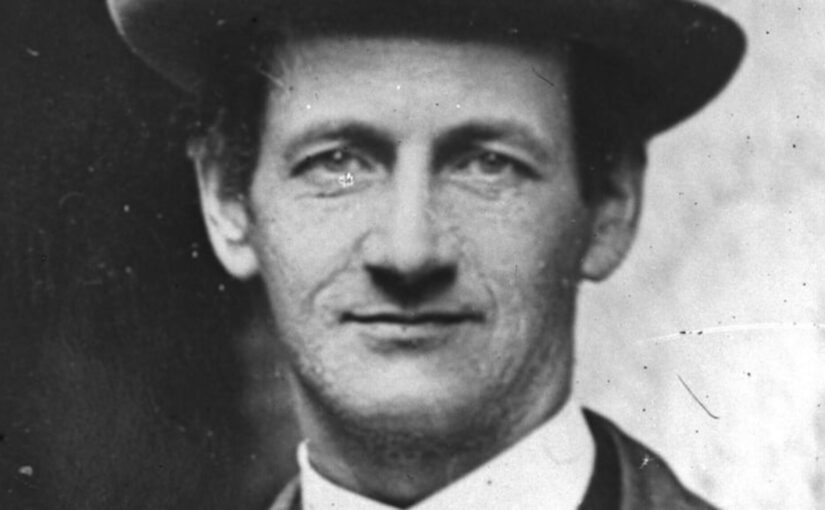
On Sunday 26 October, the Irish community in London, together with friends, gathered outside Brixton Prison for the annual Terence MacSwiney Commemoration. This year’s gathering marked 105 years since the death of the Lord Mayor of Cork, after 74 days on hunger-strike, and was once again organised by the Terence MacSwiney Committee [London].
Committee Chair Frank Glynn welcomed the approximately 60 people gathered outside the south London prison. The day’s keynote speaker was Thomas Gould, Sinn Féin TD (member of the Irish parliament) for Cork North-Central, who delivered a powerful address that appealed to the solidarity and internationalism of those living in London to support the campaign to build a new and united Ireland.
Drawing inspiration from the example of Terence MacSwiney, Gould extended solidarity to the suffering people of Palestine amidst the ongoing occupation of their land and Israel’s genocidal war. He appealed for class unity at this time, noting that the establishment and those in power are desperately seeking to turn poor people against one another. He equally paid tribute to those Irishmen and women who were forced to leave their country over the past decades, assuring them that their sacrifice is not forgotten back home.
The commemoration also heard from Pat Reynolds of the Irish in Britain Representation Group (IBRG); Pam Blakelock, who spoke about her husband’s descendance from Muriel MacSwiney (Terence MacSwiney’s widow); and the Palestinian activist, Samar Maquishi, who spoke about the unwavering support of the Irish people for the cause of Palestine. As Samar observed, “Even if the whole world was quiet, the Irish won’t be silenced!”
Longstanding London-based Irish republican Denis Grace read the Proclamation of Easter Week 1916 on behalf of the Commemoration Committee. Music was provided by the stalwart London-Irish balladeer Seán Brady and Achill Island’s own Tom Lynch on the Uilleann Pipes. Special mention was also made of the election of Catherine Connolly as the next President of Ireland. There was overwhelming support expressed for Ms Connolly, whose campaign was supported by a broad range of left-wing and progressive forces in Ireland, particularly as a candidate who placed voting rights for Irish citizens outside of the twenty-six-county state and the ongoing struggle for Irish reunification at the centre of her election platform.
(The above is an edited version of the press statement issued by the Terence MacSwiney Committee [London].)
McSwiney’s 1920 death on hunger strike, during the 1919-1921 Irish war of independence, had a profound international impact, including on such leaders of the Indian freedom movement as Jawaharlal Nehru and Mahatma Gandhi. A young Ho Chi Minh, who was working in London at the time, was profoundly moved, saying: “He died for his country. How courageous! How heroic ! A nation which has such citizens will never surrender.”
But whilst Ho Chi Minh could see for himself the very public outpouring of grief on the part of London’s Irish community, another young progressive, who was later to become an important Asian communist leader, was following the news from Japan, where he was studying at the time.
That student was Guo Moro, who was to become a senior leader of the People’s Republic of China and a close comrade of Mao Zedong. He served as Chairman of both the Chinese Academy of Sciences and the China Federation of Literary and Art Circles from their inception after liberation in 1949 to his death in 1978.
In a 2020 article written for Raidió Teilifís Éireann (RTÉ, the Irish broadcasting service), Francis Kane, a lecturer at Ulster University, explains:
“In 1920, China was in chaos, a divided country dominated by foreigners and warlords, its ancient empire having finally collapsed in 1911. In his idealistic youth, the poet Guo Moruo cannot have known that one day he would become a man of enormous power and prestige… He died not long after his comrade and friend Chairman Mao, whom he praised relentlessly.”
Kane writes that Guo penned “an astonishing poem, an emotional ‘in real time’ commemoration of fellow writer MacSwiney in 1920, usually translated as ‘Victorious in Death’.”
He also commemorates IRA Volunteer Michael Fitzgerald, whose death in Cork Gaol on October 17, 2020, came after 67 days on hunger strike.
“In the middle of the poem, Guo compares MacSwiney and Fitzgerald to the legendary hunger protesters of ancient Chinese heritage, Bo Yi and Shu Qi:
Terence MacSwiney, Irish patriot!
Today is the 22nd of October! (Never has the calendar on the wall so fixed my attention!)
Are you still alive, locked in your prison cell?
Came a cable of the 17th from London: It was sixty-six days since your fast began, and yet you bear yourself as well as ever.
You talked for a while with your dear ones on the afternoon of the 17th, and your face was even more radiant than before.
Your strength was fading daily… and today is the 22nd of October.
Irish patriot, Terence MacSwiney! Can you still be counted among living creatures?
A cable of the 17th from your native Cork told that a Sinn Feiner, a comrade of yours, Fitzgerald, fasted for sixty-eight days in Cork City Gaol, and suddenly died at sundown on the 17th.
Cruel deaths there are in history, but few so tragic.
The Shouyang Mountain of Ireland! The Po-yi and Shu-chi of Ireland!
The next cable I dread to read…
Francis Kane comments: “Who were the Chinese brothers in Guo’s poem? Bo Yi and Shu Qi lived at the time of the transition from the Shang dynasty to the Zhou, at the very beginning of Chinese recorded history (over 3,000 years ago). War against the Shang by the Zhou king, Zhou Wen Wang, was morally unacceptable to them and they refused to eat, dying on the Shouyang Mountain (首阳山, in Shanxi). They are commemorated in Chinese literary culture for their personal and moral virtue, loyalty, and pacifist idealism, occupying a longstanding cultural position as exemplars of high moral principles and integrity. For Guo to compare MacSwiney and Fitzgerald with Bo Yi and Shu Qi is praise of an interculturally profound order.”
Guo’s poem ends:
The mighty ocean is sobbing its sad lament, the boundless abyss of the sky is red with weeping, far, far away the sun has sunk in the west.
Brave, tragic death! Death in a blaze of glory! Triumphant death!
Victorious death! Impartial God of Death! I am grateful to you!
You have saved MacSwiney, for whom my love and reverence know no bounds!
MacSwiney, fighter for freedom, you have shown how great can be the power of the human will!
I am grateful to you!
I extol you!
Freedom can henceforth never die!
The night has closed down on us, but how bright is the moon…
It is hard to over-estimate or over-state Guo Moro’s contribution to the cultural and intellectual life of 20th century China. He was a poet, a playwright, a historian, an archaeologist, and a cultural standard-bearer in the political arena.
His collection of poems, ‘The Goddesses’, of which ‘Victorious in Death’ forms a part, is considered the greatest produced by the intellectual ferment occasioned by the anti-imperialist May 4th Movement of 1919, in terms of both form and content.
The Chinese website iNews outlined the importance of his study of oracle bones to the understanding of early Chinese history:
“In addition to his halo as a poet, among Guo Moruo’s many academic contributions, oracle bone research is undoubtedly the most glorious page in his academic career.
“In 1899, Wang Yirong, a scholar in the Qing Dynasty, accidentally discovered strange symbols engraved on these tortoise shells and animal bones when he was purchasing ‘dragon bones’ for use as medicine.
“Later, scholars such as Luo Zhenyu and Wang Guowei sorted out and confirmed that these symbols were divination records from the Shang Dynasty. This is one of the most important archaeological discoveries in Chinese history – the Yinxu oracle bone inscriptions.
“However, in the first few decades after the discovery of oracle bone inscriptions, research mainly focused on the interpretation of the characters. Scholars regarded them as a unique ancient script but paid less attention to the historical information they carried.
“In other words, oracle bone inscriptions were regarded as objects of ‘philology’ rather than materials of ‘history’.
“This has caused the study of oracle bone inscriptions to remain at the level of examining individual glyphs and comparing the evolution of Chinese characters for a long time, without truly realising its value in historical research.
“The emergence of Guo Moruo completely changed this situation.
“His greatest breakthrough was that he did not simply study oracle bone inscriptions as a kind of ‘ancient characters’, but rather regarded them as a door to the history of the Shang Dynasty.
“He believed that oracle bone inscriptions are not just writing symbols, but also record the politics, military, economy, religion and even daily life of the Shang Dynasty society.
“He successfully sorted out the lineage of the Shang Dynasty kings through information such as the names of kings in oracle bone inscriptions, the ancestral sacrificial system, and divination records, and proved that the lineage of the Shang kings recorded in ‘Records of the Grand Historian: The Basic Annals of Yin’ was basically reliable.
“For example, he discovered that the ‘Wu Ding’ mentioned repeatedly in the oracle bone inscriptions was exactly the king who revived the Shang Dynasty recorded in ‘Records of the Grand Historian’.
“This discovery made the history of the Shang Dynasty move from myth to reliable history and truly established the Shang Dynasty’s status as a historical dynasty.
“Based on his research on oracle bone inscriptions, Guo Moruo further expanded it to the entire ancient Chinese writing system.
“He studied the evolutionary relationship between oracle bone inscriptions and bronze inscriptions and proposed that Chinese characters are a systematic writing system that gradually evolved from oracle bone inscriptions and bronze inscriptions, rather than symbols created out of thin air.
“His research results were widely cited by later philologists and became the foundation of ancient philology.”
He was also known for his exchanges of poems with Mao Zedong, in which the two men made allegorical analysis of international events and in so doing coined phrases that entered widely into the revolutionary lexicon.
In a 1963 exchange, Guo wrote to Mao at a time of upheaval in the international communist movement:
When the seas are in turmoil
Heroes are on their mettle.
Six hundred million people,
Strong in unity,
Firm in principle,
Can shore up the falling heavens
And create order out of the reign of chaos.
The world hears the cock crowing
And day breaks in the east.
The sun rises,
The icebergs melt.
Gold is not pinchbeck
And can stand the proof of flames.
Four great volumes
Show us the way.
How absurd for Chieh’s dog to bark at Yao;
The clay oxen plunge into the sea and vanish.
The red flag of revolution is unfurling in the east wind,
The universe is glowing red.
The Chairman replied:
On this tiny globe
A few flies dash themselves against the wall,
Humming without cease,
Sometimes shrilling,
Sometimes moaning.
Ants on the locust tree assume a great-nation swagger
And mayflies lightly plot to topple the giant tree.
The west wind scatters leaves over Changan,
And the arrows are flying, twanging.
So many deeds cry out to be done,
And always urgently;
The world rolls on,
Time presses.
Ten thousand years are too long,
Seize the day, seize the hour!
The Four Seas are rising, clouds and waters raging,
The Five Continents are rocking, wind and thunder roaring.
Our force is irresistible,
Away with all pests!
Beijing’s Foreign Languages Press published his ‘Selected Poems from the Goddesses’ in 1958 and republished it in 1978. He also served as the Chairman of the China Peace Committee and was awarded the Stalin Peace Prize in 1951. The legendary African-American scholar and revolutionary Dr. WEB Du Bois dedicated his poem I sing to China to Guo.
Guo Moro joined the Communist Party of China in 1927. Delivering the eulogy at his memorial service on June 18, 1978, Deng Xiaoping described him as a “staunch revolutionary and outstanding proletarian cultural fighter who devoted his entire life to the cause of communism.”
The following article was originally published on the RTÉ website.
In 1920, events in Ireland became global news. One story above all gripped the attention of the world’s journalists, intensifying as it unfolded: the hunger strike of Terence James MacSwiney. The Lord Mayor of Cork’s fast to the death with two of his comrades was reported widely in realtime by wire and had huge impact.
The struggle in Ireland and its implications became, briefly, one of the most widely discussed topics on earth. MacSwiney inspired notions of liberty in a crumbling imperial world, destabilised by the horrors of the First World War. His words and actions famously resonated with Nehru and Ghandi. Less well known than the connection to India, but no less significant, is MacSwiney’s link to China
In 1920, China was in chaos, a divided country dominated by foreigners and warlords, its ancient empire having finally collapsed in 1911. In his idealistic youth, the poet Guo Moruo cannot have known that one day he would become a man of enormous power and prestige. He would be the longstanding Chairman of both the Chinese Academy of Sciences and the China Federation of Literary and Art Circles, from the inception of the People’s Republic of China in 1949 until his death in 1978. He died not long after his comrade and friend Chairman Mao, whom he praised relentlessly.
Moruo wrote an astonishing poem, an emotional “in real time” commemoration of fellow writer MacSwiney in 1920, usually translated as “Victorious in Death”. Unusually passionate in tone, the young Chinese intellectual produced it through October 1920, as Irish news came into Japan, where Guo was living at the time.
His subjects are alive as he begins writing, the stanzas dated as they were composed, but the poem ends with news of their deaths. Guo also commemorates volunteer Michael Fitzgerald, whose death in Cork Gaol on October 17th came after 67 days on hunger strike. A week later on October 25th saw the deaths, within hours of each other, of his two comrades, Joseph Murphy (after 76 days, also in Cork Gaol) and MacSwiney, (after 74 days in Brixton Jail).
In the middle of the poem, Guo compares MacSwiney and Fitzgerald to the legendary hunger protesters of ancient Chinese heritage, Bo Yi and Shu Qi:
Terence MacSwiney, Irish patriot! Today is the 22nd of October! (Never has the calendar on the wall so fixed my attention!) Are you still alive, locked in your prison cell? Came a cable of the 17th from London: It was sixty-six days since your fast began, and yet you bear yourself as well as ever. You talked for a while with your dear ones on the afternoon of the 17th, and your face was even more radiant than before. Your strength was fading daily… and today is the 22nd of October. Irish patriot, Terence MacSwiney! Can you still be counted among living creature? A cable of the 17th from your native Cork told than a Sinn Feiner, a comrade of yours, Fitzgerald, fasted for sixty-eight days in Cork City Gaol, and suddenly died at sundown on the 17th. Cruel deaths there are in history, but few so tragic. The Shouyang Mountain of Ireland! The Po-yi and Shu-chi of Ireland! The next cable I dread to read… October 22
Who were the Chinese brothers in Guo’s poem? Bo Yi and Shu Qi lived at the time of the transition from the Shang dynasty to the Zhou, at the very beginning of Chinese recorded history (over 3,000 years ago). War against the Shang by the Zhou king, Zhou Wen Wang, was morally unacceptable to them and they refused to eat, dying on the Shouyang Mountain (首阳山, in Shanxi). They are commemorated in Chinese literary culture for their personal and moral virtue, loyalty, and pacifist idealism, occupying a longstanding cultural position as exemplars of high moral principles and integrity. For Guo to compare MacSwiney and Fitzgerald with Bo Yi and Shu Qi is praise of an interculturally profound order.
However, the American-born Murphy, one of the three Irish patriots to die in the Cork hunger strike campaign, is not mentioned in Guo’s poem. That there were three, not two, Irish hunger strikers, may have been inconvenient for the smooth working of Guo’s cultural analogy. The poem ends thus:
The mighty ocean is sobbing its sad lament, the boundless abyss of the sky is red with weeping, far, far away the sun has sunk in the west. Brave, tragic death! Death in a blaze of glory! Triumphant death!
Victorious death! Impartial God of Death! I am grateful to you!
You have saved MacSwiney, for whom my love and reverence know no bounds! MacSwiney, fighter for freedom, you have shown how great can be the power of the human will! I am grateful to you! I extol you! Freedom can henceforth never die! The night has closed down on us, but how bright is the moon… October 27
Guo’s poem is a window on a liminal moment in world history.