Since Ibrahim Traoré came to power in 2022, the West African state of Burkina Faso has embarked on a path of independent economic development and diversification, stressing self-reliance and cooperation with fellow members of the Global South, and breaking the chains of neo-colonial exploitation, perpetrated by France in particular.
In this regard, People’s Dispatch, recently published an article, translated from the original Portuguese language publication by Brasil de Fato, on Burkina Faso’s first electric vehicle assembly plant, which began production in January 2025.
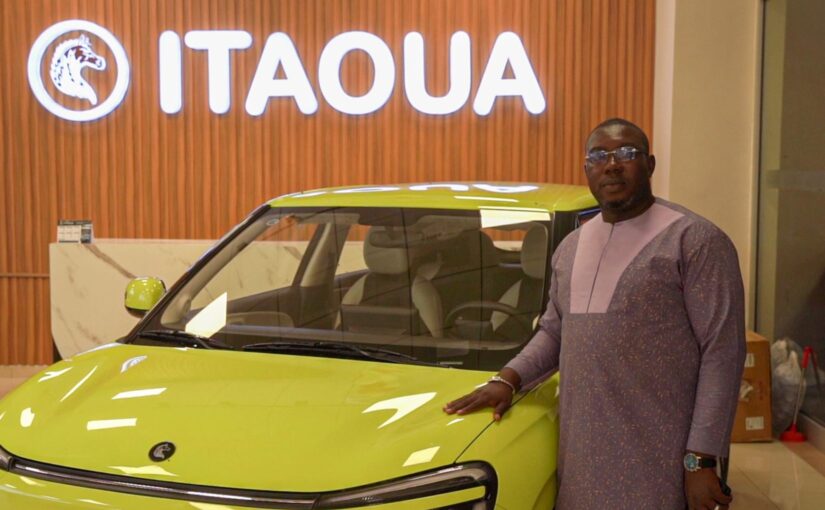
The country’s first electric vehicle has been named the Itaoua. The name is a tribute to a village near Ouagadougou, the country’s capital. The horse that illustrates the logo represents strength, prestige, and longevity.
The plant’s general director Abdoulatif Rouamba explained: “Production began in January 2025. Then we started selling Itaoua electric vehicles. We began with two entry-level models, the Itaoua Sahel and the Itaoua Native. Later we received other models, such as the Itaoua Tenakuru and the Itaoua Land Elder, which is a pickup truck. Today it’s possible to drive comfortably, at a low cost, and still protect the environment for future generations. Driving an Itawa electric vehicle is a direct contribution to this preservation.”
With technical support from China, the electric vehicles are assembled in Ouaga 2000, a district located 25 km from the capital. According to Rouamba, Burkinabé engineers were trained in Chinese factories and are now applying this knowledge on African soil. He states that at the moment, the brand only handles the assembly process, but that there is a “prospect of launching our own designs in the coming years”.
The director also values the partnership with the BRICS member countries. “We are working in a business environment with countries like China and Russia, within a win-win partnership logic. It’s not a collaboration model where we are exploited. Everyone gets their share. We are also involved in a technology transfer process. That’s why our technicians were trained abroad and today apply what they learned for the benefit of Itaoua, Burkina Faso, and Africa in general.”
Under the government of President Ibrahim Traoré, Burkina Faso launched its first brand of domestically assembled electric cars, Itaoua. The name is a tribute to a village near Ouagadougou, the country’s capital. The horse that illustrates the logo represents strength, prestige, and longevity.
To learn about the models already available and understand how Itaoua has become a symbol of the industrial and sustainable transformation the country is experiencing, Brasil de Fato visited the company’s headquarters in Ouagadougou. The concessionaire’s general director, Abdoulatif Rouamba, recalls the beginning of this journey.
“Production began in January 2025. Then we started selling Itaoua electric vehicles. We began with two entry-level models, the Itaoua Sahel and the Itaoua Native. Later we received other models, such as the Itaoua Tenakuru and the Itaoua Land Elder, which is a pickup truck,” Rouamba explains.
“Today it’s possible to drive comfortably, at a low cost, and still protect the environment for future generations. Driving an Itawa electric vehicle is a direct contribution to this preservation,” he adds.
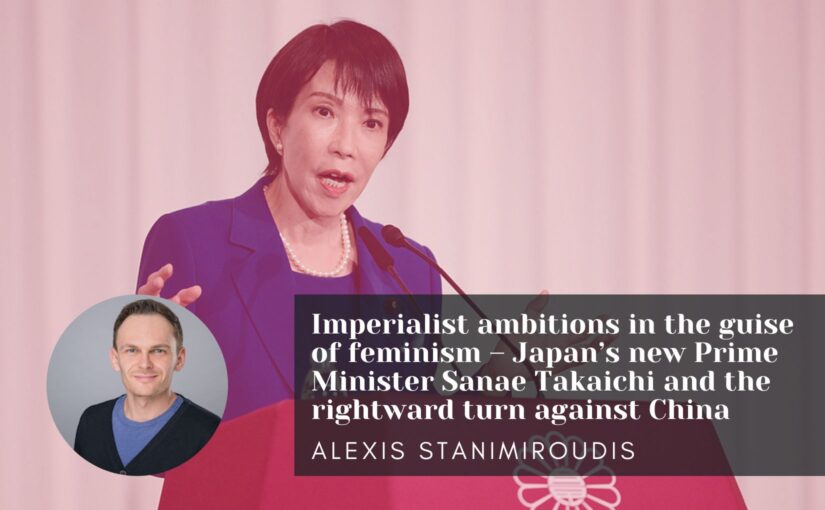
We are pleased to publish the below article, which has been contributed by Alexis Stanimiroudis, an anti-imperialist scholar based in Germany, and which analyses the political standpoint of Japan’s new Prime Minister Sanae Takaichi and its ideological roots, thereby uncovering the source of her hardline anti-China stance, which has plunged Sino-Japanese relations into a dangerous crisis, less than a month into her premiership.
Alexis draws on the work of Jun Tosaka (1900-1945), a creative Japanese Marxist theorist whose major work, The Japanese Ideology argues that both liberalism and fascism rest on the same idealistic foundation: they prioritise abstract notions of culture, nation, and spirit over the material realities of class struggle and production.
The Japanese Ideology was published in a new English translation by Robert Stolz by Columbia University Press in 2024. According to the publishers:
“Tosaka Jun was among the world’s most incisive – yet underrecognised – theorists of capitalism, fascism, and ideology during the years before World War II. The Japanese Ideology is his masterpiece, first published in 1935, as Japan and the world plummeted into an age of reaction. Tosaka offers a ruthless philosophical critique of contemporary ideology that exposes liberalism’s deep complicity with fascism.
“The Japanese Ideology provides a materialist analysis of the reactionary ideology then overtaking Japan, with profound significance for anywhere fascism has taken root. Modeled after Marx and Engels’s The German Ideology, it critiques idealism as the common ground for liberalism and fascism, against which only historical materialism can suffice. Tosaka demonstrates how liberal and fascist ideas at once justified and concealed Japan’s colonisation of East Asia, and he investigates the many traces of fascism in Japanese thought and society. The Japanese Ideology makes an important intervention in Marxist theory by criticising reliance on the East/West binary and the notion of the ‘Asiatic mode of production.’ Robert Stolz’s translation introduces Anglophone readers to a classic of twentieth-century Marxist thought by an unsung peer of [Antonio] Gramsci… with striking relevance today.”
Contrary to the revival of Japanese militarism, Alexis insists that: “Remembering the immense sacrifices of the Chinese people is essential – not as a gesture of nostalgia, but as a reaffirmation of the historical truth that socialism, not imperialism, was and remains the decisive force against fascism and war.”
The election of Sanae Takaichi as Japan’s new prime minister on October 21, 2025, marks a decisive shift to the right in the country’s political landscape. At 64, Takaichi represents the nationalist-conservative wing of the Liberal Democratic Party (LDP) and is a long-time protégé of the late Prime Minister Shinzo Abe. Her agenda continues Abe’s model of Abenomics – a form of state capitalism based on massive public spending and export-led growth – but also extends his project of remilitarisation and ideological realignment.
Takaichi presents herself as a modern, “feminist” leader, yet her programme represents a return to Japan’s pre-war imperial mindset. Her vision of making Japan “strong and independent again” echoes the chauvinistic nationalism of the early twentieth century. Symbolic of this is her stance toward the Yasukuni Shrine, which honours Japan’s war dead, including convicted war criminals.
Although she abstained from a personal visit in 2025, she made a financial offering instead – an act of calculated diplomacy aimed at appeasing her nationalist base. Japan’s continued refusal to fully acknowledge or apologise for its wartime atrocities, particularly against the Chinese people, remains a central obstacle to genuine reconciliation in East Asia.
Behind Takaichi’s gestures lies the revival of an old imperialist narrative: Japan as a “victim” surrounded by hostile powers. The rhetoric of “defending against China and North Korea [DPRK],” much like Germany’s militarisation under the pretext of fearing Russia, reproduces Cold War logic – mobilising public opinion around the illusion of a perpetual external threat.
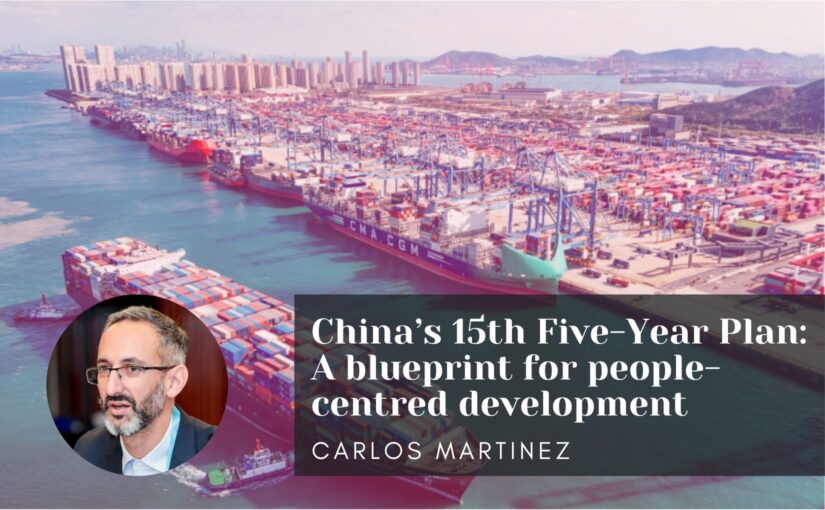
In the following article, originally published in Beijing Review on 17 November, Carlos Martinez provides an overview of the draft of China’s 15th Five-Year Plan. Carlos writes that “every Five-Year Plan is important but this one arrives at a truly pivotal moment in terms of China’s development trajectory and the global environment”, noting that the government has set an ambitious goal of “basically achieving socialist modernisation” by 2035, while at the same time the country faces an escalating campaign of containment and encirclement led by the US.
The United States in particular is responding to the rise of China and the emergence of a more multipolar world order with a New Cold War strategy designed to perpetuate US hegemony and hobble China’s progress.
In the face of a highly unpredictable tariff war, export controls, unilateralism, protectionism and so-called decoupling – along with an escalating campaign of encirclement and containment – China’s strategists necessarily have to focus on deepening domestic innovation and technological self-reliance.
The article points out the central themes of the draft plan, in particular technological development, advanced industry, common prosperity, and ecological protection. It also points to the highly democratic nature of China’s planning process. Carlos concludes:
In a turbulent and complex global environment, China continues to work towards socialist modernisation, building common prosperity and an ecological civilisation, while engaging with the world on the basis of mutual respect and mutual benefit. The 15th Five-Year Plan represents a comprehensive and forward-looking blueprint for achieving these goals.
The 20th Central Committee of the Communist Party of China (CPC) held its fourth plenary session in Beijing from October 20–23, 2025. The plenary’s central task was to deliberate on the framework of the country’s next national development roadmap: the 15th Five-Year Plan (2026–2030), which will be formally adopted at next year’s National People’s Congress.
Every Five-Year Plan is important but this one arrives at a truly pivotal moment in terms of China’s development trajectory and the global environment.
The CPC’s 20th National Congress in October 2022 laid out a two-step strategic proposal for building China into a “great modern socialist country in all respects” by the middle of the century. The first step is to “basically achieve socialist modernisation” by 2035. The period from 2026 and 2030 will be critically important in building the foundations for reaching that milestone.
At the plenary, General Secretary Xi Jinping observed:
The 15th Five-Year Plan period will serve as a critical stage in building on past successes to break new ground for basically achieving socialist modernisation. It is important that we seize this window of opportunity to consolidate and build on our strengths, remove development bottlenecks, shore up areas of weakness, seize the strategic initiative amid intense international competition, and secure major breakthroughs in strategic tasks of overall importance to Chinese modernisation.
Xi further elaborated on the meaning of “basically achieving socialist modernisation”, noting that it would include China’s per capita GDP reaching the level of the mid-level developed countries. There is no internationally agreed definition of this category, but a State Council analysis in 2021 estimated that it would correspond to a per capita GDP of about 30,000 USD, just over double China’s current level.
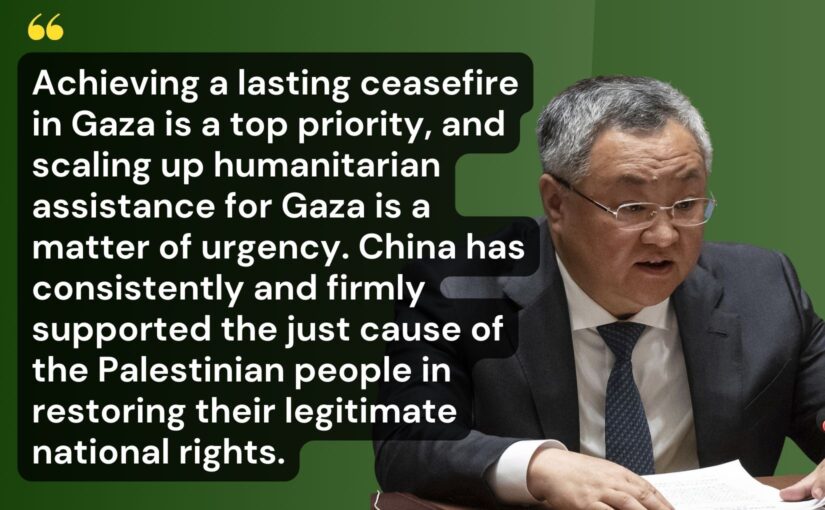
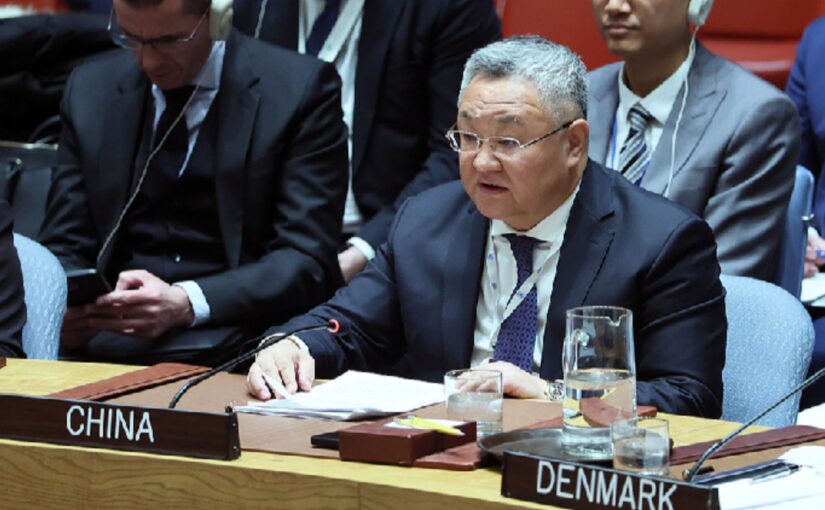
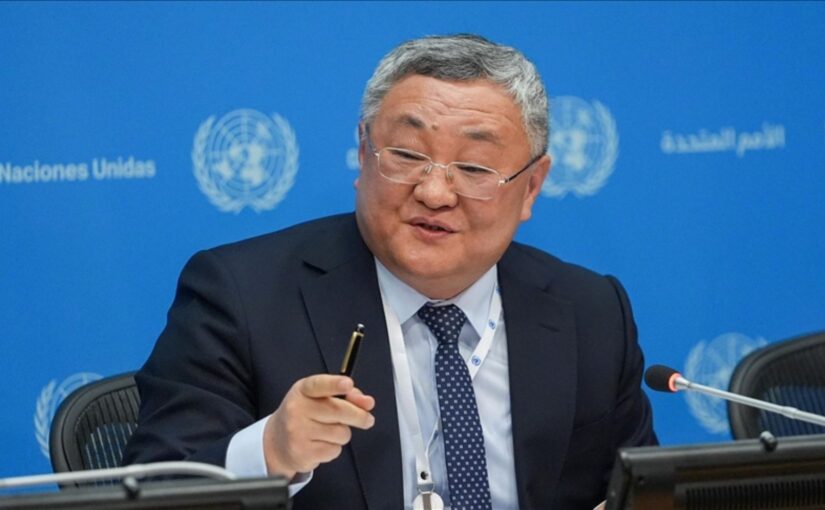
China’s UN Ambassador Fu Cong has again reiterated his country’s strong solidarity with the Palestinian people and condemned Israel for its ceasefire violations, continued obstruction of desperately needed humanitarian aid and worsening settler violence in the occupied West Bank.
Speaking at a UN Security Council briefing on November 24, Fu began by stating that: “The Palestinian question lies at the heart of the Middle East issue and bears on peace and security in the region and beyond.”
He continued: “We welcome the agreement reached on the first phase of the Gaza ceasefire. However, peace between Palestine and Israel is still far from being achieved, and the suffering of civilians continues. We call on the international community to work harder with the greatest sense of urgency and unwavering political will toward restoring peace in the region.”
In this regard, he advanced four points:
Achieving a lasting ceasefire in Gaza is a top priority. We note with concern that violent clashes persist despite the ceasefire. Israel has reportedly committed over 400 violations of the agreement, resulting in more than 300 civilian deaths in Gaza. A ceasefire means the complete cessation of all attacks and should be observed by all parties in good faith. Any incident causing civilian casualties is unacceptable and repeated attacks must not become the new normal in Gaza.
Scaling up humanitarian assistance for Gaza is a matter of urgency. The humanitarian situation remains dire, with severe shortages of essential supplies and medical equipment. Humanitarian access to Gaza continues to face multiple obstacles, and the aid that does reach Gaza falls far short of the quantity specified in the ceasefire agreement. The International Court of Justice has issued multiple advisory opinions and orders of provisional measures, stating unequivocally that, as the occupying power, Israel is under obligation to ensure the provision of humanitarian assistance to Gaza.
Easing tensions in the West Bank is a pressing demand. The occupying power’s continued settlement expansion and connivance of settler violence have further fuelled the tensions in the West Bank. As documented by the UN, there were more than 260 incidents of settler violence last month alone, resulting in significant civilian casualties and property damage, making it the most devastating month since 2006.
Implementing the two-State solution is the only way out. Both Gaza and the West Bank are inseparable parts of the Palestinian state. Any future arrangements on Gaza should be guided by the principle of Palestinians governing Palestine and respect the will of the Palestinian people. The international community must redouble efforts to advance the two-State solution, oppose any unilateral actions that undermine its foundation, and support the early realisation of independent Palestinian statehood and its full UN membership.
We reproduce Fu Cong’s full statement below. It was originally published on the website of China’s permanent mission to the UN.
China’s UN Ambassador Fu Cong has again reiterated his country’s strong solidarity with the Palestinian people and condemned Israel for its ceasefire violations, continued obstruction of desperately needed humanitarian aid and worsening settler violence in the occupied West Bank.
Speaking at a UN Security Council briefing on November 24, Fu began by stating that: “The Palestinian question lies at the heart of the Middle East issue and bears on peace and security in the region and beyond.”
He continued: “We welcome the agreement reached on the first phase of the Gaza ceasefire. However, peace between Palestine and Israel is still far from being achieved, and the suffering of civilians continues. We call on the international community to work harder with the greatest sense of urgency and unwavering political will toward restoring peace in the region.”
In this regard, he advanced four points:
Achieving a lasting ceasefire in Gaza is a top priority. We note with concern that violent clashes persist despite the ceasefire. Israel has reportedly committed over 400 violations of the agreement, resulting in more than 300 civilian deaths in Gaza. A ceasefire means the complete cessation of all attacks and should be observed by all parties in good faith. Any incident causing civilian casualties is unacceptable and repeated attacks must not become the new normal in Gaza.
Scaling up humanitarian assistance for Gaza is a matter of urgency. The humanitarian situation remains dire, with severe shortages of essential supplies and medical equipment. Humanitarian access to Gaza continues to face multiple obstacles, and the aid that does reach Gaza falls far short of the quantity specified in the ceasefire agreement. The International Court of Justice has issued multiple advisory opinions and orders of provisional measures, stating unequivocally that, as the occupying power, Israel is under obligation to ensure the provision of humanitarian assistance to Gaza.
Easing tensions in the West Bank is a pressing demand. The occupying power’s continued settlement expansion and connivance of settler violence have further fuelled the tensions in the West Bank. As documented by the UN, there were more than 260 incidents of settler violence last month alone, resulting in significant civilian casualties and property damage, making it the most devastating month since 2006.
Implementing the two-State solution is the only way out. Both Gaza and the West Bank are inseparable parts of the Palestinian state. Any future arrangements on Gaza should be guided by the principle of Palestinians governing Palestine and respect the will of the Palestinian people. The international community must redouble efforts to advance the two-State solution, oppose any unilateral actions that undermine its foundation, and support the early realisation of independent Palestinian statehood and its full UN membership.
We reproduce Fu Cong’s full statement below. It was originally published on the website of China’s permanent mission to the UN.
Relations between China and Japan have been plunged into their worst crisis in decades after Japan’s new Prime Minister Sanae Takaichi, an extreme right-wing, hardline militarist, said in a parliamentary session that a military “contingency” regarding China’s island province of Taiwan could trigger the involvement of Japanese armed forces. This was the first such clear statement from a serving Japanese Prime Minister and has aroused strong indignation from the Chinese people, particularly coming when the country has just marked the 80th anniversary of victory in the war to resist Japanese aggression and the world anti-fascist war, in which millions of Chinese sacrificed their lives.
Accordingly, as one aspect of China’s diplomatic response, on November 21, Ambassador Fu Cong, Permanent Representative of China to the United Nations, sent a letter to the UN Secretary-General António Guterres, elaborating on the position of the Chinese government regarding Takaichi’s erroneous remarks.
In his letter, Ambassador Fu notes that Takaichi blatantly made provocative remarks on Taiwan. This marks the first time since Japan’s defeat in 1945 that a Japanese leader has advocated in an official setting the notion that “a contingency for Taiwan is a contingency for Japan” and linked it to the exercise of the right of collective self-defence; the first time Japan has expressed ambitions to intervene militarily in the Taiwan question; and the first time Japan has issued a threat of force against China, openly challenging China’s core interests. These remarks are gravely erroneous and extremely dangerous, with a profoundly malicious nature and impact. Despite China’s repeated démarches and protests, the Japanese side refuses to repent or retract its wrongful statements. China expresses strong dissatisfaction and resolute opposition.
Fu’s letter went on to note that such remarks constitute a grave violation of international law and the basic norms governing international relations, seriously undermine the post-war international order, and represent an open provocation to the more than 1.4 billion Chinese people and to the peoples of other Asian countries that once suffered from Japanese aggression. Taiwan is China’s sacred territory. How to resolve the Taiwan question is a matter for the Chinese people and brooks no foreign interference. If Japan dares to attempt an armed intervention in the cross-Strait situation, it would be an act of aggression. China will resolutely exercise its right of self-defence under the UN Charter and international law and firmly defend its sovereignty and territorial integrity.
The letter has been circulated to all UN member states as an official document of the General Assembly.
On November 21, Ambassador Fu Cong, Permanent Representative of China to the United Nations, sent a letter to the UN Secretary-General António Guterres, elaborating on the position of the Chinese Government regarding the erroneous remarks on China made by Japanese Prime Minister Sanae Takaichi.
In his letter, Ambassador Fu Cong noted that recently, when responding at the Diet, Japanese Prime Minister Sanae Takaichi blatantly made provocative remarks on Taiwan. This marks the first time since Japan’s defeat in 1945 that a Japanese leader has advocated in an official setting the notion that “a contingency for Taiwan is a contingency for Japan” and linked it to the exercise of the right of collective self-defense; the first time Japan has expressed ambitions to intervene militarily in the Taiwan question; and the first time Japan has issued a threat of force against China, openly challenging China’s core interests. These remarks are gravely erroneous and extremely dangerous, with a profoundly malicious nature and impact. Despite China’s repeated démarches and protests, the Japanese side refuses to repent or retract its wrongful statements. China expresses strong dissatisfaction and resolute opposition.
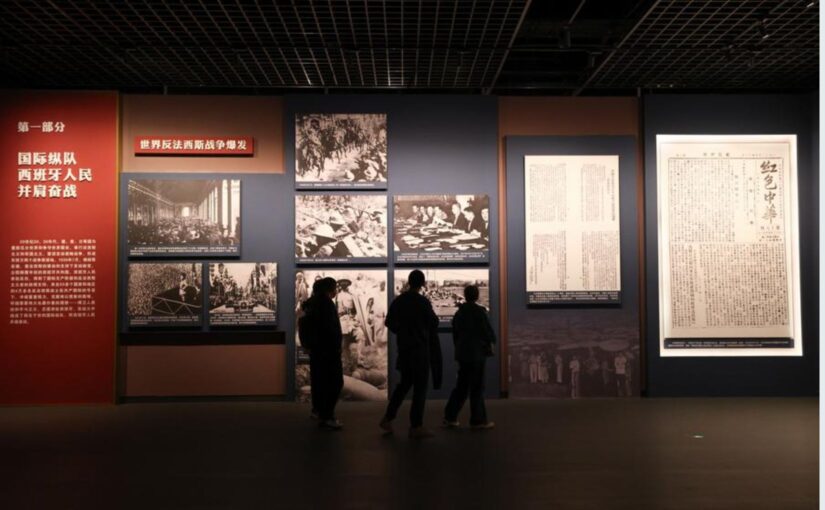
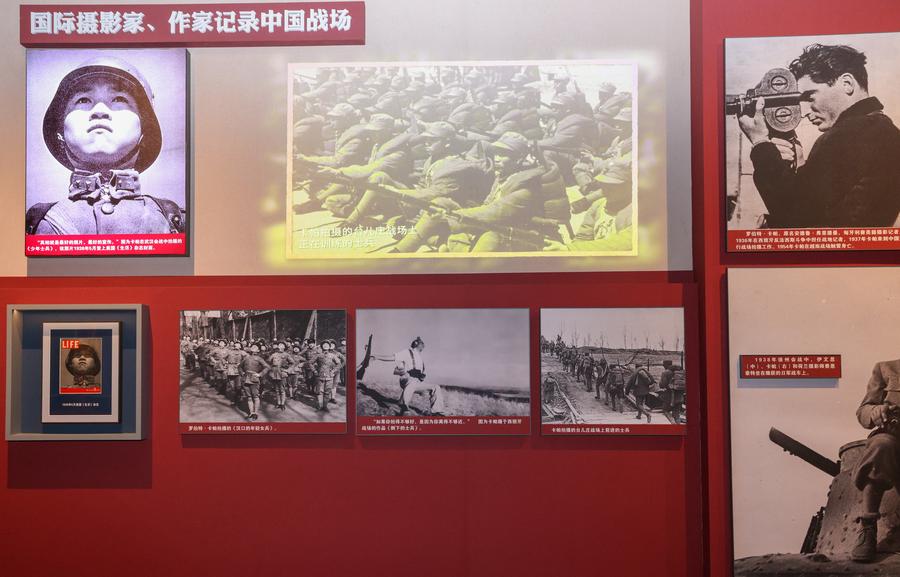
“For a Common Cause: From the Spanish Battlefield to China’s War of Resistance Against Japanese Aggression,” is the title of a major exhibition which opened in August at Beijing’s Museum of the Communist Party of China (CPC), marking the 80th anniversary of victory in the Chinese People’s War of Resistance Against Japanese Aggression and the World Anti-Fascist War. It will run till the end of 2025.
Through more than 260 photographs, 150 cultural relics and historical footage, the exhibition shows how anti-fascist volunteers of the International Brigades fought bravely on both the Spanish and Chinese battlefronts – unfolding an inspiring chapter of mutual aid in the global struggle against fascism.
A feature article published by the Xinhua News Agency on November 27 notes that: “The International Brigades mobilised over 40,000 volunteers from more than 50 countries to defend the Spanish Republic against forces including those sent from fascist Italy and Nazi Germany during its civil war (1936-1939). They fought in brutal battles such as the Defence of Madrid and the Battle of Jarama, where an estimated 10,000 lives were lost.”
It adds that less widely recognised is the Chinese contribution to this history. Among the International Brigades’ volunteers were more than 100 Chinese, many of whom were CPC members.
One prominent figure was Xie Weijin, who fought under the alias Lin Jishi. He fought in pivotal engagements, sustained two battle wounds, and narrowly avoided amputation. Beyond the frontline, Xie established an orphanage for over 100 children.
In a 1938 speech, Xie crystallised the shared struggle: “The Spanish and Chinese peoples are in a very tense phase of struggle… They are waging a revolutionary war for the national and social liberation of their respective countries, leading the fight against fascism…”
After the International Brigades were withdrawn from Spain that year, a number of internationalist fighters made their way to China, which was the main anti-fascist battlefield in the east. Among them was the Canadian surgeon Norman Bethune. After pioneering a mobile blood-transfusion service in Spain, he arrived in north China in 1938. There, he famously worked 40-hour shifts and championed setting up operating tables near the front lines. Alongside other international medical workers, Bethune saved countless lives and revolutionised battlefield medicine in China.
The following article was originally published by the Xinhua News Agency.
“There’s a valley in Spain called Jarama. It’s a place that we all know so well. It was there that we gave of our manhood, where so many of our brave comrades fell.”
These plaintive strains of the folk ballad “Jarama Valley” are more than a memorial — they are a portal to the stories of the International Brigades. This diverse group of anti-fascist fighters, drawn from across continents, now takes center stage in a touching exhibition in Beijing.
Titled “For a Common Cause: From the Spanish Battlefield to China’s War of Resistance Against Japanese Aggression,” the ongoing exhibition opened in August at the Museum of the Communist Party of China (CPC), marking the 80th anniversary of victory in the Chinese People’s War of Resistance Against Japanese Aggression and the World Anti-Fascist War.
Through more than 260 photographs, 150 cultural relics and historical footage, the exhibition shows how anti-fascist volunteers of the International Brigades fought bravely on both the Spanish and Chinese battlefronts — unfolding an inspiring chapter of mutual aid in the global struggle against fascism.
“This marks the first time China has contextualized the two battlefields within a single exhibition space, underscoring the united anti-fascist spirit of people across the world,” said Zhao Jiaojian, planner of the exhibition, which will run through the end of 2025.
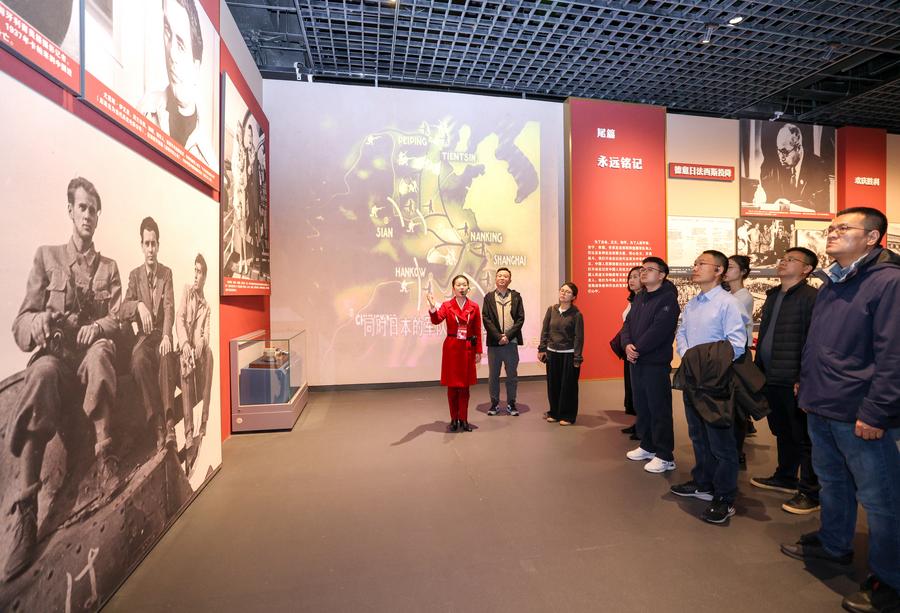
A staff member introduces exhibits to visitors at the exhibition titled “For a Common Cause: From the Spanish Battlefield to China’s War of Resistance Against Japanese Aggression” held at the Museum of the Communist Party of China (CPC) in Beijing, capital of China, Nov. 14, 2025. (Xinhua/Yin Gang)
BATTLES IN SPAIN
Organized by the Comintern — an international communist alliance — the International Brigades mobilized over 40,000 volunteers from more than 50 countries to defend the Spanish Republic against forces including those sent from fascist Italy and Nazi Germany during its civil war (1936-1939). They fought in brutal battles such as the Defense of Madrid and the Battle of Jarama, where an estimated 10,000 lives were lost.
Less widely recognized is the Chinese dimension of this chapter. Among the International Brigades’ volunteers were more than 100 Chinese, many of whom were CPC members.
One prominent figure was Xie Weijin, who fought under the alias Lin Jishi. A multilingual individual with military training, Xie rose to lead the Chinese volunteers and serve as the political commissar of an artillery brigade.
He fought in pivotal engagements, sustained two battle wounds, and narrowly avoided amputation. Beyond the frontline, Xie established an orphanage for war-orphaned children, which provided shelter for over 100 children by 1938.
In a speech delivered that year, Xie crystallized the shared struggle: “The Spanish and Chinese peoples are in a very tense phase of struggle… They are waging a revolutionary war for the national and social liberation of their respective countries, leading the fight against fascism…”
Their contributions were acknowledged back in China. A replica of the red banner sent by then CPC leaders to the volunteers in Spain is now displayed at the Beijing exhibition, bearing the inscription: “Unite the peoples of Spain and China! Down with the common foe of mankind — the Fascists!”
The heroic deeds of the volunteers, exemplified by figures like Xie, demonstrated “a commitment to justice that crossed national borders, and constituted an indelible chapter in the global fight against fascism that should never be forgotten,” said Jiang Ying, researcher of the Academy of Military Sciences.
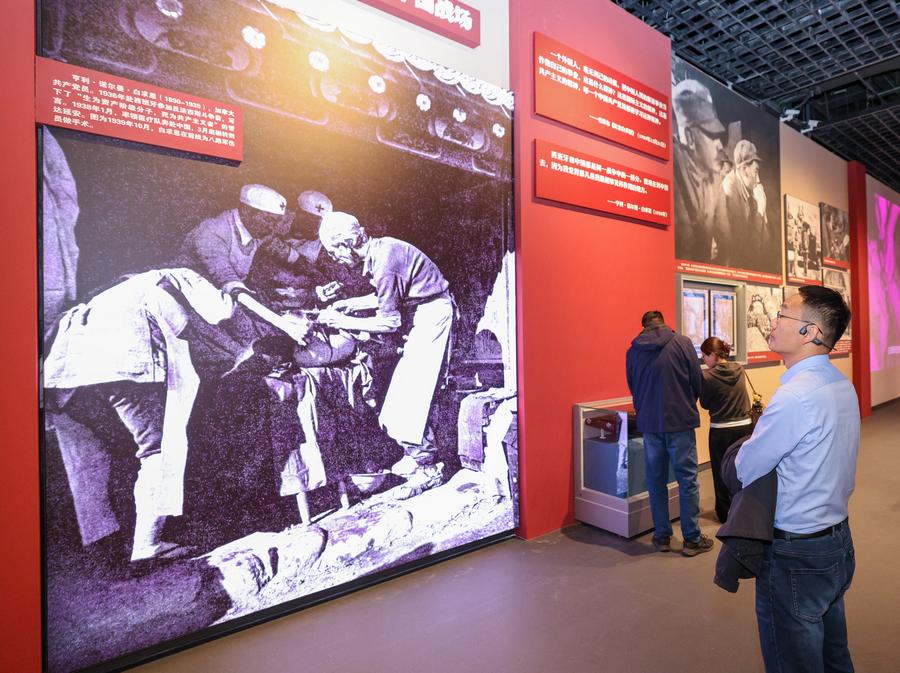
A visitor views a photo of Canadian surgeon Norman Bethune at the exhibition titled “For a Common Cause: From the Spanish Battlefield to China’s War of Resistance Against Japanese Aggression” held at the Museum of the Communist Party of China (CPC) in Beijing, capital of China, Nov. 14, 2025. (Xinhua/Yin Gang)
THE EASTERN FRONT
As the Spanish Civil War drew to a close in 1938, the International Brigades were officially withdrawn. Following a period of internment in France, the Chinese volunteers returned home to join in China’s nationwide resistance against Japanese aggression.
Yet the tide of internationalism did not recede — it flowed eastward. Foreign fighters redirected their focus from Spain to China, which had become the main theater of the World Anti-Fascist War in the East.
Among these volunteers, the most renowned was Canadian surgeon Norman Bethune, a household name in China. After pioneering a mobile blood-transfusion service in Spain, he arrived in north China in 1938. There, he famously worked 40-hour shifts and championed setting up operating tables near the front lines. Alongside other international medical workers, Bethune saved countless lives and revolutionized battlefield medicine in China.
They were joined by journalists and artists who documented the Chinese people’s arduous struggle for the rest of the world. Among them, Hungarian-American photographer Robert Capa captured the war’s brutal reality in 1937, while Dutch filmmaker Joris Ivens arrived in 1938 to produce “The 400 Million” — the first Western documentary to portray China’s resistance in a positive light, galvanizing global support.
“In this exhibition, I can clearly see how the Chinese people assisted foreign revolutionaries and how foreign revolutionaries assisted the Chinese people,” said Lin Tao, a doctoral student at Hunan Normal University, while visiting the exhibition.
This photo taken on Nov. 14, 2025 shows photographic works by Hungarian-American photographer Robert Capa displayed at the exhibition titled “For a Common Cause: From the Spanish Battlefield to China’s War of Resistance Against Japanese Aggression” at the Museum of the Communist Party of China (CPC) in Beijing, capital of China. (Xinhua/Yin Gang)
Many young Chinese visitors like Lin have been profoundly moved by the exhibition, which also highlights the pivotal contributions of International Brigades anti-fascist fighters on the Chinese battlefield.
Decades later, China continues to honor this international solidarity. On the occasion of marking the 80th anniversary of its victory in World War II on Sept. 3 this year, the nation expressed sincere gratitude to the foreign governments and individuals who aided its people.
China was the first country to rise against fascist aggression with the longest-lasting resistance that began in 1931. The country tied down and struck over half of Japan’s overseas forces, at the cost of 35 million military and civilian casualties — accounting for approximately one-third of all WWII casualties worldwide.
“The exhibition aims to deepen the understanding that the Chinese people, at a tremendous national cost, made significant contributions to the victory of the World Anti-Fascist War,” Zhao told Xinhua.
“Meanwhile, the Chinese People’s War of Resistance Against Japanese Aggression received extensive support from the international community, and the Chinese people will forever cherish these contributions. China will continue to work hand in hand with the rest of the world — and strive tirelessly to build a brighter future for humanity,” Zhao added.
Chinese President Xi Jinping has called for an immediate and lasting ceasefire in Gaza and urged the international community to step up efforts to support the legitimate rights of the Palestinian people.
In his congratulatory message to a UN meeting held on November 25 to commemorate the International Day of Solidarity with the Palestinian People, Xi said the Palestinian issue lies at the heart of the Middle East conflict, affecting international fairness, justice, and regional stability. “As a permanent member of the UN Security Council, China firmly supports the just cause of the Palestinian people to restore their legitimate national rights.”
He added that post-conflict governance and reconstruction in Gaza should be carried out under the principle of “Palestinians governing Palestine,” with full respect for the will of the Palestinian people and said the Palestinian issue is also a test of the effectiveness of the global governance system.
He called on nations to confront the root causes of the Palestinian issue, shoulder responsibility, take strong actions, correct historical injustices and uphold fairness and justice.
Chinese President Xi Jinping called for an immediate and lasting ceasefire in Gaza and urged the international community to step up efforts to support the legitimate rights of the Palestinian people, according to Chinese media cited by the Anadolu news agency.
In his congratulatory message to a UN meeting held on Tuesday to commemorate the International Day of Solidarity with the Palestinian People, Xi said the Palestinian issue lies at the heart of the Middle East conflict, affecting international fairness, justice, and regional stability, the Xinhua news agency reported.
Chinese President Xi Jinping spoke by telephone with his US counterpart Donald Trump on November 24. This latest exchange follows their October meeting in Busan, Republic of Korea, and came against a backdrop of complicated diplomatic maneuverings aimed at ending the conflict in Ukraine and heightened tensions around the Chinese province of Taiwan following provocative comments made by Japan’s new hard right and bellicose prime minister Sanae Takaichi.
During their call President Xi outlined China’s principled position on the Taiwan question. He underscored that Taiwan’s return to China is an integral part of the post-war international order. China and the US fought shoulder to shoulder against fascism and militarism. Given what is going on, it is even more important for us to jointly safeguard the victory of WWII.
President Trump said that China was a big part of the victory of WWII. The US understands how important the Taiwan question is to China.
The two presidents also discussed the Ukraine crisis. President Xi emphasised China’s support for all efforts that are conducive to peace and expressed the hope that the various sides would narrow their differences, reach a fair, lasting and binding peace agreement at an early date, and resolve the crisis at its root.
The following is the text of the readout of the call issued by the Chinese Foreign Ministry and first published on its website.
On the evening of November 24, 2025, President Xi Jinping spoke with U.S. President Donald J. Trump on the phone.
President Xi noted that we had a successful meeting in Busan last month, and reached many important common understandings. We recalibrated the course of the giant ship of China-U.S. relations and provided more momentum for it to sail forward steadily, thus sending a positive message to the world. Since then, the China-U.S. relationship has generally maintained a steady and positive trajectory, and this is welcomed by the two countries and the broader international community. What has happened demonstrates yet again that the description of China-U.S. cooperation benefiting both sides and confrontation hurting both sides reflects a common sense that has been repeatedly proven by experience, and the vision of China and the U.S. helping each other succeed and prospering together is a tangible prospect within reach. The two sides should keep up the momentum, keep moving forward in the right direction on the basis of equality, respect and mutual benefit, lengthen the list of cooperation and shorten the list of problems, so as to make more positive progress, create new space for China-U.S. cooperation and bring more benefits to the people of both countries and the world.
President Xi outlined China’s principled position on the Taiwan question. He underscored that Taiwan’s return to China is an integral part of the post-war international order. China and the U.S. fought shoulder to shoulder against fascism and militarism. Given what is going on, it is even more important for us to jointly safeguard the victory of WWII.
President Trump noted that President Xi is a great leader. I very much enjoyed our meeting in Busan, and fully share your comments about the China-U.S. relationship. The two sides are implementing all elements of what we agreed to in Busan. China was a big part of the victory of WWII. The U.S. understands how important the Taiwan question is to China.
The two presidents also discussed the Ukraine crisis. President Xi emphasized China’s support for all efforts that are conducive to peace, and expressed the hope that the various sides would narrow their differences, reach a fair, lasting and binding peace agreement at an early date, and resolve the crisis at its root.
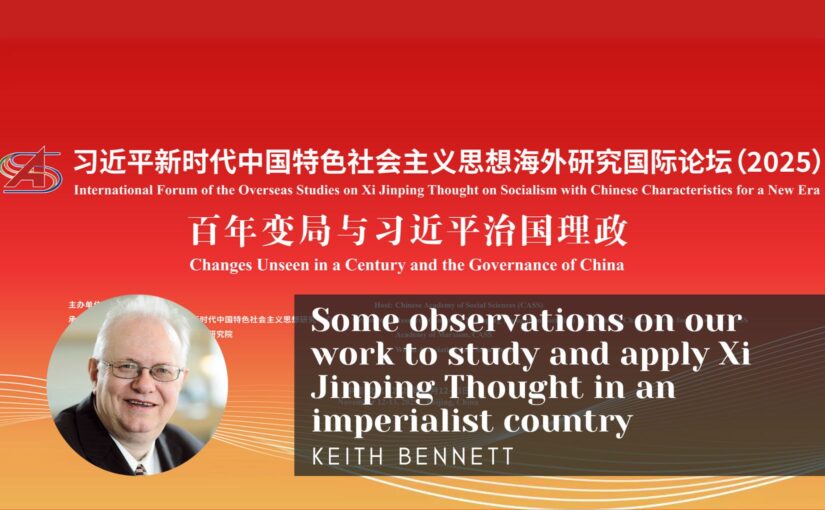
The International Forum of Overseas Studies on Xi Jinping Thought on Socialism with Chinese Characteristics for a New Era was held in Beijing, November 12-13.
Hosted by the Chinese Academy of Social Sciences (CASS), it was organised by the Research Centre for Xi Jinping Thought on Socialism with Chinese Characteristics for a New Era and the Academy of Marxism (both affiliates of CASS), along with the World Association for China Studies.
Delegates from across China were joined by former government ministers, communist party leaders, scholars and others from numerous countries including:
Vietnam, Cambodia, Pakistan, Bangladesh, Nepal, and Türkiye;
South Africa, Nigeria, Senegal, Ghana, and Burundi;
Argentina, Brazil, Dominican Republic, Ecuador, Mexico, and Venezuela; and
Russia, Belarus, Serbia, Italy, Spain, Britain, Montenegro, Poland, North Macedonia, Ireland, France, Hungary, and Greece.
Former President of Costa Rica José María Figueres addressed the conference by video.
Friends of Socialist China co-editor Keith Bennett presented a paper, highlighting some of our observations to date on studying and applying Xi Jinping Thought in an imperialist country. The following is the text of his presentation.
I am very pleased to be able to take part in this important international forum of overseas studies on Xi Jinping’s Thought on Socialism with Chinese Characteristics for a New Era and thank the Chinese Academy of Social Sciences for their kind invitation.
The basic principles of Marxism-Leninism are universally applicable, as Mao Zedong pointed out long ago. However, they must be applied and developed according to the concrete reality of each country, people, society and nation. Moreover, as Xi Jinping has pointed out, if Marxism is to truly grip the hearts of the masses and become a material force, it also needs to be integrated and combined with a people’s fine traditional culture and civilisational inheritance.
Marxism is international in its relevance, scope and sweep but it is national in its application and development. It is by no means coincidental that the five socialist countries that survived the counter-revolutionary tsunami of 1989-1991 have all not merely inherited Marxism-Leninism as it is but have creatively applied and developed it by integrating it with their indigenous revolutionary traditions and the thoughts of their own revolutionary leaders.
Moreover, life is constantly evolving, developing and changing, so Marxism also cannot stand still. If it did so, it would become ossified, dogmatic and irrelevant. Indeed, it would cease to be Marxism. Only by changing and developing in accordance with the needs and trends of the times can it remain true to its original mission and retain its relevance and scientific veracity. Based as it is on dialectical and historical materialism, Marxism itself needs to be in the vanguard not the rearguard of change and development.
The United States is once again steering dangerously toward an illegal war, this time in Latin America. Over the past two months Washington has been engaged in a military buildup around Venezuela, launching lethal strikes in international waters, dispatching its most advanced aircraft carrier, and openly weighing plans for direct attacks on Venezuelan territory. It is the largest US military concentration in the region in decades.
The arrival of the USS Gerald R Ford, the world’s largest aircraft carrier, along with three destroyers and more than 5,500 troops, has heightened fears of imminent assault. The Ford joins roughly 10,000 US troops already stationed in the region. Ostensibly, these deployments are to counter drug trafficking, but Washington has provided zero evidence to substantiate any such threat.
Since early September, US forces have carried out at least 19 airstrikes, killing nearly a hundred people on boats in international waters. These attacks have been widely denounced as being extrajudicial killings and blatant violations of international law.
President Trump said on 16 November that he wouldn’t rule out sending US troops to Venezuela, essentially to carry out a regime change operation. “I don’t rule out anything. We just have to take care of Venezuela.”
China on the other hand has taken a consistently clear and principled stand, continuing to develop its bilateral cooperation with Venezuela and roundly condemning the US’s “unilateral and excessive enforcement operations”, stressing that these violate international law and the UN Charter. China has urged the US to return to proper judicial cooperation frameworks rather than acting as a self-appointed global policeman. In contrast to Washington’s coercion, China’s position rests on respect for sovereignty and international law, and an orientation towards peace.
Cuba’s electricity system has come under intense pressure in recent years, shaped by decades of US sanctions, an ageing oil-based grid, and chronic fuel shortages due to restrictions on imports from Russia and Venezuela – a function of the US’s illegal and suffocating blockade. With peak demand reaching 2,500 MW and shortfalls of up to 1,300 MW, widespread daytime power cuts have caused significant disruptions to daily life, from water pumping to refrigeration. While emergency repairs and energy-efficiency measures—supported partly by Russian engineering—have stabilised around 850 MW, the fundamental solution being pursued is based on restructuring Cuba’s energy matrix toward renewable sources.
In this project, China has emerged as Cuba’s most vital partner. In 2024–25, China helped launch an ambitious programme of 55 solar farms capable of supplying 1,200 MW by the end of the year, with 37 more planned by 2028. This collaboration directly addresses Cuba’s shortfalls and reduces its dependence on imported fossil fuels. Chinese assistance also includes refurbishing wind turbines and supplying distributed-generation equipment, spare parts, and thousands of photovoltaic systems for isolated homes.
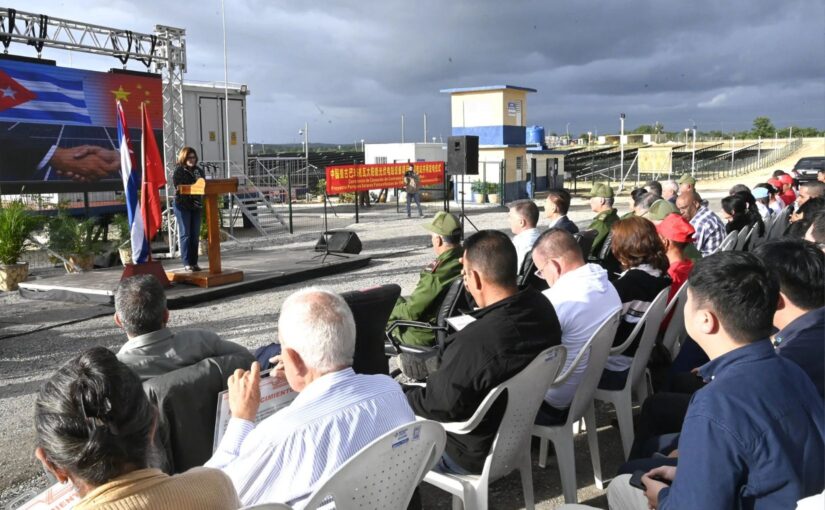
A recent landmark inauguration in Guanajay of the Mártires de Barbados II solar park symbolises this deepening partnership. The project, part of a Chinese donation that will add 120 MW to Cuba’s grid, was completed in record time thanks to tight coordination between Chinese and Cuban companies. The second phase, already underway, will add another 85 MW plus battery storage. Addressing the inauguration, Chinese Ambassador Hua Xin stated that these efforts embody China’s commitment to Cuba’s sustainable development and to building a China–Cuba community with a shared future. Cuban officials echoed this sentiment, emphasising that the new solar parks will save tens of thousands of tons of imported fuel annually, cut nearly 50,000 tons of CO₂ emissions, and significantly reduce service disruptions.
Against a backdrop of US hostility and sanctions, China’s steady, practical support is helping Cuba advance toward energy sovereignty, economic resilience, and a cleaner, more secure future.
We republish below a report on the inauguration from Granma, the newspaper of the Central Committee of the Communist Party of Cuba, along with the text of a speech by British environmental campaigner Paul Atkin at the National Education Union (NEU) Cuba Solidarity Education Conference on 15th November about Cuba’s turn to solar power.
China’s cooperation with Cuba in the energy sector remains strong and steady
Guanajay, Artemisa.– “China’s cooperation with Cuba in the energy sector remains strong and steady, from ongoing projects, such as equipment and spare parts for distributed generation, the 5,000 photovoltaic systems for isolated homes, and the installation of other solar photovoltaic parks (PSFV) with a total capacity of 85 MW, to the next project to install another 200 MW and the new 5,000 photovoltaic systems for isolated homes.”
In the video embedded below, Jyotishman Mudiar of the popular India and Global Left channel interviews Friends of Socialist China co-editor Carlos Martinez on a range of topics related to China and global political economy, including: the dimensions of China’s economic progress since 1949; the differences between the first three decades of socialist construction and the Reform and Opening Up period; the differences between Socialism with Chinese Characteristics and capitalism; the definition of socialism; the political system that enables China’s unprecedented progress on poverty alleviation and green energy; the nature of multipolarity; the differences between today’s emerging multipolarity and the inter-imperialist rivalry of the early 20th century; how multipolarity opens a path for advance to socialism; the nature of the current long crisis of capitalism; and the meaning of “changes unseen in a century”.
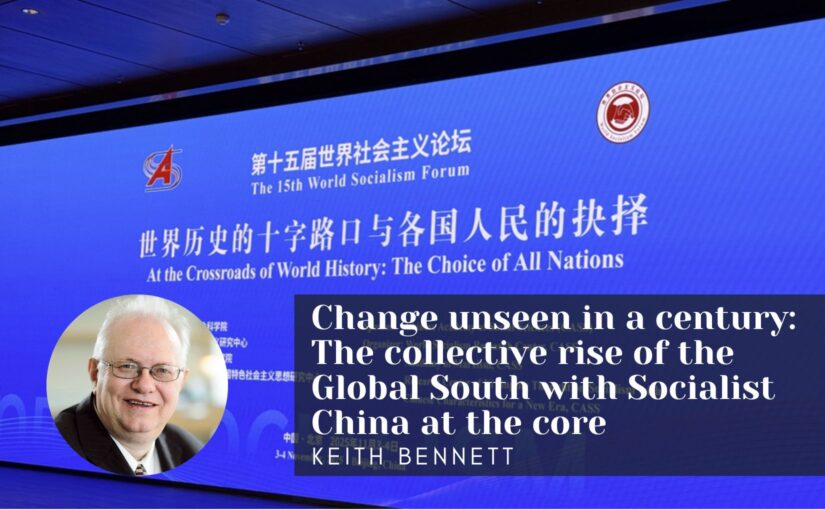
The 15th World Socialism Forum was held in Beijing from November 3-4. Organised by the Chinese Academy of Social Sciences (CASS), the forum was hosted by the World Socialism Research Centre, the Academy of Marxism, and the Institute of Xi Jinping Thought on Socialism with Chinese Characteristics for a New Era, all of which operate as units of CASS.
With an overall theme of ‘At the Crossroads of World History: The Choice of all Nations’, the forum addressed a number of topics, namely:
Chinese Modernisation and a New Form of Human Advancement
The Rise of Global South Countries and Transformation of the Global Governance System
Rejecting Unilateral Power Politics and Upholding International Equity and Justice
New Features and Trends of World Socialism amid Profound Global Changes
Safeguarding the Outcomes of the World Anti-fascist War and the Postwar International Order
Several hundred Chinese delegates were joined by comrades from Vietnam, Laos and Cuba and by senior representatives from communist parties from around the world, including:
Communist Party of Peru (Red Fatherland)
Peruvian Communist Party
Communist Party of Argentina
Colombian Communist Party
Communist Party of Uruguay
Communist Party of Spain (Party of the European Left)
Communist Refoundation Party of Italy (Party of the European Left)
Italian Communist Party
Communist Party (Italy)
Communist Party of Italy
Hungarian Workers’ Party
Communist Party (Denmark)
Communist Party of Bohemia and Moravia [Czech Republic]
Communist Party (Switzerland)
Communist Party of Finland
German Communist Party
Progressive Party of the Working People of Cyprus (AKEL)
Communist Party of Ireland
Portuguese Communist Party
Communist Party of Armenia
Communist Party of the Russian Federation
Belarusian Communist Party
Socialist Platform (Georgia)
New Socialist Movement of Georgia
South African Communist Party
Japanese Communist Party
Communist Party of Nepal (Unified Marxist-Leninist)
Communist Party of Nepal (Unified Socialist) [On November 5, this party was one of 10 that united to form the Nepali Communist Party]
Communist Party of Bangladesh
Communist Party of Lebanon
Iraqi Communist Party
Other participants included academics and scholars of Marxism from Venezuela, Colombia, Tanzania, Russia, Hungary, Ireland, Britain and other countries, think tanks and Marxist study institutions, including from Latin America, Russia, India, Germany, Italy and Cyprus, and young scholars of Marxism currently studying in China, including from the United States, Denmark and India.
Friends of Socialist China was represented by our co-editor Keith Bennett. Below we publish his speech to the forum on the subject of ‘Changes Unseen in a Century – The Collective Rise of the Global South with Socialist China at the Core.’
Following the World Socialism Forum, Keith also attended the ‘International Academic Conference on Xi Jinping Thought on Socialism with Chinese Characteristics for a New Era and 21st Century Marxism’, with sessions in Xi’an and Yan’an, and then the ‘International Forum on Overseas Studies on Xi Jinping Thought on Socialism with Chinese Characteristics for a New Era’, held in Beijing.
General Secretary Xi Jinping often reminds us that we are living in a moment of history where we are witnessing changes unseen in a century.
This statement has applicability and relevance across a range of events and numerous spheres of human endeavour. But perhaps it does not express itself quite so cogently, or with such profound import, as it does with regard to the tectonic changes in the world’s geopolitical configuration and the consequent evolution and reform of global governance.
Over a century ago, as Lenin observed, the division of the world among the great powers had been completed. This meant that the world was divided into a small number of oppressor nations on the one hand and a great mass of oppressed nations on the other. Semi-colonial, semi-feudal China, despite being the world’s longest continuous civilisation, was to be found in the latter group.
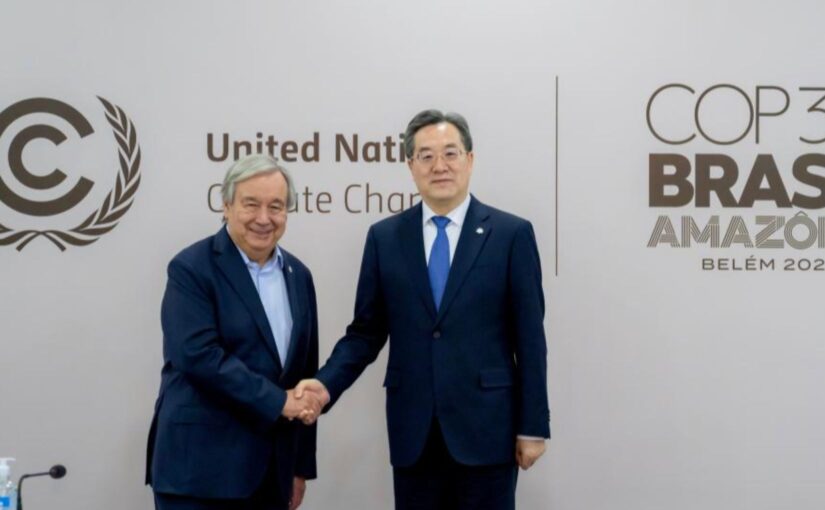
At the Belém Climate Summit, Chinese Vice Premier Ding Xuexiang praised Brazil’s leadership in global climate governance and expressed support for a successful COP30. Marking the 10th anniversary of the Paris Agreement, he stressed that global climate action has entered a critical phase. Ding highlighted China’s progress toward its 2030 goals, noting it has already surpassed targets for wind and solar capacity and forest stock, and highlighting the country’s 2035 Nationally Determined Contributions, which include its first absolute emissions-reduction target.
Vice Premier Ding emphasised that China will accelerate a comprehensive green transition across its economy as part of the 15th Five-Year Plan, guided by goals for peak carbon and carbon neutrality, and reiterated that China is a country that honours its commitments.
China will accelerate the green transition in all areas of economic and social development, work actively and prudently toward peak carbon emissions, and make greater contributions to addressing climate change.
Ding urged the assembled representatives from around the world to stay on the path of green, low-carbon development while balancing environmental goals with growth, jobs, and poverty reduction; to translate commitments into concrete action, upholding the principle of common but differentiated responsibilities, with developed nations taking the lead in emissions cuts and financing; and to deepen openness and cooperation, removing trade barriers and boosting collaboration on green technology and industries.
He concluded: “China is ready to work with all parties to unswervingly promote green and low-carbon development and build a beautiful world of harmony between humanity and nature.”
Remarks by H.E. Ding Xuexiang Special Representative of President Xi Jinping, Member of the Standing Committee of the Political Bureau of The CPC Central Committee, and Vice Premier of the State Council of the People’s Republic of China At the Belem Climate Summit Belem, November 6, 2025
Your Excellency President Luiz Inacio Lula da Silva,
Colleagues,
Good morning! It gives me great pleasure to attend the Belem Climate Summit as the special representative of Chinese President Xi Jinping. First of all, I have the honor to convey the best wishes from President Xi Jinping to Brazil for hosting this Summit. President Xi Jinping highly commends the important contributions made by the Brazilian Presidency to global climate governance, and wishes COP30 a full success.
The Communist Party of China (CPC) and the Lao People’s Revolutionary Party (LPRP) held their 13th Theoretical Seminar, November 10-11, in the Lao province of Champassak. The Chinese delegation was headed by Li Shulei, Member of the Political Bureau, Secretary of the Secretariat, and Head of the CPC Central Committee’s Publicity Department.
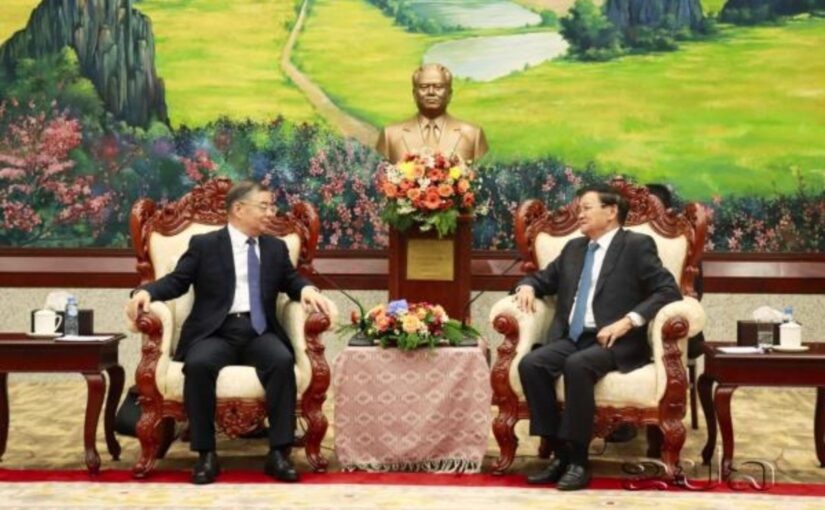
Thongloun Sisoulith, LPRP General Secretary and President of the Lao People’s Democratic Republic, met with Li on November 11, on the conclusion of the seminar.
President Thongloun warmly welcomed the delegation, noting that the visit represented a meaningful contribution to strengthening the traditional friendship and comprehensive strategic partnership between the two Parties and nations. He emphasised that the visit exemplified the “Four Good” principles of Laos-China relations – good neighbours, good friends, good comrades, and good partners.
The President underscored the importance of the 13th Theoretical Seminar as a significant platform for sharing experiences in Party building, state governance, and national administration. He highlighted that the seminar’s theme was particularly relevant as both Parties are preparing their new five-year socio-economic development plans aimed at advancing socialist development in each country.
For his part, Li Shulei expressed his gratitude for the warm reception and extended congratulations to Laos on the forthcoming 50th anniversary of the founding of the Lao People’s Democratic Republic. He also conveyed his best wishes for the success of the 12th National Congress of the Lao People’s Revolutionary Party, scheduled for early 2026. He further commended the recent meeting between President Thongloun and President Xi Jinping in Beijing in September 2025, describing it as substantive and forward-looking.
Following his visit to Laos, Li Shulei continued to Vietnam, where he attended the 20th theory seminar between the CPC and the Communist Party of Vietnam.
State President and Party General Secretary Thongloun Sisoulith received a senior delegation from the Communist Party of China (CPC) led by Mr. Li Shulei, Member of the Political Bureau, Secretary of the Secretariat, and Head of the CPC Central Committee’s Publicity Department.
The meeting took place on 11 November 2025 at the Lao People’s Revolutionary Party (LPRP) Central Office in Vientiane. The Chinese delegation visited Laos to attend the 13th Lao–Chinese Theoretical Seminar, held from 10 to 11 November in Champassak Province.
President Thongloun warmly welcomed the delegation, noting that the visit represented a meaningful contribution to strengthening the traditional friendship and comprehensive strategic partnership between the two Parties and nations. He emphasized that the visit exemplified the “Four Good” principles of Laos–China relations — good neighbours, good friends, good comrades, and good partners.
He also commended the close cooperation between the Central Publicity and Training Boards of the two Parties and encouraged both sides to continue enhancing collaboration and information exchange.
The President underscored the importance of the 13th Theoretical Seminar as a significant platform for sharing experiences in Party building, state governance, and national administration. He highlighted that the seminar’s theme was particularly relevant as both Parties are preparing their new five-year socio-economic development plans aimed at advancing socialist development in each country.
For his part, Mr. Li Shulei expressed his gratitude for the warm reception and extended congratulations to Laos on the forthcoming 50th anniversary of the founding of the Lao People’s Democratic Republic. He also conveyed his best wishes for the success of the 12th National Congress of the Lao People’s Revolutionary Party, scheduled for early 2026.
Mr. Li commended the recent meeting between President Thongloun and President Xi Jinping in Beijing in September 2025, describing it as substantive and forward-looking. He noted that the outcomes of the meeting would provide further guidance for strengthening cooperation between the two Parties and countries.
He expressed confidence that, under the leadership of both Parties, China–Laos relations will continue to deepen, becoming more effective and comprehensive in the years to come.
The following is the text of a speech given by Russel Harland, representing Friends of Socialist China’s Britain Committee, at an event held on 15 November at Bolívar Hall in London on the theme Viva Venezuela: stand against fascism, imperialism and war.
Russel argues that the world is entering a historic period of crisis and transformation marked by imperialist violence, economic oppression, and popular resistance. Drawing a line from colonialism to contemporary neoliberalism, he cites the genocide in Gaza as the culmination of imperialism’s lawless depravity, enabled by the complicity of Western governments, including that of Britain.
The speech links Palestine’s struggle against colonial oppression to US attempts to impose regime change on Venezuela, driven by its socialist orientation, its natural resources, and its close friendly relations with China and other countries that refuse to bend to US diktat. In general, the crises we are witnessing form part of the West’s response to the global multipolar shift, driven in large part by China’s rise – a “megatrend” that Western elites increasingly openly cannot prevent or reverse.
The speech concludes that defending working class interests in Britain requires supporting sovereignty and anti-imperialist struggles globally as part of a revolutionary moment demanding systemic change.
Dear friends and comrades,
It is a pleasure to speak with you today as a representative of Friends of Socialist China during what are terrifyingly dangerous times.
From the Monroe Doctrine to the Opium Wars, to the Balfour Declaration and beyond, oppressed and working-class people globally have faced a unified war of subjugation by the forces of capitalism, colonialism and imperialism. Ordinary people around the world have been dehumanised, demonised, oppressed and repressed, and their scope for economic development has been systematically constrained.1
Yet in the decaying world of neo-liberalism, capitalism’s most brutal guise2, the ongoing genocide in Gaza has propelled imperialists to the zenith of their lawless depravity. This is a watershed moment that corresponds with the Communist Party of China’s statement in its new Five-Year Plan, that “internationally, momentous changes of a magnitude not seen in a century are unfolding across the world at a faster pace”.
On November 17, the United Nations Security Council (UNSC) adopted Resolution 2803 (2025), which sets out proposed post-war arrangements for the Palestinian territory of Gaza. The resolution was adopted with 13 votes in favour and no votes against. China and Russia abstained from the vote. As permanent members of the Security Council, a negative vote by either country would have vetoed the resolution.
Following the vote, China’s UN Ambassador Fu Cong made an explanatory statement. He began by stating that:
“Gaza, brutalised by two years of war, is a land of ruins in dire need of rebuilding. Over two million people continue to live in deprivation and struggle in displacement. China supports the Security Council in taking all necessary actions to achieve a lasting ceasefire, relieve the humanitarian disaster, and launch post-war reconstruction to rekindle the hope of peace and development for the people in Gaza.”
However, he added: “Regrettably, the draft resolution that was just voted on is lacking in many respects and is deeply worrisome” and went on to set out four points in this regard:
The draft resolution is vague and unclear on many critical elements. The penholder requests the Council to authorise the establishment of a Board of Peace and international stabilisation force, which will play a key role in the post-war governance in Gaza. It should have explained in details their structure, composition, terms of reference, and criteria of participation, among others… However, the draft resolution contains skimpy details on these critical elements.
The draft resolution does not demonstrate the fundamental principle of Palestinians governing Palestine. Gaza belongs to the Palestinian people, not to anyone else. Any post-war arrangements must respect the will of the Palestinian people… The draft resolution outlines post-war governance arrangements for Gaza, but it seems that Palestine is barely visible in it, and the Palestinian sovereignty and ownership are not fully reflected.
The draft resolution does not ensure the effective participation of the UN and its Security Council… The UN has ample experience and capacities in post-conflict recovery and economic reconstruction and should therefore play a vital role in Gaza’s post-war governance. However, no such arrangement is made in the draft resolution.
The draft resolution is not a product of full consultations among Council members. Less than two weeks after introducing the draft resolution, the penholder rushed the Council into making a critical decision on the future and destiny of Gaza. Council members responsibly engaged in the consultations, raising a lot of constructive questions and suggestions, but most of them were not taken on board.
However: “Notwithstanding the above-mentioned many issues in the draft resolution and China’s major concerns about it, considering the fragile and severe situation in Gaza, the imperative of maintaining the ceasefire, and the positions of the regional countries and Palestine, China abstained in the vote. It must also be noted that our concerns and worries remain… The Palestinian question lies at the heart of the Middle East issues. It is a matter about international equity and justice… China has always firmly supported the just cause of the Palestinian people in restoring their legitimate national rights. We stand ready to work with the international community to make unremitting efforts for a comprehensive, just, and lasting solution to the Palestinian question.”
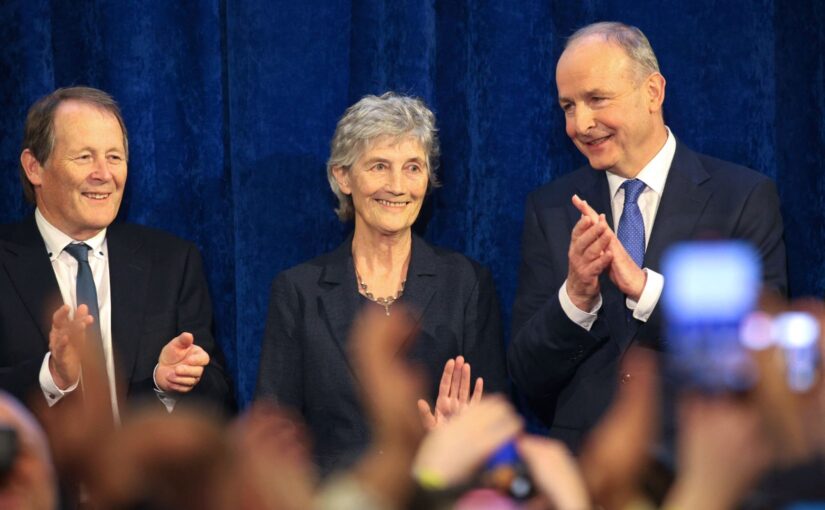
Catherine Connolly was sworn in as the tenth president (and the third woman president) of the Republic of Ireland on November 11, succeeding Michael D. Higgins, who had completed the constitutionally mandated limit of two terms of office.
Chinese President Xi Jinping sent a congratulatory message to his Irish counterpart on her assumption of office and noted that over the past 46 years since the establishment of diplomatic ties between China and Ireland, the two countries have jointly achieved remarkable development progress through mutual learning and friendly cooperation.
Xi said that he attaches great importance to the development of China-Ireland relations and stands ready to work with Connolly to enhance political mutual trust, carry forward the traditional friendship, jointly support multilateralism and free trade and promote the continuous development of the China-Ireland mutually beneficial strategic partnership to better benefit the two peoples.
Catherine Connolly, an Independent TD (member of the Irish parliament) since 2016, won a landslide victory, taking 63 percent of the vote. Key to her victory was an unprecedented unity among broad sections of the Irish left, something that is already being seen as a template for, and harbinger of, a future left government in Ireland, as well as holding important lessons for the left in Europe and elsewhere.
Seven parties represented in the Irish parliament united to back her campaign, namely Sinn Féin, the Irish Labour Party, the Social Democrats, People Before Profit, 100% Redress, Solidarity, and the Green Party. (Incidentally the first three named parties backing the election of Ireland’s third woman president are also currently led by women.) They were joined by a number of left and progressive independents (many of whom play significant roles in Irish politics), as well as cultural and other personalities, including Kneecap and (from a previous generation and from Connolly’s own County Galway) the Saw Doctors. A number of smaller left and republican parties, including the Communist Party of Ireland, Éirígí – For A New Republic, the Workers’ Party of Ireland and the Socialist Party of Ireland, also expressed support for her campaign.
Connolly stood on a clear anti-imperialist and pro-working-class platform, which included:
Defence of Irish neutrality;
Opposition to imperialist war, the militarisation of the European Union and German rearmament;
Opposition to the Gaza genocide and clear support for Palestinian self-determination and a Free Palestine;
Support for Irish reunification and an end to partition as an inevitable trend;
Promotion of the Irish language;
Opposition to racism; and
Urgent measures to tackle the housing crisis, which is one of the most acute problems currently faced by working people in Ireland.
Her campaign made astute use of social media and won wide support from young people, including through highlighting the 68-year-old’s sporting prowess.
Speaking at her inauguration, President Connolly said:
“The people have spoken and have given their President a powerful mandate to articulate their vision for a new Republic.
“A Republic worthy of its name where everyone is valued and diversity is cherished, where sustainable solutions are urgently implemented and where a home is a fundamental human right.
“The change that led to this joyful day began with a small group of elected representatives and volunteers facing what appeared to be insurmountable challenges.
“We were led to believe that it was too great a leap, that our ideas were too far out, too left, at odds with the prevailing narrative.
“In shared conversations all over the country, however, it became evident that the dominant narrative did not reflect or represent people’s values and concerns… We saw the emergence of hope, we saw the emergence of joy, along with the courage and determination of people to use their voices to shape a country that we can be proud of.”
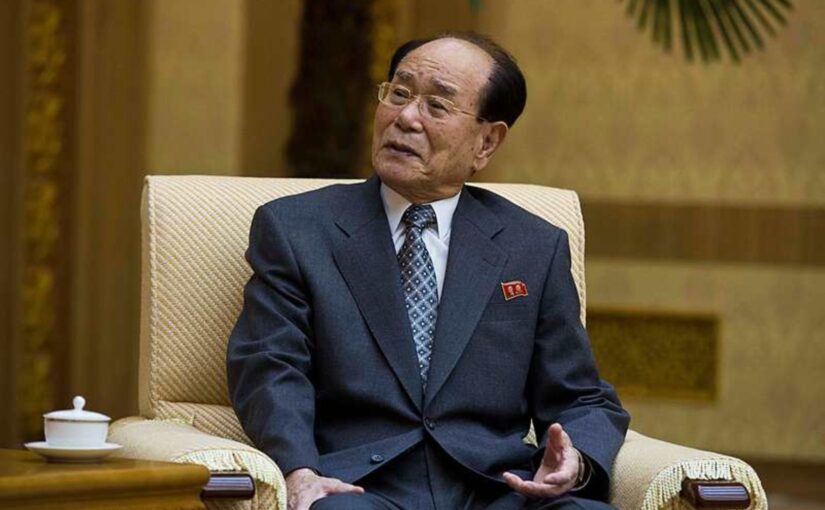
China expressed its deep condolences on the passing of Kim Yong Nam, former Chairman of the Standing Committee of the Supreme People’s Assembly of the Democratic People’s Republic of Korea (DPRK).
Kim, who had also served as the DPRK’s Foreign Minister for many years and was virtually synonymous with his country’s diplomacy, died on November 3, 2025 at the age of 97 from multiple organ failure after battling cancer.
Noting that Kim was an old friend of the Chinese people, Foreign Ministry spokesperson Mao Ning told a daily news briefing on November 4, that during his lifetime, Kim had led delegations on many visits to China and made important contributions to promoting the development of the traditional friendly and cooperative relations between China and the DPRK.
An official obituary issued by the DPRK said that:
The life of Kim Yong Nam was a brilliant one in which he was highly honoured for his allegiance to the revolution with pure loyalty and high ability.
He, who left to study abroad in the early days of building a democratic state, returned home in July 1952, when the homeland experienced a fierce war, and devoted himself to training Party cadres atthe then Central Party School. He worked at the Central Committee of the Workers’ Party of Korea (WPK) from the mid-1950s to the first half of the 1960s, contributing to enhancing the external prestige of the Party and conducting dynamic work with the progressive forces supporting and encouraging our cause in the international arena.
After working as a Vice-Minister of Foreign Affairs for four years, he successively held an important post in the field of international affairs of the Party from September 1967. In the period, he displayed strict principle and high practical ability in the important and difficult work of modeling the whole Party on the revolutionary idea of the leader, exposing and frustrating the moves of the counterrevolutionary forces that left a stain in the history of the world socialist movement and defending the revolutionary character and authority of our Party.
Since 1983, he had conducted dynamic political and diplomatic activities to defend the rights and interests of the dignified DPRK in the international arena for nearly 20 years as a Vice-Premier of the Administration Council and Foreign Minister.
In the days when he devoted all his wisdom and energy to thoroughly implementing the foreign policy of the state with independence, peace and friendship as its main idea, he made a great contribution to expanding the scope of the DPRK’s external relations and creating an environment favorable for socialist construction.
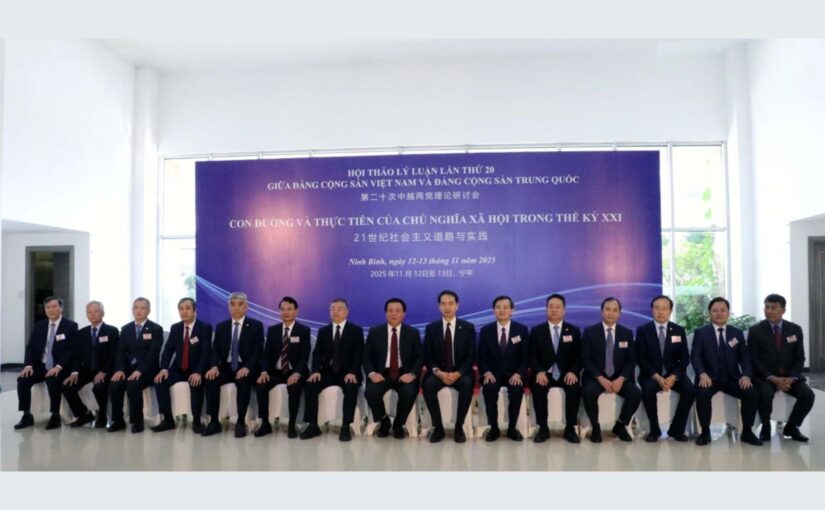
The Communist Parties of China and Vietnam held their 20th theory seminar in Vietnam’s northern Ninh Binh province on November 12 under the theme, “The path and practice of socialism in the 21st century.”
Both parties were represented at Politburo level. The Communist Party of China (CPC) delegation was headed by Li Shulei, Politburo member, Secretary of the CPC Central Committee’s Secretariat, and head of the Publicity Department of the CPC Central Committee, while the Communist Party of Vietnam (CPV) delegation was led by Nguyen Xuan Thang, Politburo member, Chairman of the Central Theory Council, and President of the Ho Chi Minh National Academy of Politics. Attending the seminar were representatives of ministries, central agencies, and localities, along with scientists, experts, and scholars from both countries, as well as the Chinese Ambassador to Vietnam.
CPC General Secretary Xi Jinping and CPV General Secretary To Lam both sent congratulatory letters to the seminar.
In the letters, the two leaders affirmed the important role of this highest-level theory exchange mechanism between the two Parties, reflecting their strategic vision, close bond, and shared responsibility in safeguarding, applying, and creatively developing Marxism-Leninism in accordance with each country’s realities, as well as demonstrating the high level of political trust between the two Parties and nations.
Xi Jinping said that both the CPC and the CPV uphold and develop Marxism, unswervingly follow the socialist path, and lead their respective countries in socialist construction, facing many of the same or similar issues of the times.
The two parties have carried out in-depth exchanges of experience in governance, jointly explored a socialist modernisation path that suits their national conditions, and worked together to promote the localisation and modernisation of Marxism and the development of the world socialist movement, constantly writing a new chapter of friendship of “comrades plus brothers” in the new era.
He also called for joint efforts to deepen theoretical discussions and academic exchanges, and to jointly enhance their understanding of the laws that underlie governance by a Communist party, socialist construction, as well as the development of human society, so as to provide theoretical support for the socialist cause of both countries and the construction of the China-Vietnam community with a shared future, and contribute to the noble cause of human peace and development.
To Lam affirmed that the CPV stands ready to work with the CPC to further deepen theory cooperation and share experiences in Party building, national development, and social governance, thereby promoting the development of socialist theory in the context of globalisation and the Fourth Industrial Revolution, for the benefit of the peoples of both countries and for a brighter future for socialism worldwide.
At a meeting between the two heads of delegations, the host congratulated China on its recent achievements, including the successful convening of the fourth plenary session of the 20th CPC Central Committee and the adoption of the orientation for formulating the 15th Five-Year Plan. He reaffirmed that Vietnam always attaches great importance and gives top priority to relations with China.
Li affirmed that the CPC firmly believes in and supports the CPV in successfully organising its 14th National Congress, opening a new era of development for Vietnam. He added that China always prioritises the development of relations with Viet Nam in its neighbourhood diplomacy.