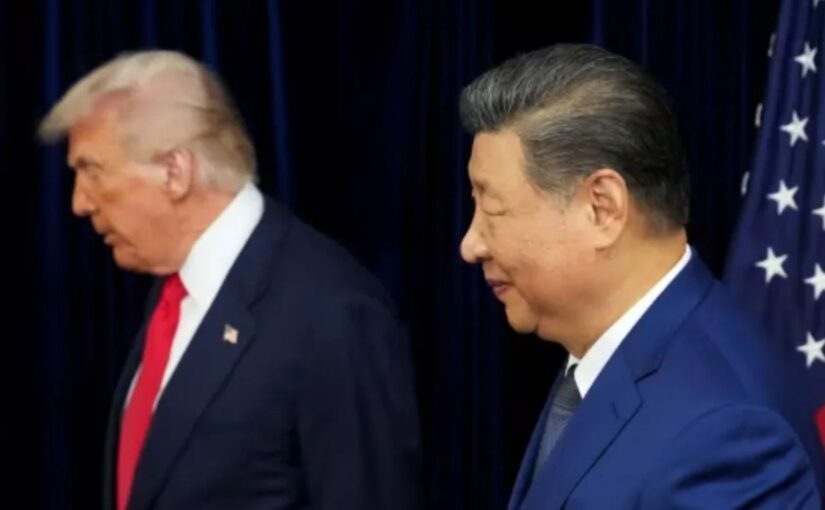
In this witty and perceptive article, originally published on his Substack, ‘The Rest is Bullshit’, Steve Howell excoriates Britain’s right wing anti-China hawks in politics and the media, arguing that Donald Trump’s positive meeting with President Xi Jinping in the Republic of Korea has exposed their foolishness.
Having noted that, “The US and China surprised almost everyone last week by calling off their trade war – for now at least. The summit between presidents Xi and Trump ended with both parties dropping plans for tougher trade restrictions and tariffs,” Howell adds:
“This was awkward for the British media. For weeks, they had been pumping out headlines on what they called the China spy scandal – the collapse of the prosecution [of] two men accused of passing information to China. There were virtually no dissenters to the view that the charges being dropped was bad news. The only issue for the media was who to blame for the failure to convict the two defendants, as if the small matter of their actual guilt was not in doubt.”
Giving the recent historical background, he writes that:
“In the build up to the US elections of 2016, both Bernie Sanders and Trump – from very different perspectives – made cheap imports from China an issue and blamed them for the de-industrialisation of the Midwest ‘rust belt’ states. On being elected, Trump introduced the first wave of tariffs on China, marking the start of a new Washington consensus that President Biden not only continued but escalated. True to form, Britain fell into line.”
However: “Amid the furore over the China ‘spy’ case, our commentariat appears not to have noticed the emerging change of policy in Washington.
“The Telegraph’s Sherelle Jacobs was certainly caught out badly, having written shortly before the summit that the government’s ‘refusal to break with China has explosive geopolitical implications.’ She thought that Britain’s ‘inaction over China’ could send Trump ‘over the edge’ and claimed that ‘if anything ends up destroying the Special Relationship it will be our gutless cosying up to Beijing.’ She must have been mortified when Trump described his meeting with Xi as ‘the G2 summit’, relegating the G7 – of which Britain is a member.”
He adds: “It remains to be seen what Trump’s China game plan is. The trade agreement arising from his summit with Xi has yet to be finalised. There is talk of Xi visiting Washington. Whatever happens, a couple of things are clear. Firstly, Britain’s long-standing policy – whoever occupies Downing Street – of hanging on to America’s coattails is a recipe for being badly bruised when there is a sudden change of direction. Secondly, if the US has had to treat China with respect, it is absurd for Britain to act as if it is ready to send gunboats up the Yangtze again.”
Steve Howell served as the Labour Party’s deputy director of strategy and communication in 2017, during the leadership of Jeremy Corbyn. He is the author of ‘Game Changer: Eight Weeks That Transformed British Politics’, about Britain’s 2017 general election; ‘Collateral Damage’, a political and international relations thriller; and ‘Cold War Puerto Rico: Anti-Communism in Washington’s Caribbean Colony (Culture and Politics in the Cold War and Beyond)’ (forthcoming).
The US and China surprised almost everyone last week by calling off their trade war – for now at least. The summit between presidents Xi and Trump ended with both parties dropping plans for tougher trade restrictions and tariffs. Asked to evaluate it on a scale of one to ten, Trump said that he thought “it was a 12.”
This was awkward for the British media. For weeks, they had been pumping out headlines on what they called the China spy scandal – the collapse of the prosecution two men accused of passing information to China. There were virtually no dissenters to the view that the charges being dropped was bad news. The only issue for the media was who to blame for the failure to convict the two defendants, as if the small matter of their actual guilt was not in doubt.
For the prosecution to go ahead, Britain had to have deemed China to be an enemy to which passing information would be a breach of the Official Secrets Act. The conservatives accused the government of deliberately withholding from the Crown Prosecution Service the evidence of enemy status needed for a conviction. The government countered that the conservatives had not classified China as an enemy when they were in power.
From my survey of the media, Keir Starmer came off worst. Fairly typical headlines were the Times’s “China spy fiasco reveals cowardice at No 10” and the Telegraph’s “Starmer’s abject China cowardice threatens the West’s very future.” For the Daily Mail, columnist Dan Hodges asked: “How could Keir Starmer get away with lying about China when Boris Johnson was hauled over the coals for a piece of cake?”
Amid these accusations of lying and cowardice, there was at least a little levity from one journalist. Tom Peck, the political sketch writer for the Times, took us back to 2015 when China was seen as Britain’s economic saviour and David Cameron took President Xi for a pint at a pub near Chequers. “The whole point of that exercise,” Peck wrote, “was to prove that China definitely wasn’t a threat, but the chairman never actually got his round in, did he, so the clues were there.”
That pub visit came at a time when the West generally was eager to get a slice of the surplus capital China had been accumulating since being admitted to the World Trade Organization in 2000. Not long afterwards, however, the political climate in the US shifted markedly. In the build up to the US elections of 2016, both Bernie Sanders and Trump – from very different perspectives – made cheap imports from China an issue and blamed them for the de-industrialisation of the Midwest ‘rust belt’ states. On being elected, Trump introduced the first wave of tariffs on China, marking the start of a new Washington consensus that President Biden not only continued but escalated.
True to form, Britain fell into line. Xi was not invited again. The friendly images in the media were replaced by scaremongering over China attacking our infrastructure and stealing our technology (as if they needed to). Voices in the media and business favouring trade were drowned out or denounced as Beijing apologists and useful idiots.
Amid the furore over the China ‘spy’ case, our commentariat appears not to have noticed the emerging change of policy in Washington. To be fair, Trump’s rhetoric is sometimes difficult to read. So, it’s perhaps understandable that journalists peddling an anti-China have been wrong-footed. The Telegraph’s Sherelle Jacobs was certainly caught out badly, having written shortly before the summit that the government’s “refusal to break with China has explosive geopolitical implications.” She thought that Britain’s “inaction over China” could send Trump “over the edge” and claimed that “if anything ends up destroying the Special Relationship it will be our gutless cosying up to Beijing.” She must have been mortified when Trump described his meeting with Xi as “the G2 summit”, relegating the G7 – of which Britain is a member – to second class status.
Britain’s most strident China hawk, Iain Duncan-Smith, seems – for now – to have gone to ground. On Thursday, as news was breaking of the Trump-Xi summit success, the former Tory leader was still attacking Starmer for refusing to define China as a “systemic threat” and speaking darkly of “an axis of totalitarian states” with China “at the heart.”
Duncan-Smith’s hope had been that Trump would set aside his ‘America first’ pragmatism and join the crusade to confront China. In an interview with Sky during the US president’s state visit to Britain in September, he said that if the countries that believe in “freedom, democracy and the rule of law” don’t unite “the totalitarian states… will dominate the world and it will be a terrible world to live in.”
This is rich, even by Duncan-Smith’s standards. He apparently thinks that the rule of law means people are guilty of spying until proven innocent, even if – judging by the leaks – the evidence amounts to no more than allegations of passing on Westminster gossip for no remuneration. And, given his strident support for Israel, he probably does not care that the world is already terrible to live in for those Gazans who have managed to survive two years of genocidal slaughter by a country that, in his world, is one of the good guys.
Duncan-Smith is a leading light in the Inter-Parliamentary Alliance on China, which was set up in 2000 to “confront” the rise of China and promote the interests of Taiwan. No doubt he was pleased that, while Trump was in China, Taiwan’s president was hosting a delegation from AIPAC, the American-Israel Public Affairs Committee. In a post on X, Lai Ching-te said he looked forward closer Taiwan-US-Israel cooperation to “deepen strategic partnerships, invest in advanced technology and enhance our defense capabilities.” That does not sound to me like an axis that would promote democracy and the rule of law.
It remains to be seen what Trump’s China game plan is. The trade agreement arising from his summit with Xi has yet to be finalised. There is talk of Xi visiting Washington. Whatever happens, a couple of things are clear. Firstly, Britain’s long-standing policy – whoever occupies Downing Street – of hanging on to America’s coat-tails is a recipe for being badly bruised when there is a sudden change of direction. Secondly, if the US has had to treat China with respect, it is absurd for Britain to act as if it is ready to send gun-boats up the Yangtze again.
Britain needs trading partners. You do not have to be a fan of the USA’s billionaire-dominated politics or its endless wars to recognise that Britain should trade with the world’s largest economy. Equally, you do not have to be a fan of China’s one-party system or its friendly relations with Russia to believe that it is important to engage constructively with the world’s second largest economy. Trade is not only essential for the growth and jobs, it can also foster greater understanding between nations. The danger with trade wars is that they can lead to deadly ones.






Brutally honest and accurate analysis of the British Establishment’s embarrassing subservience to Washington. Britain sold off its steel industry to India, and now tries to alienate the world leader in steel production ~ China!.
I have never seen such incompetence in all spheres of government and diplomacy.
Starmer and his failure of an administration should step down.