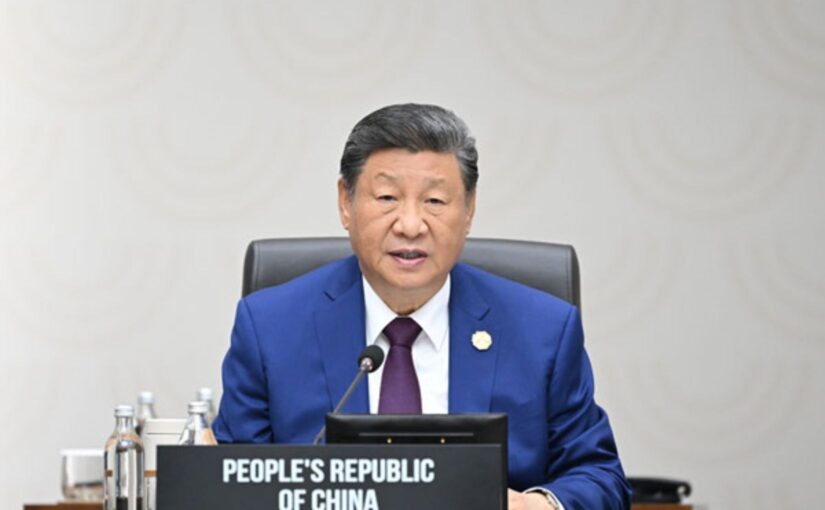
Chinese President Xi Jinping visited the Republic of Korea (ROK) from October 30-November 1 to attend the 32nd APEC (Asia-Pacific Economic Cooperation) Economic Leaders’ Meeting and to then pay a state visit to the ROK.
On October 31, he delivered a written address to the APEC CEO Summit, entitled, ‘Putting the Asia Pacific at the Forefront of the Joint Endeavor for World Development and Prosperity.’
Xi Jinping noted that: “The world has come to a new crossroads – solidarity, cooperation and mutual benefit or return of hegemonism and the law of the jungle; multilateralism, openness and inclusiveness or unilateralism and protectionism. What we choose will profoundly affect the future of the world. We must have vision, step up to our responsibility, and choose what meets the expectation of the people in the Asia Pacific and stands the test of history.
“As the saying goes, ‘He who knows the past understands the present.’ Since the great victory of the World Anti-Fascist War 80 years ago, the international system with the United Nations at its core has been put in place gradually, and multilateral systems in economic, trade, financial and other areas have been established. A new chapter was opened for humanity’s pursuit of peace and development.
“History attests that humanity shares a common destiny. While hegemonism causes only war and disaster, fairness and justice ensure global peace and development. While confrontation and antagonism breed only estrangement and turbulence, win-win cooperation proves to be the right way forward. While unilateralism precipitates division and regression, multilateralism is the viable option for tackling global challenges.”
In the current situation he noted: “We embrace peaceful development and reject the assertion that a strong country will inevitably seek hegemony. We champion win-win cooperation and denounce winner-takes-all practices. We advocate mutual learning among civilisations, and do not believe in clash of civilisations. We promote fairness and justice and oppose power politics. China has successively put forward the Belt and Road Initiative as well as the Global Development Initiative, the Global Security Initiative, the Global Civilisation Initiative, and the Global Governance Initiative. They are China’s solutions to the salient issues across the world, based on Chinese wisdom. We look forward to working with all parties to promote common prosperity and a win-win future for all and building a community with a shared future for humanity.”
He then advanced four proposals as follows:
- We should take the lead in safeguarding peace and stability. We must always ensure the equal right of all countries to participate in international affairs regardless of their size, strength, or wealth.
- We should take the lead in enhancing openness and connectivity. We should firmly safeguard the WTO-centred, rules-based multilateral trading system, strengthen solidarity and collaboration, oppose protectionism, reject unilateralism and bullying, and prevent the world from reverting to the law of the jungle. We must have the courage to remove barriers, keep global industrial and supply chains stable and unimpeded, advance regional economic integration, push forward the Free Trade Area of the Asia Pacific, and play the Asia Pacific part in global economic growth.
- We should take the lead in promoting win-win cooperation. We should stay true to the vision of harmony without uniformity, fully leverage the diversity of Asia Pacific economies, draw on each other’s strengths, and jointly make the pie of Asia Pacific cooperation bigger.
- We should take the lead in pursuing benefits for all and inclusiveness. We should put the people first and fully implement the UN 2030 Agenda for Sustainable Development. We should create greater synergy between our development strategies and step up support for developing economies. We should bridge development gaps, increase people’s well-being, and deliver prosperity to all the people in the Asia Pacific.
Next year, he added, China will host APEC for the third time. “This demonstrates our full commitment to Asia Pacific cooperation and our willingness to fulfill our responsibilities.”
Introducing China’s current domestic situation, he explained:
“China has been a major engine of world economic growth for many years. China’s 14th Five-Year Plan period ends this year. In the past five years, despite increasing external shocks, the Chinese economy has registered an annual growth rate of around 5.5 percent on average, contributing around 30 percent of global growth. A few days ago, the 20th Central Committee of the Communist Party of China adopted the Recommendations for Formulating the 15th Five-Year Plan at its fourth plenary session.”
In this regard:
- China can provide more growth opportunities for the global business community. It is now the world’s second largest market of consumption and import, and the only developing country that hosts a national-level international import expo and continually opens its market to the world. The China market is huge and promising.
- China can provide a good business environment for the global business community. China is universally recognised as one of the safest countries in the world and grants either unilateral visa exemption or full mutual visa-free entry to 76 countries.
- China can provide enabling conditions of green growth for the global business community. China is making coordinated advances in decarbonising, mitigating pollution, expanding green transition and promoting growth. It has the largest renewable energy system and the biggest, most complete new energy industrial chain in the world. The increased area of afforestation in China accounts for a quarter of the world total. We are committed to meeting our carbon peaking and carbon neutrality targets. We are actively advancing cooperation in launching green energy projects. We support the free flow of quality green technologies and products and do our best to provide assistance to developing countries.
In his address to the second session of the leaders’ meeting on November 1, President Xi said that:
“At present, the new wave of scientific and technological revolution and industrial transformation is deepening. In particular, the rapid advance of frontier technologies such as artificial intelligence is opening new horizons for humanity. On the other hand, the world faces lackluster economic growth and a widening gap in global development. Challenges such as climate change, food security and energy security are intensifying. Asia Pacific economies must enhance mutually beneficial cooperation, make good use of new opportunities, stand up to new challenges, and forge a sustainable and brighter future together.”
In this regard, he advanced three proposals:
- We should further unleash the potential of digital and smart development to give the Asia Pacific region a fresh edge in innovation-driven development. We should fully harness new technologies to empower and propel us forward, seize the opportunities of digital, smart and green development, and move faster to nurture and promote new quality productive forces. AI is very important for shaping the future and should contribute to the well-being of people of all countries and regions. We should bear in mind the well-being of the entire humanity and promote the sound and orderly development of AI while ensuring that it is beneficial, safe and fair.
- We should stay committed to green and low-carbon development to build a new paradigm for sustainable development in the Asia Pacific region. Clear waters and green mountains are just as valuable as gold and silver. We should keep in mind our responsibility to our future generations, enhance synergy between green development strategies of all economies, promote free flows of quality green technologies and products, accelerate the green and low-carbon transition, and vigorously tackle climate change. We should ensure the true fulfillment of common but differentiated responsibilities, and urge developed economies to continuously provide necessary support for developing economies in financing, technology, capacity building and other areas.
- We should build an inclusive and universally beneficial future to foster a new dynamism in the inclusive growth of the Asia Pacific. We should always put the people first, and strengthen policy communication, experience sharing and results-oriented cooperation to fully implement the United Nations 2030 Agenda for Sustainable Development, eliminate poverty together, and promote shared prosperity for all the people in the Asia Pacific.
Also, on the morning of November 1, President Xi attended the handover ceremony of the 32nd APEC Economic Leaders’ Meeting and announced that China would host the 33rd APEC Economic Leaders’ Meeting in Shenzhen, Guangdong Province.
He pointed out that Shenzhen is a modern international metropolis on the Pacific coast that only decades ago was a primitive fishing village. Its transformation is a miracle in world history created by the Chinese people. It is also an important window showcasing China’s steadfast commitment to the mutually beneficial strategy of opening up. China looks forward to welcoming all APEC members in Shenzhen next year to chart a course for Asia Pacific development and build together a brighter tomorrow for the region.
The following articles were originally published on the website of the Chinese Foreign Ministry.
Putting the Asia Pacific at the Forefront of the Joint Endeavor for World Development and Prosperity
October 31 (MFA)
Written Address by H.E. Xi Jinping
President of the People’s Republic of China
At the APEC CEO Summit
Gyeongju, October 31, 2025
Representatives of the Business Community,
Ladies and Gentlemen,
Friends,
I am very pleased to visit the historic city of Gyeongju again for the APEC CEO Summit.
The world today is undergoing accelerated transformation unseen in a century, the international landscape is fraught with changes and turbulence, and global economic recovery remains sluggish. The world has come to a new crossroads—solidarity, cooperation and mutual benefit or return of hegemonism and the law of the jungle; multilateralism, openness and inclusiveness or unilateralism and protectionism. What we choose will profoundly affect the future of the world. We must have vision, step up to our responsibility, and choose what meets the expectation of the people in the Asia Pacific and stands the test of history.
As the saying goes, “He who knows the past understands the present.” Since the great victory of the World Anti-Fascist War 80 years ago, the international system with the United Nations at its core has been put in place gradually, and multilateral systems in economic, trade, financial and other areas have been established. A new chapter was opened for humanity’s pursuit of peace and development.
History attests that humanity shares a common destiny. While hegemonism causes only war and disaster, fairness and justice ensure global peace and development. While confrontation and antagonism breed only estrangement and turbulence, win-win cooperation proves to be the right way forward. While unilateralism precipitates division and regression, multilateralism is the viable option for tackling global challenges.
China always upholds the current international order and practices true multilateralism. We embrace peaceful development, and reject the assertion that a strong country will inevitably seek hegemony. We champion win-win cooperation, and denounce winner-takes-all practices. We advocate mutual learning among civilizations, and do not believe in clash of civilizations. We promote fairness and justice, and oppose power politics. China has successively put forward the Belt and Road Initiative as well as the Global Development Initiative, the Global Security Initiative, the Global Civilization Initiative, and the Global Governance Initiative. They are China’s solutions to the salient issues across the world, based on Chinese wisdom. We look forward to working with all parties to promote common prosperity and a win-win future for all, and building a community with a shared future for humanity.
Ladies and Gentlemen,
Friends,
Founded in response to the trend of economic globalization, APEC takes it as its objective and purpose to promote trade and investment liberalization and facilitation and support economic growth and prosperity. The 1991 Seoul APEC Declaration highlighted interdependence and shared benefit. Today, as we gather once again in the Republic of Korea, we should renew our commitment to the founding mission of APEC and make outstanding contributions to the world through more vibrant and resilient Asia Pacific cooperation.
First, we should take the lead in safeguarding peace and stability. We must always ensure the equal right of all countries to participate in international affairs regardless of their size, strength, or wealth. We should embrace the vision of common, comprehensive, cooperative, and sustainable security, and resolve differences and disputes through dialogue and consultation.
Second, we should take the lead in enhancing openness and connectivity. We should firmly safeguard the WTO-centered, rules-based multilateral trading system, strengthen solidarity and collaboration, oppose protectionism, reject unilateralism and bullying, and prevent the world from reverting to the law of the jungle. We must have the courage to remove barriers, keep global industrial and supply chains stable and unimpeded, advance regional economic integration, push forward the Free Trade Area of the Asia Pacific, and play the Asia Pacific part in global economic growth.
Third, we should take the lead in promoting win-win cooperation. We should stay true to the vision of harmony without uniformity, fully leverage the diversity of Asia Pacific economies, draw on each other’s strengths, and jointly make the pie of Asia Pacific cooperation bigger. We should advance both our respective interests and those of others, and foster an environment of cooperation to achieve success and development for all economies.
Fourth, we should take the lead in pursuing benefits for all and inclusiveness. We should put the people first, and fully implement the U.N. 2030 Agenda for Sustainable Development. We should create greater synergy between our development strategies, and step up support for developing economies. We should bridge development gaps, increase people’s well-being, and deliver prosperity to all the people in the Asia Pacific.
Next year, China will host APEC for the third time. This demonstrates our full commitment to Asia Pacific cooperation and our willingness to fulfill our responsibilities. We will follow the trend of the times, listen to the calls of APEC members, and work together to build an Asia Pacific community, so as to further boost peace and development in the Asia Pacific and the wider world.
Ladies and Gentlemen,
Friends,
China has been a major engine of world economic growth for many years. China’s 14th Five-Year Plan period ends this year. In the past five years, despite increasing external shocks, the Chinese economy has registered an annual growth rate of around 5.5 percent on average, contributing around 30 percent of global growth.
A few days ago, the 20th Central Committee of the Communist Party of China adopted the Recommendations for Formulating the 15th Five-Year Plan at its fourth plenary session. We will continue to deepen reform and high-quality development through high-standard opening up, bring more stability and certainty to the Asia Pacific and world economy, and provide fertile soil for global investors and entrepreneurs.
—China can provide more growth opportunities for the global business community. It is now the world’s second largest market of consumption and import, and the only developing country that hosts a national-level international import expo and continually opens its market to the world. The China market is huge and promising. We are continually advancing high-standard opening up, and strive to help all sides succeed through greater openness and connectivity.
—China can provide a good business environment for the global business community. China is fostering a market-oriented, law-based and world-class business environment to help companies of different types of ownership to grow and thrive through fair competition. There are only 29 items left on China’s negative list for foreign investment, and zero items in the manufacturing sector. We will also continue to open the services sector. China is universally recognized as one of the safest countries in the world, and grants either unilateral visa exemption or full mutual visa-free entry to 76 countries. Sightseeing and shopping in China have become a popular trend in the world, and our foreign friends will find it more and more convenient to invest, work and live in China.
—China can provide a vast platform of innovation for the global business community. We are vigorously developing future industries, strengthening emerging industries, and upgrading traditional industries. Innovation is steadily driving the economy forward. China is going green, digital and smart at a faster pace. Breakthroughs are being made one after another in AI, quantum technologies, humanoids, new-energy vehicles, and biomedicine. China is now a global destination for the promotion and application of new technologies. Facts have proved that whoever establishes a solid presence in the Chinese market will stay ahead of the curve in the increasingly fierce international competition.
—China can provide enabling conditions of green growth for the global business community. China is making coordinated advances in decarbonizing, mitigating pollution, expanding green transition and promoting growth. It has the largest renewable energy system and the biggest, most complete new energy industrial chain in the world. The increased area of afforestation in China accounts for a quarter of the world total. We are committed to meeting our carbon peaking and carbon neutrality targets. We are actively advancing cooperation in launching green energy projects. We support the free flow of quality green technologies and products, and do our best to provide assistance to developing countries. China’s contribution to the green and low-carbon transition of the global economy is widely recognized.
In short, China is an ideal, safe and promising destination for global investors. Partnering with China means embracing opportunities. Believing in China means being optimistic about tomorrow. And investing in China means investing in the future.
Ladies and Gentlemen,
Friends,
The Asia Pacific business communities are forerunners of our times, pioneers of change, and trendsetters of the world. I hope that you will carry forward the spirit of entrepreneurship, remain pioneering, open-minded, innovative and resilient, work together to promote Asia Pacific growth and prosperity, and forge a mighty force to usher in a great future for the Asia Pacific and the world. We sincerely invite you to China next year to advance our joint lofty cause.
Thank you!
Jointly Forging a Sustainable and Brighter Future
November 1 (MFA)
Remarks by H.E. Xi Jinping
President of the People’s Republic of China
At Session II of the 32nd APEC Economic Leaders’ Meeting
Gyeongju, November 1, 2025
Your Excellency President Lee Jae Myung,
Colleagues,
At present, the new wave of scientific and technological revolution and industrial transformation is deepening. In particular, the rapid advance of frontier technologies such as artificial intelligence is opening new horizons for humanity. On the other hand, the world faces lackluster economic growth and a widening gap in global development. Challenges such as climate change, food security and energy security are intensifying. Asia Pacific economies must enhance mutually beneficial cooperation, make good use of new opportunities, stand up to new challenges, and forge a sustainable and brighter future together. To this end, I would like to make three propositions.
First, we should further unleash the potential of digital and smart development to give the Asia Pacific region a fresh edge in innovation-driven development. We should fully harness new technologies to empower and propel us forward, seize the opportunities of digital, smart and green development, and move faster to nurture and promote new quality productive forces. We should spark data into life as a basic resource and an engine for innovation, promote safe and orderly flow of data, and accelerate high-quality development of the digital economy. We should deepen cooperation on open-source technologies and build an open, competitive ecosystem for innovation.
AI is very important for shaping the future, and should contribute to the well-being of people of all countries and regions. We should bear in mind the well-being of the entire humanity, and promote the sound and orderly development of AI while ensuring that it is beneficial, safe and fair. China has proposed the establishment of a World Artificial Intelligence Cooperation Organization, which we hope will provide the international community with public goods on AI through cooperation on development strategies, governance rules and technological standards. China is ready to work with all APEC members to enhance AI literacy and bridge the digital and AI divide in the Asia Pacific region.
Second, we should stay committed to green and low-carbon development to build a new paradigm for sustainable development in the Asia Pacific region. Clear waters and green mountains are just as valuable as gold and silver. We should keep in mind our responsibility to our future generations, enhance synergy between green development strategies of all economies, promote free flows of quality green technologies and products, accelerate the green and low-carbon transition, and vigorously tackle climate change. We should ensure the true fulfillment of common but differentiated responsibilities, and urge developed economies to continuously provide necessary support for developing economies in financing, technology, capacity building and other areas.
Since announcing our carbon peaking and carbon neutrality goals five years ago, China has established the world’s largest and fastest-growing renewable energy system. Industries such as new energy vehicles, lithium-ion batteries and photovoltaics are thriving. China has submitted its 2035 Nationally Determined Contributions on climate response, and will implement the system of dual control over the volume and intensity of carbon emissions across the board. China has funded the establishment of the APEC Support Fund – Sub-fund on Promoting Digitalization for Green Transitions, and will continue to implement relevant initiatives on clean energy and green transition.
Third, we should build an inclusive and universally beneficial future to foster a new dynamism in the inclusive growth of the Asia Pacific. We should always put the people first, and strengthen policy communication, experience sharing and results-oriented cooperation to fully implement the United Nations 2030 Agenda for Sustainable Development, eliminate poverty together, and promote shared prosperity for all the people in the Asia Pacific. We should fully leverage APEC’s traditional strength in economic and technical cooperation, encourage Asia Pacific economies to take the lead in piloting the WTO’s Agreement on Electronic Commerce, and deepen cooperation in such areas as SMEs, human resources, food security, energy transition, and health to facilitate balanced growth in developing economies.
This year, the Republic of Korea has proposed the Collaborative Framework for Demographic Change, which will contribute to inclusive development in the Asia Pacific. In China, we will move faster to improve the system that provides full life-cycle population services to all the Chinese people. We will vigorously develop the silver economy, and push forward high-quality development of the population. We will promote the implementation of the initiatives that seek to deploy AI in health-care and enhance digital literacy and skills for women, so that all Asia Pacific can benefit from APEC cooperation.
As a 19th-century Chinese thinker counseled, “Alone, one falters under the weight; Together, we stride on the road.” China is ready to work with all parties to embrace the philosophy of innovative, coordinated, green, open and shared development, and build together an Asia Pacific community.
Thank you.
President Xi Jinping Announces that China will Host the 33rd APEC Economic Leaders’ Meeting in Shenzhen
November 1 (MFA) – On the morning of November 1, 2025 local time, President Xi Jinping attended the handover ceremony of the 32nd APEC Economic Leaders’ Meeting and announced that China would host the 33rd APEC Economic Leaders’ Meeting in Shenzhen of Guangdong Province.
President Xi Jinping stressed that as the most important mechanism on economic cooperation in the Asia Pacific, APEC has made crucial contributions to growth and prosperity in the region. Building an Asia Pacific community is the sure path toward long-term progress and prosperity in the region. It is also the shared vision of all sides. In 2026, China will be honored to host APEC for the third time. China stands ready to take this as an opportunity to bring all parties together to advance the goal of an Asia Pacific community, promote growth and prosperity in the region, energize practical cooperation on priorities including FTAAP, connectivity, digital economy and AI, so as to inject greater vitality and impetus to development in the Asia Pacific and deliver more benefits to the people of the region.
President Xi Jinping pointed out that Shenzhen is a modern international metropolis on the Pacific coast that only decades ago was a primitive fishing village. Its transformation is a miracle in world history created by the Chinese people. It is also an important window showcasing China’s steadfast commitment to the mutually beneficial strategy of opening up. China looks forward to welcoming all sides in Shenzhen next year to chart a course for Asia Pacific development and build together a brighter tomorrow for the region.
APEC economic leaders attending the ceremony actively supported China in taking over as the host of APEC in 2026, echoed China’s vision for APEC next year, and looked forward to the great success of the APEC “China Year” in advancing regional cooperation and promoting common development and prosperity.






Thank you FOSC, for this excellentand inspiring report.
‘Socialism with Chinese characteristics’ is the best contemporary exemplar of governance for what can and now should be done, if we are to continue achieving our full human potential. During this period most capitalist Liberal democracies are having to increase pressure on their working class populations in order that they continue producing and defending the privately owned wealth and privileges of the Liberal democratic ruling and political elites. This increasing exploitation of the working class will either worsen their suffering or alternatively, it could result in a critical mass of the international working class deciding enough is enough and uniting to prepare for the overthrow of bourgeois dictatorships and replacing them with their own working class proletariat dictatorships.