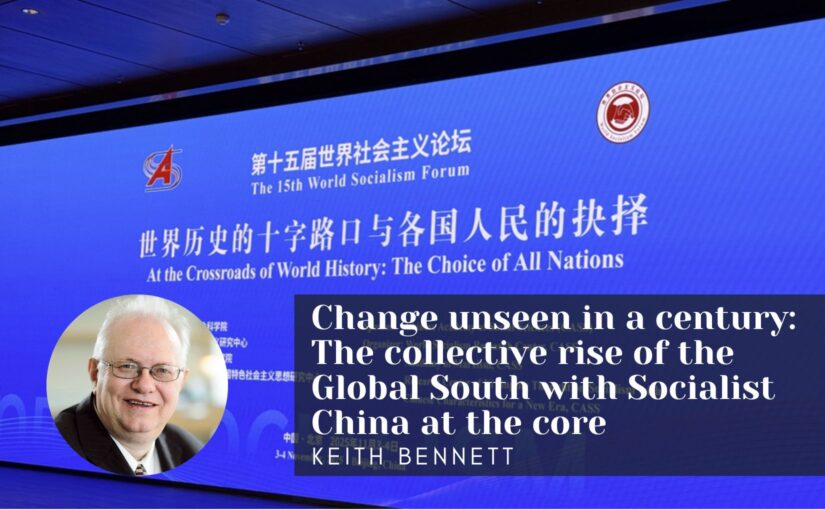
The 15th World Socialism Forum was held in Beijing from November 3-4. Organised by the Chinese Academy of Social Sciences (CASS), the forum was hosted by the World Socialism Research Centre, the Academy of Marxism, and the Institute of Xi Jinping Thought on Socialism with Chinese Characteristics for a New Era, all of which operate as units of CASS.
With an overall theme of ‘At the Crossroads of World History: The Choice of all Nations’, the forum addressed a number of topics, namely:
- Chinese Modernisation and a New Form of Human Advancement
- The Rise of Global South Countries and Transformation of the Global Governance System
- Rejecting Unilateral Power Politics and Upholding International Equity and Justice
- New Features and Trends of World Socialism amid Profound Global Changes
- Safeguarding the Outcomes of the World Anti-fascist War and the Postwar International Order
Several hundred Chinese delegates were joined by comrades from Vietnam, Laos and Cuba and by senior representatives from communist parties from around the world, including:
- Communist Party of Peru (Red Fatherland)
- Peruvian Communist Party
- Communist Party of Argentina
- Colombian Communist Party
- Communist Party of Uruguay
- Communist Party of Spain (Party of the European Left)
- Communist Refoundation Party of Italy (Party of the European Left)
- Italian Communist Party
- Communist Party (Italy)
- Communist Party of Italy
- Hungarian Workers’ Party
- Communist Party (Denmark)
- Communist Party of Bohemia and Moravia [Czech Republic]
- Communist Party (Switzerland)
- Communist Party of Finland
- German Communist Party
- Progressive Party of the Working People of Cyprus (AKEL)
- Communist Party of Ireland
- Portuguese Communist Party
- Communist Party of Armenia
- Communist Party of the Russian Federation
- Belarusian Communist Party
- Socialist Platform (Georgia)
- New Socialist Movement of Georgia
- South African Communist Party
- Japanese Communist Party
- Communist Party of Nepal (Unified Marxist-Leninist)
- Communist Party of Nepal (Unified Socialist) [On November 5, this party was one of 10 that united to form the Nepali Communist Party]
- Communist Party of Bangladesh
- Communist Party of Lebanon
- Iraqi Communist Party
Other participants included academics and scholars of Marxism from Venezuela, Colombia, Tanzania, Russia, Hungary, Ireland, Britain and other countries, think tanks and Marxist study institutions, including from Latin America, Russia, India, Germany, Italy and Cyprus, and young scholars of Marxism currently studying in China, including from the United States, Denmark and India.
Friends of Socialist China was represented by our co-editor Keith Bennett. Below we publish his speech to the forum on the subject of ‘Changes Unseen in a Century – The Collective Rise of the Global South with Socialist China at the Core.’
Following the World Socialism Forum, Keith also attended the ‘International Academic Conference on Xi Jinping Thought on Socialism with Chinese Characteristics for a New Era and 21st Century Marxism’, with sessions in Xi’an and Yan’an, and then the ‘International Forum on Overseas Studies on Xi Jinping Thought on Socialism with Chinese Characteristics for a New Era’, held in Beijing.
General Secretary Xi Jinping often reminds us that we are living in a moment of history where we are witnessing changes unseen in a century.
This statement has applicability and relevance across a range of events and numerous spheres of human endeavour. But perhaps it does not express itself quite so cogently, or with such profound import, as it does with regard to the tectonic changes in the world’s geopolitical configuration and the consequent evolution and reform of global governance.
Over a century ago, as Lenin observed, the division of the world among the great powers had been completed. This meant that the world was divided into a small number of oppressor nations on the one hand and a great mass of oppressed nations on the other. Semi-colonial, semi-feudal China, despite being the world’s longest continuous civilisation, was to be found in the latter group.
Since that time, although the relative balance of forces among the imperialist powers has shifted, for example with the rise of the fascist axis powers in the 1930s, but most fundamentally with the passing of the baton of would-be global hegemon from British to US imperialism, resulting in the post-World War II reconfiguration of the world imperialist system whereby, although inter-imperialist contradictions have by no means disappeared (in their absence we would not be speaking about imperialist powers), this process has until now been fought out within a pyramidic structure in which US imperialism sits atop.
But despite such shifts and the adjustment in the balance of forces, no new major imperialist power has emerged in the last century. Moreover, the possibility of this happening has been, and is being, progressively constricted. This is because the main historical current over the last century has not been the contention between imperialist powers but rather the struggle against them by the oppressed nations and peoples.
This struggle has been inseparable from the emergence and development of the socialist system, which has provided the strongest, most resolute, most scientific and most far-sighted bulwark and support to the struggle against imperialism and indeed all forms of oppression.
Following the October Revolution of 1917, there was for the first time in history not only a workers state, in which exploitation and oppression had been outlawed, but inseparably connected to this, a great power power that, far from being imperialist, was a committed and determined supporter and friend of the oppressed nations and peoples throughout the world.
As a result, national liberation movements made greater and more diversified progress on a worldwide scale, throughout Asia, Africa, Latin America, the Caribbean and the Pacific, and even in a number of countries in Europe, such as in Ireland. Many of these movements were led by communist or at least socialist-oriented forces.
However, the relationship was not a linear or subordinate one. Indeed, the October Revolution had been preceded, and to an extent even moulded, not least in terms of the development of Lenin’s own thinking, by significant national revolutionary movements throughout the oppressed nations – in Mexico, Ireland, Türkiye, Iran and China, to cite some prominent examples.
In his 1919 ‘Address to the Second All-Russia Congress of Communist Organisations of the Peoples of the East’, Lenin therefore drew the following conclusion:
“The socialist revolution will not be solely, or chiefly, a struggle of the revolutionary proletarians in each country against their bourgeoisie – no, it will be a struggle of all the imperialist-oppressed colonies and countries, of all dependent countries, against international imperialism.”
Moreover, in his last published article, ‘Better Fewer, But Better’, he insisted that:
“In the last analysis, the outcome of the struggle will be determined by the fact that Russia, India, China, etc., account for the overwhelming majority of the population of the globe. And during the past few years it is this majority that has been drawn into the struggle for emancipation with extraordinary rapidity, so that in this respect there cannot be the slightest doubt what the final outcome of the world struggle will be. In this sense, the complete victory of socialism is fully and absolutely assured.”
The ensuing century since Lenin wrote these words has seen a whole number of momentous events and trends that include the Chinese people’s victory in the war of resistance against Japanese aggression, the world peoples’ victory in the global anti-fascist war, the founding of the United Nations, the triumph of the Chinese revolution and the founding of the People’s Republic, and the independence of India and the other countries of South Asia.
The victories over US imperialism by the peoples of Korea, Vietnam, Laos and Cambodia and their exploration of the socialist road, the formulation and broad acceptance of the Five Principles of Peaceful Coexistence, the Asia-Africa Bandung Conference with its Bandung Principles and enduring Bandung Spirit, the formation of the Non-Aligned Movement (NAM), and the triumph of the Cuban revolution.
The almost complete, if not total, collapse of the old-line colonial empires and the call by the countries of the Third World for a New International Economic Order.
The consolidation and development of regional and continental bodies throughout the Global South and especially the steady growth and enhanced role of the Shanghai Cooperation Organisation (SCO) and BRICS Plus.
Why then is it correct to speak in this instance of changes unseen in a century? It’s because nothing emerges from a vacuum or a void. Rather, quantitative increase leads to qualitative change. And that is precisely what we are now seeing.
As far back as 1957, Mao Zedong said that the east wind prevailed over the west wind. It may have been an over optimistic assessment at that time, but in terms of historical foresight and vision it confirms him as second to none. That the GDP of the BRICS nations has now surpassed that of the G7 is just one indicator, albeit a significant one, of the veracity and acuity of Xi Jinping’s assessment that today we are indeed witnessing the sun setting in the west and rising in the east and south.
To have been present in China at the end of August and the beginning of September this year was to have the enormous privilege of witnessing this historical turning point in real time.
It was not simply to marvel at the development of China’s military deterrent power as impressive as it was. It was also to see the just announced Global Governance Initiative in action.
With the addition of the Lao People’s Democratic Republic, the SCO family now has 27 members. The largest gathering to date in its quarter century history saw the participation of some 20 heads of state or government, including such significant figures as Vladimir Putin, Narendra Modi and Recep Tayyip Erdoğan. The SCO already represents half the world and is growing.
Two days later, 26 heads of state and government, along with senior leaders from many other countries, joined President Xi on the same Tienanmen rostrum from which Mao Zedong had proclaimed on October 1st, 1949, that the Chinese people had stood up, to commemorate the 80th anniversary of the victory of the Chinese People’s War of Resistance Against Japanese Aggression and the World Anti-Fascist War.
For the first time, the heads of state of the five currently existing socialist countries – China, the DPRK, Vietnam, Laos and Cuba – stood together, in a powerful expression of the fact that a world free of imperialism can only but have socialism at its core.
Nine of the 15 former republics of the Soviet Union were represented at top level, including all five Central Asian republics, along with Mongolia.
Six of the then 10 members of the Association of Southeast Asian Nations (ASEAN)[1] were represented by their head of state or government.
The presence of the leaders of Serbia and Zimbabwe recalled blood-sealed common struggles against fascism, occupation, colonialism and racism.
That the Western powers themselves chose not to be present might in a sense be considered regrettable but nevertheless allows us to glimpse a future without imperialism, colonialism or hegemonism.
A key form this takes is a developing, interconnected and overlapping set of multilateral bodies of which the most significant are the SCO and BRICS Plus. And whilst all participants are equal, it is clear that it is only China that can cohere and lead this development, whether in theoretical terms or on a practical level. This is not simply due to China’s size and strength although these are important. But fundamentally it is because of China’s socialist system, which provides both the secret of its phenomenal economic development, the greatest in human history, as well as its theoretical underpinnings and understanding from which it can evolve practical solutions to the existential issues facing humanity, and, in the words of Dr. Sun Yat-sen, unite in common struggle with all those who treat us as equals. In this latter regard, bodies such as the Forum on China-Africa Cooperation (FOCAC) and the China-CELAC (Community of Latin American and Caribbean States) Forum also play a very important part.
As Deng Xiaoping declared at the United Nations in 1974: “China is a socialist country, and a developing country as well. China belongs to the Third World. Consistently following Chairman Mao’s teachings, the Chinese Government and people firmly support all oppressed peoples and oppressed nations in their struggle to win or defend national independence, develop the national economy and oppose colonialism, imperialism and hegemonism. This is our bounden internationalist duty.”
The struggle to realise this emerging new world clearly does not proceed in a straight line. The steadily emerging international united front may be, and indeed often is, tenuous, fragmentary and contradictory. The continued power of imperialism and neo-colonialism, which Kwame Nkrumah described as its last stage, should never be underestimated. Nevertheless, the long oppressed global majority is starting to take its destiny in its own hands, to build new societies and crucially to restructure international relations in keeping with these new and emerging realities.
Every country has its part to play in this but politically, economically and, as seen in the September 3rd parade, increasingly militarily, it is Socialist China that is today the indispensable nation in driving the changes unseen in a century.
[1] The Democratic Republic of Timor-Leste became the 11th member of ASEAN on October 26, 2025






One thought on “Change unseen in a century: The collective rise of the Global South with Socialist China at the core”