Following his visits to Russia and Zambia, Chinese Premier Li Qiang arrived in South Africa on November 20 to attend the 20th summit of the G20.
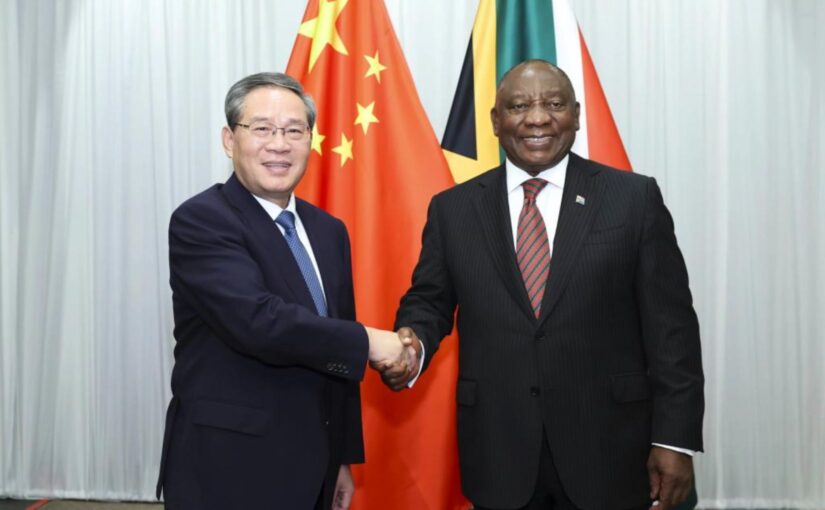
Li Qiang met with South African President Cyril Ramaphosa in Johannesburg on November 21.
Li said that China stands ready to work with South Africa to deepen political mutual trust and firmly support each other on issues concerning their respective core interests and major concerns. He conveyed to Ramaphosa the cordial greetings from Chinese President Xi Jinping, noting that for decades China and South Africa have treated each other as close brothers, with a friendship that spans mountains and seas and has grown ever stronger. China is ready to continue working with South Africa to carry forward their traditional friendship, expand cooperation across various fields, so as to better promote the common development of the two countries, as well as unity and cooperation between China and Africa as a whole.
He called on the two countries to leverage their complementary advantages in resource and economic structure, deepen cooperation in mining and infrastructure construction, develop new highlights in the auto industry, explore potential in emerging sectors such as new energy and artificial intelligence, and expand cooperation in science and technology innovation, including in satellite navigation and joint laboratory construction.
He also urged China and South Africa to strengthen exchanges of experience in poverty reduction and rural revitalisation, and advance cooperation in public health, culture, education and youth, among others, so as to enhance the sense of fulfilment of their peoples.
Ramaphosa expressed appreciation for China’s support for South Africa’s economic and social development, and said South Africa stands ready to deepen cooperation with China in areas including trade, investment, mining, industry, science and technology, energy and infrastructure, public health and poverty alleviation, so as to bring more benefits to the two peoples.
He noted that South Africa sincerely appreciates China’s strong support for hosting the G20 Summit, saying that China plays an important role in helping the summit build consensus and deliver outcomes. South Africa stands ready to strengthen communication and coordination with China within the United Nations, the G20 and other multilateral frameworks to jointly uphold multilateralism.
Meeting South African Deputy President Paul Mashatile on November 23, Li Qiang said that China and South Africa are good friends and good brothers enjoying a deep friendship. China is ready to accelerate coordination with South Africa and help more quality and competitive South African products enter the Chinese market by negotiating and signing an agreement on economic partnership for shared development and advancing in South Africa the early implementation of China’s zero-tariff treatment for 100 percent tariff lines for African countries having diplomatic relations with China.
Paul Mashatile said that South Africa is willing to work with China to maintain close multilateral communication and coordination, uphold multilateralism, safeguard the authority of the United Nations, and promote the common development and prosperity of Global South countries.
On November 22, Li Qiang attended the first session of the 20th G20 Summit in Johannesburg and delivered a speech on the topic of “Inclusive and Sustainable Economic Growth”.
He said that the world economy is once again confronted with major challenges, marked by the rise of unilateralism and protectionism, as well as escalating trade restrictions and confrontations. The G20 should face those problems squarely, explore solutions, and help bring all parties back to the track of solidarity and cooperation. Together with South Africa, China has also proposed a cooperative initiative to support Africa’s modernisation and will establish the Institute of Global Development to promote common development among all nations.
On November 22 and 23, Li attended the second and third sessions of the summit and delivered speeches respectively on the topics of “A Resilient World” and “A Fair and a Just Future for All”.
Li Qiang said that as multiple challenges such as climate change, energy and food crises are overlapping, the international community needs to unite to pool strength and solve problems through collaboration.
He proposed that the international community should:
- Strengthen ecology and environmental protection cooperation and enhance development resilience. The G20 should abide by the science-based spirit and uphold the principle of common but differentiated responsibilities in dealing with issues concerning climate change and ecology, demonstrating responsibility and acting promptly. China is ready to step up cooperation with all parties within the Kunming-Montreal Global Biodiversity Framework and accelerate the implementation of the outcomes of the 30th Conference of the Parties to the United Nations Framework Convention on Climate Change.
- Strengthen cooperation on green energy and advance a just transition. The G20 should promote global cooperation in the green industry, keep industrial and supply chains stable and unimpeded, and facilitate the free flow and application of related technologies and products.
- Enhance cooperation on food security to ensure stable supplies. The G20 should promote and optimise global food circulation and supply, build partnerships on commodities, develop an open, stable and sustainable global food market, and strengthen supply for countries facing food shortages. At the same time, the G20 should enhance cooperation in agricultural science and technology, so as to boost food production capacity. China is ready to work with all parties to advance the implementation of the International Cooperation Initiative on Global Food Security and make new contributions to the fight against hunger and poverty.
Li Qiang noted that the new round of scientific and technological revolution and industrial transformation is accelerating, bringing unprecedented development opportunities to the world, but it may also create new inequalities and development gaps. He therefore proposed that countries should:
- Promote the widespread application and effective governance of artificial intelligence (AI). The G20 should actively promote research and development cooperation and result sharing, bridge the AI divide and improve governance rules. China welcomes more countries to join the World AI Cooperation Organisation and the Action Plan of International Cooperation in Open Science, and to promote the sound and orderly development of AI in a beneficial, safe and fair way.
- Promote mutually beneficial cooperation and peaceful utilisation of critical minerals. China supports the UN Secretary-General’s Panel on Critical Energy Transition Minerals in playing an active role and calls for the implementation of the G20 Critical Minerals Framework. China urges efforts to promote a more balanced distribution of benefits in industrial and supply chains, so as to better safeguard the interests of developing countries. Meanwhile, it is necessary to adopt a prudent approach to potential military and other applications to prevent security risks. China welcomes the active participation of all parties in the International Economic and Trade Cooperation Initiative on Green Mining and Minerals.
- Strengthen development empowerment and livelihood support for the Global South. The G20 should intensify capacity-building assistance in Africa and other developing countries, create more job opportunities, and advance the development of women and youth. China is ready to work with all parties to implement the Nelson Mandela Bay Target and ensure that more young people benefit from economic globalisation.
Li Qiang returned to Beijing on November 20.
The Johannesburg summit, the first of the G20 to be held on the African continent, was boycotted by the United States on the utterly baseless charge and racist slur promoted by President Trump that Afrikaner farmers in the country are victims of a “white genocide”. As a result, there was no appropriate person present for South Africa to hand over the presidency of the group to the US as the next host country as is the normal protocol at G20 summits. In another unprecedented move, Trump has further said that South Africa will not be invited to attend the 2026 summit.
On December 4, it was announced that whilst South Africa would not be invited, an invitation would be extended to Poland, which is not presently a G20 member, but whose right-wing government is a generally loyal lickspittle of the US. The financial news service Bloomberg reported:
“Trump has signalled plans to tightly control the event, including by hosting it at his private Trump National Doral Golf Club in Miami. The president has long planned to cut the number of additional participants, including limiting interest groups that have historically attended as observers. Shunning a full member of the group would take that to another level entirely.
“‘When South Africa decides it has made the tough decisions needed to fix its broken system and is ready to rejoin the family of prosperous and free nations, the United States will have a seat for it at our table,’ [US Secretary of State Marco] Rubio said. ‘Until then, America will be forging ahead with a new G20.’”
It evidently escapes the attention of the increasingly lawless US rogue state that membership or otherwise of the G20 is not something within its exclusive gift.
The following articles were first published on the websites of China’s State Council Information Office and its Ministry of Foreign Affairs.
Premier Li: China ready to deepen political mutual trust with S. Africa
November 22 (SCIO) – Chinese Premier Li Qiang said in Johannesburg on Friday that China stands ready to work with South Africa to deepen political mutual trust, and firmly support each other on issues concerning their respective core interests and major concerns.
Li made the remarks when meeting with South African President Cyril Ramaphosa ahead of the 20th Group of 20 (G20) Summit scheduled here for Saturday and Sunday.
Li conveyed to Ramaphosa the cordial greetings from Chinese President Xi Jinping, noting that for decades China and South Africa have treated each other as close brothers, with a friendship that spans mountains and seas and has grown ever stronger.
Under the strategic guidance of the two heads of state, he said, China and South Africa are working together to advance an all-round strategic cooperative partnership in the new era, aiming to benefit the peoples of both countries.
China, Li said, is ready to continue working with South Africa to carry forward their traditional friendship, expand cooperation across various fields, so as to better promote the common development of the two countries, as well as unity and cooperation between China and Africa as a whole.
The Chinese premier noted that the fourth plenary session of the 20th Communist Party of China (CPC) Central Committee reviewed and adopted in October the Recommendations of the Central Committee of the CPC for Formulating the 15th Five-Year Plan for Economic and Social Development, and that South Africa has announced a 10-point economic action plan.
China is ready to strengthen alignment with South Africa in development strategies, promote the early implementation of zero-tariff treatment in the country, Li said.
Li called on the two countries to leverage their complementary advantages in resource and economic structure, deepen cooperation in mining and infrastructure construction, develop new highlights in the auto industry, explore potential in emerging sectors such as new energy and artificial intelligence, and expand cooperation in science and technology innovation including in satellite navigation and joint laboratory construction.
He also urged China and South Africa to strengthen exchanges of experience in poverty reduction and rural revitalization, and advance cooperation in public health, culture, education and youth, among others, so as to enhance the sense of fulfillment of their peoples.
China and South Africa have jointly initiated a cooperative initiative to support Africa’s modernization, to encourage the international community to increase attention and investment in Africa, according to Li.
Li also said China is ready to work with South Africa to strengthen coordination on platforms such as BRICS and the G20, implement the four global initiatives proposed by Xi, uphold the multilateral trading system, promote reform of the global governance system, and safeguard the common interests of developing countries.
For his part, Ramaphosa asked Li to convey his cordial greetings and best wishes to Xi. He said the important consensus he reached with Xi on establishing an all-round strategic cooperative partnership in the new era has elevated the bilateral relations to a historic new height and injected strong momentum into bilateral cooperation across various fields.
Ramaphosa reiterated that South Africa firmly adheres to the one-China policy, reaffirming that Taiwan is an inalienable part of China’s territory. South Africa will continue to work with China to support each other on issues concerning the core interests, he added.
He expressed appreciation for China’s support for South Africa’s economic and social development, and said South Africa stands ready to deepen cooperation with China in areas including trade, investment, mining, industry, science and technology, energy and infrastructure, public health and poverty alleviation, so as to bring more benefits to the two peoples.
South Africa is willing to provide a safe and sound environment for Chinese enterprises investing and operating in the country, and stands ready to work with other African countries to make full use of China’s favorable policies to deepen Africa-China cooperation, said Ramaphosa.
Ramaphosa said that South Africa highly commends the four major global initiatives proposed by Xi.
He noted that South Africa sincerely appreciates China’s strong support for hosting the G20 Summit, saying that China plays an important role in helping the summit build consensus and deliver outcomes.
South Africa stands ready to strengthen communication and coordination with China within the United Nations, the G20 and other multilateral frameworks to jointly uphold multilateralism, he added.
Li Qiang Meets with South African Deputy President Paul Mashatile
November 24 (MFA) – On November 23, 2025 local time, Premier of the State Council Li Qiang met with South African Deputy President Paul Mashatile in Johannesburg.
Li Qiang said that China and South Africa are good friends and good brothers enjoying a deep friendship. In September last year, President Xi Jinping met with President Cyril Ramaphosa in Beijing and reached important common understandings on deepening the development of bilateral relations. China is ready to work with South Africa to follow the strategic guidance of the two heads of state, further enhance political mutual trust, firmly support each other, deepen mutually beneficial cooperation, and deliver more outcomes of the China-South Africa all-round strategic cooperative partnership in the new era.
Li Qiang noted that China is ready to accelerate coordination with South Africa, and help more quality and competitive South African products enter the Chinese market by negotiating and signing an agreement on economic partnership for shared development and advancing in South Africa the early implementation of China’s zero-tariff treatment for 100 percent tariff lines for African countries having diplomatic relations with China. China supports more competitive Chinese companies in investing in South Africa and enhancing cooperation in such areas as new energy, automobiles, healthcare, digital economy and infrastructure, to broaden and upgrade bilateral cooperation and better serve the modernization of both countries. Li Qiang expressed the hope that South Africa will better protect the legitimate rights and interests of Chinese enterprises and the safety of their personnel. China-South Africa cooperation has long played a leading and demonstrative role in China-Africa cooperation. China is ready to strengthen communication with South Africa within frameworks including the Forum on China-Africa Cooperation (FOCAC), promote the implementation of the outcomes of the FOCAC Beijing Summit, and jointly create a bright future of development and prosperity for China and Africa. The two sides should step up multilateral coordination and cooperation and work with the wider Global South countries to promote a more just and equitable international order.
Paul Mashatile expressed sincere gratitude for China’s strong support in South Africa’s successful hosting of the G20 Summit. South Africa firmly upholds the one-China policy and is willing to take the implementation of China’s zero-tariff treatment in African countries as an opportunity to deepen bilateral cooperation in economy and trade, industry, agriculture, digital economy, green development and other fields, and enhance people-to-people and cultural exchanges, so as to advance the sustained and in-depth development of the all-round strategic cooperative partnership in the new era between the two countries. South Africa welcomes Chinese enterprises to invest and do business in the country, and will spare no effort to ensure the safety of Chinese nationals and companies. South Africa highly commends the four major global initiatives proposed by President Xi Jinping, and is willing to work with China to maintain close multilateral communication and coordination, uphold multilateralism, safeguard the authority of the United Nations, and promote the common development and prosperity of Global South countries.
Li Qiang Attends the First Session of the 20th G20 Summit and Delivers a Speech
November 22 (MFA) – On November 22, 2025 local time, Premier of the State Council Li Qiang attended the first session of the 20th G20 Summit in Johannesburg and delivered a speech on the topic of “Inclusive and Sustainable Economic Growth”. The leaders of the G20 member states, guest countries, and heads of relevant international organizations attended the session, which was chaired by South African President Cyril Ramaphosa.
Li Qiang said that President Xi Jinping pointed out at the 17th G20 Summit that solidarity is strength, but division leads nowhere. Looking back at the journey of the G20, its members from different regions and with different systems and cultures have managed to overcome one challenge after another and promote global progress and development, thanks to the spirit of solidarity. Today, the world economy is once again confronted with major challenges, marked by the rise of unilateralism and protectionism, as well as escalating trade restrictions and confrontations. Divergent interests among parties and weaknesses in global cooperation mechanisms have become prominent factors hindering international solidarity. The G20 should face those problems squarely, explore solutions, and help bring all parties back to the track of solidarity and cooperation.
Li Qiang noted that in the face of a sluggish global economic recovery, all parties should uphold solidarity, firmly safeguard free trade, and build an open world economy. In the face of differences and conflicts, all parties should adhere to the principle of seeking common ground while reserving differences, actively pursue the most extensive common interests, and properly resolve disputes and frictions through equal consultations, while addressing each other’s reasonable concerns. In the face of governance challenges, all parties should keep pace with the times, take the lead in upholding multilateralism, and accelerate reforms of institutions such as the World Bank, the International Monetary Fund, and the World Trade Organization (WTO), so as to enhance the voice of developing countries and build a fairer and more open international economic and trade order. China has released its “Action Plan for Implementing the G20 Initiative on Supporting Industrialization in Africa and Least Developed Countries”, supporting efforts to reduce the debt difficulties of developing countries. Together with South Africa, China has also proposed a cooperative initiative to support Africa’s modernization, and will establish the Institute of Global Development to promote common development among all nations.
Leaders attending the summit said that over the past two decades, the G20 has become an important platform for the international community to meet challenges, share opportunities and seek common development. Today’s world is facing multiple challenges, and instability and uncertainty have kept rising. As representatives of the world’s major economies and emerging markets, G20 members should earnestly shoulder their responsibilities, strengthen solidarity and cooperation, safeguard multilateralism, and join forces to meet challenges. G20 members should also safeguard the multilateral trading system with the WTO at its core, advance the reform of the global economic governance system, and bridge the development gap among countries, so as to promote a strong, balanced, inclusive and sustainable growth.
Li Qiang Attends the Second and Third Sessions of the 20th G20 Summit
November 23 (MFA) – On November 22 and 23, 2025 local time, Premier of the State Council Li Qiang attended the second and third sessions of the 20th G20 Summit in Johannesburg and delivered speeches respectively on the topics of “A Resilient World” and “A Fair and a Just Future for All”.
Li Qiang said that as multiple challenges such as climate change, energy and food crises are overlapping, the international community needs to unite to pool strength and solve problems through collaboration. The G20 should strive for broader international cooperation, jointly cope with challenges and work together to promote development. First, strengthen ecology and environmental protection cooperation, and enhance development resilience. The G20 should abide by the science-based spirit and uphold the principle of common but differentiated responsibilities in dealing with issues concerning climate change and ecology, demonstrating responsibility and acting promptly. China is ready to step up cooperation with all parties within the Kunming-Montreal Global Biodiversity Framework and accelerate the implementation of the outcomes of the 30th Conference of the Parties to the United Nations Framework Convention on Climate Change. Second, strengthen cooperation on green energy and advance a just transition. The G20 should promote global cooperation in the green industry, keep industrial and supply chains stable and unimpeded, and facilitate the free flow and application of related technologies and products. China is ready to continue to do its utmost to support the energy transition of various countries. Third, enhance cooperation on food security to ensure stable supplies. The G20 should promote and optimize global food circulation and supply, build partnerships on commodities, develop an open, stable and sustainable global food market, and strengthen supply for countries facing food shortages. At the same time, the G20 should enhance cooperation in agricultural science and technology, so as to boost food production capacity. China is ready to work with all parties to advance the implementation of the International Cooperation Initiative on Global Food Security and make new contributions to the fight against hunger and poverty.
Li Qiang noted that the new round of scientific and technological revolution and industrial transformation is accelerating, bringing unprecedented development opportunities to the world, but it may also create new inequalities and development gaps. The G20 should encourage all parties to adhere to openness, win-win cooperation and shared opportunities, and strive to enhance the well-being of people worldwide. First, promote the widespread application and effective governance of artificial intelligence (AI). The G20 should actively promote research and development cooperation and result sharing, bridge the AI divide and improve governance rules. China welcomes more countries to join the World AI Cooperation Organization and the Action Plan of International Cooperation in Open Science, and to promote the sound and orderly development of AI in a beneficial, safe and fair way. Second, promote mutually beneficial cooperation and peaceful utilization of critical minerals. China supports the UN Secretary-General’s Panel on Critical Energy Transition Minerals in playing an active role and calls for the implementation of the G20 Critical Minerals Framework. China urges efforts to promote a more balanced distribution of benefits in industrial and supply chains, so as to better safeguard the interests of developing countries. Meanwhile, it is necessary to adopt a prudent approach to potential military and other applications to prevent security risks. China welcomes the active participation of all parties in the International Economic and Trade Cooperation Initiative on Green Mining and Minerals. Third, strengthen development empowerment and livelihood support for the Global South. The G20 should intensify capacity-building assistance in Africa and other developing countries, create more job opportunities, and advance the development of women and youth. China is ready to work with all parties to implement the Nelson Mandela Bay Target and ensure that more young people benefit from economic globalization.
The Summit adopted the G20 South Africa Summit: Leaders’ Declaration.
During the summit, Li Qiang had friendly exchanges with French President Emmanuel Macron, President of the Republic of Korea Lee Jae Myung, Angolan President João Manuel Gonçalves Lourenço, Spanish Prime Minister Pedro Sánchez, and Director-General of the World Trade Organization Ngozi Okonjo-Iweala, among others.