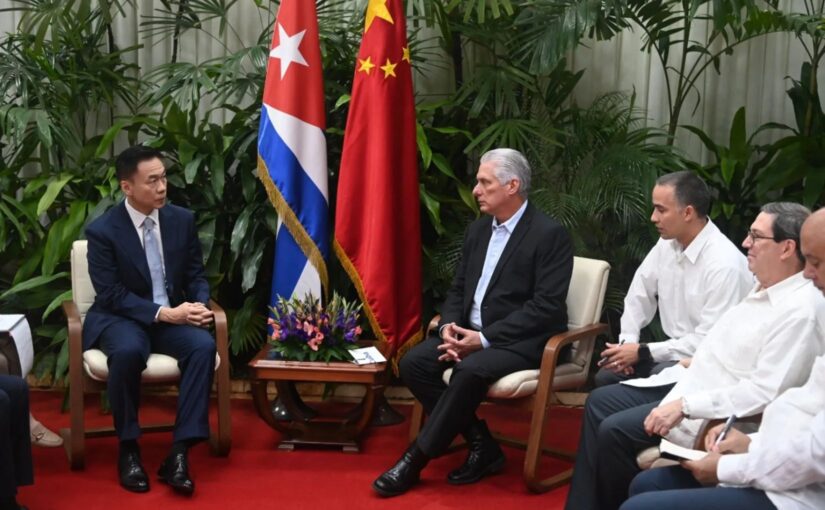
Following on from reports earlier this week about a new Chinese emergency aid program delivering 30,000 tons of rice to Cuba, China’s ambassador in Havana, Hua Xin, has announced a further set of assistance measures agreed by the Chinese government.
We republish below a report from the Cuban Communist Party (translated by The Left Chapter), which notes that the newly-announced aid package includes US$80 million in financial assistance and a donation of 60,000 tons of rice. The financial assistance is aimed specifically at helping Cuba to resolve its energy crisis – caused by the US’s illegal blockade on the island, and exacerbated by the reduced flow of oil from Venezuela following the US’s flagrantly illegal attack on that country.
The report is followed by an article in Brasil de Fato providing further information and noting that, while most of Cuba’s electricity is still generated from fossil fuels, “Chinese investment in renewables seeks to reduce dependence on imported fuels and strengthen the stability of the country’s electricity supply”.
Xi Jinping approves new round of aid from the People’s Republic of China to Cuba
January 21 (The Left Chapter) – The President of the People’s Republic of China and General Secretary of the Communist Party of China (CPC), Xi Jinping, approved a new round of aid to Cuba that includes emergency financial assistance valued at 80 million dollars for the acquisition of electrical equipment and other urgent needs that the country has, as well as a donation of 60,000 tons of rice.
The Chinese ambassador to Cuba, Hua Xin, reported this to Miguel Díaz-Canel Bermúdez, the First Secretary of the Central Committee of the Communist Party of Cuba (PCC) and President of the Republic, during a meeting on Tuesday afternoon at the Palace of the Revolution.
The diplomat informed the Head of State that he received instructions from his government this morning to relay this information to the Cuban side.
Hua Xin mentioned the recent meetings between the authorities of the two countries, including discussions between Bruno Rodríguez Parrilla, a member of the Political Bureau and Minister of Foreign Affairs, and Qiu Xiaoqi, China’s special envoy for Latin American and Caribbean Affairs.
The Head of the diplomatic mission also discussed the meetings he held with the Deputy Prime Minister and Minister of Foreign Trade and Investment, Oscar Pérez-Oliva Fraga; the Minister of Energy and Mines, Vicente de la O Levy; and comrade Carlos Miguel Pereira, director general of Bilateral Affairs of the Foreign Ministry. During these meetings, they addressed Cuba’s economic situation and the current state of the national electrical energy system, which is affected by the blockade. He conveyed this information to his government.
Hua Xin spoke of the decision to alter the approach for implementing the 200 MW photovoltaic solar energy donation projects and the distribution of 5,000 solar panel kits for individual homes. It has been decided, in coordination with the Ministry of Foreign Trade and Foreign Investment, to set up an executing company.
Upon welcoming the head of the diplomatic mission, Díaz-Canel Bermúdez conveyed heartfelt greetings at this new meeting and highlighted the vigorous efforts the Chinese ambassador is currently undertaking in Cuba. This includes Monday’s ceremony for the initial portion of a rice donation previously approved by the People’s Republic of China.
The First Secretary of the Central Committee of the Communist Party of Cuba and the President of the Republic praised the status of bilateral relations and highlighted the advancement of Phase Four in the digital transformation program, which is being implemented with Chinese assistance. He also noted the achievements in the high-definition television project and other technological areas where progress has been made.
China approves US$80 million in emergency aid to Cuba and donates 60,000 tons of rice
January 22 (Brasil da Fato) – Amid growing hostility from Washington toward Cuba, President Xi Jinping of China has authorized the delivery of emergency aid to the Caribbean island, including US$80 million in financial assistance and a donation of 60,000 tons of rice.
The decision was conveyed to Cuban President Miguel Díaz-Canel by China’s ambassador in Havana, Hua Xin, during a meeting at the Palace of the Revolution.
According to the Cuban government, the financial assistance will be used to purchase electrical equipment and address other urgent needs, at a time when the country’s economic and energy crisis has intensified.
Of the total food donation, the first shipment – 4,800 tons of rice – has already arrived on the island, with the remaining deliveries expected in the coming months. Rice, a staple of the Cuban diet, has become increasingly scarce due to the crisis in imports.
In parallel, the financial aid aims to ease Cuba’s severe energy crisis. The country has experienced prolonged blackouts that in recent days have affected more than 60% of national territory. The energy shortfall, which has worsened recently, stems from fuel shortages for distributed generation, caused by the interruption of supplies from Venezuela.
The aid comes amid heightened geopolitical tensions, particularly the growing threats and sanctions imposed by the United States, which have restricted, among other factors, the flow of Venezuelan oil to Cuba, further aggravating the island’s energy crisis.
In this context, China has consolidated its role as a strategic ally of Cuba, especially in the energy sector. Since 2024, the two governments have formalized the construction of several photovoltaic parks on the island with Chinese support. These projects are part of Cuba’s energy transition strategy, which officially aims for renewable sources to account for about 25% of electricity generation by 2030 and, in the long term, to achieve a fully renewable energy matrix by 2050.
Currently, most of Cuba’s electricity is still generated from fossil fuels, while renewable sources make up a smaller, though growing, share of the energy mix. Chinese investment in renewables seeks to reduce dependence on imported fuels and strengthen the stability of the country’s electricity supply.






This is good news!
A very nice proposit of solidaritet with The Republick of Cuba. Please continue with that.
I’d rather go to cuba than yankiland; much nicer people.
Thank you People of China for your help to Cuba brothers in these difficult moments. History will not forget.