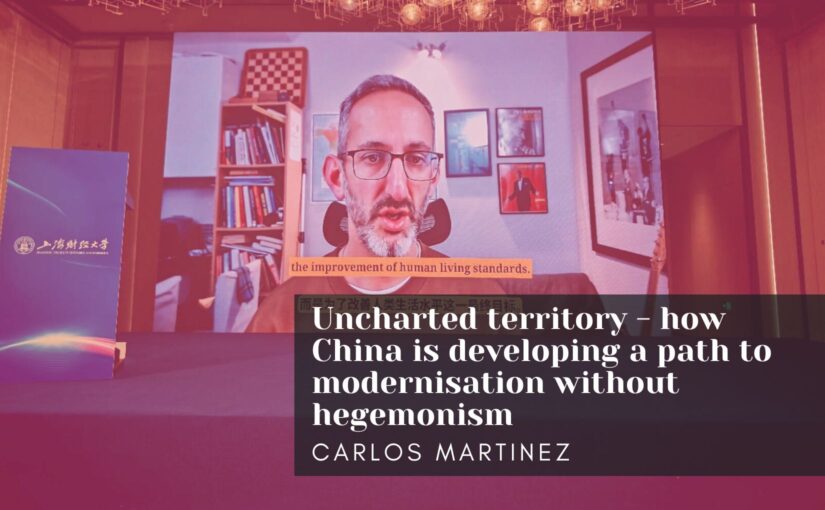
An international forum themed Multipolarity and Chinese Modernisation, hosted by Shanghai University of Finance and Economics (SUFE), was held on 13 December 2025 in Shanghai. This conference brought together numerous scholars, authors and researchers from around the world to explore pathways toward a prosperous and multipolar future for humanity.
Below is the text of the video contribution by Friends of Socialist China co-editor Carlos Martinez. Carlos argues that China is forging a historically unprecedented route to modernisation, fundamentally distinct from the Western experience. Modernisation, he stresses, is not an abstract ideal but a recognised human right, rooted in UN declarations affirming the right to development, technological progress and rising living standards. Its purpose is – or should be – to enable dignified, meaningful lives for all.
Carlos contrasts China’s approach with the dominant Western narrative, which credits liberal democracy and free markets for modernisation. Historical reality, he argues, tells a different story: Western modernisation was built on colonialism, slavery, genocide and, later, neocolonial domination enforced through military power and economic coercion. This legacy explains why only a handful of imperialist countries have modernised, while the Global South has largely been locked into underdevelopment.
China’s modernisation project, by contrast, begins with the 1949 revolution and proceeds through socialist construction, the Four Modernisations, and Reform and Opening Up. Today it is defined by ambitious but concrete goals: raising living standards to those of the mid-level developed countries, achieving scientific and technological leadership, expanding equitable public services, revitalising rural life, and pursuing ecological sustainability.
Crucially, China is modernising without war, colonisation or hegemonism. Drawing on statements by Xi Jinping, Deng Xiaoping and Hugo Chávez, Carlos argues that this is possible because China is socialist: capital does not rule the state, long-term planning replaces market anarchy, and foreign policy is not driven by the need for ever-expanding profits. As a result, China can develop peacefully while helping create space for other developing countries – through initiatives such as the Belt and Road Initiative – to pursue their own paths to modernisation.
China’s modernisation process has become a major focus of international attention in recent years, particularly as Chinese scholars and policymakers have begun to articulate a distinctive model of modernisation that contrasts starkly with the Western experience.
Modernisation is a recognised right of all countries, in the sense that the Universal Declaration of Human Rights, the International Covenant on Economic, Social and Cultural Rights, the UN Declaration on the Right to Development and other key documents affirm the right to development; the right to share in scientific and technological progress; and the right of all peoples to an adequate and continuously improving standard of living.
Within the United Nations framework, all countries have the right to leverage the latest, most advanced ideas and techniques for meeting humanity’s material and cultural needs.
Modernisation isn’t carried out for its own sake, but rather as a means to an end: the improvement of human living standards. With modernised industry, production techniques, communication methods, transport systems, energy systems and healthcare strategies, there exists the possibility of providing a healthy, meaningful and dignified life to all, such that each individual has reliable access to a nutritious diet, to decent housing, to clothing, to education, to healthcare, to a vibrant cultural, social and intellectual life, and to fulfilling work.
But so far, this right to modernisation has not been met outside a handful of imperialist countries. The fruits of modernisation have been divided extremely unequally: the process of industrialisation in North America, Europe and Japan has created previously unimaginable wealth for a few, but this has been accompanied by desperate poverty and alienation for many, both within those countries and in the Global South.
Chinese modernisation
China’s government has set a goal of “basically realising socialist modernisation by 2035”, and has defined some parameters for this:
- Reaching a per-capita GDP on a par with that of the mid-level developed countries such as Spain or the Czech Republic
- Joining the ranks of the world’s most innovative countries in the realms of science and technology
- Becoming a global leader in education, public health, culture and sport
- Substantially growing the middle-income group as a proportion of the population
- Guaranteeing equitable access to basic public services
- Ensuring modern standards of living in rural areas
- Steadily lowering greenhouse gas emissions and protecting biodiversity, so as to restore a healthy balance between humans and the natural environment
If achieved, these aims will constitute a significant – indeed world-historic – improvement in the living standards of the Chinese people, and will blaze a trail for other developing countries.
How did the West modernise?
In mainstream modernisation theory in the West, the dominant narrative is that the countries of Western Europe, North America and Japan achieved their advances via a combination of good governance, liberal democracy, free-market economics, scientific genius, geographical serendipity and a dash of entrepreneurial spirit.
Historical investigation reveals a considerably different story.
The most important precursors of the West’s modernisation are colonialism, slavery and genocide. The conquest of the Americas, the settlement of Australia, the transatlantic slave trade, the colonisation of India, the rape of Africa, the Opium Wars, the theft of Hong Kong, and more. The profits of colonialism and the slave trade were indispensable in propelling the West’s industrialisation.
As Karl Marx famously wrote in Volume 1 of Capital: “The discovery of gold and silver in America, the enslavement and entombment in mines of the aboriginal population, the beginning of the conquest and looting of the East Indies, the turning of Africa into a warren for the commercial hunting of black skins, signalled the rosy dawn of the era of capitalist production.”
Such is the ugly truth of European modernisation. And the story is not so different in the United States. Many of the so-called founding fathers of that country were slave-owners, and they established a slave-owners’ society. They went to war against the indigenous peoples and against Mexico in order to expand their territory.
In the 20th century, having established their dominion over the Americas, they constructed a neocolonial global system that is still in place to a significant degree, imposing American hegemony on the world.
This system includes a network of over 800 foreign military bases; NATO; the deployment of tens of thousands of troops and weapons around the world; an enormous nuclear arsenal; genocidal wars waged on Korea, Vietnam, Laos, Cambodia, Yugoslavia, Afghanistan, Iraq and Libya; systems of economic coercion and unilateral sanctions; proxy wars, coups, regime change projects, destabilisation; support for genocide in Gaza; and, as we speak, escalating aggression against Venezuela.
This is the global system of violence that has enabled and sustained North American modernisation.
What about Japan? Japan’s rise was facilitated first by its brutal expansionist project in East Asia, particularly Korea and China, and then through adaptation to and integration with the US-led imperialist system. Its leading role in the US’s ‘first island chain’ containment strategy against China gave the US a strong incentive to support Japan’s economic development.
South Korea, Singapore and Taiwan Province constitute the small handful of non-imperialist territories that have been able to achieve modernisation, but these are special cases. Their shared proximity to China and the Democratic People’s Republic of Korea is no coincidence; they have been inducted into the imperialist club by the US, in order to play a dual role as regional policemen and living advertisements for capitalism on the frontline of its confrontation with socialism. Both roles rely on at least a certain degree of prosperity for a section of the population.
So no matter how hard we look, we fail to find any country which has successfully modernised in the way that mainstream Western theory suggests. There is no shortage of countries of the Global South which have attempted to apply the “liberal democracy plus free market capitalism” formula, but none have been successful in modernising. Indeed the West’s prescriptions for (and interference in) developing countries have largely led to chaos and endemic poverty.
The contrast between the West’s success in modernising and the Global South’s failure has fed into a largely unspoken but widespread and pernicious racism: an assumption that white people – or in East Asia, Japanese people – are somehow inherently more advanced than everyone else.
How is China modernising?
As for China, its journey towards modernisation starts in 1949 with the founding of the People’s Republic, the early construction of socialist industry, land reform and the extirpation of feudalism and the landowning class, and the provision of at least basic levels of education and healthcare services to the whole population.
In 1963, Premier Zhou Enlai, supported by Liu Shaoqi, Deng Xiaoping and Chen Yun, first raised the question of the Four Modernisations: of agriculture, industry, national defence, and science and technology. Despite a complex political environment this goal was revived in the early 1970s, and, with the launch of reform and opening up in 1978, China accelerated its pursuit of those goals, and ushered in an era of rapid development of the productive forces and improvement in the people’s living standards.
China’s journey of modernisation has evolved again in recent years with the pursuit of the second centenary goal: of building a great modern socialist country that is prosperous, strong, democratic, culturally advanced, harmonious and beautiful by 2049.
China is on the fast track to becoming a developed country, and is doing so in a way that is fundamentally different to the Western experience. Most notably, China’s modernisation is built on the efforts of the Chinese people rather than on war, colonialism and slavery. As Xi Jinping puts it, “China will neither tread the old path of colonisation and plunder, nor the crooked path taken by some countries to seek hegemony once they grow strong”.
Venezuela’s late President Hugo Chávez made this point very concisely in 2009: “China is large but it’s not an empire. China doesn’t trample on anyone, it hasn’t invaded anyone, it doesn’t go around dropping bombs on anyone.”
How is China able to modernise without resorting to hegemonism? What is the formula that is enabling China to become the first major developing country to successfully modernise; the first country to modernise outside of a framework of colonialism, imperialism and war?
This is a question that cannot be answered without addressing China’s social, economic and political system.
At a meeting of the Chinese Academy of Sciences in 2016, Xi Jinping noted: “Our greatest strength lies in our socialist system, which enables us to pool resources in a major mission. This is the key to our success.”
Or as Deng Xiaoping commented back in 1984: “the superiority of the socialist system is demonstrated, in the final analysis, by faster and greater development of the productive forces than under the capitalist system.”
In a world still largely dominated by capitalism – and an intellectual world still dominated by bourgeois ideology – it’s easy to forget that system’s fundamental and irreconcilable contradictions, which Marx identified with such clarity 150 years ago; contradictions which lead inexorably to inefficiency, stagnation and crisis – and indeed to war.
In China, capitalists do not constitute the ruling class and are therefore not able to direct the country’s resources according to their own prerogatives. At the top level, resources are allocated by the state, in accordance with long-term planning carried out by, and in the interests of, the people.
This has two important implications.
First, it means that China can avoid the crises of productivity, profitability and overproduction that characterise capitalist economies. As a result, Chinese capital faces no material compulsion to address declining productivity by engaging in super-exploitation abroad.
Second, it means that capitalists are not in a position to determine China’s foreign policy. While a given company may seek to expand its operations overseas, it cannot do so in a way that contradicts the overall foreign policy of the state, and it certainly cannot expect the state to use its coercive powers to facilitate such expansion.
The New York Times journalist Thomas Friedman famously wrote about the US system that “the hidden hand of the market will never work without a hidden fist – McDonald’s cannot flourish without McDonnell Douglas”.
There is simply no equivalent to this in China.
So, China is able to build a path to modernisation without hegemonism precisely because it is a socialist country.
But in building that path, and by sharing the fruits of its modernisation process with the Global South – via, for example, the Belt and Road Initiative and the Global Development Initiative – China is creating space for other developing countries to modernise, to break out of underdevelopment, even where they lack China’s resources and systemic advantages.
As such, China’s evolving modernisation has great historic significance, and offers valuable lessons for the world. It is an embodiment of historical materialism in the current era: capitalism has long since exhausted its ability to fundamentally drive human progress, and therefore the future lies with socialism.