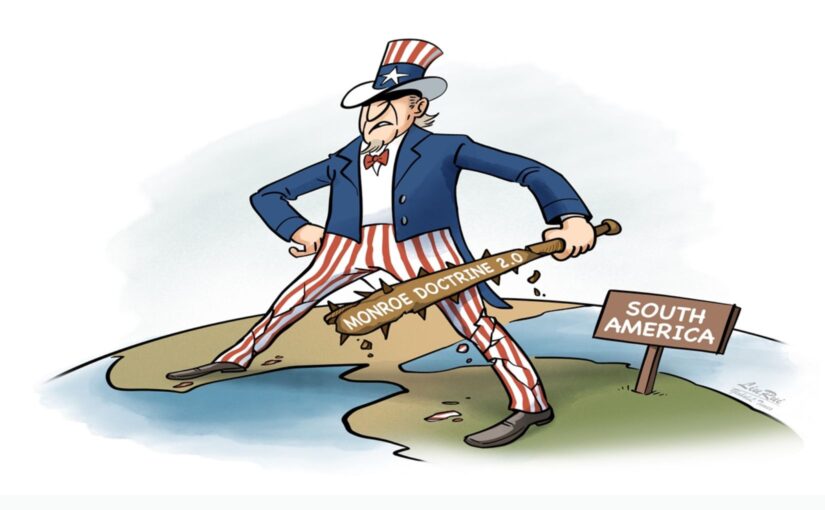
In the article below, Professor Jiang Shixue argues that “coercive diplomacy” best characterises the foreign policy of the United States. He defines coercive diplomacy as the use of diplomatic language backed by military or economic pressure to force other countries into submission. Jiang writes that the United States, as the world’s sole superpower, routinely applies such tactics not only against rivals but even against allies.
As an expert in Latin American politics, Professor Jiang cites as examples of coercive diplomacy the US’s criminal decades-long blockade on Cuba, the kidnapping of Venezuelan President Nicolás Maduro, and the recent developments in Panama, which, under pressure from the US, has cancelled a Hong Kong company’s canal port concession and withdrawn from the China-led Belt and Road Initiative.
Jiang contrasts this approach with China’s concept of building a “community of shared future for mankind”, grounded in principles of non-interference and mutual respect. The article concludes that global stability requires abandoning coercive diplomacy in favour of cooperation and multilateralism.
Jiang Shixue is Senior Research Fellow of the Chinese Academy of Social Sciences. He is also Distinguished Professor at Shanghai University, Macau University of Science and Technology, Hangzhou Normal University, and Sichuan International Studies University. Professor Jiang spoke on the subject of How to understand China’s relations with Latin America at our 2022 webinar 21st Century Socialism: China and Latin America on the Frontline alongside former Brazilian President Dilma Rousseff and a number of other prominent speakers.
If one phrase can be applied to summarize the characteristics of the US’s foreign policy, it should be “coercive diplomacy”.
What is coercive diplomacy? Different people have different definitions. But the basic meaning is simple: It is a type of diplomacy plus muscle. In other words, coercive diplomacy cloaks itself in diplomatic garb and relies on one’s military or economic power to force other countries to submit.
As the world’s sole superpower, the United States often engages in coercive diplomacy against any country at any time. The methods of coercion are varied and numerous. Even countries maintaining close relations with the U.S. sometimes become targets of its coercive diplomacy. For instance, on April 25, 2021, the Danish newspaper Politiken revealed that the U.S. Embassy in Denmark had contacted the paper, demanding it prove it did not use technical equipment such as routers or modems provided by Chinese companies including Huawei, ZTE, Hytera, Hikvision, and Dahua Technology. Otherwise, the embassy might cancel its subscription. This shows that even subscribing to a newspaper can become leverage for U.S. coercive diplomacy.
In his second term, President Trump increasingly integrates tariffs with coercive diplomacy. It wields tariffs not merely as tools for economic protection but also as primary instruments of coercive diplomacy even against his European allies.
Those which are seen as “enemies”, “adversaries” or “competitors” by the U.S. have long been victims of U.S. coercive diplomacy, with Cuba being one of the most prominent examples.
In February 1962, the United States began a comprehensive economic blockade, referred to by the U.S. as a trade embargo, against Cuba. These sanctions have continued to this day, becoming the longest-lasting sanctions imposed by a major power on a weak country in modern international relations history, despite the UN General Assembly having passed many resolutions demanding the U.S. lift these sanctions.
Recently, in a surprising ruling, Panama’s Supreme Court has declared the concession awarded to a Hong Kong-based company for the operation of key ports along the Panama Canal unconstitutional. This decision has sent shockwaves to China and other countries that have economic relations with Latin America. Earlier, Panama withdrew from its participation in China’s Belt-Road Initiative. There is no doubt that U.S. coercive diplomacy is behind these developments in Panama.
Needless to say, the kidnapping of President Maduro of Venezuela is not only an act of coercive diplomacy, but also a military aggression against a sovereign nation.
Recently, President Trump has once again revived his ambition to acquire Greenland with a sharper, more coercive tone. As many commentators have pointed out, although he has apparently backed off on using force, coercion without military invasion would still reflect an erosion of international law. Until now it is unclear whether his coercive diplomacy will succeed or not.
A commentary by Daniel Larison, editor of The American Conservative magazine, is quite insightful. He argues that the Trump administration’s coercive diplomacy is no diplomacy at all, but a series of insults, sanctions, tariffs, and threats that achieve nothing except to cause disruption and pain.[1] AP journalist Matthew Lee just simply calls it “the diplomacy of coercion”.[2]
In vivid contrast, China has put forward the notion of building a community of shared future for mankind. In order to realize this dream, the international community must do away with the coercive diplomacy.
Chinese culture advocates “do not do unto others what you would not have them do unto you” (this ‘Golden Rule’ can be found in Confucius as well as the Bible). China has never possessed a gene for hegemony or an impulse for expansion and has never coerced any country. In the face of external interference, China’s actions constitute legitimate and lawful countermeasures aimed at defending the nation’s rightful interests and upholding international fairness and justice. The People’s Republic of China has never gone to others’ doorsteps to stir up trouble, never reached its hands into others’ homes, and certainly never occupied an inch of foreign territory. The invention, patent, and intellectual property rights of coercive diplomacy indisputably belong to the United States, which flagrantly engages in unilateral sanctions, long-arm jurisdiction, and interference in internal affairs. The U.S. claim of “dealing with other countries from a position of strength” or “peace through strength” is, in essence, about bullying the weak with one’s military power.
It is evident that the planet we all share needs a community of shared future for mankind, not coercive diplomacy or “the diplomacy of coercion”.
[1] https://www.theamericanconservative.com/trumps-foreign-policy-all-coercion-no-diplomacy/
[2] https://apnews.com/article/1a65bf55405a40ca8dedf9f8968c332d