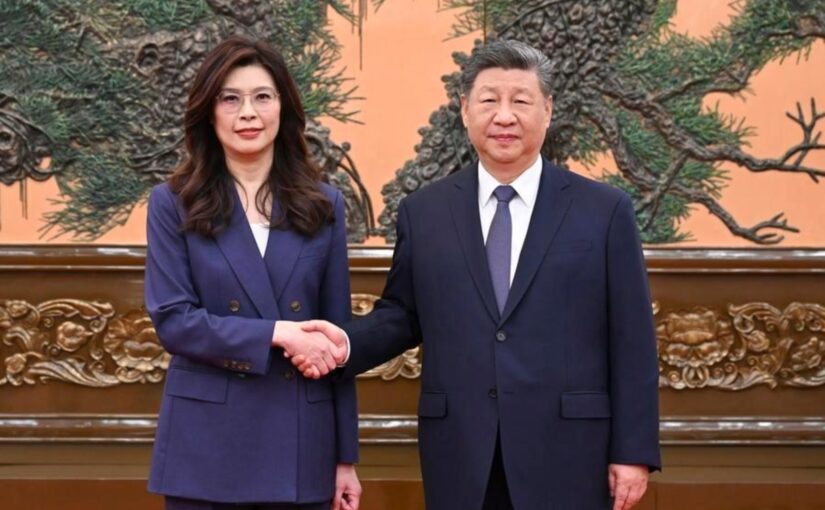
Cheng Li-wun, chairwoman of the Chinese Kuomintang (KMT) on China’s Taiwan province visited the mainland of China from April 7-12 at the invitation of the Central Committee of the Communist Party of China (CPC) and General Secretary Xi Jinping.
Arriving in Shanghai, and also visiting Nanjing and Beijing, this was the first mainland visit by a KMT leader in a decade.
Welcoming Cheng, Song Tao, head of the Taiwan Work Office of the CPC Central Committee, said that she would certainly feel the deep bond between people on the mainland and their Taiwan compatriots, and her trip would be widely supported by people on both sides of the Strait. He added that by placing the interests of the Chinese nation first and keeping in mind people’s well-being, the CPC and the KMT must work together to promote the peaceful development of cross-Strait relations and strive for national rejuvenation.
Cheng was elected KMT chairperson in October last year. Since taking office, she has repeatedly expressed her willingness to visit the mainland. After accepting the invitation, Cheng told a press conference in Taipei that the visit is in line with the mainstream public opinion in Taiwan.
“We have a choice,” she said. “For the sake of both sides of the Taiwan Strait, for regional stability, and for the well-being of the next generation, we must firmly choose the path of peace.”
At a welcome banquet hosted by Song Tao in Nanjing, Cheng said:
“First, in terms of the situation in the Asia-Pacific, we are creating a new model—one that shows the world that political differences do not inevitably lead to conflict. The two sides of the Taiwan Strait are not destined, as some in the international community worry, for war. Together, we will demonstrate that both sides have the capability, the determination, and the wisdom to resolve all issues peacefully, and to contribute to regional security and stability. We will not be troublemakers; rather, we will be builders of peace in the region. In today’s turbulent global environment, the significance of this journey for peace is all the more profound.
“Second, in terms of cross-Strait relations, this visit once again demonstrates that the ‘1992 Consensus’ and opposition to ‘Taiwan independence’ remain a durable political foundation—a stabilising anchor for current cross-Strait relations. Over the past three decades, Taiwan’s society has undergone several changes in governing parties. Yet historical experience clearly shows that as long as the ‘1992 Consensus’ is upheld and ‘Taiwan independence’ is opposed, dialogue and exchanges across the Strait can proceed; otherwise, tensions and instability will prevail. Therefore, this visit will help further tilt cross-Strait relations toward peace and stability.
“Third, regarding KMT-CPC relations, this marks the first visit in ten years led by the incumbent KMT chair to the mainland. Once again, the KMT is playing a key role in maintaining peace and stability in the Taiwan Strait. The cross-Strait peace approach advocated by our party is a correct and effective path, and one that best serves the interests of all people in Taiwan. Twenty-one years ago, I had the honour of accompanying Chairman Lien Chan on his journey of peace to the mainland, during which the two parties reached five shared visions. That historic visit ushered in what became a golden era of peaceful cross-Strait development during the KMT’s eight years in power. For the mainstream public opinion in Taiwan that cherishes cross-Strait peace and hopes for continued exchanges between the two sides, this visit is of great significance in opening a new chapter once again.
“Finally, in the context of Taiwan’s history, this visit highlights that Taiwan should not be reduced to a pawn—or worse, an expendable one—in geopolitical competition. Between war and peace, between destruction and prosperity, the KMT offers the people of Taiwan a valuable choice for peace and prosperity. Even though the KMT is currently in opposition in Taiwan, we cannot and must not evade our responsibility for guiding Taiwan toward peace and prosperity.”
On April 8, Cheng led her delegation in paying tribute at the mausoleum of Dr. Sun Yat-sen in Nanjing. Dr. Sun was the founder of the KMT and led the 1911 revolution that ended the rule of the Qing dynasty and proclaimed a republic. He is revered by both the KMT and CPC. Mao Zedong described him as “our great revolutionary forerunner”.
Following her visit to the mausoleum, Cheng delivered an extraordinary and emotional speech. She began:
“On 12 March 1925, Dr. Sun Yat-sen, Father of the Nation, passed away. At the time, the international press devoted extensive coverage to his death. Some 300,000 people flooded the streets to see him off, shouting, ‘Down with imperialism! Down with the warlords!’ By then, Taiwan had already been under Japanese colonial rule for 30 years. The Taiwanese people faced an awkward identity and a harsh predicament. Unlike the Chinese on the mainland, they had no way to openly give voice to their grief over Dr. Sun’s passing. Yet even under Japanese repression and suppression, memorial services were held across Taiwan on an unprecedented scale. Elegies and memorial writings, however, were banned and censored by the Japanese authorities…
“On the mainland, mourning Sun Yat-sen’s death was only natural, open, and honourable. In Taiwan, mourning his death meant having to do so by stealth, with great caution, and by every possible device. Taiwan had become a colony only because China had grown weak and declined and was defeated in the First Sino-Japanese War. For that reason, Taiwan’s intellectual elite and patriots followed Sun Yat-sen’s revolutionary cause of overthrowing the Manchu dynasty of Qing with deep concern, great expectation, and heartfelt admiration. Some actively devoted themselves to it, took part in it, supported it, emulated it, and learned from it.”
She added: “Of course, it was not only Taiwan. China’s neighbouring countries, indeed Asia as a whole, especially those then under semi-colonial or colonial domination, were inspired by the Xinhai Revolution and the Three Principles of the People. After his death, Sun Yat-sen rose onto the international stage and entered the ranks of the world’s great figures not only because he overthrew the… Qing dynasty and founded the Republic of China, the first democratic republic in Asia, but also because throughout his life he laboured tirelessly for the weak and oppressed peoples of the world who shared a common fate. It was for this reason that Sun Yat-sen won such special reverence among the Taiwanese and became a guiding figure in the Taiwanese people’s liberation.
“Four months before his death, Sun Yat-sen set out his vision of Pan-Asianism. Unlike the ‘Greater Asianism’ propagated by Japan to disguise its ambitions of expansion and aggression, Dr. Sun called for an alliance of Asian peoples that would raise the standing of Asia’s weaker and oppressed nations. He also urged Japan not to continue acting as the running dog of Western hegemonic culture, but instead to treat the weak and oppressed peoples in its colonies with decency. These ideas immediately won a warm response and active support among the Taiwanese…
“In the Father of the Nation’s last testament, he also placed special emphasis on this: ‘To achieve freedom and equality for China, we must unite in common struggle with all those nations of the world that treat us on a basis of equality.’ Therefore, in China’s own pursuit of freedom and equality, we must not forget to extend what we seek for ourselves to others, to join hands with all weak and oppressed peoples of the world, to treat one another as equals, to pursue common ideals, and to bring imperialism to a complete end. China must never become like Japan once was, thinking only of its own rise, only to replicate Western imperialism after becoming strong.”
Speaking of the period after the victory in the war to resist Japanese aggression, she said:
“After the war, China, scarred and shattered, fell into civil war between the Kuomintang and the Communist Party. At the same time, Chen Yi was placed in charge of taking over Taiwan, and the February 28 Incident broke out. Two years later, the Kuomintang’s million-strong forces withdrew to Taiwan, Penghu, Kinmen, and Matsu. Thereafter, under the shadow of the conflict between the Kuomintang and the Communist Party, not only were the Rural Pacification Campaign and the White Terror launched inside Taiwan, but Taiwan also endured 38 long years of martial law. [Here Chen Yi refers to the KMT provincial governor of Taiwan not to the Chinese communist leader Marshal Chen Yi who served as Vice Premier and Foreign Minister of the People’s Republic.)
“To this day, because of the First Sino-Japanese War 130 years ago, the wound carved along the Taiwan Strait by the blade of Japanese imperialism still has not healed. China’s disasters have never come only from imperialist forces abroad. Many have also arisen from internal conflicts and divisions that led to fratricidal bloodshed. Yet those who truly suffer are always the innocent, the ordinary people, and those at the bottom.”
Facing up to the reality of a long period of KMT rule on Taiwan, she said:
“Twenty-one years ago, at the beginning of 2005, cross-Strait relations were extremely tense. Chairman Lien Chan hoped to break the ice across the Strait on behalf of Taiwan’s latest mainstream public opinion. Deeply moved, I accepted Chairman Lien’s invitation, formally joined the Kuomintang, became a party member, and served as its spokesperson. Soon afterwards, in pursuit of the historic mission of breaking the ice across the Strait and promoting reconciliation between the Kuomintang and the Communist Party, I deliberately chose the eve of that year’s commemoration of the February 28 Incident to invite Mr. Chen Ming-chung, the last death-row prisoner under the White Terror, to speak at the Kuomintang’s Central Party Headquarters.
“Standing before the huge portrait of Dr. Sun Yat-sen and the full text of his testament, Mr. Chen delivered a speech on the distorted collective memory of the February 28 Incident. Mr. Chen said: ‘My family and my wife were both political victims, among the most grievous victims of the February 28 Incident and the White Terror. I have come to the Central Headquarters of the Kuomintang today not to demand justice, but in the hope that the same suffering will never again befall any Taiwanese person. The root of this historical tragedy lies in the Chinese Civil War. Therefore, ending the state of hostility across the Strait and concluding peace is a historical responsibility and duty that the Kuomintang cannot shirk.’” (The February 28 incident is the name given to a 1947 popular uprising in Taiwan which was brutally suppressed by the KMT. Thousands of people were massacred and the ensuing white terror and martial law continued for decades, into the 1980s.)
After referring to the progress made by Taiwan in, she said: “Likewise, on the mainland, we too have seen and witnessed progress and development that have exceeded everyone’s expectations and imagination… Throughout his life, Dr. Sun loved nature, valued ecology, and encouraged tree planting. I was just told, and this is also something to which I have long paid close attention, that General Secretary Xi Jinping also places great importance on ecological conservation and advocates tree planting every year. Let us hope that today we may plant seeds of peace not only for the Chinese people on both sides of the Strait, but for all humanity.”
Concluding she said: “Let us not forget the charge our leader left us before his death: ‘The revolution has not yet succeeded; comrades must still strive.’ At the heart of Sun Yat-sen’s ideal that ‘all under heaven is for the public’ have always been the values of equality, inclusion, and unity. We should work together to promote reconciliation and unity across the Strait, and to create regional prosperity and peace.
“Here today, I hope that all of us, as comrades, may offer ourselves as fuel, carrying forward the Father of the Nation’s revolutionary spirit, his broad-hearted benevolence, and his ideal of Great Harmony. May the flame be passed on as the fuel is consumed, so that the torch lit by the revolutionary pioneers a century ago may continue, like stars in the dark night, to guide those comrades who press on one after another along the revolutionary road.”
Chairwoman Cheng met with General Secretary Xi Jinping in Beijing on April 10.
Xi Jinping said that the Chinese people of all ethnic groups including Taiwan compatriots have jointly forged the shared belief that “the territory cannot be divided, the country cannot be destabilised, the nation cannot be separated, and the civilisation cannot be interrupted.”
He expressed the willingness to work with all political parties in Taiwan, including the KMT, as well as groups and people from all sectors, to strengthen exchanges and dialogue, promote peace across the Strait, improve the well-being of the people and advance national rejuvenation, on the basis of the common political foundation of adhering to the 1992 Consensus and opposing “Taiwan independence.”
Cheng said that people on both sides of the Strait are Chinese and belong to one family. The KMT and the CPC should uphold the common political foundation of adhering to the 1992 Consensus and opposing “Taiwan independence,” strengthen mutual political trust, preserve Chinese history, promote Chinese culture, and expand exchanges and cooperation across all fields.
She called for efforts to promote the peaceful development of cross-Strait relations, foster a brighter future for ties across the Strait, and advance the rejuvenation of the Chinese nation.
In the full text of his opening remarks, Xi said:
“Despite the vicissitudes of history, Taiwan compatriots have never forgotten that their roots are on the mainland, that their hearts are with the motherland, and that their souls belong to the Chinese nation. Even during the bitter years when Taiwan was occupied, Taiwan compatriots maintained a strong sense of belonging to the Chinese nation and a deep attachment to Chinese culture, proving with their blood and lives that they are inseparable members of the big family of the Chinese nation. The Chinese roots and the Chinese soul shared by all sons and daughters of the Chinese nation come from our bloodlines, are grounded in history, and are etched in our hearts. They can never be forgotten, nor can they ever be erased…
“Today’s world is far from tranquil, and peace is all the more precious. Compatriots on both sides of the Strait are all Chinese, members of one family. To seek peace, development, exchanges, and cooperation is the shared aspiration. The meeting between the leaders of our two parties today is precisely to safeguard the peace and security of our common home, advance the peaceful development of cross-Strait relations, and enable future generations to share in a better future.”
Cheng responded: “At this very moment, I feel deeply that the attention of the world, and the heavy responsibility entrusted to us by history, rest upon each and every one of us here. What we face together today is an age of profound turbulence and uncertainty, but also an age full of hope; an age in which conflict has spread more widely than at any time since the Second World War, yet also one that may, after painful reflection, inspire all sides to rebuild peace with renewed resolve. Where cross-Strait relations go from here is a question we must face together.
“There is no denying that, over more than a century of interaction, the relationship between the Kuomintang and the Communist Party has seen many twists and turns. Yet what we have both pursued, throughout, has always been to lead the Chinese nation from decline to rejuvenation…
“The mainland’s development under the leadership of General Secretary Xi has not only achieved the eradication of absolute poverty and the building of a moderately prosperous society in all respects, with extraordinary accomplishments, but has also continued to soar. The 15th Five-Year Plan has just begun, and it will surely take development to a new level. It is something well worth looking forward to. Although people on the two sides of the Strait live under different systems, we shall respect one another and also move toward one another. I believe that peace is a shared moral principle and shared value across the Strait. Both sides should rise above political confrontation and work together to think through and build a win-win and prosperous cross-Strait ‘community of shared future’ while seeking an institutional solution to prevent and avert war, so that the Taiwan Strait may become a model for the peaceful resolution of conflict in the world.
“Moreover, even as the world grows more polarised, and even as some values shared by humanity are gradually cast aside, we should stand together in upholding humanity’s shared principle of sustainability. We should work hand in hand in areas such as new energy, disease prevention and control, and the ethics and applications of artificial intelligence, so that technology may serve human well-being and advance sustainable development of the world…
“Human society today is at its wealthiest stage in history, yet it is also an age in which development and distribution are more unequal than ever. At present, the global geopolitical landscape is becoming increasingly turbulent, and uncertainty in the world economy is correspondingly rising. Both sides of the Strait enjoy advanced technology and convenient modern lives, yet the difficulties and challenges we face are also unprecedented. I believe that no hardship or obstacle can stand in the way of the determination of people on both sides of the Strait to work together in pursuit of a better life.”
Following her meeting and lunch with Xi, Cheng Li-wun gave a press conference. The next day she paid further tribute to Dr. Sun Yat-sen at the Beijing Cenotaph.
The following articles were originally published by the Xinhua News Agency and by The East is Read, a substack published under the auspices of the Centre for China and Globalisation (CCG).
Cheng arrives in Shanghai, kicking off KMT delegation’s mainland visit
SHANGHAI, April 7 (Xinhua) — A delegation of the Chinese Kuomintang (KMT) party, led by its chairwoman Cheng Li-wun, arrived in Shanghai at noon on Tuesday for a mainland visit that will run through Sunday.
The delegation is scheduled to visit Jiangsu Province, Shanghai and Beijing, marking the first time in a decade that a KMT chairperson has led a delegation to the Chinese mainland.
The visit is regarded as an important part of the exchanges and dialogue between the KMT and the Communist Party of China (CPC) under the new circumstances.
Strengthening exchanges and dialogue between the two parties, according to a spokesperson for the State Council Taiwan Affairs Office, will have a significant and positive impact on maintaining peace and stability in the Taiwan Strait and promoting the peaceful development of cross-Strait relations.
Cheng was elected KMT chairperson in October last year. Since taking office, she has repeatedly expressed her willingness to visit the mainland.
After accepting the invitation to visit the mainland, Cheng told a press conference in Taipei that the visit is in line with the mainstream public opinion in Taiwan.
“We have a choice,” she said. “For the sake of both sides of the Taiwan Strait, for regional stability, and for the well-being of the next generation, we must firmly choose the path of peace.”
She said that her visit, like previous visits to the mainland by former KMT chairmen Lien Chan and Ma Ying-jeou, is on the basis of the same political foundation — adherence to the 1992 Consensus, which embodies the one-China principle, and opposition to “Taiwan independence.”
The Taiwan question is a scar left over by a full-blown civil war fought between the forces led by the CPC and the KMT about eight decades ago. In 1949, the remnants of the defeated KMT retreated to Taiwan, and the People’s Republic of China (PRC) was founded under the leadership of the CPC.
The unresolved civil war and foreign interference have left the two sides of the Taiwan Strait in a prolonged state of political confrontation. However, the fact that Taiwan is an inalienable part of China’s territory has never changed.
In 1971, the United Nations General Assembly adopted Resolution 2758 by an overwhelming majority, clarifying that the PRC government is the sole legal government representing the whole of China. It is widely recognized by the international community that there is only one China and that Taiwan is part of China’s territory.
KMT chairwoman begins visit to Chinese mainland
NANJING, April 7 (Xinhua) — Cheng Li-wun, chairwoman of the Chinese Kuomintang (KMT) party, led a KMT delegation to the Chinese mainland on Tuesday.
Cheng led the delegation to Nanjing, capital of east China’s Jiangsu Province, after arriving in Shanghai by plane. The visit, which covers Jiangsu, Shanghai and Beijing, will run through Sunday.
The KMT chairwoman was invited by the Communist Party of China (CPC) Central Committee and Xi Jinping, general secretary of the CPC Central Committee. In Nanjing, she thanked Xi and the mainland for the warm reception, saying her visit aims to safeguard peace across the Taiwan Strait.
Welcoming Cheng in Shanghai, Song Tao, head of the Taiwan Work Office of the CPC Central Committee, said Cheng will certainly feel the deep bond between people on the mainland and their Taiwan compatriots, and her trip will be widely supported by people on both sides of the Strait.
Song said that by placing the interests of the Chinese nation first and keeping in mind people’s well-being, the CPC and the KMT must work together to promote the peaceful development of cross-Strait relations and strive for national rejuvenation.
Cheng’s trip marks the first time in a decade that a KMT chairperson has led a delegation to the Chinese mainland. The visit is regarded as an important part of the exchanges and dialogue between the KMT and the CPC under the new circumstances.
The Taiwan question is a scar left over by a full-blown civil war fought between the forces led by the CPC and the KMT about eight decades ago. In 1949, the remnants of the defeated KMT retreated to Taiwan, and the People’s Republic of China (PRC) was founded under the leadership of the CPC.
The unresolved civil war and foreign interference have left the two sides of the Taiwan Strait in a prolonged state of political confrontation. However, the fact that Taiwan is an inalienable part of China’s territory has never changed.
In 1971, the United Nations General Assembly adopted Resolution 2758 by an overwhelming majority, clarifying that the PRC government is the sole legal government representing the whole of China. It is widely recognized by the international community that there is only one China and that Taiwan is part of China’s territory.
Cheng was elected KMT chairperson in October last year. Since taking office, she has repeatedly expressed her willingness to visit the mainland.
After accepting the invitation, Cheng told a press conference in Taipei that the visit is in line with the mainstream public opinion in Taiwan.
She said that her visit, like previous visits to the mainland by former KMT chairmen Lien Chan and Ma Ying-jeou, is on the basis of the same political foundation — adherence to the 1992 Consensus, which embodies the one-China principle, and opposition to “Taiwan independence.”
In Nanjing, Cheng reiterated that the KMT will continue to uphold the 1992 Consensus, oppose “Taiwan independence,” and play an important role in promoting the peaceful development of cross-Strait relations.
Full text: Cheng Li-wun’s speech at Nanjing welcome banquet
April 7 (The East is Read) – Director Song Tao, good friends from the Taiwan Work Office of the Central Committee of the Communist Party of China (CPC), members of our delegation, good evening to you all.
First of all, I would like to express my sincere gratitude to Director Song Tao for the thoughtful and meticulous arrangements made for this visit, as well as for the warm reception extended to our party delegation. Please also allow me to convey my sincere greetings and heartfelt thanks to Director Song. To our friends from the Taiwan Affairs Office and to all members of the delegation present here, it is a great pleasure to gather together at this historic moment. I believe this visit carries four major historical significances.
First, in terms of the situation in the Asia-Pacific, we are creating a new model—one that shows the world that political differences do not inevitably lead to conflict. The two sides of the Taiwan Strait are not destined, as some in the international community worry, for war. Together, we will demonstrate that both sides have the capability, the determination, and the wisdom to resolve all issues peacefully, and to contribute to regional security and stability. We will not be troublemakers; rather, we will be builders of peace in the region. In today’s turbulent global environment, the significance of this journey for peace is all the more profound.
Second, in terms of cross-Strait relations, this visit once again demonstrates that the “1992 Consensus” and opposition to “Taiwan independence” remain a durable political foundation—a stabilising anchor for current cross-Strait relations. Over the past three decades, Taiwan’s society has undergone several changes in governing parties. Yet historical experience clearly shows that as long as the “1992 Consensus” is upheld and “Taiwan independence” is opposed, dialogue and exchanges across the Strait can proceed; otherwise, tensions and instability will prevail. Therefore, this visit will help further tilt cross-Strait relations toward peace and stability.
Third, regarding KMT-CPC relations, this marks the first visit in ten years led by the incumbent KMT chair to the mainland. Once again, the KMT is playing a key role in maintaining peace and stability in the Taiwan Strait. The cross-Strait peace approach advocated by our party is a correct and effective path, and one that best serves the interests of all people in Taiwan. Twenty-one years ago, I had the honour of accompanying Chairman Lien Chan on his journey of peace to the mainland, during which the two parties reached five shared visions. That historic visit ushered in what became a golden era of peaceful cross-Strait development during the KMT’s eight years in power. For the mainstream public opinion in Taiwan that cherishes cross-Strait peace and hopes for continued exchanges between the two sides, this visit is of great significance in opening a new chapter once again.
Finally, in the context of Taiwan’s history, this visit highlights that Taiwan should not be reduced to a pawn—or worse, an expendable one—in geopolitical competition. Between war and peace, between destruction and prosperity, the KMT offers the people of Taiwan a valuable choice for peace and prosperity. Even though the KMT is currently in opposition in Taiwan, we cannot and must not evade our responsibility for guiding Taiwan toward peace and prosperity.
In closing, with deep gratitude, I thank everyone for taking part in this historic journey for peace. Let me also raise this glass to wish that the coming days of our visit will be a complete success, serving the shared interests of people on both sides of the Strait, as well as the expectations of the international community.
KMT chairwoman pays homage to Sun Yat-sen Mausoleum in Nanjing
NANJING, April 8 (Xinhua) — Cheng Li-wun, chairwoman of the Chinese Kuomintang (KMT) party, led a KMT delegation on Wednesday morning to pay homage to the Sun Yat-sen Mausoleum in Nanjing, capital city of east China’s Jiangsu Province.
Sun was a founding figure of the KMT. Paying homage to his mausoleum has long been an important part of KMT chairpersons’ visits to the mainland.
Around 9 a.m., the delegation arrived at Bo’ai Square of the mausoleum and climbed the steps to the memorial hall set on the southern slope of the Purple Hills.
Cheng and other delegation members, including three KMT vice-chairpersons — Lee Chien-lung, Chang Jung-kung and Hsiao Hsu-tsen, stood solemnly before a white marble seated statue of Sun Yat-sen. Cheng laid a yellow wreath. Members of the delegation bowed three times and observed a moment of silence.
The delegation then visited the chamber where the coffin of Sun is placed.
Sun, a revered revolutionary leader who played a pivotal role in overthrowing imperial rule in China, died in 1925. His remains were buried in the mausoleum in 1929.
Cheng has been the first KMT chairperson in 10 years who led a delegation to the Chinese mainland. Her visit is seen as an important part of the exchanges and dialogue between the KMT and the Communist Party of China (CPC) under the new circumstances.
Cheng said her visit aims to “sow a seed of peace” among Chinese people on both sides of the Taiwan Strait. She called for joint efforts to “water and fertilize the seed so that it can grow into a towering tree.”
The Taiwan question is a scar left over by a full-blown civil war fought between the forces led by the CPC and the KMT about eight decades ago. In 1949, the remnants of the defeated KMT retreated to Taiwan, and the People’s Republic of China (PRC) was founded under the leadership of the CPC.
The unresolved civil war and foreign interference have left the two sides of the Taiwan Strait in a prolonged state of political confrontation. However, the fact that Taiwan is an inalienable part of China’s territory has never changed.
In 1971, the United Nations General Assembly adopted Resolution 2758 by an overwhelming majority, clarifying that the PRC government is the sole legal government representing the whole of China. It is widely recognized by the international community that there is only one China and that Taiwan is part of China’s territory.
Cheng arrived in Shanghai on Tuesday. The visit, which covers Jiangsu, Shanghai and Beijing, will run through Sunday.
Full text: Cheng Li-wun’s speech at the Sun Yat-sen Mausoleum in Nanjing
April 8 (The East is Read) – Today, after 21 years, I have returned once again to the Sun Yat-sen Mausoleum. My heart is filled with emotion.
On 12 March 1925, Dr Sun Yat-sen, Father of the Nation, passed away. At the time, the international press devoted extensive coverage to his death. Some 300,000 people flooded the streets to see him off, shouting, “Down with imperialism! Down with the warlords!” By then, Taiwan had already been under Japanese colonial rule for 30 years. The Taiwanese people faced an awkward identity and a harsh predicament. Unlike the Chinese on the mainland, they had no way to openly give voice to their grief over Dr Sun’s passing. Yet even under Japanese repression and suppression, memorial services were held across Taiwan on an unprecedented scale. Elegies and memorial writings, however, were banned and censored by the Japanese authorities.
When news of the Father of the Nation’s death reached Taiwan, people from all walks of life were overcome with grief. Mr Chiang Wei-shui [founding member of the Taiwanese Cultural Association and the Taiwanese People’s Party] personally wrote an editorial for the Taiwan Minpao titled “Crying Toward the Horizon in Mourning for a Great Man: On the Death of Mr Sun.” At the very beginning, the article gave voice to disbelief that such a towering figure could really have fallen. It said: “At this moment, four hundred million of our compatriots must be in mourning and anguish. Gazing towards the Central Plain from afar, we too cannot restrain the torrent of tears.” Those words fully captured the grief and sorrow felt by the Taiwanese people at the time.
Likewise, Mr Zhang Wojun [Taiwanese-born writer and educator] wrote in another essay, “The Hero’s Tears Forever Soak His Robe”: “Mr Sun, do you know that on this lonely island overseas, there is also an unknown young man whose robe is drenched in tears of sorrow?” In that single sentence, he laid bare the anguish felt by the Taiwanese under colonial rule. Perhaps it was also because the Japanese authorities forbade Taiwanese from mourning Sun Yat-sen as “Father of the Nation,” he instead referred to him as “the father of the weak and oppressed peoples”.
On the mainland, mourning Sun Yat-sen’s death was only natural, open, and honourable. In Taiwan, mourning his death meant having to do so by stealth, with great caution, and by every possible device. Taiwan had become a colony only because China had grown weak and declined, and was defeated in the First Sino-Japanese War. For that reason, Taiwan’s intellectual elite and patriots followed Sun Yat-sen’s revolutionary cause of overthrowing the Manchu dynasty of Qing with deep concern, great expectation, and heartfelt admiration. Some actively devoted themselves to it, took part in it, supported it, emulated it, and learned from it.
Xi meets KMT leader, urges joint efforts to promote cross-Strait peace, oppose “Taiwan independence” secession
BEIJING, April 10 (Xinhua) — Xi Jinping, general secretary of the Communist Party of China (CPC) Central Committee, met on Friday with Cheng Li-wun, chairwoman of the Chinese Kuomintang (KMT) party, in the first meeting between the leaders of the two parties in a decade, calling for joint efforts to promote cross-Strait peace and oppose “Taiwan independence.”
Meeting Cheng in the Great Hall of the People in central Beijing, Xi stressed that no matter how the international landscape and the situation across the Taiwan Strait may evolve, the overarching trend toward the great rejuvenation of the Chinese nation will not change, and the prevailing momentum bringing the Chinese on both sides of the Strait closer together will not change.
Xi said that people on both sides of the Strait hope for peace and tranquility, improved cross-Strait relations, and better lives.
“This is a responsibility that the CPC and the KMT cannot shirk, and also a driving force for the two parties to work together,” he said.
The Taiwan question is a scar left over by a full-blown civil war fought between the forces led by the CPC and the KMT about eight decades ago. In 1949, the remnants of the defeated KMT retreated to Taiwan, and the People’s Republic of China was founded under the leadership of the CPC.
The unresolved civil war and foreign interference have left the two sides of the Strait in a prolonged state of political confrontation. However, the fact that Taiwan is an inalienable part of China’s territory has never changed.
On Friday, Xi stressed that people on both sides of the Taiwan Strait belong to the Chinese nation.
The Chinese people of all ethnic groups including Taiwan compatriots, Xi said, have jointly forged the shared belief that “the territory cannot be divided, the country cannot be destabilized, the nation cannot be separated, and the civilization cannot be interrupted.”
Xi expressed the willingness to work with all political parties in Taiwan, including the KMT, as well as groups and people from all sectors, to strengthen exchanges and dialogue, promote peace across the Strait, improve the well-being of the people and advance national rejuvenation, on the basis of the common political foundation of adhering to the 1992 Consensus and opposing “Taiwan independence.”
Wang Huning, Cai Qi and other officials attended the meeting.
CLOSER BONDS, SHARED HOMELAND
In Friday’s meeting, Xi put forward a set of proposals for advancing cross-Strait relations.
He called for forging closer bonds across the Strait by upholding a correct understanding of identity. “Differences in social systems should not be an excuse for secession,” Xi said.
Xi also called for safeguarding the shared homeland through peaceful development. The core issue for safeguarding the shared homeland lies in recognizing that both sides of the Strait belong to one China, he said.
“We welcome any proposals conducive to the peaceful development of cross-Strait relations and will spare no effort to advance any endeavors that promote such development,” Xi said, adding that “Taiwan independence” is the chief culprit undermining peace across the Strait. “We should neither condone nor tolerate it.”
Xi called for fostering the well-being of the people through exchanges and integration.
Taiwan compatriots are welcome to visit the mainland, Xi said. He encouraged young people in Taiwan to seek development opportunities on the mainland.
Taiwan agricultural and fishery products, as well as other high-quality goods, are welcome to enter the mainland market, he added.
Xi called for joint efforts to achieve national rejuvenation. “We firmly believe that more and more Taiwan compatriots will gain a correct understanding of the mainland’s social system and development path,” he said.
“They will recognize that Taiwan’s development prospects hinge on a strong motherland, and that the interests and well-being of Taiwan compatriots are closely linked to the great rejuvenation of the Chinese nation,” he added.
Xi expressed the mainland’s willingness to share its development opportunities and achievements with Taiwan compatriots and jointly build a stronger Chinese economy.
ONE FAMILY
Cheng told Xi in their meeting that people on both sides of the Strait are Chinese and belong to one family.
The KMT and the CPC should uphold the common political foundation of adhering to the 1992 Consensus and opposing “Taiwan independence,” strengthen mutual political trust, preserve Chinese history, promote Chinese culture, and expand exchanges and cooperation across all fields, Cheng said.
She called for efforts to promote the peaceful development of cross-Strait relations, foster a brighter future for ties across the Strait, and advance the rejuvenation of the Chinese nation.
“I am willing to do anything as long as it helps promote peace across the Strait,” Cheng told the press after the meeting with Xi.
Invited by the CPC Central Committee and Xi, Cheng led a KMT delegation on a mainland visit beginning Tuesday.
Cheng Li-wun, chairwoman of the Chinese Kuomintang (KMT) party, leads a KMT delegation to pay homage to the Sun Yat-sen Mausoleum in Nanjing, east China’s Jiangsu Province, April 8, 2026. (Xinhua/Xing Guangli)
In Nanjing, an ancient capital, they paid tribute at the mausoleum of Sun Yat-sen, a founding figure of the KMT and a revered revolutionary leader who played a pivotal role in overthrowing imperial rule in China and dedicated his life to the pursuit of national rejuvenation and unification.
In Shanghai, the delegation got a glimpse of the vitality of a mainland metropolis as they sampled milk tea delivered by drone and toured cabins of domestically developed passenger aircraft at a research institute of an aviation manufacturer.
The delegation will continue its visit in Beijing before returning to Taiwan on Sunday.
Full Transcript of Xi Jinping and Cheng Li-wun’s Remarks and Cheng’s Press Conference
April 10 (The East is Read)
Xi Jinping
Compatriots, friends,
Greetings. It gives me great pleasure to meet all of you at this season of spring warmth and blossoming flowers. Yesterday brought the drizzling rain of the Qingming season, while today is bright and sunny. I am delighted to see you all.
After an interval of ten years, the leaders of our two parties are meeting once again. Ten years have passed in what seems like no time at all. Who was here when we held our last meeting? [Cheng Li-wun points at Chang Jung-kung] Yes, exactly. That is right.
This meeting carries great significance for the development of relations between our two parties and for the development of cross-Strait relations.
First of all, on behalf of the Central Committee of the Communist Party of China, I wish to extend my welcome to Chair Cheng Li-wun and the delegation on their visit.
Compatriots on both sides of the Taiwan Strait are all members of the Chinese nation. [Xi turns to Lee Chien-lung] Eight generations in Quanzhou. [Lee is reportedly ancestrally from Anxi, Quanzhou, in Fujian Province.] The Chinese nation is a great nation with a civilisation spanning more than 5,000 years, and its history can be traced back even further. Including our Taiwan compatriots, people of all ethnic groups have jointly opened up the vast territory of our motherland, jointly created a unified multi-ethnic country, jointly written the splendid history of China, jointly fostered the magnificent Chinese civilisation, and jointly cultivated the great national spirit. In the process, they have also forged the common conviction that our territory cannot be divided, our country cannot be thrown into disorder, our nation cannot be fragmented, and our civilisation cannot be severed. This conviction has guided the Chinese nation in striving continuously to strengthen itself and ensured the continuity of Chinese civilisation through the ages.
Despite the vicissitudes of history, Taiwan compatriots have never forgotten that their roots are on the mainland, that their hearts are with the motherland, and that their souls belong to the Chinese nation. Even during the bitter years when Taiwan was occupied, Taiwan compatriots maintained a strong sense of belonging to the Chinese nation and a deep attachment to Chinese culture, proving with their blood and lives that they are inseparable members of the big family of the Chinese nation. The Chinese roots and the Chinese soul shared by all sons and daughters of the Chinese nation come from our bloodlines, are grounded in history, and are etched in our hearts. They can never be forgotten, nor can they ever be erased.
At present, changes unseen in a century are accelerating across the world. Yet no matter how the international landscape or the situation in the Taiwan Strait may evolve, the overarching direction of human development and progress will not change, the prevailing trend toward the great rejuvenation of the Chinese nation will not change, and the great tide of compatriots on both sides of the Strait becoming closer, more connected, and coming together will not change. This is the verdict of history, and we are fully confident of it.
Today’s world is far from tranquil, and peace is all the more precious. Compatriots on both sides of the Strait are all Chinese, members of one family. To seek peace, development, exchanges, and cooperation is the shared aspiration. The meeting between the leaders of our two parties today is precisely to safeguard the peace and security of our common home, advance the peaceful development of cross-Strait relations, and enable future generations to share in a better future.
We are willing, on the common political foundation of upholding the 1992 Consensus and opposing Taiwan independence, to strengthen exchanges and dialogue with all political parties including the Chinese Kuomintang, groups, and people from all sectors in Taiwan society to work for peace across the Strait, for the well-being of our compatriots, and for the rejuvenation of the Chinese nation, and to keep the future of cross-Strait relations firmly in the hands of the Chinese people ourselves.
That is all I wish to say. Next, I would like to hear Chair Cheng Li-wun’s views.
Thank you.
Cheng Li-wun
General Secretary Xi Jinping, distinguished leaders, ladies and gentlemen:
Today, after a lapse of ten years, leaders of our two parties are once again able to come together under the same roof for exchanges. At this very moment, I feel deeply that the attention of the world, and the heavy responsibility entrusted to us by history, rest upon each and every one of us here. What we face together today is an age of profound turbulence and uncertainty, but also an age full of hope; an age in which conflict has spread more widely than at any time since the Second World War, yet also one that may, after painful reflection, inspire all sides to rebuild peace with renewed resolve. Where cross-Strait relations go from here is a question we must face together.
There is no denying that, over more than a century of interaction, the relationship between the Kuomintang and the Communist Party has seen many twists and turns. Yet what we have both pursued, throughout, has always been to lead the Chinese nation from decline to rejuvenation. Since Chairman Lien Chan’s ice-breaking Journey of Peace in 2005, our two parties have, with a forward-looking historical vision and from the vantage point of the nation and the times, worked to advance reconciliation and peaceful development across the Strait.
In fact, peace and reconciliation across the Strait should be only the starting point of the joint efforts of our two parties. We bear an even greater responsibility and mission toward the people on both sides of the Strait, and toward all sons and daughters of the Chinese nation. Therefore, the “great rejuvenation of the Chinese nation” must be a shared rejuvenation for people on both sides of the Strait. It must be a renewed awakening and flourishing of the spirit of Chinese civilisation. It must also embody a broad-minded vision of Great Harmony (大同), rooted in compassion for humanity, and make a positive contribution to world peace and human progress. I firmly believe that this path of “rejuvenating China” will surely inspire hearts and minds and lead the times forward. It is the shared value of both sides of the Strait, and also our common responsibility.
The Mainland’s development under the leadership of General Secretary Xi has not only achieved the eradication of absolute poverty and the building of a moderately prosperous society in all respects, with extraordinary accomplishments, but has also continued to soar. The 15th Five-Year Plan has just begun, and it will surely take development to a new level. It is something well worth looking forward to. Although people on the two sides of the Strait live under different systems, we shall respect one another and also move toward one another. I believe that peace is a shared moral principle and shared value across the Strait. Both sides should rise above political confrontation and work together to think through and build a win-win and prosperous cross-Strait “community of shared future”, while seeking an institutional solution to prevent and avert war, so that the Taiwan Strait may become a model for the peaceful resolution of conflict in the world.
Moreover, even as the world grows more polarised, and even as some values shared by humanity are gradually cast aside, we should stand together in upholding humanity’s shared principle of sustainability. We should work hand in hand in areas such as new energy, disease prevention and control, and the ethics and applications of artificial intelligence, so that technology may serve human well-being and advance sustainable development of the world.
It is my hope that, through the tireless efforts of our two parties, the Taiwan Strait will no longer be a focal point of potential conflict, nor become a chessboard for external interference. The Taiwan Strait shall become a strait linking kinship, civilisation, and hope. It should be a symbol of peace jointly safeguarded by Chinese people on both sides of the Strait. We shall show the world that people on both sides, who share Chinese civilisation, possess the highest wisdom to resolve difficult differences, and great compassion to make pivotal contributions to peace and development for humankind. Our two parties should work together to build the modern Chinese civilisation, and set an example for the integration and flourishing of human civilisation.
I look forward to the Kuomintang and the Communist Party jointly advancing the institutionalisation of cross-Strait peace. On the shared political foundation of adhering to the 1992 Consensus and opposing Taiwan independence, both sides should further plan for and establish institutionalised and sustainable mechanisms for dialogue and cooperation, so that the peaceful development of cross-Strait relations may become irreversible, and all the underlying causes of conflict may be fundamentally removed. We should join hands in launching a “Chinese Civilisation Rejuvenation Initiative”: taking Chinese culture as the foundation, and harmony and coexistence as the core, both sides of the Strait should jointly study and promote all kinds of institutions and initiatives that help reduce disputes and create peace, and turn these successful experiences into models that other conflict regions around the world may draw upon.
Accordingly, there are at least three directions in which both sides can work together:
First, we should commit ourselves to preserving Chinese history and carrying forward Chinese culture.
The overwhelming majority of people in Taiwan are descended from ancestors who crossed from the Mainland to Taiwan. They bear Chinese surnames, speak Chinese languages, celebrate Chinese festivals, and worship Chinese deities. Over the course of several centuries, migrants who came to Taiwan from different parts of the Mainland at different times continuously enriched the Chinese cultural content of Taiwanese society. Chinese culture has always been part of the DNA of Taiwanese society, and it is lived out in the everyday lives of the people of Taiwan.
On the gravestones of many people’s forebears in Taiwan are inscribed their ancestral places of origin on the Mainland, such as Yingchuan in Henan, or various places in Fujian Province. Across Taiwan, temples are dedicated to deities such as the Yellow Emperor, Fuxi, Shennong, Guan Gong, and Mazu, as well as Baosheng Dadi, the Sacred Prince of Kaizhang, Qingshui Zushi, and the Kings of the Three Mountains, all of whom originated on the Mainland.
Therefore, people on both sides of the Strait are all descendants of Yan and Huang, all belong to the Chinese nation, all have been shaped by Chinese culture, and all are one family. In modern history, from the standpoint of being Chinese, both sides shared the experience of defending their homeland and resisting foreign invasion. By continuously affirming these shared roots, strengthening the understanding that the Mainland and Taiwan belong to one nation and share one culture, and jointly carrying forward historical memory, there will be no differences across the Strait that cannot be resolved, and no emotional knots that cannot be untied. Only in this way can history move forward.
Second, we should commit ourselves to enhancing shared well-being and promoting exchanges and cooperation.
In 2005, the Kuomintang and the Communist Party reached five shared visions, opening up a golden era of peaceful development in cross-Strait relations. Beginning in 2006, think tanks from our two parties jointly organised 11 Cross-Strait Forums, putting forward more than a hundred common opinions and promoting exchanges and cooperation in the economic, trade, and cultural fields. During the Kuomintang’s eight years in office, the two sides signed 23 agreements, which continue to benefit the livelihoods of people on both sides to this day. In February this year, after a ten-year interval, think tanks from the two parties resumed the Cross-Strait Forum and reached 15 common opinions, in the hope of once again mobilising public opinion that promotes mutually beneficial cross-Strait integration.
On the basis of these existing achievements, both sides should actively promote grassroots and people-to-people exchanges and cooperation at every level and in every field, including trade, culture, and youth. In doing so, we can steadily accumulate goodwill and deepen mutual understanding. When more people on both sides visit one another and make friends, industries across the Strait can strengthen coordination and expand interests. Continuous enhancemant of the common well-being of both sides will be the strongest safeguard for cross-Strait peaceful development.
Taiwanese businesspeople and compatriots are important drivers of cross-Strait exchange and cooperation. They are bridges of mutual understanding between people on both sides, and they are also the most important force supporting and overseeing the peaceful development of cross-Strait relations. The Chinese Kuomintang has always cared about the well-being, rights, and interests of Taiwanese businesspeople and compatriots on the Mainland. I look forward to and believe in even more comprehensive protection of their rights and interests in the future.
Third, we should commit ourselves to building a better cross-Strait future and improving people’s livelihoods and well-being.
Human society today is at its wealthiest stage in history, yet it is also an age in which development and distribution are more unequal than ever. At present, the global geopolitical landscape is becoming increasingly turbulent, and uncertainty in the world economy is correspondingly rising. Both sides of the Strait enjoy advanced technology and convenient modern lives, yet the difficulties and challenges we face are also unprecedented. I believe that no hardship or obstacle can stand in the way of the determination of people on both sides of the Strait to work together in pursuit of a better life.
Because the two sides are close to one another in geopolitical setting, social patterns, cultural customs, and industrial structure, our experiences and strengths can be mutually complementary when it comes to confronting modernisation challenges such as climate change, energy security, technology governance, and population ageing. I hope that both sides can continue to strengthen exchanges and cooperation in forward-looking areas such as energy conservation and carbon reduction, disaster prevention and mitigation, healthcare and eldercare, and artificial intelligence, and together build a shared vision for the future. This will surely contribute to improving the community of shared future for mankind.
The young people of our time on both sides of the Strait are, in the history of the Chinese nation, the generation with the highest level of education, the deepest and broadest understanding of the world, the greatest vitality and creativity, and the clearest grasp of how to make full use of peaceful development to realise their talents. The hope of both sides lies in the youth. Young people should be encouraged to engage more with one another, explore life’s questions and development visions together, and work side by side toward the future. When young people on both sides appreciate one another, learn from one another, and grow together, cross-Strait relations will continue to develop in a positive direction and endure over the long term.
With “cross-Strait peace and better livelihoods” as the aspiration guiding this visit, I would like to put forward the following five proposals.
First, to promote the peaceful development of cross-Strait relations.
The peaceful development of cross-Strait relations accords with the shared aspirations of people on both sides, and with the overall interests of the Chinese nation. It must be advanced with firm resolve.
Peace and development are basic needs of humanity. All the more so across the Taiwan Strait, the two sides should not stand in opposition to one another, but should instead live together in harmony. Both sides of the Strait, and both our parties, have a responsibility to carry forward Chinese culture, to promote peace through exchanges, to enhance development through cooperation, to institutionalise the peaceful development of cross-Strait relations, and gradually to reach a framework for peace.
Second, to seek the restoration of cross-Strait consultation mechanisms.
Consultation and communication mechanisms across the Strait once played an indispensable role in peace and development for both sides, and they should be restored.
The laws and regulations on both sides of the Strait each stipulate that relations between the two sides are not state-to-state relations. In 1992, the authorised bodies of both sides reached a consensus that each side would express verbally its adherence to the one-China principle, while seeking common ground and setting aside differences. This became the political foundation for cross-Strait consultation and communication mechanisms. Historical facts cannot be denied. On this basis, consultation mechanisms should be restored to build up a positive cycle of goodwill.
Third, to safeguard peace and stability in the Taiwan Strait and enhance mutual benefit between both sides.
A peaceful and stable Taiwan Strait is what all parties in the region hope to see, and mutually beneficial cross-Strait relations are what public opinion on both sides looks forward to. The two go hand in hand. Relevant provisions on both sides, together with international reality, all embody the principle of one China. On the basis of these provisions and realities, both sides should cooperate with one another, manage differences, and consult on ways to resolve the state of antagonism, and contribute to regional security. The 23 agreements on economic cooperation, including the Three Direct Links [direct postal, transport, and trade links] across the Strait and tariff reductions and exemptions, promoted shared development and shared prosperity. Their benefits are plain for all to see, and they have been affirmed by sectors on both sides. On the basis of maintaining the shared political foundation, we should continue to expand concrete and practical benefits, and strengthen popular support for peace across the Strait.
Fourth, to expand Taiwan’s space for international participation on the basis of political mutual trust.
On the basis of the 1992 Consensus, Taiwan once participated, in an appropriate capacity, in the World Health Assembly and the International Civil Aviation Organization Assembly, only to lose that opportunity later.
In the future, once political mutual trust has been rebuilt, efforts should be made to enable Taiwan to return to the World Health Assembly and the International Civil Aviation Organization Assembly, and also explore Taiwan’s participation in the INTERPOL General Assembly. Regional economic integration bears directly on Taiwan’s economic development. Cross-Strait economic cooperation and Taiwan’s participation in regional economic integration can reinforce one another. Both sides may therefore explore Taiwan’s accession to the Regional Comprehensive Economic Partnership (RCEP) and the Comprehensive and Progressive Agreement for Trans-Pacific Partnership (CPTPP).
Fifth, to continue leveraging the communication platform between the Kuomintang and the Communist Party.
The communication platform between the Kuomintang and the Communist Party has always been a force for the right path in advancing peaceful development in cross-Strait relations and maintaining peace and stability in the Taiwan Strait. Its role should continue to be brought into play.
The mechanisms within this platform, including high-level dialogue, think tank forums, youth exchanges, grassroots exchanges, and protections for Taiwanese businesspeople, have all played a leading and supportive role in opening up cross-Strait relations. At present and in the future alike, we should continue to rely on this platform to keep encouraging exchanges, cooperation, communication, and consultation across all fields on both sides of the Strait, so as to bring peace to the Taiwan Strait and greater well-being to the people.
Finally, I would once again like to thank the Central Committee of the Communist Party of China and General Secretary Xi for the invitation. Exchanges should, by their nature, go both ways. I sincerely hope that one day in the future I may have the opportunity to serve as host and welcome General Secretary Xi and all those present here to Taiwan.
Thank you all.
Cheng’s press conference
Cheng Li-wun
First of all, I would like to express my sincere thanks to all our friends in the media for your hard work in covering this visit over the past few days. From the day we landed, everything has gone very smoothly. I am, of course, also very grateful to the Taiwan Work Office of the CPC Central Committee, as well as to our hosts in Jiangsu, Shanghai, and Beijing, for their thoughtful hospitality and highest-level reception, which made everyone in our delegation feel very comfortable.
Today was the centrepiece everyone had been waiting for. Early this morning, the weather was especially fine, with warm sunshine. It also seemed to bear out the fact that, after a lapse of ten years, the meeting between the leaders of our two parties once again reflected genuine feeling, candour, and sincerity, and fully demonstrated the shared wish, goodwill, and sincerity for peaceful development across the Strait.
This is precisely the outcome I had most sincerely hoped this visit would achieve: to send a clear message jointly to both sides of the Strait, to Taiwan, and to the whole world. So all the arrangements this morning proceeded especially smoothly. About five minutes after I delivered my remarks, members of the media left the meeting room, so I would like to take this opportunity to offer some further explanation.
In the talks that followed, the main points I raised were three directions in which both sides can work together. The first is to commit ourselves to preserving Chinese history and carrying forward Chinese culture. The second is to commit ourselves to enhancing shared well-being and promoting exchanges and cooperation. The third is to commit ourselves to building a better cross-Strait future and improving people’s livelihoods and well-being.
During the meeting, I also put forward five proposals with cross-Strait peace and better livelihoods as the aspiration guiding this visit. The first is to promote the peaceful development of cross-Strait relations. The second is to seek the restoration of cross-Strait consultation mechanisms. The third is to safeguard peace and stability in the Taiwan Strait and enhance mutual benefit between both sides. The fourth is to expand Taiwan’s space for international participation on the basis of political mutual trust. The fifth is to continue leveraging the communication platform between the Kuomintang and the Communist Party. We will provide the full details to our friends in the media later in a complete press release.
So today we had a very concrete exchange. Over the ten years since contact was interrupted, as everyone has felt, relations across the Strait have become increasingly tense, with a spiral of ill will rising ever higher. Nobody wants to see a negative turn of events. That is why I believe today’s meeting has very great and critical significance. People on both sides of the Strait can have confidence that, so long as our starting point is good and right, peaceful development across the Strait absolutely remains full of optimistic and positive possibilities. So today a successful first step has been taken, and what comes next will require the efforts of many more people working together.
Of course, the Chinese Kuomintang cannot shirk its responsibility. During this exchange visit, when I visited the Sun Yat-sen Mausoleum, I was struck in particular by the Three Principles of the People familiar to us all: nationalism, democracy, and people’s livelihood. But at the mausoleum, people’s livelihood is placed at the centre. When the mausoleum was built, the point specially emphasised was this: What are nationalism and democracy for? They are for people’s livelihood.
When we visited the Shanghai metropolis, we also saw General Secretary Xi Jinping’s expectations for Shanghai: that it should be a “people’s city”, and that all of Shanghai’s development and prosperity should ultimately be for the people. So the reason political division and confrontation across the Strait must be worked to resolve is also for the people, for people’s livelihood, so that everyone may live a good life. It is a wish as simple and plain as that. Whatever obstacles may stand in the way, I believe that so long as our original intention is right, and so long as we persevere together, the future will surely bear fruit.
That is my brief report to you. I would now like to leave more time for your questions. Thank you.
China Times
Madam Chair, hello. This is a question from the Taiwan-based China Times. During this visit, you repeatedly mentioned the differences and divergences across the Strait. The outside world is also very concerned about whether, during the closed-door meeting this morning, you raised this point with General Secretary Xi, especially the part about “one China, respective interpretations”.
In addition, the 1992 Consensus and the one-China principle have always been the common political foundation of the Kuomintang and the Communist Party. But it is also true that young people in Taiwan now in university or graduate school, as well as the new generation of first-time voters, are basically all post-2000s. In other words, they were born after the 1992 Consensus happened. And most young people feel rather indifferent to it. How will the Kuomintang show young people, or persuade party comrades, that the 1992 Consensus still stands the test of time and is not electoral poison? Thank you.
Cheng Li-wun
As for the cross-Strait differences you mentioned at the outset, in fact, what General Secretary Xi said in the closed-door meeting just now addressed this very point. I took some careful notes, although of course I was not able to record his remarks verbatim. Xinhua will issue a full report of the relevant content.
But this happens to answer your question. He spoke in particular about the divergences you just mentioned. I, too, mentioned them several times. He said there has been a very long historical process behind them, but also stressed that we must proceed with patience and perseverance, with the spirit of Yu Gong moving mountains and Jingwei filling the sea. The freeze does not happen overnight, but as long as there is open communication and a willingness to consult on matters together, and, indeed, everything is open to discussion.
On the divergences across the Strait that you mentioned, I was particularly struck by what General Secretary Xi said. He noted that, with regard to those divergences, the Mainland respects Taiwanese compatriots’ social system and their chosen way of life, which are different from those of the Mainland. But he also expressed the hope that Taiwan could acknowledge the Mainland’s development achievements. So we need more opportunities for exchange, more opportunities to know one another, and more opportunities to understand one another.
General Secretary Xi also especially noted just now that meeting face to face is particularly important, and that being able to see one another in person makes a very great difference. So I believe both sides share a highly common aspiration and starting point: hoping to narrow differences, deepen mutual understanding, expand mutual goodwill, and build up mutual trust. These are all important foundations for peaceful and stable cross-Strait relations in the future, and they are exactly what I have repeatedly emphasised. As I have said, so long as something helps peace across the Strait, I am willing to do it; so long as a person helps peace across the Strait, I am willing to meet them.
General Secretary Xi also said just now that so long as a proposition is conducive to the peaceful development of cross-Strait relations, it should be pursued with full effort; so long as a matter is conducive to the peaceful development of cross-Strait relations, it should be pursued with full effort. This is therefore a goal and direction both sides are jointly striving to achieve.
You also mentioned the 1992 Consensus and opposition to Taiwan independence. In my later remarks, I in fact once again fully restated the content of the 1992 Consensus. Just now—let me think—I cannot quite remember whether General Secretary Xi said this during the meeting or over lunch. He specifically referred to the 1992 Consensus across the Strait. Let me check. He mentioned that because I had referred in Shanghai to the Koo-Wang talks. I mentioned the Koo-Wang talks at Yangshan Port, so General Secretary also brought this up just now, saying that the talks at the time had in fact made the content of the 1992 Consensus very clear. General Secretary Xi then said that, unless one is very dark-minded or deliberately pretending to be confused, one should not fail to understand what the 1992 Consensus really means. There is therefore no need to maliciously distort it, still less to maliciously undermine reconciliation and peaceful development of cross-Strait relations.
So, to your first point, today’s successful meeting has confirmed what I have been telling everyone over the past few months: that the one and only political foundation for cross-Strait exchange and dialogue is adherence to the 1992 Consensus and opposition to Taiwan independence. Of course, we must keep pace with the times by using different language, or forms of expression suited to the present moment, so that each generation of young people understands what challenge we face at this stage, and how adherence to the 1992 Consensus and opposition to Taiwan independence can help avert war and tragedy, join hands in building peace, and on the basis of peace seek the greatest well-being for the people. I believe that should be the shared expectation and wish of any normal person. Unless, that is, someone maliciously wishes to destroy peace; unless someone has a special personal agenda and is willing to make the lives and property of the people of Taiwan the price of war across the Strait. That is what we oppose, what we must stop, and what we must prevent. We hope the two sides of the Strait can be like today’s weather: so pleasant, so comfortable.
People’s Daily
Thank you. A question from People’s Daily. This morning, General Secretary Xi Jinping met Chair Cheng Li-wun. What important significance do you think this has for promoting relations between the Kuomintang and the Communist Party and for the peaceful development of cross-Strait relations? Thank you.
Cheng Li-wun
I was especially grateful today that General Secretary Xi said that, on the same political foundation, the CPC Central Committee is willing to engage in exchange and dialogue not only with the Chinese Kuomintang but with all political parties in Taiwan. So I would also like to especially state here that the Kuomintang and the Communist Party have a complex and lengthy history of both civil war and cooperation. The Chinese Kuomintang therefore naturally has an important responsibility to help resolve the grievances and entanglements between the two parties.
But when it comes to the peaceful development of cross-Strait relations, we also hope that all political parties within Taiwan will not treat this as a tool for party competition or vote-gathering. This should stand above that level, because it is a choice between peace and war. I therefore very much hope that, on cross-Strait relations, all political parties in Taiwan can put aside their inter-party differences and work together for peace. General Secretary Xi, just now, also extended this major goodwill. Such exchanges are absolutely not limited to the Kuomintang and the Communist Party alone. I believe this breadth of vision and openness is also something the Chinese Kuomintang very much welcomes.
We have not come today for the private interests of one party. We have come because we bear a historical responsibility, because we cannot allow Taiwan and the Taiwan Strait to become a battlefield. So we are taking the lead. Once the road has begun to open, it will only become flatter and broader. Just as I said the other day at Yangshan Port, all are welcome to join; others may do even better and even more brilliantly than I have, and we would be glad to see that. So today I think that, at a moment when the world had become deeply pessimistic and no longer even dared to hope for anything from cross-Strait relations, the leaders of the Kuomintang and the Communist Party have shown the world that things are not as difficult as people imagine.
So I also believe there was one further point on which I felt quite in tune with General Secretary Xi during the exchange: political leaders must not forget their original intention, and must not allow personal or partisan interests to blind them to the role political leaders ought to play and the responsibilities they ought to fulfil. I believe this is also something I have always expected of myself. At this moment, each of us is very small. In the great arena and pivotal moments of history, one must make the right choice.
So in this process of exchange, I believe we have laid a foundation for moving ahead more firmly, no matter how complex and turbulent the global situation may become, and no matter what internal challenges may arise across the Strait. We must succeed; failure is not an option.
NBC
Thank you, Madam Chairwoman. When we spoke recently, you said that this trip was about seeking reconciliation with the Mainland as the best way forward for Taiwan. Having made this trip and having met with President Xi, would you now say that you share his goal of unification for Taiwan? Is that the way forward?
Cheng Li-wun
I think that, throughout today’s talks, what was truly highlighted and valued was the sense of kinship that comes from belonging to the Chinese nation. As I mentioned just now, in his remarks, General Secretary Xi in fact recognised and respected Taiwan’s different way of life and system, and also hoped that this would be reciprocal—that Taiwan, too, would respect and acknowledge the Mainland’s development achievements. He also specifically mentioned that he hopes there will be no conflict across the Strait, and that in future both sides, as one family, can engage in more exchanges and grow closer to one another.
Just now, he said that the freeze does not happen overnight; this requires a sustained process of effort, and it requires a firm hope for the future, so that both sides may strive together in solidarity to realise the great rejuvenation of the Chinese nation. So, in this process, matters must be handled one by one, every issue taken one by one, and the road walked step by step.
I think that, on this point, General Secretary Xi and I were both very pragmatic, and hope to proceed step by step, just as I said earlier. At the very outset, General Secretary Xi in fact said that although social systems and political propositions may differ, our common ancestors and the bloodline of the nation cannot be severed; differences in social systems should not be used as an excuse for division.
So I believe this was a very major expression of goodwill. We face pragmatically the many differences that have arisen over the course of the long historical development of cross-Strait relations. But Taiwan’s achievements today and the Mainland’s achievements today are both great and remarkable achievements of the Chinese nation. We can appreciate one another, respect one another, and even learn from one another. In the future, there are even greater opportunities for cooperation, so that the achievements both sides have already attained may be expanded further, to benefit not only both sides of the Strait but also humanity.
So, in answer to your question, we hope to consolidate and strengthen a peaceful and stable relationship. On that basis, we should handle matters one by one and move forward steadily, step by step. Thank you.
China Review News
Thank you. A question from China Review News. Chair Cheng, hello. We know this is your first meeting with General Secretary Xi. At noon today, General Secretary Xi also hosted a special luncheon for you and the main members of the delegation. Could you share with us whether there were any details in the course of that which left a particularly deep impression on you? In addition, what important outcomes do you think this meeting achieved? Thank you.
Cheng Li-wun
I am of course very grateful for General Secretary Xi’s hospitality. We have just had a very warm luncheon. The first detail that left a particularly deep impression on me was the very first dish, because General Secretary Xi specifically said it was a Fujian dish—Fujian sea clam. This was the same dish that had been served at the state banquet when the Communist Party hosted President Nixon. He said that banquet had included two Fujian dishes, and one of them was this sea clam in chicken broth. The sea clam was very special. That was the first point.
The second is that General Secretary Xi was also very thoughtful and attentive to the members of our delegation. In particular, because I do not come to the Mainland very often, he asked whether I had adapted well over the past few days, whether I was in good health, and whether everything else was going smoothly. He also conveyed particular concern for Chairman Lien Chan and Chairman Ma Ying-jeou, and asked us to pass on his regards and greetings to Chairman Lien and to Chairman Ma. He especially recalled the Ma-Xi meeting at the time, and many details from Singapore. All of this made us feel a very strong sense of warmth and familiarity.
Since today, we were fortunate to have the Chairman of the National Development and Reform Commission (NDRC) present, I also specifically discussed the situation of various sectors of Taiwanese industry, and whether there might in future be greater possibilities for alignment and cooperation. We talked about many things, including the ethnic minority group in Yunnan from which I come by birth, as well as various aspects of Taiwan’s Indigenous peoples.
So I felt that the whole course of the conversation was very pleasant and very cordial. Thank you.
As for the achievements, I have actually already touched on them. First of all, the most important thing I hope to bring back to Taiwan is a message of peace. It is clear, not vague; firm; and intended to continue over the long term. I believe that matters more than anything else. Of course, beyond the issues we raised regarding Taiwanese industry, especially the situation facing traditional manufacturing and the services sector, General Secretary Xi also showed particular concern for our agricultural and fishery products. He specifically said that Taiwanese agricultural and fishery products are very welcome to enter the Mainland market. We also exchanged views on the expectations, conditions, and needs of various sectors in Taiwan. Thank you.
United Daily News
Chair Cheng, hello. A question from United Daily News. In your remarks, you said that you hoped to institutionalise the peaceful development of cross-Strait relations, and gradually reach a framework for peace. Could you elaborate further on this concept of a peace framework? Also, in your remarks, you said you hoped to rebuild political mutual trust so that Taiwan could return to certain international organisations, and even join RCEP and the CPTPP. May I ask whether General Secretary Xi gave any concrete and positive response on these points during the closed-door meeting? Thank you.
Cheng Li-wun
In fact, General Secretary Xi’s response was especially positive. Beyond stressing our shared roots and our shared nationality, General Secretary Xi said that so long as both sides achieve a meeting of minds—as I have already mentioned several times—everything can be discussed. He also stated specifically that the proposals and expectations I put forward in my remarks, every single one of them, could be actively and comprehensively studied, coordinated, and facilitated. So, in our talks just now, I believe General Secretary Xi very clearly conveyed an extremely positive message, and showed that he attaches great importance to Taiwan’s expectations and needs.
I also forgot to mention just now that he spoke specifically about Taiwanese businesspeople as well. Because he spent such a long time in Fujian, he knew many old friends among Taiwanese businesspeople there. He also attaches great importance to them. Our vice chairman quoted what General Secretary Xi had just said: with regard to the expectations we mentioned, he said he would attach great importance to them and actively consider them.
You also asked about the framework for peace. In fact, during Chairman Lien’s first Journey of Peace, many comprehensive foundations were already laid. On that basis, we have continued to work in that direction. But what is more important is that, throughout this process—and General Secretary Xi repeatedly referred just now to much of the earlier history between the Kuomintang and the Communist Party, including many more recent exchanges and the Xi-Ma meeting, so on and so forth—he specifically said that we once had a very good opportunity, but unfortunately did not seize it firmly at the time. That is why, in my public remarks, I especially stressed that I hope a peaceful cross-Strait relationship can become irreversible and never move backwards.
That is why we hope for institutionalisation, and ultimately even the emergence of a cross-Strait peace framework. Once that uncertainty is removed, every possibility exists with regards to securing a peaceful and stable future across the Strait. This requires efforts from both sides. Of course, even more importantly, what we hope for is that the Kuomintang will return to office in 2028 and regain governing power, so that it can formally and officially represent the people of Taiwan and seek with the Mainland the institutionalised and sustainable cross-Strait framework I have just mentioned.
We also hope that such experience can be promoted and advocated to the rest of the world, so that all places where conflict may arise can draw on similar experiences and examples, turning swords into ploughshares and ensuring that war no longer takes place anywhere on earth. Thank you.
CTi News
Chair Cheng, hello. I am Chang Yang-hao from CTi News. Chair, I would like to ask: you just mentioned that, in your talks with President Xi, you raised the point that Taiwan’s space for international participation should be increased on the basis of political mutual trust. I heard in your response just now that General Secretary Xi gave a fairly positive response to that. So we would like to ask: under such circumstances, does that mean these things can only be achieved after the Kuomintang comes to power? Or is it possible that, in a more immediate sense, some of the county and city governments currently governed by the pan-blue/KMT camp could already carry out certain related cross-Strait exchanges?
Also, one report mentioned that, at the end of the meeting, you said that you hoped that one day you might have the chance to be the host in Taiwan and welcome everyone. We would like to ask whether that means you have ambitions to move up to an even higher position.
Cheng Li-wun
This is an exchange between the two parties. Today I came to the Mainland at the invitation of General Secretary Xi as the representative of the Kuomintang. So, in my capacity as Chair of the Kuomintang, I naturally also hope that, following another rotation of parties in government in the future, I may be able to invite General Secretary Xi to visit Taiwan, Penghu, Kinmen, and Matsu. So when I said I hoped one day to act as host in Taiwan, what I meant was that I genuinely look forward to and hope for an opportunity to invite General Secretary Xi and other leaders to Taiwan, so that they may come and take a look around.
Phoenix TV
Chair, hello. I am Peng Shih-ting from Phoenix TV. I wan to ask: since taking office, you have repeatedly stressed that you want to prove to the outside world that peace is a viable path, and one that can work. We also hope that through exchanges like this a great many peace dividends can be created. But the problem is that, so long as the Kuomintang is not in power, those peace dividends are difficult fully to realise. So in future, as the Kuomintang promotes these kinds of cross-Strait exchanges, how can it avoid having them manipulated by competing parties and then win the support of mainstream public opinion? How can that balance be struck? Thank you.
Cheng Li-wun
In fact, after I took office as party chair, there came from various quarters in Taiwan all sorts of very strange stories. Many false accounts were fabricated and many false messages spread. This only exposed their unease and lack of confidence, as if they were very afraid that we might successfully complete these tasks, just as we have done today.
From the day I formally took office as party chair on 1 November until today, it has only been a little over four months. That is why I have repeatedly told everyone that this is not some remote and unattainable goal, nor is it something harder than ascending to heaven. I do not have any extraordinary powers. I have stressed again and again that there are no other obstacles, no other demands, no so-called “admission ticket” of the sort they talk about. It is simply this: the 1992 Consensus and opposition to Taiwan independence.
Taiwan has sacrificed nothing, Taiwan has given up nothing, and yet we can still see spring returning, smiles on both sides, hands extended in greeting, and people sitting down at the table for exchange and dialogue. So many inner demons and obstacles have in fact been deliberately manufactured and manipulated by people.
I have also said that this will be a major electoral benefit for Taiwan, because you may not all have felt it yourselves, but after ten years of interruption, with cross-Strait relations growing ever more tense and confrontational, many sectors have suffered unspeakably and have not even known whether their industries or family businesses should continue. That kind of pain and torment is not something politicians can lightly brush aside in a few easy words. That is why I specifically stressed just now that all politics, in its original intention and breadth of mind, should take the people as its starting point.
In just these short four months, people from all walks of professions and industries have come to see me. I have travelled all over Taiwan—I have lost count of how many times I have circled the island—and everyone has consistently expressed their strong expectation for peaceful exchange across the Strait, not to mention their unwillingness to see Taiwan’s next generation sent onto the battlefield. All of this will be converted into votes.
Of course, in Taiwan, only by winning elections can we implement all our political propositions and ideals. That is a challenge the Kuomintang must face, and we are confronting this year’s election very seriously and with careful step-by-step planning. But I still want to say once again that I truly do not hope this becomes some calculation in terms of elections and votes. This issue should stand above that level. Yet in the face of the obstacles and opponents we may encounter, we must likewise overcome every difficulty and challenge. Winning the people’s endorsement through their votes will enable the path of peace across the Strait to be walked more steadily and more successfully.
TVBS
Chair Cheng, I am Feng Wei from TVBS. I would like to ask: just now you mentioned that you put forward five requests, and in the fourth point you spoke of expanding space for international participation. Did you raise that fourth point directly with General Secretary Xi? And was his reply positive? Secondly, there is a strong possibility that a Trump-Xi meeting will take place in May. In your remarks today, you also specifically said that you hope the Taiwan Strait will not become a chessboard for external interference. Did you exchange views with General Secretary Xi on that issue as well?
Cheng Li-wun
Regarding the fourth point, this is how I stated it: on the basis of the 1992 Consensus, Taiwan once participated, in an appropriate capacity, in the World Health Assembly and the International Civil Aviation Organization Assembly. But unfortunately, that opportunity was lost later. In the future, once political mutual trust has been rebuilt, efforts should be made to enable Taiwan to return to the World Health Assembly and the International Civil Aviation Organization Assembly, and also actively to explore Taiwan’s participation in the INTERPOL General Assembly.
In addition, regional economic integration bears directly on Taiwan’s economic development. So cross-Strait economic cooperation and Taiwan’s participation in regional economic integration can reinforce one another. Both sides may explore Taiwan’s accession to the Regional Comprehensive Economic Partnership and the Comprehensive (RCEP) and Progressive Agreement for Trans-Pacific Partnership (CPTPP). That was the substance of my remarks just now.
Taken as a whole, with regard to these and other requests and proposals we raised, as I said, General Secretary Xi viewed them and responded to them all very positively.
TVBS
And the Trump-Xi meeting?
Cheng Li-wun
No, that was not mentioned. That was not brought up.
KMT leader Cheng Li-wun pays tribute to Sun Yat-sen at cenotaph in Beijing
BEIJING, April 11 (Xinhua) — Cheng Li-wun, chairwoman of the Chinese Kuomintang (KMT) party, led a KMT delegation on Saturday to pay tribute to Sun Yat-sen, a great forerunner of China’s democratic revolution, at the cenotaph in Beijing.
The cenotaph is located in Biyun Temple at Fragrant Hills in the western suburbs of Beijing. Sun, a founding figure of the KMT and a revered revolutionary leader who played a pivotal role in overthrowing imperial rule in China, died in 1925 in Beijing. His remains were kept in the temple before being transferred to the Sun Yat-sen Mausoleum in Nanjing in 1929.
At around 9 a.m., the delegation arrived at the temple. In a memorial hall dedicated to Sun, the delegation bowed three times in front of a full-length white marble statue of Sun and then visited the cenotaph to pay their respects.
The delegation members included three KMT vice-chairpersons — Lee Chien-lung, Chang Jung-kung and Hsiao Hsu-tsen.
Cheng is the first KMT chairperson to have led a delegation to the Chinese mainland in the past decade. The visit runs from Tuesday to Sunday. The delegation had visited Jiangsu Province and Shanghai before coming to Beijing.






As a Canadian-born Chinese person, I think this meeting is good news! Also, I support the One China principle, which means that Taiwan is a part of China.