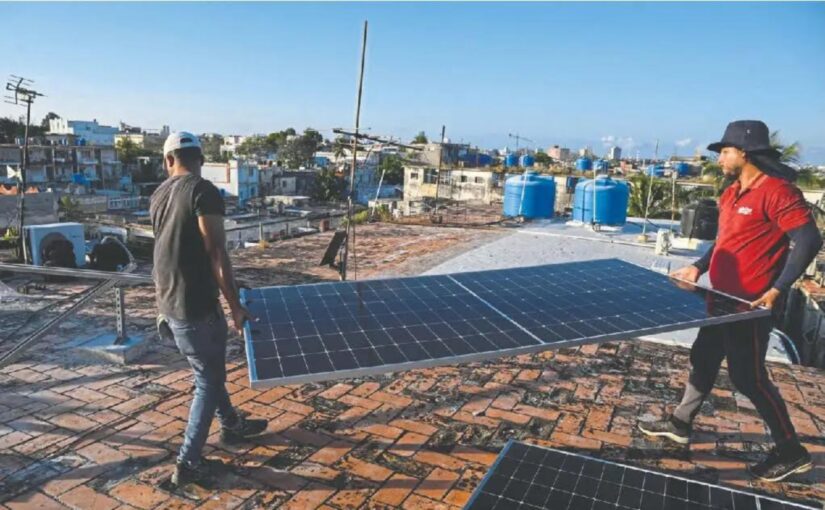
The Trump administration’s energy siege on Cuba – cutting off oil from Venezuela, threatening punitive tariffs on any country that dares sell fuel to the island – is designed to bring the Cuban Revolution to its knees. What it has produced instead is one of the fastest and most remarkable renewable energy transitions ever achieved by a developing country, carried out in close partnership with socialist China.
Facing blackouts lasting up to 20 hours a day, Cuba has responded not with capitulation but with transformation. In just twelve months, solar power’s share of Cuba’s electricity generation has tripled from 5.8 percent to over 20 percent, with 49 new solar parks now connected to the national grid. Wind energy, electric public transport and decentralised home solar systems are all expanding rapidly. The long-term goal is full energy sovereignty – complete independence from imported fossil fuels by 2050.
This article from Workers World surveys Cuba’s ongoing energy revolution, examining the extraordinary scope of China’s solidarity – from large-scale solar parks to individual kits for rural homes and maternity wards – and what it tells us about the real nature of the
China-Cuba relationship: not a relationship between patron and client, but a partnership between two socialist countries committed to each other’s development and determined to build a world beyond imperial domination.
Relations between the two countries continue to develop in all areas, with China providing emergency humanitarian aid in addition to its support in renewable energy. On 12 March, Cuban Foreign Minister Bruno Rodríguez Parrilla held a phone call with Chinese Foreign Minister Wang Yi, in which the two highlighted the powerful links of friendship between the two socialist countries and reaffirmed their intention to continuing strengthening bilateral relations.
In a remarkable example of international solidarity, Cuba, with the aid of China, has more than tripled its solar power production — one of the fastest renewable energy transitions ever achieved by a developing country. China helped Cuba develop 49 new solar parks and committed to completing 92 solar parks by 2028. Cuba’s solar power production has jumped from 5.8% in early 2025 to over 20% of its total energy generation.
The goal is for Cuba to reduce reliance on foreign fuel, gain independence from the U.S. blockade and become completely carbon neutral by 2050.
In February of this year, solar energy accounted for 38% of electricity generation, during daytime hours. However, peak demand is from 7-8 p.m., and Cuba is unable to afford battery storage capacity — the most expensive component of a solar energy system. But China is racing to improve the technology, and “progress in recent months has been incredible,” according to Ember, a global energy think tank. Chinese battery exports last year hit a record high. (Washington Post, March 1)
In addition to large solar parks, China sent 10,000 solar panel kit systems for individual homes and public buildings; 5,000 systems for critical facilities, including maternity homes, nursing homes, emergency rooms and municipal radio stations; and 5,000 kits specifically for rural and “isolated” homes that are not connected to the national grid.
“If you install a 2kW system for these people there, so they can have a refrigerator, a fan, a television, their lives change completely, and then we contribute to preventing these people from migrating from their communities,” said Elena Maidelín Ortiz Fernández, head of the Electric Union’s installation project. (bellyofthebeastcuba.com, March 6)
Cuba is also boosting renewable energy production by restoring thermal generation capacity, production of crude oil and petroleum gas and increasing their natural gas supply. China has provided Cuba with wind turbines and helped with their installation and maintenance since 2018.
Xinhua News Agency reported that Cuba has four small experimental wind farms with a fifth on the way. They have generated enough energy to save Cuba 29,630 tons of petroleum oil and about 96,000 tons of carbon dioxide (CO2) from being released into the atmosphere.
Socialist planning in energy technology
As an example of socialist planning, data is being gathered from Cuba’s experimental wind farms to determine which technology is the most feasible for each region in Cuba. Cuba’s largest wind farm being completed in La Tunas will contribute 1% of total energy production by 2028 and save 40,000 tons of fossil fuels. Cuba also plans on building another 12 wind farms along the northern central and eastern coasts.
In 2005, China sent the first electric bus to Havana. It was manufactured by Yutong, a leading global producer of electric buses. Between 2015 and 2017, China sent Cuba a fleet of electric vehicles. Since 2021, after escalating fuel shortages imposed by the U.S. blockade, Cuba increased the imports of Chinese electric scooters, tricycles and cars.
China continues to support Cuban public transport by supplying parts, components and equipment to rehabilitate the Yutong bus fleet. In a joint venture, Havana’s Caribbean Electric Vehicles (VEDCA) is assembling thousands of Chinese parts into Cuban EVs.
Dave Jones, an energy analyst with Ember, said that Cuba is in the middle of one of the most rapid solar revolutions anywhere and ahead of most countries, including the U.S., in the share of electricity generated by sun power.
Cuba’s goal is to have 26% to 37% renewable energy generation by 2030-2035. Cuban Energy Minister Vicente de la O Levy said that with China’s help, the project represents “a joint commitment to energy sovereignty.” (socialistchina.org, Feb. 25)






4 thoughts on “China invests in a bright future for Cuba”