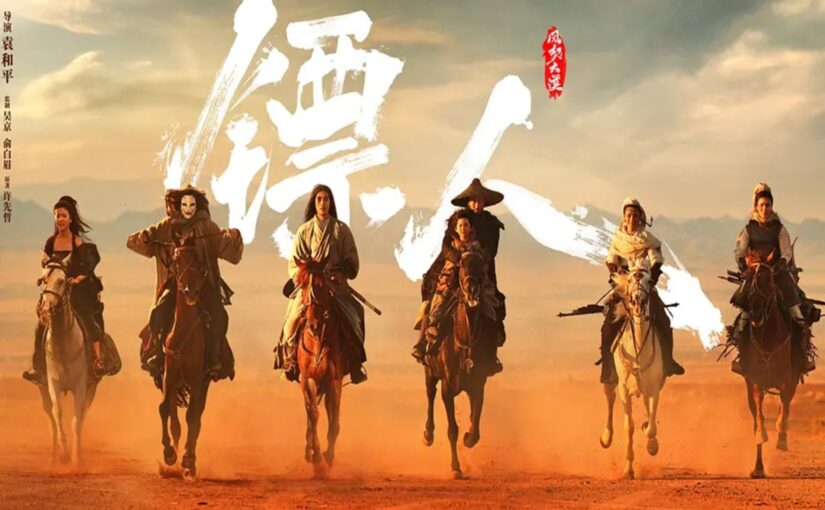
Alfie Howis reviews Blades of Guardians, the latest historical action feature film in the wuxia genre from China, and highlights its centring of the struggles and self-organisation of the common people, as well as its strong feminist ethos, at a time of political upheaval and dynastic change.
Blades of Guardians is a 2026 film releasing in Britain on April 17 to much anticipation and is expected to contribute to the growing market for contemporary Chinese cinema in Europe. The film follows a mercenary in seventh century (CE) China, living in the Western Regions (Xiyu) during the late Sui Dynasty, and a series of journeys and moral decisions that he is faced with. The heart of the story revolves around the lawless and violent nature of China’s historical periphery regions as a place where struggles for political power play out between the imperial central state, fragmented polities of clans, mercenary groups, and people-powered rebellions. It is an action packed thriller with rapid pacing, overlapping subplots, and copious amounts of fantastical swordfights which make this an exciting and engaging film.
Set against the disintegration of the Sui Dynasty, Blades of the Guardians frames the struggle and self-organisation of common people as a powerful force for change and security during a time of total political collapse. The background of the film’s story is the Flower Rebellion, a fictional uprising referencing real rebellions that occurred during the late Sui Dynasty, contributing to the twilight of the Sui as the central Chinese state weakened. The protagonist Dao Ma is tasked with escorting the leader of this rebellion to Chang’an, the ancient capital (now Xi’an), fighting off imperial troops and mercenaries along the way. Dao Ma is a famed mercenary who is known for living only for money, but he takes on this mission as he is convinced of the worthiness of the rebellion which “stands up for the helpless” and is “for the good of the people”. Through their journey they encounter civilians and soldiers willing to help them for the good of the rebellion, sacrificing their lives to tie down imperial armies and bandits. This is presented as a righteous struggle against a tyrannical and oppressive state, which all the peasants and villagers depicted in the film unequivocally support. In this way, Dao Ma’s transition from a self-interested mercenary to a guardian of the rebellion mirrors the film’s broader message that true righteousness is found in the collective defence of the marginalised rather than fighting for the powerful.
Dao Ma constantly questions the assumptions of other characters and challenges the immoral philosophies that his enemies present to him, in turn transforming himself and negating his former wrongdoings. He learned his legendary fighting skills as a member of an elite army unit that fought for the emperor, but he later explains that he deserted from this unit because it massacred civilians, and that the unit’s soldiers were “just puppets for the powerful” and thus had no real prestige or glory. He betrays wealth and power because he recognises that this causes the suffering of the helpless, and that the glory he had previously sought was built on the exploitation and killing of others. In one scene we even hear an imperial soldier complain that the elite guards are “just dogs guarding rich courtyards”. In the final showdown, Dao Ma, at the cost of his own life, defeats his former comrade who is obsessed with restoring the power of the elite guard and so finally overcomes the previous version of himself, completing his moral arc by trading hollow glory for righteous sacrifice.
The themes of Blades of Guardians move away from nationalism and veneration of the old imperial dynasties, and move towards a more nuanced and contextual view of historical eras focussing on the conditions of the periphery and those most oppressed by Chang’an’s rule. The film is able to highlight the unjust and arbitrary nature of the Sui Dynasty, dishing out immense violence, massacring swathes of innocent people, and playing divide and rule with the clans to assert their political dominance. The thread of the Chinese nation does not lay only with the current central polity, but lives through the Chinese people who endure beyond warring clans, khans, and emperors. Some of the clans rally behind the protagonists to fight against the empire whilst others exploit the moment of collapse to seize local power, eliminate rivals, and establish an independent khanate in the borderlands. The story spares no sympathy for any actors vying for power, painting the clans, the empire, and profiteering bandits as cynical, self-interested, and cruel, each seeking to enrich themselves at the expense of the people. Even Dao Ma and his companions tend toward self-interest and the mercenary mindset, always tempted by money or glory, but having to make reluctant moral choices which push them in the right direction. At the same time, this chaos and lawlessness highlights the immense downsides of state weakness and the vacuum of political authority, reflecting harshly on the weak late Sui, about to lose the mandate of governance to the Tang, ushering in an unparalleled golden era of ancient China. Ultimately we are denied a perfect hero or a heroic cause in this transitory era, and must look to the endurance of the people which can weather the shifting sands of local and imperial politics.
There is a strong feminist angle throughout the film’s narrative, asserting the role of women in the society, politics, and conflicts of ancient China. In the opening act Dao Ma is saved from imperial troops by Ayuya, a woman archer of Mojia village, who ends up being a capable warrior who can match the strength of the most feared and famed mercenaries of the land. She is agentic and assertive, leaving her village because she is curious about the world, self-confident in her ability to weather the almost impossible journey to Chang’an. She defies familial traditions, breaking off a marriage at her own will, leaving her would-be husband, of a rival clan, determined to win her back by force. He becomes a tyrant, asserting himself as a new khan, massacring Mojia village in a fit of vengeance, and capturing Ayuya to forcibly marry. He dies the most grisly and painful death of any character in the film after he attempts to rape Ayuya, killed by the hand of a fellow woman soldier acting in solidarity. By placing his execution in the hands of a woman in arms rather than the film’s various male leads, the narrative rejects the male saviour and asserts women’s agency not only to forge their own paths and bypass patriarchal marriage structures, but to militantly win their freedom. This act transforms Ayuya’s journey from a personal vendetta into a broader statement on the collective power of women to dismantle patriarchal systems by force.
Blades of the Guardians succeeds by redefining the traditional Wuxia epic for a modern, global audience. By shifting its gaze from the palaces and cities of the Chinese heartland, the film rejects the glorification of imperial power in favour of a raw, unfiltered look at the unstable edges of ancient China. This reflects a growing confidence and maturity within Chinese cinema, demonstrating a capacity for nuanced historical storytelling that is likely to resonate with international audiences eager to explore the diverse, lesser known regions and eras of Chinese history. Through morally flawed characters and reluctant heroes, we see that only the people standing up can be their own saviours, weathering the winds of political change, rejecting the prestige of power and wealth, and redefining glory not as a gift from the powerful but as the victory of the agency of the powerless. For British viewers, this film is a sophisticated blend of high-octane action and complex historical commentary, showing the breadth of Chinese cinema, which will surely contribute to its increasing popularity in the West.
- Directed by Yuen Woo Ping, previously known for Kill Bill, The Matrix, and Crouching Tiger, Hidden Dragon, Blades of the Guardians brings together an outstanding cast including Wu Jing (Wolf Warrior), Nicholas Tse (Raging Fire), Yosh Yu (Creation of the Gods Trilogy), Chen Lijun (New Dragon Gate Inn), Cisha (The Shadow’s Edge), Tony Leung Ka Fai (The Shadow’s Edge), Max Zhang (Ip Man 3), Kara Wai (My Young Auntie), Jet Li (Hero) and K-pop stars Jun (Wen Junhui) (The Shadow’s Edge) and Win Win (Dong Sicheng) (NCT).
- Blades of the Guardians will be showing in selected cinemas in the UK and Ireland from April 17 and in Malta from April 22. It is distributed by Trinity Cine Asia and details of showings can be found on their website.